Democracy
Paragraphs

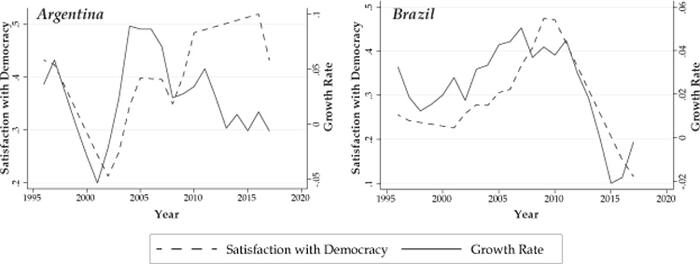
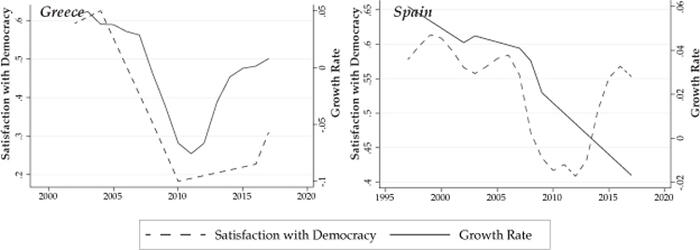
Democratic values are eroding just as citizens perceive increasing corruption, with numerous cases implicating the highest-level politicians. Could perceived increases in apex corruption be weakening democracy? We first present event study analyses of more than 170 high-profile corruption scandals involving some of the most prominent politicians in 17 Latin American countries. We show that in the aftermath of such apex corruption scandals, support for democracy falls by 0.07𝑠𝑑, support for authoritarianism rises by 11% and violent protests rise by 70%. We complement these results with a field experiment in Mexico. Randomized exposure to footage of apex corruption scandals, particularly implicating politicians known for their anticorruption platforms, decreases individuals’ support for democracy by 0.15𝑠𝑑, willingness to trust politicians and neighbors in incentivized games by 18% and 11%, volunteering as election observers by 45%, and actual voter turnout by about 5𝑝𝑝, while raising stealing from local mayors by 4%. The undermining of democratic values produces latent effects that even cumulate four months later. Seeking solutions, priming national identity proved an unsuccessful antidote, but providing exposure to national stock index funds holds some promise.

All Publications button
1
Publication Type
Working Papers
Publication Date
Journal Publisher
Stanford GSB
Authors
Saumitra Jha
Number
Working Paper No. 4166
0
stacey_clifton.jpg

Stacey is CDDRL's Events Manager, and is an essential part of our Marketing Team. With over a decade of event planning and administrative experience, Stacey is a seasoned events planner, and enjoys creating unique and seamless experiences from start to finish. Before joining Stanford, Stacey honed her skills and has demonstrated success in various sectors, contributing to nonprofit organizations, startup companies, and the venture capital space. A Bay Area native, Stacey enjoys hiking throughout the region with her family, traveling to new places, creating and tinkering, and volunteering in her community. She is deeply committed to the values of democracy and is passionate about the mission of CDDRL.

Events Manager
Date Label
Authors
Marco Widodo
News Type
News
Date
Paragraphs

The second of four panels of the “America Votes 2024” series featured critical reflections on the reliability of forecasting models, declining trust in American elections, and reforms to combat polarization. Moderated by Michael Tomz, the William Bennett Munro Professor in Political Science and Chair of Stanford’s Department of Political Science, the panel featured Stanford scholars Brandice Canes-WroneJustin Grimmer, and Larry Diamond, each drawing on their research to address the complexities shaping the 2024 election. The “America Votes 2024” series is co-organized by CDDRL, the Hoover Institution’s Center for Revitalizing American Institutions, and the Institute for Research in the Social Sciences.

Can We Trust The Polls?


Brandice Canes-Wrone, Professor of Political Science and Director of the Hoover Institution’s Center for Revitalizing American Institutions, provided a succinct overview of different forecasting models, touching on their limitations and recent adaptations. Historically, models like that of economist Ray Fair have centered their election predictions on fundamentals like the economy. These models face two main limitations. First, they do not incorporate opinion polls on the candidates themselves. Second, even if voters care about economic performance, increasing partisanship has skewed subjective perceptions of the economy. Some forecasting models have responded by weighing partisanship more in their calculations, though these poll-reliant frameworks present their own limitations as well. Currently, even the most accurate models suggest this uniquely tight race remains too close to call.

Shifting to the two candidates themselves, Canes-Wrone points out that campaign messaging from both sides aligns with the expectations of most analysts. Reacting to high inflation rates, Donald Trump has centered his campaign on economic promises while Kamala Harris tries to “turn the page” to distance herself from President Joe Biden. Both their campaign strategies echo a historic shift from persuading swing voters to mobilizing their bases. Trump has taken a rather unconventional approach to the ever-important ground game, largely outsourcing mobilization to Super PACs. As Canes-Wrone argues, however, the factors determining presidential outcomes have changed far less than the rest of US politics in the last 50 years.

Brandice Canes-Wrone presented on "The 2024 Presidential Election in Historical Context."
Brandice Canes-Wrone presented on "The 2024 Presidential Election in Historical Context." | Nora Sulots

Restoring Trust in Elections


Americans have shown declining levels of trust in elections. While many picture January 6th as the root of this distrust, Justin Grimmer — Morris M. Doyle Centennial Professor of Public Policy and Senior Fellow at the Hoover Institution — argues this turning point occurred two months earlier when Trump falsely declared victory on election night. Since then, several Republican politicians have denounced electoral losses with a series of expansive voter fraud accusations. Some Democrats have also begun to mirror these undemocratic maneuvers under a different rhetoric.

Grimmer warns that if Trump were to win the election by a narrow margin, Democrats might argue that voter suppression caused them to lose. Yet, according to Grimmer, neither argument — voter fraud nor voter suppression — holds enough weight to justify overturning the election result. Studies show that election reforms provide no partisan benefit to either party. To restore Americans’ trust in their electoral institutions, both candidates must honestly accept the results of the November election, regardless of the outcome.

Justin Grimmer presented on "Vote and Voter Manipulation."
Justin Grimmer presented on "Vote and Voter Manipulation." | Nora Sulots

Ranked Choice Voting to Combat Polarization


Larry Diamond, Mosbacher Senior Fellow in Global Democracy at the Freeman Spogli Institute for International Studies (FSI) and William L. Clayton Senior Fellow at the Hoover Institution, echoed Canes-Wrone and Grimmer in emphasizing the apparent hyper-partisanship and institutional distrust endangering American democracy. Diamond argued that, despite centuries of center-leaning politics under the Electoral College, this system now serves to heighten the social, economic, and informational factors driving polarization. The two-party dominant system is in dire need of structural reforms.

Diamond advocated for the adoption of Ranked Choice Voting (RCV) to reduce polarization. RCV is hardly a panacea, but it offers alternatives to bipartisanism by making room for moderate candidates, incentivizing parties to form broad coalitions, and affording voters more choices on their ballots. This transition, Diamond noted, is easier said than done as the polarized electorates that would benefit most from RCV are likely also most opposed to it. Beyond state-level efforts, Diamond stressed the need for bottom-up mobilization and education initiatives to accompany the implementation of RCV. 

Larry Diamond presented on "Depolarizing American Democracy: Two Reforms."
Larry Diamond presented on "Depolarizing American Democracy: Two Reforms." | Nora Sulots

The upcoming elections present both familiar and unprecedented challenges to American democracy. Economic fundamentals and campaign strategies have thus far reflected predictable historical trends, but bipartisan polarization and institutional distrust are at all-time highs. From structural reforms to personal integrity, everyone — states, media outlets, candidates, and voters — is responsible for safeguarding democracy. 

Read More

America Vote 2024 Part 1 panel with Kathryn Stoner, Beatriz Magaloni, Nate Persily, and Shanto Iyengar
News

“America Votes” in An Age of Polarization and Democratic Backsliding

The first of four panels of the “America Votes 2024: Stanford Scholars on the Election’s Most Critical Questions” series examined the changing political and global landscape shaping the upcoming U.S. presidential and congressional elections.
“America Votes” in An Age of Polarization and Democratic Backsliding
Woman holding I VOTED sticker
News

Creating a Culture of Civic Engagement

Across campus, the Stanford community is preparing for the November election and beyond with an array of educational, civic engagement, and get-out-the-vote efforts.
Creating a Culture of Civic Engagement
White House with overlayed American flag
Commentary

Stanford Scholars Discuss What’s at Stake in the 2024 U.S. Presidential Election

In a panel moderated by Didi Kuo, Bruce Cain, Hakeem Jefferson, and Brandice Canes-Wrone discussed the structural features of American democracy and addressed the issues, strategies, and stakes central to November’s race.
Stanford Scholars Discuss What’s at Stake in the 2024 U.S. Presidential Election
Hero Image
Mike Tomz, Brandice Canes-Wrone, Justin Grimmer, Larry Diamond answer questions in the second "America Votes 2024" panel.
Nora Sulots
All News button
1
Subtitle

Moderated by Michael Tomz, the William Bennett Munro Professor in Political Science and Chair of Stanford’s Department of Political Science, the second panel in our series featured Stanford scholars Brandice Canes-Wrone, Justin Grimmer, and Larry Diamond, each drawing on their research to address the complexities shaping the 2024 election.

Date Label
Authors
Khushmita Dhabhai
News Type
News
Date
Paragraphs

In a recent CDDRL seminar series talk, UVA Associate Professor of Politics Anne Meng shared her research on global patterns of presidential election concessions. Her study underscores the crucial yet often overlooked role of election concessions in democracies.

Meng emphasized the vitality of concessions in facilitating peaceful transfers of power, an essential element for the functioning of democracy. When losing candidates concede defeat, they validate the election results and contribute to a smooth transition of power. Despite their significance, systematic data on post-election concessions worldwide has been limited. Meng’s research seeks to fill this gap by presenting a comprehensive dataset tracking presidential election concessions from 1980 to 2020 across 107 countries.

Encompassing both democratic and autocratic regimes, the dataset includes 638 election observations, wherein concessions are categorized into three distinct groups:

  1. Strong concessions (losing candidates explicitly admit defeat)
  2. Weak concessions (vague statements regarding defeat)
  3. No concession (candidates either refuse to concede or make no statement at all).


Meng’s analysis unveiled significant patterns in concession behavior across different political systems. In established democracies, losing candidates typically concede, while “no concession” outcomes are more prevalent in autocratic regimes. When incumbents lose, they are more likely to concede than opposition candidates who lose, a finding that may run contrary to perceptions of incumbents. However, incumbents are less likely to lose elections in the first place.

Meng's study underscores the connection between election integrity and the likelihood of concessions. When the fairness of an election is in doubt, opposition candidates may justifiably withhold concessions to avoid legitimizing an unfair process. Furthermore, the study found that strong concessions correlate with fewer post-election protests and acts of violence, suggesting a potential link between concessions and the stability of power transitions. Meng cautioned, however, that the causal relationship remains unclear, indicating the need for further research to ascertain whether concessions directly reduce unrest or if other factors, such as election integrity, are at play.

Meng identified several factors influencing whether a losing candidate concedes. Candidate characteristics significantly impact concession behavior; for instance, incumbents and successors tend to concede more often. In contrast, factors like gender and ideology do not significantly affect the likelihood of conceding. Additionally, the specifics of the election play a role: concessions are more likely when the victory margin falls between 5% and 10%. Overall, losing candidates in democracies are generally more willing to concede than those in autocratic systems. Notably, Meng's research suggests that past concessions do not guarantee future ones, revealing challenges in establishing consistent democratic norms.

In her conclusion, Meng emphasized that while election concessions generally reflect the health of democracy, their absence can mirror legitimate concerns about unfair elections. This complexity calls for a reevaluation of how we understand concessions, emphasizing the need to consider underlying narratives of election quality and integrity.

Read More

Maria Snegovaya presents during a CDDRL research seminar.
News

Why Was the Left Sidelined by the Populist Right in Postcommunist Europe?

In her new book, "When Left Moves Right: The Decline of the Left and the Rise of the Populist Right," Maria Snegovaya unpacks the puzzling dynamic between left- and right-wing parties across the post-communist states in Eastern Europe.
Why Was the Left Sidelined by the Populist Right in Postcommunist Europe?
America Vote 2024 Part 1 panel with Kathryn Stoner, Beatriz Magaloni, Nate Persily, and Shanto Iyengar
News

“America Votes” in An Age of Polarization and Democratic Backsliding

The first of four panels of the “America Votes 2024: Stanford Scholars on the Election’s Most Critical Questions” series examined the changing political and global landscape shaping the upcoming U.S. presidential and congressional elections.
“America Votes” in An Age of Polarization and Democratic Backsliding
Julieta Casas presents her research during a CDDRL seminar on October 3, 2024.
News

The Political Origins of Civil Service Reform in the Americas

Research by CDDRL’s Einstein-Moos Postdoctoral Fellow Julieta Casas underscores how firing practices within patronage systems significantly shaped divergent trajectories of bureaucratic development across the Americas.
The Political Origins of Civil Service Reform in the Americas
Hero Image
Anne Meng (right) presented her research in a CDDRL seminar on October 17, 2024.
Nora Sulots
All News button
1
Subtitle

UVA Associate Professor of Politics Anne Meng’s research seeks to fill a gap of systematic data on post-election concessions worldwide by presenting a comprehensive dataset tracking presidential election concessions from 1980 to 2020 across 107 countries.

Date Label
Authors
Nora Sulots
News Type
News
Date
Paragraphs

The Fisher Family Summer Fellows on Democracy and Development Program at Stanford University's Center on Democracy, Development and the Rule of Law is now accepting applications for our summer 2025 program. The deadline to apply is 5:00 pm PST on Thursday, January 16, 2025.

The program brings together an annual cohort of approximately 30 mid-career practitioners from countries in political transition who are working to advance democratic practices and enact economic and legal reform to promote human development. Launched by CDDRL in 2005, the program was previously known as the Draper Hills Summer Fellows Program. The new name reflects an endowment gift from the Fisher family — Sakurako (Sako), ‘82, and William (Bill), MBA ‘84 — that secures the future of this important and impactful program.

From Afghanistan to Zimbabwe, our program participants are selected from among hundreds of applicants every year for the significant contributions they have already made to their societies and their potential to make an even greater impact with some help from Stanford. We aim to give them the opportunity to join a global network of over 500 alumni from 97 countries who have all faced similar sets of challenges in bringing change to their countries.

The Fisher Family Summer Fellows Program provides an intensive 3-week on-campus forum for civil society leaders to exchange experiences and receive academic and policy training to enrich their knowledge and advance their work. Delivered by a leading Stanford faculty team composed of Michael McFaul, Kathryn Stoner, Francis Fukuyama, Larry Diamond, Erik Jensen, and more, the program allows emerging and established global leaders to explore new institutional models and frameworks to enhance their ability to promote good governance, accountable politics, and find new ways to achieve economic development in their home countries.

Prospective fellows from Ukraine are also invited to apply for our Strengthening Ukrainian Democracy and Development (SU-DD) Program, which runs concurrently with the Fisher Family Summer Fellows Program. The SU-DD program provides a unique opportunity for mid-career practitioners working on well-defined projects aimed at strengthening Ukrainian democracy, enhancing human development, and promoting good governance. Applicants to the SU-DD program will use the Fisher Family Summer Fellows Program application portal to apply and indicate their interest there. You will then be directed to a series of supplemental questions specific to the SU-DD program, including requiring a detailed description of your proposed project.

Read More

2024 Fisher Family Summer Fellows
News

Spotlight on Summer Fellows

The Fellow Spotlight Series is an inspiring and moving series of "TED"-style talks given by each of our 2024 Fisher Family Summer Fellows to share their backstories and discuss their work.
Spotlight on Summer Fellows
Fisher Family Summer Fellows Class of 2024
News

Announcing the 2024 Cohort of the Fisher Family Summer Fellows on Democracy and Development Program

In July 2024, the Center on Democracy, Development and the Rule of Law will welcome a diverse cohort of 26 experienced practitioners from 21 countries who are working to advance democratic practices and economic and legal reform in contexts where freedom, human development, and good governance are fragile or at risk.
Announcing the 2024 Cohort of the Fisher Family Summer Fellows on Democracy and Development Program
2023 SU-DD Fellows
News

Empowering Ukrainian Democracy: Innovative Training Program Nurtures Projects for Recovery and Development

Meet the six fellows selected to participate in the first cohort of the Center on Democracy, Development and the Rule of Law’s Strengthening Ukrainian Democracy and Development Program.
Empowering Ukrainian Democracy: Innovative Training Program Nurtures Projects for Recovery and Development
Hero Image
Summer Fellows
All News button
1
Subtitle

The program will run from Sunday, July 20, through Friday, August 8, 2025. Applications are due by 5:00 pm PST on Thursday, January 16, 2025.

Date Label
Authors
Marco Widodo
News Type
News
Date
Paragraphs

Why do elites in authoritarian regimes choose to pursue democratic transitions? In a CDDRL research seminar series talk, James Fearon, Professor of Political Science and Senior Fellow at Stanford University’s Freeman Spogli Institute for International Studies (FSI), offers a theory to explain the methods and motivations behind elite-led democratization. Fearon probes how authoritarian elites safeguard their power through autocratic constitutions, focusing on Myanmar, one of the longest-lived military regimes in the post-WWII era.

The Tatmadaw — Myanmar’s armed forces — held exclusive power after General Ne Win took control in a 1962 coup d’état until the early 2010s when they pursued a power-sharing arrangement with a civilian opposition. In 2008, the military junta that ruled from 1988 to 2011 ratified a new constitution they had drafted in a dubious referendum. While the 2008 Constitution appeared to take steps toward democracy, it featured serious limitations. It handed the military full control over several key ministries, secured “rent” streams for the officers, and reserved a quarter of parliamentary seats for military-appointed representatives. It further required that any changes to the constitution be passed by 75% of the legislature, thus giving them an effective veto.

In the November 2015 General Election, the opposition scored an overwhelming victory. The National League for Democracy Party (NLD) won close to three-fourths of the seats, giving them a large parliamentary majority and a strong ability to pass laws even if they were formally constrained on changing the constitution. The trajectory of these events raises the question, why did the military choose to pursue a democratic transition? Relatedly, why did military leaders believe that the 2008 Constitution would sufficiently protect them? Fearon observes that one of the NLD’s first actions was to create a new head-of-state position outside the constitution for Aung San Suu Kyi, the NLD’s leader.

Fearon argues that the military was protected not by the formal constitution, which is just a piece of paper, but rather by maintaining direct control of important streams of income and policy influence in the form of staffing of the bureaucracy and control of natural resource and drug incomes in militarily contested parts of the country. Control of these “rent streams” meant that the new NLD government could not shift them away from the military simply passing laws in parliament — even though the NLD did have considerable control and influence on many other dimensions of policy. In effect, this was a power (and rent) sharing division of the state.

Authoritarian rulers face international and domestic pressures, such as economic and political sanctions and costly revolutionary threats. Continued authoritarian rule would preserve elites’ control of the country’s existing resources. Movement toward democratization, on the other hand, generates both opportunities and costs. It comes with the promise of lifting international sanctions and increasing the flow of foreign aid, thus increasing the total economic “pie” available. However, the military could only take full advantage of that economic opening if they maintained a significant degree of economic and political control that the newly elected government could not revise without provoking a costly conflict (such as a coup attempt to reverse democratization). More general, Fearon argues that autocratic elites will be more inclined to try democratization when they can share rent streams and their military ability to retake power if this is challenged does not decline too rapidly after the transition.

Elite-led democratic transitions hold unique implications. On the one hand, top-down transitions are more efficient than bottom-up democratic revolutions because they reduce the costs and risks of violence. On the other hand, transitions led by undemocratic leaders are likely to result in only partial democratization because they tend to perpetuate preexisting power dynamics by reinforcing the influence of ruling elites and maintaining their access to rents.

Fearon proposes that as newly democratized societies begin to institutionalize, the relative power of the old elites may gradually diminish, leading to “endogenous consolidation.” Yet, if the military sees its power fading faster than expected, it may — as in the aftermath of Myanmar’s 2020 elections — intervene militarily to restore the status quo ante.

Read More

Julieta Casas presents her research during a CDDRL seminar on October 3, 2024.
News

The Political Origins of Civil Service Reform in the Americas

Research by CDDRL’s Einstein-Moos Postdoctoral Fellow Julieta Casas underscores how firing practices within patronage systems significantly shaped divergent trajectories of bureaucratic development across the Americas.
The Political Origins of Civil Service Reform in the Americas
From Left to Right: Yuko Kasuya, Lisandro Claudio, Donald Emmerson, Aya Watanabe, Marisa Kellam, Ruosui Zhang, Reza Idria, Francis Fukuyama, Michael Bennon, and Kana Inata.
News

Workshop Brings Scholars Together to Discuss the State of Democracy, Development, and the Rule of Law in Southeast Asia

Scholars from Asia joined faculty and researchers from Stanford University’s Freeman Spogli Institute (FSI) to present research and reflections on various topics and cases from the Southeast Asia region, including the monarchy in politics, peace-making in the Philippines, Chinese infrastructure investments in Myanmar, illiberalism in the Philippines, and Islamic law in Indonesia.
Workshop Brings Scholars Together to Discuss the State of Democracy, Development, and the Rule of Law in Southeast Asia
Hero Image
James Fearon Rod Searcey
All News button
1
Subtitle

James Fearon probes how authoritarian elites safeguard their power through autocratic constitutions, focusing on Myanmar, one of the longest-lived military regimes in the post-WWII era.

Date Label
Authors
Khushmita Dhabhai
News Type
News
Date
Paragraphs

The first of four panels of the “America Votes 2024: Stanford Scholars on the Election’s Most Critical Questions” series examined the changing political and global landscape shaping the upcoming U.S. presidential and congressional elections. The panelists shed light on the challenges of election administration, shifts in campaign strategies due to polarization, and the global context animating the election. Moderated by Kathryn Stoner, Mosbacher Director of the Center on Democracy, Development and the Rule of Law (CDDRL) and Senior Fellow at the Freeman Spogli Institute for International Studies (FSI), the panel featured Stanford scholars Shanto Iyengar, Beatriz Magaloni, and Nathaniel Persily. The “America Votes 2024” series is co-organized by CDDRL, the Hoover Institution’s Center for Revitalizing American Institutions, and the Institute for Research in the Social Sciences.

Evolving Election Administration and Oversight


The 2024 election will differ significantly from previous cycles, said Nathaniel Persily, the James B. McClatchy Professor of Law at Stanford Law School and a Senior Fellow at FSI. That is due to changes in the legal landscape, a shift in the social media environment, and ongoing threats to election officials.

Persily noted that many election officials have resigned due to rising threats. Changes like the Electoral Count Reform Act have impacted the certification process, and the decline of the Electronic Registration Information Center (ERIC) has affected voter registration accuracy. Persily raised concerns about how social media platforms have restricted access to election monitoring tools, like CrowdTangle, further complicating election oversight.

While new Artificial Intelligence tools are playing a growing role in content moderation on social media, they have limited reach, especially on popular platforms like TikTok. Persily pointed out that misinformation is a continuing concern, with conspiracy theories around mail-in ballots, poll watcher interference, and vote-counting delays potentially undermining public trust. However, he expressed some optimism, indicating that early voting could help election officials proactively address issues before Election Day and that the use of paper ballots in most states will add a layer of security.

Nathaniel Persily speaks at a podium in front of a slide that reads "Panicking Responsibly About the Election."
Nathaniel Persily presented on "Administering the 2024 Election." | Nora Sulots

Campaign Strategies in a Polarized America


William Robertson Coe Professor of Political Science and Communication Shanto Iyengar highlighted the impact of increasing polarization on campaign strategies. The deep-rooted partisan divide, he explained, has made persuading voters across the partisan line nearly impossible, pushing campaigns to focus instead on mobilizing their own base and targeting independent voters. Iyengar illustrated the impact of this polarization on everyday life, noting that political affiliation is now a significant factor in personal relationships and even in matters like dating and marriage.

Campaigns have responded to this changing environment by relying heavily on negative advertising, which tends to resonate with partisan voters. Negative ads, Iyengar explained, are effective in cementing party loyalty. Additionally, campaigns have focused on get-out-the-vote (GOTV) efforts, identifying likely supporters and encouraging them to vote. For independents, campaigns use positive messaging, as these voters are generally more receptive to constructive content about candidates rather than attacks. Despite the challenges, Iyengar suggested that well-timed, targeted outreach can still influence persuadable voters who may have limited media exposure.

Shanto Iyengar presents in front of a slide that reads "ANES - Party Thermometer Ratings."
Shanto Iyengar presented on "Campaign Strategy in an Era of Polarization." | Nora Sulots

The U.S. in a World of Democratic Backsliding


FSI Senior Fellow Beatriz Magaloni situated the U.S. election vis-à-vis a global trend of democratic backsliding. Magaloni, who is the Graham H. Stuart Professor of International Relations at Stanford’s Department of Political Science, explained that the election is occurring against the backdrop of democratic regressions worldwide. Many democracies, she indicated, are experiencing the weakening of political institutions, increasing centralization power, and erosion of civil liberties.

Although the U.S. remains a robust democracy, Magaloni explained, it is not immune to elements of backsliding. Instances of political violence, such as the January 6th Capitol attack and rising polarization, pose challenges to democratic norms. She also highlighted troubling signs, such as threats to civil liberties and political violence. At the same time, Magaloni stressed that the U.S. has institutional safeguards that protect against democratic backsliding. Among them is a system of checks and balances across federal and state levels.

Beatriz Magaloni presents in front of a slide reading "Growing concern of declining liberties."
Beatriz Magaloni presented on "The US Elections in a Year of Voting Across the Globe." | Nora Sulots

The panelists emphasized the challenges posed by political polarization and declining trust in the integrity of democratic processes. They suggest that ensuring a smooth and trustworthy election will require continued vigilance from election officials, proactive problem-solving, and public reassurance. Campaigns, meanwhile, will likely double down on mobilization and targeted messaging as they navigate the complexities of an increasingly divided electorate. Finally, the broader global trend of democratic backsliding serves as a reminder that safeguarding democracy is just as relevant in the United States as it is in other parts of the world.

You can view a full recording of the event below and register for our upcoming events here:

Read More

Woman holding I VOTED sticker
News

Creating a Culture of Civic Engagement

Across campus, the Stanford community is preparing for the November election and beyond with an array of educational, civic engagement, and get-out-the-vote efforts.
Creating a Culture of Civic Engagement
White House with overlayed American flag
Commentary

Stanford Scholars Discuss What’s at Stake in the 2024 U.S. Presidential Election

In a panel moderated by Didi Kuo, Bruce Cain, Hakeem Jefferson, and Brandice Canes-Wrone discussed the structural features of American democracy and addressed the issues, strategies, and stakes central to November’s race.
Stanford Scholars Discuss What’s at Stake in the 2024 U.S. Presidential Election
Presidential candidate Claudia Sheinbaum of ''Sigamos Haciendo Historia'' coalition waves at supporters after the first results released by the election authorities show that she leads the polls by wide margin after the presidential election at Zocalo Square on June 03, 2024 in Mexico City, Mexico.
Commentary

6 Insights on Mexico’s Historic Election: Stanford Scholars Explain What This Means for the Future of its Democracy

The Center on Democracy, Development and the Rule of Law’s Poverty, Violence, and Governance Lab, in collaboration with the Carnegie Endowment for International Peace, invited a panel of scholars to discuss the implications of Mexico’s elections and to analyze the political context in which they were held.
6 Insights on Mexico’s Historic Election: Stanford Scholars Explain What This Means for the Future of its Democracy
Hero Image
America Vote 2024 Part 1 panel with Kathryn Stoner, Beatriz Magaloni, Nate Persily, and Shanto Iyengar
The first panel of the "America Votes 2024" series was moderated by Kathryn Stoner (L), and featured panelists (L to R) Beatriz Magaloni, Nathaniel Persily, and Shanto Iyengar.
Nora Sulots
All News button
1
Subtitle

The first of four panels of the “America Votes 2024: Stanford Scholars on the Election’s Most Critical Questions” series examined the changing political and global landscape shaping the upcoming U.S. presidential and congressional elections.

Date Label
0
CDDRL Honors Student, 2025-26
e7e132fb-c83b-482b-9c6b-f19f28644382_2_-_ignazio_marco_widodo.jpg

Marco is a coterminal M.A. candidate in International Policy on the Governance and Development track. He is concurrently finishing his B.A. in Political Science at Stanford with concentrations in Political Economy & Development and Data Science. Marco is also currently writing an honors thesis with the Center on Democracy, Development, and the Rule of Law (CDDRL), leveraging survey experiments to investigate how different conceptualizations of democracy influence public responses to democratic backsliding in Indonesia.

He has previously worked at the World Bank’s Development Impact Evaluation (DIME) unit and the National Endowment for Democracy’s International Forum for Democratic Studies (IFDS). His research interests lie at the intersection of comparative governance, international political economy, and democratic resilience, having served as a research assistant with both the Stanford Next Asia Policy Lab and the Hoover Institution. In his spare time, he enjoys listening to jazz, going camping, and trying out new recipes.

CDDRL Undergraduate Communications Assistant, 2024-25
Master's in International Policy Class of 2027
Date Label
-
Bill Browder event

In an era of rising autocracy, Bill Browder, the bestselling author of Red Notice and Freezing Order, brings his unparalleled expertise to the forefront. Join the Program on Capitalism and Democracy for a discussion on how business leaders can safeguard democratic principles while navigating increasingly challenging political landscapes. 

Browder's firsthand experiences combating corruption in Russia and beyond offer valuable lessons for today's global business environment. His story exemplifies how business leaders can leverage their influence to shape policy, champion justice, and uphold democratic ideals—even when confronted with grave personal and professional risks.

This event is co-sponsored by the Corporations and Society Initiative (CASI) at the Graduate School of Business and the Program on Capitalism and Democracy at the Center on Democracy, Development and the Rule of Law (CDDRL).

ABOUT THE SPEAKER

Sir William (Bill) Browder KCMG was once the largest foreign portfolio investor in Russia until being declared “a threat to national security” in 2005 for exposing corruption in Russian state-owned companies.

In 2008, Bill’s lawyer, Sergei Magnitsky, uncovered a massive fraud committed by Russian government officials stealing US $230 million of state taxes and was subsequently arrested, imprisoned without trial, and systematically tortured.

Sergei Magnitsky died in prison on November 16, 2009. Ever since, Sir William has led the Global Magnitsky Campaign for governments around the world to impose targeted visa bans and asset freezes on human rights abusers and highly corrupt officials, introducing the passage of the Sergei Magnitsky Accountability Act in 2012, & the Global Magnitsky Human Rights Accountability Act 2016. Which has since been adopted by 11 countries, including the U.S., UK, Canada, and New Zealand.

For his exceptional service to the UK abroad and internationally, in recognition of his significant and sustained contribution to human rights and anti-corruption, he was appointed by King Charles in the 2024 Birthday Honours List a Knight Commander of the Order of St Michael and St George (KCMG).

Rachel Hersh, MBA '25

In-person: GSB Knight Management Center, C102 (657 Jane Stanford Way, Stanford)
Online: Via Zoom

Bill Browder
Lectures
Date Label
Subscribe to Democracy