Polina Aldoshyna is a Ukrainian lawyer and civic leader with over nine years of experience in law, public administration, and nonprofit management. She currently leads the BGV Charity Fund, overseeing social projects that support vulnerable communities. In addition, she serves as a Deputy of the Zhytomyr Regional Council, focusing on local governance and social policy. Throughout her career, Polina has managed over 60 humanitarian projects, including the establishment of psychosocial support centers and aid programs for displaced individuals and veterans.
Project: Institutionalizing Resilience Centers for Postwar Recovery
Polina is currently working on transforming Ukraine’s emerging resilience centers—grassroots hubs that provide psychosocial support, legal aid, and essential services to displaced and vulnerable populations—into a sustainable, institutionalized model of community-based social infrastructure. While these centers have played a critical role in the war’s social response, many still lack unified standards, stable funding, and digital infrastructure, limiting their long-term impact.
Her project explores which governance structures — municipal, civic, or hybrid — are most viable in Ukraine’s decentralized context, how public, private, and donor financing can be blended to support long-term operations, and how digital tools, such as CRM systems and reporting platforms, can professionalize service delivery. Drawing on global models, such as Resilience Hubs in the United States, Polina aims to co-design a scalable framework for resilience centers that can be integrated into Ukraine’s broader post-war recovery strategy.
To support this work, Polina is interested in meeting with NGOs, charitable foundations, and private philanthropists who support Ukraine in the reconstruction of human social capital in the United States. She hopes to learn how democratic institutions adapt and deliver services during crisis and post-conflict transitions, as well as engage with scholars and practitioners working at the intersection of governance, social development, and recovery.

Oleksii Movchan is a Member of the Ukrainian Parliament and Deputy Chairman of the Verkhovna Rada Committee on Economic Development, representing the “Servant of the People” faction. He chairs the subcommittee on public procurements and state property management, and is active in inter-parliamentary groups with the USA, UK, Japan, and others. Before parliament, he led projects at Prozorro.Sale. Oleksii holds degrees from Kyiv-Mohyla Academy, Ukrainian Catholic University, and Kyiv School of Economics. He has advanced key reforms in procurements, state-owned companies, and privatization to support Ukraine’s European Union integration.
Project: Improving Corporate Governance in Municipally-Owned Enterprises (MoEs) in Ukraine
Oleksii is currently working to improve the governance of Ukraine’s municipally owned enterprises (MoEs), which number nearly 14,000—more than triple the number of state-owned enterprises. While some MoEs serve as critical infrastructure providers in areas such as water, heating, and public transport, most operate without modern governance standards. Over 82% are unprofitable and many are subsidized, making them susceptible to inefficiency, mismanagement, and corruption. These shortcomings erode public trust, distort competition, and weaken essential service delivery.
His project focuses on designing and advocating for national legislation to institutionalize OECD-based governance practices across approximately 60 high-impact MoEs in 19 cities. Proposed measures include strategic property management policies, independent supervisory boards, transparent CEO selection, and robust audit, compliance, and risk management systems. The legislation also calls for standardized financial reporting and regular external audits to enhance transparency and creditworthiness.
To support this work, Oleksii is drawing on Ukraine’s pilot reforms in Mykolaiv and Lviv, as well as prior SOE governance reforms since 2015, and global best practices from EU and OECD countries. He is particularly interested in how institutional reform can advance anti-corruption goals and how reformers in other countries have successfully designed and implemented large-scale changes. He hopes to meet with Stanford faculty, civic technologists, and philanthropic organizations, such as the Stanford Cyber Policy Center, Code for America, and the Skoll Foundation, to explore how policy and technology innovations can support municipal reform and Ukraine’s post-war recovery.
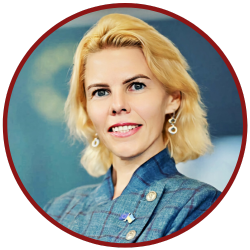
Maria Golub is a recognized expert on Ukraine’s European and Euro-Atlantic integration, with deep expertise in EU-Ukraine bilateral relations. Based in Brussels, she currently serves as a Senior Political and Policy Advisor to Ukrainian leadership, where she advocates for a just and lasting peace in Ukraine and supports the country’s advancement along the EU integration path through a decisive reform agenda. She is also actively involved in shaping Ukraine’s reconstruction strategy and is a strong proponent of the “build back better” principle, championing an ambitious revival plan for the country.
Project: Building a National Recovery Platform and Transatlantic Innovation Alliance
Maria is currently working to establish a national Coalition for Recovery—an inclusive, cross-sectoral platform designed to unify Ukraine’s defense, reconstruction, and reform agendas. As Ukraine faces the twin imperatives of resisting ongoing military aggression and laying the groundwork for long-term renewal, Maria’s project aims to ensure that recovery planning is not siloed but instead integrates priorities across security, governance, innovation, and transatlantic cooperation.
The Coalition will convene key domestic and international stakeholders to shape Ukraine’s internal reform agenda, embed EU and NATO-aligned governance standards, and streamline policy frameworks across recovery sectors. A core pillar of the project is embedding security priorities and military technological innovation directly into the recovery strategy, positioning defense modernization as a foundation — not a separate track — for rebuilding state capacity and competitiveness. In tandem, Maria is developing the concept for a large-scale technology and defense innovation alliance between Ukraine, the EU, and the United States. By fostering deeper collaboration in emerging technologies and military-industrial partnerships, the initiative seeks to contribute to Ukraine’s economic resurgence in 2025–2026 and anchor its strategic integration into the Euro-Atlantic community.
Maria is particularly interested in successful strategies and action plans that demonstrate how countries emerging from large-scale conflict can simultaneously pursue national recovery and build resilient, future-oriented security and defense architectures. She aims to explore cutting-edge developments in the tech and military tech sectors, as well as innovative tools like digital twin cities, to help design an integrated national revival plan. In addition, she hopes to deepen her understanding of how AI tools and techniques can support planning, coordination, and implementation across Ukraine’s postwar recovery landscape.
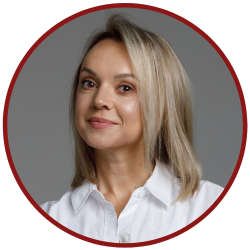
Alyona Nevmerzhytska is CEO of hromadske.ua, Ukraine’s leading independent online media platform. She began her career in 2012 at the Kyiv Post and has since focused on business development and organizational strategy. At hromadske, she has enhanced audience engagement and strengthened data-driven decision-making. Committed to building sustainable models for independent media, she ensures ethical newsroom operations and promotes democratic values. She is a graduate of the Stockholm School of Economics, an Atlantic Council Millennium Fellow, and a 2024 McCain Institute Global Leader.
Project: Strengthening Independent Media for Postwar Accountability and Recovery
Alyona is currently working to build a more resilient and innovative media ecosystem in Ukraine that can serve as both a watchdog and a unifying force during the country’s postwar recovery. As CEO of Hromadske.ua, she is leading efforts to combine investigative journalism, compelling storytelling, and technological advancement with a focus on financial sustainability and editorial independence.
Her project explores how independent media can most effectively cover Ukraine’s complex reconstruction process — holding public institutions and international aid mechanisms accountable while also building trust across communities fractured by war. Alyona is particularly interested in leveraging technology, including AI tools, to enhance investigative capacity, analyze data, and uncover patterns of corruption or inefficiency in recovery efforts.
Through the SU-DD fellowship, she also seeks to explore global models for sustainable journalism beyond donor-driven funding, learning how to strengthen independent media institutions to ensure their long-term viability and public impact. A key area of inquiry is the ethical integration of AI into journalism, ensuring that innovation does not compromise transparency, integrity, or audience trust. Alyona is eager to connect with Stanford faculty in communication and business, as well as experts, to explore sustainable models for independent journalism and civil society resilience. She is also interested in meeting with philanthropic organizations, alongside tech leaders, and Ukrainian NGOs to strengthen partnerships that support innovative, mission-driven media.