Democracy
Authors
Nensi Hayotsyan
News Type
News
Date
Paragraphs

In a CDDRL research seminar held on January 8, 2026, Neil Malhotra, Professor of Political Economy at Stanford Graduate School of Business and courtesy professor of political science, presented his upcoming book Majority Opinions: The Political Consequences of an Out of Step Supreme Court, co-authored with Stephen Jessee and Maya Sen. The project examines how the Supreme Court’s alignment with public opinion shapes its legitimacy, approval, and vulnerability to reform. Malhotra emphasized that the book does not make normative claims about whether the Supreme Court should reflect public opinion but rather offers a positive political science account of how closely the Court tracks public preferences and how that distance shapes legitimacy, approval, and political response. 

As discussed by Malhotra, this project began as a result of changes in survey research methodology, shifting from face-to-face and telephone surveys to large-scale internet-based data collection. While these advances were used to study public opinion with respect to Congress and the President, there was a clear gap in applying this approach to the Supreme Court. Hence, starting in 2020, his team partnered with YouGov to conduct annual surveys each spring, prior to  Supreme Court decisions, asking respondents how they would rule on major cases scheduled for that term. Respondents were also asked to predict how they believed the Court would decide. 

To analyze these responses, Malhotra employs ideal point estimation, mapping respondents, partisan groups, and the Court itself onto a liberal-conservative scale. The data showed that the Court was closely aligned with the median voter in 2020, but its ideological position shifted to the right following the death of Ruth Bader Ginsburg and her replacement by Amy Coney Barrett. But in later years, the Court shifted back to the middle following public backlash.

As Malhotra highlighted, rather than asking about constitutional law and legal reasoning, respondents were presented with the policy consequences of cases. For example, in the Bostock case, participants were asked whether it should be legal or illegal for employees to be fired based on sexual orientation, followed by a question asking how they believed the Supreme Court would rule. The data revealed substantial variation across cases. Some issues showed clear partisan polarization, while others reflected broad agreement across parties.

The presentation then turned to public perceptions of the Court. Malhotra showed that respondents are generally poor at predicting Supreme Court outcomes, correctly guessing decisions only slightly more than half the time. This pattern is explained largely by projection, as individuals tend to assume the Court will rule in line with their own preferences. Because the Court has recently leaned conservative, this projection makes Republicans appear more accurate than Democrats.

Finally, Malhotra distinguished between approval and legitimacy, emphasizing the importance of separating the two concepts. Approval reflects short-term evaluations of the Court’s performance and is highly responsive to disagreement with Court decisions. By contrast, legitimacy deals with the public’s belief in the Court’s rightful role as an institution and proves more stable, though still negatively affected when the Court consistently differs from public opinion. As discussed, this difference matters because declining legitimacy can give political elites room to challenge compliance with Court rulings, threatening the rule of law.

Malhotra concluded by situating the project within a broader historical perspective. The book examines moments when the Supreme Court faced severe backlash and subsequently moderated its behavior, including resistance following Brown v. Board of Education. These cases illustrate how threats to enforcement and public acceptance can shape judicial decision-making over time, depicting the political consequences of a Court that moves out of step with the public.

Read More

Nate Persily presented his research in a CDDRL seminar on December 4, 2025.
News

Election Administration, 2024 to 2026: Lessons Learned and Causes for Concern

In a CDDRL research seminar, Nate Persily, the James B. McClatchy Professor of Law at Stanford Law School and Senior Fellow at the Freeman Spogli Institute, discussed revelations from the 2024 election and how the 2024 election can forecast the upcoming 2026 midterm election cycle.
Election Administration, 2024 to 2026: Lessons Learned and Causes for Concern
Kim Lane Sheppele presented her research in a REDS Seminar co-hosted by CDDRL and TEC on November 19, 2025.
News

Guarding Democracy from Within: The EU’s Struggle Against Internal Democratic Backsliding

Professor Kim Lane Scheppele offered a clear and urgent account of a growing crisis inside the European Union (EU) during a recent REDS Seminar: the erosion of democracy within some of its own member states.
Guarding Democracy from Within: The EU’s Struggle Against Internal Democratic Backsliding
Anna Paula Pellegrino presented her research in a CDDRL seminar on November 20, 2025.
News

Organizing from Within: Defining and Classifying Police-Led Armed Groups in Rio de Janeiro

Gerhard Casper Postdoctoral Fellow Ana Paula Pellegrino presented her research on police-led armed illicit groups in Brazil, exploring what distinguishes them and the conditions that enable their formation.
Organizing from Within: Defining and Classifying Police-Led Armed Groups in Rio de Janeiro
Hero Image
Neil Malhotra presented his research in a CDDRL seminar on January 8, 2026.
Nora Sulots
All News button
1
Subtitle

The GSB's Neil Malhotra examines how ideological distance from voters shapes approval, legitimacy, and political response.

Date Label
Authors
News Type
News
Date
Paragraphs

On Jan. 7, the Democracy Action Lab convened a panel to assess Venezuela’s political landscape following the U.S. administration’s recent removal and arrest of leader Nicolás Maduro.

The event, “Venezuela After Maduro: Democracy, Authoritarian Rebalancing, or Chaos,” included speakers María Ignacia CurielHéctor FuentesDorothy KronickHarold Trinkunas, and Diego A. Zambrano. Moderated by Alberto Díaz-Cayeros, the discussion offered analyses of post-extraction scenarios that drew on comparative experiences, Venezuelan political dynamics, and theories of post-authoritarian and post-conflict transitions. 

Housed in the Center on Democracy, Development and the Rule of Law (CDDRL), the Democracy Action Lab (DAL) combines rigorous research with practitioner collaborations. It is co-directed by Beatriz Magaloni and Díaz-Cayeros, both senior fellows at the Freeman Spogli Institute for International Studies (FSI). During the panel discussion, Díaz-Cayeros said that DAL is collecting and sharing resources on the situation in Venezuela.

Authoritarian rebalance 


Maduro served as president of Venezuela for more than 10 years before he was ousted Jan. 3 in a U.S. military operation that brought him to America to face narco-terrorism charges.

Trinkunas, a senior research scholar at FSI’s Center for International Security and Cooperation (CISAC), discussed the possibility of Venezuela transitioning to democracy, especially given the opposition's overwhelming victory in the 2024 presidential elections. But an authoritarian rebalancing looms large, he noted.

“We have to remember that all the institutions of power and all the electoral offices in Venezuela below the president are held by supporters of the regime,” he said.

Trinkunas recalled political scientist Alexander B. Downs’ book, “Catastrophic Success,” which examined the negative consequences of foreign-imposed regime changes and highlighted that such interventions often lead to civil war and violent removals of leaders.

“About one-third to 40% of all regimes installed by a foreign intervention end up in civil conflict within 10 years,” Trinkunas said. And, almost half of leaders installed by foreign powers withdraw from or are pushed from office before their terms are up.

He foresees a divergence between the interests of the intervening power, the U.S., and Venezuela’s power elites and population under the proposed arrangement. “The people with the guns stay employed.” And they may not be eager to cooperate if it involves sharing Venezuela’s mineral wealth with the United States government.

Díaz-Cayeros said, “Nothing has changed in the basic underlying economic conditions of Venezuela that has forced an exodus of 8 million people.” Days after the arrest of Maduro, the government in office is still the same government that came into office through an electoral fraud, he added.

We have to remember that all the institutions of power and all the electoral offices in Venezuela below the president are held by supporters of the regime.
Harold Trinkunas
Senior Research Scholar, CISAC

Status quo interests


Curiel, a research scholar at CDDRL, research manager for the Democracy Action Lab, and a native of Venezuela, described the ecosystem of armed actors in Venezuela and outlined how both state and non-state security forces have the incentives and capabilities to preserve the status quo. 

“They’ve had arrangements that have been important for their survival, up until now. And so, there’s a question that these groups face with the loss of Maduro and [his wife Cilia] Flores,” she said.

To the extent they perceive their arrangements are under threat, they might respond with violence or engage in chaos, Curiel added. This is further complicated by the fact that different armed groups are loyal to different members of the governing coalition, creating competing power centers.

Fuentes, a CDDRL visiting scholar and Venezuelan native, noted that the situation in Venezuela remains extremely fluid and that it is still too early to determine whether Maduro’s removal will lead to authoritarian rebalancing or a genuine democratic transition. He argued that policymakers face a real tension between two objectives: stabilizing the country while accounting for the complexity and fragility of the Venezuelan state, and recognizing that stabilization without a clear commitment to democratic transition as the ultimate goal is not sustainable.

“The stability is not going to happen unless you promise and commit to the final goal of a democratic transition,” said Fuentes, a lawyer and policy expert from Venezuela.

He explained that the regime’s basic instinct is to resist and survive any U.S. involvement in the way its key ally, Cuba, has done through the decades.

Stability is not going to happen unless you promise and commit to the final goal of a democratic transition.
Héctor Fuentes
Visiting Scholar, CDDRL

Zambrano, a Stanford law professor and CDDRL affiliated faculty member who grew up in Venezuela, said he was guardedly optimistic about a democratic transition and supported the military operation that removed Maduro. As for the legal implications of the capture of Maduro, he cited prior examples of the U.S. taking military action in Kosovo, Libya, and Panama, among others, without Congressional approval and in apparent violation of international law.

The international law prohibition on the use of force “has been violated [maybe] 40 times” in the last few decades, he said. “This is one more violation. Is that good? No, that’s not good, but it’s not a drastic change the way the Russian invasion of Ukraine was,” because the latter implicated the international prohibition on the annexation of territory. Moreover, in Venezuela’s case, the Venezuelan people welcomed the U.S. intervention.

Kronick, an associate professor of public policy at UC Berkeley and Stanford alum, observed that U.S. officials at a January 3 press conference didn’t mention democracy and totally dismissed María Corina Machado, whom she described as “Venezuela's most popular politician and the driving force behind the opposition candidate in last year's presidential election.”

The 2024 Venezuelan presidential election was highly controversial, given that both the opposition showed incontrovertible evidence, widely verified by the international community, that the election was stolen by Maduro and that the opposition actually won by a landslide.

Kronick said the acting president of Venezuela, Delcy Rodríguez, is clearly not a democratic activist and has been a key member of the regime for years. “It’s a little bit hard to be optimistic about the prospects for democratization,” given her current role.

On the other hand, Venezuela has very capable election-vote-counting technology and decades of high-turnout elections, all of which could potentially facilitate re-democratization. 

This kind of U.S. unilateral action strikes a very deep chord in the Latin American psyche. And it doesn’t really matter if someone is on the left or on the right.
Alberto Díaz-Cayeros
Senior Fellow, FSI; Co-Director, Democracy Action Lab

‘Gangster diplomacy’


In the question-and-answer session, Michael McFaul, former FSI director, described the Trump Administration’s current attempt to take more than $2 billion in oil from Venezuela as “gangster diplomacy” and a “travesty.” 

Díaz-Cayeros said, “This kind of U.S. unilateral action strikes a very deep chord in the Latin American psyche. And it doesn’t really matter if someone is on the left or on the right” in Latin and South America.”

Kathryn Stoner, Mosbacher Director of CDDRL, noted that the U.S. arrest of Maduro raises troubling questions about whether Russia would attempt a similar action against Ukraine’s leaders in the future. “What then stops Putin, other than the incompetence of the Russian armed forces, from going in and trying to get (President Volodymyr) Zelensky or any other high leader in Ukraine?”

Kronick suggested audience members read a recent Foreign Affairs essay, “A Grand Bargain With Venezuela,” in which the author argues for a “pacted transition,” a negotiated, power-sharing arrangement, as the most viable path for Venezuela. This would involve an agreement between the current regime and opposition to coexist and gradually democratize, rather than one side seeking total victory.

“Whether you read this and think this is pie in the sky and this is never going to happen, or you think this is what we need to really push for, I think it’s really worth engaging with, so I’ll end with that recommendation,” she said.
 

In October 2025, CDDRL launched the Democracy Action Lab, a new initiative designed to apply the findings of leading-edge research to practice in the global effort to defend and revitalize democracy. DAL’s agenda is organized around four key issues — how democratic erosion unfolds; how practitioners navigate strategic dilemmas; how diasporas may influence political struggles at home; and how citizens’ beliefs and trade-offs shape their commitments to democracy.

Read More

Leopoldo López
News

“Venezuela can be the spark for a fourth wave of democratization,” says Leopoldo López

López, a political leader and prominent advocate for democracy in Venezuela, shared his vision for uniting global efforts to champion freedom and push back against authoritarianism with a Stanford audience on December 2, 2024.
“Venezuela can be the spark for a fourth wave of democratization,” says Leopoldo López
María Corina Machado spoke to a Stanford audience in a special video address on November 18, and engaged in a conversation with Larry Diamond.
News

Venezuela: Cultivating Democratic Resilience Against Authoritarianism

María Corina Machado, the leader of the Venezuelan pro-democracy movement, suggests that a strong international response to Venezuelan authoritarianism will help overcome electoral fraud against democracy in her country.
Venezuela: Cultivating Democratic Resilience Against Authoritarianism
A person cast a vote during the presidential elections at Escuela Ecológica Bolivariana Simón Rodríguez on July 28, 2024 in Fuerte Tiuna, Caracas, Venezuela.
Commentary

Exploring the Implications of Venezuela’s 2024 Presidential Election with Héctor Fuentes

Fuentes, a lawyer, human rights advocate, and agent of social change in Venezuela, is a member of the 2024 class of Fisher Family Summer Fellows at the Center on Democracy, Development and the Rule of Law.
Exploring the Implications of Venezuela’s 2024 Presidential Election with Héctor Fuentes
Hero Image
man holds a portrait of nicolas maduro during a march
A man holds a portrait of Nicolas Maduro during a march in Caracas, Venezuela, on January 6, 2026.
Jesus Vargas/Getty Images
All News button
1
Subtitle

A Democracy Action Lab panel weighed competing scenarios for Venezuela’s political future amid elite continuity, economic crisis, and international intervention.

Date Label
Paragraphs

This paper examines how due process reforms enable evidence manipulation. During the past two decades, most Latin American countries have radically reformed their criminal justice systems, with the aim of strengthening rights protections and curbing abuses. Focusing on Mexico, we uncover a paradox of these institutional reforms: confronted with social pressures to punish crimes, police officers and prosecutors with limited investigation capacities fabricate criminal cases that pretend to conform with stricter judicial standards. Using difference-in-differences designs with a representative prison survey and ethnographic fieldwork among criminal prosecutors, we document a decline in torture and a parallel rise in convictions grounded in fabricated evidence, most commonly planted drugs and weapons. This shift toward what we call “fabricated justice” has fueled an increase in drug trafficking convictions. This recent increase in planted evidence suggests that when rule of law reforms are implemented without corresponding investments in state capacity, they can generate new and unexpected forms of abuse.

All Publications button
1
Publication Type
Journal Articles
Publication Date
Journal Publisher
World Development
Authors
Beatriz Magaloni
Number
March 2026, 107222
-
Venezuela Panel Event

The U.S. military operation known as Operation Absolute Resolve, which resulted in the capture and removal of Nicolás Maduro from Venezuela, represents a watershed moment in hemispheric politics. The operation, characterized by precision targeting, limited duration, and the absence of a formal occupation, has nonetheless created a profound political rupture inside Venezuela and raised far-reaching questions about sovereignty, legitimacy, governance, and democratic reconstruction.

This event convenes scholars and practitioners to examine what comes after such a military intervention, providing an analysis of post-extraction scenarios, drawing on comparative experience, Venezuelan political dynamics, and theories of post-authoritarian and post-conflict transitions.

The discussion does not seek to justify or condemn the intervention itself. Rather, it aims to assess the range of plausible futures now confronting Venezuela and the conditions under which the current rupture could lead to authoritarian rebalancing, prolonged disorder, or democratic recovery.

SPEAKERS:

  • María Ignacia Curiel
  • Héctor Fuentes
  • Dorothy Kronick
  • Harold Trinkunas
  • Diego A. Zambrano
     

MODERATOR: Alberto Díaz-Cayeros 

About the Speakers

Maria Curiel

Maria Ignacia Curiel

Research Scholar, CDDRL; Research Affiliate, Poverty, Violence, and Governance Lab
Link to bio

María Ignacia Curiel is a Research Scholar at the Center on Democracy, Development and the Rule of Law and Research Affiliate of the Poverty, Violence and Governance Lab at Stanford University. Curiel is an empirical political scientist using experimental, observational, and qualitative data to study questions of violence and democratic participation, peacebuilding, and representation.

Her research primarily explores political solutions to violent conflict and the electoral participation of parties with violent origins. This work includes an in-depth empirical study of Comunes, the Colombian political party formed by the former FARC guerrilla, as well as a broader analysis of rebel party behaviors across different contexts. More recently, her research has focused on democratic mobilization and the political representation of groups affected by violence in Colombia, Mexico, and Venezuela.

Hector Fuentes

Héctor Fuentes

Visiting Scholar, Center on Democracy, Development and the Rule of Law at the Freeman Spogli Institute for International Studies
Link to bio

Hector Fuentes is a Visiting Scholar at Stanford’s Center on Democracy, Development and the Rule of Law at Stanford University. His research focuses on Venezuelan elections, exploring the dynamics that led to this semi-competitive election, analyzing the strategic successes of the opposition, and identifying windows of opportunity for fostering a transition to democracy in Venezuela.

Dorothy_Kronick

Dorothy Kronick

Associate Professor of Public Policy, Goldman School of Public Policy at Berkeley
Link to bio

Dorothy Kronick is an Associate Professor of Public Policy at the Goldman School of Public Policy at Berkeley. She studies contemporary Latin American politics, focusing on Venezuelan politics and the politics of crime and policing. Her work has been published in the American Political Science Review, the Journal of Politics, Science, and Science Advances, among other outlets. Her commentary on Venezuelan politics has appeared in the New York Times and the Washington Post.

Harold Trinkunas

Harold Trinkunas

Deputy Director and a Senior Research Scholar at the Center for International Security and Cooperation at the Freeman Spogli Institute for International Studies
Link to bio

Harold Trinkunas is a Senior Research Scholar and the Deputy Director at the Center for International Security and Cooperation at the Freeman Spogli Institute for International Studies at Stanford University. His work has examined civil-military relations, ungoverned spaces, terrorist financing, emerging power dynamics, and global governance.

Diego Zambrano

Diego A. Zambrano

Associate Professor of Law, Stanford Law School & CDDRL Affiliated Faculty
Link to bio

Diego A. Zambrano is a Professor of Law and Associate Dean for Global Programs at Stanford Law School, specializing in the areas of civil litigation and comparative law. He is also the faculty director of the Neukom Center for the Rule of Law and Faculty Affiliate at the Center on Democracy, Development and Rule of Law at Stanford University. 

Alberto Díaz-Cayeros

Alberto Díaz-Cayeros

Senior Fellow, Freeman Spogli Institute (FSI), Affiliated faculty at the Center on Democracy, Development and the Rule of Law (CDDRL), Co-director, Democracy Action Lab (DAL)
Link to bio

Alberto Diaz-Cayeros joined the FSI faculty in 2013 after serving for five years as the director of the Center for US-Mexico studies at the University of California, San Diego. He earned his Ph.D at Duke University in 1997. He was an assistant professor of political science at Stanford from 2001-2008, before which he served as an assistant professor of political science at the University of California, Los Angeles. Diaz-Cayeros has also served as a researcher at Centro de Investigacion Para el Desarrollo, A.C. in Mexico from 1997-1999. His work has focused on federalism, poverty and violence in Latin America, and Mexico in particular. He has published widely in Spanish and English. His book Federalism, Fiscal Authority and Centralization in Latin America was published by Cambridge University Press in 2007 (reprinted 2016). His latest book (with Federico Estevez and Beatriz Magaloni) is: The Political Logic of Poverty Relief Electoral Strategies and Social Policy in Mexico. His work has primarily focused on federalism, poverty and economic reform in Latin America, and Mexico in particular, with more recent work addressing crime and violence, youth-at-risk, and police professionalization. He currently serves as the co-director of the Democracy Action Lab at the Center on Democracy, Development and the Rule of Law (CDRRL) at the Freeman Spogli Institute (FSI).

Alberto Díaz-Cayeros

William J. Perry Conference Room, Encina Hall 2nd Floor 

Virtual to Public. If prompted for a password, use: 123456
Only those with an active Stanford ID with access to the William J. Perry Conference Room in Encina Hall may attend in person.

Encina Hall, Suite 052
616 Jane Stanford Way
Stanford, CA 94305-6055

0
Research Scholar
Research Manager, Democracy Action Lab
Poverty, Violence, and Governance Lab Research Affiliate, 2024-25
CDDRL Postdoctoral Fellow, 2023-24
maria_curiel_2024.jpg

María Ignacia Curiel is a Research Scholar at the Center on Democracy, Development and the Rule of Law and Research Affiliate of the Poverty, Violence and Governance Lab at Stanford University. Curiel is an empirical political scientist using experimental, observational, and qualitative data to study questions of violence and democratic participation, peacebuilding, and representation.

Her research primarily explores political solutions to violent conflict and the electoral participation of parties with violent origins. This work includes an in-depth empirical study of Comunes, the Colombian political party formed by the former FARC guerrilla, as well as a broader analysis of rebel party behaviors across different contexts. More recently, her research has focused on democratic mobilization and the political representation of groups affected by violence in Colombia, Mexico, and Venezuela.

Curiel's work has been supported by the Folke Bernadotte Academy, the Institute for Humane Studies, and the APSA Centennial Center and is published in the Journal of Politics. She holds a Ph.D. in Political Science and dual B.A. degrees in Economics and Political Science from New York University.

Date Label
María Ignacia Curiel Research Scholar Research Manager Panelist Democracy Action Lab (DAL) and CDDRL, Freeman Spogli Institute for International Studies (FSI)
0
hector_fuentes.jpg

Héctor Fuentes is a Visiting Scholar at Stanford’s Center on Democracy, Development and the Rule of Law (2024-25). His research focuses on the critical juncture of the 2024 Venezuelan elections, exploring the dynamics that led to this semi-competitive election, analyzing the strategic successes of the opposition, and identifying windows of opportunity for fostering a transition to democracy in Venezuela. As the Director of EstadoLab, he has co-authored influential pieces on state fragility and democracy in Venezuela, as well as on state fragility across South America.

Héctor holds a Master of Global Affairs from Tsinghua University, where he was a Schwarzman Scholar, and a Master of Public Policy from the University of Oxford, supported by a Chevening Scholarship. His legal training was completed at the Central University of Venezuela, where he graduated as valedictorian. Throughout his career, Héctor has built extensive expertise in institutional capacity building, rule of law strengthening, and natural resource governance.

In addition to his research and academic work, Héctor has been actively involved in democracy promotion efforts in Venezuela. He co-founded EstadoLab, leading national campaigns that reached millions of young people and supported their participation in pro-democracy initiatives. He has also worked on various international projects aimed at rebuilding state capacity and promoting justice reform.

CDDRL Visiting Scholar, 2024-26
Fisher Family Summer Fellow, 2024
Date Label
Héctor Fuentes Visiting Scholar Panelist Freeman Spogli Institute for International Studies (FSI)
Dorothy Kronick Associate Professor of Public Policy Panelist Goldman School of Public Policy, U.C. Berkeley
Harold Trinkunas Senior Research Scholar & Deputy Director Panelist Center for International Security and Cooperation (CISAC) at the Freeman Spogli Institute for International Studies (FSI)

Room N346, Neukom Building
555 Nathan Abbott Way
Stanford, CA 94305

650.721.7681
0
Professor of Law, Stanford Law School
diego-zambrano-3-1024x684_square.jpg

Diego A. Zambrano’s primary research and teaching interests lie in the areas of civil procedure, transnational litigation, and judicial federalism. His work explores the civil litigation landscape: the institutions, norms, and incentives that influence litigant and judicial behavior. Professor Zambrano also has an interest in comparative constitutional law and legal developments related to Venezuela. He currently leads an innovative Stanford Policy Lab tracking “Global Judicial Reforms” and has served as an advisor to pro-democracy political parties in Venezuela. In 2021, Professor Zambrano received the Barbara Allen Babcock Award for Excellence in Teaching.

Professor Zambrano’s scholarship has appeared or is forthcoming at the Columbia Law Review, University of Chicago Law Review, Michigan Law Review, Northwestern University Law Review, Stanford Law Review, and Virginia Law Review, among other journals, and has been honored by the American Association of Law Schools (AALS) and the National Civil Justice Institute. Professor Zambrano will be a co-author of the leading casebook Civil Procedure: A Modern Approach (8th ed. 2024) (with Marcus, Pfander, and Redish). In addition, Professor Zambrano serves as the current chair of the Federal Courts Section of the AALS. He also writes about legal issues for broader public audiences, with his contributions appearing in the Wall Street Journal, BBC News, and Lawfare.

After graduating with honors from Harvard Law School in 2013, Professor Zambrano spent three years as an associate at Cleary Gottlieb in New York, focusing on transnational litigation and arbitration. Before joining Stanford Law School in 2018, Professor Zambrano was a Bigelow Teaching Fellow at the University of Chicago Law School.

CDDRL Affiliated Faculty
Date Label
Diego A. Zambrano Associate Professor of Law, CDDRL Affiliated Faculty Panelist Stanford Law School
Panel Discussions
Date Label
Authors
News Type
Commentary
Date
Paragraphs

The war in Ukraine has been a roller coaster of emotion for many in Europe, particulary for Ukraine's closest neighbors and allies. Among these are Gabrielius Landsbergis, the former minister of foreign affairs of the Republic of Lithuania, who was scheduled to visit Kyiv the day Russia's full-scale invasion began.

Landsbergis joined Michael McFaul to discuss how Europe has been emotionally and politically navigating changes on the battlefield and attitudes about the war in government halls around the world, and explains what he believes needs to be done to develop long-term strategies of support for Ukraine.

Gabrielius Landsbergis is currently based at the Freeman Spogli Institute for International Studies at Stanford University, where he is the Bernard and Susan Liautaud Visiting Fellow. Previously, he has served as the chairman of the Homeland Union Party while concurrently a member of the Lithuanian Parliament. Before assuming these roles, Landsbergis was also a member of the European Parliament and began his career as a diplomat for the Ministry of Foreign Affairs of the Republic of Lithuania. 

Listen below to hear Landsbergis' discussion with Professor McFaul, which was originally recorded during an event hosted by the Center for Russian, East European & Eurasian Studies, Stanford University Libraries, and the Freeman Spogli Institute for International Studies on December 10, 2025. World Class is also available on Apple Podcasts, Spotify, and other major podcast platforms.

TRANSCRIPT


McFaul: You're listening to World Class from the Freeman Spogli Institute for International Studies at Stanford University. I'm your host, Michael McFaul, the director of FSI.

Today I'm sharing a conversation I had with Gabrielius Landsbergis. He is the former Minister of Foreign Affairs of the Republic of Lithuania, and he is currently here at the Freeman Spogli Institute as our Bernard and Susan Liataud Visiting Fellow.

Gabrielius has an extremely impressive resume, and we can't go through it all right now, but he's been instrumental in pursuing a values-based foreign policy in Lithuania and the European Union. He is also one of the most vocal supporters of Ukraine, Taiwan, and freedom fighters worldwide.

We had the opportunity to discuss not just the diplomatic and political ramifications for Europe of Russia's war against Ukraine, but also the emotional journey this war has had for many people in Lithuania, including Gabrielius.

This was a very unique, often poignant conversation, and I hope you'll take away as much from it as I did.

[BEGIN EVENT RECORDING]

Before we get into the questions that I have that we agreed to talk about, I first just want to get your explanation of the title of this talk. It's an interesting title. Why did you choose it?

Landsbergis: Well, first of all, it's a great honor to be here, to speak to the people who are interested in the topic of Ukraine, that's mainly at the core of it, and the war that's ongoing.

I'm really honored to be at Stanford for the year. Thank you so much for kind words. It makes me blush every time.

When I was thinking about the topic, I was thinking for the first time as a bit of an observer.

McFaul: Because you used to be a participant.

Landsbergis: Yeah, it felt like one. So, the war started in 2022 when I was a minister. I was fully in my office when I got the news. I was supposed to travel to Kyiv the same day, February 24th; I had a ticket to go to Kyiv.

McFaul: Really?

Landsbergis: Yeah. I went to the airport and the flight was canceled at 5 a.m. And I called the chief of staff of the Lithuanian Army and they said, this is it. This has started.

So the opportunity to travel to California to stay at Stanford allowed me a step back. Even though my mind is fully with the people who are fighting for their country—basically that takes all my thinking time throughout the day—but still one has an ability to reflect.

And what I reflected is that there is an amplitude of emotion when we observe the war. It started with a shock, with the first sights of burning buildings in Kyiv, Russians crossing the borders and just flowing in, like really existential threats.

Then it was changed with some sort of a relief or even a joy that Ukrainians were able to push back. Then it picked up when the counter-offensive started and when Ukrainians started pushing Russians out. I've seen people who are like watching this as if they were winning. We were winning. This was part of our victory. It felt as if any one of us could go to the front and help Ukrainians just to finish this off and restore the normality, restore something that we were afraid that we were losing.

And then it was changed again. The first signals that the West is unable to support to the extent that is needed. Russia threatening with a nuclear (possible) nuclear strike. The West taking it very seriously [and] stopping Ukrainians moving forward. And then the question, okay, so what's next?

And then when I came back here, the information that reached us was that the one that Ukrainians developed new weapons. They've developed long range missiles. They developed the ability to strike deep within Russian territory. Apparently the allies have removed the restrictions on the strikes and Ukrainians have been very successful with that.

So the first thing that I would do: I open whatever social media I'm using that day and one of the first messages there is, “New factory is burning.” It's like, oof, okay, so we still have cards. We're in this and it's not over. Even though it was said in the Oval Office that that's it, Ukraine has no cards. We do have cards. And “we” as those people who are deeply supportive of Ukraine.

And then came Alaska, now the peace plan. And again, we're over the hill and down to valley, so to say, of emotions.

So I was thinking about this trajectory because there is a lot of emotion into this. So how do we deal with that? How do we stay on the line? How do we explain to ourselves where Ukraine actually is, what actually needs to be done, and how we can continue supporting despite what the headlines are telling us today? So we don't give in to overjoy that, Okay, this is won, this is fine, like we did in late 2022.

Or we don't give in to despair like it happened a number of times when the front is breaking or one important point on the front line is being lost.

McFaul: Step back for a minute and talk about not emotions, but objectives. To the best of your knowledge and guessing—these are difficult things to establish—what are today, Russia's interests and objectives in the war? What about Europe? What is your assessment of American interests? I'm kind of curious what you think about that because I'm not quite sure what they are. And maybe they're self-evident, but I don't think they are: maybe say a little bit about what you think Ukrainian objectives are today.

And as you go through that list—and maybe add China too if you want; I think that could be interesting to hear your view on China—and as you do so, also do you think they've changed over time? Most certainly the American objectives seem to have changed with our election, but maybe not. I don't want to presume that I know that. Or have they been consistent over time since the full-scale invasion began?

Landsbergis: So first of all, think that one country that has not in no way changed their objectives is Russia. Their objective is subjugation of Ukraine or Ukrainian country. Full control, either physical or political control, any way they can exert it. That might require them conquering the whole country. That might require just creating enough instability so that the country is ungovernable and would be basically then controlled in a similar way like, for example, Georgia now is. Russians did not need tanks to take Tbilisi; they managed to do that in a different form. Even though people are still protesting there, the country is ruled basically by a Russian proxy. 

So, this is still their goal. It could be political. It could be that Putin's mandate, the way that he structured his mandate, why people do support him, why his circle of oligarchs continues to support him is because he can bring victories. And this is still required and he still has this goal. 

But there is also a practical element in this. I try to imagine if there would be a ceasefire signed between Ukrainians and Russians. Just imagine: 2,000 kilometers of frontline. 2,000 kilometers is like half of Europe from Vilnius, from Lithuania's capital, all the way to Amsterdam. That's how much frontline there is.

So to maintain a ceasefire on that extensive frontline, you basically have to have an enormous amount of trust that the other side will not counter attack. I very much doubt that Putin has that trust on Ukrainians and vice versa, right? So both sides will be forced to keep and maintain the force presence on a frontline just in order to make sure that the frontline is not moving. And Ukrainians have showed that they're capable with Belgorod.

It's almost couple of years ago when they crossed the Russian border and attacked a Russian territory, taking a bit of Russian Federation as a leverage for the possible upcoming negotiations. So, Ukrainians show that they have the capacity.

Thinking about that, Putin will have to maintain about a million peoples army, as much as he has now, on the front line to make sure that the front does not progress. Or he needs Kyiv. So, that's why I believe that in his mind, a ceasefire will not work.

And that's why he was pushing back on American efforts to offer a ceasefire. When President Trump suggested that, he said, well, I need a comprehensive peace agreement with everything that I set out to achieve. This is what I need. And the reason is it could be very practical because the ceasefire will just not work. He will never trust Ukrainians. And he doesn't want to maintain troops. If he wants to let troops do something else, attack another country, turn back home, whatever that he has on his mind, he needs Kyiv where he wants that.

So whatever comes out of any talks now, I'm pretty convinced that Russians have not moved with their goals. And they believe that they're successful with that. That's number one.

So I will jump over to Europe. Europe is developing its goals. My biggest criticism of Europe that we've set out to support Ukraine without a clear plan as to what we want to achieve. Like, what is our goal?

Do we want to stop Russians? Do we want to push them back? Do we want Ukraine to win? Do we want to restore the deterrence of the European continent with European Union on one side, but allies kind of also in this hold? What is our plan? So we paid up without knowing what we are buying.

So we bought some time. With a lot of money, we bought some time. We bought four years. But we have not developed a strategy. The reason could have been is that we've outsourced the strategic thinking over to the other side of the Atlantic.

We said, “Okay, fine, we'll pay the bill. There are people in Washington who will know how this should end. We might not like it, but we still trust that it's probably the best outcome.” And that has been happening through with the previous administration, where Jake Sullivan was the one saying the strategic defeat of Russia is in the transatlantic goal. Again, that was the only time that I heard somebody suggesting a strategy.

With the change of administration, there is no longer a strategy. And Europe is now figuring out that we have to have something. That's why you see Europeans scrambling for money. Because we don't have a plan for next year. And the only way to have a plan for next year is to have something we could finance it with.

And that's why we need frozen Russian assets. That would help us finance for next year and maybe a couple of years in the future. That is the first shape of the European strategy to Europe. I hope that it will have other steps. I'm still hoping that we have enough time.

For Ukraine, the strategy, you might say, that it has not changed fundamentally: it's to defend the sovereignty of its country. Certain elements have moved. First of all, was claiming back all the territory, 2022 autumn. Ukrainians have declared that our goal is to go all the way back to Crimea. Now this is no longer a goal. And honestly, I do understand them. They have a strategy, right? They had a strategy, but it very much depends on [if] our strategies are aligned, if we see the same way, and if we're going to help them to achieve their strategy.

Unfortunately, they were not aligned. And that means that they are unable to achieve certain goals. And Zelensky was brutally clear yesterday in his interview, suggesting that, unfortunately, the plans changed. We cannot get to NATO because there is no path for us going there. We cannot reclaim Crimea and so many other things.

I mean, it breaks my heart to listen to that. For me, it's very, very much 1938, a speech by Czechoslovakia's president saying, certain things were forced on us and we're just unable to withstand pressures from two sides. And this is where Ukraine currently is.

I could talk about China, but I mean, it will take another 20 minutes.

McFaul: Well, let’s come back to China, because they're peripheral. But you haven't seen any change in their behavior, have you?

Landsbergis: I think I do see. Many people do argue, and I participate in number of conversations where people would argue that saying, “Well, for China, they need a stable world. And they need Europe stable because it's a good client for whatever they're selling and they require stability.”

And I'm not so sure whether that's true any longer. They built up an enormous, extraordinary leverage on Russia as it is now.

When experts say that 90% of Russian military output is produced with Chinese help, either equipment or material or just produced in China, that tells me that if you remove that, Russia would be unable to fight against Ukraine, not at the extent that they are doing it currently.

So that means that China actually is invested in the war. That actually they want the war. So that raises a lot of interesting questions. So that means that instability in Europe works in their benefit.

And I mean, even in stable Europe, just the recent quarter numbers, German imports of Chinese goods has risen by 14% in just the last three months. That's biggest in the world. So even unstable Europe is a rather good client.

McFaul: So they have their cake and eat it, too.

Landsbergis: Yeah. And they are probably getting other cakes that we can only kind of try to imagine or I mean, try to understand what those are. One of them [is] building up a leverage on Russia where you can call the credit back either in Indo-Pacific or actually keeping Europe occupied. I mean “busy.”

McFaul: Talk a little bit about the U.S. and the piece that you wrote in the New York Times and what is your analysis—I'm asking not for your opinion about what should be the U.S.—we'll get to that later. Analytically, what do you think the Trump administration is trying to achieve right now?

Landsbergis: Well, that's probably one of the most difficult questions that there is. Honestly, when the administration took over, I tried to understand, tried to read the administration's mind as a European. And there are certain elements that I do understand.

It's very difficult to explain to an American why Europe is unable, like completely unable to deter Russian attack. A continent of 450 million people, if you add United Kingdom, more than half a billion people. Probably one of the richest places in the world.

And we are seeing Ukraine, a country of 40 million people, that was able to stop Russian attacks. Or at least to slow it down significantly in order to retain its sovereignty for a number of years. And then the continent of 450 million says, “Well, unfortunately, there is nothing that we can do.”

You're unable to square this. So when we hear criticism, or at least a question like, guys, are you sure that there is nothing that you can do? I cannot answer that. I only can say, yes, there are things that we can do. We should be doing them. We should have been doing them long, long ago, probably when President Obama suggested that United States will be pivoting over to Indo-Pacific.

That was the beginning of it. This is where we should have started our rethinking of a European strategy. We did not do it. It's on us. We'll fast forward it now and we'll figure things out.

I understand that Europe has to become stronger. I understand that Europe has to find ability to deter Russian attack to help its allies and make a proposal to United States why a strong partner is a better partner.

This is the part of the strategy, the part of thinking that I understood as a strategy. Now the recent documents that have been announced, they talk about very different point of view. They talk basically about weak Europe, about divided Europe, about a Europe of Hungarys that would all look just for their own interest. No united Europe, no Europe that could be able to figure out its united budget of defense.

If this is the vision of Europe, this Europe will be purchasing Russian oil and gas the same way that Hungarians are doing. This is the Europe that will not be able to help Ukraine as much as Hungary has blocked almost all the attempts of Europe to do that. This is the Europe that will not be a good partner for United States, either deterring China or stopping Russia or basically doing anything. This is the Europe that would be susceptible to Russian attacks, that will be susceptible to Chinese interventions, economic or otherwise. The weak Europe that is suggested in the latest strategy document is a very scary perspective for Europe.

It's very difficult to understand why that would be in the interest of the United States. That's probably the most difficult question to answer. Maybe it will be explained in some way. People are trying to square the circle, and I've seen Sir Elbridge Colby trying to explain that it's still the same strategy. We still want a strong Europe.

McFaul: It wasn't in the document, though.

Landsbergis: Yeah, wasn't in the document. So, for a European, it's very difficult to understand that. It doesn't change the fact that Europe has to get its act together.

And my piece in New York Times argued that basically the way that I see is that there are things that we just cannot change in the United States, and we shouldn't be attempting that. In many ways, President Trump, for us, is a force of nature. We are not participating in the election. We won't be. We don't have a vote. So we just have to accept whatever he considers is in the interest of Americans.

But that doesn't mean that there are nothing that we can do. We can make a very good proposal to American people [to] have a strong partner in Europe. Be successful. I argue that nothing brings success as much as success. And we can do that in Ukraine. We can do that with our own defense. And kind of I have a sense that if there's something that could convince [the] U.S. administration to turn around and look differently at the European Union, that would be us becoming stronger.

McFaul: Well, I agree with you, by the way. And I am an American; I do get to vote, unlike you. 

And I do think this is a debate we need to now have now that this national security strategy has put it out so baldly. I've been traveling around the country talking about my book. And in the conversations later, I sense that people like me most certainly, but maybe also Europe needs to make the case— I'm just restating what you said, but in a more America-centric way—about why Europe is so good for us. I think we've taken advantage of that and we've forgotten what the arguments were, kind of original purposes.

But come back just for a moment on the Ukraine part. What do you think this latest rounds of negotiations are they trying to achieve? What's the outcome they desire? Is it just simply they just want to end the war and let the president say he ended the war? Or is there something bigger at stake?

Landsbergis: You mean U.S. effort?

McFaul: U.S.effort, yes.

Landsbergis: I'm thinking that probably for some in the current administration, the war in Europe is a distraction. It’s a distraction for what's really happening in the Indo-Pacific and the worries that are growing there.

So it's a kind of a cut loss situation. And there's no better strategy, right? This is what President Trump has always been saying. And even in yesterday's interview in Politico, he said, “Well, if Europeans do have a strategy, they should come forward with it.” And to our embarrassment is like, yeah, we have not figured that one out. So what do you expect, right?

So it's the best strategy in town. It's a horrible strategy for Ukraine. It's a horrible strategy for Europe. It basically increases the chance of Russian attack on Europe tremendously, at least from my perspective. If he's given, if he's rewarded for his attack of 2022 and 2014, that will only increase his thinking that he can continue with that. But it's on Europe

Now we need to figure out what we're going to do with it. And then in this, well, President Trump is doing what he does, right? So if you don't have a better plan, that's my plan is the only one that I have.

So Russia’s not in good place with this. U.S. basically is just . . . I usually call that a shift, shifting from Europe, from European security area, wider security area, meaning that it's larger than just NATO. And Ukrainians are basically cornered with very little things that they can do. 

I've heard, again, it was written out that Zelenskyy spoke with the European leaders, and he said that he's extremely worried that if Europeans will not figure out the frozen assets. That's basically the last thread for Ukrainians. If that gets figured out, then Ukrainians get in a stronger position. Then they have a lifeline, know, some more runway for two, three years to figure things out. If they don't have that, then this is it.

McFaul: That debate, in my view, is so tragic. I run an international working group on Russian sanctions, and we’ve published 23 papers on how to increase sanctions over the last three and half years.

In October of 2022 was when we published a paper about these assets. We're still debating these things. That just doesn't seem strategic to me.

And this thing that you've talked about before, that we're constantly worried about escalation from Putin And you noted that the biggest moment was in the fall of 2022 when allegedly he threatened to use nuclear weapons. But then we do so many things that I just don't think are in our own national interest.

So you've hinted at this, but I want to hear you one more time on your sense of, even more emotionally, to use the title of the talk, of the sense inside Ukraine. Your colleagues there, what you're reading, does this feel like the valley? Obviously it is. We get that. But is it this last valley, and that they're just going to have to capitulate? Or is there other things that, I mean, the assets is one of them, maybe weapon systems that are coming on board, that you hear gives Ukrainians hope right now?

Landsbergis: Well, I've never heard Ukrainians complaining. I can tell a short story which defines the spirit of Ukraine. So that was in 2023, Vilnius was supposed to host [the] NATO summit and President Zelenskyy did a tour in the Baltic states to talk with the countries about what to expect from [the] NATO summit.

And prime minister of my country, my good friend, she invited me to participate in the meeting which she had with the president. During the meeting, she gave me the floor and I said, “Well, unfortunately, Mr. President, I'm doing the diplomatic rounds in Europe and NATO. And as an upcoming host of events in Vilnius, there are not too many things that I can promise. And if there is a saying about the glass being half full or half empty, my glass is almost empty, preparing for NATO summit.”

And I meant that most of the promises or belief that they had, the invitation coming over or, something substantial being announced . . . it's just not happening. There's just too many divisions within the alliance.

And Zelenskyy reacted in a very Zelenskyy way. He took his bottle of water and said, “Do you want me to pour you some?” And this is what Ukraine has always been.

I've been fourteen times in Kyiv after the war started.

McFaul: Fourteen times?

Landsbergis: Yeah.

McFaul: Wow.

Landsbergis: And every time I go over there, I said, I'm really depressed. I mean, this is looking so bad. And they're like, no, it's not that bad. We're fighting. Donbas has not fallen. Kyiv is standing. And now they're saying we're fighting corruption. Bad guys lose. We still have a hold of it.

I mean, it's incredible. It's incredible. If you want to lift your spirits, just talk to a Ukrainian. They will tell you the most horrible stories that they're undergoing, and they will still be upbeat. That kept me up and lifted me up and never allowed me to get into despair.

And today is exactly the same story. Yeah, the allies betray. Some of them walk away. Some of them change their attitudes. But nothing has been lost yet. That is their attitude. I'm pretty sure that they are. And it actually there is a political element to this.

So when people are saying, well, Zelensky can just give Donbas and let it go. Ukraine is a democracy. And that means that the president is mandated, very strongly, democratically mandated by its people. And people do not believe that they should be letting the territories that are not under Russian occupation go.

And these are the civil society, the so-called Maidan people who are still very much there, who walked over to the streets last summer during the war protesting against the reform of the anti-corruption agencies and told the government, you cannot do that. We're against this. And [the] president retracted.

These are the frontline warriors who spent decades in the front line digging in, fortifying the cities in Donbas. And I don't imagine them letting that go. And they mandate, democratically, the president. So, and when Zelenskyy says, “People will not allow me to do that,” this is not a way to politically get away from a pressure. That's a reality. His political mandate does not allow him to do that.

And this is what upsets me when the Coalition of the Willing meets, takes a picture and suggests, well, we're talking about security guarantees. Ukraine can mostly depend on Ukrainians. This is their thinking. This is not a way to do it. Ukraine needs true commitment. Ukraine needs Western commitment, no longer just words.

If we want to make sure that this peace holds, that the Russians don't attack, that we have to tell Putin that the next time you attack, you are going to meet, like President Macron suggested, French troops in Odessa, Polish troops in Kyiv, Lithuanian troops together with Poles and German air force, whoever is willing to give their equipment or people for the cause.

That is the statement that Ukrainians want and I'm pretty sure that this is the thing that is required. Are Europeans ready to do that? Well, I have not yet seen the signals that would encourage me.

McFaul: Well, that's a downer note in the valley of emotions, just like you said. But I want to end on an optimistic note.

As an American who believes that my country is stronger and more secure and prosperous and free with strong European allies, it's one thing to like debate these things abstractly when you've never been to Europe. But when you meet leaders like Gabrielius, how can you not be inspired about a future with guys like him in power in Europe? That's a world I want to be a part of. And that's why I'm so grateful that you're here with us at Stanford today.

Landsbergis: Thank you.

McFaul: Thank you!

[END EVENT RECORDING]

McFaul: You've been listening to World Class from the Freeman Spogli Institute for International Studies at Stanford University. If you like what you're hearing, please leave us a review and be sure to subscribe on Apple, Spotify, or wherever you get your podcasts, to stay up to date on what's happening in the world, and why.

Hero Image
Gabrielius Landsbrgis onstage with Michael McFaul in the Green Library at Stanford University on October 10, 2025. Melissa Morgan
All News button
1
Subtitle

On the World Class podcast, Gabrielius Landsbergis shares what the war in Ukraine has looked and felt like from a European perspective, and what he believes must be done to support Ukraine for the long-term.

Date Label
Display Hero Image Wide (1320px)
No
Authors
Surina Naran
News Type
News
Date
Paragraphs

On December 4, 2025, Nate Persily, the James B. McClatchy Professor of Law at Stanford Law School and Senior Fellow at the Freeman Spogli Institute, spoke about election administration in the United States during a CDDRL research seminar. Persily discussed revelations from the 2024 election and how the 2024 election can forecast the upcoming 2026 midterm election cycle. 

Persily started his talk by sharing the “Election Administrator’s Prayer”— "Oh God, whatever happens, please don't let it be close" — as close elections expose the “fragile underbelly” of the election administration system, like the 2024 election. Roughly 230,000 votes in key swing states ultimately determined Donald Trump’s Electoral College victory of 312 votes to Kamala Harris’ 226. 

Persily situated the 2024 results within the broader political trends. Traditional political science predictors — public evaluations of the incumbent administration and economic perceptions — pointed toward a Trump victory. At the same time, public confidence in the electoral system shifted. Republicans’ confidence in the national vote increased markedly compared to 2020, while Democrats’ confidence declined — a reversal Persily described as a “sore-loser” pattern, but a decline that saw greater change with Democrats than in past years. 

Persily narrowed in on the act of voting itself, and firstly covered vote-by-mail. He emphasized that vote-by-mail has a smaller partisan gap than might be assumed: states as ideologically diverse as Utah, California, and Washington rely heavily on all-mail voting. Nationwide, only about 34 percent of voters cast ballots on Election Day, reflecting a long-term move toward early in-person and mail voting. Persily emphasized that these categories themselves are increasingly fluid — voters may receive a mail ballot but choose to drop it off in person, complicating simple partisan narratives about “mail voters” versus “in-person voters.”

In 2024, states sent 67 million ballots to voters, and 72 percent were returned. About 1.2 million mail ballots were rejected, primarily due to missing or mismatched signatures — an issue concentrated among younger voters with inconsistent signatures and older voters experiencing age-related variation. Persily identified signature verification as a potential spot for further controversy, given its susceptibility to litigation, partisan pressure, and administrative inconsistency. In-person voting, by contrast, saw few changes from 2020. Approximately 1.7 million provisional ballots were cast, with 74 percent ultimately counted. 

Notably, several anticipated threats to the 2024 election did not materialize. Despite widespread discussion about AI-generated disinformation, deepfakes largely appeared in satirical contexts with little evidence of voter confusion. Fears of widespread voter suppression, election-related violence, and breakdowns in certification procedures were also less present than expected.

Persily highlighted several emerging risks that might impact the 2026 election cycle. Firstly, efforts to target overseas ballots for active military and overseas citizens (UOCAVA), particularly in Michigan, North Carolina, and Pennsylvania, have increased, as have general efforts to review and purge voter rolls, signaling a growing interest in using administrative disputes to challenge ballot eligibility. 

Another concern was the over 227 bomb threats made against polling places and election offices, which led a few polling places to temporarily close or extend hours. The concern here is not necessarily the explosives themselves, as no explosives were found. Rather, Persily warned that voters might not go to the polls for fear of violence.

Other challenges included wide variation in county-level rules for curing mail ballots, particularly in Pennsylvania, where some counties offer robust curing opportunities, and others offer none — raising equal-protection concerns reminiscent of Bush v. Gore. Persistent state-level differences in counting speed, with California as the slowest, create openings for misinformation about “late-counted” ballots. Election-official turnover continues to rise, leaving many jurisdictions with less experienced administrators heading into 2026.

Persily then turned to new sources of pressure. A recent executive order requiring documentary proof of citizenship — paired with DHS review of state voter lists — could impose significant burdens, as many U.S. citizens lack passports or have name discrepancies with their documentation. On Truth Social, President Trump has also floated eliminating mail voting entirely and even ending the use of voting machines. Since May 2024, the Department of Justice has requested voter-registration databases from at least 21 states, heightening tensions over data privacy and federal authority. Persily raised concerns about the potential deployment of federal troops or ICE at polling places, noting that such actions are illegal but still feared. 

Persily lastly outlined what he called a “nuclear option.” A constitutional loophole allows Congress’s ability to refuse to seat duly elected members on the basis of qualifications, which then proceeds to a vote to seat a new member. This loophole, if used, could result in back-and-forth objections where no one is able to claim their seat. 

Persily emphasized the need for states to commit resources to speeding up mail-ballot counting, for courts to resolve executive-order challenges before the 2026 cycle begins, for early in-person voting to be encouraged, and for the House to articulate rules about objections to member seating well before November 2026. Ultimately, Persily argued that although most Americans will experience the 2026 elections as the same as elections in past years, states with competitive congressional districts may feel the strain. 

Persily ended by saying the present tension in our voting systems does not favor centralization, and perhaps, federalism is our friend at this current moment. 

Read More

Anna Paula Pellegrino presented her research in a CDDRL seminar on November 20, 2025.
News

Organizing from Within: Defining and Classifying Police-Led Armed Groups in Rio de Janeiro

Gerhard Casper Postdoctoral Fellow Ana Paula Pellegrino presented her research on police-led armed illicit groups in Brazil, exploring what distinguishes them and the conditions that enable their formation.
Organizing from Within: Defining and Classifying Police-Led Armed Groups in Rio de Janeiro
Kim Lane Sheppele presented her research in a REDS Seminar co-hosted by CDDRL and TEC on November 19, 2025.
News

Guarding Democracy from Within: The EU’s Struggle Against Internal Democratic Backsliding

Professor Kim Lane Scheppele offered a clear and urgent account of a growing crisis inside the European Union (EU) during a recent REDS Seminar: the erosion of democracy within some of its own member states.
Guarding Democracy from Within: The EU’s Struggle Against Internal Democratic Backsliding
Hanna Folsz presented her research in a CDDRL seminar on November 13, 2025.
News

Economic Retaliation and the Decline of Opposition Quality

CDDRL Pre-doctoral Fellow Hanna Folsz presented her research, which builds on her focus on authoritarianism and democratic backsliding.
Economic Retaliation and the Decline of Opposition Quality
Hero Image
Nate Persily presented his research in a CDDRL seminar on December 4, 2025.
Nora Sulots
All News button
1
Subtitle

In a CDDRL research seminar, Nate Persily, the James B. McClatchy Professor of Law at Stanford Law School and Senior Fellow at the Freeman Spogli Institute, discussed revelations from the 2024 election and how the 2024 election can forecast the upcoming 2026 midterm election cycle.

Date Label
Authors
Khushmita Dhabhai
News Type
News
Date
Paragraphs

In a recent REDS (Rethinking European Security and Development) seminar co-hosted by Stanford’s Center on Democracy, Development and the Rule of Law (CDDRL) and The Europe Center (TEC), Professor Kim Lane Scheppele offered a clear and urgent account of a growing crisis inside the European Union (EU): the erosion of democracy within some of its own member states. Her central claim was that the EU now faces two different democracy deficits. The first is the traditional, institutional problem — often described as the EU being “too technocratic” and “too distant” from voters. The second, and far more dangerous, is the rise of internal democratic backsliding, where member states that were once consolidated democracies begin to dismantle their own checks and balances.

Scheppele began by explaining the older, familiar form of the democracy deficit. Many key EU institutions — the European Commission, the Council, and the European Court of Justice — are not directly elected. The EU historically justified this by assuming that democratic legitimacy flowed upward from its member states. As long as all national governments were democratically elected and accountable at home, the EU’s supranational structure remained legitimate.

But this assumption has collapsed. Over the past decade, some member states, most notably Hungary, and, until recently, Poland, have shifted away from liberal democracy while still enjoying full voting rights and benefits inside the Union. Scheppele emphasized that the EU’s treaties never anticipated a scenario in which a member might stop being a democracy yet continue to shape EU policies, budgets, and laws.

The heart of the talk outlined how Hungary under Prime Minister Viktor Orbán gradually transformed into what scholars call an “electoral authoritarian” regime — a system that holds elections but systematically tilts the playing field. Scheppele detailed how Orbán’s government captured the Constitutional Court, restricted judicial independence, took control of public media, pressured private media owners, rewrote electoral laws, weakened civil society, and used EU development funds to reward loyalists. Despite this, Hungary still nominates a European Commissioner, sends Members of the European Parliament (MEPs) elected under unfair conditions, and holds veto power in the Council of the EU.

Scheppele explained why the EU’s main disciplinary tool, Article 7 of the Treaty on European Union, proved ineffective. Article 7 is designed to sanction members that violate EU values, but the final step requires the unanimous consent of all other member states. Hungary and Poland protected each other for years, making sanctions impossible.

A major turning point came when the EU created three financial conditionality systems: the Rule-of-Law Conditionality Regulation, the Recovery and Resilience Fund, and the Common Provisions Regulation. Unlike Article 7, these tools allow the EU to freeze funds when a member state violates rule-of-law standards. Scheppele noted that these mechanisms froze €137 billion for Poland and €36 billion for Hungary — pressures that contributed to Poland’s democratic opening in 2023 and helped fuel a new political challenge to Orbán.

Still, problems remain. In late 2023, the European Commission released €10.2 billion to Hungary for geopolitical reasons, despite rule-of-law violations. Scheppele warned that such political bargaining undermines the credibility of the new system.

She ended on a cautiously optimistic note: recent EU court decisions suggest that democracy itself, not just technical legal standards, may soon become an enforceable EU obligation. Yet the ultimate question remains one of political will. The EU now has tools to defend democracy from within — but must decide whether it will use them.

Read More

Anna Paula Pellegrino presented her research in a CDDRL seminar on November 20, 2025.
News

Organizing from Within: Defining and Classifying Police-Led Armed Groups in Rio de Janeiro

Gerhard Casper Postdoctoral Fellow Ana Paula Pellegrino presented her research on police-led armed illicit groups in Brazil, exploring what distinguishes them and the conditions that enable their formation.
Organizing from Within: Defining and Classifying Police-Led Armed Groups in Rio de Janeiro
Hanna Folsz presented her research in a CDDRL seminar on November 13, 2025.
News

Economic Retaliation and the Decline of Opposition Quality

CDDRL Pre-doctoral Fellow Hanna Folsz presented her research, which builds on her focus on authoritarianism and democratic backsliding.
Economic Retaliation and the Decline of Opposition Quality
Killian Clarke
News

The Fragility of Democratic Revolutions: Why Counterrevolutions Emerge and Succeed

Georgetown political scientist Killian Clarke argues that unarmed, democratic revolutions are uniquely vulnerable to reversal, not because they lack legitimacy or popular support, but because of the kinds of power resources they rely on and later abandon.
The Fragility of Democratic Revolutions: Why Counterrevolutions Emerge and Succeed
Hero Image
Kim Lane Sheppele presented her research in a REDS Seminar co-hosted by CDDRL and TEC on November 19, 2025.
Alyssa Goya
All News button
1
Subtitle

Professor Kim Lane Scheppele offered a clear and urgent account of a growing crisis inside the European Union (EU) during a recent REDS Seminar: the erosion of democracy within some of its own member states.

Date Label
Authors
News Type
News
Date
Paragraphs

Overview & Contribution:


Salvadoran President Nayib Bukele calls himself the “world’s coolest dictator,” which may be an apt title given his social media savviness, backwards baseball caps, and concerted efforts to undermine democracy. While Bukele has enjoyed widespread popularity for his success in crushing El Salvador’s gangs, this has come at a high cost. Thousands of innocent Salvadorans have been imprisoned without due process as Salvadoran streets become ever more militarized. The “Bukele model” has been emulated by a number of Latin American leaders with authoritarian ambitions, which will likely complicate international efforts to isolate the Salvadoran government. Can Bukele continue to consolidate his personal power and popular support? 

In “Does the Bukele Model Have a Future?” Beatriz Magaloni and Alberto Díaz-Cayeros argue that the Salvadoran state’s apparent strength sits atop an extremely fragile foundation: Bukele’s crime policy has successfully improved physical security for some while failing to deliver social and economic gains for El Salvador’s increasingly vulnerable citizenry. As the country’s economic situation worsens, Bukele’s support will decline, likely increasing his reliance on repression. The article is informed by original interview data, which illustrates how dire the situation for ordinary Salvadorans has become both inside and outside of the country’s notorious prisons. 

The reader comes away somewhat optimistic that Bukele’s authoritarianism cannot remain popular indefinitely. And although El Salvador has largely evaded international pressure, this could change, for example, after the United States’ 2028 elections. At the same time, domestic efforts to push back against Bukele and his anti-democratic legacy will surely be difficult. The authors predict that Bukele will alternate between moments of popularity, episodes of repression, and external challenges.

They argue that the Salvadoran state’s apparent strength sits atop an extremely fragile foundation: Bukele’s crime policy has successfully improved physical security for some while failing to deliver social and economic gains for El Salvador’s increasingly vulnerable citizenry.

The Bukele Model and Its Pitfalls:


Bukele is perhaps best known for his war on crime, which followed his unsuccessful attempts to negotiate with and make concessions to gang leaders. Although Bukele took office at a time when homicide rates had declined considerably, crime has sharply declined during his tenure. Yet El Salvador now enjoys the world’s highest incarceration rate by more than double the next highest country. Bukele has consolidated significant executive power, firing Supreme Court justices and pressuring his opponents via armed military and police incursions into the legislature.

The authors conducted interviews with formerly incarcerated Salvadoreans to better understand how the Bukele model has been experienced both inside and outside of prison. Interviewees report that ordinary people are incentivized to provide information (whether true or false) that leads to arrests because of the cash rewards offered. As the country’s economy worsens, these practices have led to a mushrooming of innocent arrests. Although international observers have tended to focus on human rights abuses in El Salvador’s CECOT prison, the conditions in more peripheral prisons are even more harrowing. As the authors report,

Upon entry, detainees are frequently subjected to a violent initiation ritual involving beatings by multiple prison guards…leav[ing] many prisoners with severe physical injuries…once confined…basic human needs such as rest, sanitation, breathable air, food, and water were denied. Some people…reported guards throwing tear gas into their cells and banging repeatedly on cell bars throughout the night…[they] described cells as so overcrowded that they were often forced to sleep in rotations: one half lying on the floors, with their neighbors’ feet pressed against their faces, while the remainder stood waiting for their turn.


A worrying consequence of Bukele’s rise is the diffusion and emulation of his “model” across the hemisphere. For example, Honduras and Ecuador have implemented states of emergency and deployed the military against domestic gangs, citing Bukele as inspiration. Javier Milei’s cabinet has used Bukele’s alleged success as a justification for undermining judicial autonomy in Argentina. Even Costa Rica — one of Latin America’s most stable democracies — built a CECOT-inspired prison and has witnessed growing support for strongman rule as it faces its highest homicide rates on record.

Possible Scenarios:


The authors identify three routes that might characterize El Salvador’s politics in the coming years, none of which are mutually exclusive. A first scenario would involve support for Bukele continuing or increasing. However, given El Salvador’s economic situation, this situation is very unlikely. In places like Singapore and Kuwait, autocrats have enjoyed steady popularity because they have been able to deliver economic prosperity. Yet Bukele lacks foreign investment and world-class infrastructure, as in Singapore, and it lacks the Gulf oil monies that have been showered on Kuwaiti citizens to buy their acquiescence.

A second scenario, which the authors see as more likely, is that Bukele’s popularity declines, leading him to default to more repression and authoritarianism. This parallels Venezuela under Nicholas Maduro, where the collapse of oil prices — which had previously boosted Hugo Chávez’s popularity — coincided with growing corruption and economic precarity. As the country experienced hyperinflation, Maduro clamped down on his opponents and the media while rigging elections.

Magaloni and Díaz-Cayeros show how El Salvador exemplifies the tension between genuine public approval — driven by unprecedented reductions in gang violence — and mounting authoritarianism that inspires other Latin American leaders.

A third scenario would involve international pressure from democratic countries, such as the US and Brazil. This could at least strengthen Salvadoran opposition forces, but would not likely restore the country’s democracy to pre-Bukele levels. For the time being, much of the international community has minimized or ignored Bukele’s transgressions. For example, Bukele maintains a strong relationship with Donald Trump, and a recent U.S. State Department report downplayed Bukele’s human rights violations. Magaloni and Díaz-Cayeros show how El Salvador exemplifies the tension between genuine public approval — driven by unprecedented reductions in gang violence — and mounting authoritarianism that inspires other Latin American leaders.

*Research-in-Brief prepared by Adam Fefer.
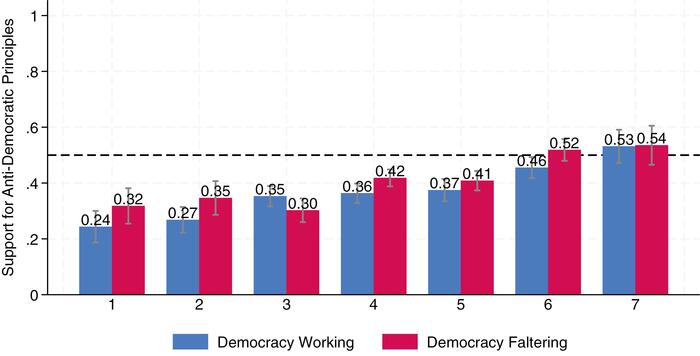
Hero Image
Santa Ana, El Salvador Luis Desiro
All News button
1
Subtitle

CDDRL Research-in-Brief [4-minute read]

Date Label
Authors
News Type
News
Date
Hero Image
Amichai Magen, Kathryn Stoner, and Larry Diamond
Amichai Magen, Kathryn Stoner, and Larry Diamond.
Rod Searcey
All News button
1
Subtitle

Building on a successful pilot at the Freeman Spogli Institute for International Studies, the Jan Koum Israel Studies Program will deepen understanding of Israel through new classes, collaborative research, and community engagement.

Date Label
Paragraphs

This brief is part of the Democracy Action Lab's "The Case for Democracy" series, which curates academic scholarship on democracy’s impacts across various domains of governance and development. Drawing from an exhaustive review of the literature, this analysis presents selected works that encompass significant findings and illustrate how the academic conversation has unfolded.

Democracies rarely, if ever, engage in war with one another. The resulting democratic peace theory has been a catalyst for investments in democracy promotion as a means of securing peace. Yet, the conclusion that democracy, and not alternative factors, is the main underlying driver of peace has required extensive research faced with fundamental empirical challenges. The most sophisticated statistical analysis supports the conclusion that democratic governance is a primary determinant of peaceful relations between similarly-democratic states. Scholars also offer theory and evidence on the specific mechanisms that make war less likely between democratic states, although this question remains unsettled. 

All Publications button
1
Publication Type
Policy Briefs
Publication Date
Subscribe to Democracy