


Taiwan's Democracy Challenged: The Chen Shui-bian Years
-
Image

This discussion will be based on the authors' recently published book, Taiwan's Democracy Challenged: The Chen Shui-bian Years, Lynne Rienner Publishing (2016).
Abstract
At the end of Chen Shui-bian’s two terms as the president of Taiwan, his tenure was widely viewed as a disappointment, if not an outright failure. Today, the Chen years (2000-2008) are remembered mostly for relentless partisan fighting over cross-Strait relations and national identity questions, prolonged political gridlock, and damaging corruption scandals—as an era that challenged, rather than helped consolidate, Taiwan’s young democracy and squandered most of the promise with which it began.
Yet as Taiwan’s Democracy Challenged: The Chen Shui-bian Years documents, this conventional narrative obscures a more complex and more positive story. The chapters here cover the diverse array of ways in which democratic practices were deepened during this period, including the depoliticization of the military and intelligence forces, the ascendance of an independent and professional judicial system, a strengthened commitment to constitutionalism and respect for the rule of law, and the creation of greater space for civil society representatives in the policy-making process. Even the conventional wisdom about unprecedented political polarization during this era is misleading: while elite politics became more divided and acrimonious, mass public opinion on cross-Strait relations and national identity was actually converging.
Not all developments were so positive: strong partisans on both sides of the political divide remained only weakly committed to democratic principles, the reporting of news organizations became more sensationalist and partisan, and the Taiwanese state’s exceptional autonomy from sectoral interests and vaunted capacity for long-term planning deteriorated. But on the whole, the authors argue, these years were not squandered. By the end of the Chen Shui-bian era, Taiwan’s democracy was firmly consolidated.
This event is sponsored by the Taiwan Democracy Project in the Center on Democracy, Development, and the Rule of Law. It is free and open to the public, and lunch will be served. Please RSVP by October 31.
Taiwan's Democracy Challenged presentation slides
Download pdf
CISAC Central Conference Room, Encina Hall 2nd Floor
Larry Diamond
CDDRL
Stanford University
Encina Hall, C147
616 Jane Stanford Way
Stanford, CA 94305-6055
0
ldiamond@stanford.edu
Mosbacher Senior Fellow in Global Democracy at the Freeman Spogli Institute for International Studies
William L. Clayton Senior Fellow at the Hoover Institution
Professor, by courtesy, of Political Science and Sociology
Larry Diamond is the William L. Clayton Senior Fellow at the Hoover Institution, the Mosbacher Senior Fellow in Global Democracy at the Freeman Spogli Institute for International Studies (FSI), and a Bass University Fellow in Undergraduate Education at Stanford University. He is also professor by courtesy of Political Science and Sociology at Stanford, where he lectures and teaches courses on democracy (including an online course on EdX). At the Hoover Institution, he co-leads the Project on Taiwan in the Indo-Pacific Region and participates in the Project on the U.S., China, and the World. At FSI, he is among the core faculty of the Center on Democracy, Development and the Rule of Law, which he directed for six and a half years. He leads FSI’s Israel Studies Program and is a member of the Program on Arab Reform and Development. He also co-leads the Global Digital Policy Incubator, based at FSI’s Cyber Policy Center. He served for 32 years as founding co-editor of the Journal of Democracy.
Diamond’s research focuses on global trends affecting freedom and democracy and on U.S. and international policies to defend and advance democracy. His book, Ill Winds: Saving Democracy from Russian Rage, Chinese Ambition, and American Complacency, analyzes the challenges confronting liberal democracy in the United States and around the world at this potential “hinge in history,” and offers an agenda for strengthening and defending democracy at home and abroad. A paperback edition with a new preface was released by Penguin in April 2020. His other books include: In Search of Democracy (2016), The Spirit of Democracy (2008), Developing Democracy: Toward Consolidation (1999), Promoting Democracy in the 1990s (1995), and Class, Ethnicity, and Democracy in Nigeria (1989). He has edited or coedited more than fifty books, including China’s Influence and American Interests (2019, with Orville Schell), Silicon Triangle: The United States, China, Taiwan the Global Semiconductor Security (2023, with James O. Ellis Jr. and Orville Schell), and The Troubling State of India’s Democracy (2024, with Sumit Ganguly and Dinsha Mistree).
During 2002–03, Diamond served as a consultant to the US Agency for International Development (USAID) and was a contributing author of its report, Foreign Aid in the National Interest. He has advised and lectured to universities and think tanks around the world, and to the World Bank, the United Nations, the State Department, and other organizations dealing with governance and development. During the first three months of 2004, Diamond served as a senior adviser on governance to the Coalition Provisional Authority in Baghdad. His 2005 book, Squandered Victory: The American Occupation and the Bungled Effort to Bring Democracy to Iraq, was one of the first books to critically analyze America's postwar engagement in Iraq.
Among Diamond’s other edited books are Democracy in Decline?; Democratization and Authoritarianism in the Arab World; Will China Democratize?; and Liberation Technology: Social Media and the Struggle for Democracy, all edited with Marc F. Plattner; and Politics and Culture in Contemporary Iran, with Abbas Milani. With Juan J. Linz and Seymour Martin Lipset, he edited the series, Democracy in Developing Countries, which helped to shape a new generation of comparative study of democratic development.
Download full-resolution headshot; photo credit: Rod Searcey.
Former Director of the Center on Democracy, Development and the Rule of Law
Faculty Chair, Jan Koum Israel Studies Program
Hide publication sections
Off
Seminars
Nate Persily on Trends in Polarization
News Type
News
Date
Paragraphs
As part of Stanford Worldview's Wide Angle: Election 2016 Project, Nate Persily of Stanford Law School recently described how the 2016 election highlights changing trends in polarization and gridlock in the United States, particularly the role of campaign finance and digital technology.
Hero Image

All News button
1
Introducing CDDRL's incoming pre- and postdoctoral fellows
News Type
Q&As
Date
Paragraphs
Stanford University’s Center on Democracy, Development and the Rule of Law (CDDRL) is proud to announce our four incoming fellows who will be joining us in the 2016-2017 academic year to develop their research, engage with faculty and tap into our diverse scholarly community.
The pre- and postdoctoral program will provide fellows the time to focus on research and data analysis as they work to finalize and publish their dissertation research, while connecting with resident faculty and research staff at CDDRL.
Fellows will present their research during our weekly research seminar series and an array of scholarly events and conferences.
Topics of the incoming cohort include electoral fraud in Russia, how the elite class impacts state power in China, the role of emotions in support for democracy in Zimbabwe, and market institutions in Nigeria.
Learn more in the Q&A below.
Image
 Natalia Forrat
Image
CDDRL Pre-Doctoral Fellow
Hometown: Tomsk, Russia
Academic Institution: Northwestern University
Discipline and expected date of graduation: Sociology, April 2017
Research Interests: authoritarianism, state capacity, social policy, civil society, trust, Russia and post-communist countries
Dissertation Title: The State that Betrays the Trust: Infrastructural State Power, Public Sector Organizations, and Authoritarian Resilience in Putin's Russia
What attracted you to the CDDRL Pre/post-doctoral program? I study the connection between state capacity and political regimes - the topic that is at the core of many research initiatives at CDDRL. Learning more about this work and receiving feedback for my dissertation will enrich and sharpen my analysis, while helping me to place it into a comparative context. I am looking forward to discussing my work with the faculty who study the post-Soviet region. I also will explore policy implications of my work with the help of policy experts at CDDRL.
What do you hope to accomplish during your nine-month residency at the CDDRL? Besides finishing writing my dissertation, I will workshop three working papers to prepare them for publication. The first one argues that Putin's regime used the school system to administer a large-scale electoral fraud in 2012 presidential elections; the second one shows how the networks of social organizations were used by subnational autocrats to strengthen the regime; and the third one will look at the factors that make the abuse of such organizations more difficult in some regions. In addition to these papers I will continue developing my post-graduation research project exploring the relationship between social trust and distrust, institutions, political competition, and democratization.
Fun fact: I have spent 25 years of my life in Siberia, and I can tell you: Chicago winters are worse!
Image
 Shelby Grossman
Image
CDDRL Postdoctoral Fellow
Hometown: Reading, MA
Academic Institution: Harvard University
Discipline & Graduation Date: Government, Summer 2016
Research interests: political economy of development, private governance, market institutions, Sub-Saharan Africa, survey methods
Dissertation Title: The Politics of Order in Informal Markets: Evidence from Lagos
What attracted you to the CDDRL post-doctoral program? I was attracted to CDDRL largely for its community of scholars. Affiliated faculty work on the political economy of development and medieval and modern market institutions, topics that are tied to my own interests.
What do you hope to accomplish during your nine-month residency at the CDDRL? I plan to prepare a book manuscript based on my dissertation, a project that explains variation in the provision of pro-trade institutions in private market organizations through the study of physical marketplaces in Nigeria. In addition, I will continue to remotely manage an on-going project in Nigeria (with Meredith Startz) investigating whether reputation alleviates contracting frictions. I also plan to work on submitting to journals a few working papers, including one on the politics of non-compliance with polio vaccination in Nigeria (with Jonathan Phillips and Leah Rosenzweig).
Fun fact: Contrary to popular belief, not all cheese is vegetarian. I have a website to help people determine if a cheese is vegetarian or not: IsThisCheeseVegetarian.com.
Image
 Daniel Mattingly
Image
CDDRL Postdoctoral Fellow
Hometown: Oakland, California
Academic Institution: University of California, Berkeley
Discipline & Graduation Date: Political Science, Summer 2016
Research Interests: Governance, rule of law, state building, authoritarian politics, Chinese politics
Dissertation Title: The Social Origins of State Power: Democratic Institutions and Local Elites in China
What attracted you to CDDRL? The Center has a fantastic community of scholars and practitioners who work on the areas that I'm interested in, including governance and the rule of law. I'm excited to learn from the CDDRL community and participate in the Center's events. The fellowship also provides me with valuable time to finish my book manuscript before I start teaching.
What do you hope to accomplish during your nine-month residency at the CDDRL? While at CDDRL, I plan to prepare my book manuscript and to work on some related projects on local elites and state power in China and elsewhere.
Fun fact: I grew up on an organic farm in Vermont.
Image
 Lauren E. Young
Image
CDDRL Postdoctoral Fellow
Hometown: Saratoga, CA
Academic Institution: Columbia University
Discipline & Graduation Date: Political Science (Comparative Politics, Methods), May 2016 (defense), Oct 2016 (degree conferral)
Research Interests: political violence, political economy of development, autocratic persistence, democratization, protest, electoral violence
Dissertation Title: The Psychology of Repression and Dissent in Autocracy
What attracted you to the CDDRL post-doctoral program? As a graduate of the CISAC honors program when I was an undergraduate at Stanford, I have seen first-hand how intellectually stimulating, collaborative, and plugged into policy CDDRL is. While at the center I will be revising my dissertation work on the political psychology of participation in pro-democracy movements in Zimbabwe for submission as a book manuscript, and moving forward new projects that similarly seek to understand how different forms of violence by non-state actors affects citizens' preferences and decision-making. Because of its deep bench of experts on autocracy, narco-trafficking, and insurgency, CDDRL will add enormous value to these projects.
What do you hope to accomplish during your nine-month residency at the CDDRL? During my fellowship year, my primary goal is to revise my research on Zimbabwe into a book manuscript. I defended my dissertation as three stand-alone articles, including two experiments showing that emotions influence whether opposition supporters in Zimbabwe express their pro-democracy preferences and a descriptive paper showing that repression has a larger effect on the behavior of the poor. To prepare the book manuscript during my fellowship, I will bring in additional quantitative and qualitative descriptive evidence and tie the three papers together into a cohesive argument about how opposition supporters make decisions about participation in protest, why emotions have such a large effect on these decisions, and how this affects variation across individuals and the strategic choices of autocrats and activists.
Fun fact: During my fieldwork I took an overnight train from Victoria Falls to a southern city in Zimbabwe and hitch-hiked into a national park. It got a little nerve-wracking when night started to fall, but ended with an invitation to a barbecue!
Hero Image

All News button
1
American Political Decay or Renewal?
News Type
News
Date
Paragraphs
In the July/August edition of Foreign Affairs, Francis Fukuyama, the Mosbacher director of CDDRL, analyzes the rising tide of populism as represented by the current candidates for the US Presidential elections. According to Fukuyama, the real story of the election is that American democracy is finally responding to the rise of inequality and economic stagnation experienced by most of the population.
Hero Image

Republican presidential candidate Donald Trump speaks to the crowd at a Pearl Harbor Day Rally at the U.S.S. Yorktown December 7, 2015 in Mt. Pleasant, South Carolina.
Sean Rayford / Stringer - Getty Images
All News button
1

The 2016 U.S. Elections and the Working Class: A Conversation with Francis Fukuyama
Related Multimedia

Presentation


A New Era in the Hong Kong Democracy Movement: Front Line Perspectives from Two Student Leaders
-
Abstract
Two student leaders and activists will discuss the new era of Hong Kong's democracy movement with prospects for the future of Hong Kong after 2047.
Speaker Bios
Image
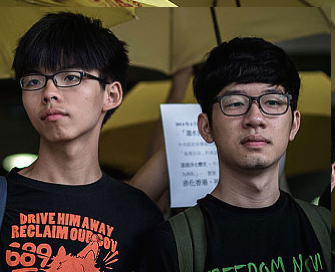
Nathan Kwun-chung Law, 22, Is a well-known student leader and organizer in Hong Kong. He is Secretary General of the Hong Kong Federation of Students, having been a Standing Committee member from 2014-15. He participated in the only negotiation session with the Hong Kong SAR government during the Umbrella Movement.
This event is sponsored by the Taiwan Democracy Project in the Center on Democracy, Development, and the Rule of Law. It is free and open to the public.
CISAC Conference Room
Encina Hall, 2nd Floor
616 Serra Street, Stanford, CA 94305
Joshua Wong
Speaker
Nathan Law
Speajer
Seminars
The War against Civil Society in Egypt: Causes and Implications
-
Abstract
In this talk Nancy Okail will reflect on the renewed crackdown on civil society in Egypt, the closing of public space, and the continued regression in rights and freedoms. In the course of the past months the military-sponsored regime of Abdel-Fattah Al-Sisi has escalated its confrontation with civil society organizations by announcing a new set of investigations against prominent human rights defenders and NGOs. The talk will analyze the conditions motivating the regime’s renewed crackdown against civil society and the impact of these politically motivated investigations on the regime’s domestic and international standing and the struggle for political change in Egypt.
Speaker Bio
Image

[[{"fid":"222701","view_mode":"crop_870xauto","fields":{"format":"crop_870xauto","field_file_image_description[und][0][value]":"Nancy Okail flyer","field_file_image_alt_text[und][0][value]":"","field_file_image_title_text[und][0][value]":"","field_credit[und][0][value]":"","field_caption[und][0][value]":"","field_related_image_aspect[und][0][value]":"","thumbnails":"crop_870xauto"},"type":"media","attributes":{"width":"870","class":"media-element file-crop-870xauto"}}]]
CISAC Central Conference Room
Encina Hall, 2nd Floor
616 Serra St
Stanford, CA 94305
Nancy Okail
Executive Director
TIMEP
Seminars
Visiting scholar remarks on ridiculing of civilian politics in Egypt
News Type
News
Date
Paragraphs
In a recent piece in Jadaliyya Magazine, Program on Arab Reform and Democracy Visiting Scholar Amr Hamzawy comments on the growing social discontent with failtures of the military-backed regime in Egypt. Hamzawy states that aside from silencing dissident voices, the regime is also implementing a powerful strategy of 'ridiculing politics' where civilian communities are rendered incompetent and inferior to the current generals running the country. Hamzawy was elected to serve in Egypt’s first parliament after the outset of the January 25 Revolution before it was dissolved in the summer of 2012.
Hero Image

All News button
1