Authors
Héctor Fuentes
News Type
News
Date
Paragraphs

El Democracy Action Lab (DAL), una iniciativa del Centro sobre Democracia, Desarrollo y Estado de Derecho de la Universidad de Stanford para defensores de la democracia, se enorgullece en anunciar oficialmente la primera cohorte de The Democracy Garage, el primer programa acelerador de su tipo dedicado a fortalecer a los defensores de la democracia en primera línea en América Latina y el Caribe.

The Democracy Garage nació de una convicción simple pero urgente: la resiliencia democrática no se construye únicamente a través de ideas, sino a través del fortalecimiento de capacidades de la sociedad civil para actuar estratégicamente, usar la evidencia con eficacia, comunicar de manera persuasiva y adaptarse a entornos políticos en rápida evolución. DAL construyó este programa para cerrar una brecha persistente en el apoyo a la democracia, tendiendo un puente entre la investigación de alto nivel y las necesidades operativas en tiempo real de las organizaciones que hacen el trabajo más difícil sobre el terreno.

Durante los próximos meses, DAL trabajará codo a codo con ocho extraordinarias organizaciones en la región, aplicando una metodología estructurada de acelerador para co-desarrollar estrategias adaptadas a los desafíos democráticos específicos de cada país. Este no es un programa de crecimiento tradicional: es una asociación profunda y colaborativa basada en la evidencia, la estrategia y la solidaridad.

Un Modelo Acelerador de Tres Ejes


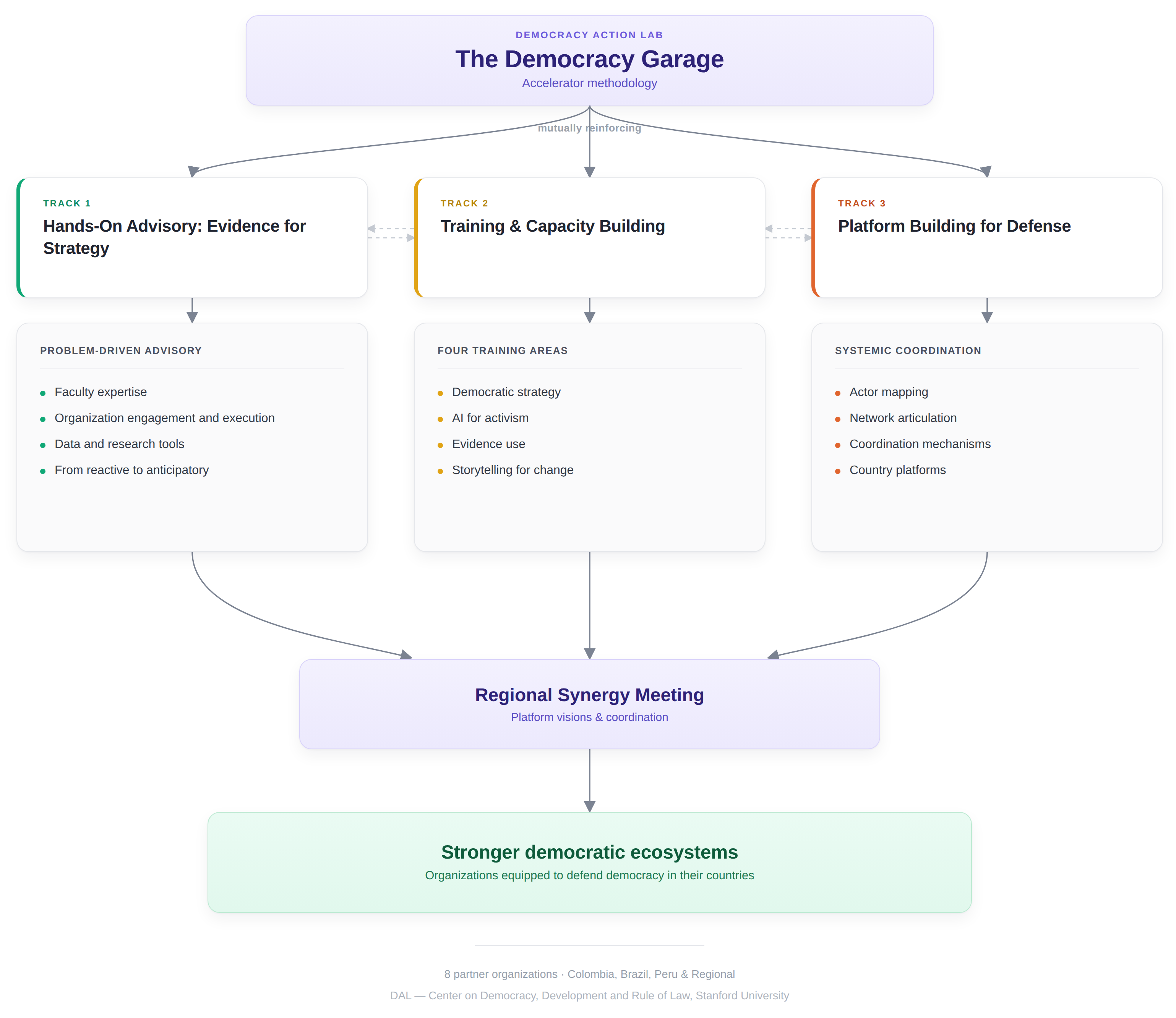
El modelo acelerador de The Democracy Garage se organiza en torno a tres ejes que se refuerzan mutuamente, diseñados para abordar una brecha clave en el ecosistema de apoyo democrático: muchos programas ofrecen formación de alto nivel desconectada de las necesidades inmediatas, o asistencia técnica a corto plazo que no genera capacidad duradera. The Garage tiende ese puente.

Eje 1  |  Análisis de Evidencia para la Estrategia Democrática  —  Asesoría Práctica

El primer eje proporciona apoyo de asesoría directa, orientada a los problemas. Cada organización  entra al Garage con un desafío concreto y actual. DAL moviliza su capacidad analítica — incluyendo la experiencia de su cuerpo docente, la participación de estudiantes y herramientas de datos — para abordarlo de forma colaborativa. No se trata de asistencia técnica unidireccional: es un proceso conjunto que desarrolla la propia capacidad de las organizaciones para usar la evidencia como herramienta estratégica, transitando de modos reactivos a anticipatorios.

Eje 2  |  Formación y Fortalecimiento de Capacidades  —  Cuatro Áreas Fundamentales

El segundo eje ofrece formación estructurada en cuatro áreas críticas para la acción democrática: (1) Estrategia para la defensa democrática — comprender el estado de la democracia en la región y sus principales desafíos; (2) IA para el activismo — aplicaciones prácticas de la inteligencia artificial para monitoreo, comunicación y toma de decisiones; (3) Evidencia para la defensa democrática — recolección, análisis e interpretación de datos vinculados directamente a las decisiones estratégicas; y (4) Narrativa para el cambio — traducir el análisis complejo en narrativas persuasivas que resuenen con tomadores de decisiones, medios de comunicación y ciudadanos.

Eje 3  |  Construcción de Plataformas para la Defensa Democrática  —  Escalar el Impacto Sistémico

El tercer eje apoya a las organizaciones  para que se conviertan en nodos fundacionales de plataformas nacionales de defensa democrática. El deterioro democrático rara vez se produce de forma aislada: requiere respuestas coordinadas entre la sociedad civil, los medios, la academia y las instituciones. A través del mapeo de actores, la articulación de redes y el desarrollo de mecanismos de coordinación, el Garage contribuye a construir ecosistemas estructurados capaces de acción colectiva. Este eje culmina en el Encuentro Regional de Sinergias en agosto de 2026, donde las organizaciones presentarán su visión de plataforma y sentarán las bases para la coordinación regional.
Image
Diagram of Democracy Action Lab's Democracy Garage accelerator methodology, showing three mutually reinforcing tracks — Advisory, Training, and Platform Building — leading to a Regional Synergy Meeting and stronger democratic ecosystems.


Metodología de aceleración de DAL (haga clic para ampliar)

Ocho Organizaciones. Tres Países. Una Región.


Tras un riguroso proceso de selección, The Democracy Garage se enorgullece en dar la bienvenida a las siguientes organizaciones participantes:

CESJUL — Centro de Estudios Socio Jurídicos Latinoamericanos (Colombia)  

Trabaja en la intersección del derecho penal, los derechos humanos y la gobernanza democrática, aportando análisis jurídico riguroso a los desafíos más urgentes de la democracia colombiana — incluyendo el uso del derecho tanto como herramienta de represión como vehículo de rendición de cuentas.

Dejusticia (Colombia)

Una de las organizaciones de derechos humanos más respetadas de América Latina — un auténtico think-and-do tank que combina investigación jurídica rigurosa con litigio estratégico, incidencia directa y formación de capacidades en antidiscriminación, justicia transicional y protección del espacio cívico.

Instituto Sou da Paz (Brazil)

Referente en política de seguridad pública en Brasil durante 25 años, influyendo en la legislación nacional sobre regulación de armas y reducción de homicidios mediante un enfoque basado en evidencia que centra a las comunidades más afectadas por la violencia, en particular la población negra brasileña.

Pacto pela Democracia (Brazil)

La principal coalición pro-democracia de Brasil, integrada por más de 200 organizaciones y reconocida internacionalmente como modelo de defensa democrática colectiva. Su protección coordinada de las elecciones de 2022 — más de 80 acciones entre 35 organizaciones — demostró el poder de construir coaliciones antes de que llegue la crisis.

Instituto de Estudios Peruanos (IEP) (Perú)

Una de las instituciones de ciencias sociales más antiguas y distinguidas de América Latina, el IEP ha construido durante seis décadas la base empírica del análisis democrático en el Perú — desde encuestas de opinión pública y estudios electorales hasta investigación interdisciplinaria sobre poder, desigualdad y el Estado.

Recambio (Perú)

En un país que ha tenido ocho presidentes en una década, Recambio reconstruye la cultura democrática desde dentro del sistema político — con una red de más de 500 egresados de 28 partidos políticos, diálogo interpartidario y la iniciativa 'Voces Contra la Polarización'.

Espacio Crítico (Regional, LAC)

Una organización regional que brinda apoyo estratégico personalizado, formación técnica y asesoría en seguridad a organizaciones de la sociedad civil, periodistas independientes y líderes políticos en la primera línea del retroceso democrático en América Latina y el Caribe.

D-Hub (Regional, Global)

Una comunidad global de defensores de la democracia que conecta a activistas de primera línea y organizaciones de la sociedad civil con expertos que han enfrentado desafíos similares — construyendo la infraestructura para la solidaridad democrática transfronteriza que ninguna organización puede sostener sola.

Un Hito Histórico


The Democracy Garage es el primer programa acelerador de este tipo diseñado específicamente para defensores de la democracia en América Latina y el Caribe. Al combinar el rigor de la investigación basada en evidencia, la agilidad de un modelo acelerador y la profundidad de una alianza a largo plazo, DAL está abriendo un camino inédito para fortalecer la resiliencia democrática — basado en la convicción de que las organizaciones más cercanas a la crisis están mejor posicionadas para afrontarla, cuando se les proporcionan las herramientas, el conocimiento y las conexiones adecuadas.

“Nos enorgullece inmensamente lanzar The Democracy Garage junto a estas ocho organizaciones extraordinarias," afirmó Beatriz Magaloni, codirectora del DAL y Graham H. Stuart Professor of International Relations en el Departamento de Ciencia Política. "Cada una de ellas representa lo que es la defensa de la democracia en la práctica, no en la teoría. Juntos, estamos comprometidos con algo sin precedentes: construir una comunidad de estrategia y solidaridad que fortalezca la democracia, país por país.”
 

Sobre el Democracy Action Lab

El Democracy Action Lab (DAL) es una iniciativa de investigación y estrategia con sede en el Center on Democracy, Development and Rule of Law de la Universidad de Stanford, dedicada a traducir las ciencias sociales en herramientas prácticas para quienes defienden la democracia. El DAL trabaja en la intersección entre la evidencia y la acción, colaborando con organizaciones de primera línea para fortalecer las instituciones democráticas, proteger el espacio cívico y contrarrestar las amenazas autoritarias en América Latina y más allá.

Read More

Wall plastered with posters and graffiti text reading "DEMOCRACY NOW"
News

Stanford Launches New Democracy Action Lab to Confront Global Democratic Backsliding

By combining rigorous research with practitioner collaborations, the Democracy Action Lab at the Center on Democracy, Development and the Rule of Law turns ideas into action.
Stanford Launches New Democracy Action Lab to Confront Global Democratic Backsliding
DAL launch panel
News

Political scientists emphasize need for pro-democracy coalitions at launch of Democracy Action Lab

Political science scholars discussed strengthening pro-democracy coalitions in a Wednesday event marking the launch of CDDRL’s new Democracy Action Lab.
Political scientists emphasize need for pro-democracy coalitions at launch of Democracy Action Lab
Prof. Adam Prezworski, Prof. Beatriz Magaloni, and Prof. Alberto Díaz Cayeros present during DAL’s Inaugural Conference at El Colegio de Mexico.
Blogs

Stanford’s Democracy Action Lab Launches in Mexico City

The new initiative from the Center on Democracy, Development and the Rule of Law connects research with frontline efforts to address democratic backsliding across Latin America.
Stanford’s Democracy Action Lab Launches in Mexico City
Hero Image
Illustration of diverse young activists emerging from a garage carrying books and a raised-fist flag, with a network of connected stars overhead, symbolizing the Democracy Garage.
Pariplab Chakraborty
All News button
1
Subtitle

El Primer Acelerador de Democracia de Este Tipo en América Latina y el Caribe.

Date Label
In Brief
  • El Laboratorio de Democracia en Acción (DAL, por sus siglas en inglés) del CDDRL lanzó el primer acelerador de democracia de América Latina, el Democracy Garage (Garaje de la Democracia).
  • El programa combina la capacidad de investigación y la experiencia docente del DAL con ocho organizaciones de Colombia, Brasil y Perú.
  • Beatriz Magaloni, codirectora del DAL, calificó la iniciativa como una comunidad de estrategia y solidaridad sin precedentes, impulsada por Stanford.
Display Hero Image Wide (1320px)
Yes
Authors
Héctor Fuentes
News Type
News
Date
Paragraphs

The Democracy Action Lab (DAL), a practitioner-centered initiative of the Center on Democracy, Development and the Rule of Law at Stanford University, is proud to officially announce the first cohort of its Democracy Garage, the first accelerator program of its kind dedicated to strengthening frontline democracy defenders across Latin America and the Caribbean.

The Democracy Garage was born from a simple but urgent conviction: democratic resilience is built not only through ideas, but through the capacity of organizations to act strategically, use evidence effectively, communicate persuasively, and adapt to rapidly evolving political environments. DAL built this program to close a persistent gap in democracy support, bridging high-level research with the real-time, operational needs of the organizations doing the hardest work on the ground.

Over the next few months, DAL will work side by side with eight extraordinary organizations across the region, applying a structured accelerator methodology to co-develop strategies tailored to the specific democratic challenges in each country. This is not a traditional growth program: it is a deep collaboration grounded in evidence, strategy, and solidarity.

A Three-Track Accelerator Model


The accelerator model of the Democracy Garage is organized around three mutually reinforcing tracks designed to address a key gap in the democracy support ecosystem: many programs either provide high-level training disconnected from immediate needs or short-term technical assistance that does not build lasting capacity. The Garage bridges this divide.

Track 1  |  Evidence Analysis for Democratic Strategizing  —  Hands-On Advisory

The first track provides direct, problem-driven advisory support. Each of the selected organizations enters the Garage with a defined, real-time challenge. DAL mobilizes its analytical capacity, including faculty expertise, student engagement, and data tools, to help address it collaboratively. This is not one-directional technical assistance: it is a joint process that builds organizations' own capacity to use evidence as a strategic tool, shifting from reactive to anticipatory modes of operation.

Track 2  |  Training and Capacity Building  —  Four Core Areas

The second track offers structured training in four areas critical to democratic action: (1) Strategizing for democratic defense — understanding the state of democracy in the region and its main challenges; (2) AI for activism — practical applications of artificial intelligence for monitoring, communication, and decision-making; (3) Evidence for democratic defense — data collection, analysis, and interpretation linked directly to strategic decisions; and (4) Storytelling for change — translating complex analysis into compelling narratives that resonate with policymakers, media, and citizens alike.

Track 3  |  Platform Building for Democratic Defense  —  Scaling for Systemic Impact

The third track supports participating organizations in becoming foundational nodes of country-level democratic defense platforms. Democratic erosion rarely unfolds in isolation: it requires coordinated responses across civil society, media, academia, and institutions. Through actor mapping, network articulation, and the development of coordination mechanisms, the Garage helps build structured ecosystems capable of collective action. This track culminates at the Regional Synergy Meeting in August 2026, where organizations will present their platform visions and lay the groundwork for regional coordination.

Image
Diagram of Democracy Action Lab's Democracy Garage accelerator methodology, showing three mutually reinforcing tracks — Advisory, Training, and Platform Building — leading to a Regional Synergy Meeting and stronger democratic ecosystems.


DAL's Accelerator Methodology (click to enlarge)

Eight Organizations. Three Countries. One Region.


After a rigorous selection process, The Democracy Garage is proud to welcome the following participating organizations:

CESJUL — Centro de Estudios Socio Jurídicos Latinoamericanos (Colombia)  

Works at the intersection of criminal law, human rights, and democratic governance, bringing rigorous legal analysis to the most pressing challenges in Colombian democracy — including the use of law as both a tool of repression and a vehicle for accountability.

Dejusticia (Colombia)

One of Latin America's most respected human rights organizations — a true think-and-do tank combining rigorous legal research with strategic litigation, direct advocacy, and capacity-building across anti-discrimination, transitional justice, and the protection of civic space.

Instituto Sou da Paz (Brazil)

A 25-year leader in public security policy in Brazil, shaping national legislation on firearms regulation and homicide reduction through an evidence-first approach that centers the communities most affected by violence — particularly Black Brazilians.

Pacto pela Democracia (Brazil)

Brazil's preeminent pro-democracy coalition of more than 200 organizations, and an internationally recognized model for coalition-based democratic defense. Its coordinated protection of the 2022 elections — over 80 actions across 35 organizations — demonstrated the power of building coalitions before the crisis arrives.

Instituto de Estudios Peruanos (IEP) (Perú)

One of Latin America's oldest and most distinguished social science institutions, IEP has spent six decades producing the empirical foundation for democratic analysis in Perú — from public opinion surveys and electoral studies to interdisciplinary research on power, inequality, and the state

Recambio (Perú)

In a country that has seen eight presidents in a decade, Recambio is rebuilding democratic culture from within the political system — with a network of over 500 alumni from 28 political parties, cross-partisan dialogue, and the 'Voices Against Polarization' initiative.

Espacio Crítico (Regional, LAC)

A regional organization providing tailored strategic support, technical training, and security advice to civil society organizations, independent journalists, and political leaders on the front lines of democratic backsliding across Latin America and the Caribbean.

D-Hub (Regional, Global)

A global community of democracy defenders connecting frontline activists and civil society organizations with experts who have faced similar challenges — building the infrastructure for cross-border democratic solidarity that no single organization can sustain alone.

A Historic First


The Democracy Garage is the first accelerator program of this type designed specifically for democracy defenders in Latin America and the Caribbean. By combining the rigor of evidence-based research, the agility of an accelerator model, and the depth of long-term collaboration, DAL is pioneering a new approach to democratic resilience — one grounded in the conviction that the organizations closest to the crisis are best positioned to address it, when equipped with the right tools, knowledge, and connections.

"We are immensely proud to launch the Democracy Garage alongside these eight remarkable organizations," said DAL co-director Beatriz Magaloni, the Graham H. Stuart Professor of International Relations. "Each of them represents what democratic defense looks like in practice, not in theory. Together, we are committed to something unprecedented: building a community of strategy and solidarity that makes democracy stronger, one country at a time."
 

About the Democracy Action Lab

The Democracy Action Lab (DAL) is a research and strategy initiative housed at Stanford University’s Center on Democracy, Development and Rule of Law, dedicated to translating social science into practical tools for democracy defenders. DAL works at the intersection of evidence and action, partnering with frontline organizations to strengthen democratic institutions, protect civic space, and counter authoritarian threats across Latin America and beyond.

Read More

Wall plastered with posters and graffiti text reading "DEMOCRACY NOW"
News

Stanford Launches New Democracy Action Lab to Confront Global Democratic Backsliding

By combining rigorous research with practitioner collaborations, the Democracy Action Lab at the Center on Democracy, Development and the Rule of Law turns ideas into action.
Stanford Launches New Democracy Action Lab to Confront Global Democratic Backsliding
DAL launch panel
News

Political scientists emphasize need for pro-democracy coalitions at launch of Democracy Action Lab

Political science scholars discussed strengthening pro-democracy coalitions in a Wednesday event marking the launch of CDDRL’s new Democracy Action Lab.
Political scientists emphasize need for pro-democracy coalitions at launch of Democracy Action Lab
Prof. Adam Prezworski, Prof. Beatriz Magaloni, and Prof. Alberto Díaz Cayeros present during DAL’s Inaugural Conference at El Colegio de Mexico.
Blogs

Stanford’s Democracy Action Lab Launches in Mexico City

The new initiative from the Center on Democracy, Development and the Rule of Law connects research with frontline efforts to address democratic backsliding across Latin America.
Stanford’s Democracy Action Lab Launches in Mexico City
Hero Image
Illustration of diverse young activists emerging from a garage carrying books and a raised-fist flag, with a network of connected stars overhead, symbolizing the Democracy Garage.
Pariplab Chakraborty
All News button
1
Subtitle

The first democracy accelerator of its kind in Latin America and the Caribbean.

Date Label
In Brief
  • CDDRL’s Democracy Action Lab (DAL) has launched Latin America's first democracy accelerator, the Democracy Garage.
  • The program pairs DAL’s research capacity and faculty expertise with eight organizations across Colombia, Brazil, and Perú.
  • DAL co-director Beatriz Magaloni called the initiative an unprecedented Stanford-led community of strategy and solidarity.
Display Hero Image Wide (1320px)
Yes
Paragraphs

Background

The pandemic of antimicrobial resistance (AMR) will only be mitigated by policy action and innovation and importantly, supported by local and community action. With the United Nations General Assembly high level meeting on AMR taking place in September 2024, we decided to ascertain citizens’ understanding of the issues and prioritisation for action.

Methods

From June to August 2024, while intergovernmental negotiations on the outcome document were taking place, we used Deliberative Polling®, a methodology founded on deliberative democratic theory, in six middle income countries across three continents to explore people’s understanding and support for 45 policies that were likely to feature in the political declaration.

Results

In total 2419 participants were randomised to deliberation intervention (written and video information, facilitated online small group discussions, and expert plenary sessions) or control groups who only completed the pre- and post-deliberation surveys. Support increased significantly through deliberation for 3/4 of the proposals (>90% for 2/3), as well as on knowledge about AMR and internal political efficacy. Proposals relating to infection prevention were most heavily supported across all six countries. We found regional variation in support for proposals relating to informal antibiotic access and the use of antibiotics in food production, with less support for selected proposals from South America.

Conclusions

Deliberative polling is a powerful method of large scale community engagement and this is new for AMR helping us to understand the views of the public relating to policies that will require their support to enact.

All Publications button
1
Publication Type
Journal Articles
Publication Date
Subtitle

[version 2; peer review: 2 approved, 3 approved with reservations]

Journal Publisher
Wellcome Open Res 2026
Authors
Alice Siu
James S. Fishkin
Number
10:690
News Type
News
Date
Paragraphs

For the second time in history, UN Member States adopted a Political Declaration on AMR in 2024. This declaration outlines ambitious commitments to tackle one of the most pressing health challenges of our time. These commitments will only be successful if the public understands, supports, and ultimately changes behavior to make them work.

Ahead of UNGA, we asked citizens in six countries what they thought about different policy proposals across six themes: Equity, Access and Stewardship; Infection Prevention; Food Security; Awareness and Education; Target setting; and Surveillance.

Working with the Trinity Challenge, we brought together 2,419 citizens from Brazil, Colombia, Nigeria, Tanzania, India, and Indonesia using Deliberative Polling®, a method that assesses what a representative and informed sample would think about policy proposals after extended, evidence-based discussions. Deliberations took place on the innovative Artificial Intelligence (AI)-assisted Stanford University Online Deliberation Platform across two days.

Citizens left the process not just more informed, but more engaged with the solutions required.

What is Deliberative Polling® ?


Deliberative Polling® is a research methodology developed by Professor James Fishkin at Stanford University's Deliberative Democracy Lab. Unlike standard opinion polling, it measures not just initial public opinion but informed public opinion - what people think after genuine engagement with the issues, trade-offs, and expert perspectives.

It has been applied in over 160 cases around the world, from national referendums to climate policy.

Learn more about the Deliberative Polling® methodology.

"Deliberative Polling® doesn't just ask what people think - it asks what they would think if they had the chance to really engage with the evidence."
Professor James Fishkin
Stanford Deliberative Democracy Lab

Key Findings


The results were striking - and they matter for policymakers, health leaders, and the public alike.

🌍 2,419 citizens across six middle-income countries participated
📈 43 out of 45 policy proposals saw increased support after deliberation
✅ The most popular proposals were those relating to infection prevention
🌐 Regional differences emerged — particularly around attitudes to restricting antibiotic use in food production.

Antimicrobial resistance is not only a scientific challenge but a societal one. This project shows that when citizens are given balanced information, diverse perspectives, and the opportunity to deliberate, they can engage meaningfully with the complexity of AMR and support the action it requires. Building public trust and community engagement is essential to reducing the global impact of AMR. We hope these findings and resources will help advance public engagement on AMR and strengthen deliberative approaches across global health.

Support increased for 43 out of 45 proposals following deliberation. Beyond the data, participants left better informed about AMR and more engaged with the solutions on the table. That is whole-of-society action in practice.
Dame Sally Davies
Master of Trinity College Cambridge and Executive Chair of the Trinity Challenge

From Understanding to Action


This study demonstrates something important: when citizens are given the chance to engage seriously with a complex global health challenge, they rise to it.

Across all six countries, deliberation moved public opinion towards greater support for ambitious AMR action — on prescription practices, agricultural use, access to medicines, and prevention. The 2024 UN Political Declaration set out what governments have committed to. This research shows that the public, when informed, is ready to support it.

The findings have direct relevance for:

  • Policymakers designing national AMR action plans, particularly in middle-income countries
  • Health communicators seeking evidence-based approaches to public engagement on AMR
  • Researchers building the evidence base for deliberative approaches in global health
  • Civil society organizations advocating for community-level AMR action
     

We are committed to sharing these findings as widely as possible — with governments, health bodies, and the communities that took part.

Thanks to our funders


With thanks to the Novo Nordisk Foundation and Wellcome.

Contact and Media


For media inquiries and further information about the research, please contact Louise Gough (Chief Operating Officer) at info@thetrinitychallenge.org.

Read our press release.

Hero Image
Person in blue shirt washing hands
Melissa Jeanty
All News button
1
Subtitle

The Deliberative Democracy Lab and the Trinity Challenge asked 2419 people in six countries through the first-ever deliberative poll on AMR.

Image
Person in blue shirt washing hands
Photo credit Melissa Jeanty
Date Label
Display Hero Image Wide (1320px)
Yes
Authors
Nensi Hayotsyan
News Type
News
Date
Paragraphs

In a CDDRL research seminar held on November 20, 2025, Gerhard Casper Postdoctoral Fellow Ana Paula Pellegrino presented her research on the emergence of police-led armed illicit groups (PLAIGs) in Brazil. Pellegrino defines them as illicit organizations with coercive capacity led by active-duty police officers. Her seminar explored what makes these groups distinctive, why they form, and the conditions that allow them to take shape.

As discussed by Pellegrino, unlike ordinary corruption, informal protection rackets, or gangs that employ off-duty police as security, PLAIGs are fully organized and independently governed armed groups that operate illicitly, possess their own coercive capacity, and are led by active-duty police officers who remain part of the state. Because of this unique position inside the public safety apparatus, these groups can draw on the authority and resources of the state, becoming spoilers of efforts to monopolize violence.

To better understand how these groups arise, Pellegrino examines both the motivations behind their formation and the conditions that enable them. She argues that officers create these groups primarily as a rent-extraction strategy when they perceive the costs of policing to be rising, typically in response to a growing armed threat. As violence escalates, both politicians and the police feel pressure: politicians face public demands for safety, while officers face greater personal danger on the ground. This imbalance produces frustration within the police ranks and motivates some officers to exploit their coercive capacity for profit. 

However, motivation alone is not enough, as the opportunity to form PLAIGs depends on two enabling conditions. First, police must have greater coercive capacity than the threat they face, allowing them to compete with or expel armed groups. Second, they must have sufficient discretion to use their capacity outside of official duties. Pellegrino emphasizes that this autonomy is shaped by the degree of political control over police. When oversight is strong, officers cannot use state resources to build private organizations. When oversight is weak, however, officers have both the means and the opportunity to organize. Pellegrino refers to this dynamic as the Warrior’s Paradox: the increased investment in police capacity meant to combat disorder also creates the conditions for police to generate disorder themselves.

To test her argument, Pellegrino draws on extensive process tracing and three years of fieldwork in Rio de Janeiro and São Paulo. Despite similar histories of police violence, only Rio developed PLAIGs. Pellegrino shows that Rio consistently expanded police coercive power while failing to impose meaningful oversight, creating the conditions for PLAIGs to flourish after the rise of the Red Command and the Third Command of the Capital, prison gangs turned drug trade organizations. São Paulo, by contrast, implemented institutional reforms in the 1990s and early 2000s that tightened accountability, standardized use-of-force rules, and constrained police discretion, even after the rise of the First Command of the Capital, an equally powerful drug trade organization. As a result, officers in São Paulo lacked the autonomy and impunity necessary to form armed organizations.

Pellegrino closed by emphasizing that PLAIGs emerge not from state weakness but from well-equipped police forces operating with insufficient oversight, enabling officers to convert state authority into private coercive power. This, she claims, illustrates how police can become actors who undermine, rather than protect, the state’s monopoly of violence.

Read More

Hanna Folsz presented her research in a CDDRL seminar on November 13, 2025.
News

Economic Retaliation and the Decline of Opposition Quality in Hungary

CDDRL Pre-doctoral Fellow Hanna Folsz presented her research, which builds on her focus on authoritarianism and democratic backsliding.
Economic Retaliation and the Decline of Opposition Quality in Hungary
Killian Clarke
News

The Fragility of Democratic Revolutions: Why Counterrevolutions Emerge and Succeed

Georgetown political scientist Killian Clarke argues that unarmed, democratic revolutions are uniquely vulnerable to reversal, not because they lack legitimacy or popular support, but because of the kinds of power resources they rely on and later abandon.
The Fragility of Democratic Revolutions: Why Counterrevolutions Emerge and Succeed
Oren Samet presented his research in a CDDRL seminar on October 30, 2025.
News

Challenging Autocrats Abroad: Opposition Parties on the International Stage

In a CDDRL research seminar, Einstein-Moos Postdoctoral Fellow Oren Samet explored the benefits, costs, and global reach of opposition diplomacy.
Challenging Autocrats Abroad: Opposition Parties on the International Stage
Hero Image
Anna Paula Pellegrino presented her research in a CDDRL seminar on November 20, 2025.
Anna Paula Pellegrino presented her research in a CDDRL seminar on November 20, 2025. | Nora Sulots
All News button
1
Subtitle

Gerhard Casper Postdoctoral Fellow Ana Paula Pellegrino presented her research on police-led armed illicit groups in Brazil, exploring what distinguishes them and the conditions that enable their formation.

Date Label
Authors
News Type
News
Date
Paragraphs

Motivation and Summary


Modern states depend upon bureaucracies effectively delivering services and enforcing regulations, from public health to environmental protection and postal services. When bureaucracies are plagued by inefficiency and incapacity and are unable to “deliver the goods,” elected representatives suffer. This can open the door for citizens to throw their support behind authoritarian leaders who promise to deliver more effectively.

A central question of bureaucratic design concerns the degree of autonomy that ‘principals’ — political actors like legislators — should delegate to bureaucratic ‘agents.’ Calibrating autonomy is crucial because principals cannot perfectly monitor or control agents, whose preferences often diverge from their own. On the one hand, highly autonomous bureaucrats may become unaccountable to their principals. Think of national security agencies that create secretive dissident watchlists or even authorize assassinations. On the other hand, bureaucracies with little autonomy will find their decision-making hamstrung by “red tape.” If public health agencies required extensive legislative approval for every aspect of vaccine delivery, infection rates would skyrocket. How, then, can bureaucracies be designed to achieve their goals, creatively respond to new problems, and minimize corruption, all while being perceived as legitimate?

In “Calibrating autonomy,” Katherine Bersch and Francis Fukuyama disaggregate the concept of autonomy into two facets (independence and discretion), present hypotheses concerning how each facet relates to capacity and quality, and then test these hypotheses, primarily using survey data from Brazilian bureaucrats. Their findings caution against overly blunt efforts to calibrate autonomy across multiple bureaucracies, suggesting instead that policymakers should understand a given agency’s capacity to perform.

Argument and Hypotheses


The article builds on earlier research by co-author Francis Fukuyama, who in 2013 hypothesized a key moderating role for bureaucratic capacity in the relationship between autonomy and quality. Briefly, low-capacity agencies — lacking expertise and resources — will likely struggle to utilize their autonomy and deliver, whereas high-capacity bureaucracies will deliver effectively for opposite reasons. However, autonomy is itself a complex concept that ought to be disentangled before one can begin to spell out how it is linked to delivery.

Independence, the first “face” of autonomy, concerns the degree to which bureaucrats are constrained by actors who are close to politics, such as elected leaders or politically-appointed agency heads. More independent bureaucrats might allocate waste management contracts on the basis of cost-effectiveness or service quality records. Less independent bureaucrats might allocate according to the whims of politicians who wish to reward their allies. The degree of independence is oftentimes a function of the number and extent of political appointees in a given agency. 

The second face of autonomy is discretion, or rather, the extent to which agencies are constrained by laws, rules, or protocols. Waste management agencies with limited discretion may struggle to respond to sporadic garbage pile-ups, whereas those with high discretion may set unpredictable collection schedules. 

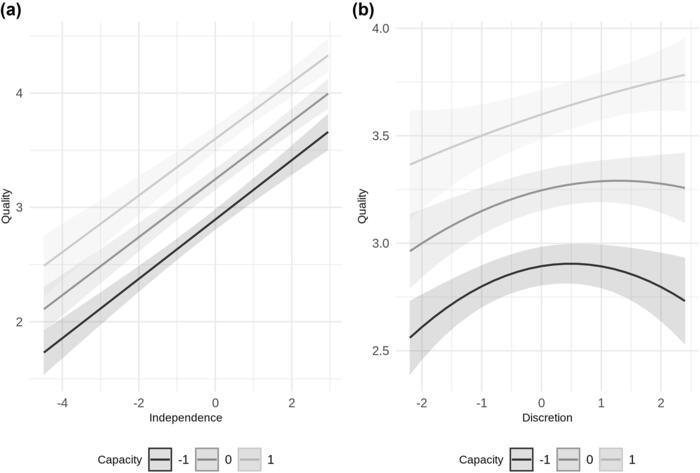
These two faces of autonomy lead to different expectations about how they are connected to quality. The authors hypothesize that independence and quality stand in a linear and positive relationship: agencies that are more unconstrained by political actors will deliver more effectively. By contrast, discretion and quality stand in a non-linear or “Goldilocks” relationship: too few and too many constraining rules will reduce quality. Following Fukuyama’s earlier research, capacity moderates these relationships; for example, less independence in specifically low-capacity agencies may strengthen quality, perhaps in cases where legislative actors are able to appoint highly qualified experts.

Methods and Findings


The authors select Brazil as their case, in part because it exhibits considerable internal variation in bureaucratic quality: some agencies are professional while others are incompetent. By focusing on one country, they avoid comparing fundamentally different national bureaucratic contexts. Further, selecting Brazil — with both strong and weak bureaucracies — reduces ‘selection biases,’ i.e., mistaking characteristics of only high- or low-quality agencies as causes of overall performance. From a global standpoint, Brazilian bureaucracies are solidly middle-ranged, neither outstanding nor abysmal. 

The main empirical part of the paper involves a 2018 survey of over 3200 Brazilian federal bureaucrats. About 60% of the respondents are political appointees and 40% are civil servants, which enables looking at bureaucrats who stand in different relationships to political actors. The authors exclude military personnel, teachers, nurses, and local police officers.

As hypothesized, respondents’ perceptions of agency independence increase their perceptions of quality in a linear way. This finding likely reflects Brazil’s coalitional style of government: politicians benefit electorally from strong government performance; without bureaucratic independence, political pressure and influence from the many coalition partners would likely hinder bureaucrats and weaken performance. Meanwhile, perceptions of discretion align with the authors’ non-linear expectations.


Image
Figure 3: (a) Impact of independence on quality at varying levels of capacity. (b) Impact of discretion on quality at varying levels of capacity.


Figure 3: (a) Impact of independence on quality at varying levels of capacity. (b) Impact of discretion on quality at varying levels of capacity.


These findings are mediated by capacity, which the authors measure in terms of resources, career length, salaries, and the proportion of agents in core or expert careers. The findings hold even when controlling for political factors like party membership or appointment type (political vs. civil servant), individual characteristics such as gender or years of service, and agency differences, including budget or size. These controls are based on administrative data from over 326,000 bureaucrats across Brazil’s 95 most important federal agencies.


Image
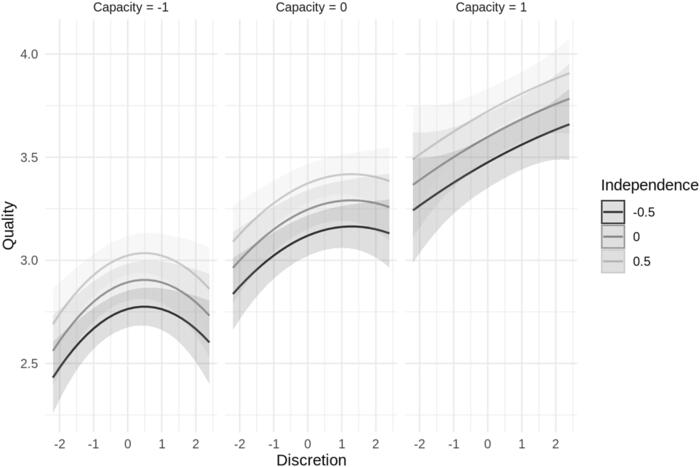
FIgure 4: Quality at varying levels of capacity.


Figure 4: Quality at varying levels of capacity.


Contributions and Implications

“Calibrating autonomy” makes important conceptual and empirical contributions to our understanding of bureaucratic performance. By disaggregating the concept of autonomy into independence and discretion, it helps make sense of seemingly contradictory empirical findings, namely that both minimally and highly autonomous bureaucracies perform well. And by evaluating their hypotheses about the two faces of autonomy using Brazilian data, the authors guard against selection biases or problems from comparing countries with quite different bureaucratic landscapes.

The paper serves as a caution against overly simplistic or blunt “solutions” to poor bureaucratic performance. Merely limiting discretion or increasing legislative oversight can make matters worse if the relevant bureaucratic culture is not properly understood, especially when it comes to capacity.

*Research-in-Brief prepared by Adam Fefer.

Hero Image
National Congress of Brazil (Congresso Nacional) in Brasília
National Congress of Brazil (Congresso Nacional). | Gabriel Tiveron
All News button
1
Subtitle

CDDRL Research-in-Brief [4-minute read]

Date Label
Paragraphs

In 2016, a team of three researchers based at Stanford University — Beatriz Magaloni, Vanessa Melo, and Gustavo Robles — conducted a groundbreaking experiment in Rocinha, Rio de Janeiro’s largest favela (informal settlement), to test whether body-worn cameras (BWC) could reduce police violence and improve community relations.

The findings reveal that body cameras hold great promise, but they also come with serious challenges.  Before the experiment started, one police unit commander ominously told the researchers: “If you give body cameras to my officers, this will stop them from doing their job.”

All Publications button
1
Publication Type
Policy Briefs
Publication Date
Subtitle

Research brief on "Warriors and Vigilantes as Police Officers: Evidence from a Field Experiment with Body Cameras in Rio de Janeiro," by Beatriz Magaloni, Vanessa Melo, and Gustavo Robles (Cambridge Journal of Evidence-Based Policing, Volume 7, article number 2, (2023)).

Journal Publisher
Scientia
Authors
Authors
News Type
News
Date
Paragraphs

Motivation


Retaliation (or the threat thereof) is a central component of human behavior. It plays a key role in sustaining cooperation — such as in international organizations or free trade agreements — because those known to retaliate come to acquire a reputation of being hard to exploit. But how does the use and function of retaliation vary across cultures, and how does it interact with formal forms of punishment?

In “Cross-cultural differences in retaliation: Evidence from the soccer field,” Alain Schläpfer tackles these questions using data on retaliation from association football. Retaliation is simply defined in terms of fouling: player B retaliates against player A if and only if, after A fouls B, B then fouls A. Among other findings, Schläpfer shows that players from cultures emphasizing revenge are more likely to retaliate on the football field. This form of ‘informal punishment’ by players also interacts with ‘formal punishment’ by referees: retaliation by B is less likely when A is sanctioned with a yellow card. Schläpfer’s paper increases our knowledge of the causes and consequences of retaliation, while showing how informal cultural norms interact with the formal rules of football.  

Data


Schläpfer creates a data set of fouls committed over three football seasons (2016-2019) in nine of the world’s top professional men’s leagues. This includes the European leagues of Premier League (England), Serie A (Italy), Bundesliga (Germany), LaLiga (Spain), and Ligue 1 (France), as well as Série A (Brazil), Liga Profesional (Argentina), Liga MX (Mexico), and Major League Soccer (United States). The dataset comprises 9,531 games, 230,113 fouls committed by 10,928 unique perpetrators from 139 countries against 11,115 unique victims from 137 countries.

Because Schläpfer hypothesizes that being from more revenge-centric cultures explains on-field retaliation, the key independent variable is measured using a dataset from Stelios Michalopoulos and Melanie Meng Xue that identifies revenge motifs in a culture’s folklore. Examples of this include supernatural forces avenging human murders or animals avenging the death of their friends by humans. Schläpfer uses a host of other independent variables, such as country-level survey data about the desire to punish — as opposed to rehabilitate — criminals, which is also theoretically linked to revenge. As stated above, retaliation is measured in terms of fouls committed. Schläpfer shows that there is substantial variation in retaliation rates among players from different countries, from Gabon (8%) to Iceland (31%). Can the folklore in the country of origin explain the behavior of players on the field?


Image
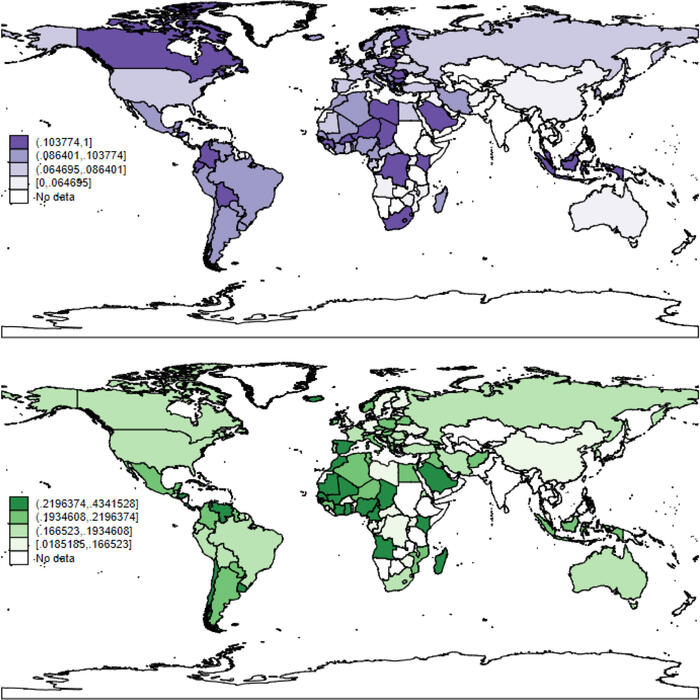
Fig. 1. The share of fouls retaliated in soccer games (top) and the prevalence of revenge motifs in folklore (bottom). Both variables tend to have higher values for players and folklore from the Middle East, Central Africa, Eastern Europe, and parts of South America.


Fig. 1. The share of fouls retaliated in soccer games (top) and the prevalence of revenge motifs in folklore (bottom). Both variables tend to have higher values for players and folklore from the Middle East, Central Africa, Eastern Europe, and parts of South America.


Findings


Retaliation:

Schläpfer finds evidence that players from cultures that value revenge are indeed more likely to retaliate for fouls. However, they are not more likely to commit fouls overall, cautioning us against conflating the concepts of retaliation and violence. Indeed, Schläpfer demonstrates that motifs of violence in a culture's folklore do not predict retaliation. Players are also found to be more retaliatory early on in a game, which is consistent with its use as a signal or aspect of one’s reputation. In other words, retaliation serves to deter future fouls. Victims of fouls also retaliate quickly. Indeed, retaliation rates are stable or slightly increasing during the first 30 minutes of a game, but then fall consistently thereafter.


Image
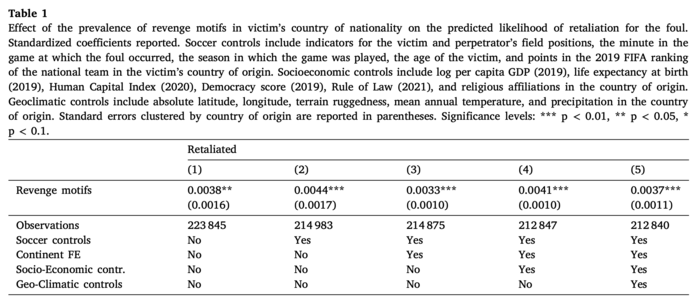
Table 1. Effect of the prevalence of revenge motifs in victim’s country of nationality on the predicted likelihood of retaliation for the foul.


Evidence is also provided to show that retaliation deters future transgressions: perpetrators are less likely to foul again if victims retaliate for the initial foul. However, this deterrence finding is only observed when the perpetrator is from a revenge culture. In other words, for retaliation to support cooperation (the absence of fouls), players must share a similar cultural background.

Schläpfer’s findings hold even when soccer-related or socioeconomic factors are taken into account. Further, the paper considers, but finds little support for, alternative explanations of why retaliation varies. These include that some teams encourage players to retaliate more or employ more players from revenge cultures. Further, retaliation does not appear to be driven by emotions; otherwise, it would be less likely to occur after halftime when players have had a chance to cool down, but this is not the case.


Image
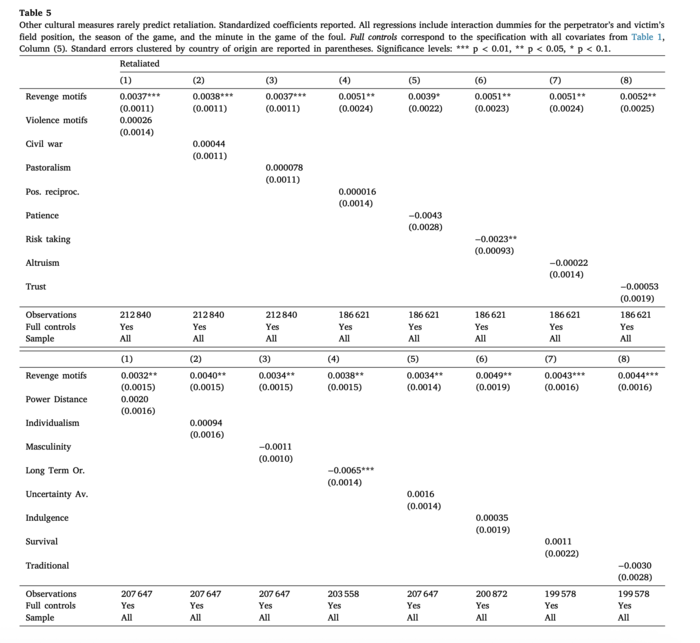
Table 5. Other cultural measures rarely predict retaliation. Standardized coefficients reported.


Informal and Formal Sanctioning:

Finally, Schläpfer analyzes the interaction between player retaliation and refereeing. Most importantly, retaliation is significantly less likely if a foul is sanctioned with a yellow card. This illustrates the theoretical principle of formal punishment “crowding out” informal punishment, such as religious excommunication, which carries greater weight than social shunning or police fines compared to peer pressure. Both retaliation and referee sanctioning are shown to reduce the frequency of repeated offenses by perpetrators, especially among players from revenge cultures. However, Schläpfer finds that formal sanctioning is roughly three times more effective than retaliation. This suggests that football referees are doing a better job managing conflict between players than players themselves. 

Schläpfer concludes by mentioning a few of the paper’s limitations. First of all, retaliation is measured only by what referees sanction. However, referees may miss crucial incidents for which retaliation is a response, such as Zinedine Zidane’s 2006 World Cup headbutt after a verbal insult (that was not sanctioned). This is important because individuals from revenge cultures are likely to be particularly offended by verbal insults. Second, the paper does not capture retaliation that occurs across games played by the same teams over time, particularly when rivalries and hostilities have intensified. Similarly, it does not account for preemptive retaliation that does not follow a foul. Ultimately, Schläpfer deepens our understanding of retaliation in a domain where many would expect it not to operate or to do so with minimal significance. The article impressively marshals large-scale data from both sports and cultural history to clarify the causes and consequences of retaliation.

*Research-in-Brief prepared by Adam Fefer.

Hero Image
A person in a red and blue football uniform on a field
Jona Møller via Unsplash
All News button
1
Subtitle

CDDRL Research-in-Brief [4-minute read]

Date Label
Authors
News Type
News
Date
Paragraphs

Motivation & Contribution


Over the past 10-15 years, both longstanding and relatively new democracies have suffered from backsliding and erosion, including India, the United States, Brazil, Turkey, and many others. Many social scientists have explained this wave of backsliding in terms of either (a) elected autocrats who undermine democracy from within or (b) declining popular support for democrats who have failed to deliver economic growth and prosperity. However, recent scholarship by Thomas Carothers and Brendan Hartnett has questioned the wisdom of the latter. For example, India enjoyed strong economic growth prior to its backsliding under Narendra Modi.

In “Delivering for Democracy,” Francis Fukuyama, Chris Dann, and Beatriz Magaloni set out to more systematically evaluate the evidence connecting popular support for democracy with delivery, examining both backsliding and non-backsliding countries. After finding preliminary evidence for the democracy-delivery relationship, they offer an explanation of why delivery is simultaneously so important and so elusive under democratic governance.

Evidence


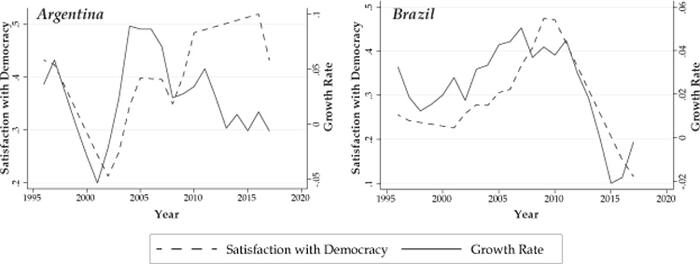
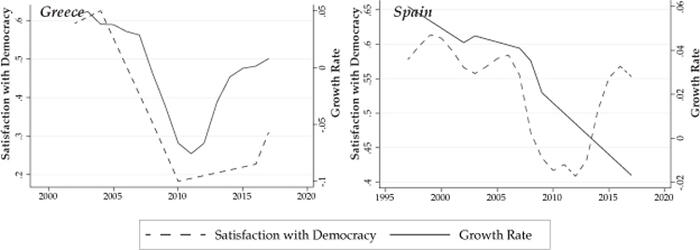
Using ten data sources covering 650,000 people in both old and new democracies, the authors find a strong, positive correlation between satisfaction with democracy and economic performance. This relationship holds not only for many countries at one point in time but for pairs of countries over time. In two developing democracies — Argentina and Brazil — as well as in two developed democracies — Greece and Spain — satisfaction and delivery have been closely connected since 2005, plummeting during economic crises and rising during periods of prosperity. These patterns call for an explanation for why voters care so much about delivery, such that they may be willing to sacrifice their democratic freedoms for it.


Image
Graphs showing satisfaction with democracy and growth rate in Argentina and Brazil


Image
Graphs showing satisfaction with democracy and growth rate in Greece and Spain


The Argument


Delivery is Important

The authors begin from the axiom that stable political life depends upon citizens perceiving their governments as legitimate. Legitimacy can be thought of in terms of both performance — the effective delivery of goods and services — and procedure, which encompasses policies that reflect the democratic will of the people. As the examples of China, Turkey, Saudi Arabia, and Singapore show, however, plenty of autocracies and backsliding democracies have not only delivered, but have also arguably outperformed their democratic peers. From China’s Belt and Road Initiative to Turkey’s Yavuz Sultan Selim Bridge, authoritarian leaders and ruling parties have achieved remarkable performance legitimacy. 

Although autocracies, by definition, cannot be procedurally legitimate, this may carry little weight for democratic citizens who experience prolonged unemployment or must deal with dilapidated infrastructure. Indeed, public engagement through procedural channels — such as voting or jury service — has steadily declined across the democratic world. Democratic voters are increasingly willing to support outsider candidates who build new infrastructure or promise to fight crime, but who nonetheless restrict their political freedoms. Many citizens of El Salvador — which now claims the world’s highest incarceration rate — continue to view Nayib Bukele’s administration as the surest way of delivering security, despite a years-long state of emergency that has seriously eroded democratic freedoms. 

Meanwhile, established democracies built much of their infrastructure decades ago, so investments primarily maintain these systems, rather than showcasing new projects that can garner public support. In some cases, democracies have struggled to even maintain their existing infrastructure, perhaps best exemplified by the collapse of Baltimore’s Francis Scott Key Bridge. All of this creates the conditions for voters to support far-right, anti-democratic parties, which often blame immigrants for economic problems and propose illiberal solutions.

Yet Democratic Delivery is Difficult

Elected democrats seeking to deliver may find themselves hamstrung in ways that autocrats are not. For one, democratic institutions are composed of ‘veto players’ who can stymie the introduction of badly needed policies: national and subnational governments, multiple legislative chambers, judges who review and overturn executive action, and so on. At the same time, democrats must worry about election cycles and term limits, decreasing their incentives to deliver for the long term when later politicians may take credit. Meanwhile, legal and regulatory systems, such as those intended to protect the environment, may prevent the building of critical infrastructure. Property rights prevent the forcible displacement of communities for development, while civil liberties prevent the repression of those who refuse to be displaced. Rules meant to prevent regulatory capture often become arenas where powerful interest groups block and delay government action. 

Independent news media present another potential impediment to delivery, as criticism from journalists can make incumbents wary of undertaking new projects. In addition, media bias can convince voters to remove politicians who do, in fact, deliver. By contrast, autocrats who censor media and arrest journalists can focus on delivery alone, even while their development schemes often rest on corrupt and nepotistic practices. Popular discontent with democratic government ultimately creates a damaging feedback loop: voters are unwilling to fund government projects, in turn leading government to function worse, generating further discontent.


Autocrats have figured out ways to deliver the goods and services their citizens want, but this does not make autocracy a just political system.


Prospects


Autocrats have figured out ways to deliver the goods and services their citizens want, but this does not make autocracy a just political system. By the same token, democracies may struggle to deliver, but their procedural legitimacy — especially voters’ ability to hold representatives to account — entails a powerful means of generating fair and inclusive delivery. As such, the authors call on democracies to examine their past and that of their peer countries — both developed and developing — for inspiration. For example, the U.S. New Deal was exemplary in building ambitious and popular infrastructure, as well as providing broad social and economic protections. (Of course, most of these projects would be hamstrung by modern-day regulatory frameworks.)

Meanwhile, Australia’s citizens have both benefited from a recent infrastructure boom and have demonstrated strong support for democracy. Finally, many Latin American countries have implemented popular and effective programs like conditional cash transfers. For the authors, addressing the issues most pressing to voters — such as job creation, which is especially salient to young people, who are most dissatisfied with democracy — will require democratic governments to strike the right balance between democracy and delivery.

*Research-in-Brief prepared by Adam Fefer.

Hero Image
Group of people protesting in Ibadan, Nigeria, holding a sign reading "#EndSARS #EndBadGov"
Group of people protesting in Ibadan, Nigeria. | Oladipo Adejumo via Unsplash
All News button
0
Subtitle

CDDRL Research-in-Brief [4-minute read]

Date Label
0
CDDRL Honors Student, 2025-26
lila_bacheller.jpg

Major: International Relations
Hometown: Sioux Falls, South Dakota
Thesis Advisors: Harold Trinkunas and Stephen Stedman

Tentative Thesis Title: Civil-Military Relations and Democratic Consolidation in Brazil: Examining Civilian Control Over the Armed Forces Since 1985

Future aspirations post-Stanford: After Stanford, my long-term goal is to work in national security. While I see multiple paths in this field, I am currently interested in attending law school and exploring opportunities in the federal government and industry.

A fun fact about yourself: When I say "bag," everyone immediately knows I'm from the Midwest.

Date Label
Subscribe to Brazil