Climate change
Authors
News Type
News
Date
Paragraphs

Introduction & Contribution:


The social and economic costs of climate change are significant, including damage to infrastructure, loss of agriculture, and disruptions to education. Hurricanes and storms, such as Hurricane Katrina or Myanmar’s Cyclone Nargis, are particularly visible and destructive manifestations of climate change. The incidence of these storms varies across places, suggesting that migration from more- to less-exposed areas could be an important form of climate adaptation, alongside, e.g., building more resilient infrastructure. However, our knowledge of climate migration, particularly its causes and frequency, is limited.

In “Understanding the migratory responses to hurricanes and tropical storms in the USA,” A. Patrick Behrer and Valentin Bolotnyy show — perhaps contrary to expectations — that Americans’ migratory response to storms is limited. Most storms do not result in meaningful out-migration from impacted counties. Meanwhile, when people do migrate, they do not necessarily move to areas with less storm exposure. The paper draws on a range of data sources to highlight the deeply economic drivers of migration, which stem from the concentration of economic opportunity in storm-exposed areas.

The paper highlights tensions between two commonplace assumptions: first, that “rational” migration should reduce the risks of climate change, and second, that migration is driven by economic opportunity. These assumptions are in tension precisely because, as Behrer and Bolotnyy show, hurricane risk and economic opportunity are highly correlated in America. One policy implication is that local governments must invest in storm-resilient infrastructure to prevent the destruction of physical capital and the flight of human capital. In addition, permitting more remote work could reduce the economic appeal of productive but vulnerable migration hubs.

A. Patrick Behrer and Valentin Bolotnyy show — perhaps contrary to expectations — that Americans’ migratory response to storms is limited. Most storms do not result in meaningful out-migration from impacted counties.

Prior Research:


Scholars have found evidence that hurricanes and storms both do and do not affect migration, which tends to vary based on the places studied and their levels of economic development. These contradictory findings would seem to call for a deeper investigation of the causal mechanisms underlying climate migration, but our understanding is also limited here. Do individuals and families migrate as a consequence of long-term factors (e.g., frequent, medium-intensity flooding) or short-term ones (e.g., a single severe flood)? Do they migrate on the basis of rational, cost-minimizing calculations, or are they influenced by cognitive biases that lead them to overestimate the true costs of one disaster? And what role do certain amenities (e.g., reliable infrastructure) or forms of protective insurance play in decreasing the incentives to migrate?

It is difficult to sustain a purely instrumental account of migration, which is largely driven by existing social networks and occurs over short distances. For example, many survivors of Hurricane Katrina moved to Houston, which is a similarly exposed city just over 300 miles away. Even long-distance migration tends to be driven by social networks and may offer little protection against storms. Finally, migration is costly, not only in terms of moving but because housing prices in less-exposed areas are often bid up for that very reason.

Data, Methods, and Results:


Behrer and Bolotnyy’s empirical analysis is guided by several questions. First, do we observe greater outmigration after storms? Second, do migrants move to less at-risk counties? And finally, has the overall population of high-risk areas declined over the last 25 years? To answer these questions, the authors utilize migration data from the Internal Revenue Service (IRS) as well as storm exposure data from the National Oceanic and Atmospheric Administration (NOAA), the National Hurricane Center, and the Federal Emergency Management Agency (FEMA). Their regression models estimate the extent of migratory change in storm years relative to non-storm years, including lagged models that estimate changes in the years following storms.


Image
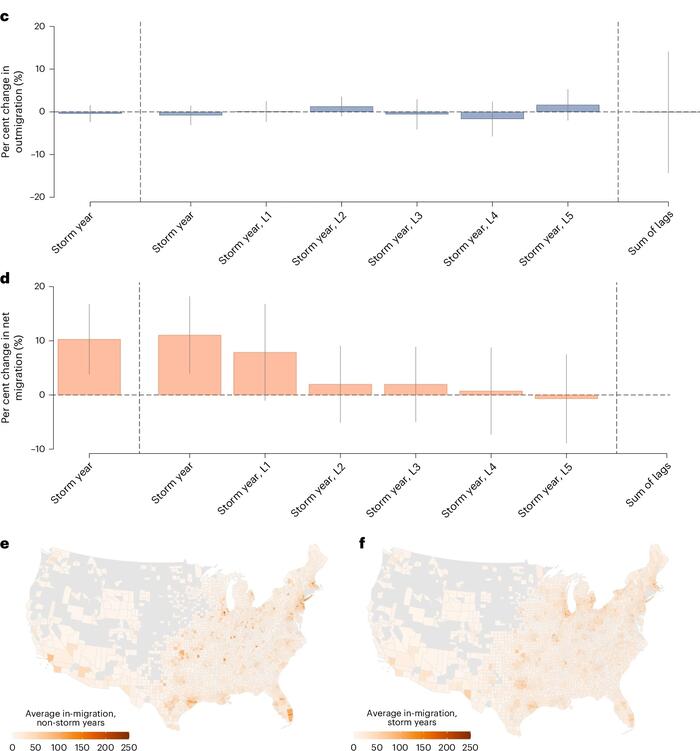
Figures 1C, 1D, 1E, and 1F


Fig. 1C-F: c,d, Coefficients from a panel fixed-effects regression of outmigration (c) and net migration (d) on whether a county experienced a storm. The first bar plots the coefficient from a regression with only contemporaneous storms. The next six bars show coefficients from a separate regression that includes contemporaneous storms and five year lags (L1–L5). The final bar shows the sum of the coefficients from the lags regression. The light grey lines show the 95% CIs. The sample size for these regressions was 52,514 for the outmigration results and 52,448 for the net migration results. e, Migrant-receiving counties in our sample period and the average number of migrants received in non-storm years. f, The same as e but in storm years.


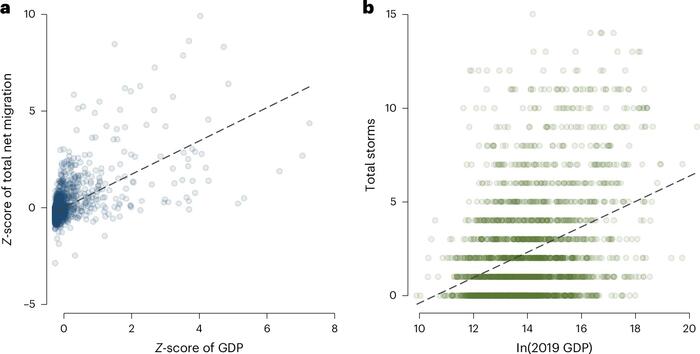
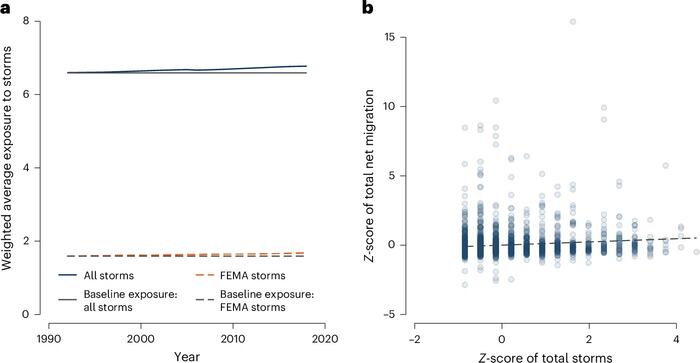
Their results indicate that American outmigration has not increased at statistically significant levels after storms. In addition, there is no evidence that migrants in storm years move to less exposed areas compared to migrants in non-storm years. The most damaging storms are indeed followed by increased outmigration, but there is no evidence that migrants move to low-risk areas. In fact, they often migrate to other high-risk areas and to places with high economic activity. This is because the majority of American GDP is generated in coastal areas where storms are more prevalent. The authors thus uncover a tradeoff, namely that places in the U.S. with more opportunity face more risk. GDP is substantially more predictive of migration than storm risk. The economic and social benefits of moving to high-risk areas appear to outweigh any incentives to reduce one’s storm exposure via relocation. Finally, the authors find that overall population exposure to storms has increased.


Image
Fig. 4: GDP versus net migration and number of storms.


Fig. 4: GDP versus net migration and number of storms. a, Correlation between net migration and GDP. The Z-score of total net migration is the Z-score across all counties of the sum of net migration (in-migration minus outmigration) for each county across all years in the sample. The Z-score of GDP is based on county GDP in 2019, as measured by the Bureau of Economic Analysis. All points are shaded equally, with darker areas on the graph indicating a greater density of counties. We omitted three outliers with GDP Z-scores >10. We show a version of this figure that includes the outliers in Supplementary Fig. 3. b, Correlation between the number of storms and GDP. Total storms is the sum of storms hitting each county across all years in our sample. ln(2019 GDP) is the natural log of county GDP in 2019, as measured by the Bureau of Economic Analysis. All points are shaded equally, with darker areas on the graph indicating a greater density of counties. The x-axis units are log points.
 

Image
Fig. 3: Trend in population-weighted exposure and correlation between net migration and total storms.


Fig. 3: Trend in population-weighted exposure and correlation between net migration and total storms. a, Trend in population-weighted exposure. We plotted the weighted average number of storms across all 2,387 counties in our sample. Weights are the county population in each year. The number of storms in each county is the sum over the sample and so remains constant across years. The change in the trend line is due to changes in where people live. The flat grey lines show the weighted average if populations had not changed from 1990 levels—that is, if no one had moved. The solid lines show all storms. The dashed lines show storms with at least US$10 million in damages according to FEMA. b, Correlation between net migration and total storms. The Z-score of total net migration is the Z-score across all counties of the sum of net migration (in-migration minus outmigration) in the county across all years in the sample. The Z-score of total storms is the Z-score across all counties of all storms over our sample period. All points are shaded equally; darker areas on the graph indicate a greater density of counties. The dashed line is the linear best fit line of the plotted data points.


The authors caution that these findings may be driven by (a) those Americans most impacted by storms being least able to move, this despite their preferences to do so, and (b) those with the means to insure themselves against climate risks having weaker preferences to move. In addition, migration within the same county — for example, moving from lower to higher sea level areas — may be a significant but hidden process that enables climate adaptation. The findings may also be less relevant to understanding migration dynamics in low- and middle-income countries, especially in places with less comprehensive insurance and less resilient infrastructure.

Behrer and Bolotnyy deepen our understanding of the importance and “stickiness” of geography. Indeed, many people do not or cannot move, even if they want to and even if staying in place puts them at risk. One wonders about how these processes interact with politics. For example, climate change has coincided with the powerful forces of climate change denial. Perhaps skepticism about storms as systemic phenomena is blunting migratory pressures, leading those affected to view them as one-off occurrences. Similarly, social scientists have coined the term “petro-masculinity” to describe an identity that views the climate change consensus as an attack on, e.g., driving large trucks or eating meat. It may be that when this identity is salient, people view climate migration as a form of weakness or betrayal.

*Brief prepared by Adam Fefer.

Hero Image
Barber shop located in the Ninth Ward, New Orleans, Louisiana, damaged by Hurricane Katrina in 2005.
Library of Congress
All News button
1
Subtitle

CDDRL Research-in-Brief [4-minute read]

Date Label
Paragraphs

Climate change is intensifying droughts and threatening water security worldwide, particularly in arid and semi-arid regions. Israel’s innovative response has been to integrate large-scale desalination into its water supply and climate resilience strategy, recently constructing the Reverse Water Carrier, a pioneering project that conveys desalinated seawater from the Mediterranean inland to Lake Kinneret (Sea of Galilee). This study examines the objectives, rationale, and feasibility of this system as a model for climate-resilient water management. Using a qualitative case study approach, it evaluates the project across four dimensions: water security, environmental sustainability, economic feasibility and regional cooperation. Data were drawn from policy documents, expert interviews, and government reports. The analysis finds that replenishing the Kinneret with surplus desalinated water enhances national water reliability, reduces salinity, stabilizes agricultural production, and provides a critical emergency reserve, while introducing manageable energy and ecological trade-offs. Although long-term sustainability will depend on continued efficiency improvements and adaptive management, Israel’s experience demonstrates how inter-basin desalination transfers can strengthen water security and offer a replicable framework for other regions confronting climate-induced scarcity.

All Publications button
1
Publication Type
Journal Articles
Publication Date
Journal Publisher
Sustainability
Authors
Alon Tal
Number
23, 10636
Authors
News Type
News
Date
Paragraphs

Motivation & Overview:


The effects of the climate crisis are thought to be extremely far-reaching, from declining economic growth and agricultural productivity to housing displacement and job loss. An important set of consequences are psychological, relating to how climate change can exacerbate anxiety and one’s sense of hopelessness about an uninhabitable future. These psychological impacts are heightened for members of vulnerable and marginalized groups, as well as for those in poor and underdeveloped places that struggle to address climate change.

In “Adolescent psychological health, temporal discounting, and climate distress under increased flood exposure in Bangladesh,” Liza Goldberg and her coauthors examine the psychological well-being of 15 to 18-year-olds in two Bangladeshi cities that have been differentially affected by floods. The authors conduct surveys and focus groups with adolescents in the low-flood-risk capital city of Dhaka and the high-flood-risk city of Barisal. They find that although adolescents in both cities fear the personal impacts of climate change, rates of anxiety and depression are significantly higher in Barisal. In addition, those with anxiety and depression exhibit greater temporal discounting, meaning that short-term consequences are favored over longer-term ones. Discounting is an important — if neglected — consequence because adolescents will emerge as household decision-makers who must plan to adapt to climate change. The article is notable in increasing our knowledge of how floods harm members of an already vulnerable population.

Case Selection and Hypotheses:


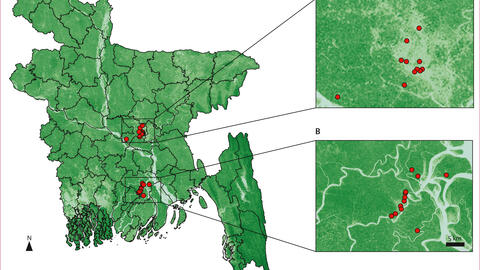
Bangladesh is among the world’s most climate-vulnerable countries. This is due to its “deltaic” geography (i.e., its low, flat land, crossed by many rivers) and consequent flood exposure, extreme temperature and humidity, and poor air quality. Barisal — a city of over 500,000 that is roughly 115 kilometers from Dhaka — is highly vulnerable to flooding, as well as being poorer (relative to Dhaka) and limited in its “climate adaptation infrastructure.” Partly for these reasons, rates of migration from Barisal to Dhaka are the highest in Bangladesh. By contrast, Dhaka — the capital city of over 24 million — is less flood-exposed and is slightly wealthier. Respondents in Barisal and Dhaka reported around four floods and one flood per year, respectively.


Figure. Study site locations in Bangladesh. Study sites at Dhaka (A) and Barisal (B) are shown in red.


Figure. Study site locations in Bangladesh. Study sites at Dhaka (A) and Barisal (B) are shown in red.


The authors hypothesize that Barisal’s greater flood exposure would be associated with more anxiety and depression among its adolescents, and that anxiety and depression would be associated with greater temporal discounting. (In other words, they do not expect that flood exposure would be directly associated with discounting.) In addition, the authors expect that these negative psychological effects would be especially pronounced among poor Bangladeshis, girls, and those with a greater awareness of the climate crisis.

Data and Findings:


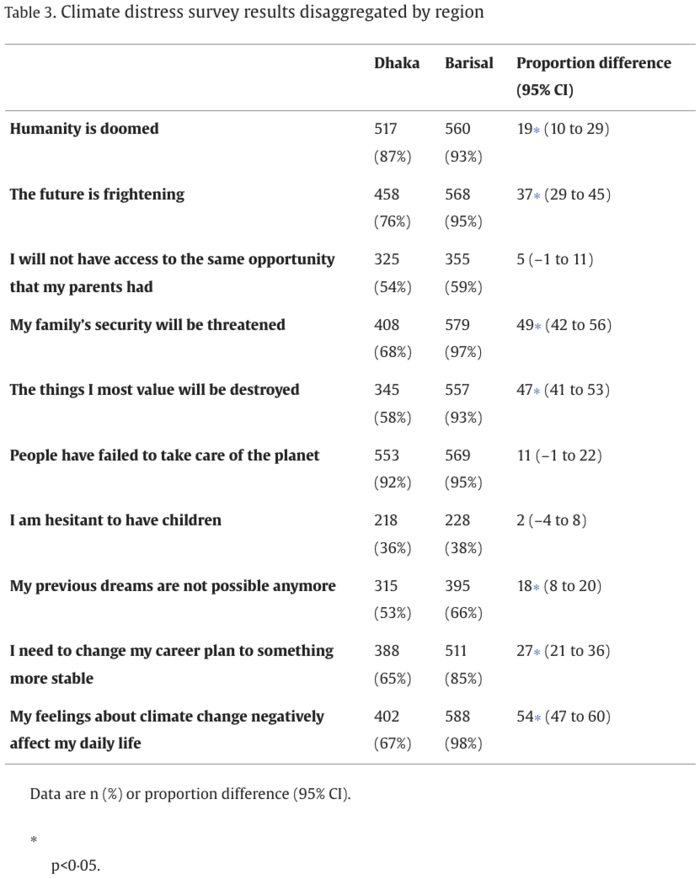
The authors surveyed 1200 Bangladeshi adolescents in 24 schools immediately after the flood season, which usually runs from May to September. In addition, 16 focus groups were conducted with around 160 total participants. Adolescents in both cities expressed a high familiarity with climate change. However, and consistent with the authors’ expectations, those in Barisal expressed significantly higher levels of agreement with statements about climate distress. For example 97% of those in Barisal compared to just 68% in Dhaka agreed that “My family’s security will be threatened,” 93% in Barisal and 58% in Dhaka agreed that “The things I most value will be destroyed,” and 98% in Barisal and 67% in Dhaka agreed that “My feelings about climate change negatively affect my daily life.” 


Image
Table 3. Climate distress survey results disaggregated by region.


Table 3. Climate distress survey results disaggregated by region.


The focus groups corroborated this unequal sense of despair, especially concerning the future and one’s educational and career goals. In Barisal, a boy said, “We expect that we will have to continue withstanding this [flooding] for many years to come,” while a girl said, “I used to want to become a teacher myself, but now I believe I will need to get married immediately after school because my father keeps losing his job during the floods.” By contrast, and because flooding in Dhaka is so infrequent, adolescents did not expect climate change to meaningfully threaten their life trajectories.

In terms of anxiety and depression, 86% of those in Barisal reported anxiety symptoms, compared to 71% in Dhaka, while 98% in Barisal and 88% in Dhaka reported depressive symptoms. After adjusting for factors like sex, wealth, and climate change awareness, the odds of being anxious and depressed in Barisal were nearly twice as high and more than 3.5 times as high, respectively. Across both cities, females were more than 1.75 times as likely to experience anxiety. And the odds of being depressed were over 1.85 times as high for those with a greater awareness of climate change.

I used to want to become a teacher myself, but now I believe I will need to get married immediately after school because my father keeps losing his job during the floods.

Girls in the Barisal focus groups revealed that flooding was linked to domestic violence. Fathers facing financial insecurity were reported to engage in violence against their mothers as a consequence of this stress. As one girl put it, “The floods keep getting worse and worse. So, I may experience even more violence than my mother does.” By contrast, few girls in Dhaka expressed worsening family dynamics, and none reported domestic violence owing to flooding. Adolescents in Dhaka believed that floods in their region were simply too fleeting to result in such abuse.

Finally, only 7% and 6% of adolescents in Barisal and Dhaka showed signs of temporal discounting. However, the odds of discounting were twice as high for those with anxiety and almost 2.5 times as high for those with depression. The authors find some evidence of discounting in the focus groups, but no meaningful differences across cities. This absence may be due to discounting behaviors emerging around adulthood, which is older than the adolescent study population. Taken together, the authors’ findings imply that mental health support will be essential for those affected by climate change — especially in impoverished areas — to help them manage stress and to improve their ability to plan for the future.

*Research-in-Brief prepared by Adam Fefer.

Hero Image
A woman stands on sandbags stacked to protect against flooding in Barisal, Bangladesh.
Liza Goldberg
All News button
1
Subtitle

CDDRL Research-in-Brief [4-minute read]

Date Label
Authors
Surina Naran
News Type
News
Date
Paragraphs

On October 9, 2025, FSI Senior Fellow Saumitra Jha presented his team’s research on how exposure to financial markets — meaning individuals’ exposure to tailored opportunities to directly engage with investment platforms and decision-making — can increase support for action on climate change. This CDDRL research seminar expanded on Jha’s earlier research on the effects of financial exposure and literacy as tools for reducing political polarization, including studies conducted in Israel, Mexico, and the United Kingdom.

During the seminar, Jha highlighted the study's relevance in an era of democratic backsliding, rising populism on both the right and the left, and increasing economic uncertainty. Jha emphasized that basic financial literacy — the ability to understand and practically apply financial concepts such as saving, investing, and diversifying risks— is essential for citizens navigating this environment. Jha’s team designed interventions that empower citizens, both in rich and poor countries, to build financial knowledge and, by focusing on common investments and the common good, ultimately mitigate political polarization and conflict.

The study focused on the partisan issue of climate change in the United States. Participants were oversampled from states either disproportionately affected by climate change or central to the green-energy transition — Pennsylvania, West Virginia, North Carolina, Tennessee, Georgia, Alabama, Arizona, Ohio, South Carolina, and Kentucky. Each participant in the treatment group initially received an investment portfolio that tracked stocks from either green energy companies (firms at the forefront of the transition, engaged in renewable energy like solar and wind) or brown energy companies (firms earlier in the transition, engaged in the extraction of fossil fuels such as oil and natural gas). Subjects had $50–$100 of real money or a virtual portfolio of funds to invest.

For five weeks, participants used a Robinhood-style investment platform (a simple online interface for buying and selling stocks) to trade their stocks. Midway through the study, they were able to trade across both green and brown stocks. At this point, they received additional financial disclosures (basic company performance data) and had access to climate-impact disclosures (data on companies' greenhouse gas emissions and how they affect or are affected by climate change). However, this is currently a central policy debate; very few participants actually chose to review climate disclosures, which Jha identified as a research question for a companion paper. The research team then evaluated results in four categories: (1) beliefs about human agency and tradeoffs with the green energy transition, (2) policy preferences, (3) political attitudes, and (4) personal behaviors.

The data demonstrated that this financial exposure treatment — i.e., hands-on stock trading experience — had a significant, meaningful, and lasting influence on participants’ beliefs. Relative to control, treated participants were 9% more likely to agree or strongly agree that human activity is a significant contributor to climate change. They further became more supportive of both government and corporate action to mitigate climate change, and came to view the green-energy transition as potentially economically beneficial. 

Further, the intervention was empowering, raising the financial literacy of participants and increasing their ongoing consumption of financial news outlets, rather than social media or Fox News. These effects were observable even eight months after the study. 

Further, these changes were not preaching to the choir — instead, the effects were observed across the political spectrum, particularly among those who were ex ante climate change skeptics. However, while treated participants were more likely to donate to climate causes and to consider climate when investing and working, they did not report an overall increased willingness to change their daily lives. For example, while reporting an increased willingness to reuse recyclable bags, most did not report an increased willingness to change ingrained daily habits, such as eating less meat or changing commute patterns.

Jha also previewed new results from a companion paper based on a long-term survey conducted 8 months after treatment. To examine how the treatment changes how participants preferred climate action to be implemented, the research team gauged support for two approaches: the “Abundance approach”, popularized by Ezra Klein, and the “Conservation and Regulation approach.” The Abundance approach emphasizes expanding investments in clean energy infrastructure, sustainable housing, and economic growth as solutions to climate change. By contrast, the Conservation and Regulation approach focuses on reducing energy use through government regulation, strong local autonomy, and personal restraint. The financial exposure treatment significantly raised the share of subjects supporting the Abundance approach.

Read More

Maria Nagawa presented her research in a CDDRL seminar on October 2, 2025.
News

Foreign Aid and the Performance of Bureaucrats

CDDRL postdoctoral scholar Maria Nagawa examines how foreign aid projects influence bureaucrats’ incentives, effort, and the capacity of bureaucratic institutions.
Foreign Aid and the Performance of Bureaucrats
Claire Adida
News

Overcoming Barriers to Women’s Political Participation: Evidence from Nigeria

In Nigeria, women are far less likely than men to attend meetings or contact leaders. Claire Adida’s research reveals interventions that make a difference.
Overcoming Barriers to Women’s Political Participation: Evidence from Nigeria
Forex trading using smartphones and laptops.
News

Trading Stocks and Trusting Others

CDDRL Research-in-Brief [4-minute read]
Trading Stocks and Trusting Others
Hero Image
Saumitra Jha presented his research in a CDDRL seminar on October 9, 2025.
Surina Naran
All News button
1
Subtitle

Can financial literacy shape climate beliefs? Saumitra Jha’s latest study suggests it can — and across party lines.

Date Label
Paragraphs

The adverse effects of climate change will be worse in some locations than in others, raising the possibility that migration from more severely impacted areas to less impacted areas will reduce future damages. Assessing whether such migration is already occurring can inform our understanding of future responses to climate change. Using data on the paths of all Atlantic basin hurricanes and tropical storms from 1992 to 2017, we study whether outmigration from US counties increases after a storm. On average, storms are not followed by outmigration, and total population-weighted exposure to storms increases over the sample period. Very destructive storms are followed by outmigration, though often to other high-risk counties. Counties with high economic activity see net in-migration after a storm. Given existing policies and incentives, the economic and social benefits of high-risk areas currently appear to outweigh the incentive to reduce exposure to future storms by relocating across counties.

All Publications button
1
Publication Type
Journal Articles
Publication Date
Journal Publisher
Nature Human Behaviour
Authors
Valentin Bolotnyy
Paragraphs
Climate Resilience and Local Governmental Policy: Lessons from Los Angeles and Tel Aviv

Climate Resilience and Local Governmental Policy: Lessons from Los Angeles and Tel Aviv" was a two-day conference at Stanford University on May 29–30, 2025. The conference, hosted by the Visiting Fellows in Israel Studies program at the Center on Democracy, Development and the Rule of Law (CDDRL) and the Environmental Social Sciences department at Stanford’s Doerr School of Sustainability, explored how Los Angeles and Tel Aviv are addressing climate resilience through local policy, equity, and innovation.

Table of Contents:


Day 1:


Opening Session: Los Angeles and Tel Aviv-Yafo: The Urgency of Climate Resilience

  • Introduction: Alon Tal, Conference Chair, Stanford University / Tel Aviv University (p. 3)
  • Presentations:
    • Nancy Sutley, Los Angeles City Council’s Deputy Mayor of Energy and Sustainability (p. 6)
    • Prof. Noah Efron, Tel Aviv City council member; Chair, Tel Aviv-Yafo Municipal Environmental Protection Committee (p. 12)


Panel 1: Water Management in Water Scarce Cities: Combatting Droughts and Ensuring Supply (p. 18)

Panel 2: Health, Trees, and Thermal Comfort: Urban Strategies (p. 19)

Panel 3a: Financing Climate Resilience in Local Government (p. 20)

Panel 3b: Preparing for Sea Level Rise – Local Strategies (p. 21)

Panel 4: Forest Fire Prevention, Cities and the Climate Crisis  (p. 23)

Day 2:


Panel 5: Climate Justice: Identifying and Protecting Vulnerable Populations in Urban Environments (p. 25)

Panel 6a: Civil Society’s Role in Promoting Climate Resilience (p. 27)

Panel 6b: The Role of Climate Technologies in Local Climate Adaptation Strategies (p. 29)

Panel 7: Urban Climate Resilience Programs and Public Policy: What’s Next? (p. 30)

All Publications button
1
Publication Type
Conference Memos
Publication Date
News Type
News
Date
Paragraphs

Both Southern California and Israel suffered disastrous wildfires this year.

In January, the Palisades and Eaton fires in Los Angeles killed 29 people and destroyed thousands of buildings, spurring a United Nations report titled “Once-in-a-generation events now happen frequently.”

In late April, a huge wildfire in central Israel threatened Jerusalem, caused nearby towns to evacuate and led to a national emergency.

The fires are just one example of the devastating effects of climate change experienced by California and Israel, said Alon Tal, an environmental scholar, former Knesset member and part of the Visiting Fellows in Israel Studies program at Stanford University’s Center on Democracy, Development and the Rule of Law, which co-hosted the conference.

Read the full story from J. The Jewish News of Northern California.

Hero Image
The gathering included a tour of the Stanford Central Energy Facility
The gathering included a tour of the Stanford Central Energy Facility.
Rod Searcey
All News button
1
Subtitle

More than 200 academics and political leaders met last week at Stanford for “Climate Resilience and Local Governmental Policy: Lessons from Los Angeles and Tel Aviv,” a groundbreaking conference organized by CDDRL's Visiting Fellows in Israel Studies program.

Date Label
Authors
Nora Sulots
News Type
News
Date
Paragraphs

As the global climate crisis accelerates, cities around the world are grappling with an increasingly urgent question: how can local governments protect communities, infrastructure, and ecosystems from the rising tide of environmental disruption? This May, Stanford University will bring that question to the forefront with a landmark event examining how two dynamic and diverse cities — Los Angeles and Tel Aviv-Yafo — are responding to the climate challenge from the ground up.

Taking place May 29–30, 2025, and hosted by the Visiting Fellows in Israel Studies program at the Center on Democracy, Development and the Rule of Law (CDDRL) and the Environmental Social Sciences department at Stanford’s Doerr School of Sustainability, Climate Resilience and Local Governmental Policy: Lessons from Los Angeles and Tel Aviv will be the largest academic conference ever held on Israel’s climate policy. The two-day event will convene experts from both cities to explore how local institutions are building equitable, sustainable, and adaptive systems to confront growing environmental risks.


This is not just a policy conversation. This is about how we prepare our communities for an uncertain future.
Alon Tal
Visiting Fellow in Israel Studies (FSI); Conference Chair


A Pivotal Moment for Climate Policy


In early May, Israel faced its second major wildfire in a month, as flames tore through the woodlands around Jerusalem, forcing the shutdown of the central region and the cancellation of Independence Day celebrations. Conference Chair, Professor Alon Tal, Visiting Fellow in Israel Studies and a leading environmental advocate, explained that once a rare occurrence, such fires have become far more frequent, reflecting a broader international pattern.

“In the past, fires of this magnitude maybe happened once a decade,” Tal noted. “But like California, Israel’s fire service now reports a tripling of high-risk fire days — ultra-dry conditions paired with high winds. This is an international phenomenon. This past year, Canadian fires destroyed 45 million acres of woodlands — seven times the annual average. Israel has received a wake-up call about the impacts of the climate crisis.”

Across two days of programming, the conference will bring together 25 Israeli experts to discuss potential solutions alongside colleagues from Los Angeles and California. “This is not just a policy conversation. This is about how we prepare our communities for an uncertain future,” Tal said. “Both Los Angeles and Tel Aviv are confronting real environmental risks, but they also have the innovation ecosystems and civic infrastructure needed to respond creatively. We have a lot to learn from studying them side by side.”

Comparing Los Angeles and Tel Aviv offers scholars and policymakers unique insights, Tal believes. “These are two of the most creative cities in the world. They both have thriving tech sectors and liberal city governments with resources and professional expertise. At the same time, they face comparable challenges: they are both dryland cities on rising coastlines, where heat waves are becoming more treacherous. Bringing their top experts together at Stanford has tremendous merit.”

Rethinking Climate Governance at the City Level


Tal emphasized that local governments are increasingly bearing the burden of climate adaptation, especially in societies marked by inequality and demographic complexity. “The changing climate brings new challenges that cities need to be ready for. And they aren’t,” he said. “Most people live in cities — they need the tools (and the budget) to reduce new risks. The LA fires have left enormous human suffering in their wake, just like the climate-driven floods in New Orleans, Houston, and New York City did. So, the question is: what steps should cities take proactively to avert disasters and maintain stability?”

While Tal emphasized the immediate environmental threats, Larry Diamond, Mosbacher Senior Fellow in Global Democracy at the Freeman Spogli Institute for International Studies (FSI) and director of the Visiting Fellows in Israel Studies program, framed the discussion within a broader governance context. “It is often said that ‘all politics is local,’ and there is a policy corollary to that. While we need national policies and international coordination to reduce fossil fuel emissions and accelerate the transition to renewable energy, the challenges of climate adaptation and resilience are also deeply local and must be met at that level. This is a great opportunity for all of us to learn from two cities on the front lines of the challenge in our respective countries — Tel Aviv and Los Angeles.”


This is a great opportunity for all of us to learn from two cities on the front lines of the [climate adaptation] challenge in our respective countries — Tel Aviv and Los Angeles.
Larry Diamond
Mosbacher Senior Fellow in Global Democracy (FSI); Director, Visiting Fellows in Israel Studies program


A Vision for Collaborative Learning


The event also reflects the broader goals of Stanford’s Visiting Fellows in Israel Studies program, launched in 2023 to foster cross-disciplinary analysis of Israel and its unique position as a regional influence and geopolitical actor. The program appoints an Israel-based scholar to serve as a visiting fellow at FSI for a recurring three-year term. The fellow will teach courses related to some aspect of Israel’s politics, society, economy, modern history, technological development, and/or regional or international relations, as well as advise students and collaborate with faculty interested in Israel and the Middle East.

Diamond emphasized the significance of the conference in fulfilling the program’s mission. “One of our key goals in the Israel Studies Program is to engage scholars, policymakers, and civil society leaders in Israel, not only individually but collectively based on their expertise. And we seek to promote functional and scholarly interaction and mutual learning. This conference is a historic opportunity to advance this mission in the realm of climate resilience.”

Tal also highlighted the significance of hosting the conference at Stanford. “Stanford has become the world’s leading academic center for researching critical ecological problems like biodiversity and climate change. The Doerr School of Sustainability and the involvement of Nobel laureate Steven Chu as a keynote speaker make this an unparalleled opportunity for collaboration.”


Alon Tal and Larry Diamond

Building a Lasting Impact


Tal hopes the conference will catalyze new approaches to addressing climate impacts. “It’s clear that new environmental conditions require new strategies and technologies. Seeing practical solutions firsthand is crucial, but they don’t matter without policies that enable cities to step up their climate mitigation game. Success stories need to be shared.”

The conference outcomes will be documented in a special issue of the academic journal Sustainability, ensuring that insights resonate beyond the event itself. “By focusing on urban policies and highlighting both successes and failures, we aim to chart pathways for cities to live with global warming while mitigating emissions to address the root causes,” Tal said.

Diamond further expressed his hopes for the conference’s impact. “We hope participants will not only take away specific ideas and strategies from the two cities and countries but also connections that can be of mutual practical value going forward. We want to underscore that Israel and California, with their similar climates and start-up cultures, have a particularly rich set of possibilities for collaboration and mutual learning.”

Community members and members of the public are invited to participate in this pivotal conversation. To view the full agenda and register, visit the conference website.

Read More

Tzipi Livni speaks at a lunch time event with Stanford faculty and students.
News

FSI's Visiting Fellow in Israel Studies Reflects on What Lies Ahead for Israel and the Middle East

The October 7, 2023, attack by Hamas has already indelibly altered Israel and the Middle East, and will continue to reverberate for decades to come, says Amichai Magen, a fellow at the Freeman Spogli Institute for International Studies.
FSI's Visiting Fellow in Israel Studies Reflects on What Lies Ahead for Israel and the Middle East
Alon Tal joins the Freeman Spogli Institute for International Studeis as a Visiting Fellow in Israel Studies
News

Alon Tal Joins the Visiting Fellows in Israel Studies Program at FSI

Professor Tal’s expertise in sustainability and public policy will offer students valuable insight into the intersection of climate change issues and politics in the Middle East.
Alon Tal Joins the Visiting Fellows in Israel Studies Program at FSI
Larry Diamond, Or Rabinowitz, Yonatan Eyov, and Amichai Magen in discussion in the Bechtel Conference Center at the Freeman Spogli Institute for International Studies at Stanford University.
News

Visiting Fellows in Israel Studies Program is in Full Swing at FSI

The program aims to foster cross-disciplinary analysis of Israel and its unique position as a regional influence and geopolitical actor.
Visiting Fellows in Israel Studies Program is in Full Swing at FSI
Hero Image
Side-by-side of Los Angeles and Tel Aviv skylines.
Los Angeles and Tel Aviv skylines.
Stock images
All News button
1
Subtitle

The two-day conference, “Climate Resilience and Local Governmental Policy: Lessons from Los Angeles and Tel Aviv,” will take place May 29-30, and is hosted by the Visiting Fellows in Israel Studies program at the Center on Democracy, Development and the Rule of Law (CDDRL) and the Environmental Social Sciences department at Stanford’s Doerr School of Sustainability.

Date Label
Authors
News Type
Commentary
Date
Paragraphs

A warming planet. Backsliding in democracy at home and abroad. Competition with China. And active war in Europe. Broadening conflicts in the Middle East.

The world today is facing no shortage of overlapping, multilateral challenges. At a recent panel titled, “Global Threats Today: What's At Stake and What We Can Do About It,” scholars from the Freeman Spogli Institute for International Studies (FSI) had an opportunity to delve deeper into what the data says about how these global threats are evolving, and how we should be thinking about how to address them.

The discussion, which was held as part of Stanford University's 2024 Reunion and Homecoming weekend, was moderated by Michael McFaul, director of the Freeman Spogli Institute, and featured Marshall Burke, Didi Kuo, Amichai Magen, Oriana Skylar Mastro, and Steven Pifer.

In the highlights below, each scholar shares what they wish people understood better about climate change, the war in Ukraine and Russia's aggression, China's strategy for building power, the health of American democracy, and how the fighting between Israel and Hamas fits into the geopolitical struggle between democracies and autocracies.

Their full conversation can be heard on the World Class podcast, and the panel can be watched in its entirety on YouTube.
 

Follow the link for a full transcript of "Global Threats Today: The 2024 Edition."


Illiberal Actors Are on the Move  |  Amichai Magen


Around the world, we are seeing a new axis of influence coalescing. Some have called it the "axis of misery" or the "axis of resistance." It is composed of Russia and Iran and North Korea, with a lot of Chinese involvement as well. It is transforming our international system in unbelievable ways. It is united by the desire to dismantle the liberal international order, and we're starting to see the nature and the interconnectivity of this new axis of chaos much more clearly. 

You see North Korean soldiers fighting for Putin in Ukraine. You see Putin helping the Houthis attack international Western shipping in Yemen. We see North Korean tunnel technology turn up in Lebanon with Hezbollah and then with Hamas in Gaza. The interconnectivity is something that we really need to know much more about.

Historically, emperors, kings, dukes, used to spend 50% of their resources on preparing for war or waging war. But in the post-Second World War era, we built a critical norm that we've called the liberal international order. And the miracle of the liberal international order is that we've managed to take global averages of defense spending from about 50% to a global average of about 7%. And the resulting surplus wealth has allowed us to invest in education, health, and scientific discovery.

What is at stake now is the possibility of a return of a norm where states are destroyed and disappear. And we have currently three states in the international system, at the very least — Ukraine, Israel and Taiwan — that are at risk of annihilation. To that end, we must articulate a positive strategic vision for the Middle East that will strive towards a two state solution, that would give the Palestinian people the dignity and the freedom that they deserve alongside a safe and secure Israel, and that will leverage the new spirit of cooperation that exists in the Middle East.

If we allow the norm of the non-disappearance of state to erode and collapse, we will go back to the law of the jungle, where we will have to spend so much more money on the wrong things. That is what is at stake in Ukraine, in the Middle East, and with Taiwan.
 

Amichai Magen

Amichai Magen

Visiting Fellow in Israel Studies at the Freeman Spogli Institute
Full Profile


Challenges to Democracy Come From Within |  Didi Kuo


Many people think that the threat to democracy comes from outside our borders, particularly from countries like Russia and China that are asserting themselves in new and aggressive ways.

But the real threat to democracies that we're seeing across the globe is coming from within. Leaders come to power through democratic means, but then they begin to erode power from within. They attack the electoral system and the process of democratic elections, and they take power from other branches of government and aggregate it to themselves within the office of the executive. 

The good news is there are examples of countries like France, Brazil, and Poland where illiberal leaders have been stopped by pro-democracy coalitions of people who came together. These coalitions don't necessarily agree with each other politically, but they've come together and adapted in order to foreclose on these anti-democratic forces. 

That flexibility and adaptability is the reason democracies succeed. We see this over and over again in the the United States. When our institutions have become out of date, we've changed them. We extended suffrage, first to Black Americans who were formerly enslaved, then to women, then to Native Americans. We eliminating poll taxes and rethought what it means to have a multiracial democracy. We have a long track record of making changes.

Today in 2024, some of our democratic institutions are antiquated and don't reflect our contemporary values. This is a moment where we should lean into that flexible strength of democracy and think about institutional reforms that will both strengthen our system against illiberal creep and help us better achieve the ideals that we aspiring to as a people.
 

Didi Kuo

Didi Kuo

Center Fellow at the Center on Democracy, Development, and the Rule of Law
Full Profile


Ukraine Is Not Fated to Lose |  Steven Pifer


There's a narrative that's taking place that Russia is winning the war, Ukraine is losing, and it's only a matter of time. And it is true that Russia has captured a bit more territory than they occupied at the start of the year. But they've only achieved that at enormous cost.

As of September, the Pentagon says Russia had lost 600,000 dead and wounded soldiers. To put that in context, in February of 2022 when this major invasion began, the total Russian military — not just the army, but the total Russian military — was 1.1 million people. And the British Ministry of Defense earlier this week assessed that Russia now is losing 1,200 soldiers killed or severely wounded per day. You have to ask how long that's sustainable.

When I talk to Ukrainians, they still regard this war as existential. They're very determined to win, and we need to do a better job of supporting that. A stable and secure Europe is vital to America's national security interests, and you're not going to have a stable and secure Europe unless there's a stable and secure Ukraine. So we need to both provide them the weapons they need and relieve some of the restrictions we currently have and allow the Ukrainians to use those weapons to strike military targets in Russia.

Because we have to ask ourselves: what does an emboldened Vladimir Putin do if he wins in Ukraine? I don't think his ambitions end with Ukraine, perhaps not even with the post-Soviet space. There's going to be a much darker Russian threat hovering over Europe if Putin wins. So let's not count the Ukrainians out.
 

Man smiling

Steven Pifer

Affiliate at the Center for International Security and Cooperation and The Europe Center
Full Profile


China Isn't Going Away Anytime Soon  |  Oriana Skylar Mastro


There is a lot of discussion right now about the fact that the economy in China is slowing down and its demography is undergoing significant changes. What I'm here to tell you is that the challenge of China is not over, and is not going to be over any time soon. China has built power in a different way than the United States, and we have to reassess how we understand that power if we want to effectively deter, blunt, and block them from acting out in ways that threaten our partners and allies.

Since the 1990s, China has developed a significant amount of political, economic, and military power. They've gone from having an economy smaller than France’s  to the second largest in the world. They've gone from not being involved in international institutions to a great degree, not even having diplomatic relations with major countries like South Korea, to now having stronger and greater diplomatic networks, especially in Asia, than the United States.

What we really need to understand is that the U.S.-China competition is not about the United States or about China; it's about the rest of the world, and how the rest of the world sees us and how China interacts with us. The balance of power is shifting, and we have to be a lot smarter and a lot faster if we want to make sure it shifts in favor of our interests.

The United States hasn't had a comprehensive strategy towards the developing world in a long time. And we are running out of time to get that balance right in Asia. We don't have the right stuff. We don't have it in the right numbers, and it's not in the right place. Some of this is about deterring war over Taiwan, but it's also about generally maintaining peace and stability in Asia.
 

Oriana Skylar Mastro

Oriana Skylar Mastro

FSI Center Fellow at the Asia-Pacific Research Center and the Center for International Security and Cooperation
Full Profile


We're Doing Better (But Not Enough) on Climate Change |  Marshall Burke


Many people don't recognize how much progress we're actually making on climate issues. Emissions have fallen by 20% since 2005. We're actually speeding up the amount of substantial progress being made in reducing greenhouse gas emissions and dealing with the core climate change problem, which is the human emission of greenhouse gasses.

In the United States, the Inflation Reduction Act and the subsequent implementation of various rules the Biden administration has championed has given a huge boost in transitioning our economy to greener energy technologies, transportation technologies, and other kinds of infrastructure. We're moving a lot of cash to get that done, and the president is trying to get as much of it out the door as he can before his term ends.

Globally, the progress has been less rapid. Emissions are roughly flat. But overall, we're still making progress. I co-teach an undergraduate class on climate change, and we've had to update our slides on how much warming we're expecting over the next century. We thought it was going to be four degrees Celsius. Now we think it's going to be something between two and three degrees Celsius.

But the flip side of that is that we're still going to get warming of two to three degrees Celsius. We're already experiencing warming of about a degree Celsius, which is about two degrees Fahrenheit, and it's projected that we're going to get another three to five degrees Fahrenheit by the end of the century. That is a lot of warming, and we are not prepared to deal with it. We need to do much more on mitigation and much more on adaptation if we're going to meet the realities of living in a changing climate.

So we've had progress on the one hand, but there's still a lot of work left to do in the coming decades.
 

Marshall Burke

Marshall Burke

Deputy Director of the Center on Food Security and the Environment
Full Profile


Get additional analysis from scholars at the Freeman Spogli Institute for International Studies by following us on X, Facebook, LinkedIn, Instagram, YouTube, and by subscribing to our newsletters and updates.

Read More

People report high levels of dissatisfaction with democracy in countries where corruption is endemic.
News

How Corruption at the Top Erodes Support for Democracy

News of high-level dishonesty and graft can reduce people’s trust in government — and their fellow citizens.
How Corruption at the Top Erodes Support for Democracy
Hero Image
[Left to right]: Michael McFaul, Marshall Burke, Steven Pifer, Oriana Skylar Mastro, Didi Kuo, and Amichai Magen on stage.
Scholars from the Freeman Spogli Institute for International Studies offered their insights on climate change, the war between Russia and Ukraine, China's ambitions, the current conflicts in the Middle East, and the state of global democracy during a panel held at Stanford's Reunion weekend.
Melissa Morgan
All News button
1
Subtitle

At a panel during Stanford's 2024 Reunion weekend, scholars from the Freeman Spogli Institute for International Studies shared what their research says about climate change, global democracy, Russia and Ukraine, China, and the Middle East.

Date Label
Authors
Rachel Owens
News Type
News
Date
Paragraphs

How does the history and culture of the American West affect its capacity to address Climate Change? In a CDDRL seminar talk, Bruce Cain addressed the question by drawing on findings from his latest book, Under Fire and Under Water: Wildfire, Flooding, and the Fight for Climate Resilience in the American West (University of Oklahoma Press, 2023). Cain — director of the Bill Lane Center for the American West, Professor of Political Science at Stanford University, and CDDRL faculty affiliate — argued that the federalist nature of the U.S., along with regional history and idiosyncratic human behavior, have made resolving collective action problems uniquely difficult.

Cain opened his talk with a reflection on American federalism. He indicated that the U.S. strongly federalist political system aims to delegate the provisions of specific public goods across its national, state, and local jurisdictions. However, the worsening issue of climate change — and its negative externalities — transcends these jurisdictional borders, thereby creating a coordination challenge. There is fracture at both the vertical level — between federal, state, and local governments — and the horizontal level, across branches of government and between states and localities themselves. Polarization, geographic sorting, and rising inequality have exacerbated the problem.

Adequately addressing climate change requires extensive coordination and planning, which is not often the strength of a highly diverse democracy. Furthermore, the public, even when it is not polarized along party lines, may hesitate to take sufficient steps to protect climate progress because people may not want to pay now for future benefits.

This national framework serves as the backdrop for the West’s regional history. The initial move to the West required incentives, as people were uneasy traveling into a land seen as untamed and wild. This created an appropriative culture, as settlers had to be motivated to undertake the risks of living and working in the American West. After World War II, the private nature of this land began to get in the way of the maturing environmental movement.

The Western climate is arid, a characteristic that will be further exemplified by the changing climate. As such, in California, we face two “water problems.” First a “too little” water problem — droughts. But we also face a “too much” water problem — sea level rise and flooding. The “too little” water problem leads to extensive wildfires — the smoke from which has serious health effects. While fires are one of the most visible and concerning effects of climate change, their bearing on electoral outcomes is marginal, as only a small number of people lose their homes in a given year.

In many places where homes have been destroyed, they tend to be promptly rebuilt. Unfortunately, this is not the only case of building in disaster-prone areas. Infrastructure continues to be built in flood zones on the coast, and neighborhoods routinely decimated by fires are erected time and time again. But this issue is confronted with a competing priority, namely the lack of housing in the state, making policy decisions all the more complicated.

Governmental fractioning and perverse incentives make the coordination necessary to address these issues even more difficult.

So what does all of this mean going forward? Cain believes the federalist nature of this country may mean a lower ceiling on progress but a higher floor in the long run. Our progress will be slower but more resilient to party shifts in the executive. He also predicts that U.S. decarbonization efforts will vary more by income and lag behind other OECD countries. Finally, in the absence of coordination, the U.S. strength will remain in providing innovation and pushing for the early adoption of first-mover policies.

A copy of Cain's presentation slides can be viewed here.

Read More

Salma Mousa shares her research findings evaluating the effectiveness of a waste sorting intervention in Lebanon.
News

Civic Behaviors and Recycling in Lebanon

Salma Mousa shares her research findings evaluating the effectiveness of a waste sorting intervention in Lebanon.
Civic Behaviors and Recycling in Lebanon
Amanda Kennard and Brandon de la Cuesta
News

How Does Climate Change Affect Public Attitudes?

Amanda Kennard and Brandon de la Cuesta share their research on the effects of climate shocks on political trust, employing innovative machine learning methods.
How Does Climate Change Affect Public Attitudes?
Tomila Lankina presented her research in a CDDRL seminar on May 9, 2024.
News

The Surprising Persistence of Pre-Communist Social Structures in Russia

Tomila Lankina’s award-winning book, “The Estate Origins of Democracy in Russia: From Imperial Bourgeoisie to Post-Communist Middle Class” (Cambridge University Press, 2022), challenges the assumption that the 1917 revolution succeeded in leveling old estate hierarchies, arguing that these social structures persist today.
The Surprising Persistence of Pre-Communist Social Structures in Russia
Hero Image
Bruce Cain presented his research during a CDDRL seminar on May 30, 2024.
Rachel Cody Owens
All News button
1
Subtitle

Bruce Cain argues that the federalist nature of the U.S., along with regional history and idiosyncratic human behavior, have made resolving collective action problems uniquely difficult.

Date Label
Subscribe to Climate change