


Is the Party Over? The Obsolescence of Authoritarian Growth in Singapore and Malaysia
Related Multimedia
Is the Party Over? The Obsolescence of Authoritarian Growth in Singapore and Malaysia
-
In Singapore the People’s Action Party has held power continuously since 1959, having won 13 more or less constrained legislative elections in a row over more than half a century. In Malaysia the Alliance Party and its heir, the National Front, have done nearly as well, racking up a dozen such victories over the same 54-year stretch. These records of unbroken incumbency were built by combining rapid economic growth with varying degrees and types of political manipulation, cooptation, and control.
In both countries, as living standards improved, most people were content to live their lives quietly and to leave politics to the ruling elite. In the last decade, however, quiescence has given way to questioning, apathy to activism, due to policy missteps by the ruling parties, the rise of credible opposition candidates, increasing economic inequality, and the internet-driven expansion of venues for dissent.
As the ground appears to shift beneath them, how are the rulers responding? Will their top-down politics survive? How (un)persuasive have official warnings against chaotically liberal democracy become? Are ethno-religious and even national identities at stake? Are comforting but slanted historical narratives being rethought? And how principled or opportunistic are the agents of would-be bottom-up change?
Sudhir Thomas Vadaketh is the author most recently of Floating on a Malayan Breeze: Travels in Malaysia and Singapore (2012) and The End of Identity? (2012). Before joining The Economist Group in Singapore in 2006 he was a policy analyst on foreign investment for the government of Dubai. He has written for many publications, including The Economist, ViewsWire, and The Straits Times, and been widely interviewed by the BBC and other media. He earned a master’s degree in public policy from the Kennedy School (Harvard, 2005) after receiving bachelor degrees in Southeast Asian studies and business administration (UC-Berkeley, 2002). His service in the Singapore Armed Forces in the late 1990s took him to Thailand, Taiwan, and Australia.
Daniel and Nancy Okimoto Conference Room
Sudhir Thomas Vadaketh
Senior Editor
Speaker
Economist Intelligence Unit, Singapore
Seminars
Intelligent Governance for the 21st Century: A Middle Way Between West and East
-
About the speakers:
Nicolas Berggruen
Nicolas Berggruen is the Chairman of Berggruen Holdings, a private company, which is the direct investment vehicle of The Nicolas Berggruen Charitable Trust. Through the Nicolas Berggruen Institute on Governance, an independent, nonpartisan think tank, he encourages the study and design of systems of good governance suited for the 21st century. Mr. Berggruen is a member of the Council on Foreign Relations and the Pacific Council on International Policy.
Nathan Gardels
Nathan Gardels has been editor of New Perspectives Quarterly since it began publishing in 1985. He has served as editor of Global Viewpoint and Nobel Laureates Plus (services of LATimes Syndicate/Tribune Media) since 1989. Mr. Gardels has written widely for The Wall Street Journal, Los Angeles Times, New York Times, Washington Post, Harper's, U.S. News & World Report and the New York Review of Books. He has also written for foreign publications. Since 1986, Gardels has been a Media Fellow of the World Economic Forum (Davos), and he has been a member of the Councilof Foreign Relations, as well as the Pacific Council, for many years.
Abstract:
From Winston Churchill at the end of World War II to Francis Fukuyama at the end of the Cold War, liberal democracy has been extolled as the best system of governance to have emerged out of the long experience of history. Today, such a confident assertion is far from self-evident. Democracy, in crisis across the West, must prove itself.
It is time, the authors argue, to take another look at democracy as we know it not just because of the sustained success of non-Western modernity, notably in the more authoritarian Asia of Singapore or China, but because the West itself has changed.
While China must lighten up, the authors quip, the US must tighten up. As the 21st Century unfolds, both of these core systems of the global order must contend with the same reality: a genuinely multi-polar world where no single power dominates and in which societies themselves are becoming increasingly diverse.
To cope, the authors argue that both East and West can benefit by adapting each other’s best practices. The authors’ essential thesis is that a post-post Cold War world characterized by the interdependence of plural identities and the spread of information technology both requires and enables a new system of “intelligent governance” to meet its challenges. Greater complexity of diversity requires a calibration of institutions that balances the distributed, participatory power of social media with smart governing capacity at the systemic level for the common good and long-term sustainability. Getting that balance right by “devolving, involving and decision-division” will make the difference between dynamic and stalled societies.
Philippines Conference Room
Nicolas Berggruen
Chairman
Speaker
Berggruen Holdings and Nicolas Berggruen Institute on Governance
Nathan Gardels
Senior Advisor
Speaker
Nicolas Berggruen Institute on Governance
Francis Fukuyama
Encina Hall, C148
616 Jane Stanford Way
Stanford, CA 94305
0
f.fukuyama@stanford.edu
Olivier Nomellini Senior Fellow at the Freeman Spogli Institute for International Studies
Director of the Ford Dorsey Master's in International Policy
Research Affiliate at The Europe Center
Professor by Courtesy, Department of Political Science
Francis Fukuyama is the Olivier Nomellini Senior Fellow at Stanford University's Freeman Spogli Institute for International Studies (FSI), and a faculty member of FSI's Center on Democracy, Development and the Rule of Law (CDDRL). He is also Director of Stanford's Ford Dorsey Master's in International Policy, and a professor (by courtesy) of Political Science.
Dr. Fukuyama has written widely on issues in development and international politics. His 1992 book, The End of History and the Last Man, has appeared in over twenty foreign editions. His book In the Realm of the Last Man: A Memoir will be published in fall 2026.
Francis Fukuyama received his B.A. from Cornell University in classics, and his Ph.D. from Harvard in Political Science. He was a member of the Political Science Department of the RAND Corporation, and of the Policy Planning Staff of the US Department of State. From 1996-2000 he was Omer L. and Nancy Hirst Professor of Public Policy at the School of Public Policy at George Mason University, and from 2001-2010 he was Bernard L. Schwartz Professor of International Political Economy at the Paul H. Nitze School of Advanced International Studies, Johns Hopkins University. He served as a member of the President’s Council on Bioethics from 2001-2004. He is editor-in-chief of American Purpose, an online journal.
Dr. Fukuyama holds honorary doctorates from Connecticut College, Doane College, Doshisha University (Japan), Kansai University (Japan), Aarhus University (Denmark), the Pardee Rand Graduate School, and Adam Mickiewicz University (Poland). He is a non-resident fellow at the Carnegie Endowment for International Peace. He is a member of the Board of Trustees of the Rand Corporation, the Board of Trustees of Freedom House, and the Board of the Volcker Alliance. He is a fellow of the National Academy for Public Administration, a member of the American Political Science Association, and of the Council on Foreign Relations. He is married to Laura Holmgren and has three children.
(October 2025)
Global Populisms
A new project examining the global surge in populist movements and what it means for established democratic rules and institutions.
Read More
CV
Document
francis_fukuyama_cv_april_2024.pdf
(223.42 KB)
Hide publication sections
Off
Seminars
Electoral Integrity, Violence and Vote-Buying
This two day workshop will bring together scholars whose research actively engages problems of electoral irregularities. Irregularities range from high levels of pre-election violence to electoral fraud to vote-buying and patronage. All these tactics potentially affect the outcomes of elections and all disempower citizens in their attempts to have their voices heard in the polity. On the whole, scholars who have concentrated on understanding patronage and clientelism have not interacted with those working on electoral fraud, and neither group has talked at great length to those expert in electoral violence. This workshop will bring together scholars with specific expertise in each of these topics in order to establish a new dialogue across expertise.
Agenda (subject to change):
Day One: April 12, 2013
8:30-9:00 am Breakfast
9:00-9:10 am—Welcoming Remarks Beatriz Magaloni, Stanford University; Miriam Golden, UCLA
9:10-10:30 am—Panel 1: Electoral Fraud, Integrity, and Violence (1)
- Karen Ferree, UCSD: “Violating the Secret Ballot: The Political Logic of Fraud in Ghana’s 2008 Elections”
- James Long, Harvard University: “Scalable Information and Communications Technology Reduces Electoral Fraud in Fragile Democracies”
- Discussant: Miriam Golden, UCLA
10:30-10:45 am Break
10:45-12:10 pm—Panel 2: Electoral Fraud, Integrity, and Violence (2)
- Isabela Mares, Columbia University: “The supply of electoral intimidation: Evidence from Imperial Germany”
- Eric Kramon and Miriam Golden: “Electoral Violence and Fraud in the 2012 Ghanaian Elections: Polling Station Results”
- Discussant: James Fearon, Stanford University
12:10-2:00 pm Lunch
2:00-3:25 pm—Panel 3: Electoral Fraud, Integrity, and Violence (3)
- George Ofosu, UCLA: “Transitional Multiparty Elections: Do Military Regimes Perform Better at Promoting Fair Elections?”
- Joseph Asunka, UCLA: “Electoral investment through formal institutions”
- Discussant: Beatriz Magaloni, Stanford University
3:25-3:40 pm Break
3:40-5:00 pm—Panel 4: Clientelism
- Mike Callen, UCSD, and Saad Gulzar, NYU: “Clientelism and Health Worker Absence: Evidence from a Field Experiment in Pakistan”
- Nahomi Ichino, Harvard: “Crossing the Line: Local Ethnic Geography and Voting in Ghana”
- Discussant: Barbara Geddes
Day Two: April 13, 2013
9:00-9:30 am Breakfast
9:30-11:00 am—Panel 5: Clientelism and Vote Buying
- Sarah Brierley, UCLA: “Buying votes or buying time? Gift giving as an extension of the political party network in Ghana”
- Simeon Nichter, UCSD: “Voter Buying: Shaping the Electorate through Clientelism”
- Discussant: Fred Finan, University of California, Berkeley
11:00-11:15 am Break
11:15-11:45 am—Concluding Session and Discussion
CISAC Conference Room
Beatriz Magaloni
Dept. of Political Science
Encina Hall, Room 436
Stanford University,
Stanford, CA
0
magaloni@stanford.edu
Senior Fellow at the Freeman Spogli Institute for International Studies
Graham H. Stuart Professor of International Relations
Professor of Political Science
Beatriz Magaloni Magaloni is the Graham Stuart Professor of International Relations at the Department of Political Science. Magaloni is also a Senior Fellow at the Freeman Spogli Institute, where she holds affiliations with the Center on Democracy, Development and the Rule of Law (CDDRL) and the Center for International Security and Cooperation (CISAC). She is also a Stanford’s King Center for Global Development faculty affiliate. Magaloni has taught at Stanford University for over two decades.
She leads the Poverty, Violence, and Governance Lab (Povgov). Founded by Magaloni in 2010, Povgov is one of Stanford University’s leading impact-driven knowledge production laboratories in the social sciences. Under her leadership, Povgov has innovated and advanced a host of cutting-edge research agendas to reduce violence and poverty and promote peace, security, and human rights.
Magaloni’s work has contributed to the study of authoritarian politics, poverty alleviation, indigenous governance, and, more recently, violence, crime, security institutions, and human rights. Her first book, Voting for Autocracy: Hegemonic Party Survival and its Demise in Mexico (Cambridge University Press, 2006) is widely recognized as a seminal study in the field of comparative politics. It received the 2007 Leon Epstein Award for the Best Book published in the previous two years in the area of political parties and organizations, as well as the Best Book Award from the American Political Science Association’s Comparative Democratization Section. Her second book The Politics of Poverty Relief: Strategies of Vote Buying and Social Policies in Mexico (with Alberto Diaz-Cayeros and Federico Estevez) (Cambridge University Press, 2016) explores how politics shapes poverty alleviation.
Magaloni’s work was published in leading journals, including the American Political Science Review, American Journal of Political Science, Criminology & Public Policy, World Development, Comparative Political Studies, Annual Review of Political Science, Cambridge Journal of Evidence-Based Policing, Latin American Research Review, and others.
Magaloni received wide international acclaim for identifying innovative solutions for salient societal problems through impact-driven research. In 2023, she was named winner of the world-renowned Stockholm Prize in Criminology, considered an equivalent of the Nobel Prize in the field of criminology. The award recognized her extensive research on crime, policing, and human rights in Mexico and Brazil. Magaloni’s research production in this area was also recognized by the American Political Science Association, which named her recipient of the 2021 Heinz I. Eulau Award for the best article published in the American Political Science Review, the leading journal in the discipline.
She received her Ph.D. in political science from Duke University and holds a law degree from the Instituto Tecnológico Autónomo de México.
Director, Poverty, Violence, and Governance Lab
Co-director, Democracy Action Lab
CV
Document
Magaloni_cv (12).pdf
(97.5 KB)
Hide publication sections
Off
Miriam Golden
Moderator
UCLA
Workshops
From Planned Economy to Market Economy: Taiwan's Economic Transformation
-
Abstract:
This talk will unveil the story of Taiwan’s economic transformation between 1949 and 1960, as Chiang Kai-shek and his Nationalist leaders turned away from a command economy to build a market economy more productive than any in Chinese history.
The talk gives special attention to how a small group ofpolitical and economic leaders began to formulate and later implement a bold new economic vision for Taiwan. In the process, they embraced institutional and organizational innovations that led to a dismantling of Taiwan's earlier centralized command economy and the growth of a new market system.
Much information in this research was obtained from historical papers that were recently made available at the Hoover Institution of Stanford University: the diaries of Chiang Kai-shek, Kuomintang party archives, and personal papers of Kuomintang leaders. It also makes use of first-hand oral interviews with former Nationalist officials and economists.
Speaker Bio:
Tai-chun Kuo is Research Fellow at the Hoover Institution, Stanford University. She was a Visiting Lecturer at the Center for East Asian Studies, Stanford University (2003) and Associate Professor at the Graduate Institute of American Studies, Tamkang University (Taiwan, 1997-2000). Prior to these positions, she served as Press Secretary to the President of the Republic of China (1990-1995), Deputy Director-General of the First Bureau of the Presidential Office (1989-1997), and Director of the ROC Government Information Office in Boston (1987-1988).
Outside of her own research, since 2003 she has assisted the Hoover Institution Archives in developing its Modern China Archives and Special Collections, including Kuomintang (Nationalist) party archives, diaries of Chiang Kai-shek and Chiang Ching-kuo, personal papers of T. V. Soong, H. H. K’ung, and other leading Chinese individuals.
Her major publications include Taiwan's Economic Transformation: Leadership, Property Rights, and Institutional Change; T. V. Soong in Modern Chinese History, China’s Quest for Unification, National Security, and Modernization; Breaking with the Past: China’s First Market Economy; Watching Communist China, 1949-79: A Methodological Review of China Studies in the United States of America and Taiwan; and The Power and Personality of Mao Tse-tung, among others.
CISAC Conference Room
Tai-chun Kuo
Research Fellow
Speaker
the Hoover Institution, Stanford University
Seminars
Stanford undergrad awarded human rights fellowship, heads to Hong Kong
News Type
News
Date
Paragraphs
Adrian Bonifacio, a second generation Filipino-American from Chicago, is one of the recipients of the Program on Human Rights and the McCoy Family Center for Ethics in Society's 2012 Human Rights Fellowship. The Program on Human Rights at the Center on Democracy, Development, and the Rule of Law together with the McCoy Family Center for Ethics in Society offer four annual summer fellowships in human rights open to Stanford undergraduates interested in working for organizations, government agencies, NGOs or international organizations that promote or defend human rights.
This summer, Bonifacio will work with the Asian Pacific Mission for Migrants, a non-governmental organization based in Hong Kong that promotes and defends the rights of migrant workers, a majority of whom are Filipino. Filipino immigrants in Hong Kong work predominately as domestic workers. The situation of Filipino diasporas is very complex with more than 10% of the Filipino population abroad, and over 4,000 Filipinos leaving the country every day.
Passionate about Filipino and Filipino-American issues relating to human rights such as migration, exploitation, and servitude, Stanford undergraduate Bonifacio has joined Filipino groups such as Stanford’s Pilipino American Student Union (PASU) and Anakbayan Silicon Valley, a youth organization based in Santa Clara County. He is currently pursuing a major in international relations with a minor in economics as well as co-term masters degree in sociology.
In the 1970s, Filipino dictator Ferdinand Marcos began the Labor Export Policy (LEP), a deliberate policy to send Filipino workers abroad. “This became a vicious cycle, the Philippines tried to achieve economic development based on remittances but because it sends both high skill and low skill workers abroad, and because the remittances they send are not usually put towards investment and long term development, there is not much progress happening in the country," explained Bonifacio. "Every president since Marcos has continued to promote the LEP in the name of national development.”
Last summer, Bonifacio worked for HURIGHTS OSAKA, a human rights non-profit organization, where he conducted research related to Filipino migrants in Japan to understand the link between human rights and remittances. “Although it was difficult integrating with the community in such a limited timeframe, a lot of different opportunities presented themselves—celebrating Philippine Independence Day, cooking Filipino food for events, even performing traditional dances," said Bonifacio. "My supervisor at work and all the migrants I have come to know made my transition into life in Japan, as well as my research, much easier.”
Japan and agencies in the Philippines that facilitate labor migration are notorious for abusing “entertainment visas” which allowed young women to be trafficked into Japan. Many Filipino women were promised jobs in high-end hotels as singers or dancers, but upon arrival in Japan, were trafficked into bars, with some entering prostitution rings and red light districts... Starting in the mid-1980s, many Japanese men in rural areas began to “import” Filipino women as mail-order brides, to solve the demographic problem of low birth rates caused largely by women moving out to cities to pursue professional careers.
Although the mail-order bride phenomenon has died down and Japan has since abolished the entertainment visa in 2006, there are still cases of abuse and human trafficking. Moreover, Filipino men have a history of working in construction, often as day laborers with insecure sources of income and housing. According to Bonifacio, “It is hard to determine the proportion of remittances that come from exploitation, but if you look at general trends and the types of employment Filipinos have all over the world—for example as “entertainers” in Japan or domestic workers in Hong Kong, Saudi Arabia, and even the United States—one could say that remittances and exploitation are closely connected.”
In preparation for his fellowship in Hong Kong Bonifacio says, “I was humbled by what I saw in Japan. I think that one of the best things one can do to educate oneself - and something that does not always happen in a classroom - is to understand the community we want to serve. We need to learn about the issues these communities face before considering fighting for change.”
Students interested in applying to the human rights fellowship for the summer of 2013 should contact Nadejda Marques to learn about the selection process and deadline for submission.
Hero Image

All News button
1
Stanford US-Russia Forum Capstone Conference
________________________________________________
Stanford U.S.-Russia Forum Capstone Conference
April 18 - 20, 2012, Stanford University
CONFERENCE AGENDA
Day 1 Wednesday, April 18th, 2012
12:00 - 1:00pm Lunch
1:30 - 2:30pm Panel: Business
Speakers: Birger Steen, Parallels CEO; Bobby Chao, DFJ DragonFund Managing
Director; David Yang, ABBYY Founder and Chairman of the Board
Moderator: Alexandra Johnson, DFJ
Topic: International Entrepreneurs and VCs in Conversation
4:30 - 6pm Keynote
Speaker: Francis Fukuyama
Topic: Regime Change in Middle East and Post-Soviet Space
6:00 - 7:00pm Dinner
Day 2 Thursday, April 19th, 2012
9:15 - 10:30am Delegate Presentations -- Civil Society
Groups: U.S.-Russia Perceptions, Corruption
11:00am - 12:30pm Panel: Civil Society
Speakers: Professor Kathryn Stoner-Weiss of Stanford, Professor Steve Fish of
Berkeley
Moderator: Dr. Patricia Young of Stanford
Topic: The Post-Election Political Landscape in Moscow
12:30 - 2:30pm: Joint BBQ with the Russian Student Association
Performance: Fleet Street
2:30 - 3:30pm Speaker: Gender
Speaker: Professor Katherine Jolluck, Stanford
Topic: Women in the Post-Soviet Sphere
5:15 - 7:15pm Delegate Presentations -- Economy
Groups: Investment Banking, Public-Private Partnerships, Resource Curse
Day 3 Friday, April 20th, 2012
9:30 - 11:00am Panel: Nuclear Defense
Speakers: Professor David Holloway of Stanford, Ambassador Jack Matlock of
Columbia, Professor Theodore Postol of MIT
Moderator: Dr. Benoît Pelopidas of Stanford
Topic: NATO, US and Russia & Cooperative Missile Defense
11:30am - 1:30 pm Delegate Presentations -- Security
Groups: Afghanistan, Missile Defense, Space
1:45 - 2:45pm Lunch
3:00 - 4:30pm Speaker: Foreign Policy
Speakers: Professor Abbas Milani of Stanford
Topic: Russia, U.S. and Iran Sanctions
4:45 - 6:00pm Delegate Presentations -- Institutions
Groups: Education, Immigration
6:30-8:30pm Closing Dinner
Keynote: Professor Stephen Walt of Harvard
Additional Information:
Meals only for SURF delegates, officers and paid attendees.
All presentations and panels will be held at the Black Community Services
Center, Room 418
Santa Teresa Street, Stanford, CA.
The closing dinner will be held at the Stanford Faculty Club, 439 Lagunita Drive
Stanford, CA.
The Closing Dinner is available by invitation only
Black Community Service Center
418 Santa Teresa Street
Stanford, California
Birger Steen
CEO Parallels
Speaker
Bobby Chao
Managing Director, DFJ DragonFund
Speaker
David Yang
ABBYY Founder and Chairman of the Board
Speaker
Alexandra Johnson
DFJ
Moderator
Francis Fukuyama
Encina Hall, C148
616 Jane Stanford Way
Stanford, CA 94305
0
f.fukuyama@stanford.edu
Olivier Nomellini Senior Fellow at the Freeman Spogli Institute for International Studies
Director of the Ford Dorsey Master's in International Policy
Research Affiliate at The Europe Center
Professor by Courtesy, Department of Political Science
Francis Fukuyama is the Olivier Nomellini Senior Fellow at Stanford University's Freeman Spogli Institute for International Studies (FSI), and a faculty member of FSI's Center on Democracy, Development and the Rule of Law (CDDRL). He is also Director of Stanford's Ford Dorsey Master's in International Policy, and a professor (by courtesy) of Political Science.
Dr. Fukuyama has written widely on issues in development and international politics. His 1992 book, The End of History and the Last Man, has appeared in over twenty foreign editions. His book In the Realm of the Last Man: A Memoir will be published in fall 2026.
Francis Fukuyama received his B.A. from Cornell University in classics, and his Ph.D. from Harvard in Political Science. He was a member of the Political Science Department of the RAND Corporation, and of the Policy Planning Staff of the US Department of State. From 1996-2000 he was Omer L. and Nancy Hirst Professor of Public Policy at the School of Public Policy at George Mason University, and from 2001-2010 he was Bernard L. Schwartz Professor of International Political Economy at the Paul H. Nitze School of Advanced International Studies, Johns Hopkins University. He served as a member of the President’s Council on Bioethics from 2001-2004. He is editor-in-chief of American Purpose, an online journal.
Dr. Fukuyama holds honorary doctorates from Connecticut College, Doane College, Doshisha University (Japan), Kansai University (Japan), Aarhus University (Denmark), the Pardee Rand Graduate School, and Adam Mickiewicz University (Poland). He is a non-resident fellow at the Carnegie Endowment for International Peace. He is a member of the Board of Trustees of the Rand Corporation, the Board of Trustees of Freedom House, and the Board of the Volcker Alliance. He is a fellow of the National Academy for Public Administration, a member of the American Political Science Association, and of the Council on Foreign Relations. He is married to Laura Holmgren and has three children.
(October 2025)
Global Populisms
A new project examining the global surge in populist movements and what it means for established democratic rules and institutions.
Read More
CV
Document
francis_fukuyama_cv_april_2024.pdf
(223.42 KB)
Hide publication sections
Off
Kathryn Stoner
FSI
Stanford University
Encina Hall C140
Stanford, CA 94305-6055
0
kstoner@stanford.edu
Satre Family Senior Fellow, Freeman Spogli Institute for International Studies
Kathryn Stoner is the Mosbacher Director of the Center on Democracy, Development and the Rule of Law (CDDRL) and the Satre Family Senior Fellow at the Freeman Spogli Institute for International Studies (FSI). From 2017 to 2021, she served as FSI's Deputy Director. She is Professor of Political Science (by courtesy) at Stanford and teaches in the Department of Political Science, the Program on International Relations, and the Ford Dorsey Master's in International Policy Program. She is also a Senior Fellow (by courtesy) at the Hoover Institution.
Prior to coming to Stanford in 2004, she was on the faculty at Princeton University for nine years, jointly appointed to the Department of Politics and the Princeton School for International and Public Affairs (formerly the Woodrow Wilson School). At Princeton, she received the Ralph O. Glendinning Preceptorship, awarded to outstanding junior faculty. She also served as a Visiting Associate Professor of Political Science at Columbia University and an Assistant Professor of Political Science at McGill University. She has held fellowships at Harvard University as well as the Woodrow Wilson Center in Washington, D.C.
In addition to many articles and book chapters on contemporary Russia, she is the author or co-editor of six books: Transitions to Democracy: A Comparative Perspective, written and edited with Michael A. McFaul (Johns Hopkins 2013); Autocracy and Democracy in the Post-Communist World, co-edited with Valerie Bunce and Michael A. McFaul (Cambridge, 2010); Resisting the State: Reform and Retrenchment in Post-Soviet Russia (Cambridge, 2006); After the Collapse of Communism: Comparative Lessons of Transitions (Cambridge, 2004), coedited with Michael McFaul; and Local Heroes: The Political Economy of Russian Regional Governance (Princeton, 1997); and Russia Resurrected: Its Power and Purpose in a New Global Order (Oxford University Press, 2021).
She received a BA (1988) and MA (1989) in Political Science from the University of Toronto, and a PhD in Government from Harvard University (1995). In 2016, she was awarded an honorary doctorate from Ilia State University in Tbilisi, the Republic of Georgia.
Download full-resolution headshot; photo credit: Rod Searcey.
Mosbacher Director, Center on Democracy, Development and the Rule of Law
Professor of Political Science (by courtesy), Stanford University
Senior Fellow (by courtesy), Hoover Institution
CV
Document
ks_cv_spring_2026.pdf
(225.13 KB)
Hide publication sections
Off
Dr. Patricia Young
Moderator
Stanford University
Katherine Jolluck
Professor
Speaker
Stanford University
Steve Fish
Professor
Speaker
UC Berkeley
David Holloway
Raymond A. Spruance Professor of International History, Professor of Political Science & Senior Fellow at Freeman Spogli Institute for International Studies
Speaker
Jack Matlock
Ambassador
Speaker
Columbia
Theodore Postol
Professor
Speaker
MIT
Dr. Benoit Pelopidas
Moderator
Stanford University
Abbas Milani
615 Crothers Way,
Encina Commons, Room 128A
Stanford University
Stanford, CA 94305
0
Research Fellow, Hoover Institution
Abbas Milani is the Hamid and Christina Moghadam Director of Iranian Studies at Stanford University and a visiting professor in the department of political science. In addition, Dr. Milani is a research fellow and co-director of the Iran Democracy Project at the Hoover Institution.
Prior to coming to Stanford, Milani was a professor of history and political science and chair of the department at Notre Dame de Namur University and a research fellow at the Institute of International Studies at the University of California at Berkeley. Milani was an assistant professor in the faculty of law and political science at Tehran University and a member of the board of directors of Tehran University's Center for International Studies from 1979 to 1987. He was a research fellow at the Iranian Center for Social Research from 1977 to 1978 and an assistant professor at the National University of Iran from 1975 to 1977.
Dr. Milani is the author of Eminent Persians: Men and Women Who Made Modern Iran, 1941-1979, (Syracuse University Press, Syracuse, NY, 2 volumes, November, 2008); King of Shadows: Essays on Iran's Encounter with Modernity, Persian text published in the U.S. (Ketab Corp., Spring 2005); Lost Wisdom: Rethinking Persian Modernity in Iran, (Mage 2004); The Persian Sphinx: Amir Abbas Hoveyda and the Riddle of the Iranian Revolution (Mage, 2000); Modernity and Its Foes in Iran (Gardon Press, 1998); Tales of Two Cities: A Persian Memoir (Mage 1996); On Democracy and Socialism, a collection of articles coauthored with Faramarz Tabrizi (Pars Press, 1987); and Malraux and the Tragic Vision (Agah Press, 1982). Milani has also translated numerous books and articles into Persian and English.
Milani received his BA in political science and economics from the University of California at Berkeley in 1970 and his PhD in political science from the University of Hawaii in 1974.
Hamid and Christina Moghadam Director of Iranian Studies
Co-director of the Iran Democracy Project
CDDRL Affiliated Scholar
Hide publication sections
Off
Conferences
Researchers call for policy, aid and innovation to help world’s poorest
News Type
News
Date
Paragraphs
Philanthropist and software giant Bill Gates spoke to a Stanford audience last week about the importance of foreign aid and product innovation in the fight against chronic hunger, poverty and disease in the developing world.
His message goes hand-in-hand with the ongoing work of researchers at Stanford’s Freeman Spogli Institute for International Studies. Much of that work is supported by FSI’s Global Underdevelopment Action Fund, which provides seed grants to help faculty members design research experiments and conduct fieldwork in some of the world’s poorest places.
Four FSI senior fellows – Larry Diamond, Jeremy Weinstein, Paul Wise and Walter Falcon – respond to some of the points made by Gates and share insight into their own research and ideas about how to advance and secure the most fragile nations.
Without first improving people’s health, Gates says it’s harder to build good governance and reliable infrastructure in a developing country. Is that the best way to prioritize when thinking about foreign aid?
Larry Diamond: I have immense admiration for what Bill Gates is doing to reduce childhood and maternal fatality and improve the quality of life in poor countries. He is literally saving millions of lives. But in two respects (at least), it's misguided to think that public health should come "before" improvements in governance.
First, there is no reason why we need to choose, or why the two types of interventions should be in conflict. People need vaccines against endemic and preventable diseases – and they need institutional reforms to strengthen societal resistance to corruption, a sociopolitical disease that drains society of the energy and resources to fight poverty, ignorance, and disease.
Second, good governance is a vital facilitator of improved public health. When corruption is controlled, public resources are used efficiently and justly to build modern sanitation and transportation systems, and to train and operate modern health care systems. With good, accountable governance, public health and life expectancy improve much more dramatically. When corruption is endemic, life-saving vaccines, drugs, and treatments too often fall beyond the reach of poor people who cannot make under-the-table payments.
Foreign aid has come under criticism for not being effective, and most countries have very small foreign aid budgets. How do you make the case that foreign aid is a worthy investment?
Jeremy M. Weinstein: While foreign aid may be a small part of most countries’ national budgets, global development assistance has increased markedly in the past 50 years. Between 2000 and 2010, global aid increased from $78 billion to nearly $130 billion – and the U.S. continues to be the world’s leading donor.
The challenge in the next decade will be to sustain high aid volumes given the economic challenges that now confront developed countries. I am confident that we can and will sustain these volumes for three reasons.
First, a strong core of leading voices in both parties recognizes that promoting development serves our national interest. In this interconnected world, our security and prosperity depend in important ways on the security and prosperity of those who live beyond our borders.
Second, providing assistance is a reflection of our values – it is these humanitarian motives that drove the unprecedented U.S. commitment to fighting HIV/AIDS during the Bush Administration.
Perhaps most importantly, especially in tight budget times, development agencies are learning a great deal about what works in foreign assistance, and are putting taxpayers’ dollars to better use to reduce poverty, fight disease, increase productivity, and strengthen governance – with increasing evidence to show for it.
Some of the most dire situations in the developing world are found in conflict zones. How can philanthropists and nongovernmental organizations best work in places with unstable governments and public health crises? Is there a role for larger groups like the Gates Foundation to play in war-torn areas?
Paul H. Wise: As a pediatrician, the central challenge is this: The majority of preventable child deaths in Sub-Saharan Africa and in much of the world occur in areas of political instability and poor governance.
This means that if we are to make real progress in improving child health we must be able to enhance the provision of critical, highly efficacious health interventions in areas that are characterized by complex political environments – often where corruption, civil conflict, and poor public management are the rule.
Currently, most of the major global health funders tend to avoid working in such areas, as they would rather invest their efforts and resources in supportive, well-functioning locations. This is understandable. However, given where the preventable deaths are occurring, it is not acceptable.
Our efforts are directed at creating new strategies capable of bringing essential services to unstable regions of the world. This will require new collaborations between health professionals, global security experts, political scientists, and management specialists in order to craft integrated child health strategies that respect both the technical requirements of critical health services and the political and management innovations that will ensure that these life-saving interventions reach all children in need.
Gates says innovation is essential to improving agricultural production for small farmers in the poorest places. What is the most-needed invention or idea that needs to be put into place to fight global hunger?
Walter P. Falcon: No single innovation will end hunger, but widespread use of cell phone technology could help.
Most poor agricultural communities receive few benefits from agricultural extension services, many of which were decimated during earlier periods of structural reform. But small farmers often have cell phones or live in villages where phones are present.
My priority innovation is for a $10 smart phone, to be complemented with a series of very specific applications designed for transferring knowledge about new agricultural technologies to particular regions. Using the wiki-like potential of these applications, it would also be possible for farmers from different villages to teach each other, share critical local knowledge, and also interact with crop and livestock specialists.
Language and visual qualities of the applications would be key, and literacy problems would be constraining. But the potential payoff seems enormous.
Hero Image

All News button
1
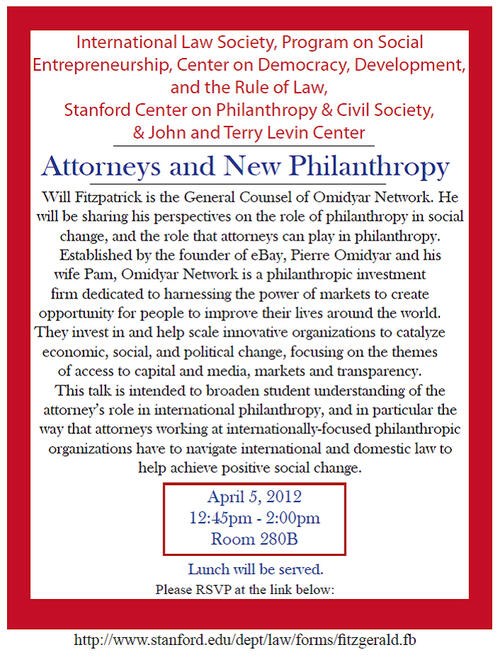
Attorneys and New Philanthrophy
-
Will Fitzpatrick is the General Counsel of Omidyar Network. He will be sharing his perspectives on the role of philanthropy in social change, and the role that attorneys can play in philanthropy. Established by the founder of eBay, Pierre Omidyar and his wife Pam, Omidyar Network is a philanthropic investment firm dedicated to harnessing the power of markets to create opportunity for people to improve their lives around the world. They invest in and help scale innovative organizations to catalyze economic, social, and political change, focusing on the themes of access to capital and media, markets and transparency. This talk is intended to broaden student understanding of the attorney's role in international philanthropy, and in particular the way that attorneys working at internationally-focused philanthropic organizations have to navigate international and domestic law to achieve positive social change.
Please RSVP to the link below:
http://www.stanford.edu/dept/law/forms/fitzgerald.fb
Lunch will be provided
Image
Room 280B
Will Fitzpatrick
General Counsel
Speaker
Omidyar Network
Conferences