Democracy
-

Speaker Bio

Tshering Tobgay is a Bhutanese politician who has been Prime Minister of Bhutan since 2013. He is also leader of the People’s Democratic Party and was Leader of the Opposition in the National Assembly from March 2008 to April 2013. Tobgay co-founded the People’s Democratic Party and was responsible for establishing the Party as Bhutan’s first registered political party. Prior to politics, Tobgay was a civil servant, beginning his career in 1991 with the Technical and Vocational Education Section under the Department of Education. In 1998 he established and headed the National Technical Training Authority and served as a director in the Ministry of Labour and Human Resources from 2003 to 2007.

Tobgay received a bachelor of science degree in mechanical engineering from the University of Pittsburgh’s Swanson School of Engineering in 1990 and later received a master’s in public administration from Harvard University in 2004. He received his secondary schooling in India, at Dr. Graham’s Homes School in the city of Kalimpong, near Darjeeling, in the eastern Himalayas.


[[{"fid":"218156","view_mode":"crop_870xauto","fields":{"format":"crop_870xauto","field_file_image_description[und][0][value]":"Democracy Bhutan Flyer","field_file_image_alt_text[und][0][value]":"","field_file_image_title_text[und][0][value]":"","field_credit[und][0][value]":"","field_caption[und][0][value]":"Democracy Bhutan Flyer","field_related_image_aspect[und][0][value]":"","thumbnails":"crop_870xauto","pp_lightbox":false,"pp_description":false},"type":"media","attributes":{"height":1344,"width":870,"class":"media-element file-crop-870xauto"}}]]

Tshering Tobgay Prime Minister, Bhutan
Seminars
-

Abstract:

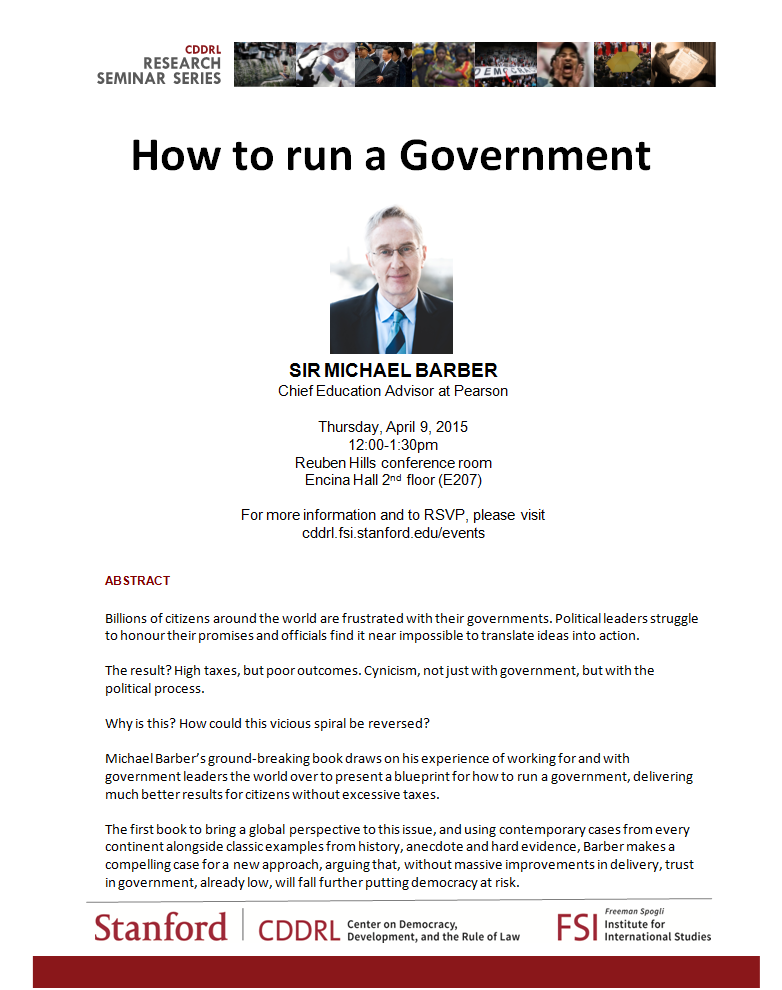
Billions of citizens around the world are frustrated with their governments. Political leaders struggle to honour their promises and officials find it near impossible to translate ideas into action. The result? High taxes, but poor outcomes. Cynicism, not just with government, but with the political process. Why is this? How could this vicious spiral be reversed? Michael Barber’s ground-breaking book draws on his experience of working for and with government leaders the world over to present a blueprint for how to run a government, delivering much better results for citizens without excessive taxes. The first book to bring a global perspective to this issue, and using contemporary cases from every continent alongside classic examples from history, anecdote and hard evidence, Barber makes a compelling case for a new approach, arguing that, without massive improvements in delivery, trust in government, already low, will fall further putting democracy at risk.


Speaker Bio:

barber Sir Michael Barber
Sir Michael Barber is Chief Education Advisor at Pearson – responsible for putting in place a process to ensure that all Pearson's products and services demonstrably deliver improved learner outcomes. He is chair of the Pearson Affordable Learning Fund, aiming to extend opportunities by investing in low-cost private education in the developing world. In 2001, he founded the Prime Minister’s Delivery Unit in No10, Downing Street, which he ran until 2005. From 2005 to 2011 he was a partner at McKinsey and Company. In 2009 he founded, in Washington DC, the Education Delivery Institute. Since 2009, on behalf of the British government, he has visited Pakistan over 30 times to oversee a radical and, so far, successful reform of the Punjab education system. He is the author of numerous books and articles, most notably Instruction to Deliver, and Deliverology 101. In 2005, he was knighted for his services to improving government.

Image
barberflyer

Sir Michael Barber Chief Education Advisor, Pearson Chief Education Advisor, Pearson Chief Education Advisor, Pearson
Seminars
Authors
Zandanshatar Gombojav
News Type
News
Date
Paragraphs

CDDRL Visiting Scholar and former Foreign Minister of Mongolia Zandanshatar Gombojav recently published an article in a Mongolian news outlet, Today.mn, commenting on the nation's deteriorating human rights record. Citing an increase in criminal cases involving foreign and domestic workers, Gombojov argues that Mongolia is no longer a secure and protected environment for business and investment. Without more transparent judicial processes, Gombojov believes Mongolia's economic difficulties will continue to worsen. Read more on Gombojav's commentary below, translated to English from Mongolian. For the full article in Mongolian, see the link above.


Lately, websites have been screaming loudly that freedom and human rights are being violated in Mongolia for both foreigners and local people. Those who run businesses are especially concerned, and live and work in constant fear.

It is accurate to say that present-day Mongolia has turned into a real nightmare for foreign investors.  Cases are sensationalized, regardless of whether the alleged perpetrator is guilty or not.  When cases involve politicians or businessmen, they continue until the accused are forced to their knees for the alleged crimes.

In Mongolia, we have an old saying about the sanctity of reputation that has seemingly been forgotten: “Break my bones instead of my reputation.”  Since 2005, there have been numerous cases when peoples’ reputations have been insulted and assaulted.  The system does not adjudicate or resolve cases according to a rule of law or well-established procedures, but rather through unsubstantiated, spurious and unethical allegations that have polluted Mongolian society.  And it doesn’t stop there.

The assault on reputations that is characterized by false accusations is expanding and becoming evermore pervasive, thus creating a huge obstacle to our economy’s development and growth.  It is unfortunate that the authorities are stirring up this circumstance, rather than seeking understanding, and taking firm action to combat mis-information and promote transparency and the rule-of-law.

One of the classic examples is the court verdict recently rendered on the three managers of “SouthGobi Sands (SGS),” which has been the object of sensational international news. If it is true that the three who have been accused are proven to have really committed tax evasion for their employer, SGS, then they should be punished according to the laws and procedures of Mongolia.  No one would argue with this.

But the case is not clear–cut or definitive. Doubt hangs behind the allegations because it is very unclear what kind of reasons or motivation are hiding behind the accusation.  The ex-managers of “SouthGobi Sands” have been sentenced to long prison terms by the criminal court, which makes everyone, foreign and domestic, worried. Foreign experts, including the US embassy, believe that this case has violated the three men’s human rights, and consequently the case has been carried actively by U.S. media.

Fortune.com reports “Rather than symbolizing due process in an emerging democracy, the trial’s numerous irregularities have raised fears that a country struggling with a resource curse has further dulled its economic prospects.”  Bloomberg Business quotes Chuluunbat Ochirbat, an economic advisor to PM Saikhanbileg as saying:  “It is an unusual practice in Mongolia that tax and other disputes are classified as criminal cases, “ and Dale Choi, founder of Independent Mongolia Metals & Mining Research in Ulaanbaatar, adds:  “It would create very negative publicity. Foreign investors and executives would be scared of signing documents in Mongolia.”  Mining.com, in an article entitled “Mongolian verdict sends chill through mining community,” comments that if the court decision is not reversed, “SouthGobi” will be bankrupted.

This is a small sample of the many posts that have appeared in U.S. and international media over the past two weeks regarding the court sentences of U.S. citizen, Justin Kapla and Philippine citizens, Hilarion V. Cajucom JR and Cristobal G. David.

If we look briefly at this world-wide sensational case: “Three ex-employees of foreign the invested company “SouthGobi Sands” have been sentenced to prison.  When, at the outset, the Tax Department detected a potential violation, they should have had independent experts prepare reports and statements in conjunction with the prosecutors and police overseeing the case. But, the Ministry of Finance prepared the reports itself, without expert review.

In addition, the Ministry’s subsequent inspections only fueled exaggerated reports, instead of inviting independent experts to prepare their own report, affirming or rejecting the legitimacy of the Tax Inspectors findings. The foreign-invested “SouthGobi” had an international audit organization inspect and prepare independent reports; but these were ignored by the Mongolian court.

Furthermore, the prosecutor initially requested that the three only pay a penalty, but later added the much stiffer request for prison terms.  What attracts our attention most is the definition of the case as a criminal case, not a civil case.  It is also puzzling that officials from the Tax Department were not present at the trial, and that the case had been returned twice because of insufficient evidence.

Justin Kapla had worked for “SouthGobi” for only 6 months at the time of the trial, though the tax evasion case had been ongoing for 5 years.  It is not very understandable which laws and rules exactly are served in Mongolia. Obviously, we know that telephone justice dominates in our country.

In the end, the three foreign citizens who were convicted were the hired employees of “SouthGobi”.  It is very unfair and unjust that the company owners and directors escaped prosecution for tax evasion, if indeed it is true and proven.  The owners and directors should be held responsible if there is evidence of wrong-doing, instead of sentencing ex-officers employed for only 6 months to 1 year.

The three are imprisoned in a foreign country accused of evading USD 6.8 billion in taxes. The question that they asked in court: “Did we really evade taxes and hide an amount of money that is equal to Mongolia’s GDP?”  These sound like the words of a desperate person, but they highlight the irresponsibility of our country’s courts and monitoring organizations.

The Mongolian authorities also drew a nonsensical and misleading parallel with the United States, arguing that if the same fraction of GDP was embezzled in the U.S. each politician would have USD 2.2 billion.

U.S. citizen Justin Kapla filed a complaint with the UN High Commission on Human Rights last summer.  Since then, he has noted repeatedly that his treatment and the irresponsible court decision will negatively affect foreign investment in Mongolia. If this negative news and reports continue to spread in international media, the reputation and credibility of the Mongolian courts will be further comprised, and fears will be fueled among people whose trust Mongolia needs.

Several years ago, there was case involving a Japanese investor who was sentenced to prison for drug abuse.  He was ultimately released, but only after having to address and overcome many issues.  First, the court had been playing around with investors from the Republic of China, Korea, and Japan.  Then, as the mining industry grew bigger, the court started harassing other large foreign investors.  It is no secret that small Chinese, Korean, and Vietnamese investors are commonly robbed, threatened, and slandered in cases brought on false charges.

Private and public property is sacred in countries where a market economy exists.  The government, or some faction on behalf of the government, are invading private and public property and taking it for themselves. This is a very poisonous and unfortunate chain of events, that communicates to domestic and foreign investors that their businesses and investments in Mongolia are not secure or protected.

We know well that not only foreigners, but also our own people, are struggling to make a living.  They are nonetheless being labeled “criminals” nation-wide, and are accused of unproven crimes associated of “bribery and corruption.”  What we don’t know is how many father’s, son’s, mother’s and daughter’s reputations, work, and lives are being tarnished and damaged by this variant of modern-day repression?

Arresting, imprisoning, and punishing those who create wealth has become a sadness that plagues our society.  This issue has elicited much criticism from law-makers as well. During an interview on Mongol television and News.mn, Member of Parliament U. Enkhtuvshin said: “Rich mining and business owners are the intentional main targets. The authorities conceal the reputation of the individual, his/her family and business through paid media tools.  After that, they sentence him/her to imprisonment. The public is brain-washed by the media and think: “Oh, as expected, this guy has been sentenced for his “you know!!!” crime”.

These kinds of baseless accusations have sadly become commonplace in our society. My successor and now-former Minister of Foreign Affairs Lu. Bold once asked: “Who would want to live or work in a country where the authorities take away investors’ passports, ban them from traveling, and then arrest them for investing after desperately inviting them to come in?”  He added, “Mongolia has turned into a prison”.

In fact, the time has come for us to understand that Mongolia’s current economic difficulties derive from a crisis of politics and from our political structure.  Whose game is it, squeezing the foreign investors out at the same time that the whole world is speculating that Mongolia will go bankrupt from its debt crisis? Whose strategy is it?

Hero Image
mongolia flag Wikipedia Creative Commons
All News button
1
-

Conference Description 


There is currently a worldwide debate regarding the transformation of democracy. The representative system (political parties, parliamentary bodies, and the executive government) has been weakened and in some cases displaced by non-electoral representative actors (mass media, judicial magistrates, public commissions, etc.) and by intense manifestations of civic empowerment that remain politically active well after elections. As a result, the legitimacy of government decisions is consistently called into question. This evolution of democracy at the beginning of the 21st century is particularly apparent in Latin America, but it is affecting the quality and stability of democracy in many countries around the globe.

One element of the transformation has been the repeated emergence of populist governments, characterized by the informal practice of power. These movements, which frequently include marginalized sectors of society and identify with charismatic leadership, exert substantial power in a number of countries. The expansion of regimes with populist features in the context of electoral democracies has led to several unresolved questions that will be discussed in the seminar.


Agenda


9:15     Coffee 

9:30     Introduction, Isidoro Cheresky, Full Professor, University of Buenos Aires; CLAS Tinker Professor

9:40     “The Global Democratic Recession and Its Implications for Latin America”

             Larry Diamond, CDDRL, Stanford

10:15   “Populism and the Politics of the Extraordinary”

             Carlos de la Torre, Professor of Sociology, University Kentucky, Lexington

11:15   “Latin America and the Theological, Epistemological and Aesthetic Regimes of Politics,” Martin Plot, School of Critical Studies, California Institute of the Arts

12:15-12:30  Concluding Discussion          


Discussants


Isidoro Cheresky

Alberto Diaz-Cayeros, Senior Fellow, Freeman Spogli Institute for International Studies


[[{"fid":"217989","view_mode":"crop_870xauto","fields":{"format":"crop_870xauto","field_file_image_description[und][0][value]":"","field_file_image_alt_text[und][0][value]":"","field_file_image_title_text[und][0][value]":"","field_credit[und][0][value]":"","field_caption[und][0][value]":"","field_related_image_aspect[und][0][value]":"","thumbnails":"crop_870xauto","pp_lightbox":false,"pp_description":false},"type":"media","attributes":{"height":1344,"width":870,"class":"media-element file-crop-870xauto"}}]]

CDDRL
Stanford University
Encina Hall, C147
616 Jane Stanford Way
Stanford, CA 94305-6055

(650) 724-6448 (650) 723-1928
0
Mosbacher Senior Fellow in Global Democracy at the Freeman Spogli Institute for International Studies
William L. Clayton Senior Fellow at the Hoover Institution
Professor, by courtesy, of Political Science and Sociology
diamond_encina_hall.png MA, PhD

Larry Diamond is the William L. Clayton Senior Fellow at the Hoover Institution, the Mosbacher Senior Fellow in Global Democracy at the Freeman Spogli Institute for International Studies (FSI), and a Bass University Fellow in Undergraduate Education at Stanford University. He is also professor by courtesy of Political Science and Sociology at Stanford, where he lectures and teaches courses on democracy (including an online course on EdX). At the Hoover Institution, he co-leads the Project on Taiwan in the Indo-Pacific Region and participates in the Project on the U.S., China, and the World. At FSI, he is among the core faculty of the Center on Democracy, Development and the Rule of Law, which he directed for six and a half years. He leads FSI’s Israel Studies Program and is a member of the Program on Arab Reform and Development. He also co-leads the Global Digital Policy Incubator, based at FSI’s Cyber Policy Center. He served for 32 years as founding co-editor of the Journal of Democracy.

Diamond’s research focuses on global trends affecting freedom and democracy and on U.S. and international policies to defend and advance democracy. His book, Ill Winds: Saving Democracy from Russian Rage, Chinese Ambition, and American Complacency, analyzes the challenges confronting liberal democracy in the United States and around the world at this potential “hinge in history,” and offers an agenda for strengthening and defending democracy at home and abroad.  A paperback edition with a new preface was released by Penguin in April 2020. His other books include: In Search of Democracy (2016), The Spirit of Democracy (2008), Developing Democracy: Toward Consolidation (1999), Promoting Democracy in the 1990s (1995), and Class, Ethnicity, and Democracy in Nigeria (1989). He has edited or coedited more than fifty books, including China’s Influence and American Interests (2019, with Orville Schell), Silicon Triangle: The United States, China, Taiwan the Global Semiconductor Security (2023, with James O. Ellis Jr. and Orville Schell), and The Troubling State of India’s Democracy (2024, with Sumit Ganguly and Dinsha Mistree).

During 2002–03, Diamond served as a consultant to the US Agency for International Development (USAID) and was a contributing author of its report, Foreign Aid in the National Interest. He has advised and lectured to universities and think tanks around the world, and to the World Bank, the United Nations, the State Department, and other organizations dealing with governance and development. During the first three months of 2004, Diamond served as a senior adviser on governance to the Coalition Provisional Authority in Baghdad. His 2005 book, Squandered Victory: The American Occupation and the Bungled Effort to Bring Democracy to Iraq, was one of the first books to critically analyze America's postwar engagement in Iraq.

Among Diamond’s other edited books are Democracy in Decline?; Democratization and Authoritarianism in the Arab WorldWill China Democratize?; and Liberation Technology: Social Media and the Struggle for Democracy, all edited with Marc F. Plattner; and Politics and Culture in Contemporary Iran, with Abbas Milani. With Juan J. Linz and Seymour Martin Lipset, he edited the series, Democracy in Developing Countries, which helped to shape a new generation of comparative study of democratic development.

Download full-resolution headshot; photo credit: Rod Searcey.

Former Director of the Center on Democracy, Development and the Rule of Law
Faculty Chair, Jan Koum Israel Studies Program
Date Label
Isidoro Cheresky Full Professor University of Buenos Aires; CLAS Tinker Professor
Carlos de la Torre Professor of Sociology University of Kentucky, Lexington
Martin Plot School of Critical Studies, California Institute of the Arts

Encina Hall, C149
616 Jane Stanford Way
Stanford, CA 94305

(650) 725-0500
0
Senior Fellow, Freeman Spogli Institute for International Studies
Professor, by courtesy, of Political Science
alberto_diaz-cayeros_2024.jpg MA, PhD

Alberto Díaz-Cayeros is a Senior Fellow at Stanford University's Freeman Spogli Institute for International Studies (FSI), and co-director of the Democracy Action Lab (DAL), based at FSI's Center on Democracy, Development and Rule of Law (CDDRL). His research interests include federalism, poverty relief, indigenous governance, political economy of health, violence, and citizen security in Mexico and Latin America.

He is the author of Federalism, Fiscal Authority and Centralization in Latin America (Cambridge, reedited 2016), coauthored with Federico Estévez and Beatriz Magaloni, of The Political Logic of Poverty Relief (Cambridge, 2016), and of numerous journal articles and book chapters.

He is currently working on a project on cartography and the developmental legacies of colonial rule and governance in indigenous communities in Mexico.

From 2016 to 2023, he was the Director of the Center for Latin American Studies at Stanford University, and from 2009 to 2013, Director of the Center for US-Mexican Studies at UCSD, the University of California, San Diego.

Affiliated faculty at the Center on Democracy, Development and the Rule of Law
Co-director, Democracy Action Lab
Director of the Center for Latin American Studies (2016 - 2023)
CV
Date Label
Discussant
Conferences
Authors
News Type
Commentary
Date
Paragraphs

As part of the Arab Reform and Democracy Program's speaker series, University of Richmond Political Scientist Sheila Carapico discussed findings from her ground-breaking study Political Aid and Arab Activism: Democracy Promotion, Justice, and Representation (Cambridge University Press, 2013) which explores two decades’ worth of projects sponsored by American, European, and other transnational agencies in four key sub-fields: the rule of law, electoral design and monitoring, female empowerment, and civil society. European and US-based scholars and practitioners have debated the purposes and sometimes the (limited) macro-effects of programs designed to promote transitions from authoritarianism to democracy in Middle East countries. Yet this discussion often lacks analysis of on-the-ground experiences or ignores the cumulative wisdom of local counterparts and intermediaries. Carapico discussed controversies and contradictions surrounding projects in Egypt, Palestine, and Iraq (the three main cases) and Jordan, Morocco, Yemen, Algeria, Tunisia, and Lebanon (where democracy brokers also work) to help explain why so many feminists and other advocates for justice, free elections, and civic agency concluded that foreign funding is inherently political and paradoxical.


Hero Image
sheila shot
All News button
1
Authors
News Type
News
Date
Paragraphs

In the 25th anniversary edition of The Journal of Democracy, CDDRL Director Larry Diamond reflects on the current democratic recession and why this trend is so troubling.

Diamond, who serves as the founding co-editor of The Journal of Democracy, argues that the world is in a mild but protracted democratic recession, which raises alarm due to the rate of democratic failures and where they are occurring. In surveying global empirical trends, Diamond cites 25 breakdowns of democracy since 2000 that were not the cause of military coups but rather the slow erosion of democratic rights and procedures.

Another worrisome trend for Diamond is the declining freedom in a number of countries and regions since 2005. This is most notable in Africa where corruption and the abuse of power are leading to the decline of the rule of law and political rights across the region. It is also affecting countries of global strategic importance with large populations and economic influence– from Taiwan to Mexico – and leading to the resurgence of authoritarianism in Russia and China. Diamond also looks to the U.S. where the dysfunction and breakdown of American democracy sets a bad precedent for the rest of the world. 

Diamond concludes on an optimistic note, stressing that strong public support for democracy may reverse many of these troubling trends and help sustain longer-term democratic progress.

img 9597 From left to right: Thomas Carothers, Carnegie Endowment for International Peace; Alina Mungiu-Pippidi, Hertie School of Governance (Berlin); Marc Plattner, National Endowment for Democracy; Larry Diamond, Stanford University; Steven Levitsky, Harvard University; and Lucan Way, University of Toronto.


Hero Image
img 9821
Larry Diamond speaks to a large audience in Washington, D.C., for the 25th anniversary of the Journal of Democracy. Other speakers at the event included: Thomas Carothers (Carnegie Endowment for International Peace), Alina Mungiu-Pippidi (Hertie School of Governance-Berlin), Marc Plattner (National Endowment for Democracy), Steven Levitsky (Harvard University), and Lucan Way (University of Toronto).
Scott Henrichsen
All News button
1
Authors
News Type
Commentary
Date
Paragraphs

As part of the Arab Reform and Democracy Program speaker series, US Institute of Peace Vice-President for Applied Research on Conflict Steven Heydemann examined the future of authoritarian rule in the Arab region in the aftermath of the Arab uprisingsThe uprisings that spread across the Middle East in 2011 created new hope for democratic change in the Arab world.  Four years later, the euphoria that greeted the Arab uprisings has given way to a far more somber mood, a recognition of the limits of mass protests to bring about political change, and acknowledgement that the region's entrenched authoritarian regimes are more resilient than many protesters imagined. Yet in responding to the challenge of mass politics, authoritarian regimes in the Middle East have not simply shown their resilience. In adapting to new challenges they have also changed, giving rise to new and more troubling forms of authoritarian rule, suggesting that the turmoil of recent years may be only the beginning of an extended period of political instability, violence, and repression in many parts of the Middle East.


Hero Image
hyedemannnbest
Steven Heydemann speaks to the CDDRL community on authoritarianism in the Arab world.
All News button
1
Authors
News Type
Commentary
Date
Paragraphs

As part of the Arab Reform and Democracy Program's speaker series, Stanford Historian Joel Beinin discussed the role of workers in advancing revolutionary struggles in Egypt and TunisiaArab workers participated prominently in the popular uprisings of 2011. They shared the outrage of many of their compatriots over daily abuse by internal security forces, widespread corruption, and foreign policies subservient to U.S. interests. Their participation in those uprisings was also informed by struggles against the neoliberal economic restructuring of the region since the 1970s, which resulted in an indecent chasm between rich and poor, deteriorating working conditions and public social services, and high youth unemployment.

Egypt experienced a strike wave of unprecedented magnitude in the 2000s. Tunisia, with one exception, experienced less intense contestation by workers and others. Egyptian workers’ have had very limited influence on national politics in the post-Mubarak era. Democratic development seems unlikely in the near future. The Tunisian national trade union federation and its affiliates were the central force in installing procedural democracy. The nature of workers’ social movements in the 2000s partially explains these divergent outcomes.


Hero Image
screen shot 2015 02 04 at 3 01 20 pm
All News button
1
-

***Note LOCATION CHANGE to GUNN 101 in Stanford Business School.***


Speaker Bio

 
Image
1622480 770675586338644 9108557166476577753 o
Serhiy Kvit, Rector of the National University of Kyiv-Mohyla Academy and outspoken blogger on higher education reform, became Ukraine’s Minister of Education and Science in March 2014.  He worked quickly with the Verkhovna Rada (Ukraine’s Parliament) to enact the Law on Higher Education, to give much greater autonomy to the country’s universities and bring Ukrainian universities into compliance with the Bologna Agreement.  The military conflict in Ukraine’s Donbas has since caused internal displacement of university scholars and students and scientific researchers, while economic crisis hampers the government’s ability to implement needed reforms.  Minister Kvit will discuss the conditions and prospects for Ukrainian education and science in a time of economic and security uncertainty.
 

Serhiy Kvit has been Ukraine’s Minister of Education and Science since February of 2014. He became President of the National University of Kyiv-Mohyla Academy in 2007 and was Dean of Social Studies from 2002 to 2007. He founded the Kyiv-Mohyla School of Journalism in 2001 and became president of the Media Reform Centre, which was founded to initiate open debate and promote transparency in government media. He also served as chair of the Consortium on University Autonomy from 2005 to 2010. Kvit has a Ph.D from the Ukrainian Free University and also holds a doctorate in philology. He was the recipient of a Fulbright scholarship to Ohio University in 2006 and 2007, a Kennan Institute scholarship winner at the Woodrow Wilson International Center for Scholars in Washington DC in 2009, and held a DAAD (German Academic Exchange Service) scholarship at the University of Cologne in 2010. He has published several books and numerous articles and, prior to his appointment as Minister, maintained a regular blog for University World News.


*This event is co-sponsored with the Center for Russian, East European and Eurasian Studies.*

GUNN Building 101

Stanford Graduate School of Business

Serhiy Kvit Minister of Education and Science of Ukraine Minister of Education and Science of Ukraine
Seminars
Subscribe to Democracy