Election Ethics: Fair Play & Due Process
Related Multimedia

Presentation

Center on Democracy, Development and the Rule of Law is part of the Freeman Spogli Institute for International Studies
After having witnessed the beginning of the Arab Spring in December 2010, and the ouster of former President Zine El Abidine Ben Ali in January 2011, Tunisia went through a period of intense political turbulence, including a rapid succession of governments and a paralyzing political gridlock in the summer of 2013. The Tunisian national dialogue quartet, which represented the major stakeholders in civil society and is the recipient of the 2015 Nobel Peace Prize, paved the way for a technocratic government that helped bring the country’s democratic transition back on track. After discussing the conditions that led to these developments, this presentation will focus on how the technocratic government managed the challenges of organizing the country’s first fully democratic presidential and legislative elections, re-establishing security, and restoring economic fundamentals. Finally, the presentation will discuss the prospects for democratic and economic development in Tunisia, one year after the appointment of the government that resulted from the 2014 elections.

CISAC Central Conference Room
Encina Hall, 2nd Floor
616 Serra St
Stanford, CA 94305
To mark five years since the onset of the January 25 Revolution, five Egypt scholars examined the evolving political landscape in Egypt as part of a panel titled “The Containment of Politics in Egypt,” organized by the Program on Arab Reform and Democracy (ARD). The panel featured Stanford Historian Joel Beinin, Associate Professor of Political Science at Stanford Lisa Blaydes, ARD Visiting Scholar Amr Hamzawy, Executive Director of the Tahrir Institute on Middle East Policy Nancy Okail, and ARD Associate Director Hesham Sallam. The discussion revolved around a number of key issues, including the recent legislative elections, the cohesion of the ruling coalition, the regime’s responses to various economic challenges, and the impact of state repression on spaces for political contestation and resistance.

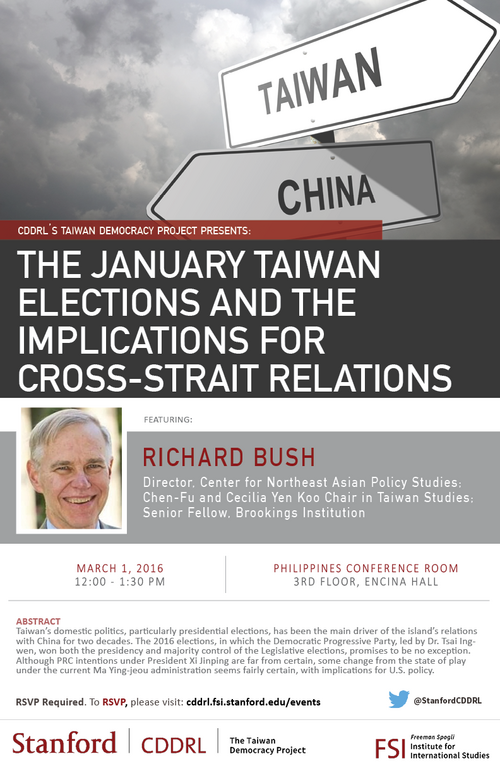
Taiwan’s domestic politics, particularly presidential elections, has been the main driver of the island’s relations with China for two decades. The 2016 elections, in which the Democratic Progressive Party, led by Dr. Tsai Ing-wen, won both the presidency and majority control of the Legislative elections, promises to be no exception. Although PRC intentions under President Xi Jinping are far from certain, some change from the state of play under the current Ma Ying-jeou administration seems fairly certain, with implications for U.S. policy.
Richard Bush is a Senior Fellow at the Brookings Institution and Director of its Center for Northeast Asian Policy Studies, and the Chen-Fu and Cecilia Yen Koo Chair in Taiwan Studies. He came to Brookings in July 2002 after nineteen years working in the US government, including five years as the Chairman and Managing Director of the American Institute in Taiwan. He is the author of a number of articles on U.S. relations with China and Taiwan, and of At Cross Purposes, a book of essays on the history of America’s relations with Taiwan, published in March 2004 by M. E. Sharpe. In the spring of 2005, Brookings published his study on cross-Strait relations, entitled Untying the Knot: Making Peace in the Taiwan Strait. In 2013, Brookings published his Uncharted Strait: The Future of China-Taiwan Relations.
This talk is co-sponsored by the Taiwan Democracy Project in the Center on Democracy, Development, and the Rule of Law and the U.S.-Asia Security Initiative in the Walter H. Shorenstein Asia-Pacific Research Center.
*Registration is now closed. For more information, please contact Kharis Templeman at kharis@stanford.edu.*
On January 16, 2016, Taiwanese went to the polls to elect a new president and legislature. The results were historic: Tsai Ing-wen of the opposition Democratic Progressive Party (DPP) won a landslide victory over two opponents, and the DPP won a comfortable majority in the legislature, giving the party full control over the central government for the first time. In contrast, the ruling Chinese Nationalist Party, or Kuomintang (KMT), suffered its worst defeat in the presidential election since 2000, and its worst-ever defeat in the legislative elections, and it faces a long, difficult road to political recovery. This election was also notable for the entry into electoral politics of some of the leaders of the so-called "Sunflower Movement": the upstart New Power Party won five seats, becoming the third-largest party in the legislature.
This seminar will feature remarks by Larry Diamond, senior fellow at the Freeman Spogli Institute for International Affairs, and Kharis Templeman, the program manager of the Taiwan Democracy Project in the Center on Democracy, Development, and the Rule of Law. Dr. Diamond and Dr. Templeman will offer their thoughts about who won, why, what it means for Taiwan's democratic development, what to expect from the new government, and how it will affect relations between Taiwan, the United States, and the People's Republic of China.
This event is free and open to the public, and lunch will be served.
[[{"fid":"221885","view_mode":"crop_870xauto","fields":{"format":"crop_870xauto","field_file_image_description[und][0][value]":"Tsai Ing-wen ","field_file_image_alt_text[und][0][value]":"","field_file_image_title_text[und][0][value]":"","field_credit[und][0][value]":"REUTERS/Pichi Chuang","field_caption[und][0][value]":"Democratic Progressive Party (DPP) Chairperson and presidential candidate Tsai Ing-wen shouts slogans as she greets supporters after her election victory at party headquarters in Taipei, Taiwan January 16, 2016. REUTERS/Pichi Chuang","field_related_image_aspect[und][0][value]":"","thumbnails":"crop_870xauto"},"type":"media","attributes":{"width":"870","class":"media-element file-crop-870xauto"}}]]
Video from this event can be found here.
CDDRL
Stanford University
Encina Hall, C147
616 Jane Stanford Way
Stanford, CA 94305-6055
Larry Diamond is the William L. Clayton Senior Fellow at the Hoover Institution, the Mosbacher Senior Fellow in Global Democracy at the Freeman Spogli Institute for International Studies (FSI), and a Bass University Fellow in Undergraduate Education at Stanford University. He is also professor by courtesy of Political Science and Sociology at Stanford, where he lectures and teaches courses on democracy (including an online course on EdX). At the Hoover Institution, he co-leads the Project on Taiwan in the Indo-Pacific Region and participates in the Project on the U.S., China, and the World. At FSI, he is among the core faculty of the Center on Democracy, Development and the Rule of Law, which he directed for six and a half years. He leads FSI’s Israel Studies Program and is a member of the Program on Arab Reform and Development. He also co-leads the Global Digital Policy Incubator, based at FSI’s Cyber Policy Center. He served for 32 years as founding co-editor of the Journal of Democracy.
Diamond’s research focuses on global trends affecting freedom and democracy and on U.S. and international policies to defend and advance democracy. His book, Ill Winds: Saving Democracy from Russian Rage, Chinese Ambition, and American Complacency, analyzes the challenges confronting liberal democracy in the United States and around the world at this potential “hinge in history,” and offers an agenda for strengthening and defending democracy at home and abroad. A paperback edition with a new preface was released by Penguin in April 2020. His other books include: In Search of Democracy (2016), The Spirit of Democracy (2008), Developing Democracy: Toward Consolidation (1999), Promoting Democracy in the 1990s (1995), and Class, Ethnicity, and Democracy in Nigeria (1989). He has edited or coedited more than fifty books, including China’s Influence and American Interests (2019, with Orville Schell), Silicon Triangle: The United States, China, Taiwan the Global Semiconductor Security (2023, with James O. Ellis Jr. and Orville Schell), and The Troubling State of India’s Democracy (2024, with Sumit Ganguly and Dinsha Mistree).
During 2002–03, Diamond served as a consultant to the US Agency for International Development (USAID) and was a contributing author of its report, Foreign Aid in the National Interest. He has advised and lectured to universities and think tanks around the world, and to the World Bank, the United Nations, the State Department, and other organizations dealing with governance and development. During the first three months of 2004, Diamond served as a senior adviser on governance to the Coalition Provisional Authority in Baghdad. His 2005 book, Squandered Victory: The American Occupation and the Bungled Effort to Bring Democracy to Iraq, was one of the first books to critically analyze America's postwar engagement in Iraq.
Among Diamond’s other edited books are Democracy in Decline?; Democratization and Authoritarianism in the Arab World; Will China Democratize?; and Liberation Technology: Social Media and the Struggle for Democracy, all edited with Marc F. Plattner; and Politics and Culture in Contemporary Iran, with Abbas Milani. With Juan J. Linz and Seymour Martin Lipset, he edited the series, Democracy in Developing Countries, which helped to shape a new generation of comparative study of democratic development.
Download full-resolution headshot; photo credit: Rod Searcey.

[[{"fid":"221900","view_mode":"crop_870xauto","fields":{"format":"crop_870xauto","field_file_image_description[und][0][value]":"Ned Foley Flyer","field_file_image_alt_text[und][0][value]":"","field_file_image_title_text[und][0][value]":"","field_credit[und][0][value]":"","field_caption[und][0][value]":"","field_related_image_aspect[und][0][value]":"","thumbnails":"crop_870xauto"},"type":"media","attributes":{"width":"870","class":"media-element file-crop-870xauto"}}]]
In a Q and A with The Stanford Daily, CDDRL Program on Arab Reform and Democracy Visiting Scholar Amr Hamzawy remarks on his time in the Egyptian parliament and the factors that led him and his family to leave the country for America.
Amr Hamzawy is a visiting scholar at Stanford’s Center on Democracy, Development, and the Rule of Law (CDDRL) and an associate professor of political science at Cairo University. Before arriving at Stanford, Hamzawy played critical roles in the Egyptian political scene, both during and after the Arab Spring — including a term in the first parliament elected after Egypt’s 2011 revolution.
The Stanford Daily sat down with Hamzawy to discuss his work at Stanford and the state of Egyptian politics today.
The Stanford Daily (TSD): Why did you choose to spend time here at Stanford, and what’s the focus of your research here?
Amr Hamzawy (AH): Well, I had to leave Egypt. The background is I took a clear position against the military coup. I was in fact banned from travel for a year in Egypt in 2014, which was basically one of the tools the repressive government uses to intimidate opponents. In 2015 my ban was lifted. I was, however, banned from teaching at my home university, Cairo University. The environment was becoming increasingly fascist, increasingly repressive for anyone who expresses a different point of view opposed to the one narrative coming from the ruling establishment. There were increased pressures as far as I [was] concerned, as far as my family [was] concerned. My wife is an actress so she [had] been banned from working as well, and she has been pressured in different ways. So we decided, in fact against our initial wish, to leave Egypt.
What happened was I basically wrote to several colleagues and friends, and my first choice was CDDRL, where [Stanford professor of political science and sociology] Larry Diamond is a very good friend of mine and [Stanford professor of political science and former U.S. Ambassador] Mike McFaul is a very good friend of mine.
Stanford was a choice based on the reputation of CDDRL, my friendship with Mike and Larry and the excellent reputation of the Program on Arab Reform and Democracy, where [research associate] Hesham Sallam is at CDDRL. That’s basically what brought me to Stanford, and I wanted to be as far away as possible from Egypt. I keep saying it’s pretty far, and one of the greatest assets of the time difference is that you wake up and the day in Egypt has passed — so you take bad news in one shot, which is a big difference than following by the minute what is happening and unfolding all day.
In terms of my focus at Stanford, I am writing a book — it’s a research assignment so far — I’m working on a book where the working title is “Egypt’s Illiberal Liberals.” It’s an attempt to look at why the Egyptian middle class, which basically took out to the streets in 2011 to demand political freedom and democracy, decided to to give up on democratization and to once again move in the direction of calling on the military establishment to interfere and freeze pluralist politics.
One of the key issues which I am working on is how liberal, intellectual elites have been able to market the army interference and the military coup as a step to protect the nation state, to save society and to save the Egyptian identity.
TSD: You have studied and worked around the world. You completed a Ph.D. in Berlin, and you were also working with the Carnegie Endowment for International Peace in Beirut. How does Stanford compare?
AH: It’s more of a vibrant intellectual environment. Of course I am not undermining the positive assets of my university in Berlin or of Carnegie in D.C. or in Beirut, where in different ways the environment has been inspiring as well.
But as of now, it relates to my role in the last four years because I went through two phases: the first phase where I was part of an attempt to make Egypt a democratic place — prior to 2011, [through] writing primarily, but post 2011… after I was elected to parliament — and a second phase where I [was] basically classified as a state enemy [in] July 2013. In a way, Stanford is an excellent place to reflect on the experience personally and to reflect in more of an objective manner — looking at what went wrong.
The big question in the literature is: Was it doomed to fail — was Egypt going to fail no matter what, or did key actors…commit key mistakes, tactical and strategic mistakes, which led Egypt to where it is today? That is sort of the big debate in the last two years, and Stanford is an excellent place to engage that debate and to try to contribute to it.
TSD: You founded a political party in 2011. However, you withdrew from Egypt’s current, 2015 parliamentary elections. Why?
AH: We founded the Egypt Freedom Party in 2011, and our platform has always been a liberal democratic platform — where you can compare our platform to the ideas of liberal parties in Europe or the U.S. — with a clear and pronounced commitment to a market economy and social justice, based on a socially responsible market economy as it’s framed in the European experience.
We fashioned a platform that enabled us to be elected to the “true parliament” — the only true parliament Egypt had in 2011 and 2012…. The level of competition was true, between people representing different shades, old and new. No one should imagine that 2011 eradicated the Mubarak regime. No, the Mubarak elite were very much out there, and it was their right. That’s very much what I believe in: As long as they are not implicated in human rights violations, they should be part of politics. We made the mistake… of trying to ban them from participating in politics. It was a shortsighted decision, which parliament took in 2012, and it backfired. It’s one of the big mistakes which I count as one of my own mistakes within the past four years.
At any rate, the elections of 2011… had the greatest voter turnout in modern Egyptian history of around 60 percent overall.
We had transparent management of the elections. Yes, religion was used, mosques were used, churches were used; but overall, it was a real breakthrough, so we participated, and I was elected to parliament. I tried to advance a democracy-based agenda — tried to push for security sector reform, transitional justice.
Parliament was dissolved six months after it started its work. The Assembly was sent home, and a year of increased tensions between the Muslim Brotherhood and the military establishment ended in a military coup in July 2013, basically freezing pluralist politics. Since then, what we have in Egypt is by no means a democratic environment or even a semi-democratic environment which would encourage someone like me to participate.
The one challenge you face is by participating you justify and legitimate that framework, that autocratic framework. When you participate in parliamentary elections in an autocratic or semi-autocratic setting or in a fascist setting, you have to have clarity with regard to how to weigh legitimating an unjust framework and becoming effective. My calculation is that I’m not going to be effective in the fascist environment, and I will only be used as a legitimating name.
TSD: You are known for criticizing the knee-jerk support that a majority of Egyptian liberals have shown Egypt’s current military regime since the 2013 coup. As a secular, liberal Egyptian yourself, has your criticism cost you any friends?
AH: Yes, many. On a personal note, that was the most shocking development in the last four years… to wake up to see most of [your friend and colleagues] giving up on democratic ideals and siding with the military establishment interfering in governance issues and freezing pluralist politics.
You see some of your friends not only buying into fascism — not only buying into the military dictatorship, but even playing the role of legitimating the dictatorship, of… justifying the bloodshed, justifying the military dictatorship, justifying the one-man show, which is backfiring.
TSD: What do you think is the biggest misunderstanding that Americans have about Egyptian politics today?
AH: I guess the biggest misunderstanding is a conventional one, which is to place your bet on the ruling establishment no matter what the ruling establishment is doing. The Americans did place their bet on Mubarak’s ruling establishment up until the very last day of the 18 days [of the 2011 Egyptian revolution], and then they shifted course.
In regards to [former Egyptian President] Mubarak and [current Egyptian President] Sisi you are placing your bet for regional issues, for international security concerns, for terror, on dictators who are basically creating more of an environment for terrorism domestically.
TSD: On a lighter note, you are a well-known personality in Egypt and the Arab world. In fact, you are married to an Egyptian movie star. Do people recognize you around the Bay Area?
AH: Yes, they do — Egyptians and Arabs. We were recently in San Francisco, [my wife] Basma and I, and she was stopped, and I was stopped by Egyptians and Arabs recognizing me. On campus, I get recognized by Arab students frequently, and so happily most of them are on our side — they are democracy fans, and so it’s pleasant recognition.
But we are enjoying being not recognized, because the last two years being recognized in a fascist environment as someone who is classified as a state enemy has been very unpleasant. There were incidents where people were shouting at us in the street. There was no physical violence, but you ask yourself, “Why am I doing this?” There are some moments personally which get to be very difficult for you to digest.

In the wake of the recent historic meeting of the leaders of China and Taiwan, the Stanford News Service asked two of the university's Asia experts about the aftermath of that meeting and its possible effects on political relations between the two countries, the military situation and Taiwan's Jan. 16 presidential and parliamentary elections.
The first presidential meeting between the leaders of the communist mainland and the democratic island, split by civil war in 1949, was held in early November on neutral territory in Singapore.
Kharis Templeman is the Taiwan Democracy program manager at Stanford's Center on Democracy, Development, and the Rule of Law at the Freeman Spogli Institute for International Studies. He recently wrote about why Taiwan's defense spending has fallen as China's has risen. Thomas Fingar is a distinguished fellow at Stanford's Walter H. Shorenstein Asia-Pacific Research Center. He served as the chairman of the National Intelligence Council and in other key positions in Washington.
Do you anticipate any lasting effects from the face-to-face meeting of Chinese leader Xi Jinping and Taiwanese President Ma Ying-jeou?
Thomas Fingar: At a minimum, the meeting appears intended by both sides to validate and lock in the much-improved cross-Taiwan Strait relationship that has evolved over the past several years.
Kharis Templeman: I do think the Ma-Xi meeting itself will have one lasting legacy: it has created a precedent for treating the directly elected president of the Republic of China as an equal and as the rightful representative of Taiwanese interests in cross-strait relations. From now on, leaders in Beijing are going to have a hard time arguing that a non-KMT (the Kuomintang, Taiwan's governing party,) president is illegitimate, as they did during the [former Taiwanese president] Chen Shui-Bian era, or to continue to insist on referring to Taiwan’s leaders as provincial-level officials. So, the next president will come into office somewhat strengthened by that precedent.
Will the meeting have any effect on the January elections in Taiwan?
Templeman: I don’t think it will make much, if any, difference. Taiwanese public opinion is deeply divided about Ma Ying-Jeou’s meeting with Xi. Ma himself remains quite unpopular, the economy is barely growing, and the KMT presidential candidate remains at least 20 points behind in the polls. There’s little indication that this meeting has shaken up what has been a large and steady lead for DPP (Democratic Progressive Party) presidential candidate Tsai Ing-Wen, and I would be shocked if she didn’t win a comfortable victory in January.
Fingar: Probably not. Beijing seems to have learned that its past attempts to influence elections on Taiwan have been ineffectual or counterproductive, and the meeting is unlikely to change minds or votes on the island.
How might the elections affect military spending on either sides, or China's aggressive island-building for military bases?
Fingar: The meeting will not have any effect on military spending or the building of artificial islands in the South China Sea, but Beijing may have hoped that agreeing to meet with Ma to demonstrate how "good" the relationship is might persuade Washington not to approve another round of arms sales to Taiwan. Regardless of who wins the election on Taiwan, the next administration is likely to seek another round of U.S. arms sales in order to prove that it has the support of the United States.
Templeman: The meeting will have no impact on the security balance in the region. Ma reportedly raised the issue of PRC (People's Republic of China) missiles within easy range of Taiwan, but Xi claimed, implausibly, that they were not targeted at Taiwan, and that was the end of it. The broader trends are unchanged: the PRC’s military budget is growing annually by double-digit rates while Taiwan’s remains essentially flat. The consequence is that the PRC’s capacity to take coercive measures against Taiwan continues to expand, even as cross-strait cooperation has been improved and institutionalized.
Dan Stober is at the Stanford News Service.


