Governance

FSI's research on the origins, character and consequences of government institutions spans continents and academic disciplines. The institute’s senior fellows and their colleagues across Stanford examine the principles of public administration and implementation. Their work focuses on how maternal health care is delivered in rural China, how public action can create wealth and eliminate poverty, and why U.S. immigration reform keeps stalling. 

FSI’s work includes comparative studies of how institutions help resolve policy and societal issues. Scholars aim to clearly define and make sense of the rule of law, examining how it is invoked and applied around the world. 

FSI researchers also investigate government services – trying to understand and measure how they work, whom they serve and how good they are. They assess energy services aimed at helping the poorest people around the world and explore public opinion on torture policies. The Children in Crisis project addresses how child health interventions interact with political reform. Specific research on governance, organizations and security capitalizes on FSI's longstanding interests and looks at how governance and organizational issues affect a nation’s ability to address security and international cooperation.

-

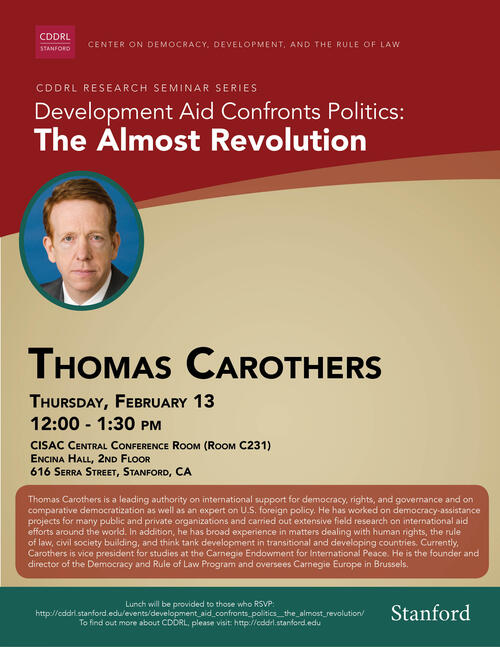
Speaker bio:

Thomas Carothers is vice president for studies at the Carnegie Endowment for International Peace. He is the founder and director of the Democracy and Rule of Law Program and oversees Carnegie Europe in Brussels.

Carothers is a leading authority on international support for democracy, rights, and governance and on comparative democratization as well as an expert on U.S. foreign policy. He has worked on democracy-assistance projects for many public and private organizations and carried out extensive field research on international aid efforts around the world. In addition, he has broad experience in matters dealing with human rights, the rule of law, civil society building, and think tank development in transitional and developing countries.

He is the author of six critically acclaimed books as well as many articles in prominent journals and newspapers. Carothers has also worked extensively with the Open Society Foundations (OSF), including currently as chair of the OSF Think Tank Fund and previously as chair of the OSF Global Advisory Board. He is an adjunct professor at the Central European University in Budapest and was previously a visiting faculty member at Nuffield College, Oxford University, and Johns Hopkins SAIS.

Prior to joining the Endowment, Carothers practiced international and financial law at Arnold & Porter and served as an attorney adviser in the Office of the Legal Adviser of the U.S. Department of State.

Carothers is the co-author (with Diane de Gramont) of Development Aid Confronts Politics: The Almost Revolution (Carnegie, 2013) and author of Confronting the Weakest Link: Aiding Political Parties in New Democracies (Carnegie, 2006); Promoting the Rule of Law Abroad: In Search of Knowledge (Carnegie, 2006); Uncharted Journey: Promoting Democracy in the Middle East, co-edited with Marina Ottaway (Carnegie, 2005); Critical Mission: Essays on Democracy Promotion (Carnegie, 2004); Funding Virtue: Civil Society Aid and Democracy Promotion, co-edited with Marina Ottaway (Carnegie, 2000); Aiding Democracy Abroad: The Learning Curve (Carnegie, 1999); and Assessing Democracy Assistance: The Case of Romania (Carnegie, 1996).

Image

CISAC Conference Room

Thomas Carothers Vice President for Studies Speaker Carnegie Endownment for International Peace
Seminars
-

Abstract:

Taiwan's system of neighborhood-level governance has origins in institutions of local control employed by both the Republican-era Kuomintang and the Japanese colonizers. In more recent times, the neighborhood wardens (lizhang, 里長) have come to play a complex set of roles, including state agent, political party operative, and community representative. Wardens of a new generation, with more women in their ranks than ever before, have adopted new practices and built different relationships with their communities, parties, and city governments compared to those of the older, often clan-based bosses.

Focusing on Taipei with glances at other locales, this paper draws on ethnographic research, interviews, surveys, public records, and other sources. It explores the particular kind of political and civic engagement that the neighborhood governance system elicits. It is statist; though independent in many respects, wardens have government-mandated duties and work closely with city and district officials. Community development associations (shequ fazhan xiehui), as well as other neighborhood groups and wardens themselves, compete for and receive government funding. Warden elections are also deeply democratic in ways that, in global perspective, are unusual for such ultra-local urban offices. Over the past 25 years, elections have become hotly contested, voter turnout has risen to remarkably high rates, and KMT dominance has partially given way to political pluralization. Citizens’ participation in this setting, like others, often shows deep divisions along partisan lines, with wardens and local associations split by party loyalties. Finally, civic engagement with the neighborhood system shows an inverted class bias. Residents with less education, for example, are more likely to know their wardens and vote in warden elections. Politics in Taiwan’s li thus has evolved substantially over time, and also contrasts in multiple ways with Western images of neighborhood politics.

Speaker Bio:

Benjamin L. Read is an Associate Professor of Politics at UC Santa Cruz. His book, Roots of the State: Neighborhood Organization and Social Networks in Beijing and Taipei (Stanford University Press, 2012) uses surveys, interviews, and participant observation to compare the ways in which constituents perceive and interact with the urban administrative structures found in China, Taiwan, and elsewhere in the region. He edited Local Organizations and Urban Governance in East and Southeast Asia: Straddling State and Society (Routledge, 2009), also on the role of state-sponsored organizations, and has published research on civil society groups as well, particularly China's nascent homeowner associations. Read's next book, Field Research in Political Science: Practices and Principles, co-authored with Diana Kapiszewski and Lauren Morris MacLean, will be published in 2014 by Cambridge University Press. His articles have appeared in the Journal of Conflict Resolution, Comparative Political Studies, the China Journal, the China Quarterly, the Washington Quarterly, and several edited books. He earned his Ph.D. in Government at Harvard University in 2003.

Daniel and Nancy Okimoto Conference Room

Benjamin L. Read Associate Professor of Politics Speaker University of California, Santa Cruz
Seminars

Encina Hall
616 Jane Stanford Way
Stanford, CA 94305-6055

0
Senior Fellow Emeritus at the Freeman Spogli Institute for International Studies
Professor, by courtesy, of Economics
marcel_fafchamps_2025.jpg

Marcel Fafchamps is a Senior Fellow Emeritus at the Freeman Spogli Institute for International Studies (FSI) and a member of the Center on Democracy, Development and the Rule of Law. Previously, he was the Satre Family Senior Fellow at FSI. Fafchamps is a professor (by courtesy) for the Department of Economics at Stanford University. His research interests include economic development, market institutions, social networks, and behavioral economics — with a special focus on Africa and South Asia.

Prior to joining FSI, from 1999-2013, Fafchamps served as professor of development economics in the Department of Economics at Oxford University. He also served as deputy director and then co-director of the Center for the Study of African Economies. From 1989 to 1996, Fafchamps was an assistant professor with the Food Research Institute at Stanford University. Following the closure of the Institute, he taught for two years at the Department of Economics. For the 1998-1999 academic year, Fafchamps was on sabbatical leave at the research department of the World Bank. Before pursuing his PhD in 1986, Fafchamps was based in Addis Ababa, Ethiopia, for 5 years during his employment with the International Labour Organization, a United Nations agency that oversees employment, income distribution, and vocational training in Africa.

He has authored two books: Market Institutions in Sub-Saharan Africa: Theory and Evidence (MIT Press, 2004) and Rural Poverty, Risk, and Development (Elgar Press, 2003), and has published numerous articles in academic journals.

Fafchamps served as the editor-in-chief of Economic Development and Cultural Change until 2020. Previously, he had served as chief editor of the Journal of African Economies from 2000 to 2013, and as associate editor of the Economic Journal, the Journal of Development Economics, Economic Development and Cultural Change, the American Journal of Agricultural Economics, and the Revue d'Economie du Développement.

He is a research associate of the National Bureau of Economic Research, an affiliated professor with J-PAL, a senior fellow with the Bureau for Research and Economic Analysis of Development, a research fellow with IZA, Germany, and with the Center for Economic and Policy Research, UK, and an affiliate with the University of California’s Center for Effective Global Action.

Fafchamps has degrees in Law and in Economics from the Université Catholique de Louvain. He holds a PhD in Agricultural and Resource Economics from the University of California, Berkeley. 

Curriculum Vitae

Publications 

Working Papers

Date Label

Stanford University

Program on Arab Reform and Democracy

Fifth Annual Conference, March 27-28, 2014, Koç University, Istanbul, Turkey

Political Change in the Arab World:

Internal Dynamics and Regional Actors

In collaboration with:

Koç University

Koç University, Istanbul, Turkey

Conferences
-

 Abstract:

That the Cairo Conference has been overshadowed by the wartime summits at Teheran and Yalta is understandable given the start of the Cold War in Europe almost immediately after the German surrender in May 1945. To understand the collapse of relations between the Anglo-American allies on the one hand and the Soviet Union on the other, it is important to look at the conferences at Teheran and Yalta, the interactions between Churchill, Roosevelt, and Stalin, the understandings they reached, and their misunderstandings. That said, the Cairo Conference also marked an important turning point in the relations between the allies in the war against Japan: China, Great Britain, and the United States, the consequences of which were critical to the defeat of Japan and the post-war order in East Asia.

The interaction of Churchill, Roosevelt, and Chiang in Cairo is every bit as compelling from a human interest perspective as the interplay between Churchill, Roosevelt, and Stalin at Teheran and Yalta, albeit less studied, and offers a sobering reminder of what can happen when policy is made at the very highest level by individuals who know relatively little about the culture of their partners and are not able to separate myths and stereotypes from realities. Summit conferences may make for good theater, but do not necessarily result in good policies as an examination of the Cairo Conference reveals.

Each of the parties at the Cairo Conference came with their own agendas, frequently contradictory. Generalissimo and Madame Chiang hoped to obtain a commitment to make the China-Burma-India theater of war the focal point in the war against Japan, a matter not only of strategic importance to them but also of poetic justice. They also sought to redress grievances against Japan and Great Britain in the post-war era. Roosevelt hoped to buoy the ego and spirits of Chiang and to insure that the Kuomintang regime would not make a separate peace with Japan thus allowing the Japanese to redeploy the nearly one million troops they had stationed in China. Churchill had no real interest in meeting with Chiang and his wife at Cairo at all, but felt obliged to humor Roosevelt and to make sure that no agreements would be reached in Cairo that would in any way prejudice British colonial interests in Southeast Asia in the post-war era. Given these conflicting agendas, it is no wonder that none of the participants would be satisfied with the results of their labors in Cairo.


Speaker Bio:

Ronald Heiferman is Professor of History and Director of the Asian Studies Program at Quinnipiac University in Hamden, Connecticut, and a Fellow of Berkeley College at Yale University. He has also taught at Connecticut College and the City University of New York. Dr. Heiferman was educated at Yale and New York University (Ph.D.). Professor Heiferman has authored or co-authored more than a dozen books, including Flying Tigers (New York: Ballantine, 1971), World War II (London: Hamlyn, 1973), Wars of the Twentieth Century (London: Hamlyn, 1974), The Rise and Fall of Imperial Japan (New York: Military Press, 1981), the Rand-McNally Encyclopedia of World II (New York: Rand-McNally, 1978), and The Cairo Conference of 1943: Roosevelt, Churchill, Chiang Kai-shek and Madame Chiang (McFarland, 2011). His latest book, The Chinese Idyll of Franklin D. Roosevelt, will be published in 2014. Professor Heiferman was a Yale-Lilly Fellow in 1978, a Yale-Mellon Fellow in 1984, and has also been the recipient of five National Endowment for the Humanities Fellowships: Duke University (1974), University of Chicago (1977), Stanford University (1980), Harvard University (1987), and the University of Texas (1991).

CISAC Conference Room

Ronald Heiferman Professor of History and Director of the Asian Studies Program Speaker Quinnipiac University
Seminars
Authors
News Type
News
Date
Paragraphs

Calling cybercrimes “the threat of the future,” former FBI Director Robert Mueller said federal investigators and businesses need to share information collected online in order to find and thwart hackers trying to disrupt Web-based networks.

“The intelligence that can be and is being collected by the private sector has to be made available in some way, shape or form to the federal government,” Mueller said.  “And that which we pick up has to be made available to the private sector. If we do not get that kind of collaboration, we will replicate what we had before 9/11 when we had stovepipes and inadequate ways of sharing information.”

Mueller – who took over the FBI a week before the Sept. 11 terrorist attacks and left the job two months ago – made his comments Friday while delivering the Payne lecture at Stanford.

“Terrorism remains today our primary threat,” Mueller said. “But tomorrow, it will probably be cyber and its various iterations.”

He said cybercrimes present a new challenge to law enforcement agencies because perpetrators are often anonymous and their motives are not always clear.

A hacker could be associated with a terrorist organization, an activist group or “an 18-year-old in his garage here in Silicon Valley who has the talent and capability and wants to make a point.”

And if the bad guy can’t be easily fingered, it’s difficult to know who should investigate the crime – the FBI, CIA, NSA or another agency. In order to pool federal resources, Mueller said a task force composed of 18 agencies works to examine cyber threats.

But their efforts to safeguard online financial, government, corporate and educational systems will go only so far without the expertise, knowledge and information gathered by Internet service providers.

“It is going to be the relationships with the private sector that are going to be absolutely critical to any success we can have in addressing cyber attacks,” he said.

Mueller’s lecture capped his weeklong visit at Stanford. He was invited by the Freeman Spogli Institute for International Studies and Stanford Law School to spend the academic year as a consulting professor and as the Payne Distinguished Lecturer.

The Payne Lectureship is named for Frank E. Payne and Arthur W. Payne, brothers who gained an appreciation for global problems through their international business operations. The position is given to someone with an international reputation as a leader, with an emphasis on visionary thinking; a broad, practical grasp of a given field; and the capacity to clearly articulate an important perspective on the global community and its challenges.

FSI Director Mariano-Florentino Cuéllar called Mueller a “perfect fit for Stanford.”

“His career embodies what I take to be the ethos of this university –practical yet principled; sensitive to complexity but also to the value of clarity and focus,” Cuéllar said.

Mueller will make several visits to Stanford during the year, spending his time working with FSI and law school scholars to develop research agendas on emerging issues in international security. He will hold graduate seminars and deliver a major lecture at the law school and work with students and fellows at the Haas Center, the law school and the Graduate School of Business. He will also mentor honors students at FSI’s Center for International Security and Cooperation and Center on Democracy, Development, and the Rule of Law.

As the FBI’s longest-serving director after J. Edgar Hoover, Mueller presided over some of the most drastic changes in the agency’s history.

The Sept. 11 attacks forced the FBI to change its priorities, placing the hunt for global terrorists at the top if its list. The counterterrorism and counterintelligence missions meant hiring more analysts and replacing the FBI’s more traditional targeting of mobsters, murderers and white-collar criminals.

Recalling his first briefing to George W. Bush after the terrorist attacks, Mueller said he began by telling the president what his agents were doing to investigate. He had been on the job for about a week, and started giving a rundown of command centers that were set up, evidence that was being collected and interviews being conducted.

“I’m about two or three minutes into it and President Bush stops me and says, `Bob, that’s all well and good,’” Mueller said. “That’s what the FBI has been doing for the hundred years of its existence. My question to you is: What is FBI doing to prevent the next terrorist attack?”

The question stumped the new director.

“I had not prepared for that question,” he said.

And it’s a question he answered continuously during the Bush and Obama administrations, and one that led to his reorganization of the FBI.

“Over those 12 years, the question has not changed,” Mueller said. “The question from both of the presidents to the FBI, to the CIA, to the community when it comes to counterterrorism is: What have you done to prevent the next terrorist attack?”

All News button
1
-

Abstract:

The Tahrir and Gezi Park protests were, amongst many other things, moments of energetic artistic creativity, in the sound world as well as other domains. Though well documented, and clearly a vital component of the political energies and transformations of the moment, they have proved difficult to think about. This talk, a musicologist's perspective, will explore them in the light of some recent thinking about crowds and social movements. 

Bio:

Martin Stokes  is King Edward Professor of Music at King's College, London. He is an ethnomusicologist, working primarily on the questions of ethnicity, identity, emotions, globalization in the context of the Middle East. His most recent book,  The Republic of Love: Cultural Intimacy in Turkish Popular Music (University of Chicago Press, 2010), has received the Merriam Prize from the Society for Ethnomusicology. Among his other publications are Celtic Modern: Music on the Global Fringe (Scarecrow 2004), Ethnicity, Identity and Music: The Musical Construction of Place (Berg 1994), and The Arabesk Debate: Music and Musicians in Modern Turkey (Oxford 1992).


Co-sponsored by the Mediterranean Studies Forum, the CDDRL Program on Arab Reform and Democracy, Department of Music, and Department of Anthropology


Encina Hall West - Room 208

Martin Stokes King Edward Professor of Music at King's College Speaker London
Conferences
-

Kavita Srivatsava, one of India's leading activists will be joining us for an informal conversation on activism around hunger, peace and justice in India.  Kavita is Secretary of People's Union for Civil Liberties, that has been at the forefront of the struggle for civil, political and socio-economic justice in India.  She is the petitioner in the internationally renowned ‘Right to food’ litigation in the Supreme Court of India, one of the most impactful socio-economic litigations in India.  She has also played a prominent role in women's movements in Rajasthan and has worked on numerous cases of violence against women. 

In addition these core issues, Kavita has also worked on issues such as communal violence, landmines in the Indo-Pak border, election monitoring in Kashmir, supporting Dalits networks an on practically every major social issue in North India.  Come join us for an informal conversation on hunger, peace and justice with this versatile activist.

Time: 3 pm

Date: 12 Nov, 2013 (Tuesday)

Location: E008 Encina Hall (East)

Supported by:

Center on Democracy, Development and the Rule of Law

Center for South Asia

San Jose Peace and Justice Center

E 008, Encina Hall (East)
616 Serra St., Stanford University

Kavita Srivastava Secretary Speaker People's Union for Civil Liberties
Seminars
Authors
News Type
News
Date
Paragraphs

The Program on Human Rights at Stanford's Center on Democracy, Development, and the Rule of Law, in partnership with the McCoy Family Center for Ethics in Society, is offering up to three summer fellowships to talented Stanford undergraduates interested in gaining practical experience at human rights organizations around the world. The fellowship will award grants of up to $5,000 for students undertaking a human rights project for a minimum of eight weeks during the summer. The deadline to apply is Dec. 9, 2013. 

Students have the opportunity to focus on issues that include freedom of speech; discrimination against women; the rights of children, elderly and minorities; and access to food, health, education and housing. Past fellows have identified and worked with a number of different organizations based in the U.S. and abroad that promote, monitor, evaluate, or advance human rights work.

Image
Photo Credit: Adrian Bonifacio

Former Human Rights Fellows include computer science major Firas Abuzaid (’14), who spent the summer of 2013 in Amman, Jordan working with Visualizing Justice, an organization that is dedicated to empowering people worldwide to create visual stories for social justice and human rights. In 2011, Adrian Bonifacio (’13) worked with the Asian Pacific Mission for Migrants, a non-governmental organization based in Hong Kong, China that promotes and defends the rights of migrant workers. Garima Sharma (’15), an economics major, spent this past summer working with Apne Aap: Women Worldwide, an anti-trafficking NGO based in Forbesganj, India.

In order to apply to the fellowship, students must submit a proposal that identifies a partner organization, a project that would contribute towards the organization’s mission and a tentative budget. The application period for the summer fellowship is now open to Stanford undergraduates through Dec. 9. To view profiles of the four 2013 fellows please click here. Additional information about the fellowship - including the application - is available here.

For more information, please contact Joan Berry, the executive director at the McCoy Family Center for Ethics in Society at joanberry@stanford.edu or Ana Bracic, the fellowship mentor at the Program on Human Rights at bracic@stanford.edu

Hero Image
100 0983 headliner logo
All News button
1

Encina Hall
616 Serra Street
Stanford, CA 94305-6055

0
Communications and Program Associate
CEO_HS.jpg

Christian Ollano joined the Center on Democracy, Development, and The Rule of Law (CDDRL) in October 2013. As a communications and program associate, he will help manage digital and social media communications between CDDRL, Stanford, and the broader international community.

Christian will bring in his skills in communication and cultural competency to increase CDDRL visibility to a wide network of alumni, faculty, and professionals. As a student, Christian was heavily involved in the Asian American community, serving in a number of capacities to strengthen community ties. From April - August 2010, Christian studied abroad in Japan as part of the Bing Overseas Studies Program where he interned at Mitsubishi Motors as a public relations intern. From 2012-2013, he worked at the Stanford Office of Undergraduate Admission on the diversity team, engaging in a number of diversity outreach initiatives aimed at increasing representation of under-served communities in the applicant pool. Most recently, Christian served as an intern for the Draper Hills Summer Fellows Program at the CDDRL assisting with logistical and programmatic efforts.

Christian holds a Bachelor of Arts in urban studies and a Masters of Arts in sociology.

Subscribe to Governance