Governance

FSI's research on the origins, character and consequences of government institutions spans continents and academic disciplines. The institute’s senior fellows and their colleagues across Stanford examine the principles of public administration and implementation. Their work focuses on how maternal health care is delivered in rural China, how public action can create wealth and eliminate poverty, and why U.S. immigration reform keeps stalling. 

FSI’s work includes comparative studies of how institutions help resolve policy and societal issues. Scholars aim to clearly define and make sense of the rule of law, examining how it is invoked and applied around the world. 

FSI researchers also investigate government services – trying to understand and measure how they work, whom they serve and how good they are. They assess energy services aimed at helping the poorest people around the world and explore public opinion on torture policies. The Children in Crisis project addresses how child health interventions interact with political reform. Specific research on governance, organizations and security capitalizes on FSI's longstanding interests and looks at how governance and organizational issues affect a nation’s ability to address security and international cooperation.

-

The Program on Human Rights (PHR), in partnership with the Stanford Program on International and Cross-Cultural Education (SPICE) and the Stanford Human Rights Education Initiative (SHREI), is working to develop a human rights curriculurm to be implemented by college and high school educators wishing to incorporate human rights into their teaching.

As part of the Stanford Human Rights Education initiative, the PHR helps organize a series of workshops with Bay area community college instructors to enable the implementation of the human rights curricula in community colleges. Under this project, the PHR also supervises students from Stanford School of Education to develop teaching modules that include PHR's areas of research, such as human trafficking and indigenous populations rights, in accessible reference materials for informing and helping community college educators in their lesson plans.

All workshops and activities on this vital pedagogical initiative are documented and available online on SHREI's website: http://shrei.stanford.edu

All workshops and activities on this vital pedagogical initiative are documented and available online on SHREI's website: http://shrei.stanford.edu

Helen Stacy Senior Fellow at the Freeman Spogli Institute for International Studies (FSI) and Director of the Program on Human Rights at CDDRL Speaker
Lectures
Paragraphs

Abstract: 

This paper offers a systematic account of political regime changes in Sub-Saharan Africa from 1996-2010. Are democratic transition processes a variance of a singular domestic politico-institutional model (political protest, political mobilization, and democratization), as Michael Bratton and Nicolas van de Walle (1997) claimed, or do other variables matter in democratic transition processes? What conditions create and maintain democracy in Sub-Saharan Africa? Combining qualitative and quantitative methods, this paper examines the development of Sub-Saharan African political regimes, contrasting the pre and post-Cold War periods (1960-1989 and 1996-2010) to understand their determinants. It focuses on the new transformations observed since the beginning of the twenty-first century, assessing recent regime history and examining the factors (political, governance, economic and international) that have contributed to democratic development in some states and autocracy in others. The findings show that democratic transitions are not only the variance of the Bratton and Van de Walle model, which downplays economic and international variables. The process is mainly, but not always, determined by domestic politico-institutional factors. Foreign intervention and economic conditions are also important determinants of democratization in Sub-Saharan Africa in the post-Cold War era.

All Publications button
1
Publication Type
Working Papers
Publication Date
Journal Publisher
CDDRL Working Papers
Authors
Landry Signé

Jerry Yang & Akiko Yamazaki
Environment & Energy Building
473 Via Ortega, First Floor
Stanford University
Stanford, CA 94305-4225

0
Charles Louis Ducommun Professor, Humanities and Sciences
Director, Bill Lane Center for the American West
Professor, Political Science
CDDRL Affiliated Faculty
bruce_cain.jpg

Bruce E. Cain is a Professor of Political Science at Stanford University and Director of the Bill Lane Center for the American West. He received a BA from Bowdoin College (1970), a B Phil. from Oxford University (1972) as a Rhodes Scholar, and a Ph D from Harvard University (1976). He taught at Caltech (1976-89) and UC Berkeley (1989-2012) before coming to Stanford. Professor Cain was Director of the Institute of Governmental Studies at UC Berkeley from 1990-2007 and Executive Director of the UC Washington Center from 2005-2012. He was elected the American Academy of Arts and Sciences in 2000 and has won awards for his research (Richard F. Fenno Prize, 1988), teaching (Caltech 1988 and UC Berkeley 2003) and public service (Zale Award for Outstanding Achievement in Policy Research and Public Service, 2000). His areas of expertise include political regulation, applied democratic theory, representation and state politics. Some of Professor Cain’s most recent publications include “Malleable Constitutions: Reflections on State Constitutional Design,” coauthored with Roger Noll in University of Texas Law Review, volume 2, 2009; “More or Less: Searching for Regulatory Balance,” in Race, Reform and the Political Process, edited by Heather Gerken, Guy Charles and Michael Kang, CUP, 2011; and “Redistricting Commissions: A Better Political Buffer?” in The Yale Law Journal, volume 121, 2012. He is currently working on a book about political reform in the US.

CV

About

The Program on American Democracy in Comparative Perspective was inaugurated in 2013 within Stanford’s Center on Democracy, Development, and the Rule of Law. It aims to investigate problems with American democracy, including polarization and gridlock, poor governance, and declining trust in government institutions. It also analyzes policy initiatives and institutional reforms that have the greatest potential to address those features of American democracy that are most impairing its performance.

India’s right to information movement had tremendous success in making strategic use of transparency for securing government accountability. Thanks to this success, demanding and disseminating information are among the most used tools in the work of activist organizations in the country today. Public records are typically demanded on paper and disseminated manually, making the process costly and slow. Over the last few years, governments have started making relevant information available online.

Recognizing both historical and contemporary trends in autocratic rule may be fundamental to addressing future research and policy. Instead of treating all governments as democratic or autocratic, recent scholarship in comparative politics and international relations has recognized the importance of opening the “black box” of autocratic rule to better understand varying behavior - such as human rights protection, use of repression, war-proneness, and trade - across these countries.

Asylum Access
1611 Telegraph Avenue
Suite #1111
Oakland, CA 94612

0
PSE Visiting Practitioner in Residence, 2013-14
emily_hs.jpg

Emily Arnold-Fernández was a social entrepreneur in residence during the fall 2012 quarter with CDDRL's Program on Social Entrepreneurship. She will be spending the 2013/14 academic year as a practitioner-in-residence with the Program on Social Entrepreneurship.

She is the founder and executive director of Asylum Access, is a social entrepreneur and human rights pioneer. Recognizing that refugees throughout Africa, Asia and Latin America – some of whom flee with nothing more than the clothes on their backs – were almost always unequipped to go into a legal proceeding in a foreign country, alone, and explain why they should not be deported, Emily founded Asylum Access to advocate on behalf of refugees seeking to assert their rights.

“For half a century, international law has given refugees the rights to live safely,
seek employment, send children to school and rebuild their lives. But those rights are
meaningless unless they are respected on the ground,” she says. “Asylum Access
provides a rare opportunity to fill a gaping hole in our human rights system – by making
refugee rights a reality for real people.”

For her innovative approach to the global refugee crisis, Emily was honored by the
Dalai Lama as one of 50 “Unsung Heroes of Compassion” from around the world (2009)
and Waldzell Institute’s Architects of the Future Award (2012). She has also been
recognized as Pomona College’s Inspirational Young Alumna (2006), awarded the
prestigious Echoing Green fellowship (2007), and recognized as the New Leaders
Council’s 40 Under 40 (2010), among others. Emily’s ground-breaking work with
Asylum Access has earned her international speaking invitations and widespread media
attention, including the Rotary International Peace Symposium (2008, 2009), the UN
High Commissioner for Refugees’ Annual Consultations (2008, 2009), a cover feature in
the Christian Science Monitor (September 2009), and the San Francisco Examiner’s
Credo column (July 2011). She holds a B.A. cum laude from Pomona College and a J.D.
from Georgetown University Law Center.

Committed to sharing her knowledge with young and aspiring social
entrepreneurs, Emily serves as an adjunct professor at the University of San Francisco,
teaching a course in social entrepreneurship. In Fall 2012, Emily was selected as one of
three Social Entrepreneurs in Residence at Stanford where she participated as “expert
respondent” in Stanford Law School’s Law, Social Entrepreneurship and Social Change
course, and in Spring 2013, Emily led an intensive skills-building course on social
entrepreneurship at Pomona College.

A visionary human rights activist, Emily Arnold-Fernández takes her inspiration
from a line in a June Jordan poem: “We are the ones we have been waiting for.”

-

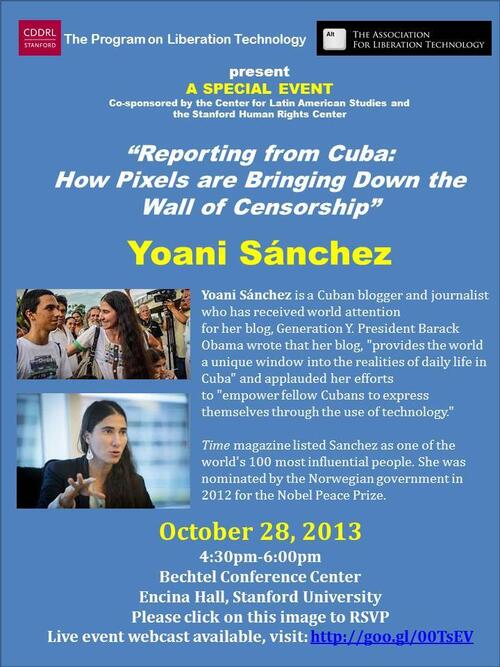
*****LIBERATION TECHNOLOGY SPECIAL EVENT****
Change of location- now in Bechtel Conference Center
Encina Hall

A livestream will be available for this event. To watch please click here

Co-sponsored by the Association for Liberation Technology, the Center for Latin American Studies and the Stanford Human Rights Center 

Yoani Sánchez was born in 1975 in a tenement in Central Havana and, on starting school, she proudly put the Little Pioneer scarf around her neck, vowing to “Be like Che!” Fourteen when the Berlin Wall fell, her adolescence was marked by what Fidel Castro called “a special period in a time of peace,” a time of terrible scarcity and broad disillusionment.

At the University of Havana Yoani’s incendiary thesis, Words Under Pressure: A Study of the Literature of the Dictatorship in Latin America, eliminated the idea of an academic career. Already married—to Reinaldo Escobar, an ousted-journal­ist-turned-elevator-mechanic—and a mother, she cobbled together a living as a Spanish teacher and tour guide. In 2002, Yoani decided to emigrate, but in 2004 she returned to Cuba. “I promised myself that I would live in Cuba as a free person, and accept the consequences,” she said. All of her work since then has been a keeping of that promise.

Yoani launched her blog, Generation Y, in April of 2007; later that year a Reuters article brought her to the attention of the world. In 2008 she won Spain’s Ortega y Gasset Prize for digital journalism and Time magazine named her one of the 100 most influential people in the world. Recognition and awards followed, including an interview with Barack Obama, posted in her blog, and nomination by the Norwegian government for the 2012 Nobel Peace Prize.

Yoani is now the journalist she always wanted to be, one deeply immersed in technology. She started The Blogger Academy in her apartment in Havana and runs frequent courses in Twitter. She has published a manual on WordPress, and she works as a correspondent for Spain’s El Pais newspaper. Yoani plans to launch a newspaper in Havana, and is currently working toward that goal.

A livestream will be available for this event. To watch pleaseclick here 

Image

Bechtel Conference Center

Yoani Sanchez Blogger "Generation Y", Journalist and Publisher in Cuba Speaker
Seminars
Date Label
Subscribe to Governance