FSI researchers consider international development from a variety of angles. They analyze ideas such as how public action and good governance are cornerstones of economic prosperity in Mexico and how investments in high school education will improve China’s economy.
They are looking at novel technological interventions to improve rural livelihoods, like the development implications of solar power-generated crop growing in Northern Benin.
FSI academics also assess which political processes yield better access to public services, particularly in developing countries. With a focus on health care, researchers have studied the political incentives to embrace UNICEF’s child survival efforts and how a well-run anti-alcohol policy in Russia affected mortality rates.
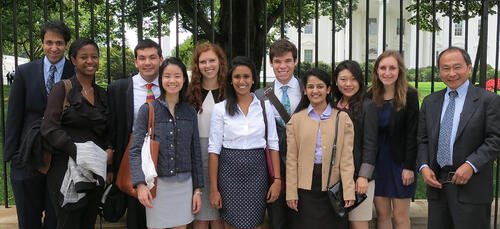
FSI’s work on international development also includes training the next generation of leaders through pre- and post-doctoral fellowships as well as the Draper Hills Summer Fellows Program.
The Politics of Polarization: Taiwan in Comparative Perspective
[[{"fid":"209960","view_mode":"crop_870xauto","fields":{"format":"crop_870xauto","field_file_image_description[und][0][value]":"","field_file_image_alt_text[und][0][value]":false,"field_file_image_title_text[und][0][value]":false,"field_credit[und][0][value]":"Arlene Hsu","field_caption[und][0][value]":"Taipei at night with Taipei 101. 28 February 2009.","field_related_image_aspect[und][0][value]":"0","thumbnails":"crop_870xauto"},"type":"media","field_deltas":{"1":{"format":"crop_870xauto","field_file_image_description[und][0][value]":"","field_file_image_alt_text[und][0][value]":false,"field_file_image_title_text[und][0][value]":false,"field_credit[und][0][value]":"Arlene Hsu","field_caption[und][0][value]":"Taipei at night with Taipei 101. 28 February 2009.","field_related_image_aspect[und][0][value]":"0","thumbnails":"crop_870xauto"}},"link_text":null,"attributes":{"width":"870","class":"media-element file-crop-870xauto","data-delta":"1"}}]]
Over the past year and more, Taiwan’s political elite has been deadlocked over the question of deepening economic relations with the People’s Republic of China. This controversial issue has led to a standoff between the executive and legislative branches, sparked a frenzy of social activism and a student occupation of the legislature, and contributed to President Ma Ying-jeou’s deep unpopularity.
On October 17-18, the Taiwan Democracy Project at CDDRL, with the generous support of the Taipei Economic and Culture Office, will host its annual conference at Stanford University to examine the politics of polarization in Taiwan.
This conference will bring together specialists from Taiwan, the U.S., and elsewhere in Asia to examine the sources and implications of this political polarization in comparative perspective. It will include a special case study of the Trade in Services Agreement with China that triggered this past year’s protests, as well as a more general overview of the politics of trade liberalization in Taiwan, prospects for Taiwan’s integration into the Trans-Pacific Partnership and other regional trade agreements, and a consideration of the implications for Taiwan’s long-term democratic future.
Conference speakers will include: Chung-shu Wu, the president of the Chung-hwa Institute of Economic Research (CIER) in Taipei; Steve Chan of the University of Colorado; Roselyn Hsueh of Temple University; Yun-han Chu, the president of the Chiang Ching-kuo Foundation; and Thitinan Pongsudhirak of Chulalongkorn University in Bangkok.
Panels will examine the following questions:
1. What are the sources and implications of political polarization in Taiwan, and how have these changed in recent years?
2. How does Taiwan’s recent experience compare to political polarization in other countries in Asia (e.g. South Korea, Thailand) and elsewhere (the US)?
3. To what extent does the latest political deadlock in Taiwan reflect concern over the specific issue of trade with the People’s Republic of China, versus a deeper, systemic set of problems with Taiwan’s democracy?
4. How are globalization and trade liberalization reshaping Taiwan’s domestic political economy, and what are the prospects for forging a stronger pro-trade coalition in Taiwan that transcends the current partisan divide?
The conference will take place October 17-18 in the Bechtel Conference Room in Encina Hall at Stanford University. It is free and open to the public.
Conference Resources
Conference Papers
How Cross-Strait Trade and Investment Is Affecting Income and Wealth Inequality in Taiwan by Chien-Fu Lin, National Taiwan University
Generational Differences in Attitudes towards Cross-Straits Trade by Ping-Yin Kuan, Department of Sociology & International Program in Asia-Pacific Studies, National Chengchi University
Change and the Unchanged of Polarized Politics in Taiwan by Min-Hua Huang, National Taiwan University; Center for East Asia Policy Studies, The Brookings Institution
Social Media, Social Movements and the Challenge of Democratic Governability by Boyu Chen, National Sun Yat-sen University, Institute of Political Science
Coping with the Challenge of Democratic Governance under Ma Ying-jeou by Yun-han Chu, National Taiwan University
Taiwan’s Bid for TPP Membership and the Potential Impact on Taiwan-U.S. Relations by Kwei-Bo Huang, National Chengchi University, Department of Diplomacy
In the Wake of the Sunflower Movement: Exploring the Political Consequences of Cross-Strait Integration by Pei-shan Lee, National Chung Cheng University, Political Science Department
The Roots of Thailand’s Political Polarization in Comparative Perspective by Thitinan Pongsudhirak, Chulalongkorn University; The Institute of Security and International Studies
The Role of the United States in Cross-Strait Economic Integration by Chen-Dong Tso, National Taiwan University
The China Factor and the Generational Shift over National Identity by Mark Weatherall, Taiwan Foundation for Democracy
Taiwan’s Strategy for Regional Economic Integration by Chung-Shu Wu, Chung-Hua Institution for Economic Research
Polarized Electorates in South Korea and Taiwan: The Role of Political Trust under Conservative Governments by Hyunji Lee, Institute of Asian Research, University of British Columbia
Polarization in Taiwan Politics by Steve Chan, University of Colorado, Boulder
CDDRL welcomes incoming fellows
Hometown: Virginia Beach, Virginia
Academic Institution: Harvard University
Discipline and date of graduation: Ph.D. in Government, Summer 2014
Research Interests: Politics and economics in non-democracies, political economy of development, political violence, food security
Manuscript working title: Political Survival and the Modern Prince
What attracted you to the CDDRL Pre/post-doctoral program? The opportunity to be surrounded by other scholars with similar substantive interests but diverse geographic expertise is extremely exciting to me. I think it's precisely what I need at the moment.
What do you hope to accomplish during your year-long residency at the Center? I will spend most of the year preparing the book manuscript for submission. The dissertation asked how modern African autocrats survive nominally democratic institutions. To focus on the elites who comprise the regime -- as well as their political parties and the elections in which they compete -- the dissertation focused exclusively on the Republic of Congo, ruled by President Denis Sassou Nguesso for all but five years since 1979. I expect to spend much of the year ascertaining to what extent the arguments are generalizable to other parts of autocratic Africa and beyond.
Please state a fun fact about yourself! I really enjoy cooking. A lot. I've cooked through most of The French Laundry Cookbook and am now cooking through the Eleven Madison Park Cookbook. Honestly, I spend way too much time cooking. It's sort of absurd.
Hometown: Beirut, Lebanon
Academic Institution: Yale University
Discipline and expected date of graduation: Ph.D. in Political Science, expected May 2015
Research Interests: Authoritarianism; Elite Networks; Coalitional Politics; Social Exclusion; Middle East Politics
Dissertation Topic/Title: The Ties that Bind: Making and Breaking Authoritarian Ruling Coalitions
What attracted you to the CDDRL Pre/post-doctoral program? My research fits well with CDDRL’s substantive focus on democratization. Opening the black box of authoritarian coalitional formation and evolution is essential for understanding how ruling coalitions may come apart. I am also eager to collaborate with scholars in The Program on Arab Reform and Democracy, especially at a time when the Arab uprisings and coalitional breakdowns have unfortunately moved towards reconfigured authoritarian arrangements.
What do you hope to accomplish during your year-long residency at the Center? As a fellow at CDDRL, I plan to complete my dissertation and begin revising it for publication. I also plan to produce an article on the methodological and ethical challenges of conducting archival research and elite interviews in authoritarian settings.
Please state a fun fact about yourself! I’m a catless cat lady.
Hometown: Thousand Oaks, CA
Academic Institution: Stanford University
Discipline and expected date of graduation: Ph.D. in Political Science, expected June 2015
Research Interests: statebuilding, state weakness, international security, conflict, political development
Dissertation Topic/Title: The International Sources of Sovereignty and State Weakness
What attracted you to the CDDRL Pre/post-doctoral program? My research is broadly focused on the understanding the causes of incomplete governance and political underdevelopment. These are among the core themes in CDDRL's research programs, and CDDRL brings together both rigorous scholarship and a sensitive to policy-relevant research in these thematic areas. For that reason, I am excited about joining CDDRL's community of researchers, particularly those engaged in scholarship in the Governance Project and in the Program on Poverty and Governance. I look forward to productive conversations around the Center, and to helpful guidance and advice.
What do you hope to accomplish during your year-long residency at the Center? During my residency at CDDRL, I plan to complete my dissertation writing. I am also eager to begin a new project with another CDDRL pre-doctoral fellow in which we examine the relationship between statebuilding and democracy in developing countries.
Please state a fun fact about yourself! I make an excellent cheesecake!
Hometown: Nairobi, Kenya
Academic Institution: Stanford University
Discipline and expected date of graduation: PhD in Political Science, expected June 2015
Research Interests: Institutions, Legislative Studies, Political Economy of Development, Elections and Governance, Natural Resource Management and Regional Cooperation
Dissertation Topic/Title: Institutions and Political Change: The Case of African Legislatures
What attracted you to the CDDRL Pre/post-doctoral program? I was attracted to CDDRL because of the centers strong emphasis on the need to link academic research with policy. I am interested in the ways in which institutional change impact development outcomes through the evolution of better, accountable governance and public policies. My research on legislatures includes analyses of how levels legislative institutionalization impact public finance management in African states.
What do you hope to accomplish during your year-long residency at the Center? I hope to finish writing my dissertation, to publish at least two chapters of the dissertation as stand alone papers, and to continue contributing to the policy world through my writing and consultancies.
Please state a fun fact about yourself! I run half marathons. Because I am Kenyan.
Hometown: Guadalajara, Mexico
Academic Institution: Stanford University
Discipline and expected date of graduation: PhD in Political Science, expected 2015
Research Interests: Economics of Crime and Violence, Legislative Studies, Political Economy of Development.
Dissertation Topic/Title: Three Essays on the Political Economy Drug-Related Violence in Mexico
What attracted you to the CDDRL Pre/post-doctoral program? CDDRL is a great place for students doing comparative work since it has a unique and vibrant community of faculty, visiting scholars, and policy makers from all over the world, including an important number of specialists in Latin American politics.
Moreover, the Center’s research agenda substantially aligns with my work on the relationship between democracy, partisanship, and governments’ efforts to contain and reduce crime and violence.
Finally, the work of the Program on Poverty and Governance at CDDRL on criminal violence and citizen security throughout Latin America has significantly shaped my PhD dissertation and research agenda.
What do you hope to accomplish during your year-long residency at the Center? I would like to complete the part of my dissertation that explores the relationship between Mexico’s democratization, criminal violence, and the government’s enforcement of the rule of law. In addition, the pre-doctoral fellowship will facilitate the completion of different ongoing research projects I am involved with at the Center.
Please state a fun fact about yourself! I’m a good salsa dancer, jigsaw puzzle enthusiast, and amateur beach volleyball player.
Hometown: Bremen, GA
Academic Institution: University of California, Berkeley
Discipline and expected date of graduation: Ph.D. in Political Science, expected May 2015
Research Interests: Comparative Politics, Policing, Governance, Rule of Law, and Chinese Politics
Dissertation Topic/Title: Policing China: Struggles of Law, Order, and Organization for Ground-Level Officers
What attracted you to the CDDRL Pre/post-doctoral program? CDDRL's mission to understand how the rule of law and government institutions operate speaks directly to my work on the police bureaucracy. The Center's multidisciplinary approach brings together.scholars and intellectuals, making it an excellent forum for grappling with issues of institutional reform and local state security. As one of the newest additions to CDDRL, I look forward to engaging this community as I continue to investigate the weaknesses and strengths of the institutional apparatus China employs to carry out state priorities of reform and control.
What do you hope to accomplish during your year-long residency at the Center? While at CDDRL I will finish my dissertation and prepare two chapters for publication. I also plan to lay the groundwork for my next project on the rapidly evolving relationship between police and media.
Please state a fun fact about yourself! I'm a terrible gardener.
Coalition against corruption
About the Conference
CoCo 2014 was the inaugural edition of the Coalition against Corruption (CoCo) conference co-hosted by The Center on Democracy, Development and the Rule of Law, Stanford University, Janaagraha Centre for Citizenship and Democracy, Bangalore and Sunlight Foundation, Washington DC.
CoCo brought together participants from over fifteen countries and across a wide spectrum comprising researchers and academics, elected representatives, government officials, practitioners, civil society organisations, technologists and citizens.
Over three days, we engaged in conversations on a wide range of issues on the following corruption types:
- Corruption in public resource allocation
- Political financing and lobbying
- Corruption in public procurement
- Retail corruption in public services for citizens
CoCo 2014 explored these corruption-types in an innovative format across the themes of rule of law, tools of transparency and accountability and the impact of grassroots pressure groups and digital platforms.
Besides the four plenaries, CoCo allowed plenty of time for short presentations, for showcasing practitioner successes and for open group discussions. Part of the agenda was also an “Unconference” session for surfacing and discussing critical challenges that went beyond the four corruption-types in focus at CoCo.
Conference Partners
Janaagraha Centre for Citizenship and Democracy (Janaagraha) is a Bangalore based not for profit organisation committed to transforming quality of life in India’s cities and towns.
Janaagraha defines quality of life not just as quality of infrastructure and services, but also as quality of citizenship in a democracy. Along with its sister organisation Jana Urban Space Foundation, it runs multiple programs on transforming cities and citizenship. These programmes are based on a Theory of Change built around a City-Systems framework that Janaagraha has developed over many years of grassroots work with citizens, and reforms advocacy with government for scalable and sustainable change.
Sunlight Foundation is a leading innovator in the transparency and accountability space, bringing greater government transparency by engaging individual citizens and communities - technologists, policy analysts, open government advocates and ordinary citizens to demand policies that ensure government accountability.
Conference Video Playlist
Bangalore, India
Celebrating a decade of impact
In August, CDDRL’s Draper Hills Summer Fellows program marked its 10-year anniversary by welcoming 20 of its alumni back to Stanford for a weeklong reunion.
Supported by Ingrid Hills and Bill and Phyllis Draper, the program brings practitioners from across the developing world to Stanford for a three-week intensive academic training program on democracy, good governance and rule of law reform.
From Afghanistan to Venezuela, the program’s alumni form a network of over 250 leaders working under some of the most adverse conditions.
Fellows apply the academic lessons - taught by leading Stanford faculty - to practical problems in their countries. Many learn how to use technology to expose corruption, draw on case studies to improve the quality of public administration and borrow examples from history to build institutions in the aftermath of revolution.
An alumni network program - supported by the Omidyar Network - host’s global workshops, Stanford reunions and a robust communication platform to connect this global community of democratic leaders.
During the reunion, alumni attended sessions led by former Secretary of State Condoleezza Rice and Michael McFaul who has just returned back to Stanford after serving as U.S. ambassador to Russia.
While back on campus, some alumni found the occasion to reflect on the program and its impact on their professional and personal lives. Their inspiring stories are testament to the incredible work they are doing to build democratic systems in some of the most complex corners of the world.
Fighting for Democracy in Ukraine
When the EuroMaidan protests started in November 2013 in Kiev, Andriy Shevchenko (09’) was in Independence Square calling for the resignation of Ukraine’s President Viktor Yanukovych. It was there that he reflected on the lessons from the Draper Hills Summer Fellows Program on social mobilization as he helped translate the demands of protesters into political action.
Shevchenko, who was elected to parliament in 2006, is one of nine fellows from Ukraine who are part of a new generation of leadership working to move their country away from Russian influence and towards greater European integration. Working as journalists, civil society leaders and politicians, these fellows are pushing for democratic institutions and political accountability in a country transitioning towards democracy.
Before joining politics, Shevchenko was a journalist and founded the first independent 24-hour news channel – 5th Channel – which covered the events surrounding Ukraine’s 2004 Orange Revolution.
Shevchenko describes the program as “one of the greatest experiences of his life” because of the knowledge, friendships and inspiration he gained from his participation in the program. Leaving the program with an expanded interest in human rights, Shevchenko now serves as the first deputy chairman of the Human Rights Commission in Ukraine.
While the struggle for democracy continues in Ukraine, Shevchenko will draw on the program’s teachings and the strength of the peer community during these challenging times.
Empowering Women through Education in Afghanistan
Sakeena Yacoobi (08’) understands firsthand how education can change a life. After receiving her degree in the U.S., Yacoobi returned to Afghanistan with a mission to empower women and children through access to quality education. In 1995, Yacoobi founded the Afghan Institute of Learning (AIL) and set off to change the system of education – often operating underground due to threats from the Taliban – by training a network of teachers and opening women’s learning centers.
Yacoobi was overwhelmed with interest from women seeking education and in decades AIL has set up 300 learning centers in 12 provinces, serving over 11 million people in Afghanistan. Training is at the heart of AIL’s model and Yacoobi has applied much of what she has learned from the Draper Hills Summer Fellows Program to offer civic education to AIL’s students.
As the country emerges from over three decades of conflict, Yacoobi credits the Program and its curriculum in democracy and leadership for inspiring Afghan citizens to be more civic minded and involved in democratic processes - such as voting. Recognizing the current political struggles that Afghanistan faces, Yacoobi hopes that these important lessons will help to build a greater democratic culture for the country’s future generations.
Building New Institutions of Democracy in Argentina
Laura Alonso (12’) never envisioned herself as a politician. With an esteemed career in civil society as the head of the Argentine chapter of Transparency International, she had always operated outside of the political system. But one day she realized that she might be more effective inside government.
In 2009, Alonso was elected as a member of Congress for the city of Buenos Aires and began to advocate for greater transparency and reform Her push for better governance has often put her at odds with her party and the subject of attacks, but she continues to defend her reform agenda.
Re-elected to a second term of Congress in 2013, Alonso has set out to improve the quality of democracy in Argentina by strengthening institutions that deliver public services and to help steer the country in a different direction. From time to time, she has been able to reflect on the case studies taught in the Draper Hill’s Summer Fellows Program by Francis Fukuyama to inform her policymaking.
While Alonso is unsure of what her future may hold - may it be in politics or elsewhere - she will continue to raise her voice when necessary to make the government more accountable to the people of Argentina.
Defending Civil Society in Russia
Anna Sevortian (06’) served as the Russian director for Human Rights Watch when the crackdown on civil society began in 2011. Non-profit organizations (NGO’s) receiving foreign funding were labeled as foreign spies and forced to register their operations with the Russian government.
Sevortian describes this repressive environment as reminiscent of Soviet times when propaganda and inspections were common practice. Cut off from funding, many NGO’s supporting important social needs have been forced to shut their doors.
A longtime journalist, Sevortian spent three years at Human Right’s Watch in the height of this crackdown documenting worsening conditions for civil society and also covering Belarus, Ukraine and the North Caucuses.
It was during this period that one of the Draper Hills Summer Fellows Program’s founding faculty members - Michael McFaul - was serving as U.S. ambassador to Russia and Sevortian was able to raise human rights concerns to him directly.
Sevortian now serves as the executive director for the newly launched EU-Russia Civil Society Forum in Berlin, a platform designed to amplify the voice of civil society. Despite the deteriorating situation in Russia, Sevortian hopes to use the forum to help encourage the growth and development of civil society in Russia and Europe.
Keynote Address: Hon. Aminu Waziri Tambuwal
Keynote address by Rt. Hon. Aminu Waziri Tambuwal CFR, Speaker, House of Representatives, National Assembly of Nigeria on the occasion of the Omidyar Network African Democracy and Leadership Forum organized by the Stanford University Center on Democracy, Development, and the Rule of Law (CDDRL) on the 26th of June, 2014, at the Sheraton Hotel, Abuja.
This address was delivered as part of the conference on 'The Future of Human Rights and Good Governance in Africa' held from June 26 - 28, 2014, in Abuja, Nigeria, which convened many members of the Omidyar Network's Africa Leadership Forum.
European Union can overcome extremism vote, Stanford faculty say
Appeared in Stanford Report, May 29, 2014
By Clifton B. Parker
The electoral eruption of anti-European Union populism is a reflection of structural flaws in that body but does not represent a fatal political blow, according to Stanford scholars.
In the May 25 elections for the European Parliament, anti-immigration parties won 140 of the 751 seats, well short of control, but enough to rattle supporters of the EU, which has 28 member nations. In Britain, Denmark, France and Greece, the political fringe vote totals stunned the political establishments.
Stanford political scientist Francis Fukuyama said the rise of extremism and anti-elitism is not surprising in the wake of the 2008 economic downturn and subsequent high levels of unemployment throughout Europe. In one sense, the EU elites have themselves to blame, he said.
"The elites who designed the EU and the eurozone failed in a major way," he said. "There was a structural flaw in the design of the euro (monetary union absent fiscal union, and the method of disciplining countries once in the zone)," said Fukuyama, the Olivier Nomellini Senior Fellow at Stanford's Freeman Spogli Institute for International Studies and the Center for Democracy, Development and the Rule of Law, and Research Afflilate at The Europe Center.
Some have argued that the European Union should adopt a form of fiscal union because without one, decisions about taxes and spending remain at the national level.
As Fukuyama points out, this becomes a problem, as in the case of a debt-ridden Greece, which he believes should not have qualified for EU membership in the first place. In fact, he said, it would have been better for Greece itself to leave the euro at the outset of the 2008 crisis.
Still, Fukuyama said the big picture behind the recent election is clear – it was a confluence of issues and timing.
"It is a bit like an off-year election in the U.S., where activists are more likely to vote than ordinary citizens," he said.
Fukuyama believes the EU will survive this electoral crisis. "I think the EU will be resilient. It has weathered other rejections in the past. The costs of really exiting the EU are too high in the end, and the elites will adjust, having been given this message," he said.
Meanwhile, the populist parties in the different countries are not unified or intent on building coalitions with each other.
"Other than being anti-EU, most of them have little in common," Fukuyama said. "They differ with regard to specific positions on immigration, economic policy, and they respond to different social bases."
Ongoing anger
Dan Edelstein, a professor of French, said the largest factor for success by extremist candidates was "ongoing anger toward the austerity policy imposed by the EU," primarily by Germany.
Edelstein estimates that a large majority of French voters are still generally supportive of the EU. For the time being, the anti-EU faction does not have a majority, though they now have much more representation in the European Parliament.
Edelstein noted existing strains among the anti-EU parties – for example, the UK Independence Party in Britain has stated that it would not form an alliance with the National Front party in France.
Immigration remains a thorny issue for some Europeans, Edelstein said.
"'Immigration' in most European political debates, tends to be a synonym for 'Islam.' While there are some countries, such as Britain, that are primarily worried about the economic costs of immigration, in most continental European countries, the fears are cultural," he said.
As Edelstein put it, Muslims are perceived as a "demographic threat" to white or Christian Europe. However, he is optimistic in the long run.
"It seems a little early to be writing the obituary of the EU. Should economic conditions improve over the next few years, as they are predicted to, we will likely see this high-water mark of populist anger recede," said Edelstein.
Cécile Alduy, an associate professor of French, writes in the May 28 issue of The Nation about how the ultra-right-wing National Front came in first place in France's election.
"This outcome was also the logical conclusion of a string of political betrayals, scandals and mismanagement that were only compounded by the persistent economic and social morass that has plunged France into perpetual gloom," she wrote.
Historian J.P. Daughton said that like elsewhere in the world, immigration often becomes a contentious issue in Europe in times of economic difficulties.
"High unemployment and painful austerity measures in many parts of Europe have led extremist parties to blame immigrants for taking jobs and sapping already limited social programs," he said.
Anti-immigration rhetoric plays particularly well in EU elections, Daughton said. "Extremist parties portray European integration as a threat not only to national sovereignty, but also to national identity.
Edelstein, Alduy and Daughton are all Faculty Affiliates of The Europe Center.
Wake-up call
Russell A. Berman, a professor of German studies and comparative literature, said many Europeans perceive the EU as "somehow impenetrable, far from the civic politics of the nation states."
As a result, people resent regulations issued by an "intangible bureaucracy," and have come to believe that the European Parliament has not grappled with major issues such as mustering a coherent foreign policy voice, he said.
"The EU can be great on details but pretty weak on the big picture," said Berman, who is the Walter A. Haas Professor in the Humanities, Senior Fellow at the Hoover Institution, and Faculty Affiliate of The Europe Center. "It is this discrepancy that feeds the dissatisfaction."
Yet he points out that the extremist vote surged in only 14 nations of the EU – in the other 14, there was "negligible extremism," as he describes it.
"We're a long way from talking about a fatal blow, but the vote is indeed a wake-up call to the centrists that they have to make a better case for Europe," Berman said.
European Union can overcome extremism vote, Stanford faculty say
The electoral eruption of anti-European Union populism is a reflection of structural flaws in that body but does not represent a fatal political blow, according to Stanford scholars.
In the May 25 elections for the European Parliament, anti-immigration parties won 140 of the 751 seats, well short of control, but enough to rattle supporters of the EU, which has 28 member nations. In Britain, Denmark, France and Greece, the political fringe vote totals stunned the political establishments.
Stanford political scientist Francis Fukuyama said the rise of extremism and anti-elitism is not surprising in the wake of the 2008 economic downturn and subsequent high levels of unemployment throughout Europe. In one sense, the EU elites have themselves to blame, he said.
"The elites who designed the EU and the eurozone failed in a major way," he said. "There was a structural flaw in the design of the euro (monetary union absent fiscal union, and the method of disciplining countries once in the zone)," said Fukuyama, the Olivier Nomellini Senior Fellow at Stanford's Freeman Spogli Institute for International Studies and the Center on Democracy, Development and the Rule of Law, and Research Afflilate at The Europe Center.
Some have argued that the European Union should adopt a form of fiscal union because without one, decisions about taxes and spending remain at the national level.
As Fukuyama points out, this becomes a problem, as in the case of a debt-ridden Greece, which he believes should not have qualified for EU membership in the first place. In fact, he said, it would have been better for Greece itself to leave the euro at the outset of the 2008 crisis.
Still, Fukuyama said the big picture behind the recent election is clear – it was a confluence of issues and timing.
"It is a bit like an off-year election in the U.S., where activists are more likely to vote than ordinary citizens," he said.
Fukuyama believes the EU will survive this electoral crisis. "I think the EU will be resilient. It has weathered other rejections in the past. The costs of really exiting the EU are too high in the end, and the elites will adjust, having been given this message," he said.
Meanwhile, the populist parties in the different countries are not unified or intent on building coalitions with each other.
"Other than being anti-EU, most of them have little in common," Fukuyama said. "They differ with regard to specific positions on immigration, economic policy, and they respond to different social bases."
Ongoing anger
Dan Edelstein, a professor of French, said the largest factor for success by extremist candidates was "ongoing anger toward the austerity policy imposed by the EU," primarily by Germany.
Edelstein estimates that a large majority of French voters are still generally supportive of the EU. For the time being, the anti-EU faction does not have a majority, though they now have much more representation in the European Parliament.
Edelstein noted existing strains among the anti-EU parties – for example, the UK Independence Party in Britain has stated that it would not form an alliance with the National Front party in France.
Immigration remains a thorny issue for some Europeans, Edelstein said.
"'Immigration' in most European political debates, tends to be a synonym for 'Islam.' While there are some countries, such as Britain, that are primarily worried about the economic costs of immigration, in most continental European countries, the fears are cultural," he said.
As Edelstein put it, Muslims are perceived as a "demographic threat" to white or Christian Europe. However, he is optimistic in the long run.
"It seems a little early to be writing the obituary of the EU. Should economic conditions improve over the next few years, as they are predicted to, we will likely see this high-water mark of populist anger recede," said Edelstein.
Cécile Alduy, an associate professor of French, writes in the May 28 issue of The Nation about how the ultra-right-wing National Front came in first place in France's election.
"This outcome was also the logical conclusion of a string of political betrayals, scandals and mismanagement that were only compounded by the persistent economic and social morass that has plunged France into perpetual gloom," she wrote.
Historian J.P. Daughton said that like elsewhere in the world, immigration often becomes a contentious issue in Europe in times of economic difficulties.
"High unemployment and painful austerity measures in many parts of Europe have led extremist parties to blame immigrants for taking jobs and sapping already limited social programs," he said.
Anti-immigration rhetoric plays particularly well in EU elections, Daughton said. "Extremist parties portray European integration as a threat not only to national sovereignty, but also to national identity.
Edelstein, Alduy and Daughton are all Faculty Affiliates of The Europe Center.
Wake-up call
Russell A. Berman, a professor of German studies and comparative literature, said many Europeans perceive the EU as "somehow impenetrable, far from the civic politics of the nation states."
As a result, people resent regulations issued by an "intangible bureaucracy," and have come to believe that the European Parliament has not grappled with major issues such as mustering a coherent foreign policy voice, he said.
"The EU can be great on details but pretty weak on the big picture," said Berman, who is the Walter A. Haas Professor in the Humanities, Senior Fellow at the Hoover Institution, and Faculty Affiliate of The Europe Center. "It is this discrepancy that feeds the dissatisfaction."
Yet he points out that the extremist vote surged in only 14 nations of the EU – in the other 14, there was "negligible extremism," as he describes it.
"We're a long way from talking about a fatal blow, but the vote is indeed a wake-up call to the centrists that they have to make a better case for Europe," Berman said.
Program on Arab Reform and Democracy welcomes new leadership
This summer Stanford’s Center on Democracy, Development, and the Rule of Law (CDDRL) is welcoming new leadership to oversee the growth and development of the Program on Arab Reform and Democracy (ARD), one of the Center's principal research programs examining contemporary issues of political development in the Arab world.
Lisa Blaydes, assistant professor of political science at Stanford, will assume the role of faculty co-director, working together with CDDRL Director Larry Diamond to help shape the program's research agenda. Blaydes will be joined by Hesham Sallam, currently a CDDRL pre-doctoral fellow completing his Ph.D. in government at Georgetown University. He will serve as the program's new associate director, assuming operational management and developing the program's research initiatives and activities at Stanford and throughout the Arab world, in partnership with the faculty co-directors. Sallam is also joining CDDRL as a research associate. In that capacity he will produce research and publications on questions related to political and economic reform in the Arab World.
Sallam is replacing ARD's founding director Lina Khatib, who left CDDRL last year to assume directorship of the Carnegie Endowment for Peace's Middle East office in Beirut.
"We are very excited to have Hesham Sallam assuming this leadership role in the ARD program, and joining the research staff of CDDRL,” said Diamond. “Hesham is not only a superb scholar of Arab politics and political economy, but has also been deeply engaged in analytic and public policy debates about the future of the region. His deep knowledge and broad credibility in the field will be strong and immediate assets to the program, and will help us build on the strong foundation laid by our founding program leader, Lina Khatib."
“I am extremely delighted to join the CDDRL and FSI family,” said Sallam. “I look forward to working closely with the Stanford community, faculty, students, and staff, to expand interdisciplinary discussions of Arab politics and society on campus.”
“By enhancing its intellectual engagement with scholars and activists in Arab world, ARD will continue to nuance our understanding of conflicts over political, social and economic rights in the region by supporting critical scholarship and by developing innovative research agendas,” he said.
Sallam’s dissertation examines how Islamist movements have impacted the politics of economic reform in Egypt before and after the Arab uprisings in 2011. His previous research has received the support of the United States Institute of Peace and the Social Science Research Council. Sallam also serves as co-editor of the Jadaliyya, a leading online magazine, which invites critical debate and analysis of current events in the Arab world from academics, activists and journalists.
Diamond expressed great enthusiasm over the addition of Lisa Blaydes to the program’s faculty leadership. “Over the past several years, Lisa has rapidly emerged as one of the most original and influential scholars of politics and social change in the Arab world,” he said. “She brings to the program intense intellectual curiosity, scholarly distinction and a keen interest in advancing social science studies of the Arab world."
Blaydes, a specialist in comparative politics and politics in the Middle East, recently published the book, Elections and Distributive Politics in Mubarak’s Egypt, which examines the complex relationships among regimes, rent-seeking elites and citizens fostered by authoritarian elections.
“The Arab world is at a critical juncture,” said Blaydes. “Although mass protests have transformed public political consciousness, the long-term impact of the protest movement on more concrete forms of power has yet to be determined. Policy-relevant scholarly research such as that conducted by the Program on Arab Reform and Democracy may help us to identify pathways to political reform.”
Blaydes and Sallam, together with Diamond, participated in the most recent ARD Program conference on political change in the Arab world. Held in collaboration with the Center for Research on Globalization and Democratic Governance at Koc University in Turkey, the conference brought together leaders in policy, academia and government to address issues of violence and government transitions in the region following continuous civil unrest and political uncertainty.
Founded in 2010 with annual support from the Moulay Hicham Foundation, CDDRL's Program on Arab Reform and Democracy aims to be a hub for intellectual capital about issues related to good governance, social change and political reform in the region, producing rigorous and policy-relevant academic research. Conferences and seminars in the U.S. and the Arab world provide innovative forums for academics and policy-makers to advance new ideas and approaches to the most pressing issues facing the region today.
For more information on the Program on Arab Reform and Development, please visit: http://arabreform.stanford.edu/.