The populist backlash against globalization is being felt acutely across Europe as well as here in the US. And yet whether you look at it from an economic, political or military perspective, transnational cooperation has become an integral part of our global landscape. Hear CDDRL Mosbacher Director Francis Fukuyama on the future of globalization for World Affairs.
Encina Hall
616 Jane Stanford Way
Stanford, CA 94305
(650) 723-4270
0
amgbusse@stanford.edu
Senior Fellow at the Freeman Spogli Institute for International Studies
Michelle and Kevin Douglas Professor of International Studies
Professor of Political Science
Senior Fellow, Hoover Institution
anna_gb_4_2022.jpg
Anna Grzymała-Busse is a professor in the Department of Political Science, the Michelle and Kevin Douglas Professor of International Studies, senior fellow at the Freeman Spogli Institute for International Studies and the director of The Europe Center. Her research interests include political parties, state development and transformation, informal political institutions, religion and politics, and post-communist politics.
In her first book, Redeeming the Communist Past, she examined the paradox of the communist successor parties in East Central Europe: incompetent as authoritarian rulers of the communist party-state, several then succeeded as democratic competitors after the collapse of these communist regimes in 1989.
Rebuilding Leviathan, her second book project, investigated the role of political parties and party competition in the reconstruction of the post-communist state. Unless checked by a robust competition, democratic governing parties simultaneously rebuilt the state and ensured their own survival by building in enormous discretion into new state institutions.
Anna's third book, Nations Under God, examines why some churches have been able to wield enormous policy influence. Others have failed to do so, even in very religious countries. Where religious and national identities have historically fused, churches gained great moral authority, and subsequently covert and direct access to state institutions. It was this institutional access, rather than either partisan coalitions or electoral mobilization, that allowed some churches to become so powerful.
Other areas of interest include informal institutions, the impact of European Union membership on politics in newer member countries, and the role of temporality and causal mechanisms in social science explanations.
Global Populisms
A new project examining the global surge in populist movements and what it means for established democratic rules and institutions.
This workshop course is designed to develop skills that faculty in policy-focused universities and training institutions can use both to develop interactive and participant-centered teaching styles and to help faculty develop skills in case writing.
The first two days mostly involve "how to" lessons on both teaching and writing, interspersed with activities where the participants work in teams to prepare case teaching plans and class openings that they present to all of the participants. The initial emphasis is on case teaching, since before participants can write a successful case, they must understand how learning in a case-oriented classroom takes place. The workshop includes case discussions on several existing cases, combined with a “post-mortem” of what worked and what did not in both the written case and the case discussion. We discuss core teaching strategies including development of time management plans, whiteboard management plans, how to pose opening questions, “cold-calling” versus “warm calling,” and how to close a case-discussion class with “Take-Aways.”
This five day intensive program for a select group of mid- and high-level Indian government officials and business leaders is designed to address how government can encourage and enable the private sector to play a larger, more constructive role as a force for economic growth and development. A driving principle of this LAD-LBSNAA program is that policy reform is not like engineering or other technical fields that have discrete skills and clear, optimal solutions. Instead, successful reformers must be politically aware and weigh a broad range of factors that influence policy outcomes. This program is designed to provide participants with an analytical framework to build these leadership abilities and operate effectively under adverse conditions.
This five day intensive program for a select group of mid- and high-level Brazilian government officials and business leaders is designed to address how government can encourage and enable the private sector to play a larger, more constructive role as a force for economic growth and development. A driving principle of this LAD-Insper program is that policy reform is not like engineering or other technical fields that have discrete skills and clear, optimal solutions. Instead, successful reformers must be politically aware and weigh a broad range of factors that influence policy outcomes. For example, they must have a solid grasp of country-specific economic, financial, political and cultural realities. Most importantly, they must have a sense of how to set priorities, sequence actions and build coalitions. This program is designed to provide participants with an analytical framework to build these leadership abilities and operate effectively under adverse conditions.
In a recent piece in The American Interest, FSI Senior Fellow Larry Diamond, alongside Christopher Walker and Marc Plattner of the National Endowment for Democracy, describe how undemocratic states are cooperating and wielding sophisticated soft power arsenals to expand their areas of influence and reshape international values and norms. While the U.S. and E.U. have scaled back their support for democracy abroad, the authors argue that democracies must better leverage new technologies in media to translate and distribute democratic knowledge; improve the functioning of their own democratic institutions; and band together to stop autocratic efforts at restricting internet freedom.
Hero Image
TV screens display Russia President Vladimir Putin. | NATALIA KOLESNIKOVA/AFP/Getty Images
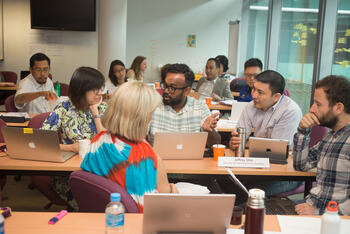
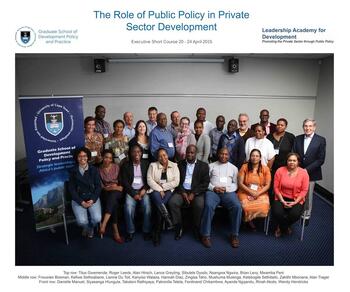
The Leadership Academy for Development (LAD) is an innovative program at Stanford’s Center on Democracy, Development and the Rule of Law that trains mid-level government officials and business leaders to be more effective in promoting policy changes in developing countries.
In order to accomplish this goal, LAD teaches weeklong courses with partner institutions located in Africa, Asia, Latin America, and the Former Soviet Union. The most recent workshop was held in Tbilisi, Georgia in partnership with a leading Georgian think tank.
LAD’s programs attract leaders from the private and public sector who are driving public policy in countries that are transitioning to democracy and strengthening their public institutions. Since LAD’s launch in 2010, the Program has trained over 400 students hailing from nations as diverse as Timor-Leste, Zimbabwe, and the United Kingdom.
The LAD teaching team is composed of faculty from Stanford, Johns Hopkins’s School of Advanced International Studies, Georgetown University, and Texas A&M.
At the core of LAD’s curriculum is a set of case studies that encourage students to think critically about the best methods for solving a policy problem. LAD’s case studies are developed by Stanford faculty and students, and are grounded in real-world scenarios drawn from many of the countries where the program is taught. Case studies reframe policy problems based on various scenarios that invite students to contribute their own perspectives and experience.
Image
As described by LAD co-founder and CDDRL Director Francis Fukuyama, "The Leadership Academy for Development is unique in that by utilizing the case study method, it provides students with a hands-on, interactive framework for problem solving.” Fukuyama continued, “Students must put themselves in the shoes of the case study's protagonist and then devise a solution to the dilemma presented in the text."
Case study authors are sent to the field where they conduct original interviews and research topics ranging from the funding of a vaccination program in Bangladesh to the challenge of administrative decentralization in Peru. To date, LAD has grown its case study library to over 20 cases that are publically available online for wider use and dissemination.
Michael Goldfien, an alumnus of Stanford’s International Policy Studies master’s program, researched and wrote three case studies for LAD over the course of a year.
“While I was writing a case about wine export promotion in the Republic of Georgia, speaking with current and former government officials helped put the challenges facing the Georgian wine industry in a broader domestic and international political context, said Goldfien.”
Goldfien continued, “Researching and writing a LAD case study is about more than simply establishing the facts of a specific policy initiative, it’s about putting things in context and mapping out the constellation of stakeholders who stand to gain or lose from a particular reform to understand the political landscape that a would-be reformer must navigate to effect change.”
One of LAD’s more commonly employed case studies is Gifford Pinchot and Sustainable Forest Management, which introduces the student to Gifford Pinchot, who served as the chief forester in the US at the turn of
Image
the 20th century. Grounded in the political history during this period, Pinchot faces the moral dilemma of whether he should expose the corrupt political patronage practices reaching all the way up to the office of President Taft, or keep his job and continue to fight for the relevance of the fledgling U.S. Forest Bureau. This case study exposes students to pivotal leadership decisions that they may have to face in their own professional careers.
Farai Maguwu, a prominent civil society leader in Zimbabwe who participated in the LAD workshop in Kenya last year summarized his experience, “The case study method was very effective as it made it easy for us to understand that Public-Private Partnerships (PPP’s) are a viable option if there is political will.” Maguwu continued, “For instance, we saw evidence of PPP in practice in one particular case that clearly demonstrated how the private sector could make a public park both beautiful and profitable.”
To learn more about the LAD program and access the case study library, please click here.
Hero Image
CDDRL Director Francis Fukuyama leads a lecture during the Leadership Academy for Development workshop in Tblisi, Georgia. January 2016.