FSI researchers strive to understand how countries relate to one another, and what policies are needed to achieve global stability and prosperity. International relations experts focus on the challenging U.S.-Russian relationship, the alliance between the U.S. and Japan and the limitations of America’s counterinsurgency strategy in Afghanistan.
Foreign aid is also examined by scholars trying to understand whether money earmarked for health improvements reaches those who need it most. And FSI’s Walter H. Shorenstein Asia-Pacific Research Center has published on the need for strong South Korean leadership in dealing with its northern neighbor.
FSI researchers also look at the citizens who drive international relations, studying the effects of migration and how borders shape people’s lives. Meanwhile FSI students are very much involved in this area, working with the United Nations in Ethiopia to rethink refugee communities.
Trade is also a key component of international relations, with FSI approaching the topic from a slew of angles and states. The economy of trade is rife for study, with an APARC event on the implications of more open trade policies in Japan, and FSI researchers making sense of who would benefit from a free trade zone between the European Union and the United States.
Why did colonial powers establish courts to address Indigenous grievances? Under which conditions did these rulers decide to rule in favor of Indigenous claimants, even at the expense of their own state agents? This paper addresses these questions by studying the legal battles between Indigenous communities, Spanish settlers, and local bureaucrats in the General Indian Court of colonial Mexico (GIC). I apply an existing framework developed in the judicial politics literature to understand how the Spanish Crown allowed, and even encouraged, the Indigenous population to raise claims against local bureaucrats. Moreover, I offer a theoretical contribution to this literature by defining the scope conditions under which autocratic regimes might also use the judicial system to constrain local elites. To further explore the decision-making process of this colonial court, I develop a model that predicts that the GIC offered favorable rulings to Indigenous claimants in a strategic way. I predict that a favorable ruling was more likely in cases that involved colonial agents, were related to land invasions or physical abuses, and originated from areas where local elite power was high and Indigenous population more vulnerable. I provide empirical evidence of the strategic use of the colonial court using a mixed-methods approach including paleographic transcriptions, human coding, and text analysis of a novel dataset of more than 30,000 judicial claims. These results have implications for our understanding of both the development of Indigenous legal autonomy in colonial history and for the more general strategic development of judicial power in autocracies. One plausible, yet controversial, implication is that Indigenous communities had more tools to resist oppression during the colonial period than following the rise of the nation-state.
Speaker Bio:
Image
Edgar Franco Vivanco is a post-doctoral fellow at the University of Michigan. He studied a PhD in political science at Stanford University. During 2018-19, he was a pre-doctoral fellow at the Center on Democracy, Development, and the Rule of Law (CDDRL). Edgar is a collaborator with the Poverty, Governance, and Violence Lab at Stanford University, and with the Digging Early Colonial Mexico project at the University of Lancaster. Edgar’s research agenda explores how colonial-era institutions and contemporary criminal violence shape economic under-performance, particularly within Latin America. In his book project, Strategies of Indigenous Resistance and Assimilation to Colonial Rule, he examines the role Indigenous groups have played in the state-building process of the region since colonial times.
Post-doctoral fellow at the University of Michigan
At any given moment there are hundreds of international negotiations being undertaken in numerous institutions and forums, touching upon every legal and social aspect, including cyber, trade, terrorism, telecommunications, environment and human rights, just to name a few. International investigation and monitoring groups, and international committees and specialized bodies, are routinely created, subjecting states to investigations and reviews. States are subject to strict reporting requirements, having to submit hundreds of detailed reports a year to different institutions. International courts and over 160 international dispute settlement mechanisms are at work in their respective areas– creating new bodies of law, and thousands of professional committees whether in economic blocs, international institutions, or other forums, are revising and creating new international norms. Black lists are being formed, alliances changing, and new actors, including multinational corporations, are now an integral player of the international arena.
The challenges states are facing in building capacity and training personnel to deal with this vast and evolving international scene are formidable, requiring substantial funds, human capital, leadership, strategic planning, specialized education, and extensive inter ministerial cooperation, just to name a few. Ramifications for a state for lack of capacity may be huge.
This talk will seek to take a birds eye view of the evolving international arena, and focus on some of the challenges states, particularly developing countries, have in building their capacity to enable effective navigation in this sphere. The talk will showcase the International Rule Making Project, which seeks to assist in the development of global tools and policies. The talk will also address the increasing participation of China, who openly seeks to reshape global governance, as a strong player in the international space, and the possible interconnections between all of these issues.
Speaker Bio:
Image
Dr. Shavit Matias was Deputy Attorney General of Israel in charge of international issues. She and the teams she led formed and implemented a strategic plan for Israel to deal with globalization and the numerous international institutions and forums. She formed and headed the Department for International Agreements and International Litigation, which deals with policy and law, globalization, international institutions, negotiations of bilateral and multilateral international agreements, joining international organizations, international investigations, and international litigation and arbitration in international forums. She spearheaded changes in inter-ministerial cooperation, training, and decision-making processes throughout government.
Dr. Matias regularly advised Prime Ministers and the Government on policy and law regarding international matters. She was a member of Israeli National Security Council teams on a range of national security challenges, national strategy building, international law, Middle East policy, counter-terrorism, and international conflicts. She headed inter ministerial committees, and worked with colleagues from around the world to develop international mechanisms, international tools, and law.
Matias represented the State of Israel in United Nations committees, international investigations of Israel, international and foreign courts, and co-headed Israel’s inter ministerial task force on matters relating to universal jurisdiction and issues relating to the laws of war. She represented the state in numerous bilateral and multilateral negotiations, including complex trade matters with the EU, joining the OECD, permanent-status issues with the Palestinians, and as a member of Israeli-Palestinian joint committees. She was also a member of Israeli government teams working with the international donor community on matters of Palestinian institution and capacity building, and a member of numerous policy teams.
Since 2014 she heads the Global Affairs and Conflict Resolution program at the Lauder School of Government IDC, and teaches courses on globalization, diplomacy, law, and conflict resolution. She is also on the Professional Advisory Board of the International Institute for Counter Terrorism. She is a recipient of the 2008 Award from Georgetown University Law Center for Outstanding Achievements in the Profession, and in 2017-2018 served on the President of Israel’s Committee for Doctoral Grants for Academic Excellence and Scientific Innovation.
Between 2013-2018 she was a fellow at the Hoover Institution and since 2018 is a visiting scholar at CDDRL heading the International Rule Making Project geared at developing global international tools enhancing good governance, rule of law, capacity building, and economic growth particularly in developing countries and areas of conflict.
Matias is a member of the Israeli bar and the New York bar. She clerked at the Supreme Court of Israel, received her LLB from Tel-Aviv University, her LLM from Georgetown University, and her Doctorate in International Law (S.J.D.) from George Washington University under the supervision of Judge Thomas Buergenthal.
CDDRL’s Program on Arab Reform and Democracy held its annual conference at Stanford University on October 11 and 12, titled “The Struggle for Political Change in the Arab World.” The conference is an outgrowth of ARD’s efforts to support new research on the dynamics of political change in the countries of the Arab world. Scholars from across different disciplines sought to understand how social, economic, and political dynamics at the national level, as well as international and regional conflict and power rivalries, impact struggles for political and social change in the region.
Overview of Panels and Speakers
Image
Following opening remarks by FSI Senior Fellow Larry Diamond, the first panel titled “The Boundaries of Authoritarianism post-Arab Uprisings” featured CDDRL Senior Research Scholar Amr Hamzawy. His paper examined how the regime of Abdel Fattah Al-Sisi has employed discursive strategies to discredit calls for democratic change in the country. Sean Yom, Associate Professor of Political Science at Temple University, outlined how the protest strategies of Jordanian youth have limited their effectiveness in advancing meaningful political change. University of California, Davis Scholar Samia Errazzouki discussed the failure of state-led political and economic reform in Morocco.
Chaired by Harvard University Fellow Hicham Alaoui, the second panel was titled “Popular Uprisings and Uncertain Transitions.” University of California, Santa Cruz Political Scientist Thomas Serres provided an overview of the economic disruptions that contributed to Algeria’s uprising. Lindsay Benstead, who is an Associate Professor of Political Science at Portland State University, analyzed the electoral successes of Tunisia’s Ennahda Party. Khalid Medani, Professor of Political Science at McGill University, explained how Sudanese protesters leveraged new strategies of contention to force Omar Al-Bashir out of power.
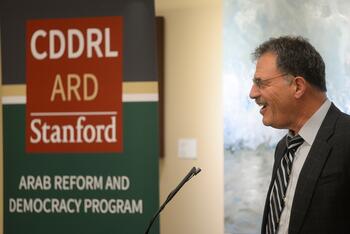
Farah Al-Nakib (right) and Michael Herb (left)
The third panel, titled “Politics, Succession and Sectarianism in the GCC States,” included Oxford University Fellow Toby Matthiesen, who discussed how Saudi Arabia and the GCC states have increasingly sought to protect their regimes by actively molding the politics of their autocratic patrons in the region, and by using new technologies to upgrade the effectiveness of their surveillance states. Georgia State University Political Scientist Michael Herb explained how the aging of the Saudi line of succession contributed to the political ascendancy of Crown Prince Mohammad Bin Salman and the decay of family rule in the country. Cal Poly Historian Farah Al-Nakib described how Kuwait’s royal family has used its sponsorship of large-scale development projects to sidestep the country’s political polarization, undermine the power of the parliament, and weaken public access to spaces of political contestation.
Image
The fourth panel focused on “Social Strife and Proxy Conflict in the Middle East.” Chatham House Scholar Lina Khatib described Syria’s transformation during the civil war from a highly centralized security state to a transactional state in which the regime depends heavily on local powerbrokers. Stacey Philbrick Yadav, Associate Professor and Chair of the Department of Political Science at Hobart and William Smith Colleges, discussed differences in how local communities in Yemen have been affected by the country’s conflict. David Patel, who serves as Associate Director for Research at the Crown Center for Middle East Studies at Brandeis University, argued that Iraq’s democratic institutions have been impressively robust to a series of existential challenges, but he also highlighted a widespread feeling among the Iraqi public that its parliamentary system is failing to deliver.
Image
Finally, the fifth panel examined the topic of “International Forces in the Arab Political Arena.” Stanford University Political Scientist Lisa Blaydes suggested that China’s efforts to involve itself in the regional economy may improve its reputation among economically-frustrated Arab citizens, but that such efforts also spell trouble for democracy and human rights in the Middle East. Hamid & Christina Moghadam Director of Iranian Studies at Stanford University Abbas Milani argued that Iran’s ideological commitment to exporting the Islamic Revolution has been remarkably consistent for several decades. Colin Kahl, Co-director of the Center for International Security and Cooperation at FSI, reviewed the strategies of US administrations toward the Middle East, and posited that President Trump’s approach of pursuing maximalist objectives with minimal commitments is particularly likely to heighten instability in the region. FSI Scholar Ayca Alemdaroglu emphasized that Turkey’s neo-Ottoman foreign policy has failed to achieve its objectives in the face of mounting regional upheaval.
Common Themes of Political Change and Continuity
Image
Several themes emerged from conference presentations. First, across the panels, scholars discussed the lessons learned by autocrats and activists alike in the aftermath of the Arab Spring, and the ways in which these lessons have transformed regional politics. Hamzawy emphasized that the Sisi regime in Egypt has increasingly relied on intensive repression over cooptation to maintain stability, while at the same time refusing to grant even limited political openings as existed under Hosni Mubarak’s presidency. In part, this change appears to be rooted in the regime’s belief that relaxing the state’s authoritarian posture had contributed to the revolutionary upheaval of 2011. Likewise, Matthiesen suggested that Saudi Arabia and the Gulf Cooperation Council States have learned to become more aggressive in strengthening their surveillance apparatus and policing popular discourse transnationally. By contrast, Serres discussed how the Algerian military and bureaucracy have responded to mass protests not by intensifying repression, but instead by attempting to coopt anti-corruption initiatives and democratic reforms to limit political and economic change. Similarly, regarding Kuwait, Al-Nakib illustrated how the restructuring of urban spaces has proved itself a subtle but successful strategy for the royal family to rehabilitate its reputation while limiting geographic focal points for popular politics.
Image
Activists have also learned their own lessons from the aftermath of the Arab Spring. According to Yom, Jordanian activists continue to look to the leaderless revolutions of Tunisia and Egypt as a model to be emulated. As a result, they prioritize agility and horizontality in their protests, and they forgo the organization of formal political movements. This approach has succeeded in acquiring short-term concessions from the regime but has failed to generate broader structural changes. On the other hand, activists in Sudan appear to have been more successful at using lessons from the Arab Spring to push for systematic transformations of their political system. According to Medani, Sudanese protesters developed novel tactics to avoid the repression of the coercive apparatus, and they were effective at gradually forging a counterhegemonic discourse that clearly exposed the regime’s failures to the public. Following the overthrow of Omar Al-Bashir, activists in Sudan have also insisted on dismantling the political and economic might of the deep state to avoid following Egypt’s path.
Image
Second, the conference discussion indicated widespread dissatisfaction with formal political institutions across the region. For instance, Hamzawy suggested that Sisi’s regime has been relatively successful at discrediting civilian political institutions, including the legislature and civilian-led ministries. Errazzouki highlighted widespread dissatisfaction in Morocco with existing political institutions. Likewise, Yom’s discussion of activists in Jordan emphasized their lack of interest in entering formal politics. In Kuwait, the royal court has found an opening to pursue urban development projects outside of normal institutions in part because of the public’s frustration with gridlock in the legislature. Patel speculated that frustration with the parliament and muhasasa system in Iraq may finally prompt major changes to the country’s political process.
Image
Third, despite this disillusionment with formal politics, these political institutions have proved remarkably durable in countries across the region. For example, though current frustrations may finally prompt change in Iraq, Patel also highlighted the resilience of the parliamentary system in the face of a sectarian civil war, US troop withdrawal, the rise of ISIS, and a number of other major challenges. For both Algeria and Sudan, Serres and Medani stressed that militaries continue to exercise significant influence despite the popular uprisings. Meanwhile, for Egypt, Hamzawy noted the firm grip of the current military regime on power, and for Morocco, Errazzouki described the lack of systematic changes to the country’s ruling monarchy, even after years of popular pressure.
Image
Fourth, this durability has not precluded a number of important shifts within existing political institutions. Regarding Syria, for instance, Khatib explained how the survival of Bashar al-Asad’s presidency has depended on moving state institutions away from a centralized security state to a transactional state reliant on local actors with a degree of independence from the regime. Herb described how the consensus-based family rule of the Saudi monarchy fell victim to deaths among the aging senior princes, which opened up opportunities for the king to appoint more officials in a manner that heightened his direct influence. Herb suggested that Mohammad Bin Salman recognized this change and knew that he would likely lose relevance upon his father’s death; as a result, he was motivated to gamble on consolidating his control while his father still held the power to issue royal decrees. In Algeria, the influence of the military and bureaucracy may remain paramount for now, but Serres also pointed out that protesters have succeeded in stripping away the civilian intermediaries who used to protect these institutions. Regarding the durability of local institutions, Yadav noted how pre-conflict and even pre-unification institutions in Yemen have continued to operate effectively in a number of local communities around the country.
Image
Fifth, foreign interventions will continue to destabilize the region and impede prospects for democratization or post-conflict reconstructions in the coming years. Khatib noted that Russia has positioned itself as the agenda setter who can bring the Syrian state back to its feet, but also that Russia and Iran are competing to profit off the country’s reconstruction. For Yemen, Yadav argued that fragmentation at the local level has important implications for best practices in the international community’s reconstruction efforts, but that current actors are not well positioned to understand these trends. Kahl predicted that the Middle East strategy of the Trump administration would likely contribute to further destabilization of the region because of its emphasis on empowering allies to do what they want and go after Iran while the United States maintains its distance. Meanwhile, Blaydes’ presentation on China’s regional involvement, Milani’s discussion of Iran’s efforts to export the Islamic Revolution, and Matthiesen’s observations about the GCC States’ authoritarian coordination all illustrated how intervening states are reducing prospects for democratic political change.
Image
Sixth, even as interventionist countries have contributed to the destabilization of the region, they have also confronted major obstacles themselves – and in some cases have failed outright to achieve their primary objectives. Khatib noted that Iran has faced backlash in Syria, while Abbas Milani and David Patel pointed to backlash against Iran in Iraq. Kahl emphasized that the Trump administration’s Middle East policy was unlikely to achieve its goals. Blaydes observed that China has not acquired greater salience in the Middle East despite its more active economic involvement, and individuals in many of the region’s countries – particularly those that are more developed – do not see China’s growth as a positive force. She also stressed the reputational risks China is taking in pursuing potentially unpopular investments through the Belt and Road Initiative. The GCC States are attempting to prop up strongmen in both Libya and Sudan, but this strategy has struggled in the face of local political dynamics; furthermore, the intervention in Yemen has been a disaster for Saudi Arabia and the UAE. Finally, Alemdaroglu stressed that Turkey’s ambitious “neo-Ottoman” foreign policy, which reflects a desire to revive Turkish influence in areas ruled by the Ottoman Empire, has largely failed. In particular, the architect of the policy, former foreign minister Ahmet Davutoglu, lost his job; the country miscalculated badly in how it handled the aftermath of the Arab Spring; and Turkey’s relations with many of its neighbors have soured.
Hero Image
ARD 2019 Annual Conference participants. Front row (from left): Sean Yom, Stacey Philbrick Yadav, Lindsay Benstead, David Patel, Michael Herb. Middle row (from left): Colin Kahl, Lina Khatib, Hicham Alaoui, Larry Diamond, Samia Errazzouki, Lisa Blaydes, Hesham Sallam. Back row (from left): Toby Matthiesen, Ayca Alemdaroglu, Abbas Milani, Amr Hamzawy, Michael McFaul, Scott Williamson
Legal compliance has gotten a bad rap in international relations research. Compliance – the state of being on the “legal” side of a legal/illegal binary – has been largely set aside as a variable of interest in empirical studies of international law in favor of more substantive measures of behavioral change. Nevertheless, efforts to frame political science inquiry in terms of law’s effects have not succeeded in sidestepping compliance. To the contrary, none of the core functions of law (guiding behavior, assessing it, attributing responsibility, or assigning remedies) is possible without an applied concept of legal compliance as an orienting point on the horizon.This paper reclaims compliance as an essential concept for the empirical study of international law—albeit in a transformed state that emphasizes its potential for contextual variability and its essentially legal-political character.
Speaker Bio:
Image
Tonya Putnam (Ph.D., Stanford, 2005; J.D., Harvard 2002) is an Associate Professor of Political Science at Columbia University. Her work exploresthe intersectionsof international relations and international law in relation tointernational and transnational regulationand jurisdiction, human rights, international humanitarian law, migration, international dispute resolution, institutional design, and judicial politics.Professor Putnamis the author ofCourts Without Borders:Law, Politics, and U.S. Extraterritoriality(Cambridge University Press 2016). Herresearch has appeared inInternational Organization, International Security,Human Rights Review, Journal of Physical Securityand in edited volumes.She was a Post-DoctoralFellow at the Niehaus Center for Globalization and Governance at Princeton University and a Pre-and Post-Doctoral Fellow at CISAC.She is currently completing a second book on why and how social scientists should factor basic properties of law, such as its semantic indeterminacy, into theories and empirical models of its impact on behavior.Professor Putnam is also a member (inactive) of the California State Bar.
Resurrecting Compliance in Assessing Law's Impact on Behavior
The Democrats are facing a dilemma: If they defend democratic norms by acting to remove President Trump from office, they risk getting dragged into a polarizing style of politics that works to his political advantage. Read here.
Our Francis Fukuyama and UELP alumni, Sergii Leshchenko (Draper Hills Summer Fellow 2017) and Oleksandra Ustinova (Ukrainian emerging leaders 2018-9), are feat inMichelle Goldberg's NYT opinion piece "The Beacon Has Gone Out: What Trump & Giuliani Have Wrought." Read here.
This event is open to Stanford undergraduate students only.
The Center on Democracy, Development, and the Rule of Law (CDDRL) will be accepting applications from eligible juniors on who are interested in writing their senior thesis on a subject touching upon democracy, economic development, and rule of law (DDRL) from any university department. The application period opens on January 13, 2020 and runs through February 14, 2020. CDDRL faculty and current honors students will be present to discuss the program and answer any questions.
For more information on the Fisher Family CDDRL Honors Program, please click here.
CDDRL
Encina Hall, C152
616 Jane Stanford Way
Stanford, CA 94305-6055
(650) 725-2705
(650) 724-2996
0
sstedman@stanford.edu
Senior Fellow at the Freeman Spogli Institute for International Studies
Professor, by courtesy, of Political Science
Stedman_Steve.jpg
PhD
Stephen Stedman is a Senior Fellow at the Freeman Spogli Institute for International Studies (FSI) and the Center on Democracy, Development and the Rule of Law (CDDRL), an affiliated faculty member at CISAC, and professor of political science (by courtesy) at Stanford University. He is director of CDDRL's Fisher Family Honors Program in Democracy, Development and Rule of Law, and will be faculty director of the Program on International Relations in the School of Humanities and Sciences effective Fall 2025.
In 2011-12 Professor Stedman served as the Director for the Global Commission on Elections, Democracy, and Security, a body of eminent persons tasked with developing recommendations on promoting and protecting the integrity of elections and international electoral assistance. The Commission is a joint project of the Kofi Annan Foundation and International IDEA, an intergovernmental organization that works on international democracy and electoral assistance.
In 2003-04 Professor Stedman was Research Director of the United Nations High-level Panel on Threats, Challenges and Change and was a principal drafter of the Panel’s report, A More Secure World: Our Shared Responsibility.
In 2005 he served as Assistant Secretary-General and Special Advisor to the Secretary- General of the United Nations, with responsibility for working with governments to adopt the Panel’s recommendations for strengthening collective security and for implementing changes within the United Nations Secretariat, including the creation of a Peacebuilding Support Office, a Counter Terrorism Task Force, and a Policy Committee to act as a cabinet to the Secretary-General.
His most recent book, with Bruce Jones and Carlos Pascual, is Power and Responsibility: Creating International Order in an Era of Transnational Threats (Washington DC: Brookings Institution, 2009).
Director, Fisher Family Honors Program in Democracy, Development and Rule of Law
Director, Program in International Relations
Affiliated faculty at the Center for International Security and Cooperation
Encina Hall, C150
616 Jane Stanford Way
Stanford, CA 94305
0
jdkuo@stanford.edu
Center Fellow, Freeman Spogli Institute for International Studies
didi_kuo_2023.jpg
Didi Kuo is a Center Fellow at the Freeman Spogli Institute for International Studies (FSI) at Stanford University. She is a scholar of comparative politics with a focus on democratization, corruption and clientelism, political parties and institutions, and political reform. She is the author of The Great Retreat: How Political Parties Should Behave and Why They Don’t (Oxford University Press) and Clientelism, Capitalism, and Democracy: the rise of programmatic politics in the United States and Britain (Cambridge University Press, 2018).
She has been at Stanford since 2013 as the manager of the Program on American Democracy in Comparative Perspective and is co-director of the Fisher Family Honors Program at CDDRL. She was an Eric and Wendy Schmidt Fellow at New America and is a non-resident fellow with the Carnegie Endowment for International Peace. She received a PhD in political science from Harvard University, an MSc in Economic and Social History from Oxford University, where she studied as a Marshall Scholar, and a BA from Emory University.
PLEASE CHECK BACK FOR VIDEO/LIVE STREAM OF THIS EVENT
Image
30 years ago, communist rule ended across central Europe in a dramatic series of events ranging from Solidarity's election triumph in Poland on 4 June 1989, through the ceremonial reburial of Imre Nagy in Budapest (with a fiery young student leader called Viktor Orbán demanding the withdrawal of all Soviet troops), to the fall of the Berlin Wall and the Velvet Revolution in Czechoslovakia. Timothy Garton Ash witnessed these events and described them memorably in his book The Magic Lantern: The Revolution of '89 Witnessed in Warsaw, Budapest, Prague and Berlin.
Now he has revisited all these countries, to explore the long term consequences of the revolutions and subsequent transitions. What went right? More pressingly: What went wrong? For today, Orbán is presiding over the systematic dismantling of democracy in Hungary, the Law and Justice party in Poland is trying to follow his example, the prime minister of the Czech Republic is an oligarch and former secret police informer, while a xenophobic populist party, the AfD, is flourishing in the former East Germany. In this lecture, Garton Ash will explore the peculiar character of populism in post-communist Europe, and the considerable forces of resistance to it.
Image
Timothy Garton Ash is Professor of European Studies, Oxford University, and Senior Fellow, Hoover Institution, Stanford. He is the author of ten books of contemporary history, including The File: A Personal History, History of the Present, In Europe's Name: Germany and the Divided Continent, and, most recently, Free Speech: Ten Principles for a Connected World. His commentaries appear regularly in the Guardian, and are widely syndicated.
Light refreshments will be served after the lecture, and copies of The Magic Lantern: The Revolution of '89 Witnessed in Warsaw, Budapest, Prague and Berlin, will be on sale
This event is free and open to the public.
Timothy Garton Ash
<i>Professor of European Studies, Oxford University and Senior Fellow, Hoover Institute, Stanford University</i>
Democratic institutions worldwide have reached a unique and precarious turning point, said Larry Diamond on a recent episode of the World Class podcast by the Freeman Spogli Institute for International Studies (FSI).
After the Cold War, the world became dominated by liberal values and a prevailing consensus for freedom, democracy and human rights, Diamond told World Class host and FSI Director Michael McFaul. During this time, the percentage of democratic states rose from making up about a quarter to more than half of all of the independent states in the world — which had never happened before in history. However, explained Diamond, who is senior fellow at the Center on Democracy, Development and the Rule of Law, this trend may come to an end soon.
“It’s under severe challenge from Russia, China, Iran and from many other countries that were until recently democracies or are in danger of no longer being democracies soon,” Diamond said. “We are in a new and urgent situation.”
In 2018, Freedom House — a non-governmental organization that conducts research on democracy and political freedom — reported a decline in global freedom for the 13th consecutive year, reversing the post-Cold War trend between 1991 and 2006.
“We could be on the cusp of a democratic depression,” said Diamond. In his view, here are the four main causes of this worldwide shift.
[Sign up for the FSI monthly newsletter to receive stories like this directly to your inbox.]
Incremental Authoritarianism
The first cause, according to Diamond, is what he calls “incremental authoritarianism,” which usually occurs when elected populist rulers — such as Russia’s Vladimir Putin or Turkey’s Tayyip Erdoğan, for example — begin to spread conservative, anti-immigrant or anti-pluralist values in an attempt to “save” the nation from corruption or threatening international illiberal values.
“Of course, the corrupting influences are human rights, accountability, pluralism, the rule of law and anything that would constrain their power and eliminate all potential rivals,” Diamond explained.
Russian Rage
The second cause has to do with Russia’s status as what Diamond describes as a “fallen superpower.”. Russia has begun to intervene in the politics of European democracies, meddle with the politics of the U.S. electoral democracy, spread confusion and promote division — all actions that stem from “Russian rage.”
“I think Putin has become unleashed,” he said. “He’s much more aggressive and ambitious now that he has found a cost-effective way of inflicting damage on democracy through disinformation and the penetration of the electoral space of democracies that we thought was sacred and secure.”
Chinese Ambition
Since coming to power in 1949, the Chinese Communist Party has tried to cultivate ties with “sympathetic actors” abroad — whether it be by sending Chinese citizens to U.S. graduate programs or to think tanks — but this effort has been ramped up and extended under Xi Jinping to a degree that hasn’t been seen before, according to Diamond.
“Chinese influence is extending into universities, corporations, Chinese-language media overseas, and certainly into aggressive — and I’d say illegal — technology practices that are boldly trying to create a new world of Chinese influence and even domination by the People’s Republic of China,” he explained.
American Complacency
Finally, Americans have become complacent about the security of their democracy, and many think that it doesn’t require their attention or participation in order to be upheld, said Diamond. In addition, some Americans have also become comfortable about the slow deterioration of their democracy through the polarization of U.S. politics.
“People are becoming so intense in their feelings about parties and politicians that they won’t even talk to people from the other side at the Thanksgiving dinner table,” Diamond said. “Some of the statements of our own president are not consistent with democratic values…in which everyone is recognized as having the right to speak and in which violence can never be encouraged.”
Russian President Vladimir Putin shakes hands with Chinese President Xi Jinping during a signing ceremony in Beijing's Great Hall of the People on June 25, 2016. (Photo by Greg Baker-Pool/Getty Images).
The dynamic game between political and business elites in both democratic and non-democratic countries has received much attention since the rise of the super-rich in global politics. How does the Chinese Communist Party manage its rising super-rich in the private sector in order to prevent state capture and stay in power? Using a mixed-method approach, this research project details how the super-rich have become a particular target of the party-state, which aims to monitor them and channel their involvement in politics in ways that minimize their potentials to capture the state and maximize their willingness to cooperate with the regime. This inquiry proposes a new perspective for understanding how China has maintained regime stability thus far with its rapid economic development, and what processes may lead to destabilization.
Speaker Bio:
Image
Zhu Zhang is a pre-doctoral fellow at CDDRL and a Ph.D. candidate in Political Science at Tulane University, with a major field in comparative politics. She studies authoritarianism with particular interests in state-business relations and Chinese politics. Her dissertation book project, Wealth without Power: The Rise of Chinese Private Business Elites and Their Relationship to the Communist Party, examines how the party-state embraces its business elites while preventing them from preying on the state in autocracy. Zhu holds an M.A. in International Affairs from the Pennsylvania State University, and a B.A. in History from Shanghai Normal University.

 FSI researchers strive to understand how countries relate to one another, and what policies are needed to achieve global stability and prosperity. International relations experts focus on the challenging U.S.-Russian relationship, the alliance between the U.S. and Japan and the limitations of America’s counterinsurgency strategy in Afghanistan.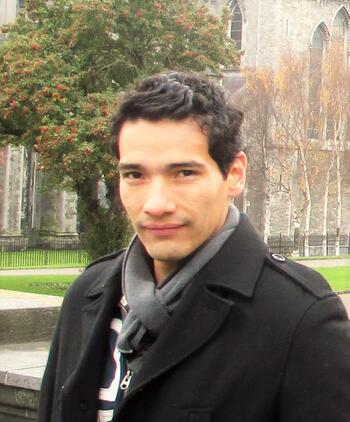

 Farah Al-Nakib (right) and Michael Herb (left)