-

About the Event: A panel discussion convened in partnership with the Institute for Nonviolence and Social Justice, University of San Francisco, the Center for International Security and Cooperation, Stanford University, and the World House Project, Center for Democracy, Development and Rule of Law, Stanford University.

About the Speakers:

Scott D. Sagan is the Caroline S.G. Munro Professor of Political Science, the Mimi and Peter Haas University Fellow in Undergraduate Education, and Senior Fellow at the Center for International Security and Cooperation and the Freeman Spogli Institute at Stanford University. He also serves as Chairman of the American Academy of Arts and Sciences’ Committee on International Security Studies. Before joining the Stanford faculty, Sagan was a lecturer in the Department of Government at Harvard University and served as special assistant to the director of the Organization of the Joint Chiefs of Staff in the Pentagon.

Clayborne Carson, the Martin Luther King, Jr., Centennial Professor of History, emeritus, at Stanford University, has devoted his professional life to the study of Martin Luther King, Jr., and the human rights movements inspired by King, Mohandas K. Gandhi, and other visionaries. His award-winning first book, In Struggle: SNCC and the Black Awakening of the 1960s, was published in 1981 and remains the definitive study of the courageous activists and organizers who challenged the strongholds of segregation. In 1985, Mrs. Coretta Scott King chose Dr. Carson to edit and publish a definitive, multi-volume edition of her late husband’s speeches, sermons, correspondence, publications, and unpublished writings. In addition to publishing numerous other books and scholarly articles, Carson has also reached broader audiences as a senior advisor to the Eyes on the Prize series and his contributions to more than two dozen subsequent documentaries. After launching the online Liberation Curriculum for K-12 students, Carson founded Stanford's Martin Luther King, Jr., Research and Education Institute in 2005 to disseminate King-related educational resources to a global audience. After retiring as the King Institute’s Director, Carson has continued his online educational efforts by establishing The World House Project to collaborate with other human rights advocates to realize King's vision of a global community in which all people can "learn somehow to live with each other in peace.”

Rose Gottemoeller is the Steven C. Házy Lecturer at Stanford University's Freeman Spogli Institute for International Studies and its Center for International Security and Cooperation. Before joining Stanford Gottemoeller was the Deputy Secretary General of NATO from 2016 to 2019, where she helped to drive forward NATO’s adaptation to new security challenges in Europe and in the fight against terrorism.  Prior to NATO, she served for nearly five years as the Under Secretary for Arms Control and International Security at the U.S. Department of State, advising the Secretary of State on arms control, nonproliferation and political-military affairs. While Assistant Secretary of State for Arms Control, Verification and Compliance in 2009 and 2010, she was the chief U.S. negotiator of the New Strategic Arms Reduction Treaty (New START) with the Russian Federation.

David Holloway is the Raymond A. Spruance Professor of International History, a professor of political science, and an FSI senior fellow. He was co-director of CISAC from 1991 to 1997, and director of FSI from 1998 to 2003. His research focuses on the international history of nuclear weapons, on science and technology in the Soviet Union, and on the relationship between international history and international relations theory. His book Stalin and the Bomb: The Soviet Union and Atomic Energy, 1939-1956 (Yale University Press, 1994) was chosen by the New York Times Book Review as one of the 11 best books of 1994, and it won the Vucinich and Shulman prizes of the American Association for the Advancement of Slavic Studies. It has been translated into seven languages, most recently into Chinese. The Chinese translation is due to be published later in 2018. Holloway also wrote The Soviet Union and the Arms Race (1983) and co-authored The Reagan Strategic Defense Initiative: Technical, Political and Arms Control Assessment (1984). He has contributed to the Bulletin of the Atomic Scientists, Foreign Affairs, and other scholarly journals.

 All CISAC events are scheduled using the Pacific Time Zone.

Virtual

Scott Sagan Stanford Center for International Security and Cooperation
Clayborne Carson Stanford Department of History
Rose Gottemoeller Stanford Center for International Security and Cooperation
David Holloway Stanford Center for International Security and Cooperation
Seminars
News Feed Image
640px-lemay_cuban_missile_crisis.jpeg
-

Image
Stanford CLAS and CDDRL logos

Join us for a conversation on Cuba led by scholars and professionals within and outside Cuba who will discuss contemporary Cuba from a variety of perspectives. Going beyond the media headlines and coverage of the July 11th protest, the panelists will discuss Cuba from a longer-term perspective primarily focused on the early 21st century and considering US-Cuban relations, Cuba in the US media, freedom of academic, literary, and artistic expression in Cuba, as well as other relevant topics concerning Cuba’s present and future.

Speakers: Ernesto Domínguez , Darsi Fernández, Sachie Fernández, and Mikael Wolfe.
 

Join the Livestream


Please feel free to send your questions in the comments section on the Youtube page and we will read them to the panelists. 

Sponsored by the Center for Latin American Studies, CDDRL, and the FSI Racial Equity, Diversity, and Inclusion Task Force.

Panel Discussions
News Type
News
Date
Paragraphs

The Center on Democracy, Development, and the Rule of Law (CDDRL) at Stanford University is pleased to announce the 2015 class of undergraduate senior honors students. 

Honors students will spend four quarters participating in research seminars to refine their proposed thesis topic, while working in consultation with a CDDRL faculty advisor to supervise their project. In September, the group will travel to Washington, D.C. for honors college where they will visit leading government and development organizations to witness policymaking in practice and consult with key decision-makers.

Please join CDDRL in congratulating the 2015 Senior Honors students and welcoming them to the Center.

Below are profiles of the nine honors students highlighting their academic interests, why they applied to CDDRL, and some fun facts.  


Monica Dey

Major: Human Biology

Hometown: Nashville, TN

Thesis Title: Evaluating Information and Communication Technologies for Reproductive and Sexual Health in Uganda

Thesis Advisor: Josh Cohen

Why is this topic important to the field of democracy, development, and the rule of law? Sexual and reproductive health is a significant problem all over the world, but especially in developing countries.  In Uganda, which has some of the highest fertility and highest maternal mortality rates in the world, investment and improvement in sexual and reproductive health could have enormous consequences for economic development, education equality, and public health.  In addition, with the boom in mobile technology in even rural regions, it is essential that civil society organizations and local governments discover the most effective methods to apply this technology to the toughest problems in sexual and reproductive health.  I hope to evaluate the pitfalls and potential of these mobile interventions, as well as recommend best practices for the field.

What attracted you to the CDDRL undergrad honors program?  I love the interdisciplinary environment of the CDDRL, whose professors hail from departments all over the university.  I believe it is essential to approach development issues from a multitude of perspectives, and this philosophy is ingrained into the values of the CDDRL.  I am so honored to be able to learn from this community of scholars who care deeply about working together to create real impact with their research.

Future aspiration post-Stanford: I will continue working on international development issues after graduation, as well as attend medical school after taking a gap year (or two).

What are your summer research plans: I will be interviewing a cross-section of Ugandan society (public officials, organizational leaders, local people, and more) both remotely and hopefully in the field.

Fun fact about yourself: I went kayaking for the first time on the Nile River last summer!


Selamile Dlamini

Major: Management Science & Engineering

Hometown: Ezulwini, Swaziland

Thesis Title: Political Participation in Swaziland  

Thesis Advisors: Larry Diamond & Joel Samoff

Why is this topic important to the field of democracy, development, and the rule of law? Political science presents several theories about how and why democratization occurs. Despite the democratic transitions that occured in sub-Saharan Africa during the post-colonial period, Swaziland has remained largely politically unchanged. My thesis will present Swaziland's interaction with the theories proposed in of political science, and demonstrate the extent to which events in Swaziland fit into these theories. Moreover, it will show the extent to which Swaziland differs, and presents additional nuance to the theories and models discussed in the field of democracy, development and the rule of law. This is particularly important in sub-Saharan Africa, where the presence and quality of democracy has been shown to be closely correlated to the development outcomes. 

What attracted you to the CDDRL undergrad honors program?  I am inspired by the fact that it is an interdisciplinary program, therefore, I can explore a single subject through multiple lenses.

Future aspiration post-Stanford: Eat, pray, love, and make a positive impact in the world.

What are your summer research plans: I will get started with the readings on my thesis reading list in June, and go to Swaziland to conduct some interviews in August.

Fun fact about yourself: I love writing fiction!


Max Johnson

Major: International Relations

Hometown: Edina, Minnesota

Thesis Title: The Economic and Political Scenarios for Cuban Regime Change and their Policy Implications 

Thesis Advisor: Alberto Diaz-Cayeros

Why is this topic important to the field of democracy, development, and the rule of law? Cuba is one of the last staunch political strongholds resisting what many say is an inevitable fall to democracy. I believe understanding how this transition might take place will reveal a lot about democratic development and the formation of free markets. 

What attracted you to the CDDRL undergrad honors program?  I visited Cuba in 2011 and fell in love with the landscape and culture. The Cuban people are so beautiful and eager to live fruitfully and contribute to global society. I want to use my thesis to explore the multiple political perspectives of Cubans in Miami and Havana and try to predict how their lives will change with the end of the Castro regime. 

Future aspiration post-Stanford: Find a fulfilling career that has an international perspective and will allow me to impact the lives of others in a positive way. And live in New York City. 

What are your summer research plans: I will be interning at the Project on Government Oversight in Washington D.C. where I'll be learning about corruption and transparency advocacy. I will also spend part of August in Miami interviewing Cuban-American activists and political leaders. 

Fun fact about yourself: I was a vegetarian my entire life until last summer when I lived in Port au-Prince, Haiti and was compelled to eat chicken. One thing lead to another and I found myself studying abroad in Madrid eating plates of freshly cured jamon Iberico every week. Needless to say, I've tasted the forbidden fruit, and I'm never going back! 


Hamin Kim

Major: Human Biology

Hometown: San Jose, CA

Thesis Title: Tuberculosis Control in the Democratic People's Republic of Korea

Thesis Advisor: Gary Schoolnik

Why is this topic important to the field of democracy, development, and the rule of law?  Public health is important to the development and well-being of the local, regional, and global society. Management of infectious diseases also requires much coordination between the existing infrastructure and internal, as well as external resources. My research project on tuberculosis control investigates the process of building a control program for a widespread infectious disease. It illuminates the areas of need for development in the infrastructure and society of the Democratic People’s Republic of Korea, as well as the constraints and challenges in delivering the aid. Examining the management of a public health issue opens up a unique platform to investigate and aid the development of a reclusive nation. 

What attracted you to the CDDRL undergrad honors program?   The CDDRL undergraduate honors program offers the network and support of experts. I was attracted by the multifaceted focus on global issues, and was excited to examine development when democracy and the rule of law may not be manifested in the form that we expect. The required courses and readings would broaden my perspectives about the way that the world functions. Moreover, the expert guidance from professors would help me to apply these new insights to my research topic. The interdisciplinary group of colleagues who would participate in the program with me also attracted me. This is a unique opportunity to learn about global issues through lenses of different expertise and focus. 

Future aspiration post-Stanford: My Stanford education has prepared me to engage people, culture, and issues with curiosity and critical examination. As a Human Biology major with an area of concentration in Global Health, I have been exposed to various issues which affect the health of many people around the world. After Stanford, I wish to become a physician with a global perspective who cares for patients in the context of their whole persons—their cultural, as well as personal, beliefs. I also hope to be involved in global health policy development and public health management in foreign countries. 

What are your summer research plans: I will conduct individual interviews with various health experts and gather information through file and literature reviews. 

Fun fact about yourself: Something I appreciate about college is that it has developed many new interests which I never knew I had. After joining Testimony A Cappella, I changed from not wanting to sing even in front of my family to breaking out in song and harmonizing whenever and wherever. I have recently revived my love of social dance and hope to pursue this further in my last year at Stanford!


Stefan Norgaard

Major: Public Policy

Hometown:  Boulder, Colorado

Thesis Title: The “Born Free Generation” and the Future of South African Democracy: Shaping a Transition to Accountable Governance

Thesis Advisor: Larry Diamond

Why is this topic important to the field of democracy, development, and the rule of law?  In South Africa today, around 40 percent of the population is under 18 years and fully half of its people are under 25. These young South Africans have grown up in a fully different South Africa than that of their parents: apartheid rule, once a harsh reality, is now a past event even as racial divisions persist, and many youth only know the rule of the African National Congress (ANC) party, which has governed since Nelson Mandela’s 1994 election.  This “born free” generation has witnessed the fragile democratic system created by Mandela cave under increasingly stressed institutions during the Mbeki and Zuma presidencies. As young South Africans turn to new methods to make their voices heard, the upcoming 2014 elections may mark the beginning of a period of political realignment, a sounding call for accountable, issue-based governance. In this election, over 4 million of South Africa’s 50 million people will be eligible to vote for the first time, and they are increasingly frustrated about the lack of efficacy in South Africa’s government. A youth population that chooses not to engage through democratic channels may fail to reinvigorate a struggling nation. On the other hand, a population that translates its electoral significance into new government policies can help ignite a long-term political realignment in South African civil society.   

What attracted you to the CDDRL undergrad honors program?  The CDDRL Honors Program offers superb faculty support and mentorship, a cohort of like-minded students pursuing similar thesis topics, and an interdisciplinary framework that allows for a capstone intellectual experience.  I heard from previous CDDRL Honors Program participants that Professor Larry Diamond, Professor Frank Fukuyama, and numerous other CDDRL-affiliated faculty support and mentor students, challenging them to produce the best theses they can.  In addition, the thesis coursework and Honors College experience allow for students to make close friendships with others interested in democracy, development, and the rule of law.  Finally, CDDRL’s interdisciplinary component will allow me to write a thesis on South Africa using historical accounts, ethnographic interviews, and quantitative survey data.  Using all three research methods will give me the type of comprehensive intellectual experience I was looking for in my thesis.  

Future aspiration post-Stanford:  Though I am not sure what my future will hold, I hope to spend time working internationally, ideally in public service.  I am drawn to social entrepreneurship, civic and political engagement through government service or advocacy, and the nonprofit and nongovernmental sector.  I love seeing new places and spending time in the outdoors, and hope that my future allows for such experiences as well.  As I learn more about myself as an individual, I hope to discover where I am most effective as an agent of social change and where I feel most passionately about the work I am doing.  I hope to ultimately attend law school and advocate on behalf of the public interest.    

What are your summer research plans: I plan to conduct research in Johannesburg and Bloemfontein, South Africa for my thesis while I work and stay at an urban planning and development nonprofit—the Global Regeneration Initiative for Neighborhood Development (GRIND)—in Johannesburg’s Maboneng Precinct. In my work I will apply coursework in Public Policy and Urban Studies with the larger goal of planning and developing a diverse and integrated urban neighborhood in Johannesburg.  A second portion of my summer will be solely dedicated to thesis work in Johannesburg and Bloemfontein.  

Fun fact about yourself: A Colorado native, I love climbing and mountaineering.  Of the continental United State’s 67 tallest 14,000 foot mountains (also known as “14ers”), I have climbed over 20 of them, and hope to one day climb them all!  


Cara Reichard

Major: Political Science

Hometown: Carlsbad, CA

Thesis Title: Regional Solutions for Human Rights in Sub-Saharan Africa

Thesis Advisor: Helen Stacy

Why is this topic important to the field of democracy, development, and the rule of law? Many sub-Saharan African nations have, since independence, struggled with the protection of the human rights of their citizens. I believe this topic is important because it will, hopefully, offer perspective on ways in which human rights promotion can best be integrated into the current political and economic situations of these countries.

What attracted you to the CDDRL undergrad honors program? Since freshman year I knew that I wanted to write a senior thesis, and CDDRL seemed by far the best fit for my interests. I was also attracted by the idea of being a part of a community of students who also cared about these issues and were eager to answer research questions of their own. 

Future aspiration post-Stanford: I am still very undecided on my future goals, though I am strongly considering law school. After I graduate from Stanford I hope to spend a few years working in Washington, D.C. on something policy-related.

What are your summer research plans: For the first part of the summer I will be in Washington, D.C. working at the U.S. Department of State, Bureau of Democracy, Human Rights and Labor. After that, I will travel to Arusha, Tanzania, to conduct research for my thesis on the East African Court of Justice.


Image
Ashley Semanskee

Major:  Human Biology

Hometown: Edmonds, WA

Thesis Title: Private Wealth and Public Policy: Philanthropy, democracy, and public education reform in urban school districts

Thesis Advisor: Stephen Stedman

Why is this topic important to the field of democracy, development, and the rule of law? It is important to understand the role of philanthropy and other private actors in public policy debates, particularly in the realm of public education policy because it affects almost every child in the United States. Although philanthropic foundations may be important to drive education reform forward in a stagnant and torpid political process, the political influence of foundations may shut out the contributions of reformers without the wealth to legitimize their ideas, and it may undercut the public’s voice in education reform. Specifically, the school reform movement in recent decades has largely been driven by philanthropic foundations and .has pushed for market-based solutions including small schools, school choice, charter schools, and pay-for-performance schemes for teachers. However, opponents point out that market-based reforms do little to mediate the effect of poverty on education outcomes. Through this thesis, I will explore the education outcomes of opposing reform paradigms, and how philanthropic foundations can be held more accountable to local communities. 

What attracted you to the CDDRL undergrad honors program? I was attracted to the CDDRL honors program because I want to learn about issues that matter, study the policy debates that are shaping our world and, above all, perform research with real policy implications. I am incredibly grateful for the opportunity work with faculty members and a cohort of like-minded Stanford students as enthusiastic about democracy and development as I am. 

Future aspiration post-Stanford: After graduation, I hope to pursue my joint interests in health and education policy, and eventually apply to a MPH/MBA program. 

What are your summer research plans: I will conduct interviews and data collection on the outcomes of public school reform in the Washington DC and New York City school districts. 

Fun fact about yourself:  Like Garima, I am a twin. I have a sister, Casey, studying business at the University of Washington. 


Garima Sharma

Major: Economics

Hometown: New Delhi, India

Thesis Title: Factors Shaping Parent Aspirations for Daughters in small-town Indian communities

Thesis Advisor: Christine Wotipka

Why is this topic important to the field of democracy, development, and the rule of law? India is home to 24 million child brides—the largest of any country in the world. The early marriage of a girl represents a trade-off in terms of her education, health and wellbeing. When compared with her overage counterparts, a child bride is twice as likely to suffer from spousal domestic violence, 2.5 times more likely to experience unwanted pregnancies, and 1.5 times more likely to die in child birth; her children are 3 times more likely to be malnourished. Because parents’ decisions for their daughter necessarily follow their aspirations on her behalf, understanding the latter is the first step to formulating policy and programs that alter incentives for encouraging female enrolment in school and delaying child marriage. I hope that my thesis is able to create new knowledge on parental aspirations in pursuit of this goal.

What attracted you to the CDDRL undergrad honors program?  I am drawn towards the interdisciplinary nature of the CDDRL program because it is well suited for my thesis, which employs a mixed methods design and draws from literature in development economics as well as feminist theory. Incorporating various lenses for analysis will enable me to glean a more holistic understanding of factors that shape parent aspirations (for daughters) than would a purely economic or purely feminist approach. Additionally, I believe that the support provided through the year-long CDDRL Honors Seminar will be invaluable in terms of the design and execution of my field research and data analysis. Finally, I am excited by the prospect of working with a community of scholars (both Professors and peers) who come from many different academic backgrounds and interests, and will, through their insight on my proposed topic, enrich my learning as well as my research.

Future aspiration post-Stanford:  I hope to leverage policy to advance women’s rights in India and across the world. 

What are your summer research plans: For the first part of the summer, I will be working as a Stanford in Government Fellow at the International Labour Organization DWT South Asia office in Delhi. I will then travel to Forbesganj, Bihar to conduct field research for my thesis.

Fun fact about yourself: I am one of two. I have a twin sister, named Anima, who attends medical school in India.


Thuy Tran

Major: Economics

Hometown: San Diego, California

Thesis Title: What´s in it for us? The Incentives and Strategic Decisions by For-Profit Firms to Engage in Social Impact Initiatives.

Thesis Advisor: Stephen Krasner

Why is this topic important to the field of democracy, development, and the rule of law? Consumers these days are eager to take part in social change and large corporations have lately made this very easy for consumers; companies like TOMS Shoes that base their business models on charitable giving, as well as companies that attach social causes to their products, are very popular among citizens interested in being "charitable". Obviously, these companies have motivations for participating in social change movements and this recent phenomenon of "corporate social responsibility" shows how corporations are adapting to changing societal preferences. But whether these initiatives are effective is another issue and it is crucial that these companies are not doing more harm than good. Understanding the incentives for firms to engage in social impact is the first step to assessing the level of success of these programs.

What attracted you to the CDDRL undergrad honors program?  I was drawn to the CDDRL undergraduate honors program because of the possibility to establish strong relationships with my fellow honors students and faculty in the CDDRL. The program offers a chance for students to closely interact with each other during the honors thesis process and I am sure that we will all be able to teach each other something new. I am also very excited to work closely with the CDDRL faculty and for the opportunity to pick their brains! 

Future aspiration post-Stanford: I would love a career that allows me to combine my technical and artistic interests, that makes me excited to go to work, and that allows me learn new things everyday! 

What are your summer research plans:  I plan on doing extensive research into particular industries that engage in social impact projects, namely consumer brands and also companies that have built their business models on charitable giving. Hopefully I will also have a chance to interview decision makers at these companies as well to better understand the true incentives and thought processes behind corporate social responsibility tactics. 

Fun fact about yourself: When I was younger, I used to hate the first day of school because none of my teachers knew how to pronounce my name! 


Shawn Tuteja

Major: Mathematics

Hometown: Birmingham, Alabama

Thesis Title: Rethinking the Institutional Design of Deliberative Democracy through an Analysis of the Impact of the Moderator 

Thesis Advisor: James Fishkin

Why is this topic important to the field of democracy, development, and the rule of law? When deliberative democracy is implemented, it usually takes the form of members of society gathering to debate key issues. Moderators usually facilitate these discussions, and the key assumption is that the moderators do not influence the people's final opinions. I argue that there is a great amount of statistical analysis that has not been done to verify this assumption. If the moderator does contribute to people's opinions, it may mean that we should rethink the institutional design of these processes. 

What attracted you to the CDDRL undergrad honors program?  I have ben interested in issues of international affairs and democracy since I was in high school, and I wanted the opportunity to explore these passions in an honors thesis. The CDDRL undergraduate honors program provided the perfect opportunity. 

Future aspiration post-Stanford:  I hope to continue studying and learning skills (such as the ones that I will hone in working on this honors thesis) to better society through whatever job I eventually decide on.   

What are your summer research plans:  I will work to test the mass amounts of data that I will be working with. This includes designing a coding system, running statistical analysis, and analyzing the results. 

Fun fact about yourself: I once starred in a PBS TV show on the benefits of recycling. Oh, and I'm a huge fan of the TV show Friday Night Lights.


Hero Image
ENCINA LONG2
All News button
1
-

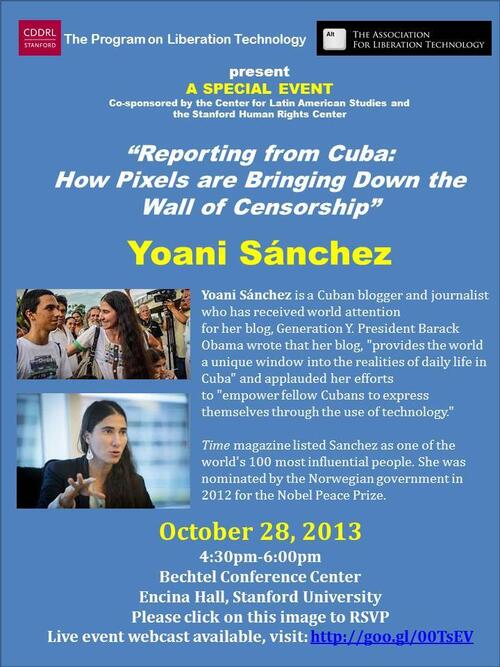
*****LIBERATION TECHNOLOGY SPECIAL EVENT****
Change of location- now in Bechtel Conference Center
Encina Hall

A livestream will be available for this event. To watch please click here

Co-sponsored by the Association for Liberation Technology, the Center for Latin American Studies and the Stanford Human Rights Center 

Yoani Sánchez was born in 1975 in a tenement in Central Havana and, on starting school, she proudly put the Little Pioneer scarf around her neck, vowing to “Be like Che!” Fourteen when the Berlin Wall fell, her adolescence was marked by what Fidel Castro called “a special period in a time of peace,” a time of terrible scarcity and broad disillusionment.

At the University of Havana Yoani’s incendiary thesis, Words Under Pressure: A Study of the Literature of the Dictatorship in Latin America, eliminated the idea of an academic career. Already married—to Reinaldo Escobar, an ousted-journal­ist-turned-elevator-mechanic—and a mother, she cobbled together a living as a Spanish teacher and tour guide. In 2002, Yoani decided to emigrate, but in 2004 she returned to Cuba. “I promised myself that I would live in Cuba as a free person, and accept the consequences,” she said. All of her work since then has been a keeping of that promise.

Yoani launched her blog, Generation Y, in April of 2007; later that year a Reuters article brought her to the attention of the world. In 2008 she won Spain’s Ortega y Gasset Prize for digital journalism and Time magazine named her one of the 100 most influential people in the world. Recognition and awards followed, including an interview with Barack Obama, posted in her blog, and nomination by the Norwegian government for the 2012 Nobel Peace Prize.

Yoani is now the journalist she always wanted to be, one deeply immersed in technology. She started The Blogger Academy in her apartment in Havana and runs frequent courses in Twitter. She has published a manual on WordPress, and she works as a correspondent for Spain’s El Pais newspaper. Yoani plans to launch a newspaper in Havana, and is currently working toward that goal.

A livestream will be available for this event. To watch pleaseclick here 

Image

Bechtel Conference Center

Yoani Sanchez Blogger "Generation Y", Journalist and Publisher in Cuba Speaker
Seminars
Date Label
-

Christopher Painter has been on the vanguard of cyber issues for twenty years. Most recently, Mr. Painter served in the White House as Senior Director for Cybersecurity Policy in the National Security Staff. During his two years at the White House, Mr. Painter was a senior member of the team that conducted the President's Cyberspace Policy Review and subsequently served as Acting Cybersecurity Coordinator. He coordinated the development of a forthcoming international strategy for cyberspace and chaired high-level interagency groups devoted to international and other cyber issues.

Mr. Painter began his federal career as an Assistant U.S. Attorney in Los Angeles where he led some of the most high profile and significant cybercrime prosecutions in the country, including the prosecution of notorious computer hacker Kevin Mitnick. He subsequently helped lead the case and policy efforts of the Computer Crime and Intellectual Property Section in the U.S. Department of Justice and served, for a short time, as Deputy Assistant Director of the F.B.I.'s Cyber Division. For over ten years, Mr. Painter has been a leader in international cyber issues. He has represented the United States in numerous international fora, including Chairing the cutting edge G8 High Tech Crime Subgroup since 2002. He has worked with dozens of foreign governments in bi-lateral meetings and has been a frequent spokesperson and presenter on cyber issues around the globe. He is a graduate of Stanford Law School and Cornell University.

Sloan Mathematics Center

Christopher Painter Coordinator for Cyber Issues Speaker US State Department
Seminars

This two day conference will examine the use of information and communication technologies (ICTs) to expand freedom and generate more pluralistic flows of ideas and information in authoritarian contexts. Through presentation of papers and panel sessions, three key themes will be explored:

  • How individuals in authoritarian countries are using liberation technologies (particularly the internet and mobile phones) to expand pluralism and freedom.
  • How authoritarian states are censoring, constraining, monitoring, and punishing the use of ICT for that purpose.
  • How citizens and groups can circumvent authoritarian censorship and control of these technologies.

Discussion will focus on these challenges generally and also specific developments in countries such as China, Iran, Cuba, Burma, and North Korea, as well as Russia and selected Arab authoritarian regimes.

The conference is sponsored by the Program on Liberation Technology at the Center on Democracy, Development and the Rule of Law at Stanford, in cooperation with the Hoover Institution.

Bechtel Conference Center

Conferences
-

SAMUEL BOWLES, (PhD, Economics, Harvard University) is Research Professor at the Santa Fe Institute where he heads the Behavioral Sciences Program. He is also Professor of Economics at the University of Siena. He taught economics at Harvard from 1965 to 1973 and at the University of Massachusetts, where he is now emeritus professor. His recent studies on cultural and genetic evolution have challenged the conventional economic assumption that people are motivated entirely by self-interest. These have included the mathematical modeling and agent-based computer simulations of the evolution of altruistic behaviors and behavioral experiments in 15 hunter-gather and other small-scale societies. Recent papers have also explored how organizations, communities and nations could be better governed in light of the fact that altruistic and ethical motives are common in most populations. Bowles' current research also includes theoretical and empirical studies of political hierarchy and wealth inequality and their evolution over the very long run. 

His scholarly papers have appeared in Science, Nature, American Economic Review,Theoretical Population Biology, Journal of Theoretical Biology, Journal of PoliticalEconomy, Quarterly Journal of Economics, Behavioral and Brain Science, Philosophy and Public Affairs, Journal of Public Economics, Theoretical Primatology, Proceedings of the National Academy (USA), Harvard Business Review, Journal of Economic Literature, Journal of Economic Perspectives, and the Economic Journal. 

His recent books include Microeconomics: Behavior, Institutions and Evolution(Princeton University Press, 2004), Moral Sentiments and Material Interests: the Foundations of Cooperation in Economic Life (MIT Press, 2005), Unequal Chances: Family Background and Economic Success (Princeton 2004), Poverty Traps (Princeton 2006), Inequality, Cooperation and Environmental Sustainability (Princeton 2005), Globalization and Egalitarian Redistribution (Princeton, 2006), Foundations of Human Sociality: Economic Experiments and Ethnographic Evidence in 15 Small-scale Societies. (Oxford University Press. 2004) and Understanding Capitalism: Competition, Command and Change (Oxford 2004). 

He has also served as an economic advisor to the governments of Cuba, South Africaand Greece, to presidential candidates Robert F. Kennedy and Jesse Jackson, to the Congress of South African Trade Unions and to South African President Nelson Mandela.

His next major work, A Cooperative Species: Human reciprocity and its evolution,co-authored with Herbert Gintis, will be published in 2011. Drawing on their recentresearch on cultural and genetic evolution and his empirical studies of behavior in smallscale societies, this work will explain why humans, unlike other animals, engage incooperation among large numbers of people beyond the immediate family. His CastleLectures at Yale University, Machiavelli's Mistake: Why good laws are no substitute forgood citizens, will be published in 2011 by Yale University press.

Encina Ground Floor Conference Room

Samuel Bowles, PhD. Research Professor Speaker Sante Fe Institute
Workshops
Authors
Larry Diamond
News Type
Commentary
Date
Paragraphs
Bush gave democracy promotion a bad name, Larry Diamond writes in Newsweek. The new administration needs to get it right.

The new U.S. President will face more than one kind of global recession. In addition to the economic downturn, the world is suffering a democratic contraction. In Russia, awash with oil money, Vladimir Putin and his KGB cronies have sharply restricted freedom. In Latin America, authoritarian (and anti-American) populism is on the rise. In Nigeria, the Philippines and once again in Pakistan, democracy is foundering amid massive corruption, weak government and a loss of public faith. In Thailand, the government is paralyzed by mass protests. In Africa, more than a dozen fragile democracies must face the economic storm unprepared. And in the Middle East—the Bush administration's great democratic showcase—the push for freedom lies in ruins.

In the past decade, the breathtaking democratic wave that swept the world during the final quarter of the 20th century reversed course. Making democracy work proved harder than bringing down authoritarian rule. And receptive peoples everywhere were alienated by the arrogance and unilateralism of President George W. Bush's approach, which associated "democracy promotion" with the use of force and squandered America's soft power. Advancing democracy abroad remains vital to the U.S. national interest. But the next president will have to craft a more modest, realistic and sustainable strategy.

It's easy today to forget how far freedom has advanced in the past 30 years. When the wave of liberation began in 1974 in Portugal, barely a quarter of the world's states met the minimal test of democracy: a place where the people are able, through universal suffrage, to choose and replace their leaders in regular, free and fair elections. Over the course of the next two decades, dictatorships gave way to freely elected governments first in Southern Europe, then in Latin America, then in East Asia. Finally, an explosion of freedom in the early '90s liberated Eastern Europe and spread democracy from Moscow to Pretoria. Old assumptions—that democracy required Western values, high levels of education and a large middle class—crumbled. Half of sub-Saharan Africa's 48 states became democracies, and of the world's poorest countries, about two in every five are democracies today.

This great shift coincided with an unprecedented moment of U.S. military, economic and cultural dominance. Not only was America the world's last remaining superpower, but U.S. values—individual freedom, popular sovereignty, limited government and the rule of law—were embraced by progressive leaders around the world. Opinion surveys showed democracy to be the ideal of most people as well.

In recent years, however, this mighty tide has receded. This democratic recession has coincided with Bush's presidency, and can be traced in no small measure to his administration's imperial overreach. But it actually started in 1999, with the military coup in Pakistan, an upheaval welcomed by a public weary of endemic corruption, economic mismanagement and ethnic and political violence. Pakistan's woes exposed more than the growing frailty of a nuclear-weapon state. They were also the harbinger of a more widespread malaise. Many emerging democracies were experiencing similar crises. In Latin America and the post-communist world, and in parts of Asia and Africa, trust in political parties and parliaments was sinking dramatically, as scandals mounted and elected governments defaulted on their vows to control corruption and improve the welfare of ordinary people.

Thanks to bad governance and popular disaffection, democracy has lost ground. Since the start of the democratic wave, 24 states have reverted to authoritarian rule. Two thirds of these reversals have occurred in the past nine years—and included some big and important states such as Russia, Venezuela, Bangladesh, Thailand and (if one takes seriously the definition of democracy) Nigeria and the Philippines as well. Pakistan and Thailand have recently returned to rule by elected civilians, and Bangladesh is about to do so, but ongoing crises keep public confidence low. Democracy is also threatened in Bolivia and Ecuador, which confront rising levels of political polarization. And other strategically important democracies once thought to be doing well—Turkey, South Africa and Ukraine—face serious strains.

This isn't to say there haven't been a few heartening successes in recent years. Indonesia, the world's most populous Muslim country, has become a robust democracy nearly a decade after its turbulent transition from authoritarian rule. Brazil, under the left-leaning Luiz Inácio Lula da Silva, has also strengthened its democratic institutions while maintaining fiscal discipline and a market orientation and reducing poverty. In Africa, Ghana has maintained a quite liberal democracy while generating significant economic growth, and several smaller African countries have moved in this direction.

But the combination of tough economic times, diminished U.S. power and the renewed energy of major authoritarian states will pose a stiff challenge to some 60 insecure democracies in Asia, Africa, Latin America and the former Soviet bloc. If they don't strengthen their political institutions, reduce corruption and figure out how to govern more effectively, many of these democracies could fail in the coming years.

Part of the tragedy is that Washington has made things worse, not better. The Bush administration was right that spreading democracy would advance the U.S. national interest—that truly democratic states would be more responsible, peaceful and law-abiding and so become better contributors to international security. But the administration's unilateral and self-righteous approach led it to overestimate U.S. power and rush the dynamics of change, while exposing itself to charges of hypocrisy with its use of torture and the abuse of due process in the war on terror. Instead of advancing freedom and democracy in the Middle East, 2005 and 2006 witnessed a series of embarrassing shocks: Hamas winning in the Palestinian territories and Islamist parties winning in Iraq; Hizbullah surging in Lebanon and the Muslim Brotherhood surging in Egypt. After a brief moment of optimism, the United States backed away and Middle Eastern democrats grew embittered.

The new American administration will have to fashion a fresh approach—and fast. That will mean setting clear priorities and bringing objectives into alignment with means. The United States does not have the power, resources or moral standing to quickly transform the world's entrenched dictatorships. Besides, isolating and confronting them never seems to work: in Cuba, for example, this policy has been a total failure. This does not mean that the United States should not support democratic change in places like Cuba, Burma, Iran and Syria. But it needs a more subtle and sophisticated approach.

The best strategy would be to open up such places to the freer flow of people, goods, ideas and information. The next administration should therefore start by immediately lifting the self-defeating embargo on Cuba. It should offer to establish full diplomatic ties with Havana and free flows of trade and investment in exchange for a Cuban commitment to improve human rights. Washington should also work with Tehran to hammer out a comprehensive deal that would lift economic sanctions, renounce the use of force to effect regime change and incorporate Iran into the WTO, in exchange for a verifiable halt to nuclear-weapons development, more responsible behavior on Iraq and terrorism, and improved human-rights protection and monitoring. Critics will charge that talking to such odious governments only legitimizes them. In fact, engaging closed societies is the best way to foster democratic change.

At the same time, the United States should continue to support diaspora groups that seek peaceful democratic change back home, and should expand international radio broadcasting, through the Voice of America and more specialized efforts, that transmits independent news and information as well as democratic values and ideas.

In the near term, however, Washington must focus on shoring up existing democracies. Fragile states need assistance to help them adjust to the shocks of the current economic crisis. But they also need deep reforms to strengthen their democratic institutions and improve governance. This will require coordinated help from America and its Western allies to do three things.

First, they must ramp up technical assistance and training programs to help the machinery of government—parliaments, local authorities, courts, executive agencies and regulatory institutions—work more transparently and deliver what people want: the rule of law, less corruption, fair elections and a government that responds to their economic and social needs. This also means strengthening democratic oversight.

Second, we know from experience that these kinds of assistance don't work unless the political leaders on the receiving end are willing to let them. So we need to generate strong incentives for rulers to opt for a different logic of governance, one that defines success as delivering development and reducing poverty rather than skimming public resources and buying support or rigging elections. This will mean setting clear conditions that will have to be met before economic and political aid is doled out to governments.

The third priority is to expand assistance to independent organizations, mass media and think tanks in these fragile states that will increase public demand for better governance and monitor what governments do. This means aiding democratic professional associations, trade unions, chambers of commerce, student groups and organizations devoted to human rights, women's rights, transparency, civic education, election monitoring and countless other democratic activities. Ordinary people must be educated to know their rights and responsibilities as citizens—and be ready to defend them.

While Western countries have provided this kind of aid for more than two decades, economic assistance handed out at the same time has often undermined democracy efforts by subsidizing corrupt, abusive governments. Aid donors should thus strike a new bargain with recipients, telling them: if you get serious about containing corruption, building a rule of law and improving people's lives, we will get serious about helping you. Those that show a real commitment should get significant new rewards of aid and freer trade. Those unwilling to reform should get little, though the West should continue to fight disease and directly help people in dire need wherever they are.

Finally, the new president should keep in mind the power of example. Washington can't promote democracy abroad if it erodes it at home. The contradictions between the rhetoric of Bush's "freedom agenda" and the realities of Abu Ghraib, Guantánamo, torture, warrantless surveillance and boundless executive privilege have led even many of the United States' natural allies to dismiss U.S. efforts as hypocritical. Thus the new president must immediately shut down Guantánamo and unequivocally renounce the use of torture; few gestures would restore American credibility more quickly. The United States should also reduce the power of lobbyists, enhance executive and legislative transparency and reform campaign-finance rules—both for its own good and for the message it would send.

Make no mistake: thanks to the global economic crisis and antidemocratic trends, things may get worse before they get better. But supporting democracy abroad advances U.S. national interests and engages universal human aspirations. A more consistent, realistic and multilateral approach will help to secure at-risk democracies and plant the seeds of freedom in oppressed countries. Patience, persistence and savvy diplomacy will serve the next president far better than moralistic rhetoric that divides the world into good and evil. We've seen where that got us.

All News button
1
Authors
News Type
News
Date
Paragraphs

“Should the United States promote democracy around the world?” Stanford alumna Kathleen Brown, a former FSI advisory board member, former Treasurer of the State of California, and current head of public finance (Western region) Goldman Sachs

How are democracy, development, and the rule of law in transitioning societies related? How can they be promoted in the world’s most troubled regions? These were among the provocative issues addressed by faculty from the Freeman Spogli Institute’s Center on Democracy, Development, and the Rule of Law, as part of Stanford Day in Los Angeles on January 21, 2006. Panelists included Michael A. McFaul, CDDRL director, associate professor of political science, and senior fellow, the Hoover Institution; Kathryn Stoner, associate director for research and senior research associate at CDDRL; and Larry Diamond, coordinator of CDDRL’s Democracy Program, a Hoover Institution senior fellow, and founding co-editor of the Journal of Democracy.

The capstone of a day devoted to “Addressing Global Issues and Sharing Ideas,” the CDDRL panel was attended by more than 850 alumni, Stanford trustees, and supporters as part of the nationwide “Stanford Matters” series. Moderated by Stanford alumna Kathleen Brown, a former FSI Advisory Board member, former treasurer of the State of California, and current head of public finance (western region) Goldman Sachs, the panel looked at some of the toughest trouble spots in the world, including Iraq, Russia, and other parts of the former Soviet Union.

“Should the United States promote democracy around the world?” Brown began by asking Center Director Michael McFaul. “The President of the United States has said that the United States should put the promotion of liberty and freedom around the world as a fundamental policy proposition,” McFaul responded, noting “it is the central policy question in Washington, D.C., today.” It is not a debate between Democrats and Republicans, he continued, but rather between traditional realists, who look at the balance of power, and Wilsonian liberals, who argue that a country’s conduct of global affairs is profoundly affected by whether or not it is a democracy. The American people, McFaul noted, are divided on the issue. In opinion polls, 55 percent of Republicans say we should promote democracy, while 33 percent say no. Among Democrats, only 13 percent answer unequivocally that the United States should promote democracy.

“The President of the United States has said that the United States should put the promotion of liberty and freedom around the world as a fundamental policy proposition, and it is the central policy question in Washington, D.C., today.” CDDRL Director Michael McFaulAsserting that the United States should promote democracy, McFaul offered three major arguments. First is the moral issue—democracies are demonstrably better at constraining the power of the state and providing better lives for their people. Democracies do not commit genocide, nor do they starve their people. Moreover, most people want democracy, opinion polls show. Second are the economic considerations—we benefit from open societies and an open, liberal world trade system, which allows the free flow of goods and capital. Third is the security dimension. Every country that has attacked the United States has been an autocracy; conversely, no democracy has ever attacked us. The transformation of autocracies, including Japan, Germany, Italy, and the Soviet Union, has made us safer.

It is plausible to believe that the benefits of transformation in the Middle East will make us more secure, McFaul argued. “It would decrease the threats these states pose for each other, their need for weapons, and the need for U.S. intervention in the region,” he stated. Democratic transformation would also address a root cause of terrorism, as the vast majority of terrorists come from autocratic societies. There are, however, short-term problems, McFaul pointed out. Free elections could lead to radical regimes less friendly to the United States, as they have in Egypt, Iran, Iraq, and now in Palestine. U.S. efforts to promote democracy, he noted, can actually produce resistance.

Having advanced a positive case, McFaul asked FSI colleague Stoner-Weiss, “So, how do we promote democracy?” Stoner-Weiss, also an expert on Russia, said it is instructive to see how Russia has fallen off the path to democracy. In 1991, when the Soviet Union collapsed, it seemed to be an exciting time, rife with opportunity. “Here was an enemy, a major nuclear superpower, turning to democracy,” she stated. Despite initial U.S. enthusiasm, the outcome has not been a consolidated democracy. Russia, under Vladimir Putin, is becoming a more authoritarian state, a cause for concern because it is a nuclear state and a broken state—with rising rates of HIV and unable to secure its borders or control the flow of illegal drugs.

“So can we promote democracy?” Stoner-Weiss asked. The answer is a qualified yes, from Serbia to Georgia, and the Ukraine to Kyrgyzstan. But Russia has 89 divisions, 130 ethnicities, 11 time zones, and is the largest landmass in the world, she noted. Moving from a totalitarian state to a democracy and an open economy is enormously complicated. As Boris Yeltsin said in retiring as president on December 31, 1999, “What we thought would be easy turned out to be very difficult.”

Where is Russia today? It ranks below Cuba on the human development index; it is moving backward on corruption; and its economic development is poor, with 30 percent of the public living on subsistence income. Under Putin’s regime, private media have come under pressure, television is totally stated controlled, elections for regional leaders have been canceled, troops have remained in Chechnya, and Putin has supported controversial new legislation to curb civil liberties and NGO’s operating in Russia.

“How did Russia come to this?” she asked. In retrospect, the power of the president has been too strong. Initial “irrational exuberance” in the United States and Europe about what we could do has given way to apathy. Under Yeltsin, rule was oligarchical and democracy disorganized. Putin came to office promising a “dictatorship of law” to rid the country of corruption. Yet Russia under Putin, who rose through the KGB and never held elective office, has become far less democratic. He has severely curtailed civil liberties. The economy, dependent on oil and natural gas, is not on a path of sustainable growth.

“What can the United States do?” Stoner-Weiss asked. We have emphasized security over democracy, she pointed out, and invested in personal relations with Russia’s leaders, as opposed to investing in political process and institutions. We do have important opportunities, she noted. Russia chairs the G-8 group of major industrial nations this year, providing major opportunities for consultation, and wants to join the World Trade Organization. The United States should advance an institutional framework to help put Russia back on a path to democracy, a rule of law, and more sustainable growth, she argued.

Diamond, an expert on democratic development and regime change, examined U.S. involvement in the Middle East, noting that it is difficult to be optimistic at present. “Democracy is absolutely vital in the battle against terrorism,” he stated. The United States has to drain the swamp of rotten governments, lack of opportunity for participation and the pervasive indignity of human life. “The dilemma we face,” he pointed out, “is getting from here to there in the intractable Middle East.” There is not a single democracy in the Arab Middle East. This is not because of Islam, but rather the authoritarian nature of regimes in the region and the problem of oil.

“Can we promote democracy under these conditions?” Diamond asked. We need to get smart about it, he urged, noting that success depends on the particular context of each country. “If we want to promote democracy, the first rule is to know the country, its language, culture, history, and divisions,” he stated. We need to know, he continued, “who stands to benefit from a democratic transformation and, conversely, who stands to lose?” Rulers of these countries need to allow the space for freedom, for civic and intellectual pluralism, for open societies and meaningful participation. The danger is that there could be one person, one vote, one time. A second rule is that “academic knowledge and political practice must not be compartmentalized.” “To succeed,” Diamond stated, “we need to marry academic theories with concrete knowledge of these countries’ traditions, cultures, practices, and proclivities.”

In the lively question-and-answer session, panelists were asked, “Under what conditions is it appropriate to use force to promote democracy?” McFaul answered that we cannot invade in the name of democracy—we rebuilt Japan in that name but we did not invade that nation. We invaded Iraq in the name of national security. We know how to invade militarily, but still must learn how to build democracy. Effectiveness in the promotion of democracy, Diamond pointed out, requires the exercise of “soft” power—engagement with other societies, linkages with their schools and associations, and offering aid to democratic organizations around the world. Stoner-Weiss concurred, noting that we have used soft power effectively in some parts of the former Soviet Union, notably the Ukraine. People-to-people exchanges definitely help, she added.

To combat Osama bin Laden and the threat of future attacks in the United States, Diamond stated, we must halt the proliferation of nuclear weapons. North Korea and Iran are two of the most important issues on the global agenda. And we have got to improve governance in the Middle East in order to reduce the chances that the states of the region will breed and harbor stateless terrorists. A democratic Iran is in our interest, McFaul emphasized. Saudi Arabia must change as well—the only issue is whether change occurs with evolution or revolution. Democracy, economic development, and the rule of law, McFaul concluded, are inextricably intertwined.

Asked by alumnus and former Stanford trustee Brad Freeman what needs to happen to re-democratize Russia, McFaul pointed out that inequality has been a major issue in Russia—a small portion of the population controls its wealth and resources and, therefore, the political agenda and the use of law. Russia has been ruled by men and needs the rule of institutions, said Stoner-Weiss. We should insist that Putin allow free and fair elections, freedom of the press, and freedom of political expression, and re-focus efforts on developing the institutions of civil society, she stated.

Reform is a generational issue, McFaul emphasized. We need to educate and motivate the young so they can change their country from within. The Stanford Summer Fellows Program, which brought emerging leaders from 28 transitioning countries to Stanford in the program’s inaugural year of 2005, provides an important venue for upcoming generations to meet experienced U.S. leaders and others fighting to build democracies in their own countries. Such exchanges help secure recognition that building support for democracy, sustainable development, and the rule of law is a transnational issue.

All News button
1
Subscribe to Cuba