Encina West 410
616 Jane Stanford Way
Stanford, CA 94305

0
Lecturer, Political Science
Associate Director of the Capstone Program, Political Science
Affiliated scholar, CDDRL
paci_headshot_-_simone_paci.jpg

Simone Paci is a lecturer in Political Science at Stanford University. His research focuses on political economy across public policy domains. His three main areas of interest include taxation, AI, and gender politics.

Simone's research has been published in the American Journal of Political Science, PS: Political Science & Politics, the UN WIDER Working Paper Series, and the Journal of Interdisciplinary History.

Before Stanford, Simone held a Postdoctoral Research Associate position at Princeton University. Simone received a PhD in Political Science from Columbia University and a BA in Political Science and Economics from Yale University.

Date Label
Authors
News Type
News
Date
Paragraphs

Motivation


Political parties have long reflected  dividing lines between groups in a society, often called political ‘cleavages’. Examples include workers vs. business owners, Protestants vs. Catholics, and urban vs. rural constituents. Civil society organizations (CSOs) — such as unions, churches, and chambers of commerce — have historically shaped the content and strength of these cleavages.

However, both CSOs and cleavages have changed in recent decades. For one, traditional cleavages have declined in importance, and new divides have emerged, such as between the so-called winners and losers of globalization or between those on one side or the other of the culture wars. In addition, formal CSOs have seen declining membership and reduced political influence, while informal groups and more episodic activism have grown. While CSOs and political parties used to have highly formalized relationships, they now tend to engage with each other more opportunistically and sometimes antagonistically. It seems clear that CSOs continue to influence political cleavages — both old and new — in the 21st century. But how exactly does this occur?

Contribution


In “Cleavage Theory Meets Civil Society,” Alex Mierke-Zatwarnicki, Endre Borbáth, and Swen Hutter examine the varied historical and contemporary relationships between CSOs, cleavages, and political parties in Western Europe. The authors develop a general framework for understanding the relationship between CSOs and cleavage development, providing insights into how contemporary politics reflects long-term changes in the structure of civil society. 

The paper is set against social science research on cleavages, which can be divided into two broad streams. First, classical scholarship emphasized the importance of early 20th-century mass associations, such as unions, in shaping cleavages and party politics. By contrast, newer work, written against the backdrop of a changing CSO landscape, has viewed CSOs as largely irrelevant, arguing that opposition parties shape cleavages via direct interactions with voters. Neither body of previous work provides a compelling framework for understanding how contemporary CSOs — given their fragmentation, informationalization, and politicization -- matter for cleavages.

The authors also shed light on the phenomenon of polarization, which is a key part of democratic backsliding. Indeed, electorates are polarized around several cleavages — economic, religious, and cultural — that populist leaders have used to justify excluding their opponents from politics, portraying them as existential threats to a specific way of life.

Processes and Mechanisms


The authors suggest that cleavage development can be seen as the culmination of three processes, which CSOs may influence in key ways. The first is “group formation,” which concerns how individuals come to identify as workers, congregants, or otherwise. The second process is “political institutionalization,” which entails cleavages being embodied in party competition. The third is “political stabilization,” whereby cleavages are reinforced over time by parties.


Stage of cleavage developmentImportance of political linkageImportance of social closure
I. Group formationLowHigh
II. Political institutionalisationHighMedium
III. Electoral stabilisationHighHigh


Table 1. Role of civil society across stages of cleavage development.


To understand how CSOs might shape these three processes, the authors outline two mechanisms. The first is “linkage,” whereby CSOs communicate group demands and pressure political parties to represent them. Linkage is hypothesized to be more important during the latter processes of institutionalization and stabilization; it was historically important in group formation but less so today because of the aforementioned decline of formal CSOs.

The second mechanism is “social closure,” which concerns how group boundaries are solidified. CSOs are hypothesized to contribute to social closure by bringing group members together and organizing them around shared demands, increasing their sense of ingroup identification. This mechanism is important for group formation as well as  political stabilization.

CSOs still appear to facilitate linkage and social closure, albeit in different ways than in the early 20th century. For example, CSOs are less likely to have formal links to parties but continue to exert pressure by organizing around individual issues, candidates, and elections. Voters’ relationships to CSOs are also more varied, creating divisions within the electorate between highly-active individuals who have a strong sense of group identity and people who are less ‘anchored’ to the cleavage. The authors also hypothesize that some of these dynamics may produce asymmetric changes across the left and right, as the strength and tactics of CSOs vary.


Trend in civil societyImplications for political linkageImplications for social closure
FragmentationCivil society groups have less capacity to present unified demands to parties and are more likely to compete for influence and adherents. Groups that persist are likely to be highly mobilised and ideologically distinct, exerting targeted pressure on priority issues and succeeding when they find points of cross-organisational consensus.Groups and identities likely to be more heterogeneous; individuals tend to form multiple, competing group attachments which vary over time in their personal salience. Likely to produce pockets of high social closure amongst ‘untethered’ masses.
InformalizationCivil society organisations less likely to have ongoing formal relationships with parties; influence comes through mobilisation in moments of political crisis or indecision.Interactions between group members become less frequent and more spontaneous, reducing social closure for most people while increasing it amongst committed adherents.
PoliticisationLandscape of civil society organisations is more differentiated and issue-specific, with groups pursuing alternate (and occasionally competing) linkage strategies; pressure on parties comes from different sources during different periods of mobilisation and is most effective in moments of coordination.Salience of voters’ group identities changes across different moments, depending on how parties and civil society groups invoke them. ‘Groupishness’ of the population as a whole may become very high in particular critical moments.
Overall effectMove towards more volatile forms of linkage, operating through punctuated equilibrium moments of mobilisation and contestation rather than stable formal ties.Proliferation of multiple identities leads social closure to bifurcate; ‘tight’, mobilised groups coexist alongside heterogeneous masses who become sporadically activated.
 Combination of the three trends widens the number and types of civil society actors that intervene in processes of political linkage, leading different groups to exert influence at different times and ‘successful’ pressure to hinge on effective cross-group coordination.Combination of the three trends simultaneously widens and blurs possibilities for participation, leading to a growing gap between people who are activated consistently and those whose group identification is more fluid and context-dependent.


Table 2. Implications of the changing structure of civil society.


Cross-National and Case Study Evidence


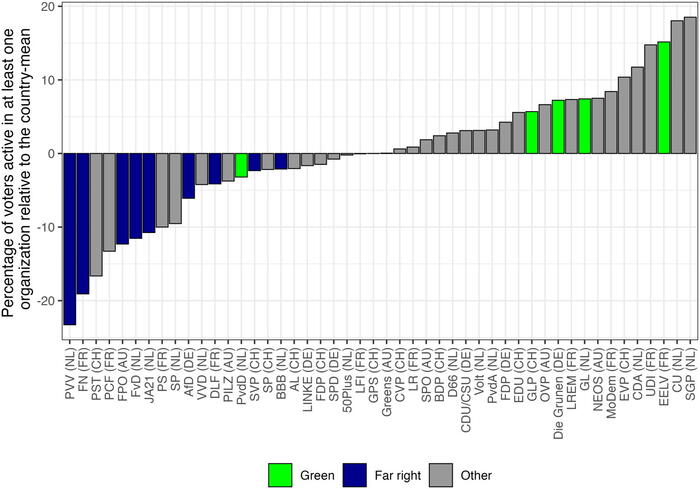
The authors then analyze cross-national data on political parties and voters in Austria, France, Germany, the Netherlands, and Switzerland. One data source concerns the extent to which political parties are tied to CSOs and whether they receive large-scale CSO donations. A second source looks at whether party supporters are active in CSOs. Preliminary findings point to important differences between old, class-based parties (especially Social Democrats) and newer parties, with the latter much less tied to CSOs. However, within the new party families, Green parties are more tightly linked to CSOs than far-right parties, but there also exists variation within far-right parties. These patterns demand a more fine-grained analysis of specific cases.


Image
Figure 2. Members of civil society organizations among the electorate of political parties in Austria, France, Germany, the Netherlands, and Switzerland.


Figure 2. Members of civil society organizations among the electorate of political parties in Austria, France, Germany, the Netherlands, and Switzerland.

Note: The figure is based on the Joint EVS/WVS 2017-2022 Dataset (2022). It uses the battery of membership in organizations and partisanship questions. In the WVS, partisanship is measured with ‘Which party would you vote for?’; in the EVS, with ‘Which political party appeals to you most?’ For this figure, the two items are treated as functional equivalents. The percentage of members is calculated from all respondents indicating sympathy towards the respective party.


Finally, the authors qualitatively analyze three distinct cases: one New Left party and both old and new far-right populist parties — the German Green Party, the Swiss People’s Party (SVP), and the Alternative for Germany (AfD). Their analysis reveals key differences as regards the importance of CSOs in fostering linkage and social closure. CSOs played a key role in consolidating the Greens and SVP, whereas in the case of AfD, antipathy from German CSOs helped generate a more outsider identity.

The Greens emerged via linkages with left-libertarian social movements in the 1970s and 80s. This included groups supportive of environmental protection and feminism and opposed to nuclear proliferation. CSOs provided ideas and personnel, which helped build a sense of social closure among party supporters. This identity still persists in spite of the subsequent fragmentation of civil society.

By contrast, SVP emerged through connections to Swiss farmers' associations, rural economic networks, and local interest groups. SVP has been radicalizing since the 1990s, becoming one of Europe’s most successful far-right parties and aligning itself with Euroscepticism. SVP’s long history of rural and community penetration has helped strengthen social closure among its electorate.

Finally, AfD emerged in a more fragmented context, via its ties to right-wing protest networks. The party was a top-down vehicle that organized in response to what it saw as Germany’s mismanagement of the Eurozone crisis. AfD lacks dense connections to CSOs and has instead built informal and often volatile alliances with protesters. Many German CSOs — as well as German society more generally — explicitly oppose AfD, which has ironically helped AfD build an outsider identity because its supporters feel isolated and stigmatized.

The case studies vividly illustrate how varied CSO relationships shape cleavages and partisanship in three of the most important Western European parties.

*Research-in-Brief prepared by Adam Fefer.

Hero Image
Brown and white concrete building under white clouds during daytime Sorin Gheorghita
All News button
1
Subtitle

CDDRL Research-in-Brief [4-minute read]

Date Label
0
CDDRL Postdoctoral Fellow, 2024-25
alex_mierke-zatwarnicki_2.jpg

Alex Mierke-Zatwarnicki is a postdoctoral fellow at the Center on Democracy, Development and the Rule of Law (CDDRL) at the Freeman Spogli Institute for International Studies (FSI) at Stanford University. She holds a Ph.D. in Government from Harvard University and was previously a Max Weber Fellow at the European University Institute.

Alex’s work focuses on political parties and group identity in Western Europe, in macro-historical perspective. A core theme of her research is understanding how different patterns of political and social organization combine to shape the ‘arena’ of electoral politics and the opportunity space for new competitors.

In her ongoing book project, Alex studies the different ways in which outsider parties articulate group identities and invoke narratives of social conflict in order to gain a foothold in electoral competition. Empirically, the project employs a mixed-methods approach — including qualitative case studies and quantitative text analysis — to compare processes of party-building and entry across five distinct ‘episodes’ of party formation in Western Europe: early twentieth-century socialists, interwar fascists, green and ethno-regionalist parties in the post-war period, and the contemporary far right.

Date Label
Paragraphs

This article examines the consequences of the opium concession system in the Dutch East Indies—a nineteenth-century institution through which the Dutch would auction the monopolistic right to sell opium in a given locality. The winners of these auctions were invariably ethnic Chinese. The poverty of Java's indigenous population combined with opium's addictive properties meant that many individuals fell into destitution. The author argues that this institution put in motion a self-reinforcing arrangement that enriched one group and embittered the other with consequences that persist to the present day. Consistent with this theory, the author finds that individuals living today in villages where the opium concession system once operated report higher levels of out-group intolerance compared to individuals in nearby unexposed counterfactual villages. These findings improve the understanding of the historical conditions that structure antagonisms between competing groups.

All Publications button
1
Publication Type
Journal Articles
Publication Date
Subtitle

This article examines the consequences of the opium concession system in the Dutch East Indies—a nineteenth-century institution through which the Dutch would auction the monopolistic right to sell opium in a given locality.

Journal Publisher
World Politics
Authors
Nicholas Kuipers
Number
pp. 1–38
Graduate School of Business 655 Knight Way Stanford, CA 94305
(650) 721 1298
0
Associate Professor of Political Economy, GSB
Associate Professor, by courtesy, of Economics and of Political Science
saumitra_jha.jpg

Along with being a Senior Fellow at the Freeman Spogli Institute for International Studies, Saumitra Jha is an associate professor of political economy at the Stanford Graduate School of Business, and convenes the Stanford Conflict and Polarization Lab. 

Jha’s research has been published in leading journals in economics and political science, including Econometrica, the Quarterly Journal of Economics, the American Political Science Review and the Journal of Development Economics, and he serves on a number of editorial boards. His research on ethnic tolerance has been recognized with the Michael Wallerstein Award for best published article in Political Economy from the American Political Science Association in 2014 and his co-authored research on heroes with the Oliver Williamson Award for best paper by the Society for Institutional and Organizational Economics in 2020. Jha was honored to receive the Teacher of the Year Award, voted by the students of the Stanford MSx Program in 2020.

Saum holds a BA from Williams College, master’s degrees in economics and mathematics from the University of Cambridge, and a PhD in economics from Stanford University. Prior to rejoining Stanford as a faculty member, he was an Academy Scholar at Harvard University. He has been a fellow of the Niehaus Center for Globalization and Governance and the Center for the Study of Democratic Politics at Princeton University, and at the Center for Advanced Study in the Behavioral Sciences at Stanford. Jha has consulted on economic and political risk issues for the United Nations/WTO, the World Bank, government agencies, and for private firms.


Senior Fellow at the Freeman Spogli Institute for International Studies
Dan C. Chung Faculty Scholar at the Freeman Spogli Institute for International Studies
Senior Fellow at the Stanford Institute for Economic Policy Research
Date Label
-

The Program on American Democracy in Comparative Perspective is holding a conference on Democracy and its Discontents on October 8-10 in Budapest, Hungary. The conference, co-hosted with Central European University, will bring together scholars of American and European politics to examine topics such as democratic backsliding, inequality, and money in politics. Saskia Sassen of Columbia University will deliver the keynote address. 

Democracy and its Discontents Agenda
Download pdf
Conferences
Paragraphs

Author

Karen Del Biondo

Postdoctoral Scholar at CDDRL, 2012-2013

Postdoctoral Fellow, KFG Transformative Power of Europe, Free University of Berlin, 2013-2014


Abstract

Internationally, there has been an increasing call for ‘partnership’ in development cooperation. This refers to development cooperation based on negotiation with the recipient government on an equal basis. While both the E.U. and the U.S. have formally committed to this principle, the E.U. is known to be a frontrunner in partnership-based development, while the U.S. was found to be rather slow in implementing this agenda. This paper investigates the degree to which E.U. and U.S. development policies reflect partnership, particularly regarding general features, aid characteristics, conditionality and aid selectivity and aid motives. It finds that, while E.U. development cooperation has traditionally been stronger focused on partnership than it is the case for the U.S., in recent years the gap is narrowing. On the one hand, E.U. development policies have increasingly resembled those of the U.S., as E.U. development assistance is becoming more focused on security and there are increasing conditions on budget support. While U.S. development policies are still strongly driven by security motives, the U.S. has recently madeefforts to increase country ownership.


All Publications button
1
Publication Type
Working Papers
Publication Date
Journal Publisher
CDDRL Working Papers
Authors
Karen Del Biondo
Authors
News Type
News
Date
Paragraphs

Prince Moulay Hicham Ben Abdallah, a consulting professor at the Center on Democracy, Development and the Rule of Law is leaving Stanford at the end of this academic year to pursue research in Islamic studies in the United Kingdom.

Ben Abdallah joined CDDRL – a center at the Freeman Spogli Institute for International Studies – as a visiting scholar in 2007, and then became a consulting professor. In 2010, Ben Abdallah worked with CDDRL Director Larry Diamond to launch one of the center’s principal research programs, the Program on Arab Reform and Democracy (ARD). Examining political and democratic reform in the Arab world, ARD is a multidisciplinary program that brings together policy-makers, academics and civil society members to advance policy-relevant research.

“We are very proud to have been able to engage Prince Moulay Hicham and provide him an intellectual home during this past formative period for the Program on Arab Reform and Democracy, and for his own scholarship and reflection. He has had a profound and enduring impact in helping to launch and shape a significant program of research on Arab politics and society at Stanford, and through that in stimulating the broader growth of Arab studies at Stanford,” said Diamond. “In giving so generously of his time, knowledge, and resources to our students, he has also supported and inspired many of them to make what I expect will be a lifelong commitment to study of and engagement with the Arab World. We wish him every success in this next phase of his intellectual journey.”

Written during his residence at CDDRL, Ben Abdallah's memoir entitled Journal d’un Prince Banni or the Diary of a Banished Prince debuted this spring. The autobiography shares his life story as a member of Morocco's royal family. The first cousin of Morocco's King Mohammed VI, Diary of a Banished Prince traces Ben Abdallah's evolution as a political activist against the historical backdrop of Morocco's authoritarian politics.

“At CDDRL, I found an intellectual community that was tightly knit, yet diverse enough to foster the cross-fertilization of ideas," said Ben Abdallah "Its cutting-edge research and classical scholarly debates provided an environment that broadened my expertise and offered opportunities to engage in real introspection.. All these elements were crucial in allowing me to write my book as well as explore new frontiers of research.”

Ben Abdallah has served on the FSI advisory board since November 2009, and has stepped down from that role this year.

Ben Abdallah will continue to stay engaged at Stanford through his role on the board of advisors for the American Middle Eastern Network for Dialogue at Stanford, a student group on campus. He will also stay involved with the ARD program as a principal advisor and supporter of the initiative.

Hero Image
myhicham
Moulay Hicham
All News button
1
Authors
Date
Paragraphs

The electoral eruption of anti-European Union populism is a reflection of structural flaws in that body but does not represent a fatal political blow, according to Stanford scholars.

In the May 25 elections for the European Parliament, anti-immigration parties won 140 of the 751 seats, well short of control, but enough to rattle supporters of the EU, which has 28 member nations. In Britain, Denmark, France and Greece, the political fringe vote totals stunned the political establishments.

Stanford political scientist Francis Fukuyama said the rise of extremism and anti-elitism is not surprising in the wake of the 2008 economic downturn and subsequent high levels of unemployment throughout Europe. In one sense, the EU elites have themselves to blame, he said.

"The elites who designed the EU and the eurozone failed in a major way," he said. "There was a structural flaw in the design of the euro (monetary union absent fiscal union, and the method of disciplining countries once in the zone)," said Fukuyama, the Olivier Nomellini Senior Fellow at Stanford's Freeman Spogli Institute for International Studies and the Center on Democracy, Development and the Rule of Law, and Research Afflilate at The Europe Center.

Some have argued that the European Union should adopt a form of fiscal union because without one, decisions about taxes and spending remain at the national level.

As Fukuyama points out, this becomes a problem, as in the case of a debt-ridden Greece, which he believes should not have qualified for EU membership in the first place. In fact, he said, it would have been better for Greece itself to leave the euro at the outset of the 2008 crisis.

Still, Fukuyama said the big picture behind the recent election is clear – it was a confluence of issues and timing.

"It is a bit like an off-year election in the U.S., where activists are more likely to vote than ordinary citizens," he said.

Fukuyama believes the EU will survive this electoral crisis. "I think the EU will be resilient. It has weathered other rejections in the past. The costs of really exiting the EU are too high in the end, and the elites will adjust, having been given this message," he said.

Meanwhile, the populist parties in the different countries are not unified or intent on building coalitions with each other.

"Other than being anti-EU, most of them have little in common," Fukuyama said. "They differ with regard to specific positions on immigration, economic policy, and they respond to different social bases."

Ongoing anger

Dan Edelstein, a professor of French, said the largest factor for success by extremist candidates was "ongoing anger toward the austerity policy imposed by the EU," primarily by Germany.

Edelstein estimates that a large majority of French voters are still generally supportive of the EU. For the time being, the anti-EU faction does not have a majority, though they now have much more representation in the European Parliament.

Edelstein noted existing strains among the anti-EU parties – for example, the UK Independence Party in Britain has stated that it would not form an alliance with the National Front party in France.

Immigration remains a thorny issue for some Europeans, Edelstein said.

"'Immigration' in most European political debates, tends to be a synonym for 'Islam.' While there are some countries, such as Britain, that are primarily worried about the economic costs of immigration, in most continental European countries, the fears are cultural," he said.

As Edelstein put it, Muslims are perceived as a "demographic threat" to white or Christian Europe. However, he is optimistic in the long run.

"It seems a little early to be writing the obituary of the EU. Should economic conditions improve over the next few years, as they are predicted to, we will likely see this high-water mark of populist anger recede," said Edelstein.

Cécile Alduy, an associate professor of French, writes in the May 28 issue of The Nation about how the ultra-right-wing National Front came in first place in France's election.

"This outcome was also the logical conclusion of a string of political betrayals, scandals and mismanagement that were only compounded by the persistent economic and social morass that has plunged France into perpetual gloom," she wrote.

Historian J.P. Daughton said that like elsewhere in the world, immigration often becomes a contentious issue in Europe in times of economic difficulties.  

"High unemployment and painful austerity measures in many parts of Europe have led extremist parties to blame immigrants for taking jobs and sapping already limited social programs," he said.

Anti-immigration rhetoric plays particularly well in EU elections, Daughton said. "Extremist parties portray European integration as a threat not only to national sovereignty, but also to national identity.

Edelstein, Alduy and Daughton are all Faculty Affiliates of The Europe Center.

Wake-up call

Russell A. Berman, a professor of German studies and comparative literature, said many Europeans perceive the EU as "somehow impenetrable, far from the civic politics of the nation states."

As a result, people resent regulations issued by an "intangible bureaucracy," and have come to believe that the European Parliament has not grappled with major issues such as mustering a coherent foreign policy voice, he said.

"The EU can be great on details but pretty weak on the big picture," said Berman, who is the Walter A. Haas Professor in the Humanities, Senior Fellow at the Hoover Institution, and Faculty Affiliate of The Europe Center. "It is this discrepancy that feeds the dissatisfaction."

Yet he points out that the extremist vote surged in only 14 nations of the EU – in the other 14, there was "negligible extremism," as he describes it.

"We're a long way from talking about a fatal blow, but the vote is indeed a wake-up call to the centrists that they have to make a better case for Europe," Berman said.


All News button
1
Subscribe to Western Europe