-

Speaker bio:

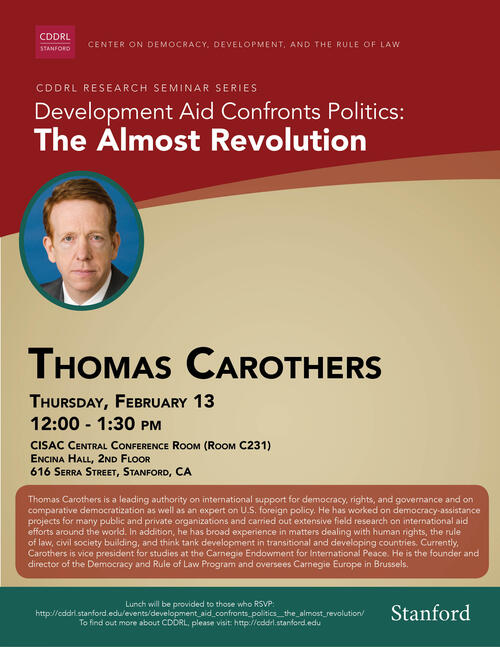
Thomas Carothers is vice president for studies at the Carnegie Endowment for International Peace. He is the founder and director of the Democracy and Rule of Law Program and oversees Carnegie Europe in Brussels.

Carothers is a leading authority on international support for democracy, rights, and governance and on comparative democratization as well as an expert on U.S. foreign policy. He has worked on democracy-assistance projects for many public and private organizations and carried out extensive field research on international aid efforts around the world. In addition, he has broad experience in matters dealing with human rights, the rule of law, civil society building, and think tank development in transitional and developing countries.

He is the author of six critically acclaimed books as well as many articles in prominent journals and newspapers. Carothers has also worked extensively with the Open Society Foundations (OSF), including currently as chair of the OSF Think Tank Fund and previously as chair of the OSF Global Advisory Board. He is an adjunct professor at the Central European University in Budapest and was previously a visiting faculty member at Nuffield College, Oxford University, and Johns Hopkins SAIS.

Prior to joining the Endowment, Carothers practiced international and financial law at Arnold & Porter and served as an attorney adviser in the Office of the Legal Adviser of the U.S. Department of State.

Carothers is the co-author (with Diane de Gramont) of Development Aid Confronts Politics: The Almost Revolution (Carnegie, 2013) and author of Confronting the Weakest Link: Aiding Political Parties in New Democracies (Carnegie, 2006); Promoting the Rule of Law Abroad: In Search of Knowledge (Carnegie, 2006); Uncharted Journey: Promoting Democracy in the Middle East, co-edited with Marina Ottaway (Carnegie, 2005); Critical Mission: Essays on Democracy Promotion (Carnegie, 2004); Funding Virtue: Civil Society Aid and Democracy Promotion, co-edited with Marina Ottaway (Carnegie, 2000); Aiding Democracy Abroad: The Learning Curve (Carnegie, 1999); and Assessing Democracy Assistance: The Case of Romania (Carnegie, 1996).

Image

CISAC Conference Room

Thomas Carothers Vice President for Studies Speaker Carnegie Endownment for International Peace
Seminars
-

Abstract:

Professor Gold will make a presentation that is part of a larger book project that applies the theory of fields as elaborated by Pierre Bourdieu, Neil Fligstein and Doug McAdam to the remaking of Taiwan since the end of martial law in 1987. He argues that political democratization is only one part of the larger dispersal of all forms of power (what Bourdieu terms “capital”) away from the tight centralized control of the mainlander—dominated KMT to broader segments of Taiwan’s society. This talk will look at this process of the breakdown and reconstruction of the old order of various fields, in particular the political, economic and cultural fields, and the effect of this on the overarching field of power.


Speaker Bio:

Thomas B. Gold is Professor of Sociology at the University of California, Berkeley, and Executive Director of the Inter-University Program for Chinese Language Studies, whose executive office is at Berkeley and teaching program at Tsinghua University in Beijing. He received his B.A. in Chinese Studies from Oberlin College, and M.A. in Regional Studies – East Asia and PhD in Sociology from Harvard University. He taught English at Tunghai University in Taiwan. He was in the first group of U.S. government-sponsored students to study in China, spending a year at Shanghai’s Fudan University from 1979-1980. Prof Gold’s research has examined numerous topics on the societies on both sides of the Taiwan Strait. These include: youth; guanxi; urban private entrepreneurs (getihu); non-governmental organizations; popular culture; and social and political change. He is very active in civil society in the United States, currently serving on the boards of several organizations such as the Asia Society of Northern California, International Technological University, Teach for China, and the East Bay College Fund.  His books include State and Society in the Taiwan Miracle, and the co-edited volumes Social Connections in China: Institutions, Culture, and the Changing Nature ofGuanxi, The New Entrepreneurs of Europe and Asia: Patterns of Business Development in Russia, Eastern Europe and China, and Laid-Off Workers in a Workers’ State: Unemployment With Chinese Characteristics.  

Reuben W. Hills Conference Room

Thomas B. Gold Professor of Sociology Speaker UC Berkeley
Seminars
News Type
News
Date
Paragraphs

The Center on Democracy, Development, and the Rule of Law (CDDRL) is pleased to introduce our 2013-14 pre and postdoctoral scholars. Selected from upwards of 100 applicants, these scholars will spend the year in residence at CDDRL to pursue their research, work closely with faculty and connect to an innovative learning community. Hailing from Yale University, New York University, Georgetown University and Stanford these scholars bring diverse backgrounds and expertise to enrich the ranks at CDDRL. Please read the Q&A's below to learn more about our new scholars, their research and what brought them to CDDRL. 


Image
Ana Bracic

Hometown: Slovenska Bistrica, Slovenia

Academic Institution: New York University

Discipline and expected date of graduation: PhD, May 2013

Research Interests: Human rights, Gender and Ethnic Discrimination, State Failure, International Organizations, and using Quantitative and Experimental Methods.

Dissertation Topic/Title: Essays on Human Rights

What attracted you to the CDDRL Pre/post-doctoral program? I am excited to become a post-doctoral fellow at the Center because my work closely fits the scholarly agenda of CDDRL. While human rights form the core of my dissertation, I touch on several other topics central to CDDRL—I evaluate the efficacy of a strong mechanism for promotion of democracy, I explore how much worse human rights abuses are in failed states, and I examine the conditions under which ground level NGO action can decrease discrimination against a vulnerable population. The faculty affiliated with the Center have a great deal of expertise in areas relevant to my research efforts - ranging from human rights and consolidation of democracy to field experiments - and I very much look forward to their guidance and advice.

What do you hope to accomplish during your year-long residency at the Center? My central aim is to complete the next phase of my research project on discrimination against the Roma in Central and Eastern Europe, while writing a book manuscript that stems from the same project. I hope to build relationships and potentially develop collaborations with members of the academic community at CDDRL and Stanford more generally.

Please state a fun fact about yourself! I used to compete in ballroom dancing.


Image
Adi Greif

Hometown: Stanford, CA

Academic Institution: Yale University

Discipline and expected date of graduation: Political Science, Spring 2014

Research Interests: International Relations, Middle East, Colonialism, Gender Politics, Islamic Law, Demography

Dissertation Topic/Title: "The Long-Term Impact of Colonization on Gender"

What attracted you to the CDDRL Pre/post-doctoral program? Improving gender equality is correlated with improved economic growth, democratization and rule of law. In addition to these research themes, CDDRL's focus on both scholarship and policy-relevance is important to me. I hope that understanding the processes leading to changes in gender equality over time will help us pursue better policies for advancing gender equality.

What do you hope to accomplish during your year-long residency at the Center? I hope to turn my thesis into multiple articles. I also intend to write a short monograph analyzing the relationship between opinions on gender, religion and political party affiliation in the Middle East through use of satellite data to proxy for religious piety.

Please state a fun fact about yourself! I live in the same housing complex that I lived in as a child.


Image
Alexander Lee

Hometown: Los Angeles, CA

Academic Institution: Stanford University

Discipline and expected date of graduation: PhD, Political Science, September 2013

Research Interests: Historical Political Economy, Development, Colonialism, South Asia, Identity Politics, Terrorism

Dissertation Topic/Title: "Diversity and Power: Caste in Colonial India"

What attracted you to the CDDRL Pre/post-doctoral program? Much of my work is on the historical origins of underdevelopment, and I'm interested in exploring contemporary policies that can alleviate these inequalities.

What do you hope to accomplish during your year-long residency at the Center? I hope to develop my dissertation into a book, particularly by adding material on the post-colonial period.

Please state a fun fact about yourself! I make a very good chana masala.


Image
Hesham Sallam

Hometown: Cairo, Egypt

Academic Institution: Georgetown University

Discipline and expected date of graduation: Political Science; 2013-2014

Research Interests: Democratization, Identity Politics and Distribution, Authoritarian Elections, Political Islam; Political Economy of Authoritarianism

Dissertation Topic/Title: “Indispensible Arbiters: Islamist Movements, Economic Liberalization, and Authoritarian Rule in the Arab World”

What attracted you to the CDDRL Pre/post-doctoral program? What I find most appealing about CDDRL is its demonstrated commitment to advancing innovative, rigorous research on questions pertaining to the challenges of democratization and other related topics that speak directly to my current work. It hosts a distinguished set of scholars whose work has been highly influential in informing and guiding my own research. As home to the Arab Reform and Democracy Program, CDDRL also offers a great opportunity for engaging with scholars and practitioners who share my strong interest in developing research agendas that could enhance understanding of the Arab uprisings, their origins and the dynamic political and social struggles they encompass.

What do you hope to accomplish during your year-long residency at the Center? During my residency at the Center, I look forward to finishing my dissertation writing, along with a number of related research projects pertaining to the relationship between contentious politics and formal electoral competition in the aftermath of the Arab uprisings.

Please state a fun fact about yourself! I’m a dedicated bikram yogi and a strong believer that every great idea begins with a deep backward bend.


Image
Anna West

Hometown: Bay Area

Academic Institution: Stanford University

Discipline and expected date of graduation: Anthropology, June 2015

Research Interests: Critical ethnographic approaches to development and the state, the role of traditional authorities in post-colonial democracies, global health, citizenship, human rights, and discourses of participation and community in Southern Africa, particularly Malawi.

Dissertation Title: "Health Promotion, Citizenship, and Rural Governance in Malawi"

What attracted you to the CDDRL Pre/post-doctoral program?  I am drawn to CDDRL's focus on the complex intersections between development and governance, and to the Center's embrace of both theoretical and policy dimensions of scholarship on these themes. My dissertation research in Malawi examines how modular global health interventions engage local power structures, patronage systems and political cultures. In particular, I focus on traditional authorities' involvement in rural health promotion and examine the continuing salience of chiefly governance for local and national discourse on community participation, human rights and citizenship. I draw on ethnographic fieldwork and archival research to trace the salience of health promotion strategies for the formation and consolidation of ideas, values and processes of governance and democracy in Malawi. I look forward to stimulating conversations with faculty and visiting scholars through the Center's Programs on Poverty and Governance and Human Rights and the CDDRL-affiliated Center for Innovation in Global Health.

What do you hope to accomplish during your year-long residency at the Center? I will be returning from 18 months of fieldwork in Malawi this fall and am excited to join CDDRL's diverse community of scholars. I aim to complete a draft of my dissertation during my fellowship year. As a social and cultural anthropologist, I especially look forward to sharing my findings and seeking feedback from faculty mentors and fellows in other disciplines with shared interests in the quality of and contestations around democratic processes in post-colonial African states.

All News button
1
News Type
Commentary
Date
Paragraphs

In this paper, Marinov draws on the experience of the European Union (EU) to ask under what conditions economic integration furthers democratization. Scholars agree that incentives at the European level have helped democratic transitions in Southern and Eastern Europe. However, there is no agreement on (i) the exact causal mechanisms involved, (ii) the relative size of the effects, (iii) whether this success can be replicated outside or Europe. He addresses these issues by offering a theory of how integration furthers democratization. He argues economic integration can help citizens resolve the coordination dilemmas they face in holding their rulers accountable. Integration works in two ways: (a) through diffusion of civic culture, it enables citizens to second-guess each other's likely actions in the event of government abuse, (b) through credible conditionality, integration removes the ability of the ruler to lean on some support coalitions while abusing others. An empirical test of the theory strongly confirms that economic integration leads to democracy when its culture-spreading aspect is strongly backed by conditionality. An important aspects of the theory is that it generalizes. The theory and evidence suggest that there are substantial unexploited opportunities for encouraging democracy in Latin America, the Middle East, Africa and Asia.

All News button
1
Authors
News Type
News
Date
Paragraphs

Stanford's Center on Democracy, Development, and the Rule of Law (CDDRL) is pleased to announce that undergraduate senior honors student, Anna Barrett Schickele, received the Firestone Medal for Excellence in Undergraduate Research. This university award is given to the top ten percent of honors theses in social science, science, and engineering.

Schickele's thesis entitled, "One Drop At A Time," examines the factors that inform farmers' decisions to use modern irrigation systems in the Lurín Valley of Peru, where she spent several months conducting fieldwork with a Lima-based NGO. Schickele — a public policy major —was able to collect primary data through interviews with farmers and fieldworkers to inform her research study that includes policy recommendations to the NGO community and government officials.

Anna Schickele (center) with Francis Fukuyama (left) and Larry Diamond (right).

Martin Carnoy, the Vida Jacks Professor of Education at the Stanford Graduate School of Education, served as Schickele's thesis advisor together with Rosamond L. Naylor, the director of the Center on Food Security and the Environment at FSI.

"Ana's thesis is an important contribution to our understanding of the barriers and openings for stimulating agricultural development among subsistence farmers," said Carnoy. "Her original insights make the thesis particularly valuable for those addressing development issues in the world’s poorest regions."

In August, Schickele will begin a research position at the Abdul Latif Jameel Poverty Action Lab at the Massachusetts Institute of Technology.

CDDRL's best thesis award was given to Kabir Sawhney, a management science and engineering major, who wrote his thesis on the effect of regime type and the propensity to default on sovereign debt. Advised by Professor of Political Science Gary Cox, Swahney cited the cases of Romania in the 1980s and more recently of Greece to conclude that the quality of government — rather than regime type alone — determines whether a country chooses to default. 

After graduation. Sawhney will join the consulting firm Accenture as an analyst in their San Francisco office.  

Three honors students' received fellowships from Stanford's Haas Center of Public Service to pursue public service-related work after graduation. Keith Calix and Imani Franklin both received the Tom Ford Fellowship in Philanthropy and will be working in New York for grant-making foundations, and Lina Hidalgo received the Omidyar Network Postgraduate Fellowship to work with an international organization.     

The CDDRL Undergraduate Senior Honors Program is an interdisciplinary honors program led by Francis Fukuyama, the Olivier Nomellini Senior Fellow at FSI. The program recruits a diverse group of talented students interested in writing original theses on topics impacting the field of democracy, development, and the rule of law. During the year-long program, students write their thesis in consultation with a CDDRL faculty member, participate in research workshops, and travel to Washington, D.C. for "honors college."

The nine members of the graduating class of 2013 CDDRL undergraduate honors students include:


Keith Calix


International Relations 

Wie is ek? Coloured Identity and Youth Involvement in Gangsterism in Cape Town, South Africa  

Advisor: Prudence Carter

Vincent Chen


Earth Systems; Economics

Democracy and the Environment: An Empirical Analysis and Observations from Taiwan’s Maturing Democracy  

Advisor: Larry Diamond

Holly Fetter


Comparative Studies in Race and Ethnicity 

From DC to the PRC: Examining the Strategies and Consequences of U.S. Funding for Chinese Civil Society  

Advisor: Jean Oi

Imani Franklin


International Relations

Living in a Barbie World: Skin Bleaching and the Preference for Fair Skin in India, Nigeria, and Thailand  

Advisor: Allyson Hobbs

Mariah Halperin


History

Religion and the State: Turkey under the AKP 

Advisor: Larry Diamond

Thomas Hendee


Human Biology

The Health of Pacification: A Review of the Pacifying Police Unit program in Rio de Janeiro, Brazil 

Advisors: Beatriz Magaloni & Paul Wise 

Lina Hidalgo


Political Science

Tiananmen or Tahrir? A Comparative Study of Military Intervention Against Popular Protest  

Advisors: Jean Oi & Lisa Blaydes

Kabir Sawhney


Management Science and Engineering

Repayment and Regimes: The Effect of Regime Type on Propensity to Default on Sovereign Debt    

Advisor: Gary Cox

Anna Schickele


 Public Policy

One Drop at a Time: Diffusion of Modern Irrigation Technology in the Lurín Valley, Peru  

Advisors: Martin Carnoy & Roz Naylor

Hero Image
Schickele Logo
All News button
1
Authors
News Type
News
Date
Paragraphs

The Program on Human Rights at Stanford's Center on Democracy, Development, and the Rule of Law (CDDRL), together with the McCoy Family Center for Ethics in Society, are pleased to introduce the 2013 Summer Human Rights Fellows. These four remarkable Stanford undergraduates were selected from a competitive pool of applicants to spend the summer serving in organizations advancing human rights work around the world.

The Summer Human Rights Fellowship enables undergraduate students to gain practical experience at international organizations that promote, monitor, evaluate, or advance human rights work. In order to apply, potential fellows must identify their ideal placement and work with the partner to ensure there is a viable project that allows the student to contribute meaningfully to the organization’s work. This year, the fellows will be working on the ground in India, Jordan, and Guatemala with informal workers, at-risk children, trafficking victims, and using technology to advance social justice worldwide. Upon their return to Stanford next year, each of the Human Rights Fellows will participate in campus events to describe their work.

Below are the profiles of our four fellows highlighting their summer projects, interest in human rights and some fun facts. Click here to learn more about the fellowship program.


Image
Name: Firas Abuzaid (’14)

Major: Computer Science

Hometown: Plano, Texas

Tell us about your project. I'll be working with Visualizing Justice in Amman, Jordan. The mission of Visualizing Justice is to empower people worldwide to create visual stories for social justice and human rights. My mission for the summer is to exploit new software innovations in web development to augment Visualizing Justice’s data visualization capabilities, thus making their stories more expressive and accessible worldwide.

What first sparked your interest in human rights? I think there is a disconnect between the technologies we develop and the societies we live in, and that gap is most noticeable in the area of human rights. In particular, our innovations in technology have created an information overload problem. We are now inundated with information about various human rights issues, but struggle for a more nuanced or contextualized understanding of those issues. Also, the quality of the information has not kept up with the growth in quantity. If we can invest the time to build better tools and re-couple the quality of information with its quantity, then we, as a society, can make a lot more progress in the field of human rights.

What are your post-Stanford aspirations? I want to develop new tools that make it easier for individuals to create compelling data visualizations, especially those that lie outside the traditional domains of technology.

Fun fact about yourself: I can solve a Rubik's cube in under a minute.


Image
Name: Lara Mitra (’15)

Major: Human Biology

Hometown: Washington, D.C.

Tell us about your project. I’m traveling to Ahmedabad, India to work with Self-Employed Women's Association (SEWA), a union of 1.4 million informal economy workers, which provide community-driven socioeconomic services, including healthcare, local banking, social security, and housing to marginalized groups. Given my interest in public health, I will focus on SEWA’s initiatives responding to people's inherent right to a healthy life, working with the health team to analyze and document the changing role of front-line health workers who deliver care to expecting mothers. I aim to assess the effectiveness of services provided by three unique classes of health workers, and identify how their knowledge and skills can be harnessed to deliver primary health care to a broad swath of the rural and urban population.

What first sparked your interest in human rights? The day of my 16th birthday found me waiting in line at the DMV in Washington, DC. When I reached the front of the line, I was given one final form to fill out. I mindlessly scribbled my name and date of birth before I stumbled upon a question that I did not know the answer to: “Would you like to be an organ donor?” This was my first exposure to a human rights issue that I hope to pursue well into the future. Upon doing some research, I became hooked on the topic of organ donation. The future human biology major in me enjoyed reading about the dire need for kidneys in the US, but the humanitarian in me found another area of the debate more gripping – the black market for organs. 

What are your post-Stanford aspirations?  Find a job that allows me to combine my interests in medicine and human rights! 

Fun fact about yourself: My parents made me take classes in juggling and unicycling growing up in case the whole college thing didn't work out.


Image

Name: Nicolle Richards (’16)

Major: Human Biology (planned)

Hometown: Vienna, Austria

Tell us about your project. I will be traveling to Guatemala to work with Kids Alive, a nonprofit that works to rescue orphans and at-risk children. In Guatemala, they run a care home for girls who have been abandoned or abused – often in the form of forced labor and/or physical and sexual abuse. I will be working with the girls in the care home, and also evaluating a program that works to continue supporting the girls who have returned home.

What first sparked your interest in human rights? Throughout high school, I volunteered at a care home in Romania for women and girls who had experienced abuse. This first exposure to drastic poverty sparked my interest in social work and development, and led me to explore different aspects of human rights. Later in high school, I taught summer school in the Dominican Republic to at-risk children, where exposure to obvious injustice solidified my passion to fight for human rights. As a Christian, I believe that I have a responsibility to help those less fortunate – and fighting for human rights is an obvious way to do this!

What are your post-Stanford aspirations? I hope to study international human rights law and eventually work combatting human trafficking around the world. 

Fun fact about yourself: I get to spend my vacations in Seoul, South Korea where my family currently lives.


Image
Name: Garima Sharma (’15)

Major: Economics

Hometown: New Delhi, India

Tell us about your project. I am going to be working with Apne Aap: Women Worldwide, an anti-trafficking NGO based in Forbesganj, India. Forbesganj is in close proximity to the Indo-Nepalese border, which has led to its emergence as a source, transit center, and destination for women trafficked for prostitution. I have spent the past two quarters designing an interactive human rights education curriculum focused on sex trafficking, which I will use in Forbesganj to engage with at-risk girls who are the daughters of sex workers in the red light district, as well as 12-14 year-old girls belonging to the Nutt (lower-caste) community. Simultaneously, I will be working with older men, women and community leaders, with the goal of making preliminary headway into a community-wide anti-trafficking strategy.

What first sparked your interest in human rights? I cannot count the number of times that I have been verbally harassed, whistled at or sung to by strange men in the course of my fairly “normal” existence as a middle-class girl in India. My passion for wanting to ensure that women are able to demand and access a life of dignity is a consequence of having grown up in a society that normalizes aggression against us. This prompted me to intern at the National Human Rights Commission of India, where I spent my time reading reports on trafficking, examining anti-trafficking legislation, and talking to activists and victims of human rights violations. I realized we critically need to place greater focus on the prevention of violations and develop a true, nuanced appreciation for the concept of human rights – a change I am hoping to effect through this fellowship.

What are your post-Stanford aspirations? A few years down the line, I hope to work as a policymaker advancing women’s rights in India.

Fun fact about yourself: I am one of two—I have a twin sister named Anima, who attends medical school in India.


Hero Image
65637 10151591582933128 1486130847 n
All News button
1
-

Online campus map:
http://campus-map.stanford.edu/

ONLINE RSVP required by 4 pm on 2/19:
http://creees.stanford.edu/event/roundtable-new-europe

Until recently, democracies in new European Union members and aspirants were believed to be on their way to consolidation. Nonetheless, the recent financial crisis has had important political implications, with renewed fears of instability and even reversal of democratic gains. In Hungary, the Fidesz government has changed the Constitution and the electoral system, and has fired more than 10,000 government employees amid complaints of political discrimination. In Romania, austerity measures have led to in-fighting between the president and the parliament-backed prime minister, resulting in a failed attempt to impeach the president, and EU concerns over government attacks on the independence of the Constitutional Court. Moreover, the December 9, 2012, Romanian elections have dealt a decisive victory to the prime minister’s Social Liberal Union, which will likely make co-habitation with the current president crisis-prone. Bulgaria is another recently admitted EU member wherein concerns over the rule of law negatively affected democratic performance, while Serbia has recently elected a nationalist government with connections to the Milosevic regime. These developments raise doubts over the sustainability of New Europe’s democratic gains, and warrant a reassessment of the consolidation of these democracies.


Landau Economics Building, SIEPHR conference room A

Grigore Pop-Eleches Associate Professor of Politics and Public International Affairs Panelist Woodrow Wilson School, Princeton University
Jason Wittnberg Associate Professor of Political Science Panelist University of California, Berkeley
Milada Vaduchova Associate Professor of Political Science Panelist University of North Carolina, Chapel Hill
Patricia Young Postdoctoral Fellow, Department of Sociology Panelist Stanford University
Kathryn Stoner Deputy Director, Center on Democracy, Development, and the Rule of Law; Senior Fellow, Freeman Spogli Institute for International Studies Panelist Stanford University
Panel Discussions
-

Carla Ferstman is Director of REDRESS. She is currently on sabbatical leave and is a Jennings Randolph Senior Fellow 2012-2013 at the United States Institute of Peace. She joined REDRESS in 2001 as its Legal Director and became its Director in 2005. She was called to the Bar in British Columbia, Canada where she practiced as a criminal law barrister. She has also worked with the UN High Commissioner for Human Rights on legal reform and capacity building in post-genocide Rwanda, with Amnesty International's International Secretariat as a legal researcher on trials in Central Africa and as Executive Legal Advisor to Bosnia and Herzegovina's Commission for Real Property Claims of Displaced Persons and Refugees (CRPC). She has an LL.B. from the University of British Columbia, an LL.M. from New York University and is a doctoral candidate at the University of Oxford. Ms. Ferstman has published and is a regular commentator on victims' rights, the International Criminal Court and the prohibition against torture.

Bechtel Conference Center

Carla Ferstman Director Speaker REDRESS -- Jennings Randolph Senior Fellow 2012-13 at United States Institute of Peace
Lectures
-

Abstract:

The roots of the revolts known as the Arab Spring lie in many sources but one of the leading causes was the high rates of unemployment, low skill levels, and the growth of the youth populations. Now Arab governments are faced with the dual challenges of creating new political and economic systems that can meet the needs and demands of the peoples of their countries. This presentation will focus on the role of the private sector and the need to build an entrepreneurial eco-system that can foster rapid economic growth. Practical examples of reform programs will be emphasized drawing from the work of the Center for International Private Enterprise.

Speaker Bio:

John D. Sullivan is the executive director of the Center for International Private Enterprise (CIPE), an affiliate of the US Chamber of Commerce. As associate director of the Democracy Program, Sullivan helped to establish both CIPE and the National Endowment for Democracy in 1983. After serving as CIPE program director, he became executive director in 1991. Under his leadership CIPE developed a number of innovative approaches that link democratic development to market reforms: combating corruption, promoting corporate governance, building business associations, supporting the informal sector, and programs to assist women and youth entrepreneurs. Today, CIPE has more than 90 full-time staff with offices in Afghanistan, Egypt, Iraq, Pakistan, Romania, Russia, and Ukraine.

Sullivan began his career in Los Angeles’ inner city neighborhoods, helping to develop minority business programs with the Institute for Economic Research and the Office of Minority Business Enterprise. In 1976 he joined the President Ford Election Committee in the research department on campaign strategy, polling, and market research.  Sullivan joined the public affairs department of the U.S. Chamber of Commerce in 1977 as a specialist in business and economic education.

Encina Ground Floor Conference Room

John D. Sullivan Executive Director Speaker The Center for International Private Enterprise (CIPE)
Seminars
News Type
Q&As
Date
Paragraphs

President Obama and Mitt Romney meet for their third debate to discuss foreign policy on Monday, when moderator Bob Schieffer is sure to ask them about last month's terrorist attack in Libya and the nuclear capabilities of Iran.

In anticipation of the final match between the presidential candidates, researchers from five centers at Stanford’s Freeman Spogli Institute for International Studies ask the additional questions they want answered and explain what voters should keep in mind.


What can we learn from the Arab Spring about how to balance our values and our interests when people in authoritarian regimes rise up to demand freedom?  

What to listen for: First, the candidates should address whether they believe the U.S. has a moral obligation to support other peoples’ aspirations for freedom and democracy. Second, they need to say how we should respond when longtime allies like Egypt’s Hosni Mubarak confront movements for democratic change.

And that leads to more specific questions pertaining to Arab states that the candidates need to answer: What price have we paid in terms of our moral standing in the region by tacitly accepting the savage repression by the monarchy in Bahrain of that country's movement for democracy and human rights?  How much would they risk in terms of our strategic relationship with Bahrain and Saudi Arabia by denouncing and seeking to restrain this repression? What human rights and humanitarian obligations do we have in the Syrian crisis?  And do we have a national interest in taking more concrete steps to assist the Syrian resistance?  On the other hand, how can we assist the resistance in a way that does not empower Islamist extremists or draw us into another regional war?  

Look for how the candidates will wrestle with difficult trade-offs, and whether either will rise above the partisan debate to recognize the enduring bipartisan commitment in the Congress to supporting democratic development abroad.  And watch for some sign of where they stand on the spectrum between “idealism” and “realism” in American foreign policy.  Will they see that pressing Arab states to move in the direction of democracy, and supporting other efforts around the world to build and sustain democracy, is positioning the United States on “the right side of history”?

~Larry Diamond, director of the Center on Democracy, Development, and the Rule of Law


What do you consider to be the greatest threats our country faces, and how would you address them in an environment of profound partisan divisions and tightly constrained budgets? 

What to listen for: History teaches that some of the most effective presidential administrations understand America's external challenges but also recognize the interdependence between America's place in the world and its domestic situation.

Accordingly, Americans should expect their president to be deeply knowledgeable about the United States and its larger global context, but also possessed of the vision and determination to build the country's domestic strength.

The president should understand the threats posed by nuclear proliferation and terrorist organizations. The president should be ready to lead in managing the complex risks Americans face from potential pandemics, global warming, possible cyber attacks on a vulnerable infrastructure, and failing states.

Just as important, the president needs to be capable of leading an often-polarized legislative process and effectively addressing fiscal challenges such as the looming sequestration of budgets for the Department of Defense and other key agencies. The president needs to recognize that America's place in the world is at risk when the vast bulk of middle class students are performing at levels comparable to students in Estonia, Latvia and Bulgaria, and needs to be capable of engaging American citizens fully in addressing these shared domestic and international challenges.

~Mariano-Florentino Cuéllar, co-director of the Center for International Security and Cooperation


Should our government help American farmers cope with climate impacts on food production, and should this assistance be extended to other countries – particularly poor countries – whose food production is also threatened by climate variability and climate change?

What to listen for: Most representatives in Congress would like to eliminate government handouts, and many would also like to turn away from any discussion of climate change. Yet this year, U.S. taxpayers are set to pay up to $20 billion to farmers for crop insurance after extreme drought and heat conditions damaged yields in the Midwest.

With the 2012 farm bill stalled in Congress, the candidates need to be clear about whether they support government subsidized crop insurance for American farmers. They should also articulate their views on climate threats to food production in the U.S. and abroad.

Without a substantial crop insurance program, American farmers will face serious risks of income losses and loan defaults. And without foreign assistance for climate adaptation, the number of people going hungry could well exceed 15 percent of the world's population. 

~Rosamond L. Naylor, director of the Center on Food Security and the Environment


What is your vision for the United States’ future relationship with Europe? 

What to listen for: Between the end of World War II and the end of the Cold War, it was the United States and Europe that ensured world peace. But in recent years, it seems that “Europe” and “European” have become pejoratives in American political discourse. There’s been an uneasiness over whether we’re still friends and whether we still need each other. But of course we do.

Europe and the European Union share with the United States of America the most fundamental values, such as individual freedom, freedom of speech, freedom to live and work where you choose. There’s a shared respect of basic human rights. There are big differences with the Chinese, and big differences with the Russians. When you look around, it’s really the U.S. and Europe together with robust democracies such as Canada and Australia that have the strongest sense of shared values.

So the candidates should talk about what they would do as president to make sure those values are preserved and protected and how they would make the cooperation between the U.S. and Europe more effective and substantive as the world is confronting so many challenges like international terrorism, cyber security threats, human rights abuses, underdevelopment and bad governance.

~Amir Eshel, director of The Europe Center


Historical and territorial issues are bedeviling relations in East Asia, particularly among Japan, China, South Korea, and Southeast Asian countries. What should the United States do to try to reduce tensions and resolve these issues?

What to listen for: Far from easing as time passes, unresolved historical, territorial, and maritime issues in East Asia have worsened over the past few years. There have been naval clashes, major demonstrations, assaults on individuals, economic boycotts, and harsh diplomatic exchanges. If the present trend continues, military clashes – possibly involving American allies – are possible.

All of the issues are rooted in history. Many stem from Imperial Japan’s aggression a century ago, and some derive from China’s more assertive behavior toward its neighbors as it continues its dramatic economic and military growth. But almost all of problems are related in some way or another to decisions that the United States took—or did not take—in its leadership of the postwar settlement with Japan.

The United States’ response to the worsening situation so far has been to declare a strategic “rebalancing” toward East Asia, aimed largely at maintaining its military presence in the region during a time of increasing fiscal constraint at home. Meanwhile, the historic roots of the controversies go unaddressed.

The United States should no longer assume that the regional tensions will ease by themselves and rely on its military presence to manage the situation. It should conduct a major policy review, aimed at using its influence creatively and to the maximum to resolve the historical issues that threaten peace in the present day.

~David Straub, associate director of the Korea Studies Program at the Walter H. Shorentein Asia-Pacific Research Center


Compiled by Adam Gorlick.

Hero Image
debatepic
President Obama and Mitt Romney speak during the second presidential debate on Oct. 16, 2012. Their third and final debate will focus on foreign policy.
Reuters
All News button
1
Subscribe to Eastern Europe