In 2015, Volodymyr Zelenskyy was at the height of a successful career as an entertainer. Though trained as a lawyer at the Kryvyi Rih Institute of Economics in Eastern Ukraine, the then 37 year old Zelenskyy was a successful comedian and public personality. As the star of the popular TV show, Servant of the People, he played a local history teacher who inadvertently becomes the president of Ukraine following a viral video rant about corruption.
No one watching comedic President Zelenskyy then could have possibly imagined the real-life plot twist that would follow. In an incredible act of life imitating art, in April 2019, Volodymyr Zelenskyy once again stood on stage in front of a cheering crowd, but this time as the actual president of Ukraine.
He won in a landslide election against incumbent president Petro Poroshenko on a platform of systemic change and progress using an almost exclusively virtual campaign. Speaking from his headquarters on election night, he affirmed the exuberance and hope of his supporters: “I can say as a citizen of Ukraine to all countries of the post-Soviet Union: Look at us — everything is possible.”
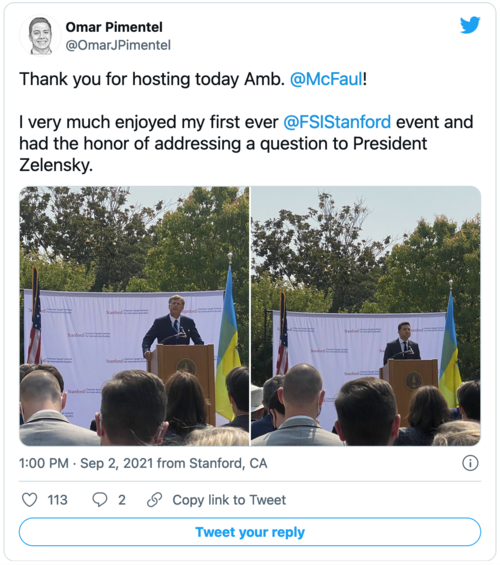
This same message shaped the theme of President Zelenskyy’s remarks at his historic address from the Freeman Spogli Institute for International Studies (FSI) at Stanford University on September 2. The first Ukrainian president to ever visit California, President Zelenskyy, First Lady Olena Zelenska and their delegation joined a group of FSI faculty members led by FSI Director Michael McFaul at an outdoor event held in the Encina Courtyard.
Melissa Morgan
The Office of President Volodymyr Zelenskyy
Melissa Morgan
The Office of President Volodymyr Zelenskyy of Ukraine
The Office of President Volodymyr Zelenskyy of Ukraine
President Volodymyr Zelenskyy of Ukraine is greeted by FSI Director Michael McFaul, Anna Grzymala-Busse, Francis Fukuyama, Kathryn Stoner, Steven Pifer, Markos Kounalakis and Lieutenant Governor Eleni Kounalakis.
Photo by:
Melissa Morgan
President Volodymyr Zelenskyy spoke about how innovation and technology can help strengthen democracy in Ukraine.
Photo by:
The Office of President Volodymyr Zelenskyy
The Lieutenant Governor of California, Eleni Kounalakis and her husband Markos Kounalakis were among the dignitaries who welcomed President Zelenskyy to California.
Photo by:
Melissa Morgan
Due to ongoing COVID-19 precautions, President Zelenskyy's address was given outside to an audience gathered in the Encinca Courtyard at the Freeman Spogli Institute for International Studies.
Photo by:
The Office of President Volodymyr Zelenskyy of Ukraine
President Volodymyr Zelenskyy of Ukraine and Michael McFaul share remarks together onstage at the Freeman Spogli Institute for International Studies.
Photo by:
The Office of President Volodymyr Zelenskyy of Ukraine
In his remarks, Zelenskyy drew inspiration from Steve Jobs’ famous "How to Live Before You Die" commencement address given at Stanford in 2005.
"This is one of the most famous speeches ever given at Stanford,” he said. “It's about believing in dreams and overcoming the impossible. This is the same as my story. I am just a common guy from a common family from a common industrial town in Eastern Ukraine. Yet here I am today at Stanford, because everything is possible."
He continued, “It is the same for Ukraine. Many people look at us and think that it will be impossible to achieve the goals we hope for. But we know that our critics are wrong. The people of our country love democracy and freedom and will not let threats take those things away. We know that anything is possible."
Looking to the future, Zelenskyy outlined the steps his administration is undertaking to bring increased digitization to Ukraine. These efforts include launching fully electronic passports, moving business and legal services online and expanding the scope of e-goverance. The hope is that this meld of new technology will help curb corruption while simultaneously creating more equitable opportunities and better access to public services for more Ukranians.
Speaking on the ambitious scope of these plans, the president acknowledged, “There will be resistance to the changes and innovations that we are going to make.” Nonetheless, he remains committed to the work ahead of strengthening democratic institutions in Ukraine and building on the progress that has already been made. “We do not have a ‘Ukrainian Dream,’ yet,” he said. “But we have a ‘Ukrainian Goal’ and a ‘Ukrainian Mission’ to make the future we want for our country.” An edited recording of his remarks is below.
Keeping with Stanford tradition, Zelenskyy took questions from the audience after his prepared remarks. A variety of students and Stanford community members from Russia, Burma, Belarus and beyond had the opportunity to engage the president on a range of issues including U.S.-Ukraine relations, armament sales abroad and concerns over Russian aggression in Crimea and influence Eastern Ukraine. Of particular meaning was Zelensky’s affirmation and support for the democratic movement in Belarus led by Svaitlana Tsikhanouskaya, whom FSI hosted earlier this summer at a faculty roundtable.
Students and faculty alike were appreciative of the president’s candor and good nature in addressing difficult topics.
Image
Image
Image
Image
Following the formal remarks, President Zelenskyy and First Lady Zelenska had an opportunity to meet with Stanford President Marc Tessier-Lavigne in the Memorial Church Courtyard. Prior to leaving, the First Lady also sat down with leaders and students from Stanford's Office of Accessible Education (OAE), an area of interest she would like to support and better develop in Ukraine.
For FSI, the president’s visit was another affirmation of the special connection between Ukraine and the Stanford community. Since 2016, the Center on Democracy, Development and the Rule of Law has hosted the Ukrainian Emerging Leaders Program, which provides a 10-month academic training fellowship in support of mid-career practitioners working actively as policy-makers, legal professionals, entrepreneurs and leaders of civil society organizations in Ukraine.
Speaking to this shared history in his opening introductions, FSI Director Michael McFaul emphasized the crucial need for ongoing support and intellectual investment into Ukraine. “The fight for democracy and independence in Ukraine is one of the most important causes in the world today,” he affirmed. “Not just for Ukrainians, but for all who cherish the ideals of democracy, liberty and sovereignty.”
To President Zelenskyy, McFaul extended a future invitation: “You are always welcome back, either as president or in retirement as a professor.”
“With the classes you offer, I will think about it,” Zelenskyy replied with a smile.
Rod Searcey
Rod Searcey
Rod Searcey
Rod Searcey
Rod Searcey
Stanford President Marc Tessier-Lavigne met President Volodymyr Zelensky of Ukraine and First Lady Olena Zelenska outside the Stanford Memorial Church.
Photo by:
Rod Searcey
President Zelenskyy and the First Lady walk with Michael McFaul to the Memorial Church courtyard on Stanford's campus.
Photo by:
Rod Searcey
FSI Director Michael McFaul bids President Zelenskyy farewell.
Photo by:
Rod Searcey
A Stanford student asks a question to President Zelenskyy during the Q&A session the event.
Photo by:
Rod Searcey
First Lady of Ukraine Olena Zelenska met with leaders and students from the Office of Accessible Education (OAE) to learn how to incorporate accessibility practices into Ukrainian society.
Photo by:
Rod Searcey
Read More
Commentary
"We Have Entered a New Historical Era": Larry Diamond on the Future of Democracy
Speaking at the April 2022 meeting of the FSI Council, Larry Diamond offered his assessment of the present dangers to global democracy and the need to take decisive action in support of liberal values.
Belarusian Leader Sviatlana Tsikhanouskaya Meets with Stanford Scholars for Roundtable on Democracy in Belarus
Democratic leader Sviatlana Tsikhanouskaya and her delegation joined an interdisciplinary panel of Stanford scholars and members of the Belarusian community to discuss the future of democracy in Belarus.
President Zelenskyy outlined the steps his administration is undertaking to bring increased digitization to Ukraine, curb corruption and create more equitable access to public services for more Ukrainians.
On August 9, 2020 citizens in the Republic of Belarus went to the polls to vote for their next president. The incumbent was Alexander Lukashenko, a 67-year-old military officer who has kept an iron grip on the presidency for the entire 26 years Bealrus has held elections. But the challenger was an unexpected, new face. Sviatlana Tsikhanouskaya is a 38-year-old English teacher, mother and pro-democracy activist who stepped into a campaign following her husband's arrest and imprisonment in May 2020 for political dissension. In four short months, she galvanized the nation with a message of democracy, freedom and fair elections that reached across opposition factions and gained enough momentum to become a serious contender for the presidency.
On election day, projections estimated an initial win for Tsikhanouskaya at 60%. But when the country's Central Elections Commission announced the election results, Lukashenko carried 80% of the vote, and Tsikhanouskaya a mere 10%. Given the long history of election engineering in Belarus, the results were expected. But what happened next was not. Outraged by the fraud, Tsikhanouskaya's supporters poured into city centers in Brest and Minsk by the tens of thousands, instigating the largest public protests in the history of post-Soviet Belarus. Caught off-guard, the regime hit back with a ruthless wave of violence and political imprisonments, prompting the European Union, NATO and other countries to impose sanctions and condemn Lukashenko as an illegitimate leader.
While Tsikhanouskaya's presidential campaign ended last August, her role as a democratic leader in Eastern Europe has not. In the year since the election, she has traveled the globe to meet with lawmakers, policy experts and heads of state to speak out against the ongoing repression of Lukashenko's regime and advocate for support of Belarus by the international community. The Freeman Spogli Institute for International Studies (FSI) was honored to host Tsikhanouskaya and her delegation at Stanford for a roundtable discussion on the challenges that lay ahead in preparing Belarus for a democratic transition. Director Michael McFaul hosted the discussion, which brought together scholars from across FSI, the Hoover Institute and the Belarusian expatriate community. The full recording is below.
Rather than holding a typical press conference, Tsikhanouskaya's visit at FSI gave members of the Belarusian delegation an opportunity to engage in back-and-forth dialogue with an interdisciplinary panel of experts on governance, history and policy. Tsikhanouskaya and her senior advisors shared their perspectives on the challenges they are facing to build and maintain pro-democracy efforts, while Stanford scholars offered insights from their extensive research and scholarship.
Presidents, Protests and Precedent in Belarus
As leader of the delegation, Sviatlana Tsikhanouskaya gave an overview of the brutality of Lukashenko's regime and the lawlessness that has enveloped the country. But she also reaffirmed the commitment of everyday Belarusians to defending their independence and continuing the work of building new systems to push back against the dictatorship, and encouraged the support of the international democratic community.
"Belarusians are doing their homework. But we also understand that we need the assistance and help of other democratic countries," said Tsikhanouskaya. "That support is vital, because our struggle relates not just to Belarusians, but to all countries who share these common values."
Speaking to the work that Belarusians have already undertaken, Franak Viačorka, a senior advisor to Sviatlana Tsikhanouskaya, described how citizens are creating new means of protesting and organizing. Though they learned some tactics from recent protests in Hong Kong and classic theories by political scientists like Gene Sharp, organizers in Belarus quickly realized that they needed to innovate in order to keep ahead of Lukashenko's crack-downs. Today the opposition is a tech-driven movement that spreads awareness and support quickly through digital spaces and underground channels while avoiding large in-person gatherings that attract government brutality.
By Tanya Bayeva's assessment, these methods of organizing have been effective in capturing widespread support amongst people. A member of the Belarusian diaspora, Bayeva described the sense of empowerment she felt in coming together in a common cause with like-minded people.
"By coming out like this, people have started realizing that it is up to us, the people, and our individual willpower to make a difference," said Bayeva. "We are realizing that the king has no clothes, and that working together we can forward the process of democratization."
But there is still plenty of work ahead. In order to facilitate a more peaceful future transition to a democratic system, there will need to be frameworks in place to bridge the divide between old systems and new. Valery Kavaleuski, the representative on foreign affairs in Sviatlana Tsikhanouskaya's delegation, is focusing extensively on these issues, such as reconciliation processes and plans for future investments between Belarus and the European Union.
"These are political moves that reinforce hope among Belarusians and tells that that they are not alone and that when the change comes, they will have friends by their side to overcome the challenges of the transition period," said Kavaleuski.
Advice from Stanford Scholars: Focus on Processes and People
Responding to the Belarusian delegation's questions and comments, the faculty from FSI and the broader Stanford community offered insights and considerations from a variety of perspectives and disciplines on 'next steps' for the pro-democracy movement.
Francis Fukuyama, the Olivier Nomellini Senior Fellow at FSI and Mosbacher Director at the Center on Democracy, Development and the Rule of Law (CDDRL), cautioned against the impulse to immediately take down the state and bureaucratic systems of the existing regime. While dismantling the mechanisms from the old state may feel emotionally satisfying, examples from history such as post-Nazi Germany and post-invasion Iraq illustrate the crippling effect on efficiency, functionality and the ability of the new order to govern in a vacuum of bureaucratic expertise.
FSI's Deputy Director, Kathryn Stoner, gave similar advice in regard to drafting and implementing a new constitution and conventions.
"People care to a great degree [about a new constitution], but not to months and months of debate and politicians yelling at one another. People can't eat constitutions," said Stoner. "You have to demonstrate that your system is going to be better than what was. When things have not gone well in transitioning countries, it's been because people don't see concrete change. So have a constitutional convention, but make it fast."
Amr Hamzawy, a senior research scholar for the Middle East Initiative at the Center for Democracy, Development and the Rule of Law, also pointed to the importance of engaging the public and building alliances within both the old and new political systems. Based on his observations of the failed Egyptian and Tunisian efforts at democratic transition, he cautioned against discussions of impunity, arguing that while politically and morally symbolic, this practice often backfires and alienates important factions of the state apparatus which are vital for the function and success of a new government.
Hamzawy similarly encouraged carefully blending nationalism and populism to keep divisions within the public sector in check. Imbuing such narratives with pro-democracy rhetoric, he believes, can create a powerful tool for unifying the population around the new government and emerging national identity.
The advice from the Europe Center's director, Anna Grzymala-Busse, succinctly brought together many of the points made by the faculty panel: "No post-transitional government can achieve all the promises they've made right away," said Grzymala-Busse. "So make the transition about processes rather than specific outcomes, about ensuring the losers are heard along with the winners, and about making sure all people can participate."
Additional participants in the roundtable discussion not noted above include Hanna Liubakova, a journalist and non-resident fellow at the Atlantic Council, Dmytro Kushneruk, the Consul General of Ukraine in San Francisco, and Stanford scholars Larry Diamond, David Holloway, Norman Naimark, Erik Jensen, Kiyoteru Tsutsui and John Dunlop.
Read More
News
'In Being Together, We Had the Power' - A Belarusian Activist Describes Life on the Front Lines of Minsk Protests
On the World Class Podcast, Belarusian scholar and activist Aleś Łahviniec explains why people are protesting, and what it feels like to be out on the streets in Minsk.
CDDRL Statement Regarding the Arrest of Tatiana Kouzina by Belarusian Authorities
The faculty and staff of Stanford's Center on Democracy, Development and the Rule of Law, as well as the undersigned alumni of the Draper Hills Summer Fellows Program, wish to protest the completely unjustified arrest and pending trial of the researcher Tatiana Kouzina on June 28 by Belarusian authorities.
Sviatlana Tsikhanouskaya, Michael McFaul, Franak Viačorka, and Francis Fukuyama participate in a roundtable discussion on democracy in Belarus. | Office of Sviatlana Tsikhanouskaya
All News button
1
Subtitle
Democratic leader Sviatlana Tsikhanouskaya and her delegation joined an interdisciplinary panel of Stanford scholars and members of the Belarusian community to discuss the future of democracy in Belarus.
PLEASE CHECK BACK FOR VIDEO/LIVE STREAM OF THIS EVENT
Image
30 years ago, communist rule ended across central Europe in a dramatic series of events ranging from Solidarity's election triumph in Poland on 4 June 1989, through the ceremonial reburial of Imre Nagy in Budapest (with a fiery young student leader called Viktor Orbán demanding the withdrawal of all Soviet troops), to the fall of the Berlin Wall and the Velvet Revolution in Czechoslovakia. Timothy Garton Ash witnessed these events and described them memorably in his book The Magic Lantern: The Revolution of '89 Witnessed in Warsaw, Budapest, Prague and Berlin.
Now he has revisited all these countries, to explore the long term consequences of the revolutions and subsequent transitions. What went right? More pressingly: What went wrong? For today, Orbán is presiding over the systematic dismantling of democracy in Hungary, the Law and Justice party in Poland is trying to follow his example, the prime minister of the Czech Republic is an oligarch and former secret police informer, while a xenophobic populist party, the AfD, is flourishing in the former East Germany. In this lecture, Garton Ash will explore the peculiar character of populism in post-communist Europe, and the considerable forces of resistance to it.
Image
Timothy Garton Ash is Professor of European Studies, Oxford University, and Senior Fellow, Hoover Institution, Stanford. He is the author of ten books of contemporary history, including The File: A Personal History, History of the Present, In Europe's Name: Germany and the Divided Continent, and, most recently, Free Speech: Ten Principles for a Connected World. His commentaries appear regularly in the Guardian, and are widely syndicated.
Light refreshments will be served after the lecture, and copies of The Magic Lantern: The Revolution of '89 Witnessed in Warsaw, Budapest, Prague and Berlin, will be on sale
This event is free and open to the public.
Timothy Garton Ash
<i>Professor of European Studies, Oxford University and Senior Fellow, Hoover Institute, Stanford University</i>
Ivan Prymachenko is an educational technology innovator and a co-founder of the largest Ukrainian massive open online courses platform Prometheus with 600,000 users. Structured as a non-profit organization, Prometheus creates and publish on its platform massive online courses from leading Ukrainian universities, companies, international organizations, and government. Prometheus also works on making its online courses a part of the curriculum of Ukrainian educational facilities in the blended learning format: twenty-two Ukrainian universities are already participating in this program. In addition, Prymachenko is a lead educational expert in the largest NGO coalition in Ukraine, the Reanimation Package of Reforms, the most influential non-governmental reform advocate in the country.
In 2011, Prymachenko saw the first massive open online courses launched by Stanford and was inspired to create similar courses in Ukraine. In 2013, while still pursuing a master’s degree, he launched the first massive open online course in post-soviet countries. In 2014, Prymachenko co-founded Prometheus and initially funded the project with six months' of his university scholarship. In four years, the volunteer initiative grew into one of the largest educational projects in independent Ukraine’s history. To date, the platform hosts 75 massive online courses from top-rated Ukrainian universities, international organizations such as United Nations Development Program, the Council of Europe, OSCE, and leading companies — Microsoft Ukraine and EY Ukraine. To support the implementation of key Ukrainian reforms, such as the public procurement system - Prozorro, Prometheus worked with the state authorities to create several governmental massive online courses and enrolled tens of thousands of civil servants as students.
My research examines political extremism, destigmatization, and radicalization, focusing on the role of popularity cues in online media. My related research examines a broad range of threats to democratic governance, including authoritarian encroachment, ethnic prejudice in public goods allocation, and misinformation.
My dissertation won APSA's Ernst B. Haas Award for the best dissertation on European Politics. I am currently working on my book project, Engineering Extremism, with generous funding from the William F. Milton Fund at Harvard.
My published work has appeared in the American Political Science Review, Governance, International Studies Quarterly, Public Administration Review, and the Virginia Journal of International Law, along with an edited volume in Democratization (Oxford University Press). My research has been featured in KQED/NPR, The Washington Post, and VICE News.
I received my Ph.D. in Political Science at the University of California, Berkeley in 2020. I was a Predoctoral Research Fellow at the Center on Democracy, Development and the Rule of Law at Stanford University and the Stanford Program on Democracy and the Internet. I hold a B.A. (Magna Cum Laude; Phi Beta Kappa) from Cornell University and an M.A. (with Distinction) from the University of California, Berkeley.
The Program on American Democracy in Comparative Perspective is holding a conference on Democracy and its Discontents on October 8-10 in Budapest, Hungary. The conference, co-hosted with Central European University, will bring together scholars of American and European politics to examine topics such as democratic backsliding, inequality, and money in politics. Saskia Sassen of Columbia University will deliver the keynote address.
Douglas Lute, America’s ambassador to the North Atlantic Treaty Organization, said Washington and Moscow found a way to collaborate since the collapse of the Soviet Union. But that has changed under President Vladimir Putin, he said.
“It’s clear today that we don’t have the partnership with Russia that we had for two decades,” Lute said. “NATO does not wish to be an enemy of Russia, but Russia has to understand that it will defend its 27 allies.”
He warned Russia that the tactics being used in Crimea “don’t play on NATO territory; these allies will be defended as the treaty demands.”
Lute’s talk on Tuesday capped his two-day visit at Stanford. He spent the day before lecturing in the International Policy Studies course “America’s War in Afghanistan: Multiple Actors and Divergent Strategies” taught by Karl Eikenberry. Eikenberry, a former ambassador to Afghanistan, is now a consulting professor at the Freeman Spogli Institute for International Studies and an affiliate of several of the institute’s centers.
Ambassador Lute spoke to the class about the White House and National Security Council perspective on the war in Afghanistan, drawing on his experience in both the Bush and Obama administrations.
During his talk on Tuesday, Lute said that as NATO celebrates its 66th year, it is transitioning to an alliance that must now face “hybrid warfare,” such as cyber attacks and unconventional forces.
That will call for a Special Forces-type base in Europe that can defend the 28 nations of the North Atlantic Treaty Alliance from hybrid assaults, he said.
“A cyber attack on a NATO ally could rise to the level of requiring a mutual defense response,” he said.
Lute’s talk was sponsored by the Freeman Spogli Institute for International Studies, The Europe Center, the Center for International Security and Cooperation, and the Center for Russian, East European and Eurasian Studies.
Hero Image
Ambassador Douglas Lute addresses a Stanford audience on April 7, 2015 | Beth Duff-Brown
Is democracy heading toward a depression? CDDRL Director Larry Diamond answers in a recent Foreign Policy piece, assessing the challenges of overcoming a global, decade-long democratic recession. With much of the world losing faith in the model of liberal democracy, Diamond believes the key to setting democracy back on track involves heavy reform in America, serious crackdowns on corruption, and a reassessment of how the West approaches its support for democratic development abroad.
Hero Image
'Protect your Republic Protest' in Anıtkabir, Ankara, Turkey. 14 April 2007. | Selahattin Sönmez, Wikimedia Commons
How can international organizations influence behavior at the level of the individual? This paper tests whether incentive-based and norm promoting strategies have effects that trickle down to individuals and affect their behavior at the ground level. The study uses a hard case, that of discrimination against the Roma (commonly known by the disfavored term "Gypsies"), and spans three towns, Murska Sobota and Novo mesto in Slovenia and Cakovec in Croatia. Levels of discrimination were estimated via trust games played with money, which are particularly appropriate because the Roma are widely stereotyped as cheaters and thieves. The findings suggest that the EU accession process, widely regarded as an exceptionally strong incentive-based mechanism of rights diffusion, does not severely reduce discrimination on the ground. Instead, they suggest that ground level organizing aimed at improving relations between Roma and non-Roma helps reduce discrimination.
Speaker Bio:
Ana Bracic is a postdoctoral fellow at CDDRL. She received her PhD from NYU in May 2013, and was a Junior Visiting Fellow at the Human Rights Program at Harvard Law School in 2012-13. Her research aims to identify and understand mechanisms that tangibly improve the lives of people whose rights are violated, whether through measures are best applied at the state level or on the ground. Her dissertation consists of three related projects: a micro-level fieldwork study of discrimination against the Roma in Slovenia and Croatia, a macro-level study of cross-country diffusion of human rights practices, and a macro-level comparison of physical integrity rights violations in failed and stable autocracies. Her work has been funded in part by the American Political Science Association.