Jews vs. Rome: Barry Strauss & Erich Gruen in Conversation
-
Building 380, Math Corner
450 Jane Stanford Way, Building 380, Stanford, CA 94305
380X
Panel Discussions

Center on Democracy, Development and the Rule of Law is part of the Freeman Spogli Institute for International Studies
Building 380, Math Corner
450 Jane Stanford Way, Building 380, Stanford, CA 94305
380X
The Fisher Family Summer Fellows on Democracy and Development Program at Stanford University's Center on Democracy, Development and the Rule of Law is now accepting applications for our summer 2026 program. The deadline to apply is 11:59 pm PST on Thursday, January 15, 2026.
The program brings together an annual cohort of approximately 30 mid-career practitioners from countries in political transition who are working to advance democratic practices and enact economic and legal reform to promote human development. Launched by CDDRL in 2005, the program was previously known as the Draper Hills Summer Fellows Program. The new name reflects an endowment gift from the Fisher family — Sakurako (Sako), ‘82, and William (Bill), MBA ‘84 — that secures the future of this important and impactful program.
From Afghanistan to Zimbabwe, our program participants are selected from among hundreds of applicants every year for the significant contributions they have already made to their societies and their potential to make an even greater impact with some help from Stanford. We aim to give them the opportunity to join a global network of over 500 alumni from 97 countries who have all faced similar sets of challenges in bringing change to their countries.
The Fisher Family Summer Fellows Program provides an intensive 3-week on-campus forum for civil society leaders to exchange experiences and receive academic and policy training to enrich their knowledge and advance their work. Delivered by a leading Stanford faculty team composed of Michael McFaul, Kathryn Stoner, Francis Fukuyama, Larry Diamond, Erik Jensen, and more, the program allows emerging and established global leaders to explore new institutional models and frameworks to enhance their ability to promote good governance, accountable politics, and find new ways to achieve economic development in their home countries.
Prospective fellows from Ukraine are also invited to apply for our Strengthening Ukrainian Democracy and Development (SU-DD) Program, which runs concurrently with the Fisher Family Summer Fellows Program. The SU-DD program provides a unique opportunity for mid-career practitioners working on well-defined projects aimed at strengthening Ukrainian democracy, enhancing human development, and promoting good governance. Applicants to the SU-DD program will use the Fisher Family Summer Fellows Program application portal to apply and indicate their interest there. You will then be directed to a series of supplemental questions specific to the SU-DD program, including requiring a detailed description of your proposed project.

The program will run from Sunday, July 19, to Friday, August 7, 2026. Applications are due by 11:59 pm PST on Thursday, January 15, 2026.

As part of Stanford Democracy Day, several Stanford scholars share their perspectives on domestic and comparative erosion of democracy, providing context for current elections in the United States and around the world.
Speakers:
Christophe Crombez, Senior Research Scholar at The Europe Center at the Freeman Spogli Institute for International Studies and Professor of Political Economy at the Faculty of Economics and Business at KU Leuven in Belgium. His research focuses on EU institutions and their impact on policies, EU institutional reform, lobbying, party politics, and parliamentary government.
Anna Grzymała-Busse, Professor in the Department of Political Science, the Michelle and Kevin Douglas Professor of International Studies, senior fellow at the Freeman Spogli Institute for International Studies and the director of The Europe Center. Her research interests include political parties, state development and transformation, informal political institutions, religion and politics, and post-communist politics.
Hakeem Jefferson, Assistant Professor in the Department of Political Science, faculty affiliate with the Center for Comparative Studies in Race and Ethnicity and the Stanford Center for American Democracy. His research focuses primarily on the role identity plays in structuring political attitudes and behaviors in the U.S., with a special interest in understanding how stigma shapes the politics of Black Americans, particularly as it relates to group members’ support for racialized punitive social policies.
Hesham Sallam, Senior Research Scholar at CDDRL, where he serves as Associate Director for Research. He is also Associate Director of the Program on Arab Reform and Development. Sallam is co-editor of Jadaliyya ezine and a former program specialist at the U.S. Institute of Peace. His research focuses on political and social development in the Arab World. Sallam’s research has previously received the support of the Social Science Research Council and the U.S. Institute of Peace.
Kathryn Stoner, Mosbacher Director of the Center on Democracy, Development, and the Rule of Law (CDDRL), and a Senior Fellow at CDDRL and the Center on International Security and Cooperation at FSI. From 2017 to 2021, she served as FSI's Deputy Director. She is Professor of Political Science (by courtesy) and teaches in the Program on International Relations, as well as in the Ford Dorsey Master's in International Policy Program. She is also a Senior Fellow (by courtesy) at the Hoover Institution.
Encina Hall
616 Jane Stanford Way
Stanford, CA 94305
Anna Grzymała-Busse is a professor in the Department of Political Science, the Michelle and Kevin Douglas Professor of International Studies, senior fellow at the Freeman Spogli Institute for International Studies and the director of The Europe Center. Her research interests include political parties, state development and transformation, informal political institutions, religion and politics, and post-communist politics.
In her first book, Redeeming the Communist Past, she examined the paradox of the communist successor parties in East Central Europe: incompetent as authoritarian rulers of the communist party-state, several then succeeded as democratic competitors after the collapse of these communist regimes in 1989.
Rebuilding Leviathan, her second book project, investigated the role of political parties and party competition in the reconstruction of the post-communist state. Unless checked by a robust competition, democratic governing parties simultaneously rebuilt the state and ensured their own survival by building in enormous discretion into new state institutions.
Anna's third book, Nations Under God, examines why some churches have been able to wield enormous policy influence. Others have failed to do so, even in very religious countries. Where religious and national identities have historically fused, churches gained great moral authority, and subsequently covert and direct access to state institutions. It was this institutional access, rather than either partisan coalitions or electoral mobilization, that allowed some churches to become so powerful.
Anna's most recent book, Sacred Foundations: The Religious and Medieval Roots of the European State argues that the medieval church was a fundamental force in European state formation.
Other areas of interest include informal institutions, the impact of European Union membership on politics in newer member countries, and the role of temporality and causal mechanisms in social science explanations.

In this talk, Michta focuses on the current condition of European security and defense policy, including the roles played by the US and NATO, and Europe’s attempts to build up an EU-based security architecture. He will explore the hard security/military dimension of the issue in the context of a broader discussion of regionalized security optics and internal political change.
Speaker: Andrew A. Michta is Professor of Strategic Studies at the Hamilton School. Before joining Hamilton, Michta was a Senior Fellow with the GeoStrategy Initiative in the Atlantic Council’s Scowcroft Center for Strategy and Security and the former dean of the College of International and Security Studies at the George C. Marshall European Center for Security Studies. He holds a PhD in international relations from the Johns Hopkins University. His areas of expertise are international security, NATO, and European politics and security, with a special focus on Central Europe and the Baltic states.
His most recent book with Paal Hilde, The Future of NATO: Regional Defense and Global Security, was published by the University of Michigan Press in 2014. He is currently completing a book Europe Reconfigured: U.S. Europe Strategy for an Age of Great Power Conflict, funded by a two-year grant from the Smith Richardson Foundation. The book will be published in 2026.
Michta is a life member of the Council on Foreign Relations. He is also a Nonresident Senior Fellow at the Atlantic Council and a Visiting Fellow at the Hoover Institution on War Revolution and Peace at Stanford University. He is fluent in Polish and Russian and proficient in German and French.
The REDS Seminar Series aims to deepen the research agenda on the new challenges facing Europe, especially on its eastern flank, and to build intellectual and institutional bridges across Stanford University, fostering interdisciplinary approaches to current global challenges.
REDS is organized by The Europe Center and the Center on Democracy, Development and the Rule of Law, and co-sponsored by the Hoover Institution and the Center for Russian, East European and Eurasian Studies.
Learn more about REDS and view past seminars here.


In its early days, the European Union was accused of having a democratic deficit because its central institutions were not elected. The response was to increase the democratic responsiveness of the European Parliament and to give it a greater role in lawmaking. As for the Commission and the Council, however, the argument was that Member States populated these bodies and the governments of those states were democratically elected so those institutions were indirectly democratically accountable. But what happens if some Member States are no longer reliably democratic? This talk traces the way that the EU responded to first Hungary and then Poland taking an autocratic path, and assesses the successes and failures of those EU efforts.
Speaker: Kim Lane Scheppele is the Laurance S. Rockefeller Professor of Sociology and International Affairs at Princeton University and visiting professor of law at Stanford Law School. Scheppele's work focuses on the rise and fall of constitutional democracy. After 1989, Scheppele studied the new constitutional courts of Hungary and Russia, living in both places for extended periods. After 9/11, she researched the effects of the international "war on terror" on constitutional protections around the world. Since 2010, she has been documenting attacks on constitutional democracy by legalistic autocrats. Her book Destroying (and Restoring) Democracy by Law is forthcoming from Harvard University Press.
Scheppele is an elected member of the American Academy of Arts and Sciences and the International Academy of Comparative Law. In 2014, she received the Law and Society Association’s Kalven Prize for influential scholarship in comparative constitutional law and in 2024, she received a Guggenheim Fellowship for her work on democratic backsliding. She started her career in the political science department at the University of Michigan before moving to a full-time law teaching at the University of Pennsylvania. She was the founding director of the gender program at Central European University Budapest and has held visiting faculty positions in the law schools at Yale, Harvard, Erasmus/Rotterdam, and Humboldt/Berlin. She was President of the Law and Society Association from 2017-2019.
The REDS Seminar Series aims to deepen the research agenda on the new challenges facing Europe, especially on its eastern flank, and to build intellectual and institutional bridges across Stanford University, fostering interdisciplinary approaches to current global challenges.
REDS is organized by The Europe Center and the Center on Democracy, Development and the Rule of Law, and co-sponsored by the Hoover Institution and the Center for Russian, East European and Eurasian Studies.
Learn more about REDS and view past seminars here.

Professor Mary Elise Sarotte, award-winning historian and author of Not One Inch: America, Russia, and the Making of Post-Cold War Stalemate, will offer reflections on the difficult task of writing history that is still unfolding. Covering the pivotal years from 1989 to 2022, her work traces how early decisions at the end of the Cold War shaped the trajectory of U.S.–Russia relations and contributed to the impasse that continues to trouble the international order today. In this conversation, Sarotte will explore the historian’s challenge of disentangling myth from evidence, of balancing archival distance with contemporary resonance, and of reckoning with a legacy that remains deeply contested and urgently relevant.
The event will begin with opening remarks from Kathryn Stoner, Mosbacher Director of the Center on Democracy, Development, and the Rule of Law (CDDRL). The event will conclude with an audience Q&A.
This event is co-sponsored by the Center on Democracy, Development and the Rule of Law (CDDRL), and the Center for International Security and Cooperation (CISAC).

Mary Elise Sarotte received her AB in History and Science from Harvard and her PhD in History from Yale. She is an expert on the history of international relations, particularly European and US foreign policy, transatlantic relations, and Western relations with Russia. Her book, Not One Inch: America, Russia, and the Making of Post-Cold War Stalemate, was shortlisted for both the Cundill Prize and the Duke of Wellington Medal, received the Council on Foreign Relations Arthur Ross Prize Silver Medal, and won the Pushkin House Prize for Best Non-Fiction Book on Russia. Not One Inch is now appearing in multiple Asian and European languages, including a best-selling and updated version in German, Nicht einen Schritt weiter nach Osten. In 2026, Sarotte will return to Yale for a joint appointment as a tenured professor in both the Jackson School of Global Affairs and the School of Organization and Management.

Kathryn Stoner is the Mosbacher Director of the Center on Democracy, Development and the Rule of Law (CDDRL), and a Senior Fellow at CDDRL and the Center on International Security and Cooperation at FSI. From 2017 to 2021, she served as FSI's Deputy Director. She is Professor of Political Science (by courtesy) at Stanford, and she teaches in the Department of Political Science, in the Program on International Relations, as well as in the Ford Dorsey Master's in International Policy Program. She is also a Senior Fellow (by courtesy) at the Hoover Institution.
William J. Perry Conference Room, 2nd Floor
Encina Hall (616 Jane Stanford Way, Stanford)
This is a hybrid event. For virtual participation, if prompted for a password, use: 123456
Retaliation (or the threat thereof) is a central component of human behavior. It plays a key role in sustaining cooperation — such as in international organizations or free trade agreements — because those known to retaliate come to acquire a reputation of being hard to exploit. But how does the use and function of retaliation vary across cultures, and how does it interact with formal forms of punishment?
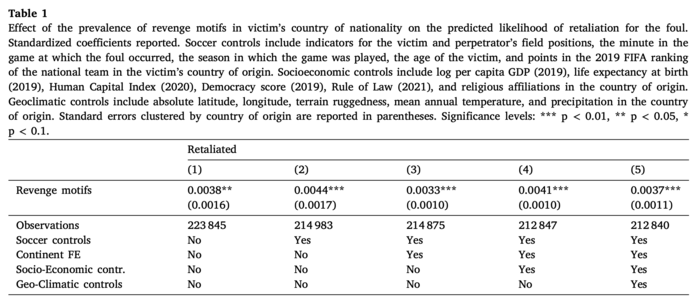
In “Cross-cultural differences in retaliation: Evidence from the soccer field,” Alain Schläpfer tackles these questions using data on retaliation from association football. Retaliation is simply defined in terms of fouling: player B retaliates against player A if and only if, after A fouls B, B then fouls A. Among other findings, Schläpfer shows that players from cultures emphasizing revenge are more likely to retaliate on the football field. This form of ‘informal punishment’ by players also interacts with ‘formal punishment’ by referees: retaliation by B is less likely when A is sanctioned with a yellow card. Schläpfer’s paper increases our knowledge of the causes and consequences of retaliation, while showing how informal cultural norms interact with the formal rules of football.
Schläpfer creates a data set of fouls committed over three football seasons (2016-2019) in nine of the world’s top professional men’s leagues. This includes the European leagues of Premier League (England), Serie A (Italy), Bundesliga (Germany), LaLiga (Spain), and Ligue 1 (France), as well as Série A (Brazil), Liga Profesional (Argentina), Liga MX (Mexico), and Major League Soccer (United States). The dataset comprises 9,531 games, 230,113 fouls committed by 10,928 unique perpetrators from 139 countries against 11,115 unique victims from 137 countries.
Because Schläpfer hypothesizes that being from more revenge-centric cultures explains on-field retaliation, the key independent variable is measured using a dataset from Stelios Michalopoulos and Melanie Meng Xue that identifies revenge motifs in a culture’s folklore. Examples of this include supernatural forces avenging human murders or animals avenging the death of their friends by humans. Schläpfer uses a host of other independent variables, such as country-level survey data about the desire to punish — as opposed to rehabilitate — criminals, which is also theoretically linked to revenge. As stated above, retaliation is measured in terms of fouls committed. Schläpfer shows that there is substantial variation in retaliation rates among players from different countries, from Gabon (8%) to Iceland (31%). Can the folklore in the country of origin explain the behavior of players on the field?
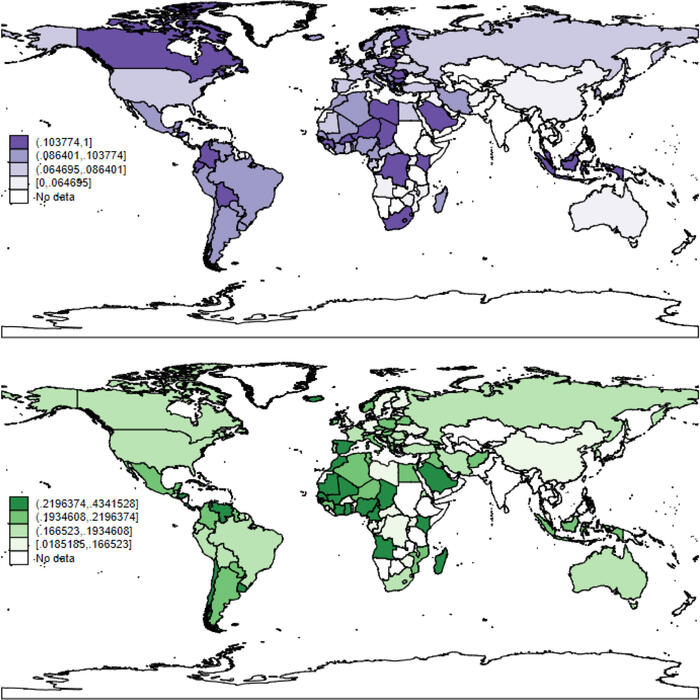
Fig. 1. The share of fouls retaliated in soccer games (top) and the prevalence of revenge motifs in folklore (bottom). Both variables tend to have higher values for players and folklore from the Middle East, Central Africa, Eastern Europe, and parts of South America.
Retaliation:
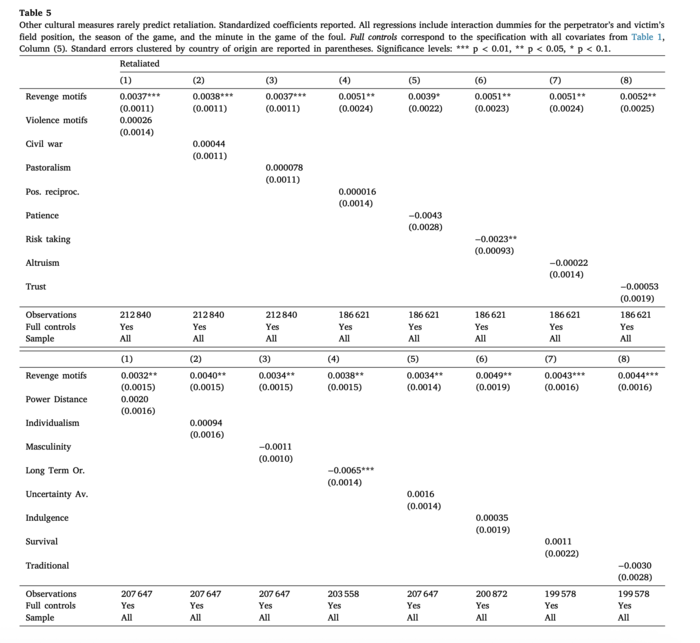
Schläpfer finds evidence that players from cultures that value revenge are indeed more likely to retaliate for fouls. However, they are not more likely to commit fouls overall, cautioning us against conflating the concepts of retaliation and violence. Indeed, Schläpfer demonstrates that motifs of violence in a culture's folklore do not predict retaliation. Players are also found to be more retaliatory early on in a game, which is consistent with its use as a signal or aspect of one’s reputation. In other words, retaliation serves to deter future fouls. Victims of fouls also retaliate quickly. Indeed, retaliation rates are stable or slightly increasing during the first 30 minutes of a game, but then fall consistently thereafter.
Evidence is also provided to show that retaliation deters future transgressions: perpetrators are less likely to foul again if victims retaliate for the initial foul. However, this deterrence finding is only observed when the perpetrator is from a revenge culture. In other words, for retaliation to support cooperation (the absence of fouls), players must share a similar cultural background.
Schläpfer’s findings hold even when soccer-related or socioeconomic factors are taken into account. Further, the paper considers, but finds little support for, alternative explanations of why retaliation varies. These include that some teams encourage players to retaliate more or employ more players from revenge cultures. Further, retaliation does not appear to be driven by emotions; otherwise, it would be less likely to occur after halftime when players have had a chance to cool down, but this is not the case.
Informal and Formal Sanctioning:
Finally, Schläpfer analyzes the interaction between player retaliation and refereeing. Most importantly, retaliation is significantly less likely if a foul is sanctioned with a yellow card. This illustrates the theoretical principle of formal punishment “crowding out” informal punishment, such as religious excommunication, which carries greater weight than social shunning or police fines compared to peer pressure. Both retaliation and referee sanctioning are shown to reduce the frequency of repeated offenses by perpetrators, especially among players from revenge cultures. However, Schläpfer finds that formal sanctioning is roughly three times more effective than retaliation. This suggests that football referees are doing a better job managing conflict between players than players themselves.
Schläpfer concludes by mentioning a few of the paper’s limitations. First of all, retaliation is measured only by what referees sanction. However, referees may miss crucial incidents for which retaliation is a response, such as Zinedine Zidane’s 2006 World Cup headbutt after a verbal insult (that was not sanctioned). This is important because individuals from revenge cultures are likely to be particularly offended by verbal insults. Second, the paper does not capture retaliation that occurs across games played by the same teams over time, particularly when rivalries and hostilities have intensified. Similarly, it does not account for preemptive retaliation that does not follow a foul. Ultimately, Schläpfer deepens our understanding of retaliation in a domain where many would expect it not to operate or to do so with minimal significance. The article impressively marshals large-scale data from both sports and cultural history to clarify the causes and consequences of retaliation.
*Research-in-Brief prepared by Adam Fefer.

CDDRL Research-in-Brief [4-minute read]

Why do opposition parties so often struggle to challenge aspiring autocrats in elections? I argue that elite economic coercion—the credible threat of economic retaliation against opposition-aligned elites—is a core, overlooked authoritarian strategy that erodes opposition candidate quality and electoral appeal. Incumbents leverage control over state institutions and resources to punish candidates and their families through firings, blacklisting, tax audits, and contract denials. This deters state-dependents from political entry, shrinking opposition parties’ talent pool. I use original data from Hungary’s autocratization episode. New panel data on the performance of candidate-connected firms documents widespread economic retaliation upon opposition political entry. A survey experiment with opposition elites demonstrates its negative effect on political ambition, while data on candidate backgrounds indicate a decline in opposition quality, particularly the share of candidates in high-quality state-dependent occupations. The findings highlight the key role of coercive economic retaliation in preventing successful opposition challenge during democratic decline.
ABOUT THE SPEAKER
Hanna Folsz is a 6th-year PhD Candidate in Political Science at Stanford University and a Pre-Doctoral Fellow at the Center on Democracy, Development and the Rule of Law. Her research examines the electoral challenges and opportunities in countering democratic decline. Her dissertation develops a theory of “opposition traps” to explain why opposition parties often struggle to challenge authoritarian dominant parties in autocratizing regimes, and why electoral turnover frequently emerges from new opposition formations. She brings evidence from Hungary’s autocratization since 2010 using a multi-method approach that combines original large-N datasets, text data, elite and mass surveys, and qualitative research.
Folsz grew up in Budapest, Hungary, and completed a B.A. in Economics and Politics at Durham University and an MSc in Political Science and Political Economy at the London School of Economics. In addition to English and Hungarian, she speaks Polish, Spanish, French, and German. She co-organizes the East European Politics Graduate Workshop (EEPGW) and is a member of the Poverty, Violence, and Governance Lab (PovGov) and the Democracy and Polarization Lab (DPL) at Stanford.
Virtual to Public. Only those with an active Stanford ID with access to Room E-008 in Encina Hall may attend in person.
Virtual to Public. If prompted for a password, use: 123456
Only those with an active Stanford ID with access to Room E-008 in Encina Hall may attend in person.
Encina Hall, E111
616 Jane Stanford Way
Stanford, CA 94305-6055
Hanna Folsz is a PhD candidate in Political Science at Stanford University. Her research focuses on opposition parties in authoritarian dominant-party regimes, with a particular focus on the challenges and opportunities they face in countering autocratization. More broadly, her work examines the causes and consequences of democratic backsliding, populism, media capture, and political favoritism — primarily in East-Central Europe and, secondarily, in Latin America. She uses a multi-method approach, including modern causal inference and text analysis techniques.
Her research has been supported by the National Science Foundation and the American Political Science Association, among others. She is the co-founder and co-organizer of EEPGW, a monthly online graduate student workshop on East European politics, and a co-founder and regular contributor to The Hungarian Observer, the most widely read online newsletter on Hungarian politics and culture. At Stanford, she is an active member of CDDRL's Poverty, Violence, and Governance Lab (PovGov).

Women’s political participation remains persistently lower than men’s worldwide. This study evaluates whether a group-based training intervention can enhance women’s engagement in local governance. In a randomized controlled trial across 300 communities in southwest Nigeria, we recruited 3,900 politically unaffiliated women into newly formed women’s action committees (WACs). Control WACs received basic civic education, while treatment WACs received additional training aimed at strengthening women’s collective efficacy. Leveraging baseline and endline surveys, as well as behavioral data from a community grant competition, we find that the intervention significantly increased both the level and quality of women’s political participation. It also improved women’s perceptions of community leaders’ responsiveness. Such gains appear to be driven by increased perceptions of individual and collective agency. These findings underscore the potential of addressing both psychological and structural barriers to advance women’s political engagement.
ABOUT THE SPEAKER
Claire Adida is a Senior Fellow at FSI (CDDRL), Professor (by courtesy) of Political Science, and faculty co-director at the Immigration Policy Lab at Stanford University. She is also a faculty affiliate with the Center for Effective Global Action (CEGA), the Evidence in Governance and Politics (EGAP) group, the Policy Design and Evaluation Lab (PDEL), and the Future of Democracy Initiative at the UC Institute on Global Conflict and Cooperation (IGCC). She is an invited researcher with J-PAL’s Humanitarian Protection and Displaced Livelihoods Initiatives and an international advisory board member with CFREF’s Bridging Divides research program.
Virtual to Public. Only those with an active Stanford ID with access to the Philippines Conference Room in Encina Hall may attend in person.
Virtual to Public. If prompted for a password, use: 123456
Only those with an active Stanford ID with access to the Philippines Conference Room in Encina Hall may attend in person.
Encina Hall
616 Jane Stanford Way
Stanford, CA 94305-6055
Claire Adida is Senior Fellow at FSI (CDDRL), Professor (by courtesy) of Political Science, and faculty co-director at the Immigration Policy Lab at Stanford University. She is also a faculty affiliate with the Center for Effective Global Action (CEGA), the Evidence in Governance and Politics (EGAP) group, the Policy Design and Evaluation Lab (PDEL), and the Future of Democracy Initiative at the UC Institute on Global Conflict and Cooperation (IGCC). She is an invited researcher with J-PAL’s Humanitarian Protection and Displaced Livelihoods Initiatives and an international advisory board member with CFREF’s Bridging Divides research program.
Adida uses quantitative and field methods to investigate how countries manage new and existing forms of diversity, what exacerbates or alleviates outgroup prejudice and discrimination, and how vulnerable groups navigate discriminatory environments. She has published two books on immigrant integration and exclusion: Immigrant exclusion and insecurity in Africa; Coethnic strangers (Cambridge University Press, 2014); and Why Muslim integration fails in Christian-heritage societies (with David Laitin and Marie-Anne Valfort, Harvard University Press, 2016). Her articles are published in the American Political Science Review, Science Advances, the Proceedings of the National Academy of Sciences, the Quarterly Journal of Political Science, Comparative Political Studies, the Journal of Population Economics, the Journal of Experimental Political Science, and Political Science Research & Methods, among others.
Prior to joining Stanford, she was Assistant Professor (2010-2016), Associate Professor (2016-2022), and Professor of Political Science at UC San Diego, where she also served as the co-Director and Director of the Center for Comparative Immigration Studies (2018-2024). In 2021-2022, she served as Research Advisor to the Director of the Office of Refugee Resettlement in the U.S. Government’s Department of Health & Human Services. She received her Ph.D. in political science from Stanford University in 2010, her Master's in International Affairs from Columbia University’s School of International and Public Affairs (2003), and her Bachelor's in political science and communication studies from Northwestern University (2000).
In 2025, the Center on Democracy, Development and the Rule of Law (CDDRL) celebrated the 20th year of its Fisher Family Summer Fellows on Democracy and Development Program. This summer, 27 democracy leaders from across the developing world convened at Stanford for an intensive three-week training focused on democracy, good governance, and rule of law reform. Chosen from a highly competitive applicant pool, the fellows represent a diverse range of professional backgrounds and geographical regions, spanning civil society, public service, social enterprise, media, and technology. Launched in 2005, the program was previously known as the Draper Hills Summer Fellows Program. It was renamed in 2023 in recognition of a gift from the Fisher family — Sakurako (Sako), ‘82, and William (Bill), MBA ‘84 — that endowed the program and secured its future.
Fellows were instructed by a leading Stanford faculty team composed of FSI Director and former U.S. Ambassador to Russia Michael McFaul; CDDRL Mosbacher Director Kathryn Stoner; Olivier Nomellini Senior Fellow Francis Fukuyama; Senior Fellow in Global Democracy Larry Diamond; and Erik Jensen, Lecturer in Law at Stanford Law School on new institutional models and frameworks to enhance their ability to promote good governance, accountable politics, and find new ways to achieve economic development in their home countries.
Esteemed guest lectures were also presented by individuals from the greater FSI and Stanford communities, as well as by Damon Wilson, President of the National Endowment for Democracy; Joshua Achiam, Head of Mission Alignment at OpenAI; Austin Mejia, Product Manager and Head of AI for Wearables at Google and a founding member of the AI for Developing Countries Forum, which advocates for equitable AI development globally; and various speakers from the Bay Area Council Economic Institute, the leading think tank focused on the most critical economic and policy issues facing the nine-county Bay Area region.
During the program, the fellows delivered "TED"-style talks during our Fellow Spotlight Series, sharing personal stories about the struggles in their home countries, stories of their fight for justice, equality, and democracy, and stories of optimism and endurance. You can watch their talks in the playlist below:

The Fellow Spotlight Series is an inspiring and moving series of "TED"-style talks given by each of our 2025 Fisher Family Summer Fellows to share their backstories and discuss their work.


