Health and Medicine

FSI’s researchers assess health and medicine through the lenses of economics, nutrition and politics. They’re studying and influencing public health policies of local and national governments and the roles that corporations and nongovernmental organizations play in providing health care around the world. Scholars look at how governance affects citizens’ health, how children’s health care access affects the aging process and how to improve children’s health in Guatemala and rural China. They want to know what it will take for people to cook more safely and breathe more easily in developing countries.

FSI professors investigate how lifestyles affect health. What good does gardening do for older Americans? What are the benefits of eating organic food or growing genetically modified rice in China? They study cost-effectiveness by examining programs like those aimed at preventing the spread of tuberculosis in Russian prisons. Policies that impact obesity and undernutrition are examined; as are the public health implications of limiting salt in processed foods and the role of smoking among men who work in Chinese factories. FSI health research looks at sweeping domestic policies like the Affordable Care Act and the role of foreign aid in affecting the price of HIV drugs in Africa.

-

Audio 


Abstract

Governance is exceptionally complex in health systems. Part of the complexity lies in the differences between these systems; especially across countries. Differences make it difficult to assess governance conditions in a comparative sense, and call for a framework to think about this issue. This talk discusses a potential framework based on the idea that governance mechanisms vary depending on relationships in systems and the problems that systems face. The framework is applied to different countries to show how different health sector governance regimes might be required for different contexts.


Speaker Bio

mattandrews Matt Andrews
Matt Andrews is Associate Professor of Public Policy at Harvard Kennedy School. A South African, he does research on governance in developing countries and also on implementation of reforms. His most recent work examines comparative governance arrangements as well as problem driven approaches to doing development differently.


**This event is co-sponsored by the FSI Policy Implementation Lab.** 


Governance Maps, Traps and Emergent Strategies
Matt Andrews Associate Professor of Public Policy, Harvard Kennedy School Associate Professor of Public Policy, Harvard Kennedy School
Seminars
Authors
News Type
Commentary
Date
Paragraphs

Elizabeth Blake, Habitat for Humanity International’s General Counsel and team leader of its Government Relations and Advocacy operations, spoke to students at the Freeman Spogli Institute on February 25 as part of the Program on Human Rights Winter Speaker Series that examined U.S Human Rights NGO’s and International Human Rights. 

Habitat for Humanity is a Christian not-for-profit organization that started in 1974 with the credo that every person has a human right to secure shelter and tenure of land. Most of its work is overseas, where Habitat for Humanity has built homes for over 3 million people in over 70 countries. Using security of tenure as its cornerstone, it especially assists women and children who are the most vulnerable to homelessness and insecure tenure. Habitat for Humanity has also recently expanded into housing microfinance, water and sanitation, risk reduction and response, and in creating Habitat Resource Centers.    

Blake’s provocative starting salvo was that “NGOs often do harm and frequently waste money.” Instead, they need to work better among themselves and invite partnerships with other NGOs, governments, and multi-lateral partners. This is not simply a moral imperative but also a practical necessity given the size of the U.S. not-for-profit sector, which as an employer of 13 million people is a significant part of the national economy.   

Habitat for Humanity’s approach maximizes its impact abroad through four principles:

1.     Community development starts with its people – people are the true assets;

2.     International community development must be based upon priorities set by the local community itself;

3.     The test of success of any community development is that local capacity is improved; and

4.     “Accompaniment” – a term first coined by Paul Farmer of Partners in Health: Habitat for Humanity works with and works for the people of that community.

This last principle is the most important: Habitat for Humanity has 1 million volunteers each year who work together with communities, or as Blake says, “scraping walls together with people from a local community is a different relationship to handing out soup” and ensures “going from aid to empowerment.”

Responding to questions from Dana Phelps, program associate for the Program on Human Rights and moderator of the event, Blake emphasized the relevance of her corporate background to working in the non-profit world.  As a graduate of Columbia University’s School of Law, she brings her extensive corporate experience to her work at Habitat, and stressed that “non-profits are businesses – a major corporate undertaking” for which her business background had trained her “not to take no for an answer.” 

Blake also explained that while Habitat for Humanity is a multi-denominational Christian organization, it is not registered as a church.  This means it is subject to anti-discrimination laws in its hiring practices and daily operations. It does not engage in prosthletyzing but instead sees itself as a morals-based organization.   

When Blake was further pressed on how “accompaniment” works in practice, she emphasized that Habitat for Humanity does not impose its values and morals on communities, but instead has intentionally slow processes that ensure communities adapt new practices in their own time. For example, when questioned on the impact of gender-equality housing improvements, Blake said, “Habitat for Humanity doesn’t make the first running – it tends to go in to communities that are already taking the running on gender equality.” 

Helen Stacy, Director of the Program on Human Rights


Hero Image
dsc 0411
Elizabeth Blake, former SVP of Habitat for Humanity, speaks at Stanford
Dana Phelps
All News button
1
Authors
News Type
Commentary
Date
Paragraphs

Mark Lorey, vice president for Child Development and Program Effectiveness at World Vision International, spoke on his experience working for a faith-based international NGO on human rights issues at the Stanford Program on Human Rights’ Winter Speaker Series, U.S. Human Rights NGOs and International Human Rights, on February 18, 2015.

Lorey addressed the Stanford audience from the Christian perspective and outlined World Vision’s mission for the sustained well-being of children. The projects and other initiatives that World Vision has in place often have a strong religious component to them. For example, many of the projects aim to empower local religious leaders to mobilize marginalized populations through deep faith and commitment to their God. He focused on the stigma and judgment that is attached to HIV/AIDS, especially coming from those of strict religious orientation. In believing in the capability for change, he presented a video that highlighted the experience of a devout Armenian Orthodox priest that once spoke adamantly against those inflicted with HIV/AIDS, but that through a World Vision educative program became a strong advocate for the victims of the disease.

Nicolle Richards, a Stanford undergraduate whose commitment to faith-based organizations has shifted considerably throughout her Stanford career, moderated the event. Richards pressed Lorey on World Vision’s work and the work of faith-based organizations more broadly. She questioned the contrast between faith-based and secular NGOs’ mission and impact in the field; the ethics involved when working with children of secular backgrounds; incorporating religious differences into their community work; and the details of a particular World Vision controversy over their decision to not hire people of different sexual orientations. Lorey struggled to answer many of these sensitive and important questions, leaving the audience with an impression that World Vision battles internally with its constraints as a faith-based organization and that the work of faith-based organizations may not be as impactful as we hope. There was a particularly uncomfortable tension in the room when Helen Stacy, director of the Program on Human Rights, interjected in the discussion, asking Lorey to speak in more detail about World Vision’s recently revoked anti-gay policy that inhibited the hiring of peoples in same-sex marriages. Unwilling to speak about this in an open forum, Lorey asserted that while it is an important issue, it is not one that he wished to dwell on.

Questions from the silenced audience were sparse, but addressed the prevalent gender inequalities among faith-based leaders and concerns about being overly authoritarian in the Good Samaritan model towards human rights work abroad.

Dana Phelps, Program Associate, Program on Human Rights


Hero Image
dsc 0484
Mark Lorey of World Vision speaks at Stanford
Dana Phelps
All News button
1
Authors
News Type
Commentary
Date
Paragraphs

Julie Cordua, executive director of Thorn, a non-profit organization founded by Ashton Kutcher and Demi Moore, spoke passionately on the topic child exploitation and sexual abuse imagery for the Stanford Program on Human Rights’ Winter Speaker Series U.S Human Rights NGOs and International Human Rights on February 4, 2015.

Cordua addressed the Stanford audience about the importance of technology for acting as the “digital defenders of children." She provided a chilling account of child sexual exploitation, first describing the problem and then going on to challenge preconceived notions about it. For example, she highlighted that in order to tackle the issue, it must first be understood that it concerns a highly vulnerable population; most child victims of sexual exploitation come from extremely abusive backgrounds and many have been sexually abused by one or more parents.

Cordua emphasized that technology innovations have contributed to a proliferation of child exploitation and sexual abuse imagery through the use of encrypted networks that make it extremely difficult to hunt down perpetrators and find victims. Cordua feels that while technology is intensifying the problem, technology is also the solution.  Examples she gave were the development of algorithms that aim to track perpetrators and their victims and advertisements that encourage pedophiles to seek help.

Helen Stacy, director of the Program on Human Rights, queried Cordua on Thorn’s relationship with the government and private sector, as well as on Thorn’s approach for testing the efficacy of their programs. Cordua responded that Thorn does not apply for government funds so as to maintain independence over their projects but that they actively cultivate strong relationships with politicians and law enforcers. In relation to evaluation metrics, Cordua acknowledged that metrics are especially difficult in such a cryptic field as it is nearly impossible to know what numbers they are dealing with from the onset. Questions from the audience included effective strategies for changing the conversation of pedophilia in the public sphere, the emotional stamina required for pursuing such work, and strategies for connecting with and providing a safe platform for victims of child sexual exploitation.

Dana Phelps, Program Associate, Program on Human Rights


Hero Image
dsc 0476
Julie Cordua, executive director of Thorn, speaks at Stanford
Dana Phelps
All News button
1
-

The final class will pose nine questions, each question digging into
each of the nine topics covered over the quarter.  Pizza at 6pm!

Bechtel Conference Center, EncinaHall

Helen Stacy
-

Abstract

Thorn (www.wearethorn.org) drives technology innovation to fight child sexual exploitation. The talk will provide an overview of how technology has drastically changed the dynamics of crimes against children and will present concepts for how technology can also be used in new, innovative ways to combat these crimes and protect children.
 

Bechtel Conference Room, Encina Hall

Julie Cordua Speaker CEO,Thorn
Helen Stacy Director Commentator Program on Human Rights
Seminars
-

The Fabric of NGOs

Please join us in a discussion of the role of NGOs in the field of human rights, and of the important role they play in the world today. Our speakers represent both the activist and grant-making sides of the NGO world.


Speaker Bios

Nick Deychakiwsky

Program Officer, Charles Stewart Mott Foundation

Nick Deychakiwsky is a Program Officer at the Charles Stewart Mott Foundation managing its Civil Society – United States and Global Philanthropy & Nonprofit Sector program areas.  Between 2000 and 2006 he oversaw the Mott Foundation’s grantmaking in Russia, Ukraine, and Belarus.  During the 1990s Nick lived in Ukraine, holding managerial positions at the International Management Institute – Kyiv, the Council of Advisors to the Parliament of Ukraine, the International Renaissance (Soros) Foundation, and the Eurasia Foundation. 

Maurice I Middleberg

Executive Director, Free the Slaves

Maurice Middleberg is the Executive Director of Free the Slaves, a global leader in the fight to eradicate modern day slavery. The mission of Free the Slaves is to liberate slaves and change the condiitons that allow slavery to exist. Free the Slaves fosters long-term solutions to slavery, that encompasses building local capacity to fight slavery; community-based education and mobilization, strengthening legal protections and anti-slavery policies, and building critical assets in vulnerable households. Free the Slaves currently has programs in Brazil, Democratic Republic of the Congo, Ghana, Haiti, India and Nepal. Mr Middlberg's career spans more than thrity years, and covers global health, social justice and international development. He has held senior and executive positions at CARE, the Global Health Council, EngenderHealth and IntraHealth, and has worked for the U.S. Agency for International Development. A political scientist by training, he has held academic appointments at Columbia and Emory Universities. 


Bechtel Conference Room, Encina Hall

616 Serra Street

Stanford, CA 94305

Maurice I. Middleberg Executive Director Speaker Free the Slaves
Nick Deychakiwsky Program Officer Speaker Charles Stewart Mott Foundation
Seminars
-

Speaker Bio

14120 Michael Callen
Michael Callen

Assistant Professor, Public Policy

Harvard Kennedy School


Michael Callen is assistant professor of public policy at the Harvard Kennedy School of Government. His recent work uses experiments to identify ways to address accountability and service delivery failures in the public sector. He has published in the American Economic Review, the Journal of Conflict Resolution, and the British Journal of Political Science. He is an Affiliate of Evidence for Policy Design (EPoD), the Bureau for Research and Economic Analysis of Development (BREAD), the Jameel-Poverty Action Lab (J-PAL), the Center for Effective Global Action (CEGA), the Center for Economic Research Pakistan (CERP), Empirical Studies of Conflict (ESOC), and a Principal Investigator on the Building Capacity for the Use of Research Evidence (BCURE): Data and evidence for smart policy design project. His primary interests are political economy, development economics, and experimental economics.

This event is part of the Liberation Technology Seminar Series

**** NOTE LOCATION****

School of Education

Room 128

Michael Callen Assistant Professor, Public Policy, Harvard Kennedy School
Seminars
-

This event is open to Stanford undergraduate students only. 

The Center on Democracy, Development, and the Rule of Law (CDDRL) is currently accepting applications from eligible juniors due February 27, 2015 who are interested in writing their senior thesis on a subject touching upon democracy, economic development, and rule of law (DDRL) from any university department. CDDRL faculty and current honors students will be present to discuss the program and answer any questions.

For more information on the CDDRL Senior Honors Program, please click here.


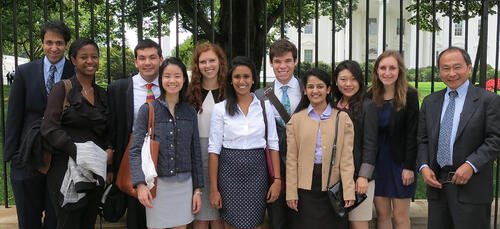
CDDRL Class of 2015 Class of 2015 in front of the White House with Francis Fukuyama.


[[{"fid":"217337","view_mode":"crop_870xauto","fields":{"format":"crop_870xauto","field_file_image_description[und][0][value]":"SHP15 Info Session Flyer","field_file_image_alt_text[und][0][value]":"","field_file_image_title_text[und][0][value]":"","field_credit[und][0][value]":"","field_caption[und][0][value]":"SHP15 Info Session Flyer","field_related_image_aspect[und][0][value]":"","thumbnails":"crop_870xauto","pp_lightbox":false,"pp_description":false},"type":"media","attributes":{"height":1056,"width":870,"class":"media-element file-crop-870xauto"}}]]

Encina Hall, C148
616 Jane Stanford Way
Stanford, CA 94305

0
Olivier Nomellini Senior Fellow at the Freeman Spogli Institute for International Studies
Director of the Ford Dorsey Master's in International Policy
Research Affiliate at The Europe Center
Professor by Courtesy, Department of Political Science
yff-2021-14290_6500x4500_square.jpg

Francis Fukuyama is the Olivier Nomellini Senior Fellow at Stanford University's Freeman Spogli Institute for International Studies (FSI), and a faculty member of FSI's Center on Democracy, Development and the Rule of Law (CDDRL). He is also Director of Stanford's Ford Dorsey Master's in International Policy, and a professor (by courtesy) of Political Science.

Dr. Fukuyama has written widely on issues in development and international politics. His 1992 book, The End of History and the Last Man, has appeared in over twenty foreign editions. His book In the Realm of the Last Man: A Memoir will be published in fall 2026.

Francis Fukuyama received his B.A. from Cornell University in classics, and his Ph.D. from Harvard in Political Science. He was a member of the Political Science Department of the RAND Corporation, and of the Policy Planning Staff of the US Department of State. From 1996-2000 he was Omer L. and Nancy Hirst Professor of Public Policy at the School of Public Policy at George Mason University, and from 2001-2010 he was Bernard L. Schwartz Professor of International Political Economy at the Paul H. Nitze School of Advanced International Studies, Johns Hopkins University. He served as a member of the President’s Council on Bioethics from 2001-2004. He is editor-in-chief of American Purpose, an online journal.

Dr. Fukuyama holds honorary doctorates from Connecticut College, Doane College, Doshisha University (Japan), Kansai University (Japan), Aarhus University (Denmark), the Pardee Rand Graduate School, and Adam Mickiewicz University (Poland). He is a non-resident fellow at the Carnegie Endowment for International Peace. He is a member of the Board of Trustees of the Rand Corporation, the Board of Trustees of Freedom House, and the Board of the Volcker Alliance. He is a fellow of the National Academy for Public Administration, a member of the American Political Science Association, and of the Council on Foreign Relations. He is married to Laura Holmgren and has three children.

(October 2025)

CV
Date Label
Honors Program Director

Encina Hall, C150
616 Jane Stanford Way
Stanford, CA 94305

0
Center Fellow, Freeman Spogli Institute for International Studies
didi_kuo_2023.jpg

Didi Kuo is a Center Fellow at the Freeman Spogli Institute for International Studies (FSI) at Stanford University. She is a scholar of comparative politics with a focus on democratization, corruption and clientelism, political parties and institutions, and political reform. She is the author of The Great Retreat: How Political Parties Should Behave and Why They Don’t (Oxford University Press) and Clientelism, Capitalism, and Democracy: the rise of programmatic politics in the United States and Britain (Cambridge University Press, 2018).

She has been at Stanford since 2013 as the manager of the Program on American Democracy in Comparative Perspective and is co-director of the Fisher Family Honors Program at CDDRL. She was an Eric and Wendy Schmidt Fellow at New America and is a non-resident fellow with the Carnegie Endowment for International Peace. She received a PhD in political science from Harvard University, an MSc in Economic and Social History from Oxford University, where she studied as a Marshall Scholar, and a BA from Emory University.

Date Label
Mentor
-

Stanford’s Program on Human Rights in the Center on Democracy, Development and the Rule of Law is collaborating with U.S. Fund for UNICEF and the Stanford Center for Innovation in Global Health to present the Children’s Human Rights Seminar Series for 2014-2015. This monthly series will bring together UNICEF representatives, academic experts, and global civil society leaders to discuss some of the most pressing issues facing children today. Each event will highlight one of UNICEF's main programmatic areas, in the following order: emergency response, HIV/AIDS, disabilities, child protection, nutrition, water and sanitation, health and immunizations, and education.

SPEAKERS BIOS

Nick Hellmann, MD is the Strategy and Science Advisor at the Elizabeth Glaser Pediatric AIDS Foundation (EGPAF) and a consultant to the Bill and Melinda Gates Foundation on HIV-related issues. He previously worked from June 2008 to April 2014 as the EGPAF Executive Vice President of Medical & Scientific Affairs, responsible for strategic oversight and direction of the Foundation’s research initiatives and medical programs focused on ending HIV/AIDS in children and providing HIV prevention, care, and treatment services to children, women, and families at over 7000 foundation-supported sites in 14 countries across the globe.

Lisa Jacobs is a global health consultant with expertise in advocacy and communications, strategy, governance, and global health architecture. Lisa was a founding staff member at the GAVI Alliance, and served as head of governance for 10 years. In 2012 and 2013 she worked as a consultant to the UNICEF HIV/AIDS section in New York, supporting the development of UNICEF’s role in the global effort to eliminate mother-to-child transmission of HIV (eMTCT) and its strategy for adolescents and HIV/AIDS. Her other clients have included AVAC: Global Advocacy for HIV Prevention, WHO, UNAIDS, UCSF, and Clinton Health Access Initiative.

CISAC Central Conference Room

2nd FLoor Encina Hall

Nick Hellmann, MD Strategy and Science Advisor at the Elizabeth Glaser Pediatric AIDS Foundation
Lisa Jacobs Global Health Consultant
Subscribe to Health and Medicine