Governance

FSI's research on the origins, character and consequences of government institutions spans continents and academic disciplines. The institute’s senior fellows and their colleagues across Stanford examine the principles of public administration and implementation. Their work focuses on how maternal health care is delivered in rural China, how public action can create wealth and eliminate poverty, and why U.S. immigration reform keeps stalling. 

FSI’s work includes comparative studies of how institutions help resolve policy and societal issues. Scholars aim to clearly define and make sense of the rule of law, examining how it is invoked and applied around the world. 

FSI researchers also investigate government services – trying to understand and measure how they work, whom they serve and how good they are. They assess energy services aimed at helping the poorest people around the world and explore public opinion on torture policies. The Children in Crisis project addresses how child health interventions interact with political reform. Specific research on governance, organizations and security capitalizes on FSI's longstanding interests and looks at how governance and organizational issues affect a nation’s ability to address security and international cooperation.

Authors
News Type
News
Date
Paragraphs

Measuring the quality of governance is a challenge for social scientists trying to assess a country’s ability to deliver public services to its citizens. Francis Fukuyama, the Olivier Nomellini Senior Fellow at Stanford’s Freeman Spogli Institute, recognized that many of the current ways to assess good governance are too general and do not account for the variations that occur within complex societies such as China or the United States. Fukuyama has also realized that democracy is not always a necessary ingredient for good governance and in some cases authoritarian countries govern more effectively than their democratic counterparts.

The Governance Project was launched in January 2012 at FSI’s Center on Democracy, Development, and the Rule of Law to engage scholars around the world in the exercise of evaluating the quality of state institutions and government effectiveness. Over the next year, workshops at Stanford and in China will bring governance experts together to showcase the ongoing work in this field and contribute original scholarship to a working paper series. Case studies of China and the United States will conceptualize and measure state performance in the world’s largest economies, comparing and contrasting both models to better understand the inner-workings of governance.    


All News button
1
-


In commemoration of the Syrian revolution's one year anniversary, STAND and CDDRL are

proud to host a panel discussion about international responses to the crisis in Syria.  

Join us in the Arrillaga Study Room from 6:00-7:30pm on Thursday, March 15th.


Co-sponsored by:  MSAN


Study Room at Arrillaga Family Dining Commons

CDDRL
Stanford University
Encina Hall, C147
616 Jane Stanford Way
Stanford, CA 94305-6055

(650) 724-6448 (650) 723-1928
0
Mosbacher Senior Fellow in Global Democracy at the Freeman Spogli Institute for International Studies
William L. Clayton Senior Fellow at the Hoover Institution
Professor, by courtesy, of Political Science and Sociology
diamond_encina_hall.png MA, PhD

Larry Diamond is the William L. Clayton Senior Fellow at the Hoover Institution, the Mosbacher Senior Fellow in Global Democracy at the Freeman Spogli Institute for International Studies (FSI), and a Bass University Fellow in Undergraduate Education at Stanford University. He is also professor by courtesy of Political Science and Sociology at Stanford, where he lectures and teaches courses on democracy (including an online course on EdX). At the Hoover Institution, he co-leads the Project on Taiwan in the Indo-Pacific Region and participates in the Project on the U.S., China, and the World. At FSI, he is among the core faculty of the Center on Democracy, Development and the Rule of Law, which he directed for six and a half years. He leads FSI’s Israel Studies Program and is a member of the Program on Arab Reform and Development. He also co-leads the Global Digital Policy Incubator, based at FSI’s Cyber Policy Center. He served for 32 years as founding co-editor of the Journal of Democracy.

Diamond’s research focuses on global trends affecting freedom and democracy and on U.S. and international policies to defend and advance democracy. His book, Ill Winds: Saving Democracy from Russian Rage, Chinese Ambition, and American Complacency, analyzes the challenges confronting liberal democracy in the United States and around the world at this potential “hinge in history,” and offers an agenda for strengthening and defending democracy at home and abroad.  A paperback edition with a new preface was released by Penguin in April 2020. His other books include: In Search of Democracy (2016), The Spirit of Democracy (2008), Developing Democracy: Toward Consolidation (1999), Promoting Democracy in the 1990s (1995), and Class, Ethnicity, and Democracy in Nigeria (1989). He has edited or coedited more than fifty books, including China’s Influence and American Interests (2019, with Orville Schell), Silicon Triangle: The United States, China, Taiwan the Global Semiconductor Security (2023, with James O. Ellis Jr. and Orville Schell), and The Troubling State of India’s Democracy (2024, with Sumit Ganguly and Dinsha Mistree).

During 2002–03, Diamond served as a consultant to the US Agency for International Development (USAID) and was a contributing author of its report, Foreign Aid in the National Interest. He has advised and lectured to universities and think tanks around the world, and to the World Bank, the United Nations, the State Department, and other organizations dealing with governance and development. During the first three months of 2004, Diamond served as a senior adviser on governance to the Coalition Provisional Authority in Baghdad. His 2005 book, Squandered Victory: The American Occupation and the Bungled Effort to Bring Democracy to Iraq, was one of the first books to critically analyze America's postwar engagement in Iraq.

Among Diamond’s other edited books are Democracy in Decline?; Democratization and Authoritarianism in the Arab WorldWill China Democratize?; and Liberation Technology: Social Media and the Struggle for Democracy, all edited with Marc F. Plattner; and Politics and Culture in Contemporary Iran, with Abbas Milani. With Juan J. Linz and Seymour Martin Lipset, he edited the series, Democracy in Developing Countries, which helped to shape a new generation of comparative study of democratic development.

Download full-resolution headshot; photo credit: Rod Searcey.

Former Director of the Center on Democracy, Development and the Rule of Law
Faculty Chair, Jan Koum Israel Studies Program
Date Label
Larry Diamond CDDRL Director, Senior Fellow at the Freeman Spogli Institute and the Hoover Institution Speaker
Lina Khatib Co-founder and Program Manager Moderator Program of Arab Reform, CDDRL
Nabeel Khoury Director of the Office of Political Analysis for the Middle East Speaker US State Department
Anas Qtiesh Syrian Human Rights activist and a blogger Speaker
Conferences

The Brookings Doha Center-Stanford University "Project on Arab Transitions" - a joint initiative between the BDC and the Program on Arab Reform and Democracy at Stanford University's Center on Democracy, Development, and the Rule of Law (CDDRL) - aims to generate comprehensive analysis of the conditions impacting democratic transition in the Arab world. Because there have been so few democratic transitions in the Arab world, as well as a lack of cross-regional studies, there is a real need for better understanding among Western scholars and policymakers an

-

Abstract:

One of Taiwan's leading political scientists and most widely quoted authorities on Taiwan politics and cross-Strait relations, Professor Chu will address five issues in his talk:

   First, how should we interpret the outcome of the January election and the nature and extent of President Ma's renewed mandate?

   Second, to what extent has the 2012 election enhanced the overall quality of Taiwan's democracy?

   Third, what can we expect in terms of President Ma's domestic agenda for the next four years?

   Fourth, how much further and faster can the warming of cross-Strait relations proceed during President Ma's second term?

   Fifth, what are the challenges and opportunities for the US-Taiwan relationship in the coming year?

 Speaker Bio:

Yun-han Chu is Distinguished Research Fellow of the Institute of Political Science at Academia Sinica and Professor of Political Science at National Taiwan University. He also serves concurrently as President of Chiang Ching-Kuo Foundation for International Scholarly Exchange. Professor Chu joined the faculty of National Taiwan University in 1987. He was a visiting associate professor at Columbia University in 1990-1991 and has held a visiting professorship at Peking University since 2007. Professor Chu specializes in politics of Greater China, East Asian political economy, international political economy, and democratization. He is the Coordinator of Asian Barometer Survey, a regional network of survey on democracy, governance and development covering more than seventeen Asian countries. He currently serves on the editorial board of Pacific Affairs, International Studies Perspective, China Review, Journal of Contemporary China, Journal of East Asian Studies and Journal of Democracy. He is the author, co-author, editor or co-editor of thirteen books. Among his recent English publications are Consolidating Third-Wave Democracies (Johns Hopkins University Press, 1997), China Under Jiang Zemin (Lynne Reinner, 2000), The New Chinese Leadership: Challenges and Opportunities after the 16th Party Congress (Cambridge University Press 2004) and How East Asians View Democracy (Columbia University Press, 2008).

Philippines Conference Room

Yun-han Chu Distinguished Research Fellow at Academia Sinica; Professor of Political Science Speaker National Taiwan University
Seminars
-

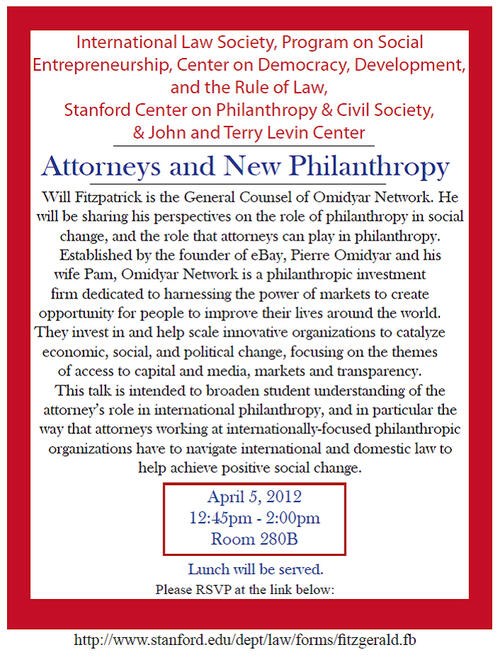
Will Fitzpatrick is the General Counsel of Omidyar Network.  He will be sharing his perspectives on the role of philanthropy in social change, and the role that attorneys can play in philanthropy.  Established by the founder of eBay, Pierre Omidyar and his wife Pam, Omidyar Network is a philanthropic investment firm dedicated to harnessing the power of markets to create opportunity for people to improve their lives around the world.  They invest in and help scale innovative organizations to catalyze economic, social, and political change, focusing on the themes of access to capital and media, markets and transparency.  This talk is intended to broaden student understanding of the attorney's role in international philanthropy, and in particular the way that attorneys working at internationally-focused philanthropic organizations have to navigate international and domestic law to achieve positive social change.

Please RSVP to the link below:

http://www.stanford.edu/dept/law/forms/fitzgerald.fb

Lunch will be provided

Image

Room 280B

Will Fitzpatrick General Counsel Speaker Omidyar Network
Conferences
News Type
News
Date
Paragraphs

Steve Hilton, senior advisor to British Prime Minister David Cameron, will join Stanford as a visiting scholar at the university’s Freeman Spogli Institute for International Studies.

Hilton, who will also be a visiting fellow at Stanford’s Hoover Institution, will arrive in May and spend his year on campus teaching, researching and writing.

“We look forward to having Steve Hilton in residence at FSI starting later this spring,” said Coit Blacker, FSI’s director. “Lively and engaging, Steve is certain to bring a fresh perspective to many of the issues and challenges that are of ongoing concern to our faculty, fellows and students.”

As Cameron’s top advisor, Hilton’s primary responsibility is the development and implementation of domestic policy. He specializes in the promotion of enterprise and economic growth, public service reform, family policy, decentralization, and government transparency and accountability.

Hilton will focus on innovation in government, public services and communities around the world while at Stanford. He will work with a wide range of centers and organizations across the university, including FSI’s Center on Democracy, Development and the Rule of Law and The Europe Center; the Graduate School of Business' Center for Social Innovation; the Center on Philanthropy and Civil Society; and the Hasso Plattner Institute of Design.

"I'm delighted to be joining the academic community at Stanford and greatly look forward to an exhilarating and productive year,” Hilton said. “It will be a huge pleasure to be able to focus on our most pressing social and governmental challenges."

Before Cameron’s election as prime minister in 2010, Hilton served as his chief strategist and developed the ideas associated with the modernization of the British Conservative Party.

Hilton previously ran Good Business, a corporate responsibility consulting firm, and is the author of Good Business: Your World Needs You. The book makes the case for businesses to play a more direct and active role in advancing social progress.

Hero Image
Hilton SQUARE
All News button
1
Authors
News Type
News
Date
Paragraphs

The Program on Human Rights presented the seventh installment of the Sanela Diana Jenkins International Speakers Series on February 28, which focused on anti-trafficking measures in the Bay area. Lt. John Vanek and Sgt. Kyle Oki from the San Jose Police Department Human Trafficking Task Force and Captain Antonio Parra from the San Francisco Police Department Human Trafficking Task Force spoke about their unit’s recent implementation of a victims-based approach in law enforcement, speaking frankly about its importance and the challenges it presents.

Lt. Vanek explained how the San Jose Police Department had transitioned from a criminal approach to prostitution to a multi-disciplinary model to combat modern-day slavery. The San Jose human trafficking task force was created in 2005 but the victim-centered approach is still developing. He spoke about some of the ongoing challenges, namely that all police officers need training on program management and victim assistance, and also deeper expertise on criminal investigations of human trafficking cases.

Sgt. Oki argued that a victim-centered approach is often restricted to identifying and rescuing victims of human trafficking. He noted that while it would be ideal to prosecute offenders, that is often not possible because police officers must ensure that they respect the victims’ agency and also guarantee their safety and confidentiality. He mentioned that sometimes trafficked children are safer in juvenile hall than in shelters, where they could be repeatedly exposed to traffickers. 

Although the San Francisco Special Victims Unit (SVU) is relatively new – it was created in October 2011— it already includes 60 members. “The SVU represents a philosophical transition that shifts from enforcement to investigation,” explained Captain Parra. “The SVU maintains a proactive stance and integrates related disciplines to investigate specialized crimes such as: human trafficking, elder abuse, internet crimes against children, financial crimes, missing persons, domestic violence and sex crimes,” he continued.

The three presenters agreed that cooperation and coordination is key for a successful victim-based approach. There is need for coordination mechanisms established to stimulate deeper reflection and cooperation in dealing with the problem among different counties, states and countries.

Hero Image
Vanek Oki Parra Logo
Sgt. Kyle Oki, Helen Stacy, Captain Antonio Parra and Lt. John Vanek.
NM
All News button
1
Authors
Landry Signé
News Type
Commentary
Date
Paragraphs

In an opinion piece for The New York Times, CDDRL postdoctoral scholar Landry Signé discusses Senegal's backsliding democracy and the threat that President Abdoulaye Wade's third presidential bid poses to a country that was once West Africa's most stable. By manipulating the legal system, Wade was able to violate the constitution's two-term limit, but was unsuccessful in securing the necessary 50 percent of votes in Sunday's presidential race to avoid a runoff. Signé depicts the corruption, repression, and institutional manipulation Wade has committed to this young electoral democracy, impressing on the international community the urgency of supporting and defending Senegal's democratic traditions.

Hero Image
Signe OpEd Logo
Defaced campaign poster of President Abdoulaye Wade of Senegal.
IRIN/Tanya Bindra
All News button
1
-

Dear members of the Arab Studies Table, 

You are cordially invited to a private informal networking event with  world-renowned Palestinian activist, MP, and former presidential candidate and Nobel Peace Prize nominee  

 Dr. Mustafa Barghouti  

on Monday March 5, 6-7pm   

at CISAC central conference room, Encina Hall 2nd floor

followed by a speech at

Cubberley Auditorium

at 7:00pm

The event is an exclusive opportunity for the members of the Arab Studies Table to meet and network with Dr. Barghouti, who will be delivering a speech afterwards at the Cubberley Auditorium (at 7pm) on non-violent activism in Palestine. Please see attached flyer for further details. The Cubberley talk is a public event.  

We hope you can join us for the informal networking event with Dr. Barghouti on March 5 at 6pm. Coffee, refreshments, and cookies will be served!  

Please RSVP by replying to Arab Studies Table coordinator Brian Johnsrud (johnsrud@stanford.edu) with your name and affiliation. Non-Arab Studies Table guests are welcome if they are accompanied by a Table member (please send their names when you RSVP). Please RSVP by Sunday March 4.

Dr. Barghouti's bio:

Member of the Palestinian parliament; former Minister of Information under the 2007 National Unity Government; 2005 presidential candidate; General Secretary of the Palestinian National Initiative; physician; social, political, human rights and peace activist; one of the most active grassroots leadersin Palestine; campaigner for the development of Palestinian civil society and grassroots democracy; outspoken advocate of internal reform; international spokesperson for the Palestinian cause; leading figure in the non-violent, peaceful struggle against the Occupation; and organizer of international solidarity presence in the Palestine, Mustafa Barghouthi has made an extraordinary contribution to initiatives to peacefully challenge the ongoing Israeli Occupation of Palestine and bring it to end, as well as efforts to build the institutional framework of Palestinian civil society and promote the principles of internal democracy and good governance.  He writes extensively for local and international audiences on civil society and democracy issues and the political situation in Palestine, as well as on health development policy in Palestine. In 2010 Dr. Mustafa Barghouthi was nominated for the Nobel Peace Prize by Mairead Maguire, Nobel Peace Prize Laureate and Co-founder of the Peace People. 

In 2002, Dr. Barghouthi co-founded Al Mubadara (the Palestinian National Initiative, PNI), along with Dr. Edward Said, Dr. Haider Abdel-Shafi and Mr. Ibrahim Dakak, and currently serves as its General Secretary.  Al Mubadara is a democratic opposition movement that provides a reformist, inclusive, democratic alternative to both autocracy and corruption, and to fundamentalist groups.  It looks to achieve this by promoting an accountable and transparent democratic system in Palestine, and by strengthening contacts between Palestinians in the Territories and those in the Diaspora.  It also seeks to develop mass non-violence and international solidarity as the preferred means of ending the Israeli Occupation and achieving lasting peace, and to mobilize public opinion by making the Palestinian story visible in the international media.  

 Latest article on non-violent activism in the New York Times: http://www.nytimes.com/2012/02/22/opinion/peaceful-protest-can-free-palestine.html?ref=opinion

  Arab Studies Table at Stanford: http://www.stanford.edu/group/arabstudiestable/index.html


Cubberley Auditorium
459 Lasuen Mall
Stanford, CA, 94305

Dr. Mustafa Barghouti Co-founder of the Palestinian National Initiative and the Union of Palestinian Medical Committees Speaker
Conferences
Subscribe to Governance