International Relations

FSI researchers strive to understand how countries relate to one another, and what policies are needed to achieve global stability and prosperity. International relations experts focus on the challenging U.S.-Russian relationship, the alliance between the U.S. and Japan and the limitations of America’s counterinsurgency strategy in Afghanistan.

Foreign aid is also examined by scholars trying to understand whether money earmarked for health improvements reaches those who need it most. And FSI’s Walter H. Shorenstein Asia-Pacific Research Center has published on the need for strong South Korean leadership in dealing with its northern neighbor.

FSI researchers also look at the citizens who drive international relations, studying the effects of migration and how borders shape people’s lives. Meanwhile FSI students are very much involved in this area, working with the United Nations in Ethiopia to rethink refugee communities.

Trade is also a key component of international relations, with FSI approaching the topic from a slew of angles and states. The economy of trade is rife for study, with an APARC event on the implications of more open trade policies in Japan, and FSI researchers making sense of who would benefit from a free trade zone between the European Union and the United States.

-


Abstract
Diarrheal disease is the second leading cause of death for children under five years of age, globally.  Barriers to improving outcomes include an inability to identify cases early, provide support, and understand transmission collectively at the household level.   In this talk, we will propose a project to use crowdsourcing to identify pre-emergency patients with diarrheal disease at the level of the household, improve outcomes by providing basic 24 hour access to oral rehydration solution via a social business model at the level of pharmacies, and establish a novel method for patient recruitment to increase statistical power while decreasing the cost of clinical research.  Our primary and initial use case will be twice annual cholera outbreaks in Bangladesh.  Partners include Stanford University, Medic Mobile, ideSHi, and the International Centre for Diarrhoeal Disease Research, Bangladesh.

Dr. Eric Nelson studied evolution at Cornell University (BA)  and conducted marine microbial ecology research in Papua New Guinea.  He then received a Masters Degree for studies on the symbiosis between light-producing bacteria and marine animals at the University of Hawaii.  Then he switched to microbial pathogenesis during my MD PhD training at Tufts University.  During this time, he received a Fogarty NIH fellowship to research cholera transmission at the International Centre for Diarrhoeal Disease Research, Bangladesh.  DR. Nelson co-authored an ebook called the Cholera Outbreak Training and Shigellosis (COTS) Program that has taken him to outbreaks in Zimbabwe and Haiti.  He also finished a Stanford pediatrics residency in 2013 and was awarded a Pediatric Global Health Postdoctoral Fellowship through the Stanford Society of Physician Scholars.  His core effort now is to explore ways to leverage mobile technology to overcome poverty-based barriers to improve health outcomes from diarrheal diseases.

Wallenberg Theater

Eric Nelson, MD PhD Pediatric Global Health Postdoctoral Fellow Speaker Stanford University School of Medicine
Seminars
Date Label
Paragraphs

The levels of violence in Mexico have dramatically increased in the last few years due to structural changes in the drug trafficking business. The increase in the number of drug trafficking organizations (DTOs) fighting over the control of territory and trafficking routes has resulted in a substantial increase in the rates of homicides and other crimes. This study evaluates the economic costs of drug-related violence. We propose electricity consumption as an indicator of the level of municipal economic activity and use two different empirical strategies to test this. To estimate the marginal effects of violence, we utilize an instrumental variable regression created by Mejía and Castillo (2012) based on historical seizures of cocaine in Columbia interacted with the distance of the Mexican border towns to the United States. We find that marginal increases of violence have negative effects on labor participation and the proportion of unemployed in an area. The marginal effect of the increase in homicides is substantive for earned income and the proportion of business owners, but not for energy consumption. We also employ the methodology of synthetic controls to evaluate the effect that inter-narco wars have on local economies. These wars in general begin with a wave of executions between rival criminal organizations and are accompanied by the deterioration of order and a significant increase in extortion, kidnappings, robberies, murders, and threats affecting the general population. To evaluate the effect that these wars between different drug trafficking organizations have on economic performance, we define the beginning of a conflict as the moment when we observe an increase from historical violence rates at the municipal level beyond a certain threshold, and construct counterfactual scenarios as a weighted average from optimal control units. The analysis indicates that the drug wars in those municipalities that saw dramatic increases in violence between 2006 and 2010 significantly reduced their energy consumption in the years after the change occurred.

All Publications button
1
Publication Type
Working Papers
Publication Date
Authors
Beatriz Magaloni
Gabriela Calderón
-

Speaker Bio:

Nabil Mouline is a senior researcher in The French National Centre for Scientific Research (CNRS) and The School for Advanced Studies in the Social Sciences (EHESS). Prior to this, he was a research professor at the Institute of Political Studies of Paris (Sciences Po).
He earned a Ph.D. in history from the Paris-Sorbonne University and a Ph.D. in political science from the Institute of Political Studies of Paris (Sciences Po).

He is the author, among other works, of The Imaginary Caliphate of Ahmad al-Mansûr: Power and Diplomacy in Morocco in the 16th Century (PUF, Paris, 2009) and The Clerics of Islam: Religious Authority and Political Power in Saudi Arabia (PUF, Paris, 2011). Cambridge University Press and Yale University Press will publish the English translation of these two books in 2014 respectively.

During his residency at Stanford, he will work on a book on the sociological history of Saudi Arabia.

Encina Ground Floor Conference Room

Encina Hall
616 Serra Street
Stanford, CA 94305-6055

0
Visiting Scholar, ARD
Mouline_HS.jpg
Nabil Mouline is a senior researcher in The French National Centre for Scientific Research (CNRS) and The School for Advanced Studies in the Social Sciences (EHESS). Prior to this, he was a research professor at the Institute of Political Studies of Paris (Sciences Po).
 
He earned a Ph.D. in history from the Paris-Sorbonne University and a Ph.D. in political science from the Institute of Political Studies of Paris (Sciences Po).
 
He is the author, among other works, of The Imaginary Caliphate of Ahmad al-Mansûr: Power and Diplomacy in Morocco in the 16th Century (PUF, Paris, 2009) and The Clerics of Islam: Religious Authority and Political Power in Saudi Arabia (PUF, Paris, 2011). Cambridge University Press and Yale University Press will publish the English translation of these two books in 2014 respectively.
 
During his residency at Stanford, he will work on a book on the sociological history of Saudi Arabia.
Nabil Mouline Visiting Scholar, Program on Arab Reform and Democracy Speaker CDDRL
Seminars
-

Image


Abstract:

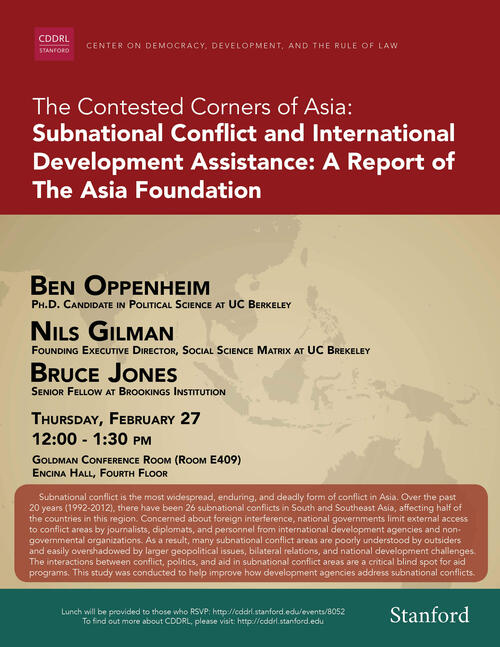
Subnational conflict is the most widespread, enduring, and deadly form of conflict in Asia. Over the past 20 years (1992-2012), there have been 26 subnational conflicts in South and Southeast Asia, affecting half of the countries in this region. Concerned about foreign interference, national governments limit external access to conflict areas by journalists, diplomats, and personnel from international development agencies and non-governmental organizations. As a result, many subnational conflict areas are poorly understood by outsiders and easily overshadowed by larger geopolitical issues, bilateral relations, and national development challenges. The interactions between conflict, politics, and aid in subnational conflict areas are a critical blind spot for aid programs. This study was conducted to help improve how development agencies address subnational conflicts.


Speaker Bios:

Ben Oppenheim is a Fellow (non-resident) at the Center on International Cooperation at New York University. His research spans a diverse set of topics, including fragile states, transnational threats (including pandemic disease risks and terrorism), and the strategic coherence and effectiveness of international assistance in fragile and conflict-affected areas.

Oppenheim has consulted for organizations including the World Bank, the United Nations, the Asia Foundation, the Institute for the Future, and the Fritz Institute, on issues including organizational learning, strategy, program design, foresight, and facilitation. In 2009, he served as Advisor to the first global congress on disarmament, demobilization, and reintegration, supported by the World Bank and the UN.

In 2013, Oppenheim was a visiting fellow at the Uppsala University Forum on Democracy, Peace, and Justice. His research has been supported by a Simpson Fellowship, and a fellowship with the Institute on Global Conflict and Cooperation. He was also a research fellow with UC Berkeley's Institute of International Studies, affiliated with the New Era Foreign Policy Project.


Nils Gilman is the Executive Director of Social Science Matrix. He holds a B.A., M.A. and Ph.D. in History from the University of California, Berkeley. Gilman’s first scholarly interest was in American and European intellectual history, with a particular focus on the institutional development of the social sciences, the lateral transfer and translation of ideas across disciplinary boundaries, and the impact of social scientific ideas on politics and policy.

Gilman is the author of Mandarins of the Future: Modernization Theory in Cold War America (Johns Hopkins University Press, 2004), the co-editor of Staging Growth: Modernization, Development, and the Global Cold War (University of Massachusetts Press, 2003) and Deviant Globalization: Black Market Economy in the 21st Century (Continuum Press, 2011), as well as the founding Co-editor of Humanity: An International Journal of Human Rights, Humanitarianism, and Development. He also blogs and tweets.

Prior to joining Social Science Matrix in September 2013, Gilman was research director at Monitor 360, a San Francisco consultancy that addresses complex, cross-disciplinary global strategic challenges for governments, multinational businesses, and NGOs. He has also worked at a variety of enterprise software companies, including Salesforce.com, BEA Systems, and Plumtree Software. Gilman has taught and lectured at a wide variety of venues, from the Harvard University, Columbia University, and National Defense University, to PopTech, the European Futurists Conference, and the Long Now Foundation.


Bruce Jones is a senior fellow and the director of the Project on International Order and Strategy in the Foreign Policy program at the Brookings Institution. He is also the director of the Center on International Cooperation at New York University.

Jones served as the senior external advisor for the World Bank’s 2011 World Development Report, Conflict, Security and Development, and in March 2010 was appointed by the United Nations secretary-general as a member of the senior advisory group to guide the Review of International Civilian Capacities. He is also consulting professor at the Center for International Security and Cooperation at Stanford University and professor (by courtesy) at New York University’s department of politics.

Jones holds a Ph.D. from the London School of Economics, and was Hamburg fellow in conflict prevention at Stanford University.

He is co-author with Carlos Pascual and Stephen Stedman of Power and Responsibility: Building International Order in an Era of Transnational Threats (Brookings Press, 2009); co-editor with Shepard Forman and Richard Gowan of Cooperating for Peace and Security (Cambridge University Press, 2009); and author of Peacemaking in Rwanda: The Dynamics of Failures(Lynne Reinner, 2001).

Jones served as senior advisor in the office of the secretary-general during the U.N. reform effort leading up to the World Summit 2005, and in the same period was acting secretary of the Secretary-General’s Policy Committee. In 2004-2005, he was deputy research director of the High-level Panel on Threats, Challenges and Change. From 2000-2002 he was special assistant to and acting chief of staff at the office of the U.N. special coordinator for the Middle East peace process. 

Richard and Rhoda Goldman Conference Room

Ben Oppenheim Ph.D. Candidate in Political Science Speaker UC Berkeley
Nils Gilman Founding Executive Director, Social Science Matrix Speaker UC Berkeley
Bruce Jones Senior Fellow Speaker Brookings Institution
Seminars
-

Hon.Agnes Binagwaho has served as Permanent Secretary of the Ministry of Health in Rwanda since October 2008. She specialized in emergency pediatrics, neonatology, and the treatment of HIV/AIDS; and she chairs the Rwandan Pediatric Society. From 1986 to 2002, she practiced medicine in public hospitals in Rwanda and several other countries before joining Rwanda's National AIDS Control Commission as Executive Secretary. She is a member of the Editorial Board of Public Library of Science, and the Harvard University Health and Human Rights Journal. Dr. Binagwaho co‐chaired the Millennium Development Goal Project Task Force on HIV/AIDS and Access to Essential Medicines for the Secretary‐General of the United Nations under the leadership of Professor Jeffrey Sachs. She was the global co‐chair of the Joint Learning Initiative on Children and HIV/AIDS. In addition to her medical degree and Master in Peadiatry, she received an Honorary Doctor of Sciences from Dartmouth College. Dr. Binagwaho serves as a visiting lecturer in the Department of Global Health and Social Medicine of Harvard Medical School.

Building 200 (History Corner)
Room 205
Stanford University

Hon. Agnes Binagwaho Minister of Health Speaker Rwanda
Seminars
-

Zainab Hawa Bangura of Sierra Leone is Special Representative on Sexual Violence in Conflict at the level of Under-Secretary-General at the United Nations.

Prior to this appointment, Ms. Bangura was the Minister of Health and Sanitation for the Government of Sierra Leone, and brings to the position over 20 years of policy, diplomatic and practical experience in the field of governance, conflict resolution and reconciliation in Africa. She was previously the second female Minister of Foreign Affairs and International Cooperation, including Chief Adviser and Spokesperson of the President on bilateral and international issues. Ms. Bangura has been instrumental in developing national programmes on affordable health, advocating for the elimination of genital mutilation, managing the country’s Peace Building Commission and contributing to the multilateral and bilateral relations with the international community. She is experienced in meeting with interlocutors in diverse situations, including rebel groups, and familiar in dealing with State and non-State actors relevant to issues of sexual violence while fighting corruption and impunity.

Ms. Bangura has on-the-ground experience with peacekeeping operations from within the United Nations Mission in Liberia (UNMIL), where she was responsible for the management of the largest civilian component of the Mission, including promoting capacity-building of government institutions and community reconciliation. She is an experienced results-driven civil society, human and women’s rights campaigner and democracy activist, notably as Executive Director of the National Accountability Groups, Chair and Co-founder of the Movement for Progress Party of Sierra Leone, as well as Coordinator and Co-founder of the Campaign for Good Governance.

Ms. Bangura is a former fellow of the Chartered Insurance Institute of London, possessing Diplomas in Insurance Management from the City University Business School of London and Nottingham University. She received her Bachelor of Arts from the Fourah Bay College, University of Sierra Leone.

Building 200 (History Corner)
Room 205
Stanford University

Zainab Bangura United Nations Special Representative on Sexual Violence in Conflict Speaker
Seminars
-

Abstract
The scope and complexity of global health can be overwhelming, making it difficult to form an inspiring and unified vision for the future. Mired in this complexity, the international community defines success disease by disease‹without a clear picture of what fundamental reform would actually look like. If the aspiration of global health with justice is the right goal, then answering three simple questions may pierce the haze.

First, what would global health look like? That is, given optimal priority-setting, funding, and implementation, to what level of health should we aspire, and with what provision of health-related services? Posing these three elementary questions, of course, oversimplifies a field that is fraught with tensions and trade offs. But I want to imagine a more ideal future for world health, with bold proposals to get there. After thinking about these three basic questions, I turn to an idea for innovative global governance for health‹a Framework Convention on Global Health.

Second, what would global health with justice look like? Global health seeks to improve all the major indicators of health, such as infant and maternal mortality and longevity. Global health with justice, however, requires that we look beyond improved health outcomes for the population as a whole. Although overall population health is vitally important, justice requires a significant reduction in health disparities between the well-off and the poor. Societies that achieve high levels of health and longevity for most, while the poor and marginalized die young, do not comport with social justice.

Third, what would it take to achieve global health with justice? That is, once we clearly state the goal, and meaning, of global health with justice, what concrete steps are required to reach this ambitious objective? This raises fundamental challenges, intellectually and operationally, as the response cannot be limited to ever-greater resources, but must also involve improved governance‹at the country and international level and across multiple sectors.

Lawrence O. Gostin is University Professor, Georgetown University’s highest academic rank conferred by the University President. Prof. Gostin directs the O’Neill Institute for National and Global Health Law and was the Founding O’Neill Chair in Global Health Law. He served as Associate Dean for Research at Georgetown Law from 2004 to 2008. He is Professor of Medicine at Georgetown University, Professor of Public Health at the Johns Hopkins University, and Director of the Center for Law & the Public’s Health at Johns Hopkins and Georgetown Universities.

 Prof. Gostin holds a number of international academic professorial appointments: Visiting Professor (Faculty of Medical Sciences) and Research Fellow (Centre for Socio-Legal Studies) at the University of Oxford, United Kingdom; the Claude Leon Foundation Distinguished Scholar and Visiting Professor at the University of Witwatersrand, Johannesburg, South Africa; and the Miegunyah Distinguished Visiting Fellow and Founding Fellow of the Centre for Advanced Studies (Trinity College), University of Melbourne. Prof. Gostin serves as Secretary and a member of the Governing Board of Directors of the Consortium of Universities for Global Health.

Building 200 (History Corner)
Room 205
Stanford University

Lawrence O. Gostin O'Neill Professor in Global Health Law Speaker Georgetown University
Seminars
-

Abstract:
The peoples of Burma/Myanmar have faced military rule, human rights violations, and poor health outcomes for decades. The country Is now undergoing a political liberalization, and multiple changes in political, social and economic life. The human rights and health situation of the country's many ethnic nationalities remain challenging, and represent one of the clearest threats to the prospect of successful transition to peace, and to democracy. We will explore the current health and human rights situation in the country, the ongoing threats to peace, and ways forward for this least developed nation as it emerges from 5 decades of military rule.

Chris Beyrer MD, MPH, is a professor of Epidemiology, International Health, and Health, Behavior, and Society at the Johns Hopkins University Bloomberg School of Public Health. He is the founding Director of the University¹s Center for Public Health and Human Rights, which seeks to bring the tools of population-based sciences to bear on Health and rights threats. Dr. Beyrer also serves as Associate Director of the Johns Hopkins Centers for AIDS Research (CFAR) and of the Center for Global Health. He has been involved in health and human rights work with Burmese populations since 1993. Prof. Beyrer is the author of more than 200 scientific papers, and author or editor of six books, including War in the Blood: Sex, Politics and AIDS in Southeast Asia, and Public Health and Human Rights: Evidence-Based Approaches. He has served as a consultant and adviser to numerous national and international institutions, including the National Institutes of Health, the World Bank, WHO, UNAIDS, the Open Society Foundations, the Walter Reed Army Institute for Research, amfAR The Foundation for AIDS Research, Physicians for Human Rights and Human Rights Watch. Dr. Beyrer received a BA in History from Hobart and Wm. Smith Colleges, his MD from SUNY Downstate in Brooklyn, NY, and completed his residency in Preventive Medicine, public health training, an MPH and a Infectious Diseases Fellowship at Johns Hopkins University in Baltimore. He received an honorary Doctorate (PhD) in Health Sciences from Chiang Mai University in Thailand, in 2012, in recognition of his 20 years of public health service in Thailand

Building 200 (History Corner)
Room 205
Stanford University

Chris Beyrer Director Speaker Johns Hopkins Center for Public Health & Human Rights
Seminars
-

Abstract
Preventing tobacco addiction is one of the leading ways to prevent fatal disease, yet many nations have declined to take steps against it. In recent years an international legal effort has begun to fill this void. In this lecture Professor Koh, formerly Legal Adviser of the U.S. State Department, will review the various dimensions of the legal campaign that is now underway.

Harold Hongju Koh is Sterling Professor of International Law at Yale Law School. He returned to Yale Law School in January 2013 after serving for nearly four years as the 22nd Legal Adviser of the U.S. Department of State.

Professor Koh is one of the country’s leading experts in public and private international law, national security law, and human rights. He first began teaching at Yale Law School in 1985 and served as its fifteenth Dean from 2004 until 2009. From 2009 to 2013, he took leave as the Martin R. Flug ’55 Professor of International Law to join the State Department as Legal Adviser, service for which he received the Secretary of State's Distinguished Service Award. From 1993 to 2009, he was the Gerard C. & Bernice Latrobe Smith Professor of International Law at Yale Law School, and from 1998 to 2001, he served as U.S. Assistant Secretary of State for Democracy, Human Rights and Labor.

Building 200 (History Corner)
Room 205
Stanford University

Harold Hongju Koh Sterling Professor of International Law Speaker Yale Law School
Seminars
Subscribe to International Relations