International Relations

FSI researchers strive to understand how countries relate to one another, and what policies are needed to achieve global stability and prosperity. International relations experts focus on the challenging U.S.-Russian relationship, the alliance between the U.S. and Japan and the limitations of America’s counterinsurgency strategy in Afghanistan.

Foreign aid is also examined by scholars trying to understand whether money earmarked for health improvements reaches those who need it most. And FSI’s Walter H. Shorenstein Asia-Pacific Research Center has published on the need for strong South Korean leadership in dealing with its northern neighbor.

FSI researchers also look at the citizens who drive international relations, studying the effects of migration and how borders shape people’s lives. Meanwhile FSI students are very much involved in this area, working with the United Nations in Ethiopia to rethink refugee communities.

Trade is also a key component of international relations, with FSI approaching the topic from a slew of angles and states. The economy of trade is rife for study, with an APARC event on the implications of more open trade policies in Japan, and FSI researchers making sense of who would benefit from a free trade zone between the European Union and the United States.

-


Abstract
Earlier generations of radicals understood themselves to be in an ongoing battle against the privatization of land and water.  They instrumentalized maps in the court system as a tool for battling for native sovereignty over traditional lands, protecting the rights of squatters, and securing access to water by poor farmers in the developing world.   Wherever battles for the commons take the form of a war for access to particular spaces, maps can help, whether activists are striking against high rents in the city, or protecting rivers from pollution.  Today, crowdsourced maps of land, food, and water present an opportunity for makers who want to work in support of a movement. My talk will highlight some of the most and least promising frontiers ahead.

 Professor Jo Guldi is presently Assistant Professor in the History of Britain and its Empire at Brown, where I teach courses related to capitalism, empire, land use, and computation.  Born in Dallas, Texas, I received my AB from Harvard University, and then studied at Trinity College, Cambridge before completing my PhD in History at the University of California, Berkeley, after which I continued on to postdocs at the University of Chicago and the Harvard Society of Fellows.  My first book, Roads to Power: Britain Invents the Infrastructure State (Harvard University Press, 2011), tells the story of how Britain built the first nation connected by infrastructure and technology caused strangers to stop speaking on the public street.  My next monograph, The Long Land War, will tell the story of international land reform movements from the Irish land war to Movimiento sin Tierra, lingering on legal reformers and civil servants, London's dredlocked squatters and their accidental influence on World Bank Policy, and the genesis of participatory mapping from Marxist development economists in the 1970s through radical coders in contemporary Chennai.

Wallenberg Theater

Prof. Jo Guldi Asst Prof., Department of History Speaker Brown University
Seminars
Date Label
-

Speaker bio:

Karl Eikenberry is the William J. Perry Fellow in International Security at the Center for International Security and Cooperation and a faculty member of the Shorenstein Asia-Pacific Research Center at Stanford University.  He is also an affiliated faculty member with the Center for Democracy, Development, and Rule of Law, and researcher with The Europe Center.

Prior to his arrival at Stanford, he served as the U.S. Ambassador to Afghanistan from May 2009 until July 2011, where he led the civilian surge directed by President Obama to reverse insurgent momentum and set the conditions for transition to full Afghan sovereignty.

Before appointment as Chief of Mission in Kabul, Ambassador Eikenberry had a thirty-five year career in the United States Army, retiring in April 2009 with the rank of Lieutenant General.  His military operational posts included commander and staff officer with mechanized, light, airborne, and ranger infantry units in the continental U.S., Hawaii, Korea, Italy, and Afghanistan as the Commander of the American-led Coalition forces from 2005-2007. 

He has served in various policy and political-military positions, including Deputy Chairman of the North Atlantic Treaty Organization (NATO) Military Committee in Brussels, Belgium; Director for Strategic Planning and Policy for U.S. Pacific Command at Camp Smith, Hawaii; U.S. Security Coordinator and Chief of the Office of Military Cooperation in Kabul, Afghanistan; Assistant Army and later Defense Attaché at the United States Embassy in Beijing, China; Senior Country Director for China, Taiwan, Hong Kong and Mongolia in the Office of the Secretary of Defense; and Deputy Director for Strategy, Plans, and Policy on the Army Staff.

He is a graduate of the U.S. Military Academy, has master’s degrees from Harvard University in East Asian Studies and Stanford University in Political Science, and was a National Security Fellow at the Kennedy School of Government at Harvard.

Ambassador Eikenberry earned an Interpreter’s Certificate in Mandarin Chinese from the British Foreign Commonwealth Office while studying at the United Kingdom Ministry of Defense Chinese Language School in Hong Kong and has an Advanced Degree in Chinese History from Nanjing University in the People’s Republic of China. 

His military awards include the Defense Distinguished and Superior Service Medals, Legion of Merit, Bronze Star, Ranger Tab, Combat and Expert Infantryman badges, and master parachutist wings.  He has received the Department of State Distinguished, Superior, and Meritorious Honor Awards, Director of Central Intelligence Award, and Chairman of the Joint Chiefs of Staff Joint Distinguished Civilian Service Award.  He is also the recipient of the George F. Kennan Award for Distinguished Public Service and Harvard University Graduate School of Arts and Sciences Centennial Medal.  His foreign and international decorations include the Canadian Meritorious Service Cross, French Legion of Honor, Afghanistan’s Ghazi Amir Amanullah Khan and Akbar Khan Medals, and the NATO Meritorious Service Medal.

Ambassador Eikenberry serves as a Trustee for the International Institute for Strategic Studies, The Asia Foundation, and the National Committee on American Foreign Policy, and is a Fellow of the American Academy of Arts and Sciences.  He is a member of the Council on Foreign Relations, the American Academy of Diplomacy, and the Council of American Ambassadors, and was previously the President of the Foreign Area Officers Association.  His articles and essays on U.S. and international security issues have appeared in Foreign Affairs, The Washington Quarterly, American Foreign Policy Interests, The New York TimesThe Washington Post, Foreign Policy, and The Financial Times.  He has a commercial pilot’s license and instrument rating, and also enjoys sailing and scuba diving.

Reuben W. Hills Conference Room

Karl Eikenberry William J. Perry Fellow in International Security at CISAC, CDDRL, TEC, and Shorenstein APARC Distinguished Fellow; and Former U.S. Ambassador to Afghanistan and Retired U.S. Army Lt. General Speaker FSI
Seminars
-

Speaker bio:

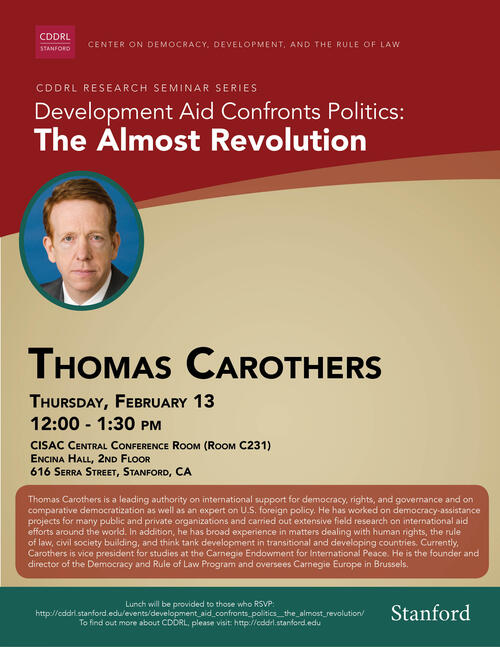
Thomas Carothers is vice president for studies at the Carnegie Endowment for International Peace. He is the founder and director of the Democracy and Rule of Law Program and oversees Carnegie Europe in Brussels.

Carothers is a leading authority on international support for democracy, rights, and governance and on comparative democratization as well as an expert on U.S. foreign policy. He has worked on democracy-assistance projects for many public and private organizations and carried out extensive field research on international aid efforts around the world. In addition, he has broad experience in matters dealing with human rights, the rule of law, civil society building, and think tank development in transitional and developing countries.

He is the author of six critically acclaimed books as well as many articles in prominent journals and newspapers. Carothers has also worked extensively with the Open Society Foundations (OSF), including currently as chair of the OSF Think Tank Fund and previously as chair of the OSF Global Advisory Board. He is an adjunct professor at the Central European University in Budapest and was previously a visiting faculty member at Nuffield College, Oxford University, and Johns Hopkins SAIS.

Prior to joining the Endowment, Carothers practiced international and financial law at Arnold & Porter and served as an attorney adviser in the Office of the Legal Adviser of the U.S. Department of State.

Carothers is the co-author (with Diane de Gramont) of Development Aid Confronts Politics: The Almost Revolution (Carnegie, 2013) and author of Confronting the Weakest Link: Aiding Political Parties in New Democracies (Carnegie, 2006); Promoting the Rule of Law Abroad: In Search of Knowledge (Carnegie, 2006); Uncharted Journey: Promoting Democracy in the Middle East, co-edited with Marina Ottaway (Carnegie, 2005); Critical Mission: Essays on Democracy Promotion (Carnegie, 2004); Funding Virtue: Civil Society Aid and Democracy Promotion, co-edited with Marina Ottaway (Carnegie, 2000); Aiding Democracy Abroad: The Learning Curve (Carnegie, 1999); and Assessing Democracy Assistance: The Case of Romania (Carnegie, 1996).

Image

CISAC Conference Room

Thomas Carothers Vice President for Studies Speaker Carnegie Endownment for International Peace
Seminars
-

Abstract:

The Tahrir and Gezi Park protests were, amongst many other things, moments of energetic artistic creativity, in the sound world as well as other domains. Though well documented, and clearly a vital component of the political energies and transformations of the moment, they have proved difficult to think about. This talk, a musicologist's perspective, will explore them in the light of some recent thinking about crowds and social movements. 

Bio:

Martin Stokes  is King Edward Professor of Music at King's College, London. He is an ethnomusicologist, working primarily on the questions of ethnicity, identity, emotions, globalization in the context of the Middle East. His most recent book,  The Republic of Love: Cultural Intimacy in Turkish Popular Music (University of Chicago Press, 2010), has received the Merriam Prize from the Society for Ethnomusicology. Among his other publications are Celtic Modern: Music on the Global Fringe (Scarecrow 2004), Ethnicity, Identity and Music: The Musical Construction of Place (Berg 1994), and The Arabesk Debate: Music and Musicians in Modern Turkey (Oxford 1992).


Co-sponsored by the Mediterranean Studies Forum, the CDDRL Program on Arab Reform and Democracy, Department of Music, and Department of Anthropology


Encina Hall West - Room 208

Martin Stokes King Edward Professor of Music at King's College Speaker London
Conferences
-

Abstract:

Professor Gold will make a presentation that is part of a larger book project that applies the theory of fields as elaborated by Pierre Bourdieu, Neil Fligstein and Doug McAdam to the remaking of Taiwan since the end of martial law in 1987. He argues that political democratization is only one part of the larger dispersal of all forms of power (what Bourdieu terms “capital”) away from the tight centralized control of the mainlander—dominated KMT to broader segments of Taiwan’s society. This talk will look at this process of the breakdown and reconstruction of the old order of various fields, in particular the political, economic and cultural fields, and the effect of this on the overarching field of power.


Speaker Bio:

Thomas B. Gold is Professor of Sociology at the University of California, Berkeley, and Executive Director of the Inter-University Program for Chinese Language Studies, whose executive office is at Berkeley and teaching program at Tsinghua University in Beijing. He received his B.A. in Chinese Studies from Oberlin College, and M.A. in Regional Studies – East Asia and PhD in Sociology from Harvard University. He taught English at Tunghai University in Taiwan. He was in the first group of U.S. government-sponsored students to study in China, spending a year at Shanghai’s Fudan University from 1979-1980. Prof Gold’s research has examined numerous topics on the societies on both sides of the Taiwan Strait. These include: youth; guanxi; urban private entrepreneurs (getihu); non-governmental organizations; popular culture; and social and political change. He is very active in civil society in the United States, currently serving on the boards of several organizations such as the Asia Society of Northern California, International Technological University, Teach for China, and the East Bay College Fund.  His books include State and Society in the Taiwan Miracle, and the co-edited volumes Social Connections in China: Institutions, Culture, and the Changing Nature ofGuanxi, The New Entrepreneurs of Europe and Asia: Patterns of Business Development in Russia, Eastern Europe and China, and Laid-Off Workers in a Workers’ State: Unemployment With Chinese Characteristics.  

Reuben W. Hills Conference Room

Thomas B. Gold Professor of Sociology Speaker UC Berkeley
Seminars

Asylum Access
1611 Telegraph Avenue
Suite #1111
Oakland, CA 94612

0
PSE Visiting Practitioner in Residence, 2013-14
emily_hs.jpg

Emily Arnold-Fernández was a social entrepreneur in residence during the fall 2012 quarter with CDDRL's Program on Social Entrepreneurship. She will be spending the 2013/14 academic year as a practitioner-in-residence with the Program on Social Entrepreneurship.

She is the founder and executive director of Asylum Access, is a social entrepreneur and human rights pioneer. Recognizing that refugees throughout Africa, Asia and Latin America – some of whom flee with nothing more than the clothes on their backs – were almost always unequipped to go into a legal proceeding in a foreign country, alone, and explain why they should not be deported, Emily founded Asylum Access to advocate on behalf of refugees seeking to assert their rights.

“For half a century, international law has given refugees the rights to live safely,
seek employment, send children to school and rebuild their lives. But those rights are
meaningless unless they are respected on the ground,” she says. “Asylum Access
provides a rare opportunity to fill a gaping hole in our human rights system – by making
refugee rights a reality for real people.”

For her innovative approach to the global refugee crisis, Emily was honored by the
Dalai Lama as one of 50 “Unsung Heroes of Compassion” from around the world (2009)
and Waldzell Institute’s Architects of the Future Award (2012). She has also been
recognized as Pomona College’s Inspirational Young Alumna (2006), awarded the
prestigious Echoing Green fellowship (2007), and recognized as the New Leaders
Council’s 40 Under 40 (2010), among others. Emily’s ground-breaking work with
Asylum Access has earned her international speaking invitations and widespread media
attention, including the Rotary International Peace Symposium (2008, 2009), the UN
High Commissioner for Refugees’ Annual Consultations (2008, 2009), a cover feature in
the Christian Science Monitor (September 2009), and the San Francisco Examiner’s
Credo column (July 2011). She holds a B.A. cum laude from Pomona College and a J.D.
from Georgetown University Law Center.

Committed to sharing her knowledge with young and aspiring social
entrepreneurs, Emily serves as an adjunct professor at the University of San Francisco,
teaching a course in social entrepreneurship. In Fall 2012, Emily was selected as one of
three Social Entrepreneurs in Residence at Stanford where she participated as “expert
respondent” in Stanford Law School’s Law, Social Entrepreneurship and Social Change
course, and in Spring 2013, Emily led an intensive skills-building course on social
entrepreneurship at Pomona College.

A visionary human rights activist, Emily Arnold-Fernández takes her inspiration
from a line in a June Jordan poem: “We are the ones we have been waiting for.”

Subscribe to International Relations