Authors
News Type
News
Date
Paragraphs

Introduction and Contribution


Economies depend on infrastructure: roads enable the movement of goods and workers, electricity powers businesses and factories, and communications technologies allow for the exchange of information and services. Yet in our connected world, roughly 1 billion people live more than two kilometers from an all-season road, and approximately 1.2 billion have no access to electricity.1

For decades, institutions such as the World Bank and McKinsey Global Institute have promoted the idea that closing a trillion-dollar gap between planned global infrastructure investment and the estimated level of investment needed to drive growth will alleviate poverty, harness the potential of developing nations to increase global GDP, and enrich foreign investors. But despite the fact that unrealized gains from greater infrastructure investment in emerging market and developing economies (EMDEs) outstrip those in the rich world, comparatively little capital flows into the infrastructure of poor countries.

In “The Global Infrastructure Gap: Potential, Perils, and a Framework for Distinction,” Camille Gardner and Peter Blair Henry reject the received narrative that flooding poor countries with capital simply to reach a target level of infrastructure investment will yield the desired gains. Instead, they urge investors and policymakers to move from thinking about infrastructure “gaps” to prioritizing infrastructure returns. Specifically, they propose the first “dual hurdle” framework. The framework uses cross-country differences in returns to identify efficiency in cross-country investments, incorporating the incentives that suppliers and allocators of capital must have to finance productive projects.

The authors reject the received narrative that flooding poor countries with capital simply to reach a target level of infrastructure investment will yield the desired gains.

Applying the framework to historical data, Gardner and Henry debunk the notion that poor countries offer ubiquitous opportunities for productive investment. Only 13 percent of countries in the data set cleared the dual-hurdle tests of efficiency for projects in both roads and electricity. But for countries that did clear the hurdles, the return on infrastructure was large: more than 10 times greater in some cases than the return on rich-country private capital.

This underscores the need for updated and more accessible data to drive decisions and prioritize projects. Differences across countries, sectors (e.g., roads vs. electricity), and locations (urban vs. rural) must be taken seriously to avoid a wasteful allocation of global infrastructure capital.

Gardner and Henry expand our understanding of when cross-country infrastructure investments are efficient and why poor countries have struggled to catch up. And as labor forces in poor countries grow rapidly, the problems associated with infrastructure scarcity are likely to become more acute, increasing migration pressures. Effective investment can mitigate risks while generating mutual gains for poor and rich countries alike.

When Infrastructure Investment Pays Off


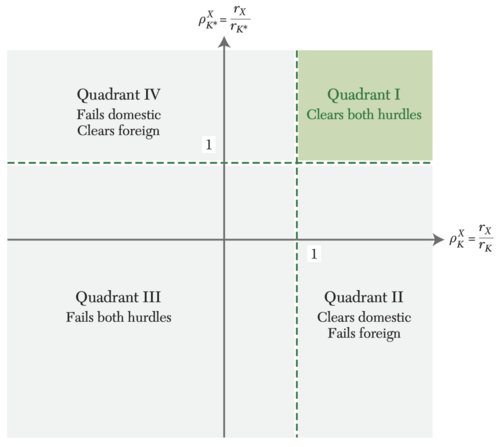
The authors’ dual hurdle framework reveals that public infrastructure investment in a poor country is efficient only if it yields higher returns than the social rate of return on private capital (a) within the country and (b) in rich countries. Countries that clear both hurdles are deemed strong candidates for more investment.


Image
Figure 4. The Dual-Hurdle Framework


Figure 4. The Dual-Hurdle Framework

Note: For a given poor country and type of infrastructure, the dual-hurdle framework sorts each country-infrastructure observation into one of four quadrants according to whether it clears the hurdle for efficient: (a) domestic investment, and (b) foreign investment.


Gardner and Henry apply their framework to 53 countries that belong to the only known data set of comprehensive cross-country estimates of the social rates of return on infrastructure (roads and electricity) in poor countries, found in a paper commissioned by the World Bank that is based on data from 1985.2 In their analysis, Gardner and Henry show that while some countries have opportunities for high returns (especially for paved roads), many others do not. In very few countries can the case be made for investing across multiple kinds of infrastructure (only 7 of 53 countries cleared the dual hurdles for both roads and electricity), and for some countries there is no case to be made.

To be clear, infrastructure investment is not generally inefficient. Indeed, worthwhile projects to increase or upgrade infrastructure in poor countries can yield much higher gains than are available from private investment in both poor and rich countries. This is because infrastructure improvements raise productivity across the economy. The problem is that these high-return opportunities are difficult to identify, especially without updated, readily accessible, quality data.

Different types of infrastructure also vary in their impact depending on the context. For example, investments in electricity often yield low returns in rural settings but high returns in urban settings (where firms are concentrated and struggle due to unreliable power). By contrast, roads more often yield higher returns because they support market activity overall. Finally, the authors show that efficient infrastructure also depends on the interaction of private capital, human capital, and good institutions. This underscores the limitations of simply building more infrastructure in isolation. 

Challenges to Infrastructure Investment


Gardner and Henry document extensive variation in efficiency when comparing private versus public capital allocation (in roads and electricity) across rich and poor countries. The social rates of return on public capital vary much more than with private capital, which is the case in both rich and poor countries, and inefficiencies in public capital allocation are greater in poor countries than in rich ones. This variation is driven not just by economic factors but also by political and institutional constraints.

The concept of “frozen capital” helpfully describes the outcome of problems facing prospective investors. For one, because infrastructure requires complementarities (e.g., electrifying an area requires the preexistence of reliable roads), individual projects may be unprofitable unless others are simultaneously financed and coordinated.

Additionally, foreign investors may distrust the governments of the countries where they invest, or they may be wary of the quality of domestic firms tasked with completing a given project. This will certainly be true where transparency and accountability are lacking. Especially in poor autocracies or semi-democracies, governments may arbitrarily change the law, fail to honor contracts, or face political and social instability, leaving investors uncertain about the prospect of repayment and return on their investments.

Ultimately, infrastructure investment offers great promise, but it must be evidence-based and approached with caution. The challenge is not to simply raise the level of investment but, as “The Global Infrastructure Gap” shows, to use cross-country differences in returns to identify the right infrastructure projects, in the right places, to maximize the efficiency of cross-country capital allocation.

*Brief prepared by Adam Fefer.

References:

1. Canning, David, and Esra Bennathan. 2000. “The Social Rate of Return on Infrastructure Investment.” World Bank Policy Research Working Paper 2390.

2. Rozenberg, Julie, and Marianne Fay, eds. 2019. Beyond the Gap: How Countries Can Afford the Infrastructure They Need While Protecting the Planet. Washington, DC: World Bank.

Hero Image
Aerial view of a multi-level highway interchange with sweeping curved overpasses crossing above one another. A few cars and a white semi-truck travel on the mostly empty concrete roads, while patches of vegetation and water are visible below the elevated ramps.
Brendan Beale
All News button
1
Subtitle

CDDRL Research-in-Brief [3.5-minute read]
Date Label
Display Hero Image Wide (1320px)
No
Authors
News Type
News
Date
Paragraphs

1991 was a pivotal moment in history. Boris Yeltsin and other Russian democrats thwarted a coup against Mikhail Gorbachev, hastening the Soviet Union’s collapse. The new leadership embraced democratic ideals and sought to join the Western-led liberal international order.

Michael McFaul was in Moscow doing field work for his PhD. For the budding academic, it was an exhilarating time to be a political scientist, a multilateralist, an American, and a ‘small-d’ democrat. It seemed Russia wanted to join the democratic world, and China was open to the possibility. As his future Stanford colleague Francis Fukuyama argued in a famous essay, it felt like the end of history.

Cover of Autocrats vs Democrats Book

Today, that story looks very different. Vladimir Putin’s Russia has grown increasingly authoritarian. China under Xi Jinping has as well. And new threats to democracy have emerged worldwide.

McFaul, who has led the Freeman Spogli Institute for International Studies for 11 years and will step down as director at the end of the year, wrote Autocrats vs. Democrats: China, Russia, America, and the New Global Disorder to explain how we got to this point, how to understand today’s great-power competition, and what Americans leaders and citizens can do about it.

Below, McFaul, who is a professor of political science in Stanford’s School of Humanities and Sciences, offers five of the book’s main takeaways in his own words.

#1 Competition and confrontation are not inevitable.

When it comes to U.S.-Russia and U.S.-China history, my new book shows the relationship between power, regime type and individuals, and how they change over time. How these three variables interact determines when there have been moments of cooperation or confrontation. In the first two substantive chapters of the book, I trace U.S.-Russia and U.S.-China relations from the 18th century until today, identifying 5 distinct eras of both cooperation and confrontation.

Today we're in a period of confrontation because China is powerful, autocratic, and has a leader with global ambitions. Russia is also stronger than it was 30 years ago, is now a dictatorship again, and is ruled by a leader with global revisionist aims. This combination creates a challenge – and a confrontational atmosphere – with the United States, another great power that is still democratic.

But if you go over that history, you'll find that it wasn't always that way. Sometimes there were greater moments of cooperation, in part because of the different balance of power between the countries, but mostly because of the different regimes that undergirded those systems. When Russia was more democratic, we cooperated with them. Likewise, when China was leaning toward a less authoritarian structure there was more cooperation.

The main point of that part of the book is to underscore that it is not inevitable that we will be in competition and confrontation with China and Russia forever.

#2 Are we in a new Cold War? It’s complicated.

There are some similarities between the Cold War and today, but also important differences. On the similarities, I believe there are two superpowers emerging today – China and the United States. There's also an ideological dimension to this conflict. It is not just about power. If China were a democracy, there would likely be less conflict. The same goes for Russia. A third similarity is that both the United States and China have global agendas, not just regional ones (although President Trump recently seems to want to change that for the United States and have us focus on our hemisphere). Fourth, like the Cold War, this new era of great power competition is likely to endure for several decades.

But differences matter. First, the ideological clash between Washington and Beijing is far less intense than it was between Washington and Moscow. China is not trying to make the world communist, and it is not waging proxy wars against U.S. allies. By the way, the Cold War wasn’t that cold. Millions died. That is not happening in the U.S.-China relationship. Regarding Russia and the United States, the ideological competition is not between communism and capitalism but between illiberal nationalism and liberal internationalism. Unlike the Cold War, this ideological contest is more prevalent within countries than between them. Putinism has a lot of admirers in Europe and even the United States.

Second, China is a rising great power. But so is the United States. The China-rising/America-falling trope isn’t supported by the data. We’re rising too, just not as fast. The Chinese haven’t caught up with us yet, and may never, as I explain in the book. Add allies to the equation, and the democratic world remains stronger than the autocratic camp in military, economic, and even ideological power.

Third, the economic relationship is different. China is deeply integrated into the global – and American – economy, and its economy is far more successful than the Soviet Union’s. That creates new challenges that we never faced with Moscow. Trying to sever China from the global or U.S. economy, Cold War–style, is likely to fail. Smart policy toward China – and Russia – must account for that integration.

#3 Do not overestimate China, or underestimate Russia.

American presidents and foreign policy experts underestimated Chinese power for too long. I lay that out in the book. But now we've overshot, and we're starting to exaggerate the Chinese threat to our very existence. Containing China should be a central U.S. foreign policy objective for decades to come, and we must remain competitive – not only militarily, but economically, technologically, and educationally. But China is not an existential threat to the United States or the free world. China is not seeking to destroy us or our allies. And while highly skilled and advancing in many dimensions, in the aggregate China is still not America's equal and may never be.

Conversely, while we sometimes overestimate China, we've underestimated the Russian threat. I actually wrote the first draft of this book before Russia invaded Ukraine. My argument then, tragically true today, was that although Russia lacks China’s economic and military capabilities, Putin is an ideologically motivated autocrat whose ambitions threaten our economic, political, and security interests. The ongoing war in Ukraine is grim proof. Putin is a risk-taker, willing to deploy Russian troops aggressively to advance his agenda in ways Xi Jinping has not yet done. Therefore, we must maintain a vigilant strategy to contain the Russian threat as well, even if Russia today does not possess China’s overall power.

#4 We can learn from the Cold War to better meet the challenges today.

If there are some parallels between the Cold War and great power competition today, then we should learn from our mistakes and our successes in the past century. Three Cold War mistakes stand out. First, we overestimated the communist ideological threat, which fueled disastrous errors like McCarthyism at home and the Vietnam War abroad. We didn’t need to fight in Vietnam to win the Cold War; we shouldn’t repeat that. Second, in pursuing containment, we embraced horrific right-wing dictators – we did not need to support the apartheid regime in South Africa, for instance, to prevail. We should avoid that again in 21st-century great-power competition. Third, we overestimated Soviet economic and military strength. I’ve read those 1960s and 1970s reports predicting the Soviet economy would overtake America’s. They were wrong, and the echo of that narrative in today’s China debate should make us cautious.

At the same time, we also got important things right during the Cold War that should be replicated. By creating the U.S. Agency for International Development (USAID) in 1961, President Kennedy expanded international economic assistance to compete with Soviet aid. We need more of that now to compete with China. We also created the Voice of America, Radio Free Europe, and later Radio Free Asia. We need these tools of soft power. The Chinese and Russians are investing in them, and we should too.  During the Cold War, the U.S. also established new tools to promote democracy, including the National Endowment for Democracy. To compete effectively with authoritarian China and Russia, we need more innovative instruments for promoting our values, not fewer.

We also anchored the liberal international economic order by building institutions like the World Bank, IMF, and later the World Trade Organization to unite the free, capitalist world. We all prospered from that strategy. We need to anchor the free world again by creating, reforming, and sustaining such economic institutions.

Finally, we forged powerful alliances in Europe and Asia. Allies were our greatest advantage over the Soviets and should remain our greatest comparative advantage over China and Russia. We have to nurture those relationships to keep them strong.

#5 In the long course of history, democracies are more powerful than autocracies.

I believe that democratic ideas are more popular today than autocratic ideas. If the U.S. can unite the democratic world again, I’m much more optimistic about our ability to prevail in this new era of great-power competition. I'd much rather be on the side of the small-d democrats than the autocrats. For the details, you’ll have to read the prescriptive chapters in Autocrats versus Democrats, where I explain exactly how we can do that again. I'm excited for you to read the book and hear your thoughts on navigating this new era of global great-power competition.

Michael McFaul headshot

Professor Michael McFaul

FSI Director
"Autocrats vs. Democrats: China, Russia, America, and the New Global" is available starting October 28, 2025.
Order Now

Read More

Larry Diamond on World Class Podcast
Commentary

How Democracy Is Doing Around the World

On the World Class podcast, Larry Diamond and Michael McFaul compare how civic discourse and political institutions are holding up in the United States, South Korea, Taiwan, and other democracies.
How Democracy Is Doing Around the World
Hero Image
Professor Michael McFaul, director of the Freeman Spogli Institute, stands in front of his desk.
All News button
1
Subtitle

Professor Michael McFaul, former U.S. ambassador to Russia, shares insights from his new book on Cold War lessons and the autocracy-democracy struggle.

Image
Professor Michael McFaul, director of the Freeman Spogli Institute, stands in front of his desk.
Title
Five Lessons on How the World’s Great Powers Compete, and Why
Date Label
Display Hero Image Wide (1320px)
No
Subscribe to Russia and Eurasia