This talk is based on the speakers’ recently published edited volume The Unfinished Arab Spring: Micro-Dynamics of Revolts between Change and Continuity. Adopting an original analytical approach in explaining various dynamics at work behind the Arab revolts and giving voice to local dynamics and legacies rather than concentrating on debates about paradigms, we highlight micro-perspectives of change and resistance as well as of contentious politics that are often marginalized and left unexplored in favor of macro-analyses. First, we re-examine the stories of the uprisings in Tunisia, Egypt, Syria, Morocco and Algeria through diverse and novel perspectives, looking at factors that have not yet been sufficiently underlined but carry explanatory power for what has occurred. Second, rather than focusing on macro-comparative regional trends – however useful they might be – we focus on the particularities of each country, highlighting distinctive micro-dynamics of change and continuity.
SPEAKERS BIO
Image
Fatima el Issawi is a Reader in Journalism and Media Studies at the University of Essex. Her research focuses on the intersection between media, politics and conflicts in transitional contexts to democracy in North Africa. She is the Principal Investigator for the research project “Media and Transitions to Democracy: Journalistic Practices in Communicating Conflicts- the Arab Spring” funded by the British Academy Sustainable Development Programme, looking at media’s impact on communicating political conflicts in post uprisings in North Africa. Since 2012, el Issawi has been leading empirical comparative research projects on the interplay between media and political change, funded by Open Society Foundation and the Middle East Centre/LSE, covering Egypt, Tunisia, Morocco, Libya and Algeria. El Issawi’s expertise crosses journalism, public communication, policy and academia. She has over fifteen years of experience as international correspondent in conflict zones in the MENA region. She is the author of “Arab National Media and Political Change” investigating the complex intersections between traditional journalists and politics in uncertain times of transitions to democracy.
Image
Francesco Cavatorta is full professor of political science and director of the Centre Interdisciplinaire de Recherche sur l’Afrique et le Moyen Orient (CIRAM) at Laval University, Quebec, Canada. His research focuses on the dynamics of authoritarianism and democratization in the Middle East and North Africa. His current research projects deal with party politics and the role of political parties in the region. He has published numerous journal articles and books.
[The following article originally appeared in French in Le Soir]
Over the past 20 years of exile, I returned to Morocco sporadically to visit family and friends. Now, I am here indefinitely until the coronavirus pandemic passes. I have observed its effects upon my homeland as not just a proud Moroccan, but also a trained social scientist assessing how the Moroccan state has responded – and how new social dynamics can emerge from it.
Officially, Moroccan containment and mitigation measures have been described as a model of responsiveness. Notwithstanding testing shortages, and the failure to repatriate Moroccans abroad, new resources like personal protective equipment have been supplied to hospitals. Emergency funds are supporting the economy. The military and security forces have enforced strict quarantine and sheltering policies. Despite that infectious rates are among the highest in Africa, deaths from COVID-19 still remain comparatively low, a reality for which all Moroccans are grateful.
However, the aggressiveness of these responses stems from a troubling reality. The state moved quickly to contain the pandemic because it could not afford to do otherwise. It already lagged behind in providing basic goods like education and jobs, due to the unbridled neoliberal economic model espoused by national planners for two decades at the expense of social development. The healthcare sector could not absorb even a modest surge in hospitalizations and deaths. In sum, Morocco’s response was optimal given its resources, but suboptimal given its potential.
Why is this troubling? Not only do medical projections suggest a second wave of the pandemic looms this winter, but there will be more existential threats to come of this type. Climate change will further accentuate these dangers. Further, entire swathes of the Moroccan economy will remain in crisis for the foreseeable future. Vast numbers of the labor force work in the informal sector, the product of unfettered neoliberalism that did not produce any trickle-down effects due to weak rule of law. Grinding inequality means that successful treatments for COVID-19 will not reach most of the population. As Moroccans, we need only to consider the Rif to acknowledge the dangers that lie ahead.
In the context of this crisis, many Moroccans have put aside standing grievances and put faith in their state. Politically, Moroccans do not labor under the extreme polarization often seen in other Arab countries. True, Morocco does not have the democratic system of Tunisia, where electoral institutions keep things in place. But, neither does it feature the deep schisms of Algeria, where the Hirak protest movement last year exposed the eroding legitimacy of the military and its civilian façade. If anything, Algerian politics will become even more fractured after the pandemic.
Morocco stands in the middle. Unlike Tunisia, where democratic institutions absorb and mediate this crisis, here the state can only deflect and postpone it. However, neither has Moroccan politics splintered across irreconcilable rifts, partly due to the unifying presence of the monarchy. This gives Moroccans the chance to envision a future of improved governance that compensates for past deficiencies, and leaves us better prepared for future threats. This is not a substitute for genuine pluralism, but it can facilitate its onset.
Recently, King Mohamed pronounced the prevailing paradigm of economic development to have floundered. As the Chinese proverb holds that with every crisis comes opportunity, we now have an opening to realign it, despite that more hardships will likely ensue as the pandemic continues to have long-lasting consequences. For instance, remittances, long a vital source of economic funding, will decline, as Moroccans abroad will more likely keep their cash close. The tourism sector will take many years to recover. But Morocco can also take advantage of global supply chain disruptions to secure new modes of production. Self-sufficiency and social spending must be priorities.
Crucially, we cannot merely tweak the neoliberal model in favor of a master turn-key monarchical plan. The focus here falls upon not just the ideas behind national development, but the process through which those ideas come to fruition. Major ruptures that allow such soul- searching are rare in Morocco. One came after the passing of my uncle, King Hassan II, in 1999. A second came with the Arab Spring in 2011. Today marks another such inflection point, which allows all of society sharing common trauma and frustration to step back from the brink.
That process will not be easy. Many Moroccans have lost faith in political engagement after too many failed reform promises. The Arab Spring’s impetus to demand voice and dignity will become more omnipresent. New social and economic initiatives must be formulated in close concertation with society, through inclusive dialogues that favor participation over top-down imposition.
The state must avoid succumbing to the huge temptation of stoking false patriotism, or aggrandizing its authoritarian impulse by securitizing the pandemic. For instance, surveillance technologies utilized to ensure social distancing cannot be retooled to suppress political mobilization, as is happening in Russia and China. Indeed, many have wrongly assumed that autocracies are better equipped for the current crisis by comparing China with the US. However, this is a false dichotomy. For every China, there are successful democracies like South Korea and Taiwan where close state-society coordination is mediated not by the army or police, but rather by trust, transparency, and citizen engagement.
In short, an historical opportunity now presents itself for Morocco; let us not squander it.
Democracy promotion has been a longstanding goal of US foreign policy in the Middle East and elsewhere. President George W. Bush championed democracy promotion as a way to counter the ideology and extremism that led to the September 11, 2001 terror attacks against the United States. After Bush’s attempts ended in abject failure, President Barack Obama sought to repair relations with the Muslim world but also withdraw the US footprint in the Middle East. But Obama was forced to take a far more hands-on approach with the outbreak of the 2010-2011 uprisings known as the Arab Spring. President Donald Trump, who has displayed an almost allergic aversion to Obama’s policies, has openly embraced the region’s autocrats with little regard for their abuse of human rights or absence of attention to political or economic freedom. How the United States approaches the region matters – both for aspiring democrats and for those who wish to silence them. Despite the rise of Russia and China, the United States remains the sole superpower, with the loudest voice on the world stage. Thus, the shift from democracy promoter – albeit reluctantly at times – to authoritarian enabler has made the task of democratic political reform far more challenging for people across the Middle East. This discussion will examine the recent democracy promotion efforts of the United States, with a focus on the Obama and Trump years.
SPEAKER BIO
Image
Sarah Yerkes is a fellow in the Carnegie Endowment for International Peace’s Middle East Program, where her research focuses on Tunisia’s political, economic, and security developments as well as state-society relations in the Middle East and North Africa. She has been a visiting fellow at the Brookings Institution and a Council on Foreign Relations international affairs fellow and has taught in the Security Studies Program at Georgetown University and at the Elliott School of International Affairs at the George Washington University. Yerkes is a former member of the State Department’s policy planning staff, where she focused on North Africa. Previously, she was a foreign affairs officer in the State’s Department’s Office of Israel and Palestinian affairs. Yerkes also served as a geopolitical research analyst for the U.S. military’s Joint Staff Strategic Plans and Policy Directorate (J5) at the Pentagon, advising the Joint Staff leadership on foreign policy and national security issues.
CDDRL’s Program on Arab Reform and Democracy held its annual conference at Stanford University on October 11 and 12, titled “The Struggle for Political Change in the Arab World.” The conference is an outgrowth of ARD’s efforts to support new research on the dynamics of political change in the countries of the Arab world. Scholars from across different disciplines sought to understand how social, economic, and political dynamics at the national level, as well as international and regional conflict and power rivalries, impact struggles for political and social change in the region.
Overview of Panels and Speakers
Image
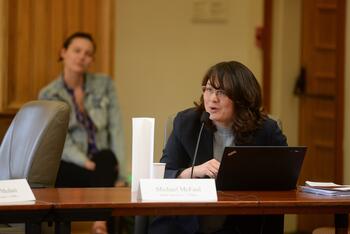
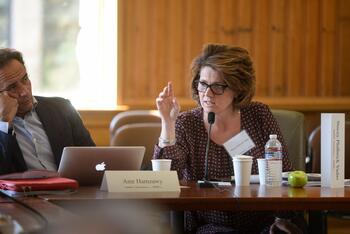
Following opening remarks by FSI Senior Fellow Larry Diamond, the first panel titled “The Boundaries of Authoritarianism post-Arab Uprisings” featured CDDRL Senior Research Scholar Amr Hamzawy. His paper examined how the regime of Abdel Fattah Al-Sisi has employed discursive strategies to discredit calls for democratic change in the country. Sean Yom, Associate Professor of Political Science at Temple University, outlined how the protest strategies of Jordanian youth have limited their effectiveness in advancing meaningful political change. University of California, Davis Scholar Samia Errazzouki discussed the failure of state-led political and economic reform in Morocco.
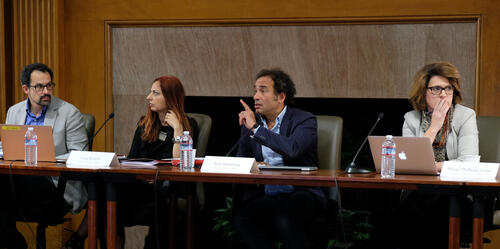
Chaired by Harvard University Fellow Hicham Alaoui, the second panel was titled “Popular Uprisings and Uncertain Transitions.” University of California, Santa Cruz Political Scientist Thomas Serres provided an overview of the economic disruptions that contributed to Algeria’s uprising. Lindsay Benstead, who is an Associate Professor of Political Science at Portland State University, analyzed the electoral successes of Tunisia’s Ennahda Party. Khalid Medani, Professor of Political Science at McGill University, explained how Sudanese protesters leveraged new strategies of contention to force Omar Al-Bashir out of power.
Farah Al-Nakib (right) and Michael Herb (left)
The third panel, titled “Politics, Succession and Sectarianism in the GCC States,” included Oxford University Fellow Toby Matthiesen, who discussed how Saudi Arabia and the GCC states have increasingly sought to protect their regimes by actively molding the politics of their autocratic patrons in the region, and by using new technologies to upgrade the effectiveness of their surveillance states. Georgia State University Political Scientist Michael Herb explained how the aging of the Saudi line of succession contributed to the political ascendancy of Crown Prince Mohammad Bin Salman and the decay of family rule in the country. Cal Poly Historian Farah Al-Nakib described how Kuwait’s royal family has used its sponsorship of large-scale development projects to sidestep the country’s political polarization, undermine the power of the parliament, and weaken public access to spaces of political contestation.
Image
The fourth panel focused on “Social Strife and Proxy Conflict in the Middle East.” Chatham House Scholar Lina Khatib described Syria’s transformation during the civil war from a highly centralized security state to a transactional state in which the regime depends heavily on local powerbrokers. Stacey Philbrick Yadav, Associate Professor and Chair of the Department of Political Science at Hobart and William Smith Colleges, discussed differences in how local communities in Yemen have been affected by the country’s conflict. David Patel, who serves as Associate Director for Research at the Crown Center for Middle East Studies at Brandeis University, argued that Iraq’s democratic institutions have been impressively robust to a series of existential challenges, but he also highlighted a widespread feeling among the Iraqi public that its parliamentary system is failing to deliver.
Image
Finally, the fifth panel examined the topic of “International Forces in the Arab Political Arena.” Stanford University Political Scientist Lisa Blaydes suggested that China’s efforts to involve itself in the regional economy may improve its reputation among economically-frustrated Arab citizens, but that such efforts also spell trouble for democracy and human rights in the Middle East. Hamid & Christina Moghadam Director of Iranian Studies at Stanford University Abbas Milani argued that Iran’s ideological commitment to exporting the Islamic Revolution has been remarkably consistent for several decades. Colin Kahl, Co-director of the Center for International Security and Cooperation at FSI, reviewed the strategies of US administrations toward the Middle East, and posited that President Trump’s approach of pursuing maximalist objectives with minimal commitments is particularly likely to heighten instability in the region. FSI Scholar Ayca Alemdaroglu emphasized that Turkey’s neo-Ottoman foreign policy has failed to achieve its objectives in the face of mounting regional upheaval.
Common Themes of Political Change and Continuity
Image
Several themes emerged from conference presentations. First, across the panels, scholars discussed the lessons learned by autocrats and activists alike in the aftermath of the Arab Spring, and the ways in which these lessons have transformed regional politics. Hamzawy emphasized that the Sisi regime in Egypt has increasingly relied on intensive repression over cooptation to maintain stability, while at the same time refusing to grant even limited political openings as existed under Hosni Mubarak’s presidency. In part, this change appears to be rooted in the regime’s belief that relaxing the state’s authoritarian posture had contributed to the revolutionary upheaval of 2011. Likewise, Matthiesen suggested that Saudi Arabia and the Gulf Cooperation Council States have learned to become more aggressive in strengthening their surveillance apparatus and policing popular discourse transnationally. By contrast, Serres discussed how the Algerian military and bureaucracy have responded to mass protests not by intensifying repression, but instead by attempting to coopt anti-corruption initiatives and democratic reforms to limit political and economic change. Similarly, regarding Kuwait, Al-Nakib illustrated how the restructuring of urban spaces has proved itself a subtle but successful strategy for the royal family to rehabilitate its reputation while limiting geographic focal points for popular politics.
Image
Activists have also learned their own lessons from the aftermath of the Arab Spring. According to Yom, Jordanian activists continue to look to the leaderless revolutions of Tunisia and Egypt as a model to be emulated. As a result, they prioritize agility and horizontality in their protests, and they forgo the organization of formal political movements. This approach has succeeded in acquiring short-term concessions from the regime but has failed to generate broader structural changes. On the other hand, activists in Sudan appear to have been more successful at using lessons from the Arab Spring to push for systematic transformations of their political system. According to Medani, Sudanese protesters developed novel tactics to avoid the repression of the coercive apparatus, and they were effective at gradually forging a counterhegemonic discourse that clearly exposed the regime’s failures to the public. Following the overthrow of Omar Al-Bashir, activists in Sudan have also insisted on dismantling the political and economic might of the deep state to avoid following Egypt’s path.
Image
Second, the conference discussion indicated widespread dissatisfaction with formal political institutions across the region. For instance, Hamzawy suggested that Sisi’s regime has been relatively successful at discrediting civilian political institutions, including the legislature and civilian-led ministries. Errazzouki highlighted widespread dissatisfaction in Morocco with existing political institutions. Likewise, Yom’s discussion of activists in Jordan emphasized their lack of interest in entering formal politics. In Kuwait, the royal court has found an opening to pursue urban development projects outside of normal institutions in part because of the public’s frustration with gridlock in the legislature. Patel speculated that frustration with the parliament and muhasasa system in Iraq may finally prompt major changes to the country’s political process.
Image
Third, despite this disillusionment with formal politics, these political institutions have proved remarkably durable in countries across the region. For example, though current frustrations may finally prompt change in Iraq, Patel also highlighted the resilience of the parliamentary system in the face of a sectarian civil war, US troop withdrawal, the rise of ISIS, and a number of other major challenges. For both Algeria and Sudan, Serres and Medani stressed that militaries continue to exercise significant influence despite the popular uprisings. Meanwhile, for Egypt, Hamzawy noted the firm grip of the current military regime on power, and for Morocco, Errazzouki described the lack of systematic changes to the country’s ruling monarchy, even after years of popular pressure.
Image
Fourth, this durability has not precluded a number of important shifts within existing political institutions. Regarding Syria, for instance, Khatib explained how the survival of Bashar al-Asad’s presidency has depended on moving state institutions away from a centralized security state to a transactional state reliant on local actors with a degree of independence from the regime. Herb described how the consensus-based family rule of the Saudi monarchy fell victim to deaths among the aging senior princes, which opened up opportunities for the king to appoint more officials in a manner that heightened his direct influence. Herb suggested that Mohammad Bin Salman recognized this change and knew that he would likely lose relevance upon his father’s death; as a result, he was motivated to gamble on consolidating his control while his father still held the power to issue royal decrees. In Algeria, the influence of the military and bureaucracy may remain paramount for now, but Serres also pointed out that protesters have succeeded in stripping away the civilian intermediaries who used to protect these institutions. Regarding the durability of local institutions, Yadav noted how pre-conflict and even pre-unification institutions in Yemen have continued to operate effectively in a number of local communities around the country.
Image
Fifth, foreign interventions will continue to destabilize the region and impede prospects for democratization or post-conflict reconstructions in the coming years. Khatib noted that Russia has positioned itself as the agenda setter who can bring the Syrian state back to its feet, but also that Russia and Iran are competing to profit off the country’s reconstruction. For Yemen, Yadav argued that fragmentation at the local level has important implications for best practices in the international community’s reconstruction efforts, but that current actors are not well positioned to understand these trends. Kahl predicted that the Middle East strategy of the Trump administration would likely contribute to further destabilization of the region because of its emphasis on empowering allies to do what they want and go after Iran while the United States maintains its distance. Meanwhile, Blaydes’ presentation on China’s regional involvement, Milani’s discussion of Iran’s efforts to export the Islamic Revolution, and Matthiesen’s observations about the GCC States’ authoritarian coordination all illustrated how intervening states are reducing prospects for democratic political change.
Image
Sixth, even as interventionist countries have contributed to the destabilization of the region, they have also confronted major obstacles themselves – and in some cases have failed outright to achieve their primary objectives. Khatib noted that Iran has faced backlash in Syria, while Abbas Milani and David Patel pointed to backlash against Iran in Iraq. Kahl emphasized that the Trump administration’s Middle East policy was unlikely to achieve its goals. Blaydes observed that China has not acquired greater salience in the Middle East despite its more active economic involvement, and individuals in many of the region’s countries – particularly those that are more developed – do not see China’s growth as a positive force. She also stressed the reputational risks China is taking in pursuing potentially unpopular investments through the Belt and Road Initiative. The GCC States are attempting to prop up strongmen in both Libya and Sudan, but this strategy has struggled in the face of local political dynamics; furthermore, the intervention in Yemen has been a disaster for Saudi Arabia and the UAE. Finally, Alemdaroglu stressed that Turkey’s ambitious “neo-Ottoman” foreign policy, which reflects a desire to revive Turkish influence in areas ruled by the Ottoman Empire, has largely failed. In particular, the architect of the policy, former foreign minister Ahmet Davutoglu, lost his job; the country miscalculated badly in how it handled the aftermath of the Arab Spring; and Turkey’s relations with many of its neighbors have soured.
Hero Image
ARD 2019 Annual Conference participants. Front row (from left): Sean Yom, Stacey Philbrick Yadav, Lindsay Benstead, David Patel, Michael Herb. Middle row (from left): Colin Kahl, Lina Khatib, Hicham Alaoui, Larry Diamond, Samia Errazzouki, Lisa Blaydes, Hesham Sallam. Back row (from left): Toby Matthiesen, Ayca Alemdaroglu, Abbas Milani, Amr Hamzawy, Michael McFaul, Scott Williamson
Under the title “Political Contestation and New Social Forces in the Middle East and North Africa,” the Program on Arab Reform and Democracy convened its 2018 annual conference on April 27 and 28 at Stanford University. Bringing together a diverse group of scholars from across several disciplines, the conference examined how dynamics of governance and modes of political participation have evolved in recent years in light of the resurgence of authoritarian trends throughout the region.
Image
Delivering the opening remarks of the conference, Freeman Spogli Institute (FSI) and Hoover Institution Senior Fellow Larry Diamond reflected on the state of struggle for political change in the Middle East and North Africa (MENA) region. In a panel titled “Youth, Culture, and Expressions of Resistance,” FSI Scholar Ayca Alemdaroglu discussed strategies the Turkish state has pursued to preempt and contain dissent among youth. Adel Iskandar, Assistant Professor of Communications at Simon Fraser University, explained the various ways through which Egyptian youth employ social media to express political dissent. Yasemin Ipek, Assistant Professor of Global Affairs at George Mason University, unpacked the phenomenon of “entrepreneurial activism” among Lebanese youth and discussed its role in cross-sectarian mobilization.
The conference’s second panel, tilted “Situating Gender in the Law and the Economy,” featured Texas Christian University Historian Hanan Hammad, who assessed the achievements of the movement to fight gender-based violence in Egypt. Focusing on Gulf Cooperation Council states, Alessandra Gonzales, a Visiting Postdoctoral Fellow at the Stanford Institute for Economic Policy Research, analyzed the differences in female executive hiring practices across local and foreign firms. Stanford University Political Scientist and FSI Senior Fellow Lisa Blaydes presented findings from her research on women’s attitudes toward Female Genital Mutilation (FGM) in Egypt.
Image
Speaking on a panel titled “Social Movements and Visions for Change,” Free University of Berlin Scholar Dina El-Sharnouby discussed the 2011 revolutionary movement in Egypt and the visions for social change it espouses in the contemporary moment. Oklahoma City University Political Scientist Mohamed Daadaoui analyzed the Moroccan regime’s strategies of control following the Arab Uprisings and their impact on various opposition actors. Nora Doaiji, a PhD Student in History at Harvard University, shared findings from her research examining the challenges confronting the women’s movement in Saudi Arabia.
The fourth panel of the conference, “The Economy, the State, and New Social Actors,” featured George Washington University Associate Professor of Geography Mona Atia, who presented on territorial restructuring and the politics governing poverty in Morocco. Amr Adly, an Assistant Professor of Political Science at the American University in Cairo, analyzed the relationship between the state and big business in Egypt after the 2013 military coup. Rice University Professor of Economics Mahmoud El-Gamal shared findings from his research on the economic determinants of democratization and de-democratization trends in Egypt during the past decade.
Image
The final panel focused on the international and regional dimensions of the struggle for political change in the Arab world, and featured Hicham Alaoui, a Research Fellow at Harvard University’s Weatherhead Center for International Affairs, Georgetown University Political Scientist Daniel Brumberg, and Nancy Okail, the Executive Director of the Tahrir Institute for Middle East Policy.
The conference included a special session featuring former fellows of the American Middle Eastern Network at Stanford (AMENDS), an organization dedicated to promoting understanding around the Middle East, and supporting young leaders working to ignite concrete social and economic development in the region. AMENDS affiliates from five different MENA countries shared with the Stanford community their experiences in working toward social change in their respective countries.
Hero Image
ARD 2018 Annual Conference participants.
Front row (from left): Hanan Hammad, Hamza Arsbi, Ayca Alemdaroglu, Mahdi Lafram, Lior Lapid.
Second to front row (from left): Dina El-Sharnouby, Daniel Brumberg, Radidja Nemar, Mona Atia.
Third to front row (from left): Hesham Sallam, Joel Beinin, Nora Doaiji, Hicham Alaoui, Mohamed Daadaoui, Salma Takky, Larry Diamond, Amr Adly, Sultan Al Amer, Heba Al-Hayek.
Back row (from left): Amr Gharbeia, Mahmoud El-Gamal, Amr Hamzawy
Islamism has imitated, or colluded with, the state autocracies it claims to oppose. It has failed to suggest its own answers to economic problems, social justice, education or corruption, writes Hicham Alaoui in Le Monde diplomatique. Click here to read the full article, which is based on research that Alaoui presented at UC Berkeley and CDDRL on October 10 and 11, respectively.
Hero Image
Supporters of former Egyptian President Mohammed Morsi at a Muslim Brotherhood rally. December 12, 2012. | Yuli Weeks for VOA
The event will be held at Stanford University. The exact location will be shared via e-mail with registered participants a week prior to the conference. Please read registration instructions below.
In a talk dated April 21, 2016, American University in Cairo Economist Samer Atallah presented his research analyzing the effects of economic liberalization policies on institutions in Arab countries. Atallah discussed the impact of trade and capital flows on different types of institutions in Egypt, Morocco, Tunisia, and Jordan, as well as the role of existing institutions in these experiences of economic liberalization.
Prince Moulay Hicham Ben Abdallah, a consulting professor at the Center on Democracy, Development and the Rule of Law is leaving Stanford at the end of this academic year to pursue research in Islamic studies in the United Kingdom.
Ben Abdallah joined CDDRL – a center at the Freeman Spogli Institute for International Studies – as a visiting scholar in 2007, and then became a consulting professor. In 2010, Ben Abdallah worked with CDDRL Director Larry Diamond to launch one of the center’s principal research programs, the Program on Arab Reform and Democracy (ARD). Examining political and democratic reform in the Arab world, ARD is a multidisciplinary program that brings together policy-makers, academics and civil society members to advance policy-relevant research.
“We are very proud to have been able to engage Prince Moulay Hicham and provide him an intellectual home during this past formative period for the Program on Arab Reform and Democracy, and for his own scholarship and reflection. He has had a profound and enduring impact in helping to launch and shape a significant program of research on Arab politics and society at Stanford, and through that in stimulating the broader growth of Arab studies at Stanford,” said Diamond. “In giving so generously of his time, knowledge, and resources to our students, he has also supported and inspired many of them to make what I expect will be a lifelong commitment to study of and engagement with the Arab World. We wish him every success in this next phase of his intellectual journey.”
Written during his residence at CDDRL, Ben Abdallah's memoir entitled Journal d’un Prince Banni or the Diary of a Banished Prince debuted this spring. The autobiography shares his life story as a member of Morocco's royal family. The first cousin of Morocco's King Mohammed VI, Diary of a Banished Prince traces Ben Abdallah's evolution as a political activist against the historical backdrop of Morocco's authoritarian politics.
“At CDDRL, I found an intellectual community that was tightly knit, yet diverse enough to foster the cross-fertilization of ideas," said Ben Abdallah "Its cutting-edge research and classical scholarly debates provided an environment that broadened my expertise and offered opportunities to engage in real introspection.. All these elements were crucial in allowing me to write my book as well as explore new frontiers of research.”
Ben Abdallah has served on the FSI advisory board since November 2009, and has stepped down from that role this year.
Ben Abdallah will continue to stay engaged at Stanford through his role on the board of advisors for the American Middle Eastern Network for Dialogue at Stanford, a student group on campus. He will also stay involved with the ARD program as a principal advisor and supporter of the initiative.
Moulay Hicham’s newly published memoir, Journal d’un prince banni, retells his personal life within the context of devastating political critique against the Moroccan political system, its authoritarian monarchy, and the “deep state” within that resists democratic change, the Makhzen. Written during Moulay Hicham's time as a fellow at the Center for Democracy, Development, and Rule of Law at Stanford University, the volume is neither a settlement of accounts nor a gossipy narrative of frivolous stories. It instead uniquely ensconces vivid personal recollections within the context of authoritarian politics. The prince witnessed the rise of the system under King Hassan II, the long-lasting ruler who eliminated all opposition, centralized power, and linked a loyal community of courtiers, elites, and cronies to his will—the Makhzen. The memoir reveals how Moulay Hicham’s aspirations towards autonomy and independence were constantly blocked by this system, often by either the King himself or his coercive apparatus, comprising the intelligence services and military. At the same time, the nearly half-century reign of King Hassan exposes critical insight into the development of Moroccan politics and identity, from his acumen regarding the Western Sahara problem to his ability to make the kingdom a focal point of Arab politics after the demise of Nasserism.
Those personal observations on governance continue with the royal ascent of Hassan’s son, Mohamed VI, who assumed the throne in 1999 and is Moulay Hicham’s cousin. Replacing Hassan’s powerfully intent personality was this more humane yet political disengaged new king. His inability to curb the Makhzen and enact meaningful democratic reforms shows the system’s very success. Whereas the pressures of conforming to the system crushed many of those personalities who grew up in the court, Moulay Hicham managed to elude this destructive side through his self-imposed exile to the United States and his intellectual decision to criticize an authoritarian machine to which he was meant to belong. As the memoir concludes, such resistance to change implicates the monarchy’s future. Decades of political exclusion, false promises, and rising inequality have alienated much of the Moroccan public. As the Arab Spring showed, such discontentment portends to future social and political conflict that could well discredit the monarchy, resulting in its overthrow after 350 years of continuous reign.
Journal d’un prince banni has become a literary and political phenomenon in Morocco and the Moroccan diaspora worldwide. Its release ignited tumultuous debates within the press, social media, and civil society. Dubbed an “exceptional document” by Le Nouvel Observateur, the memoir has become one of the best-selling non-fiction works in France. Though print versions are currently unavailable in Morocco, electronic versions have been downloaded and disseminated on an exponential scale. Arabic, English, and other language-editions are scheduled for release in the near future.
Speaker Bio:
Hicham Ben Abdallah received his B.A. in Politics in 1985 from Princeton University, and his M.A. in Political Science from Stanford in 1997. His interest is in the politics of the transition from authoritarianism to democracy.
He has lectured in numerous universities and think tanks in North America and Europe. His work for the advancement of peace and conflict resolution has brought him to Kosovo as a special Assistant to Bernard Kouchner, and to Nigeria and Palestine as an election observer with the Carter Center. He has published in journals suchLe Monde, Le Monde Diplomatique,Pouvoirs,Le Debat,The Journal of Democracy,The New York Times,El Pais, andEl Quds.
In 2010 he has founded the Moulay Hicham Foundation which conducts social science research on the MENA region. He is also an entrepreneur with interests in agriculture, real estate, and renewable energies. His company, Al Tayyar Energy, has a number of clean energy projects in Asia and Europe.
CDDRL
Stanford University
Encina Hall
616 Serra Street
Stanford, CA 94305-6055
0
ate@stanford.edu
Consulting Professor
Ben_Abdallah.jpg
MA
Hicham Ben Abdallah received his B.A. in Politics in 1985 from Princeton University, and his M.A. in Political Science from Stanford in 1997. His interest is in the politics of the transition from authoritarianism to democracy.
He has lectured in numerous universities and think tanks in North America and Europe. His work for the advancement of peace and conflict resolution has brought him to Kosovo as a special Assistant to Bernard Kouchner, and to Nigeria and Palestine as an election observer with the Carter Center. He has published in journals such Le Monde, Le Monde Diplomatique,Pouvoirs, Le Debat, The Journal of Democracy, The New York Times, El Pais, and El Quds.
In 2010 he has founded the Moulay Hicham Foundation which conducts social science research on the MENA region. He is also an entrepreneur with interests in agriculture, real estate, and renewable energies. His company, Al Tayyar Energy, has a number of clean energy projects in Asia and Europe.
Hicham Ben Abdallah
Consulting Professor
Speaker
Stanford University

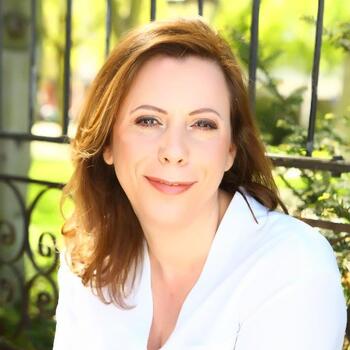


 Farah Al-Nakib (right) and Michael Herb (left)