Authors
News Type
Commentary
Date
Paragraphs

Since the beginning of 2023, many citizens in Israel have taken part in a weekly ritual: street protests.

Most of the demonstrations are aimed at proposals from Prime Minister Benjamin Netanyahu’s administration to reform aspects of Israel’s judicial system, including reducing certain powers held by the Supreme Court to check the power of Israel’s legislative body, the Knesset.

After months of sustained opposition, it appeared that the most controversial proposals would be dropped. In March, Prime Minister Netanyahu announced a pause on the judicial overhaul plan, citing intentions to seek a compromise with dissenting members of the legislature. But in late July, a vote in the Knesset successfully passed a bill which removes the Supreme Court’s ability to invoke the “reasonableness clause,” or a legal tool by which the court can reject decisions or appointments made by the government if they fail to meet a standard of reasonable precedent and function.

This move has set off alarm bells both inside and outside of Israel. The only well-established, functioning democracy in the Middle East, many fear that the country may be heading toward a constitutional crisis.

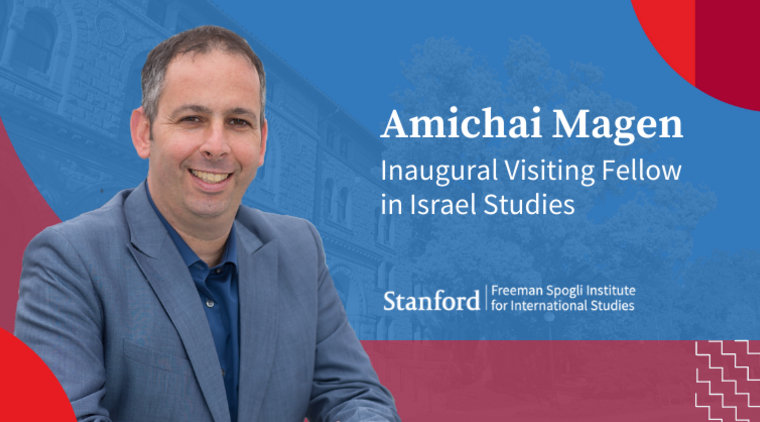
To offer context on the current situation and its implication both for Israel and the broader geopolitical community, Amichai Magen, the inaugural Visiting Fellow in the Israel Visiting Fellows Program at the Freeman Spogli Institute for International Studies, joined Michael McFaul on the World Class podcast

In their conversation, Magen explains some of the cultural and political reasons that led Israel to this point, and offers his analysis of how Israel might move forward.

Listen to the full episode above, or browse highlights from their conversation below. Click here for a transcript of "Understanding Israel's Democracy."


The Paradox of Israeli Democracy


At the heart of the current crisis, says Magen, are unresolved tensions in Israel’s identity as a democratic nation. It has been a democracy since its recognition as an independent state in 1948, and in its 75 years as a nation, pulled off nothing less than a miracle of growth, development, and economic success. In 2022, it was the fastest growing country of the Organization for Economic Co-operation and Development (OECD) nations and entered the top 20 ranking of countries with the highest GDP per capita. Outside of strictly economic statistics, it was also listed as the fourth happiest country on earth, falling in line behind Finland, Denmark and Iceland.

“This is a country that came from very inauspicious circumstances and has not only survived, but thrived as an open and pluralistic society,” Magen told McFaul. “If you and I looked at Israel this time last year, we would be in awe of this country.”

However, there have always been vulnerabilities brewing under the surface of this great success.

Israel has done pretty well by fudging those issues and focusing on mundane bread-and-butter political issues. But we find ourselves confronting a coalition government that today wants to take Israel down a different path.
Amichai Magen
Visiting Scholar

Israel notably lacks a formal, written constitution, and has long relied on what Magen references as “norms and mores” in order to keep the work of government in line with accepted precedent. He explains further:

“Israel has decided not to decide on some of the critical questions that are normally settled in constitutional conventions. We don't have formal rules on separation of church and state. We decided not to decide on whether the ultra-orthodox in Israel should serve in the army or not serve in the army. We decided not to decide what should be the relationship between the Jewish majority and the Arab Israeli minority that makes up 20% of the Israeli population.

“And Israel has done pretty well by fudging those issues, by not bringing them to the fore, and by essentially trying to focus on mundane bread-and-butter political issues. But we find ourselves confronting a coalition government that today wants to take Israel down a different path.” 
 

Learning from the Current Crisis


In the short-term, Magen does not see a short-term fix for the current situation as long as the Netanyahu government remains entrenched. Speaking about the situation in a recent BBC interview, he expressed his fears that the situation “has reached a point where Netanyahu's personal political fortunes are being put ahead of everything else in Israel."

But there are signs of what may lay ahead. Current polling in Israel shows that if national elections were held now, the Netanyahu administration would lose. And the ongoing protests , now nearly eight months long, show the commitment of the demonstrators.

Magen hopes that this current crisis will be a springboard for Israel to finally address some of the issues it has “decided not to decide.” While a singular, decisive constitutional convention would be satisfying, Magen imagines these changes will most likely come as a series of decisions over time.

“At the very least, we need to set in place the procedural rules of the game to make sure that we have stronger guardrails around how we’re going to conduct our national politics,” he explained.

Continuing, he said, “It might happen in one grand bargain, but I think more realistically, we will see a series of incremental changes of finer grained reforms that will try to put in place those guardrails. I think there's going to be quite a lot of pressure for Israelis to move in that direction, and that is the space to watch over the coming months and years.”
 

International Implications


Magen says another important lesson Israel’s current situation has to offer is a comparative lens for other democracies around the world suffering from similar polarization.

“This is not unique to Israel. We've seen something similar happening in places like Holland, Sweden, and Germany. There's something in the air that is driving mistrust and polarization and a collapse in public trust in elected authorities all around the world. And that is something we need to do a better job at understanding,” Magen emphasizes.

Just as authoritarians and populists have their international networks and circles, we really need to strengthen the circles and the networks of support for democracy all around the world.
Amichai Magen
Visiting Scholar in Israel Studies

The implications of Israel’s importance as a democratic cornerstone in the Middle East also shouldn’t be underestimated, says Magen.

“We've managed to make tremendous progress in Middle Eastern peace based on the understanding that Israel's neighbors have that Israel is a powerful, cohesive, and coherent international actor. If that is undermined, then we could find ourselves in a much more precarious regional and international environment with very serious consequences for energy markets and for stability in the Middle East and Europe and beyond,” he warns.

Magen explains that it is critical in this moment for the people of Israel to know that their efforts to protect and preserve democracy in their country is recognized by fellow democrats around the world.

“This is a time when the people of Israel — not only the Israeli government — really need to hear from their friends around the world, including, and I would say first and foremost, in the United States,” says Magen.

It’s a principle that’s applicable not only to the current situation in Israel, but to the global democratic community as a whole, he explains. 

“Just as authoritarians and populists have their international networks and circles, we really need to strengthen the circles and the networks of support for democracy all around the world, including for Israeli democracy,” Magen urges. “And we'd better do it earlier rather than later.”

Read More

Larry Diamond, Or Rabinowitz, Yonatan Eyov, and Amichai Magen in discussion in the Bechtel Conference Center at the Freeman Spogli Institute for International Studies at Stanford University.
News

Visiting Fellows in Israel Studies Program is in Full Swing at FSI

The program aims to foster cross-disciplinary analysis of Israel and its unique position as a regional influence and geopolitical actor.
Visiting Fellows in Israel Studies Program is in Full Swing at FSI
Hero Image
Protestors wave flags as thousands of Israelis attend a rally against Israeli Government's judicial overhaul plan on March 27, 2023 in Jerusalem, Israel.
Protestors wave flags as thousands of Israeli citizens attend a rally against the government's judicial overhaul plan in Jerusalem, Israel.
Getty
All News button
1
Subtitle

Law and governance expert Amichai Magen joins FSI Director Michael McFaul on the World Class podcast to discuss the judicial reforms recently passed by Israel’s legislature, and the implications these have for democracy in Israel and beyond.

Date Label
News Type
News
Date
Paragraphs

The Freeman Spogli Institute for International Studies (FSI) is pleased to announce that Amichai Magen has been selected as the inaugural Visiting Fellow in Israel Studies. Dr. Magen is currently the head of the MA program in Diplomacy and Conflict Studies, and director of the Program on Democratic Resilience & Development at the Lauder School of Government, Diplomacy, and Strategy at Reichman University, in Herzliya, Israel.

As a Visiting Fellow in Israel Studies, Dr. Magen will teach courses on Israeli politics, society, and policy, and also on his recent research regarding liberal orders, governance in areas of limited statehood, and political violence. In addition, he will help guide FSI programming related to Israel, advise and engage Stanford students and faculty.

An alumnus of Stanford Law School, where he obtained his JSD in 2008, he has also been a pre-doctoral scholar at the Center on Democracy, Development, and the Rule of Law (CDDRL) and a National Fellow at the Hoover Institution.

“I’ve had the pleasure of publishing a book with Amichai before, and can attest that he’s a first-rate scholar and academic,” said FSI Director Michael McFaul. “I recall a conversation between us when Amichai was a pre-doctoral fellow at CDDRL, and I told him that once you arrive at Stanford you spend the rest of your life trying to make it back here. I’m delighted that time will come soon.”

The son of refugees from Nazi Germany and Soviet-occupied Latvia, Dr. Magen's scholarship addresses the constitutive elements, vulnerabilities, and evolution of modern liberal political and legal orders – notably statehood, democracy, the rule of law, and regionalism – as well as Israel's place in such orders.

Amichai Magen brings a brilliant scholarly mind, a great love of teaching, and broad expertise on Israeli politics, society, public policy, and regional relations. He's going to contribute greatly to the research work of CDDRL with his expertise.
Larry Diamond
Mosbacher Senior Fellow in Global Democracy at FSI

Dr. Magen’s current research examines limited statehood, governance failures, and political violence in the international system, and his book on the subject is forthcoming from Stanford University Press. During his time at Stanford, Dr. Magen will be based at FSI’s Center on Democracy, Development, and the Rule of Law.

“I am thrilled that CDDRL will have the opportunity to host and welcome back Dr. Amichai Magen,” said Kathryn Stoner, the Mosbacher Director of Center on Democracy, Development, and the Rule of Law. “He was an outstanding contributor to the Center in its earliest days, and I know that he will be an outstanding inaugural Israel Fellow. I look forward to working with him again.”

In addition to his academic duties, Dr. Magen has also served on the executive committee of the World Jewish Congress, and is a board member of the International Coalition for Democratic Renewal, the Israel Council on Foreign Relations, and the Israeli Association for the Study of European Integration. He regularly briefs diplomats, journalists, and academics from around the world on Israeli political, constitutional, and geopolitical affairs.

“I am delighted to return to Stanford and engage with the many talented faculty and students on this unique campus,” said Dr. Magen. “FSI was my intellectual home as a graduate student at Stanford, and a model academic community that has shaped my subsequent career as a researcher and teacher. This is a real homecoming moment for me, and I am deeply grateful to be granted the opportunity to be a part of this wonderful community once again.”

The Visiting Fellow in Israel Studies program was launched in September 2021 with the generous support of Stanford alumni and donors. The search committee was led by Larry Diamond, the Mosbacher Senior Fellow in Global Democracy at FSI, and included other senior fellows from throughout the institute.

“In developing and anchoring the program over the next three years, Amichai Magen will bring a brilliant scholarly mind, a great love of teaching, and broad expertise on Israeli politics, society, public policy, and regional relations,” said Diamond. “In addition, he will contribute greatly to the research work of CDDRL with his expertise on governance crises, limited statehood, and challenges to the liberal international order.”

In addition to Dr. Magen, the Visiting Fellow in Israel Studies program plans to bring a second Israeli visiting fellow to teach and conduct research during the next academic year. Media inquiries about the program can be directed to Ari Chasnoff, FSI’s associate director for communications.

Read More

Nonviolence
News

New Continuing Studies Course on Nonviolence with The World House Project's Clayborne Carson

Enrollment is open now for "Nonviolence and Human Rights in the World House: Realizing Martin Luther King Jr.’s Vision," which will run Thursdays from April 14 through June 2.
New Continuing Studies Course on Nonviolence with The World House Project's Clayborne Carson
Hakeem Jefferson
News

Welcoming Hakeem Jefferson to CDDRL

Jefferson, an assistant professor of political science at Stanford University, will join the center as a faculty affiliate.
Welcoming Hakeem Jefferson to CDDRL
Hero Image
Amichai Magen joins the Freeman Spogli Institute as its inaugural Visiting Fellow in Israel Studies.
Amichai Magen will join the Freeman Spogli Institute as its inaugural Visiting Fellow in Israel Studies in the 2022-23 academic year.
All News button
1
Subtitle

Magen, a scholar of law, government and international relations, will arrive at Stanford in the 2022-2023 academic year.

Date Label
Authors
News Type
Commentary
Date
Paragraphs

[This article originally appeared in Orient XII.]

Political observers have voiced contrasting opinions about the peace treaty between Israel and the Arab Emirates. Some have seen it as a monumental betrayal, others as an historic breakthrough. Actually, the treaty changes nothing in the Middle East political equation, nor does it attenuate in any way the tragic disregard for the rights of the Palestinians which we have witnessed for so many years now. It is simply a strategic arrangement which has short-term advantages for the United Arab Emirates, Israel and the United States but addresses none of the basic issues.

First of all, this peace treaty cannot be regarded as an historic betrayal of Arab positions. The UAE have been working for years to normalize their relations with Israel. The two countries have established high-level contacts in capitals all over the world and have made it known to the international community by organizing their own leaks: they have also sent signals to Western and Arab public opinion. In recent months, the UAE conveyed humanitarian aid to Palestine via the Ben Gurion airport, in co-ordination with Israeli authorities rather than with their Palestinian counterparts. The peace treaty is a normal, organic stage of this process. True, from a legal point of view, it is a decision which goes counter to the Arab peace initiative of 2002. But this latter had already been abandoned just as the Arab League’s sponsorship which went along with it had already been discredited.

At the same, brutal as it may seem, this agreement does not constitute a betrayal of the Palestinians. Their rights have already been sacrificed in the face of Israel’s determination to destroy any prospect of a Palestinian State by laying siege to the Gaza Strip and by gradually annexing the West Bank. The Palestinians have understood that in the Gulf, only Kuwait and Qatar are determined to reject any US sponsored “deal of the century” unless those Israeli policies are abandoned. Though the peace treaty does contain a clause theoretically putting an end to that territorial colonization. It only stops the annexation legally and formally while backing de facto the pursuance of the illegal colonization process.

Nor is the peace treaty an historic breakthrough. The Palestinian struggle has lost much of its political importance in the eyes of the Arab masses during the last three decades. And though it is still capable of sparking an emotional response and remains apolitical issue for Arab public opinion, it generates much less solidarity that it used to do.

DECLINE OF THE PALESTINIAN CAUSE

This decline has taken place in several stages. The first phase began with the Oslo peace process, which obliged the Palestinians to renounce many of their rights in exchange for the vague promise of a future state, meant to be the fruition of a peace process negotiated under the auspices of the international community. The second phase began with the US invasion of Iraq in 2003. By destroying a traditional Arab power, the United States opened the way for Iranian expansion, the new disruptive element in the geopolitics of the region. In the years that followed, Iran considerably extended its strategic power in the Middle East.

Iranian military expansion climaxed in 2013 with the battle of Al-Qusayr in Syria. Before the Syrian civil war began, the UAE and Saudi Arabia, both members of the Sunni axis in the region, faced off against Iran in low intensity clashes in the Gulf area. Al-Qusayr inaugurated a new era in which Iranian military forces could operate openly in Arab countries and provide support for regimes that are their allies. Not only Syria and Iraq, but also Lebanon and Yemen have become arenas of confrontation, fueled as much by sectarian hyperbole as by the principles of realpolitik.

The Sunni Arab states, which form the so-called “moderate” axis in the Middle East, regard such non-governmental actors as Hezbollah, the Houthi movement in Yemen and the militias of the Popular Mobilization Forces in Iraq as auxiliaries in the Iranian war effort. In this context, the containment of Iran comes before the defense of the Palestinians.

The third event which has relegated the Palestinians to the sidelines of regional geopolitics was the Arab Spring. This foregrounded the issues of democratic emancipation and the overthrow of authoritarianism in many countries. The uprisings showed the extent to which the major ideologies of the past, pan-Arabism or its successor, Islamism, had lost much of their emotional appeal with Arab public opinion. Thus, the Palestinian cause became less visible, except in countries hosting large numbers of Palestinian refugees, like Lebanon and Jordan.

Yet while the Palestinians no longer figure high on the foreign policy agenda of most Arab states, the Arab world is certainly not about to plunge headlong into a collective normalization of relations with Israel. The big Arab countries would be likely to meet with strong public resistance. On the other hand, Bahrain, Oman and Mauritania are prepared to follow in the footsteps of the Emirates, and a modest “bandwagon” effect is not out of the question: other Arab countries could become involved in asymmetric exchanges with Israel in order not to be left out of any future settlement and to stay in the good graces of the USA. Short of complete diplomatic recognition, these steps might include the opening of liaison offices and the authorization of bilateral tourism.

For all these reasons, the peace treaty represents neither a tragic betrayal nor an historic breakthrough. From a strategic point of view, it is a calculated move meant only to offer short-term advantages to the three parties concerned.

THE UAE AND THE PRESERVATION OF A COUNTER-REVOLUTIONARY FRONT

From the UAE viewpoint, the treaty allows them to stand firm at a time when the Arab counter-revolution is in difficulty and imperils their reputation. Since the Arab Spring, the Emirates, along with Saudi Arabia, are at the forefront of the region’s countries which regard the propagation of democratic uprisings in the Middle East as an existential threat. The UAE are the leader of this counter-revolutionary front which advocates a Middle East of stable authoritarian regimes in which their petroleum resources guarantee them a decisive influence. According to this world view, electoral Islamism and political liberalism are two sides of the same coin; both represent radical changes which endanger the internal legitimacy of these regimes. It was the UAE that launched the counter-revolutionary battle and they cannot afford to lose it.

Recently, however, they have begun to lose ground. The Yemeni conflict has turned into a humanitarian disaster.

The over-confidence placed in certain factions to carry on their proxy war, as with General Khalifa Haftar in Libya, has not been repaid on the battlefield. As with the unwise embargo against Qatar, their diplomatic adventurism did not achieve its goals. Their investments in Egypt, aimed at making the Abdel Fattah Al-Sisi regime a model of the new Arab stability, have also failed to extricate the country from its political and economic stagnancy. In short, there is too much chaos and considering the initial investment, a rate of return much too low.

Considering all this, the peace treaty with Israel represents a calculated strategic consolidation. The leadership of the UAE hope to use Israel as a more powerful vector to help them achieve their geopolitical objectives, just as they used Saudi Arabia in the first phase of their counter-revolutionary thrust. The UAE are also protecting themselves against another threat: the shock wave that could result from an internal conflict in Saudi Arabia which would neutralise Mohamed Ben Salman. If this were to occur, the UAE leadership would find itself completely isolated.

Thus, the alliance with Israel offers the UAE some degree of protection in view of their common interests. Both countries share a deep hostility towards Iran and reject the nuclear agreement signed by former US President Obama. Both are equally disappointed by President Trump’s refusal to launch a large-scale military campaign against the Iranian forces. The lack of Trump’s military response in July 2019 after the attack on the Saudi Aramco oil facilities was seen as highly significant. And besides, Israel harbors a silent aversion to the democratization of Arab countries.

ISRAEL SAVES FACE

For Israel, the real advantage of this treaty is not economic. The Emirati leadership will make flashy investments in Israel, if only to show the Palestinians what they missed by turning down the “deal of the century”. But at the end of the day, the financial advantages for Israel will be slender. Trade with the UAE will be overshadowed by the existing exchanges with the USA and the West in general, while conversely the oil-rich UAE have no particular need of Israeli investments.

But Israel benefits from the agreement in other ways. First of all, it adds a little more legitimacy to its role in the regional order of the Middle East, even though it does run the risk of being sucked into the impulsive counter-revolutionary actions of its new peace partner.

Above all, however, Israel can go on pulling the strings in the Palestinians situation. Despite the passing mention in the treaty of a halt to the West Bank annexation process, the Netanyahu government considers this to be merely a temporary pause. The “deal of the century,” drawn up by Donald Trump’s entourage having bogged down this year, in view of the international condemnation of the annexation of the Jordan Valley, this new peace treaty provides an ideal opportunity to save face. Actually, no Israeli colony has been dismantled and no land has been returned to the Palestinians. Yet since the annexation plans have been officially suspended, the Palestinian Authority must remain operative as a political player, which preserves the fiction of a peace process in a bilateral framework.

A PUBLICITY OPERATION FOR TRUMP

A treaty like this is grist to the American mill because it is an excellent PR operation at a time when the presidential campaign is in full swing. The agreement can be passed off as a victory for the Trump administration, and the President can score some points as a successful negotiator. The fulfilment of the White House dream of hosting a peace treaty between Israel and an Arab country provides Trump with an excellent diversion to make voters forget his many governance failings in such areas as the coronavirus pandemic, race relations and other domestic issues.

The peace treaty also serves to hide the fiasco of the “deal of the century.” By claiming to have blocked the controversial annexation plans, the US will try to revive this moribund framework. At the same time, it helps Trump prop up his reputation with certain portions of his electorate. It enables the administration to recover a degree of credibility among liberal Jews who aspire to a collective peace in the Middle East while at the same time reassuring rabid Zionists that Israel’s claims to the West Bank are still on the table.

TOWARDS A “PALESTINIAN SPRING”?

In the last analysis, the real losers here are, as usual, the Palestinians. They will keep up their struggle to obtain the constituent elements of a viable state which include the right of return, a capital in East Jerusalem, and the end of Israel’s illegal occupation of their land. While the UAE, Israel and the USA may derive some short-term advantages from this treaty, the long-term future of the Palestinians is still up in the air.

Left at the periphery of the regional power play, the Palestinian struggle needs a fresh uprising. It is to be hoped that it will not take the form of yet another Intifada but rather that of a Palestinian version of the Arab Spring. This would require a rejuvenation of the Palestinian political establishment, the rise to power of a more responsible and better representative leadership, backed by united resistance on the part of Palestinian society as a whole.

This would also require that the Palestinians appeal to the whole rest of the world, not just the Middle East, because international support for a Palestinian State is still extremely high. Today the recovery of their rights by the people of Palestine is probably not linked to the two-state solution which is indeed no longer a viable option but must be sought henceforth in the framework of a single state.

Hero Image
hicham alaoui ls
All News button
1
-

Abstract:  

Image
Arabs and Israelis: Conflict and Peacemaking in the Middle East is a new, ground-breaking textbook on the history of the Arab-Israeli conflict. It is the first on this hyper-sensitive subject to have been team-written by a Palestinian, an Israeli, and an Egyptian representing a broader Arab perspective: The book presents competing narratives that the different parties have developed and adopted with respect to the conflict's various milestones and provides a toolbox for analyzing past, current and future developments in the conflict and in the efforts to resolve it.

At the CDDRL seminar, two of the book's three authors, Shai Feldman and Khalil Shikaki will address the challenges associated with teaching the Arab-Israeli conflict and the manner in which they suggest overcoming these challenges. In addition, they will share what insights they gain from the historical record of the efforts to resolve the Arab-Israeli conflict when assessing the likely prospects of the most recent attempt to end the Palestinian-Israeli conflict, launched and orchestrated by Secretary of State John Kerry. 

Speaker bios:

Image
Shai Feldman is the Judith and Sidney Swartz Director of the Crown Center for Middle East Studies and Professor of Politics at Brandeis University. Prof. Feldman is also a Senior Fellow and a member of the Board of Directors of Harvard University’s Belfer Center for Science and International Affairs where he serves as Co-Chair of the Middle East Security Project. In 1997-2005, he was Head of the Jaffee Center for Strategic Studies at Tel Aviv University and in 2001-2003, he served as a member of the UN Secretary General’s Advisory Board on Disarmament Matters. Educated at the Hebrew University in Jerusalem, Prof. Feldman was awarded his Ph.D. by the University of California at Berkeley in 1980.

Prof. Feldman is the author of numerous publications. These include five books: Israeli Nuclear Deterrence: A Strategy for the 1980s (New York: Columbia University Press, 1982); The Future of U.S.-Israel Strategic Cooperation (Washington D.C.: The Washington Institute for Near East Policy, 1996); Nuclear Weapons and Arms Control in the Middle East (Cambridge: MIT Press, 1997); Bridging the Gap: A Future Security Architecture for the Middle East (Lanham, Maryland: Rowman & Littlefield, 1997 – with Abdullah Toukan (Jordan); and, Track-II Diplomacy: Lessons from the Middle East (Cambridge: MIT Press, 2003 – with Hussein Agha, Ahmad Khalidi, and Zeev Schiff).


Image

Khalil Shikaki is a professor of political science and director of the Palestinian Center for Policy and Survey Research in Ramallah. Since 2005 he has been a senior fellow at the Crown Center for Middle East Studies at Brandeis University. He earned his PhD in Political Science from Columbia University in 1985, and taught at several Palestinian and American universities. Between 1996-99, Prof. Shikaki served as the dean of scientific research at al Najah University in Nablus. Since 1993 he has conducted more than 200 polls among Palestinians in the West Bank and the Gaza Strip and, since 2000, dozens of joint polls among Palestinians and Israelis.

He is the co-author of the annual report of the Arab Democracy Index. His recent publications include “The future of Israel-Palestine: a one-state reality in the making,” NOREF Report, May 2012; "Coping with the Arab Spring; Palestinian Domestic and Regional Ramifications," Middle East Brief, no. 58, Crown Center for Middle East Studies, Brandeis University, December 2011; Public Opinion in the Israeli-Palestinian Conflict: The Public Imperative During the Second Intifada, with Yaacov Shamir, Indiana University Press, 2010.

CISAC Conference Room

Seminars
News Type
Commentary
Date
Paragraphs

When do people perceive themselves to be losing out from international economic integration?  Do these perceptions translate into vote change? Existing literature studies gain and loss from economic integration as a function of its objective material effect and political preferences that follow are assumed to reflect concerns about a broader set of social outcomes that they associate with economic openess, particularly reentment about relative deprivation.

All News button
1

Encina Hall
616 Serra Street
Stanford, CA 94305-6055

0
PHR Assistant
Jessie_headshot.jpg

Following her undergraduate studies in journalism and Spanish at U.C. Berkeley, Brunner spent six years in the professional arena, first as a reporter for the Los Angeles Times and then in public relations/marketing for two nonprofit organizations. She came to Stanford University this fall to undertake her master’s degree in international policy studies, concentrating in global justice. Her professional pursuits have long been coupled with passionate activism in the arenas of human rights advocacy, conflict resolution in Israel, and the Occupied Palestinian Territories, and poverty reduction. Brunner was an active participant in the winter quarter’s Sanela Diana Jenkins Human Rights Speaker Series: The International Criminal Court: The Next Decade. Brunner recently returned from a study trip to Rwanda where she delved into issues of human rights, governance, and economic development through meetings with government officials, NGOs, and the business community.

Subscribe to Israel