News Type
Q&As
Date
Paragraphs

Stanford University’s Center on Democracy, Development and the Rule of Law (CDDRL) is proud to announce our four incoming fellows who will be joining us in the 2016-2017 academic year to develop their research, engage with faculty and tap into our diverse scholarly community. 

The pre- and postdoctoral program will provide fellows the time to focus on research and data analysis as they work to finalize and publish their dissertation research, while connecting with resident faculty and research staff at CDDRL. 

Fellows will present their research during our weekly research seminar series and an array of scholarly events and conferences.

Topics of the incoming cohort include electoral fraud in Russia, how the elite class impacts state power in China, the role of emotions in support for democracy in Zimbabwe, and market institutions in Nigeria. 

Learn more in the Q&A below.


Image
natalia embedded
Natalia Forrat

CDDRL Pre-Doctoral Fellow

Hometown: Tomsk, Russia

Academic Institution: Northwestern University

Discipline and expected date of graduation: Sociology, April 2017

Research Interests: authoritarianism, state capacity, social policy, civil society, trust, Russia and post-communist countries

Dissertation Title: The State that Betrays the Trust: Infrastructural State Power, Public Sector Organizations, and Authoritarian Resilience in Putin's Russia

What attracted you to the CDDRL Pre/post-doctoral program? I study the connection between state capacity and political regimes - the topic that is at the core of many research initiatives at CDDRL. Learning more about this work and receiving feedback for my dissertation will enrich and sharpen my analysis, while helping me to place it into a comparative context. I am looking forward to discussing my work with the faculty who study the post-Soviet region. I also will explore policy implications of my work with the help of policy experts at CDDRL.

What do you hope to accomplish during your nine-month residency at the CDDRL? Besides finishing writing my dissertation, I will workshop three working papers to prepare them for publication. The first one argues that Putin's regime used the school system to administer a large-scale electoral fraud in 2012 presidential elections; the second one shows how the networks of social organizations were used by subnational autocrats to strengthen the regime; and the third one will look at the factors that make the abuse of such organizations more difficult in some regions. In addition to these papers I will continue developing my post-graduation research project exploring the relationship between social trust and distrust, institutions, political competition, and democratization.

Fun fact: I have spent 25 years of my life in Siberia, and I can tell you: Chicago winters are worse!


Image
shelby embedded
Shelby Grossman

CDDRL Postdoctoral Fellow

Hometown: Reading, MA

Academic Institution: Harvard University

Discipline & Graduation Date:  Government, Summer 2016

Research interests: political economy of development, private governance, market institutions, Sub-Saharan Africa, survey methods

Dissertation Title: The Politics of Order in Informal Markets: Evidence from Lagos

What attracted you to the CDDRL post-doctoral program? I was attracted to CDDRL largely for its community of scholars. Affiliated faculty work on the political economy of development and medieval and modern market institutions, topics that are tied to my own interests.

What do you hope to accomplish during your nine-month residency at the CDDRL? I plan to prepare a book manuscript based on my dissertation, a project that explains variation in the provision of pro-trade institutions in private market organizations through the study of physical marketplaces in Nigeria. In addition, I will continue to remotely manage an on-going project in Nigeria (with Meredith Startz) investigating whether reputation alleviates contracting frictions. I also plan to work on submitting to journals a few working papers, including one on the politics of non-compliance with polio vaccination in Nigeria (with Jonathan Phillips and Leah Rosenzweig). 

Fun fact: Contrary to popular belief, not all cheese is vegetarian. I have a website to help people determine if a cheese is vegetarian or not: IsThisCheeseVegetarian.com. 


Image
daniel embedded
Daniel Mattingly

CDDRL Postdoctoral Fellow

Hometown: Oakland, California

Academic Institution: University of California, Berkeley

Discipline & Graduation Date: Political Science, Summer 2016

Research Interests: Governance, rule of law, state building, authoritarian politics, Chinese politics

Dissertation Title: The Social Origins of State Power: Democratic Institutions and Local Elites in China

What attracted you to CDDRL?  The Center has a fantastic community of scholars and practitioners who work on the areas that I'm interested in, including governance and the rule of law. I'm excited to learn from the CDDRL community and participate in the Center's events. The fellowship also provides me with valuable time to finish my book manuscript before I start teaching.

What do you hope to accomplish during your nine-month residency at the CDDRL? While at CDDRL, I plan to prepare my book manuscript and to work on some related projects on local elites and state power in China and elsewhere. 

Fun fact: I grew up on an organic farm in Vermont.


Image
lauren embedded
Lauren E. Young

CDDRL Postdoctoral Fellow

Hometown: Saratoga, CA

Academic Institution: Columbia University 

Discipline & Graduation Date: Political Science (Comparative Politics, Methods), May 2016 (defense), Oct 2016 (degree conferral)

Research Interests: political violence, political economy of development, autocratic persistence, democratization, protest, electoral violence

Dissertation Title: The Psychology of Repression and Dissent in Autocracy

What attracted you to the CDDRL post-doctoral program? As a graduate of the CISAC honors program when I was an undergraduate at Stanford, I have seen first-hand how intellectually stimulating, collaborative, and plugged into policy CDDRL is. While at the center I will be revising my dissertation work on the political psychology of participation in pro-democracy movements in Zimbabwe for submission as a book manuscript, and moving forward new projects that similarly seek to understand how different forms of violence by non-state actors affects citizens' preferences and decision-making. Because of its deep bench of experts on autocracy, narco-trafficking, and insurgency, CDDRL will add enormous value to these projects.

What do you hope to accomplish during your nine-month residency at the CDDRL?  During my fellowship year, my primary goal is to revise my research on Zimbabwe into a book manuscript. I defended my dissertation as three stand-alone articles, including two experiments showing that emotions influence whether opposition supporters in Zimbabwe express their pro-democracy preferences and a descriptive paper showing that repression has a larger effect on the behavior of the poor. To prepare the book manuscript during my fellowship, I will bring in additional quantitative and qualitative descriptive evidence and tie the three papers together into a cohesive argument about how opposition supporters make decisions about participation in protest, why emotions have such a large effect on these decisions, and how this affects variation across individuals and the strategic choices of autocrats and activists.

Fun fact: During my fieldwork I took an overnight train from Victoria Falls to a southern city in Zimbabwe and hitch-hiked into a national park. It got a little nerve-wracking when night started to fall, but ended with  an invitation to a barbecue! 


Hero Image
cddrl fellows 2016 logo
All News button
1
-

Abstract

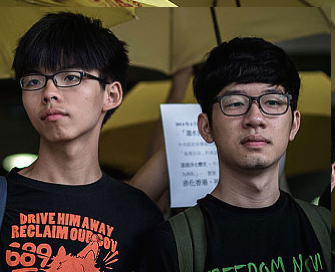
Two student leaders and activists will discuss the new era of Hong Kong's democracy movement with prospects for the future of Hong Kong after 2047.


Speaker Bios 

Image
wl
Joshua Chi-fung Wong (left), 19, founded the Hong Kong student activist group Scholarism,  and is best known for his leadership role among fellow high school students in the Sept-Dec 2014 pro-democracy  Umbrella Movement, a massive protest that demanded genuine universal suffrage for China's Hong Kong Special Administrative Region. Wong first attained popular fame in the highly successful mid-2012 "anti-Brain Washing" campaign against the HKSAR government's introduction of a mandatory "national education" course to all local schools to promote pro-PRC/CCP patriotism. He was named one of TIME Magazine's “Most influential Teens of 2014” and was nominated for TIME's 2014 “Person of The Year”.

Nathan Kwun-chung Law, 22, Is a well-known student leader and organizer in Hong Kong. He is Secretary General of the Hong Kong Federation of Students, having been a Standing Committee member from 2014-15. He participated in the only negotiation session with the Hong Kong SAR government during the Umbrella Movement.

This event is sponsored by the Taiwan Democracy Project in the Center on Democracy, Development, and the Rule of Law. It is free and open to the public. 


Video of event

Post-event interview with Joshua Wong and Nathan Law

CISAC Conference Room

Encina Hall, 2nd Floor

616 Serra Street, Stanford, CA 94305


Joshua Wong Speaker
Nathan Law Speajer
Seminars
Paragraphs

Abstract

I am very happy to have the opportunity to revisit my ideas about Chinese governance, and to offer some speculations about its future. I have written on this subject in my two most recent books, The Origins of Political Order: From Prehuman Times to the French Revolution , and Political Order and Political Decay: From the Industrial Revolution to the Globalization of Democracy.  These books have been widely read in China and have attracted a good deal of comment; they have also produced considerable misunderstanding so I think it is important to clarify some of my judgments about the nature and the future of Chinese government. I will therefore summarize the conceptual framework I have tried to establish, describe how contemporary China fits into it, and then go on to discuss some possible futures for the Chinese political system.
All Publications button
1
Publication Type
Working Papers
Publication Date
Journal Publisher
CDDRL Working Papers
Authors
Francis Fukuyama
-

Abstract

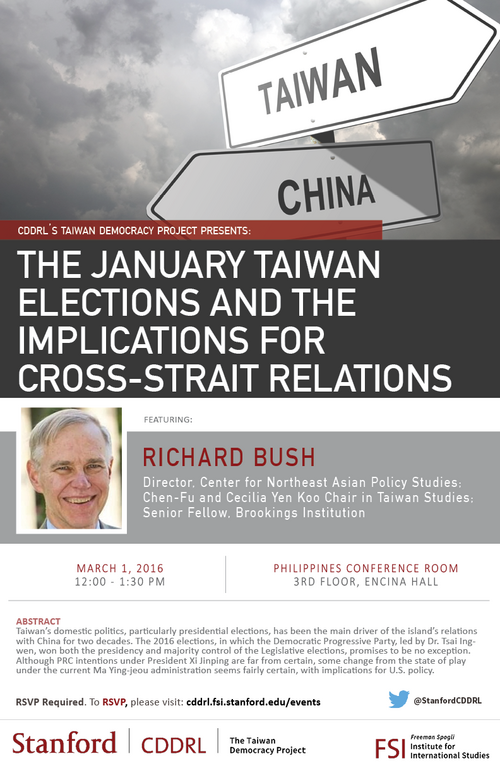
Taiwan’s domestic politics, particularly presidential elections, has been the main driver of the island’s relations with China for two decades. The 2016 elections, in which the Democratic Progressive Party, led by Dr. Tsai Ing-wen, won both the presidency and majority control of the Legislative elections, promises to be no exception. Although PRC intentions under President Xi Jinping are far from certain, some change from the state of play under the current Ma Ying-jeou administration seems fairly certain, with implications for U.S. policy.


Bio

Richard Bush is a Senior Fellow at the Brookings Institution and Director of its Center for Northeast Asian Policy Studies, and the Chen-Fu and Cecilia Yen Koo Chair in Taiwan Studies. He came to Brookings in July 2002 after nineteen years working in the US government, including five years as the Chairman and Managing Director of the American Institute in Taiwan. He is the author of a number of articles on U.S. relations with China and Taiwan, and of At Cross Purposes, a book of essays on the history of America’s relations with Taiwan, published in March 2004 by M. E. Sharpe. In the spring of 2005, Brookings published his study on cross-Strait relations, entitled Untying the Knot: Making Peace in the Taiwan Strait. In 2013, Brookings published his Uncharted Strait: The Future of China-Taiwan Relations.


This talk is co-sponsored by the Taiwan Democracy Project in the Center on Democracy, Development, and the Rule of Law and the U.S.-Asia Security Initiative in the Walter H. Shorenstein Asia-Pacific Research Center.

Image
richard bush taiwan talk flyer


Richard C. Bush Senior Fellow and Director, Center for East Asian Policy Studies Brookings Institution
Seminars
Authors
News Type
Q&As
Date
Paragraphs

In the wake of the recent historic meeting of the leaders of China and Taiwan, the Stanford News Service asked two of the university's Asia experts about the aftermath of that meeting and its possible effects on political relations between the two countries, the military situation and Taiwan's Jan. 16 presidential and parliamentary elections.

The first presidential meeting between the leaders of the communist mainland and the democratic island, split by civil war in 1949, was held in early November on neutral territory in Singapore.

Kharis Templeman is the Taiwan Democracy program manager at Stanford's Center on Democracy, Development, and the Rule of Law at the Freeman Spogli Institute for International Studies. He recently wrote about why Taiwan's defense spending has fallen as China's has risen. Thomas Fingar is a distinguished fellow at Stanford's Walter H. Shorenstein Asia-Pacific Research Center. He served as the chairman of the National Intelligence Council and in other key positions in Washington. 

Do you anticipate any lasting effects from the face-to-face meeting of Chinese leader Xi Jinping and Taiwanese President Ma Ying-jeou?

Thomas Fingar: At a minimum, the meeting appears intended by both sides to validate and lock in the much-improved cross-Taiwan Strait relationship that has evolved over the past several years.

Kharis Templeman: I do think the Ma-Xi meeting itself will have one lasting legacy: it has created a precedent for treating the directly elected president of the Republic of China as an equal and as the rightful representative of Taiwanese interests in cross-strait relations. From now on, leaders in Beijing are going to have a hard time arguing that a non-KMT (the Kuomintang, Taiwan's governing party,) president is illegitimate, as they did during the [former Taiwanese president] Chen Shui-Bian era, or to continue to insist on referring to Taiwan’s leaders as provincial-level officials. So, the next president will come into office somewhat strengthened by that precedent.   

Will the meeting have any effect on the January elections in Taiwan?

Templeman: I don’t think it will make much, if any, difference. Taiwanese public opinion is deeply divided about Ma Ying-Jeou’s meeting with Xi. Ma himself remains quite unpopular, the economy is barely growing, and the KMT presidential candidate remains at least 20 points behind in the polls. There’s little indication that this meeting has shaken up what has been a large and steady lead for DPP (Democratic Progressive Party) presidential candidate Tsai Ing-Wen, and I would be shocked if she didn’t win a comfortable victory in January.

Fingar: Probably not. Beijing seems to have learned that its past attempts to influence elections on Taiwan have been ineffectual or counterproductive, and the meeting is unlikely to change minds or votes on the island. 

How might the elections affect military spending on either sides, or China's aggressive island-building for military bases?

Fingar: The meeting will not have any effect on military spending or the building of artificial islands in the South China Sea, but Beijing may have hoped that agreeing to meet with Ma to demonstrate how "good" the relationship is might persuade Washington not to approve another round of arms sales to Taiwan.  Regardless of who wins the election on Taiwan, the next administration is likely to seek another round of U.S. arms sales in order to prove that it has the support of the United States.

Templeman: The meeting will have no impact on the security balance in the region. Ma reportedly raised the issue of PRC (People's Republic of China) missiles within easy range of Taiwan, but Xi claimed, implausibly, that they were not targeted at Taiwan, and that was the end of it. The broader trends are unchanged: the PRC’s military budget is growing annually by double-digit rates while Taiwan’s remains essentially flat. The consequence is that the PRC’s capacity to take coercive measures against Taiwan continues to expand, even as cross-strait cooperation has been improved and institutionalized.

Dan Stober is at the Stanford News Service.

Hero Image
22655287560 9d34c4bd69 o
Taiwanese President Ma Ying-jeou meets with Chinese President Xi Jinping in Singapore on Nov. 7, 2015.
Flickr/Office of the President Republic of China (Taiwan)
All News button
1
Paragraphs


Over the past 20 years, the military balance between the People’s Republic of China and Taiwan has rapidly shifted. As China’s defense budget has grown annually at double-digit rates, Taiwan’s has shrunk. These trends are puzzling, because China’s rise as a military power poses a serious threat to Taiwan’s security. Existing theories suggest that states will choose one of three strategies when faced with an external threat: bargaining, arming, or allying. Yet for most of this period, Taiwan’s leaders have done none of these things. We explain this apparent paradox as a consequence of Taiwan’s transition to democracy. Democracy has worked in three distinct ways to constrain rises in defense spending: by intensifying popular demands for non-defense spending, introducing additional veto players into the political system, and increasing the incentives of political elites to shift Taiwan’s security burden onto its primary ally, the United States. Together, these domestic political factors have driven a net decline in defense spending despite the rising threat posed by China’s rapid military modernization program. Put simply, in Taiwan the democratization effect has swamped the external threat effect. 


All Publications button
1
Publication Type
Working Papers
Publication Date
Authors
-

Sponsored by the Taiwan Democracy Project and the U.S. Asia Security Initiative at the Asia-Pacific Research Center (APARC)

Abstract

During the recent meeting between PRC President Xi Jinping and Taiwan President Ma Ying-jeou, the “1992 One China Consensus” served as a mutually acceptable paradigm for maintaining “peaceful and stable” conditions across the Taiwan Strait.  For Xi Jinping, the warmth of the visit thinly veiled a message to Taiwan’s leaders and electorate, as well as to onlookers in Washington.  Chinese officials and media clearly link the talks and confirmation of the 1992 Consensus to “the great rejuvenation of the Chinese nation”—a concept that is increasingly unpalatable to many in Taiwan.  Xi hopes to keep DPP presidential candidate Tsai Ing-wen (and perhaps even future KMT leaders) in the 1992 Consensus “box” and to co-opt the U.S. in this effort, but perhaps underestimates the political transformation underway on Taiwan. 

The Xi administration has also hardened its position regarding “core interests” such as Taiwan, embodied in a “bottom line principle” policy directive that eschews compromise.  Although many commentators and most officials across the region have shied away from stating that the PRC and Taiwan are at the crossroads of crisis, the collision of political transformation on Taiwan and the PRC’s “bottom line principle” will challenge the fragile foundations of peaceful cross-Strait co-existence.  Changes in the regional balance of military power brought about by a more muscular People’s Liberation Army compounds the potential for increased friction, providing Beijing with more credible options for coercion and deterrence.

This talk will consider the politics and principles involved in cross-Taiwan Strait relations in light of the upcoming 2016 Taiwan elections and the policies of the Xi Jinping administration; and will discuss some of the possible implications for China’s national security policy, regional stability, and the future of cross-Strait relations.

Bio

Image
Cortez Cooper
Mr. Cortez A. Cooper III joined RAND in April 2009, providing assessments of security challenges across political, military, economic, cultural, and informational arenas for a broad range of U.S. government clients.  Prior to joining RAND, Mr. Cooper was the Director of the East Asia Studies Center for Hicks and Associates, Inc.  He has also served in the U.S. Navy Executive Service as the Senior Analyst for the Joint Intelligence Center Pacific, U.S. Pacific Command.  As the senior intelligence analyst and Asia regional specialist in the Pacific Theater, he advised Pacific Command leadership on trends and developments in the Command’s area of responsibility.  Before his Hawaii assignment, Mr. Cooper was a Senior Analyst with CENTRA Technology, Inc., specializing in Asia-Pacific political-military affairs.  Mr. Cooper’s 20 years of military service included assignments as both an Army Signal Corps Officer and a China Foreign Area Officer.  In addition to numerous military decorations, the Secretary of Defense awarded Mr. Cooper with the Exceptional Civilian Service Award in 2001.

2016 Taiwan Elections and Implications for Cross-Strait and Regional Security
Download pdf
Cortez Cooper Senior International Policy Analyst RAND Corporation
Seminars
-
Abstract 
Based on first-hand participant-observation, this talk will examine the culture, politics, and spatiality of the Sunflower Movement. Taiwan's most significant social movement in decades, the Sunflower Movement not only blocked the passage of a major trade deal with China, but reshaped popular discourse and redirected Taiwan's political and cultural trajectory. It re-energized student and civil society, precipitated the historic defeat of the KMT in the 2014 local elections, and prefigured the DPP's strong position coming into the 2016 presidential and legislative election season.
 
The primary spatial tactic of the Sunflowers-- occupation of a government building-- was so successful that a series of protests in the summer of 2015 by high school students was partly conceived and represented as a "second Sunflower Movement". These students, protesting "China-centric" curriculum changes, attempted to occupy the Ministry of Education building. Thwarted by police, these students settled for the front courtyard, where a Sunflower-style pattern of encampments and performances emerged. While this movement did not galvanize the wider public as dramatically as its predecessor, it did demonstrate the staying power of the Sunflower Movement and its occupation tactics for an even younger cohort of activists.
 
The Sunflower Movement showed that contingent, street-level, grassroots action can have a major impact on Taiwan's cross-Strait policies, and inspired and trained a new generation of youth activists. But with the likely 2016 presidential win of the DPP, which has attempted to draw support from student activists while presenting a less radical vision to mainstream voters, what's in store for the future of Taiwanese student and civic activism? And with strong evidence of growing Taiwanese national identification and pro-independence sentiment, particularly among youth, what's in store for the future of Taiwan's political culture? 
 

Speaker Bio

Ian Rowen in Legislative Yuan Ian Rowen in Taiwan's Legislative Yuan during the Sunflower Student Movement protest.

Ian Rowen is PhD Candidate in Geography at the University of Colorado, Boulder, and recent Visiting Fellow at the European Research Center on Contemporary Taiwan, Academia Sinica’s Institute of Sociology, and Fudan University. He participated in both the Sunflower and Umbrella Movements and has written about them for The Journal of Asian StudiesThe Guardian, and The BBC (Chinese), among other outlets. He has also published about Asian politics and protest in the Annals of the Association of American Geographers (forthcoming) and the Annals of Tourism Research. His PhD research, funded by the US National Science Foundation, the Fulbright Program, and the Taiwan Foundation for Democracy, has focused on the political geography of tourism and protest in China, Taiwan, and Hong Kong. 


Presentation Slides

Ian Rowen Doctoral Candidate University of Colorado Dept of Geography
Seminars
-

In this talk, Wellington Shih will provide a historical and legal overview of the Republic of China’s territorial claims in the South China Sea. He will also review the latest developments in the ongoing dispute between the People’s Republic of China, the ROC on Taiwan, and other claimants in the region, including the Philippines, and discuss the South China Sea Peace Initiative proposed by the administration of President Ma Ying-jeou. 

The Possible Approaches for Defusing Tensions in the South China Sea: A Taiwanese Perspective
Download pdf
Visiting scholar Ministry of Foreign Affairs, Republic of China (Taiwan)
Lectures
Subscribe to China