Authors
News Type
Commentary
Date
Paragraphs

If you had five minutes to speak with the president of the United States, what would you say? That’s the question Michael McFaul, director of the Freeman Spogli Institute for International Studies, posed to FSI scholars at a Stanford 2023 Reunion Homecoming event.

The discussion, “Global Threats Today: What's At Stake and What We Can Do About It,” centered around five major challenges currently facing the world: political dissatisfaction and disillusionment at home, tensions between China and Taiwan, the consequences of climate change, the ongoing war between Russia and Ukraine, and the conflict between Hamas and Israel.

Speaking to each of these areas of concern and how they overlap, FSI scholars Didi Kuo, Larry Diamond, Marshall Burke, Michael McFaul, and Amichai Magen offered their perspectives on what can be done. You can listen to their full conversation on the World Class podcast and browse highlights from their policy ideas below.

Follow the link for a full transcript of "Global Threats: What's at Stake and What We Can Do About It."


Reform the Electoral College |  Didi Kuo


One of the major problems people feel right now in American politics is that their voices aren’t heard. We live in what my colleague Francis Fukuyama calls a "vetocracy," meaning there are a lot of veto points in our system.

In a lot of other democratic institutional configurations, you have rule by the majority. But in the United States, we have an institutional configuration that allows a very small group — for example, 15 people in the House of Representatives — to hold up government in various ways. We see this in dramatic examples on the national level, but it also trickles down to the local level where you see it in issues like permitting hold-ups.

Reforming the Electoral College would be a very direct way of changing that vetocracy. The United States is one of the only advanced democracies that has this indirect system of elections. If all the votes counted equally and all the presidential candidates had to treat all of us the same and respond to us equally in all 50 states, it would do a lot to show the power of the popular vote and realign us more closely to the principle of majoritarianism that we should seek in our institutions.

Didi Kuo

Didi Kuo

Center Fellow at the Freeman Spogli Institute
Full Profile


Allow Taiwan to License Weapons Production |  Larry Diamond


My recommendation is deterrence, deterrence, deterrence. It is not inevitable that the People's Republic of China is going to launch an all-out military assault on Taiwan. But if the United States does not do more to make that a costly decision, the likelihood it will happen are exponentially higher.

Deterrence works. The United States deterred the Soviet Union from moving against West Berlin and much of Europe for decades. But it only works if you have a superior force.

To that end, the United States needs to pre-position more military force in the region. There's now a $12 billion backlog of weapons that Taiwan has ordered and paid for but hasn't received yet. That’s because the American defense production system is completely broken. This is the same reason why we can’t get weapons to Ukraine at the pace we need there.

This issue could be fixed, at least in part, if we licensed the production of some of these weapon systems directly to Taiwan. Their ability to build plants and produce these systems is much more agile than our own, and so licensing the rights to production would dramatically increase the deterrence factor against China, in addition to deepening our cooperation with allies throughout the region.

Professor Larry Diamond

Larry Diamond

Mosbacher Senior Fellow in Global Democracy at FSI
Full Profile


Pursue Climate Mitigation AND Adaptation |  Marshall Burke


There are three things we can do in response to climate change: we can mitigate, we can adapt, or we can suffer. We’re off to a good start, but we have decades of long slog ahead of us to get that right. And it's not just us; even if we do a good job, we depend on other countries to also do a good job. The Biden administration has already been engaged on some of that front, but there’s more work to do there.

And even with our best efforts, we are not going to be able to move as fast as we want or mitigate our greenhouse gas emissions as quickly as we need to avoid climate change. So, we're going to have to live with some climate change, which means adaptation. And if we can't adapt, then we're going to suffer. 

The key point is that we are very poorly adapted to today's climate, much less the climate we're going to have 30 or 50 years from now. The West Coast and California are prime examples of this. There have been monumental wildfire seasons there the last few years, and there are significant negative health impacts from smoke exposure. I see it in my own home, even as someone who studies this and should know better and do more to reduce those risks.

The point is, we're really poorly adapted to the current climate, and things are going to get a lot worse. We need to focus on mitigation; it’s still really important and we need to get it done. But at the same time, we need to figure out how to adapt and live with the changing climate that we're going to experience.

Marshall Burke

Marshall Burke

Deputy Director of the Center on Food Security and the Environment
Full Profile


Weapons for Ukraine, Sanctions on Russia |  Michael McFaul


When I was in Kyiv this September, I had a chance to meet with President Zelenskyy, and he pointed out an absolutely crazy reality. Companies in the United States and Europe are still making tens of thousands of dollars in profits from selling various technologies that ultimately end up in Russia. It’s getting in through places like Hong Kong and Kazakhstan and Belarus and Georgia, and it allows Russia to keep waging its horrific war.

At the same time, the United States is spending millions of dollars to arm Ukraine with systems to shoot down the Russian rockets that were built using the components they got from the West. That’s completely illogical, bad policy. I know it’s hard to control technology, but we have to find a better way than what we’re doing right now. If you're an American taxpayer, that is your money being wasted.

That means more and better weapons for Ukraine, faster. And that means more and better sanctions on Russia, faster. That is the way to speed the end of this war.

Michael McFaul

Michael McFaul

Director of the Freeman Spogli Institute
Full Profile


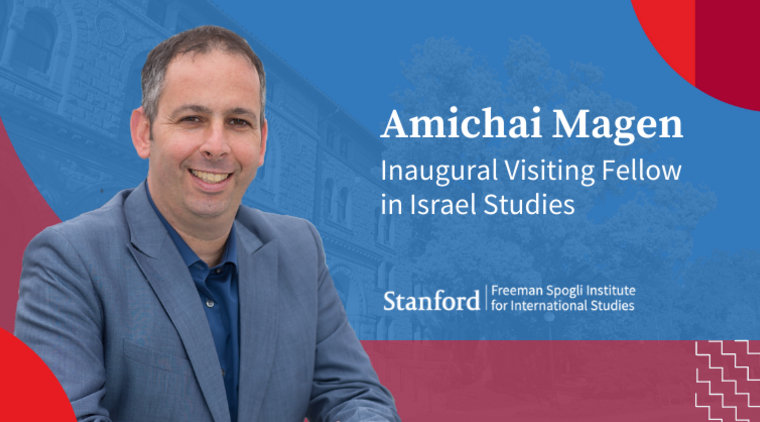
Be Confident in America |  Amichai Magen


Just a few short years ago, we were all talking about the decline of the United States. I think that is far from inevitable. People speak about the 20th century as the “American Century.” The 21st century can also be the American Century. It's in our hands.

Be bullish on America. Be confident in America. Rediscover the spirit of America for adaptation and innovation and entrepreneurship. We need to wake up from the break we’ve taken from history in the post-Cold War era and rally once again in our spirit, our research, and our intellect.

We need to find new solution structures to the great challenges of our era: environmental challenges, AI, biotechnological challenges, nuclear challenges. And we can do it. China is on the verge of demographic decline and economic decline. Russia is a very dangerous international actor, but it is not a global superpower. We must reinvent the institutions and the alliances that we need for the 21st century in order to make sure that we continue a journey towards greater peace and prosperity for all of mankind.

Amichai Magen

Amichai Magen

Visiting Fellow in Israel Studies at the Freeman Spogli Institute
Full Profile


The entire discussion, including the audience Q&A, is available to watch on FSI's YouTube channel. To stay up to date on our content, be sure to like, subscribe, and turn on notifications.

Read More

Family and friends of May Naim, 24, who was murdered by Palestinians militants at the "Supernova" festival, near the Israeli border with Gaza strip, react during her funeral on October 11, 2023 in Gan Haim, Israel. (Getty Images)
News

FSI Scholars Analyze Implications of Hamas’ Terror Attack on Israel

Larry Diamond moderated a discussion between Ori Rabinowitz, Amichai Magen and Abbas Milani on the effects of Hamas’ attacks on Israel and what the emerging conflict means for Israel and Middle Eastern geopolitics.
FSI Scholars Analyze Implications of Hamas’ Terror Attack on Israel
Michael McFaul poses with a Stanford University flag in front of a group of Ukrainian alumni during a reunion dinner in Kyiv.
Blogs

On the Ground in Ukraine: A Report from Michael McFaul and Francis Fukuyama

A trip to Kyiv gave FSI Director Michael McFaul and Olivier Nomellini Senior Fellow Francis Fukuyama the opportunity to meet with policymakers, military experts, and Ukrainian alumni of FSI's programs and fellowships.
On the Ground in Ukraine: A Report from Michael McFaul and Francis Fukuyama
Democracy Day 2023 light up marquee letters
News

Democracy Day sweeps Stanford

Thousands turned out for the student-run, campuswide event, which has grown significantly since launching in 2021.
Democracy Day sweeps Stanford
Hero Image
Amichai Magen, Marshall Burke, Didi Kuo, Larry Diamond, and Michael McFaul onstage for a panel discussion at Stanford's 2023 Reunion and Homecoming
Melissa Morgan
All News button
1
Subtitle

FSI scholars offer their thoughts on what can be done to address political polarization in the United States, tensions between Taiwan and China, climate change, the war in Ukraine, and the Israel-Hamas war.

Date Label
Paragraphs

Using a feminist perspective, this chapter focuses on two factors that bring China and Turkey together: the transnationalization of domestic repression and patriarchal authoritarian policies and offers a multi-perspective analysis, which looks at the state of the strategic partnership between two countries not only in terms of economic and security relations but also its effects on different groups marginalized by these two regimes. By applying the insights from a theoretical perspective that questions the masculine constructions of power, the chapter argues that the strengthening connections between China and Turkey under presidents Xi and Erdoğan increase the capacity of both authoritarian regimes to constrain and marginalize its dissident and vulnerable groups as well as women. The chapter concludes that while the partnership between China and Turkey promotes state elites’ interests, it also facilitates human rights violations and anti-democratic practices.

All Publications button
1
Publication Type
Book Chapters
Publication Date
Subtitle

Chapter in One Hundred Years of Turkish Foreign Policy (1923-2023), eds. Binnur Özkeçeci-Taner and Sinem Akgül Açıkmeşe. Part of the Global Foreign Policy Studies book series (GFPS).

Authors
Ayça Alemdaroğlu
Book Publisher
Palgrave Macmillan, Cham
Authors
Rachel Owens
News Type
News
Date
Paragraphs

As part of the Center on Democracy, Development and the Rule of Law’s Fall 2023 Research Seminar series, University of Southern California Political Scientists, Hoover Fellows, and CDDRL affiliated scholars Erin Baggot Carter and Brett Carter presented findings from their latest book Propaganda in Autocracies: Institutions, Information, and the Politics of Belief (Cambridge University Press, 2023). The book offers unique insight into how and why autocratic regimes use propaganda.

Under authoritarian regimes with “non-binding electoral constraints,” the authors explained, the goal of propaganda is to intimidate citizens and convey the idea that the regime can survive without their support. Propaganda in this context also makes the consequences of dissent common knowledge, thereby saving the regime the cost of actual repression. 

As for regimes with binding electoral constraints, their use of propaganda is often aimed at creating a semblance of credibility with a view to enhancing the functioning of future messaging. This involves mixing fact and fiction by exploiting the infrequent provision of public goods and occasionally conceding policy failures. The latter can sometimes prove damaging to the regime since it may contribute to future protests and unrest. 

The data compiled and analyzed by the Carters in this book constitute the world’s largest dataset on propaganda in autocracies, comprising 80 newspapers from 70 countries. Based on extensive coding and computational linguistics techniques, the authors used the coverage of about 8 million articles to build several measures of pro-regime propaganda.

Book on table
Propaganda in Autocracies: Institutions, Information, and the Politics of Belief (Cambridge University Press, 2023). | Rachel Cody Owens

Propaganda in Autocracies is full of novel findings on how repressive governments approach propaganda. For example, the book challenges conventional wisdom that the Chinese Communist Party’s (CCP) propaganda is actually persuasive to its citizens. Using an innovative list experiment, they found no evidence that citizens’ beliefs were swayed by propaganda, although exposure to propaganda can reduce people’s propensity to protest by cueing fear. 

By analyzing propaganda trends over time, the book brings to light the CCP’s strategies of control during anniversaries of pro-democracy events. For most such anniversaries, regime propaganda remained the same. Yet, for salient anniversaries, like that of the Tiananmen Square massacre, the regime propped up its propaganda messaging. The authors found that repression against the ethnic Uygurs is often more heavily broadcasted, possibly to showcase the regime’s repressive power.

Hero Image
Brett Carter and Erin Baggot Carter present their new book during CDDRL's Fall 2023 Research Seminar Series
Brett Carter and Erin Baggot Carter present their new book during CDDRL's Fall 2023 Research Seminar Series.
Rachel Cody Owens
All News button
1
Subtitle

Erin Baggot Carter and Brett Carter discuss their new book in the Center on Democracy, Development and the Rule of Law’s weekly research seminar.

Date Label
Authors
Nora Sulots
News Type
Q&As
Date
Paragraphs

The Belt and Road Initiative (BRI), launched by China in 2013, is a sweeping and ambitious development strategy aimed at enhancing global connectivity through the construction of extensive infrastructure networks across Asia, Europe, Africa, and beyond. While heralded as a potential catalyst for economic growth and cooperation, the BRI has also attracted a spectrum of criticisms. Concerns range from worries about the debt burdens placed on participating countries due to large-scale infrastructure investments to questions about transparency in project agreements and financing terms. Additionally, the initiative's geopolitical implications, potential environmental impacts, and uneven distribution of benefits have sparked debates about its long-term viability and impact on recipient nations.

CDDRL researchers Francis Fukuyama, the Olivier Nomellini Senior Fellow at the Freeman Spogli Institute for International Studies (FSI), and Michael Bennon, a research scholar and program manager for CDDRL’s Global Infrastructure Policy Research Initiative, have written widely about BRI’s challenges. Their latest essay, “China’s Road to Ruin: The Real Toll of Beijing’s Belt and Road,” published today in the September/October issue of Foreign Affairs, explores the current state of the BRI, the challenges it has created, and the reforms needed to protect the World Bank and International Monetary Fund (IMF) from the fallout of the BRI debt crisis.

Below, Fukuyama and Bennon share their insights on the potential implications of the BRI on global development finance, as well as suggestions for reforms that could bolster the ability of international financial institutions to manage any potential debt crises arising from these projects.

What are the key factors contributing to the risk of debt crises stemming from the Belt and Road Initiative? How significant is this risk in your assessment?


It is clear that fears from a few years ago about China using “debt trap diplomacy” to gain access to strategic assets were overblown. The real problem is that poorly conceived Chinese projects have created a new round of sovereign debt crises for developing countries and put the burden of resolving them on international institutions like the IMF. This diverts time and resources away from activities that would contribute to the long-term development of many poor countries.

Assessments of the current emerging markets debt crisis have tended to focus on the amount of BRI debt that exists in aggregate or for a particular country since it is such a large initiative. A much more important factor is transparency regarding the debts associated with BRI projects and the key terms of those debts. Without considerable transparency efforts, loans to large infrastructure projects are naturally opaque. They include many contingent liabilities for borrowing governments. These are liabilities that may be the responsibility of the borrowing government if they materialize. A lack of transparency over BRI debt also undermines the trust needed when a restructuring is necessary if other lenders become concerned that other “hidden” bilateral debts are not participating. So a key difference is not simply the debt crisis itself but the lack of trust among key bilateral lenders.

The real problem is that poorly conceived Chinese projects have created a new round of sovereign debt crises for developing countries and put the burden of resolving them on international institutions like the IMF.
Francis Fukuyama and Michael Bennon

How have the dynamics of global development finance changed with the emergence of large-scale initiatives like the BRI? What challenges does this pose to established financial institutions such as the World Bank and the IMF?


The BRI has impacted the World Bank and the IMF in very different ways. For the World Bank, it simply represents a very viable alternative for countries in need of bilateral loans for large infrastructure projects. For decades, the World Bank has developed and improved its Environmental and Social safeguards for infrastructure projects. These are intended to improve project outcomes, but they also clearly impose costs in funding and project delays for borrowers. With the emergence of the BRI, borrowers had an alternative source of financing without the World Bank’s same safeguards.

For the IMF, the challenge is clearly on assisting countries in credit distress and managing the restructuring process, and this has been playing out over the last few years. The IMF has developed programs to lend into and then “referee” debt restructurings in the past, but the present situation is very unique both financially and geopolitically.

Are there lessons that can be drawn from historical cases of emerging market debt crises that could inform strategies to prevent or manage such crises in the context of the BRI?


Historically the best “solution” for an emerging market debt crisis is a fast, deep restructuring that gives the distressed borrower the headroom to resume economic growth. That is the opposite of what is happening for the initial restructurings in the current emerging market debt crisis. There is very little trust among lenders, and those restructurings that have been negotiated have been underwhelming. Geopolitically speaking, the emerging market debt crisis currently underway is a bit unique.

Hero Image
Construction on a building in Sri Lanka
COLOMBO, SRI LANKA - NOVEMBER 13: Construction is underway for the Ritz Carlton and the JW Marriott hotels, which is a Chinese-managed project seen on November 13, 2018, in Colombo, Sri Lanka.
Paula Bronstein/Getty Images
All News button
1
Subtitle

Francis Fukuyama and Michael Bennon share their insights on the potential implications of the Belt and Road Initiative (BRI) on global development finance, as well as suggestions for reforms that could bolster international stakeholders’ ability to manage any potential debt crises arising from BRI projects.

Paragraphs
Silicon Triangle report cover

Silicon Triangle draws on the deliberations of a multidisciplinary expert working group to contemplate the dynamic global supply chain in semiconductors—one in which US industry faces growing vulnerabilities, China aggressively promotes home-grown semiconductor mastery, and Taiwan finds itself with a crucial monopoly on high-end logic chips sought by buyers globally.

All Publications button
1
Publication Type
Reports
Publication Date
Subtitle

A joint report of the Hoover Institution and the Asia Society Center on U.S.-China Relations.

Authors
Larry Diamond
Book Publisher
Hoover Institution Press
Paragraphs

Many autocrats govern with an in-group, whose support must be secured, and an out-group, which is subject to repression. How do autocrats exploit in-group/out-group dynamics to secure their survival? One strategy, we argue, is to broadcast out-group repression to the in-group as a signal of the regime’s capacity for violence. Empirically, we focus on China, where the government represses ethnic Uyghurs in Xinjiang. Drawing on 1 million articles from six propaganda newspapers, we show that the regime broadcasts out-group repression to urban elites on each anniversary of the 1989 Tiananmen Square massacre, when 10% of Beijing residents joined anti-regime protests. To understand its effects, we conducted a survey experiment balanced on the national census during the June 2020 Tiananmen anniversary. Using a list experiment to mitigate preference falsification, we show that CCP propaganda about Uyghurs during the Tiananmen anniversary discourages protests among politically engaged urban elites because they fear repression.

All Publications button
1
Publication Type
Journal Articles
Publication Date
Journal Publisher
Journal of Conflict Resolution
Authors
Erin Baggott Carter
Brett Carter
Number
0
0
CDDRL Honors Student, 2023-24
isabelle_coloma.jpg

Major: International Relations
Minor: Translation Studies and Economics
Hometown: Walnut Creek, CA
Thesis Advisor: Christine Wotipka

Tentative Thesis Title: “A Chicken Coop without a Door?” Investigating Civic Education in the Hong Kong Context

Future aspirations post-Stanford: Looking towards post-grad, I intend to (1) pursue graduate studies in international policy and law and (2) explore how academia and policymaking can more effectively inform each other. As I consider the US Foreign Service or human rights NGO work as a future career, I ultimately aim to ground my future work (whatever that may be!) in public service, community engagement, and within the international affairs space.

A fun fact about yourself: After my study abroad in HK, seal engraving has become a new hobby of mine!

0
CDDRL Honors Student, 2023-24
michael_alisky.jpg

Major: BA International Relations, MA International Policy
Minor: Computer Science
Hometown: Aurora, CO
Thesis Advisor: Scott Rozelle

Tentative Thesis Title: Education, Migration, and Citizenship in Rural China

Future aspirations post-Stanford: I might just keep coaching speech and debate. Diplomacy, academia, and international policymaking would also be cool. I'd also love to work at an Ethiopian restaurant.

A fun fact about yourself: I keep a Quizlet of pretentious vocabulary words.

Authors
News Type
News
Date
Paragraphs

From June 23 to 25, the world watched as Yevgeny Prigozhin, head of the private militia Wagner Group, ordered his fighters to  seize the military headquarters in the Russian city of Rostov-on-Don, demanded the resignation of Defense Minister Sergei Shoigu and Chief of General Staff Valeriy Gerasimov, and advanced his forces toward  Moscow.

The rebellion posed the most significant threat to President Vladimir Putin’s power in his 23-year tenure as Russia’s leader. While the mutiny was abruptly called off following a deal brokered by Belarusian president Aleksandr Lukashenko, the effects continue to reverberate throughout Russia, Eastern Europe, and beyond.

Much is still unknown about the mutiny, Prigozhin’s exile in Belarus, and internal disputes within the Kremlin. But long-time Putin watchers and Russia experts agree that the events of the weekend have significantly weakened Putin’s image as an authoritarian strongman and sole commander of Russia.  

Below, scholars from the Freeman Spogli Institute for International Studies offer their analysis of how the mutiny may impact Russia, Putin’s power, and the war in Ukraine.


Ongoing Problems for Putin

Kathryn Stoner

Writing in Journal of Democracy, Kathryn Stoner, the Mosbacher DIrector of the Center on Democracy, Development, and the Rule of Law, explains how the rebellion is both a symptom and cause of Putin’s instability as a leader:

“Putin’s rule relies on individual loyalties rather than institutionalized, transparent chains of command and responsibility. This allows him to retain unrivaled control over a hierarchy of patron-client relationships and to change policies quickly before any real internal elite opposition can coalesce. But the result of such a system is that it operates at the mercy of shifting loyalties and is therefore inherently fragile. The Prigozhin rebellion, therefore, is a symptom of this latent instability within Putinism.”

Stoner, who has written previously about the conditions that lead to regime changes in autocracies, offered her insights in The Atlantic on how Putin might try to recoup from the embarrassment caused by the rebellion:  

“What does all of this tell us about what might now be going on in Russia and how Putin might pursue the war in Ukraine going forward? While to us Putin may look weak and ineffective, he will undoubtedly use his control over the Russian media to pin the rebellion on Ukraine, NATO, and Russia’s other enemies. He may even take credit for avoiding mass casualties in a civil war by making a deal with Prigozhin. Spinning the story as best he can, Putin himself will survive, although his carefully crafted myth of competence will be damaged. Over time, this might erode elite confidence, although it is unlikely to result in an open coup attempt anytime soon.”

Stoner believes that there is “much still to learn about all that has transpired,” but that one thing is certain: Putin’s ill-considered war in Ukraine has weakened his grip on Russia.

“Although this is not the end of the war or of Putin,” she says, “the Wagner rebellion might yet prove the beginning of the end of both.”

Kathryn Stoner

Kathryn Stoner

Mosbacher Director of the Center on Democracy, Development, and the Rule of Law (CDDRL)
Full Profile


Impacts on Russia, Ukraine, and Beyond

Michael McFaul

The implications of the 72-hour mutiny will last much longer and extend much further beyond Rostov and Moscow, says FSI Director and former U.S. ambassador to Russia Michael McFaul.

Speaking with Madeline Brand of KRCW, McFaul outlined the difficult situation Putin now finds himself in.

“This whole series of events has made Putin look a lot weaker than he looked three or four days ago. The very fact that the Wagner group exists is a sign of weakness. Putin needs them because he couldn’t rely on his armed forces.”

Elaborating further on Putin’s dilemma, McFaul says:

“As those mercenaries were getting closer to Moscow, Putin went on TV and sounded very macho, calling Prigozhin’s men traitors and promising to crush them, but then four hours later, he capitulates and starts to negotiate. And now he’s given another speech where it sounds like he’s pleading with these mercenaries to lay down their weapons and join the Russian forces. That clearly shows he hasn’t resolved this Wagner crisis yet.”

McFaul predicts that Putin’s remaining partners are also taking note of his fumbled reaction to the rebellion.

“​​If you’re Xi Jinping watching this, the big bet you made on Putin as a partner in opposing the West is looking really problematic right now.”

What Chinese officials fear most, McFaul explained to MSNBC’s Jonathn Capehart, is instability and dissolution, both internally and amongst their neighbors. Historically, the collapse of the Soviet Union was a catastrophic event for Chinese Communist Party officials, and a lesson the current leadership is loath to repeat.

McFaul asserts that, “The longer Putin’s war in Ukraine goes, the more probable it becomes that Russia becomes more unstable. The longer this war goes on, the more likely it is we could see something like this play out over and over again. So I would hope that Xi Jinping understands that putting pressure on Putin to end the war in Ukraine is the best way to prevent chaos on China's borders.”

There are also important lessons the United States and its allies need to consider when evaluating the kind of support they are willing to give Ukraine as the war wears on.

“Putin capitulated very fast, and I think that says a lot about how he’s going to fight in Ukraine and whether he needs an ‘off ramp’ like we’ve been saying. We’ve heard all of these arguments that if he’s backed into a corner he’ll never negotiate. Well, this weekend Putin was in a corner, and he didn't double down. He didn't escalate. He negotiated,” McFaul observes.

Continuing this thought on his Substack, McFaul emphasized that, “The lesson for the war in Ukraine is clear. Putin is more likely to negotiate and end his war if he is losing on the battlefield, not when there is a stalemate. Those who have argued that Ukraine must not attack Crimea for fear of triggering escalation must now reevaluate that hypothesis. The sooner Putin fears he is losing the war, the faster he will negotiate.”

Or, as McFaul writes in Journal on Democracy, “Anything that weakens Putin is good for Ukraine. It is as simple as that.”  

Michael McFaul Headshot

Michael McFaul

Director of the Freeman Spogli Institute for International Studies
Full Profile


Fallout on Nuclear Security and Norms

Rose Gottemoeller

Throughout the full-scale invasion of Ukraine, there have been concerns about nuclear sabre rattling by Putin and Kremlin-backed propagandists. Writing in the Financial Times, Rose Gottemoeller, the Steven C. Házy Lecturer at CISAC and former Deputy Secretary of NATO offered this insight:

“The fixation with nuclear apocalypse seems to be the symptom of a wider anxiety that the west is bent on Russian dismemberment because of its aspirations in Ukraine. The Kremlin argues that it only wanted to resume its ancestral right to a Slavic heartland, but that the U.S. and NATO are seeking as punishment Russia’s full and complete destruction as a nation state.”

Gottemoeller has been quick to condemn Putin’s casual threats of nuclear use and clear in her recommendations to the U.S. administration and its allies to find constructive ways to keep nuclear arms talks open despite the war in Ukraine and setbacks like Russia’s suspension of its participation in the New START Treaty.

The Wagner takeover of Rostov-on-Don adds a new layer to the security concerns surrounding Russia’s nuclear posture. Looking at the evolution of Putin’s nuclear rhetoric over the last 18 months, Gottemoeller writes:

“Putin embraced nuclear weapons to keep the United States and its NATO allies off his back and out of his way as he pursued his adventure in Ukraine. It did not work out that way. The United States and NATO were not ready to fight inside Ukraine, but they were willing to do everything else to support Kyiv’s cause — economic, political, security and military assistance to ensure Russia’s defeat. Nuclear weapons failed Putin as a guarantee against external meddling.”

Turning to the events of the last week, Gottemoeller continues:

“We learned on June 24 that they are no help to him internally, either. He could not brandish nuclear weapons in the face of the Wagner Group uprising . . . Nuclear weapons are not the authoritarian’s silver bullet when his power is strained to the breaking point — far from it. In fact, they represent a consummate threat to national and global security if they should fall into the wrong hands in the course of domestic unrest.”

In light of Prigozhin’s mutiny, she urges global leaders to “focus on the problem, stop loose nuclear talk, and put new measures in place to protect, control and account for nuclear weapons and the fissile material that go into them.” 

Woman smiling

Rose Gottemoeller

Steven C. Házy Lecturer at the Center for International Security and Cooperation (CISAC)
Full Profile


The Unknown Unknowns of the Settlement

Steven Pifer

Major questions remain about the deal struck between Putin, Prigozhin, and Lukashenko. While Lukashenko has confirmed that the Wagner boss is now in Belarusian territory, it is unclear — and many feel, unlikely — that he will stay there in quiet retirement. 

Weighing in on Twitter, Steven Pifer, an affiliate at the Center for International Cooperation and Security and The Europe Center, and a former U.S. Ambassador to Ukraine, acknowledged, “We likely do not know all carrots and/or sticks that were in play to lead to Prigozhin’s decision to end his mutiny . . . Something does not add up.”

Following up in Politico, Pifer added:

“The ‘settlement’ supposedly brokered by President Alexander Lukashenko of Belarus leaves Putin, who was invisible during the day except for a short morning TV broadcast, as damaged goods. It provided the impression that all was forgiven, likely because the Russian president feared the prospect of Prigozhin’s troops parading in Moscow — even if they lacked the numbers to take control of the capital. It is harder to understand Prigozhin. His demands went unmet, yet he ordered his troops back to garrison, accepted that they might join the Russian army that he detests, and meekly set off for Belarus. There clearly is more behind this ‘settlement’ than we understand.”

Man smiling

Steven Pifer

Affiliate at the Center for International Security and Cooperation and The Europe Center
Full Profile

Understanding Russia and the War in Ukraine

For more commentary and analysis from FSI scholars about the war in Ukraine and events in Russia, follow the link to our resources page, ‘Russia’s Invasion of Ukraine’

Read More

Michael McFaul moderates a panel with Oleksiy Honcharuk, Serhiy Leshchenko, Oleksandra Matviichuk, Oleksandra Ustinova on the one-year anniversary of the full-scale invasion of Ukraine.
News

Ukraine’s Fight for Democracy, One Year In

To commemorate the first year of the full-scale invasion of Ukraine, Ukrainian leaders joined a panel hosted by the Freeman Spogli Institute for International Studies to express their hopes for victory and their gratitude for Western support.
Ukraine’s Fight for Democracy, One Year In
Hero Image
Crew onboard a 'Terminator' tank support fighting vehicle during a Victory Day military parade in Red Square marking the 75th anniversary of the victory in World War II, on June 24, 2020 in Moscow, Russia.
Getty
All News button
1
Subtitle

Scholars at the Freeman Spogli Institute for International Studies offer insight on what Yevgeny Prigozhin’s mutiny may signal about Russia, Putin’s power, and the war in Ukraine.

Date Label
Authors
News Type
News
Date
Paragraphs

Despite their many differences, Taiwan and Ukraine have been portrayed as two fronts in a global struggle between democracy and authoritarianism. The interrelations between the two geopolitical flashpoints took center stage at the recent Yomiuri International Conference, Taiwan and Ukraine: Challenging Authoritarianism. Cohosted by APARC’s Japan Program, the Yomiuri Shimbun, and the Asia Pacific Initiative, the conference was held on January 16, 2023 at the International House of Japan (IHJ) in Tokyo. It examined paths to addressing autocratic challenges to democracy and offered recommendations for coordinated deterrence in the Indo-Pacific region by the United States and its allies.

The forum included two sessions with Freeman Spogli Institute (FSI) experts. The first session, moderated by Ken Jimbo, IHJ managing director and API president, featured panelists Oriana Skylar Mastro, FSI center fellow at APARC, and Michael McFaul, the director of FSI. They examined the fallout of the war in Ukraine, the risks of a Taiwan crisis, and their implications for security in East Asia, including Japan. The second session, moderated by Kiyoteru Tsutsui, the deputy director of APARC and director of the Japan Program, featured panelists Larry Diamond, Mosbacher Senior Fellow in Global Democracy at FSI, and Francis Fukuyama, Olivier Nomellini Senior Fellow at FSI. They considered the war in Ukraine and the tensions over Taiwan against the struggle to bolster the liberal international order.


Sign up for APARC newsletters to receive our experts' updates


Military Miscalculations, Economic Dislocations

McFaul opened the first session by reviewing some of the lessons from the war in Ukraine. The international community underestimated the Ukrainian military, he said. Putin, however, miscalculated the response of the United States and NATO, on the military side, and the scope of the sanctions the global community of democratic states, including Japan, would be willing to impose on Russia, on the economic side. 

It turned out, noted McFaul, that it was possible to reduce drastically Russian oil and gas coming into Europe, and Russia today has significantly fewer resources to fight Ukraine than it had anticipated. “I think it is very important to look at just how much economic dislocation happened with Russia, a country that was not integrated into the global economic world in the same way that China is,” McFaul said. He pointed out that the international community might also be underestimating the political pressure and dislocation that will erupt if, unprovoked, China invades Taiwan. “It will have very deep economic consequences for the Chinese economy,” said McFaul.

It is important to remember that the international community did not make credible commitments to deterring Russia before 2022, McFaul noted. In the case of China, he emphasized the imperative of considering concrete ways to enhance deterrence against a Chinese invasion of Taiwan before military action begins. 

Rethinking Defense and Deterrence

China, however, is not easily deterrable, as Mastro explained in her following remarks. President Xi has been clear from early on that enhancing China’s role on the international stage would be a key part of the Chinese Communist Party’s agenda. Taiwan is a top priority issue in the Chinese Communist Party’s long-term thinking, said Mastro. She reminded the audience that at the recent CCP Congress, President Xi reaffirmed that China will not rule out using force to bring Taiwan under its control. He also elevated Party members with extensive expertise in the joint operational domain and with Taiwan contingencies to the Central Military Commission, the Chinese top decision-making body for military affairs.

I am convinced that if Japan were to commit to fighting with the United States in this contingency, that would be enough to deter China.
Oriana Skylar Mastro

How, then should the United States and its allies approach the question of deterring China? Mastro emphasized three conditions that U.S and Japanese defense policy must meet.

First, whatever the United States and Japan do in the defense realm must have an operational impact. For example, U.S. carriers will do nothing to prevent China from taking Taiwan in a wartime scenario, Mastro argued. “And along those lines, from the Japanese point of view, enhancing defense of the Senkaku Islands does nothing to deter China from taking Taiwan unless Japanese operations are going to be involved directly in stopping a Chinese invasion of Taiwan.”

The second condition is that China has to know about any defense changes the U.S. and its allies are making. For instance, if, in peacetime, there is no indication that the Japanese military is engaging in Taiwan Strait transits with the United States and the Chinese do not know about such activities, then they do not enhance deterrence.

Third, deterrence must happen before a war starts. It may seem an obvious point, but if the prevalent view is that, for example, the Japanese public will support the United States once a conflict over Taiwan erupts, then this approach does not deter China. “We have to let the Chinese know now that there is such support,” Mastro stated.

One issue China is concerned about, Mastro noted, is widening a Taiwan contingency. “China only wins Taiwan if the war is short, geographically limited to Taiwan, and only involves the United States, potentially in Taiwan,” she explained. “So I am convinced that if Japan were to commit to fighting with the United States in this contingency, that would be enough to deter China.”

Ultimately, the question before the United States and its allies is: “Do we want a happy China that is undeterred or an unhappy China that's deterred,” Mastro concluded. “Those are our only two options.” Deterrence is expensive and requires tradeoffs, but one thing that is costlier than deterrence is a major war, she emphasized.

“Let’s start thinking about how to actually change the environment with the sense of urgency that we need, because my biggest fear is that we're going to find ourselves in a major war with massive cost,” she urged the audience. There will be sacrifices to make, but the alternative, in Mastro's view, is worse.

Opportunities and Perils for Democracy

In the second session of the conference, panelists Larry Diamond and Francis Fukuyama examined the war in Ukraine and the tensions over Taiwan from the lens of democratic decline and its implications for the liberal international order.

Democracy has been in a global recession for most of the last two decades, yet the picture is not as bleak for democracies as it was just two or three years ago, said Diamond. In the United States, reforms at the state level have occurred, election deniers took control of Congress seats by a much smaller margin than predicted before the 2022 midterms, and extreme election deniers in crucial swing states were virtually defeated. Meanwhile, on the international stage, 2022 spotlighted autocrats’ inevitable shortcomings. In Russia, Putin has catastrophically miscalculated the war in Ukraine. In China, Xi has massively mismanaged the COVID pandemic, and the country’s economic growth is severely impaired.

It's going to be very important that the people of Taiwan see that they're not alone, that the democracies of the world — not just the United States and Japan but Australia and Europe — are with them; it will increase their will to fight.
Larry Diamond

Fukuyama said he was encouraged by the democratic solidarity shown in response to the war in Ukraine, especially in Europe, within NATO, and in Japan. Germany’s and Japan’s decisions to increase their defense budgets have been remarkably reassuring signals of strength among democracies, he noted.

But we sometimes forget that many countries in the Global South and elsewhere do not buy into this narrative, cautioned Fukuyama. Among the big disappointments in this regard is India, he stated, which raises the question of whether the issue at stake is indeed a battle between democracy and authoritarianism.

Indeed, democracies still face intractable challenges, Diamond explained. These include the corrupting influence of dirty money around the world, the trends of de-industrialization and hollowing out of the working class in advanced democracies, and social media, which Diamond sees as the single biggest driver of democratic decline. “I cannot tell you how much damage social media has done to destroy the social fabric of Truth and credibility and polarize society into tribal camps who don't have the same facts,” he said. “We have not found a way to temper that impact and win the battle For Truth.”

Taiwan and Deterrence

When it comes to the question of Taiwan, Diamond says he is worried. “There is going to be a PRC military invasion of Taiwan, probably in this decade, unless it is deterred,” he said. The three most crucial actors in deterring China are Taiwan, the United States, and Japan, he explained. Successful deterrence must involve coordination among all three in multiple arenas — from military cooperation to increased defense capacity and preparedness to impose such heavy costs in response to a Chinese invading force that will change Xi’s calculus.

Diamond observed that democracy is about uncertainty, of which there is now plenty in Taiwan as it looks ahead to a January 2024 contentious presidential election. Diamond’s prediction is that "China will intervene however it thinks it can” in Taiwan’s upcoming presidential election, as Xi would certainly prefer to pick up the island peacefully than by force, he said. “I think it's going to be very important that the people of Taiwan see that they're not alone, that the democracies of the world — not just the United States and Japan but Australia and Europe — are with them; it will increase their will to fight.”

Read More

Gi-Wook Shin and Francis Fukuyama at Encina Hall, Stanford, in conversation.
Q&As

A Resurgence of Democracy?

A Conversation with Francis Fukuyama on the Challenges of a Changing Global Order
A Resurgence of Democracy?
Hero Image
Michael McFaul, Oriana Skylar Mastro, Ken Jimbo, Kiyoteru Tsutsui, Larry Diamond, and Francis Fukuyama speaking at the Yomiuri Conference, Tokyo.
All News button
1
Subtitle

At the Yomiuri International Conference, Freeman Spogli Institute scholars Larry Diamond, Francis Fukuyama, Oriana Skylar Mastro, Michael McFaul, and Kiyoteru Tsutsui examined lessons from the war in Ukraine, the risks of a crisis over Taiwan, and the impacts of both geopolitical flashpoints for defending democracy and for a coordinated approach to deterrence in the Indo-Pacific.

Subscribe to China