International Cooperation and Coordination: The European Challenge to Combating and Preventing Human Trafficking
Some twelve years after the unveiling of the UN Anti-Trafficking Protocol in 2000, most European countries have sound anti-trafficking legislation. Worldwide, while many countries amend their legislation and policies, they follow practice developed, applied and tested in Western Europe. Some of these practices consider national and international coordination and cooperation for an effective anti-trafficking policy. However, notwithstanding the progress European countries have made, within Europe, governments have not been able to coordinate and develop a comprehensive and multi-pronged approach to render criminal networks of human trafficking inoperative. Why? The authors suggest that different definitions of human trafficking and variations in criminal law, the existing national security and state sovereignty framework, as well as lack of training and proactive investigation combine to facilitate corruption and limit successful prosecutions, convictions and international cooperation.
What the Greek elections mean for Europe’s future
Greece's recent elections failed to produce a parliamentary majority, leaving the political system fragmented and the economy on the brink of collapse. A fresh round of voting is scheduled for June 17 amidst skepticism that Greece may withdraw from the eurozone and default on its debt. Like French voters who elected a new president this month, Greeks are railing against harsh austerity measures and the European model of economic liberalism.
CDDRL Visiting Scholar Ruby Gropas is now in Athens as a lecturer at the Democritus University of Thrace and research fellow at the Hellenic Foundation for European and Foreign Policy where she researches trends of protest and opposition to Europe. During this pivotal moment in European history, Gropas interprets the election results and what they mean for the future of Greece and the EU.
Was the outcome of the Greek election a surprise to you?
It was not a surprise, but an unpleasant acknowledgement of a grim reality. The messages and trends had been clear for awhile. It is only the intensity of the results that shocked political analysts, politicians and even citizens both in Greece and the world over.
How has the Greek political system and society been affected by this election?
The political system has imploded. The two main governing parties are severely weakened, beaten, punished, defied and delegitimized, leaving the political scene more fragmented than ever. The election plunged the country into even further political and economic uncertainty as 50 percent of the votes cast were in support of parties from both the left and right that reject the terms of the bailout and denounce the associated austerity policies.
Politics and society have become polarized once more along a new political cleavage that is formulated as pro or anti-bailout positions. Severe austerity policies against a background of poor governance, corruption scandals, economic mismanagement, and growing economic insecurity have pushed the electorate to vote for the extremes.
What can we expect from the run-off elections?
Given that all attempts at creating a coalition government of one form or another failed, two very different dilemmas are put to the electorate. The centrist parties are declaring that the conditions of the bailout cannot be denounced. But they are suggesting that that there is room for adjustment through negotiation with our European partners.
The parties opposing the conditions of the ‘Solidarity Pact’ refute this, arguing that the choice put to voters next month is about ending austerity. Regardless of what position one takes, forthcoming elections are essentially a referendum for or against Greece’s European future.
What do the election results in Greece and France mean for Europe and the future of the eurozone?
In Greece, the vote was a call for anti-austerity agendas and programs aimed towards Brussels, Berlin, and Frankfurt (the European Central Bank seat), just as much as its own politicians. The election results have led to an outburst of declarations and scenarios claiming that Greece’s exit from the eurozone is now inevitable and even more claims that a ‘Grexit’ is by no means an option. Continued instability and uncertainty – combined with volatile markets – are sending ripples across the entire eurozone, testing the limits of European solidarity and most likely the endurance of the euro.
French President François Hollande’s victory has given hope to those wishing to revisit the 'Merkozy' austerity program and envision a new role for the European Central Bank.
Do you think these developments will incentivize political change in the EU?
They already have. Yet much more is needed. What is clear now is that the current state of Europe and the eurozone's political integration are neither sustainable nor a viable pattern for the future. There has long been a disconnect between Europe’s political elites and its citizens and for too long the academic and public debate has stressed the need to bridge this disconnect. It is now imperative to organize politics in Europe and give the eurozone a political framework to generate the policy consensus that it needs to address current and future challenges.
What is the message the European voter is sending through the ballot box?
The core messages are “Yes to Europe," but "No to this kind of Europe.” These election results have shown that severe austerity politics are not working and that citizens are calling – in some cases demanding – for a change of politics. More strikingly, they have also highlighted that discontented citizens who feel marginalized, ignored and insecure turn to extreme right-wing nationalist and xenophobic forces. These are the same forces that the entire project of European integration aimed at eradicating over half a century ago.
Is there a silver lining to recent events in Europe?
European citizens have returned to politics and are driven by a desire to provoke change in the EU. The eurozone crisis has transformed the political debate in more EU member states on ‘European’ matters and on what sort of politics and policies need to be pursued at the EU level. This is crucial for the development of a long-aspired transnational political space within and across the EU, and a greater politicization of Europe.
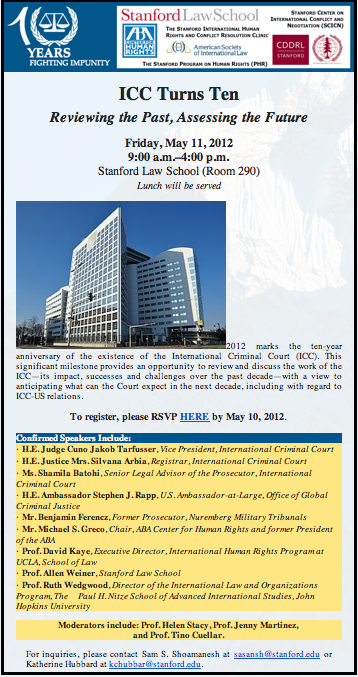
ICC Turns Ten: Reviewing the Past, Assessing the Future
Stanford Law School (Room 290)
Democracy Against the Odds
Michael Aagaard Seeberg is a CDDRL visiting researcher in winter and spring 2012, while researching on his PhD project titled “Democracy Against the Odds”. He expects to obtain his PhD from Aarhus University, Denmark in the fall 2013.
Speaker Bio:
Michael Seeberg’s PhD project seek to understand the emergence of stable (though minimalist) democracy in a number of countries despite low levels of modernization, lack of democratic neighboring countries and other factors consistently related to democratic stability in the literature. Cases in point are Ghana, India, Mauritius and Mongolia. The study of deviant democracies can give us some leverage in understanding the determinants of democracy – determinants that have not really been uncovered yet. Current accounts stress the absence of ‘damaging factors’ as decisive for the successful emergence of democracy. With the project, Michael Seeberg hope to refine existing explanations of democratization while, on the other hand identify the positive drivers that also contributed to new stable democracies. The overall aim is to build a foundation for a better understanding of why some regime changes result in stable democracies whereas others are stuck as hybrid regimes or return to the set of outright autocracies.
Prior to his PhD studies, Michael Seeberg has been a visiting scholar at the University of Washington, Seattle, assistant attaché at the Danish Mission to the United Nations in New York, and a visiting scholar at the Danish Institute for International Studies in Copenhagen, Denmark. He holds an MSc in political science from Aarhus University. Concurrently with his PhD studies, Michael Seeberg is engaged in the Scouts in Denmark, where he is a member of the executive board at the YMCA Scouts, and member of the Steering Committee for the Project supporting Guiding and Scouting in Eastern and Central Europe.
Encina Ground Floor Conference Room
Michael A. Seeberg
Encina Hall
616 Serra Street
Stanford, CA 94305-6055
Michael Aagaard Seeberg is a CDDRL visiting researcher in winter and spring 2012, while researching on his PhD project titled “Democracy Against the Odds”. He expects to obtain his PhD from Aarhus University, Denmark in the fall 2013.
Michael Seeberg’s PhD project seek to understand the emergence of stable (though minimalist) democracy in a number of countries despite low levels of modernization, lack of democratic neighboring countries and other factors consistently related to democratic stability in the literature. Cases in point are Ghana, India, Mauritius and Mongolia. The study of deviant democracies can give us some leverage in understanding the determinants of democracy – determinants that have not really been uncovered yet. Current accounts stress the absence of ‘damaging factors’ as decisive for the successful emergence of democracy. With the project, Michael Seeberg hope to refine existing explanations of democratization while, on the other hand identify the positive drivers that also contributed to new stable democracies. The overall aim is to build a foundation for a better understanding of why some regime changes result in stable democracies whereas others are stuck as hybrid regimes or return to the set of outright autocracies.
Prior to his PhD studies, Michael Seeberg has been a visiting scholar at the University of Washington, Seattle, assistant attaché at the Danish Mission to the United Nations in New York, and a visiting scholar at the Danish Institute for International Studies in Copenhagen, Denmark. He holds an MSc in political science from Aarhus University. Concurrently with his PhD studies, Michael Seeberg is engaged in the Scouts in Denmark, where he is a member of the executive board at the YMCA Scouts, and member of the Steering Committee for the Project supporting Guiding and Scouting in Eastern and Central Europe.
Publications
-
"Mongolian Miracles and Central Asian Disappointments: Nomadic Culture, Clan Politics and the 16. Soviet Republic”, Politica, 2009, 41(3): 315-330.
Restoring Democracy and Peace in Mali
On March 22, a military coup abruptly ended two decades of uninterrupted democracy in Mali, the well-reputed West African country and key counter-terrorism partner of the United States. The coup leader Army Captain Amadou Sanogo and his mutinous troops suspended the 1992 democratic constitution, took over the presidential palace, the state television and several institutions, arrested members of the government, and promised a more efficient fight against Tuareg rebels. Interruption of the Malian democracy by a belligerent military faction is a serious threat to stability, peace, and human rights given the domestic context.
Since the coup, the conflict with the Tuareg rebels has continued to worsen. The two main Tuareg groups — the National Movement for the Liberation of Azawad (MNLA) and Islamist Ansar Dine — have gained ground and seized new territories in the north of the country, pushing for sharia law. If a domestic solution is not found quickly, African regional organizations and the international community should act in concert with Malian democratic defenders - either diplomatically or coercively - to restore democracy and peace, and stop rebel progression before it is too lateAfrican regional organizations and the international community should act in concert with Malian democratic defenders — either diplomatically or coercively — to restore democracy and peace, and stop rebel progression before it is too late.
The Coup in Mali: Who is Behind it and Why?
Plotters deposed the widely respected and democratically elected President Amadou Toumani Touré, a little over a month before the scheduled presidential election on April 29. Coup leader Captain Sanogo justified the unconstitutional seizure of power under the guise of national security, accusing President Touré of inefficiently fighting the decades-old Tuareg rebellion, and not providing enough resources to the army.
However, given the electoral timing, reasons advanced by Captain Sanogo to justify the coup are illogical. President Touré was not a candidate in the 2012 presidential election, and had just over a month left in his second and last term in office. As a visionary leader, he respected the unique Malian societal and political culture, improved governance, and put the country on a path to sustainable economic growth. Therefore, it is not surprising that Freedom House has continued over the past two decades to classify Mali as a democratic regime — whether electoral or liberal — despite several challenges such as; weak public institutions and central government, poverty, aid dependency, the Tuareg separatist rebellion, and labor or social unrests. The coup leader’s argument is further weakened because the democratic Malian government was offering public space to potentially unsatisfied military personnel to negotiate within the constitutional framework, along with the option to openly discuss issues of concern with presidential candidates.
The Coup is Reinvigorating Fear of a Repressive Military Regime
The coup is reinvigorating fear of the resurgence of repressive rule that reigned for decades after successive military coups. Such repressive rule must be prevented. In 1968, Lieutenant Moussa Traoré ousted the civilian government, eight years after Mali gained its independence from France. Because he was resistant to democratic changes, Traoré was ousted in 1991 by Amadou Toumani Touré in the face of widespread civil unrest and demands for greater political rights and democratic reforms.
In 1991, the Transitional Committee for the Salvation of the People (CTSP) was formed by various groups representing civil society and under the supervision of Amadou Toumani Touré. The Committee organized successful political liberalization, which included; a national conference, a constitutional referendum, a founding election won by President Alpha Oumar Konaré (1992-2002), and consequently a democratic transition in 1992. Many hope that twenty years of democratic developments are not eradicated by this coup. Captain Sanogo still has the window of opportunity to respect the Malian values and people, and end his rule, as requested by the people.
The Devastating Consequences of the Coup in Mali and Africa
The coup has significant implications on the political developments in Mali, West Africa and the African continent. It weakens the already fragile democratic institutions, and calls into question the solidity of the unique political culture, visionary leadership, and the subordination of the military to the executive that were considered by many as the foundation of Malian democracy.The coup weakens the already fragile democratic institutions, and calls into question the solidity of the unique political culture, visionary leadership, and the subordination of the military to the executive that were considered by many as the foundation of Malian democracy. In addition, it worsened the situation in the north of the country, with rebel militias controlling more towns than before the coup. The coup has consequently increased the risk of disproportionate use of force, potentially leading to more violent and deadly conflicts threatening minority groups in Mali, with negative consequences for the entire West African region.
The coup also gives reasons — not necessarily valid — to citizens and pessimistic observers to despair about the prospect of democracy in West Africa. The spirit of democracy has recently been challenged in countries such as Cote d’Ivoire, Senegal, Mauritania, Guinea and Guinea-Bissau. If most plotters manage to stay in power, Africa may face a resurgence of military coup plots, reviving the violent nightmare of the two last decades of the twentieth century.
Malian and International Reactions to the Coup
Malian domestic leadership and the international community have all taken serious steps towards returning the country to civilian rule and restoring the democratic system. Malian political and civil society leaders have clearly shown deep opposition to the rupture of the constitutional order, and they have requested return to the rule of law. They are peacefully demonstrating to avoid violence and to preserve national unity. On March 28, the ousted President Touré called for a consensual solution and told French Radio station RFI "what is important is democracy, institutions, and Mali." In the same vein, the international community has strongly condemned the coup, applied some diplomatic sanctions, and requested a return to an elected civilian government.
The U.N. Secretary General has called for immediate restoration of constitutional rule, and the U.N. Security Council echoed a similar sentiment by calling for "the restoration of constitutional order and the holding of elections as previously scheduled." The Economic Community of West African States (ECOWAS) reiterated its policy of “zero tolerance” for unconstitutional seizures of power, organized high-level meetings with heads of state to persuade the junta to step-down, readied its stand-by forces, and placed an economic embargo on Mali.
The African Union immediately suspended the membership of Mali until constitutional rule is restored, and the U.S. paused military aid to Mali and urged rebels to end fighting. France has suspended its official cooperation with Mali, but maintained humanitarian aid and is pushing the U.N. Security Council to explore avenues to support ECOWAS in their efforts to restore order. Canada, the African Development Bank, the European Union, and the World Bank have all suspended their aid. These diplomatic actions, especially from ECOWAS, have pressured the junta to announce (formally but not yet effectively) the restoration of the 1992 constitution on April 1, a few days after unconstitutionally promulgating a new one. Further actions should be made in a timely manner to pressure the junta to step-down, to ensure that power is transferred back to civilian rule and constitutional order restored.
Restoring democracy and peace in Mali — diplomatically or coercively — is imperative. It will send a strong warning to those who try to undermine democratic efforts that unconstitutional appropriation of power and threats to peace and security will not be tolerated. Citizens will also be shown that they are supported in their battle for democracy and peace.
Historic summit to convene leaders of the new Middle East at Stanford
From the Arab Spring to the Occupy Wall Street movement, young people have emerged at the helm of citizen-led change, opposing and challenging the status quo. Recognizing their local and global impact, youth are increasingly stepping up to fulfill Gandhi's famous maxim: "Be the change you want to see in the world." In turn, they are encouraging other members of their generation to answer this call to duty. In the aftermath of revolutions across the Middle East and North Africa (MENA), youth have never been more engaged and active in the future development of their communities.
Inspired by these events, a group of young Stanford students launched a forum to unite leaders from the MENA region with their Western counterparts to build a bridge towards greater understanding, collaboration, and partnership. Nothing of this scale had ever been done on the Stanford campus, and there was a clear demand from the student body for deeper engagement with the region.
It was in this spirit that the American Middle Eastern Network for Dialogue at Stanford (AMENDS) was born, which will host its inaugural conference at Stanford University April 10 to 14, 2012 to convene exceptional young leaders together to share their ideas, seed potential collaborations and inspire the world. The AMENDS team represents a diverse group of students of various nationalities, faiths, and persuasions, but the common thread that connects them all is a desire to interact with the future generation of leaders who are writing a new chapter in the history of the Middle East.
AMENDS seeks to take a step forward towards greater partnership with a post-Arab Spring generation of leaders in the Middle East. -AMENDS co-founders Elliot Stoller and Khaled AlShawi
Co-founders Elliot Stoller (BA '13) and Khaled AlShawi (BA '13), hailing from Chicago and Bahrain respectively, were inspired to start a project devoted to U.S.-MENA relations largely in response to events surrounding the Arab Spring, “The problems addressed through the uprisings transcend a single country or region. They affect us all and require global collaboration to solve. AMENDS seeks to take a step forward towards greater partnership with a post-Arab Spring generation of leaders in the Middle East. ”
Within a year of launching the initiative, the AMENDS team received applications from over 300 promising delegates, organized a four-day summit, and launched an ambitious fundraising campaign to cover the costs of such an endeavor. Described by AMENDS senior leadership as a "full-time job" on top of their demanding academic schedules, this grassroots operation is fueled by the entrepreneurial energy of a band of passionate and dedicated student volunteers. AMENDS has benefited from the consultation of a board of advisors comprised of Stanford faculty and staff from the Center on Democracy, Development, and the Rule of Law (CDDRL), the Freeman Spogli Institute for International Studies, and the Hamid and Christina Moghadam Program in Iranian Studies.
According to Larry Diamond, CDDRL director and member of the AMENDS advisory board, "It has been a pleasure working with the AMENDS team on the design and implementation of this innovative project — the first of its kind — to convene a new generation of leaders in the U.S. and the Middle East at Stanford University."
AMENDS delegates hail from 17 countries and together represent students and young professionals leading projects driven by the ingenuity of the new Middle East.
AMENDS delegates hail from 17 countries and together represent students and young professionals leading projects driven by the ingenuity of the new Middle East. While many of their projects are still in their initial stages of development, the AMENDS conference and network is intended to provide leadership training and peer support to help scale-up these initiatives. A mentorship program pairs delegates with professionals, development practitioners, and industry leaders for tailored advice and support.
AMENDS delegates are as diverse as the issues they are confronting in the Middle East, North America, and the United Kingdom. Several AMENDS delegates are leveraging the use of new technology and social media to unite civil society, stimulate public debate, introduce alternative energy resources, and promote citizen-led journalism. In Egypt, Morocco, and Palestine, delegates are members of youth movements at the forefront of the Arab Spring revolutions and are championing new approaches for political change. Others are working in their local communities to defend the rights of HIV/AIDS patients in Egypt, support children with disabilities in Canada, and empower uninsured MENA immigrants in the U.S. Many projects share the common goal of getting more youth engaged and active in their local communities to achieve broader societal goals.
Over a five-day period, delegates will deliver ten-minute "AMENDS Talks" styled after TEDTalksTM, where they will introduce their initiatives to the larger Stanford community. The videos will be recorded and available through an online forum — in both Arabic and English — giving delegates’ a global platform to share their ideas, inspiring others to take action. Delegates will also participate in leadership development workshops at the Stanford Graduate School for Business and networking events sponsored by AMENDS strategic partner TechWadi, a Silicon Valley-based organization fostering high-tech entrepreneurial development in the Arab world.
Notable scholars and practitioners from the U.S. and the MENA region will provide unique insight and analysis to some of the timeliest topics emerging from the region. Speakers include Sami Ben Gharbia, Tunisian political activist and a Foreign Policy Top 100 Thinker; Thomas T. Riley, former U.S. ambassador to Morocco; and Rami Khouri, director of the Issam Fares Institute for Public Policy and International Affairs at the American University of Beirut.
CDDRL faculty and staff will also be leading sessions and addressing the AMENDS delegates at the summit, including CDDRL Director Larry Diamond, CDDRL Consulting Professor and AMENDS Advisory Board Member Prince Hicham Ben Abdallah, Arab Reform and Democracy Program Manager Lina Khatib, and Moroccan journalist and CDDRL Visiting Scholar Ahmed Benchemsi.
Most AMENDS Talks and sessions are open to the Stanford community and general public. For more information on AMENDS, to read about the 2012 delegates, and to view the conference agenda, please visit: amends.stanford.edu.
The Tortuous Trajectories of Democracy and the Persistence of Authoritarianism in Africa
Abstract:
The "spirit of democracy" has recently been undermined in several African countries as authoritarian methods have been the preferred approach. In countries such as Kenya, Zimbabwe, Cote d'Ivoire, Niger and Gabon political change has come through the following means; military interventions ousting former presidents clinging to power after their terms; violently repressed popular unrests leading to power-sharing solutions, or former presidents being replaced by their sons. In few countries such as Guinea, free elections were organized after several decades of dictatorship.
In this seminar, CDDRL Post-Doctoral Fellow Landry Signé will examine what makes certain countries adopt and consolidate liberal or electoral democracies when others stay authoritarian - whether competitive, hegemonic or politically closed. Signé will analyze the transformations of political regimes and democratization in the 48 Sub-Saharan African countries over the two last decades contrasting various political trajectories, comparing results between successful and failed countries, and exploring the conditions that create, maintain and sustain democracies.
Speaker Bio:
Landry Signé is a recipient of the 2011-2013 Banting Postdoctoral Fellowship Award from the Social Sciences and Humanities Research Council of Canada hosted by the Center on Democracy, Development and the Rule of Law at Stanford University. He is working on a project entitled “The Efficiency of the Political Responses to the Global Financial and Economic Crisis in Africa: Does the Political Regime and Economic Structure Matter?”. He completed his PhD in Political Science (2010), with the Award of Excellence, at the University of Montreal, and has been bestowed the Award for Best International PhD Dissertation of 2011 by the Center for International Studies and Research (CÉRIUM). His dissertation is entitled “Political Innovation: The Role of the International, Regional and National Actors in the Economic Development of Africa”.
Prior to joining the CDDRL, Dr. Signé was a visiting scholar at the Stanford Center on African Studies, lecturer on Emerging African Markets: Strategies, Investments and Government Affairs at the Stanford Continuing Studies, founding president of a Canadian corporation specialized in public affairs and business development, part-time professor and lecturer in political science at Ottawa University and the University of Montreal, administrator at the United Nations Association of Canada-Greater Montréal, and president of the Political Commission of Montreal-CJ. He has worked or interned at the United Nations Department of Political Affairs, the Senate of France, the National Assembly of Cameroon, and the French Distributor, Casino Group. He studied Political Science, International Relations, Communication and Business at the University of Montreal, Lyon 3 University, Sciences Po Paris, Sandar Institute, Stanford Continuing Studies, and McGill University.
Reuben W. Hills Conference Room
Landry Signé
Not in Residence
Professor Landry Signé is a distinguished fellow at Stanford University’s Center for African Studies, founding chairman of the award-winning Global Network for Africa’s Prosperity, special adviser to world leaders on international and African affairs, full professor and senior adviser on international affairs to the chancellor and provost at UAA, and partner and chief strategist at a small African-focused emerging markets strategic management, investment, and government affairs firm. He has been recognized as a World Economic Forum’s Young Global Leader, Andrew Carnegie fellow as one of the “most creative thinkers,” Woodrow Wilson Public Policy fellow, JCI Ten Outstanding Young Persons in the World, Private Investors for Africa Fellow, and Tutu Fellow who “drives the transformation of Africa,” among others. Previously, Landry was founding president of a business strategy and development firm based in Montreal and a visiting scholar at the University of Oxford. He has also served on the board of organizations such as AMPION Catalyst for Entrepreneurship and Innovation in Africa, Citizens Governance Initiative, and the United Nations Association of Canada–Montreal, and was appointed by a United Nations Under-Secretary-General to serve on the Global Network on Digital Technologies for Sustainable Urbanization. He is the author of numerous key academic and policy publications on African and global affairs, with a special interest in the political economy of growth, development and governance; the politics of economic reform, foreign aid, and regional integration; entrepreneurship, non-market and business strategies in emerging and frontier countries; institutional change, political regimes, and post-conflict reconstruction; state capacity and policy implementation. Professor Signé received the fastest tenure and promotion to the highest rank of full professor of political science in the history of United States universities, for a scholar who started at an entry-level position in the discipline. He is a highly sought-after keynote speaker and presenter at conferences worldwide, engaging a broad variety of business, policy, academic, and civil society audiences. He has won more than 60 prestigious awards and distinctions from four continents and his work has appeared in The New York Times, The Washington Post, and the Harvard International Review. Professor Signé was educated in Cameroon (with honors and distinction), in France (valedictorian and salutatorian), earned his PhD in Political Science from the University of Montreal (Award of Excellence and Award for the Best International PhD Dissertation), and completed his Postdoctoral Studies at Stanford University (Banting fellowship for best and brightest researchers). He has also completed executive leadership programs at the University of Oxford Said School of Business (Tutu fellowship) and Harvard Kennedy School (World Economic Forum fellowship).
Democracy, Dictatorship and Demophily
Abstract:
The hegemony of the democratic ideal may be waning. Until recently, even the custodians of dictatorships claimed democratic status for their regimes. Many still do. But other rulers now drop the pretense of democracy and claim that their nondemocratic regimes provide the people with conditions that are superior to those found in democracies. They portray themselves as demophiles rather than democrats, and claim that their concern for their people provides a superior alternative to popular control over the state. What is more, some actually do pursue policies that differ meaningfully from the predation that characterizes the behavior of elites in many nondemocratic regimes. How may we understand contemporary demophily, and how does it challenge democracy?
Speaker Bio:
M. Steven Fish is a comparative political scientist who studies democracy and regime change in developing and postcommunist countries, religion and politics, and constitutional systems and national legislatures. He is the author of Are Muslims Distinctive? A Look at the Evidence (Oxford, 2011). He is also author of Democracy Derailed in Russia: The Failure of Open Politics (Cambridge, 2005), which was the recipient of the Best Book Award of 2006, presented by the Comparative Democratization Section of the American Political Science Association, and Democracy from Scratch: Opposition and Regime in the New Russian Revolution (Princeton, 1995). He is coauthor of The Handbook of National Legislatures: A Global Survey (Cambridge, 2009) and Postcommunism and the Theory of Democracy (Princeton, 2001). He served as a Senior Fulbright Fellow and Visiting Professor at the Airlangga University, Surabaya, Indonesia, in 2007 and at the European University at St. Petersburg, St. Petersburg, Russia, in 2000-2001. In 2005, he was the recipient of the Distinguished Social Sciences Teaching Award of the Colleges of Letters and Science, University of California-Berkeley.
CISAC Conference Room