


Maritime Issues in East Asia: Finding Peaceful Solutions
-
This seminar will discuss the current issues surrounding the sovereignty of the Diaoyutai Islets and the East China Sea peace initiative of the government of the Republic of China, Taiwan, through which ROC president Ma ying-jeou is calling for dialogue to resolve disputes over the archipelago.
Prof. Edward I–Hsin Chen, who earned his Ph.D. from Department of Political Science at Columbia University in 1986, is currently teaching in the Graduate Institute of Americas (GIA) at Tamkang University. He was a Legislator from 1996 to 1999, an Assemblyman in 2005, and the director of the institute from 2001 to 2005. He specializes in IR theories, IPE theories, and decision-making theories of U.S. policy toward China and Taiwan.
His recent English articles include U.S. Role in Future Taipei-Beijing Relation, in King-yuh Chang, ed., Political Economic Security in Asia-Pacific (Taipei: Foundation on International & Cross-Strait Studies, 2004); A Retrospective and Prospective Overview of U.S.-PRC-ROC Relations, in Views & Policies: Taiwan Forum, Vol. 2, No. 2, December 2005 (A Journal of Cross-Strait Interflow Prospect Foundation in Taipei); The Decision-Making Process of the Clinton Administration in the Taiwan Strait Crisis of 1995-96, in King-yuh Chang, ed., The 1996 Strait Crisis Decisions, Lessons & Prospects (Taipei: Foundation on International & Cross-Strait Studies, 2006); From Balance to Imbalance: The U.S. Cross-Strait Policy in the First Term of the Bush Administration, in Quansheng Zhao and Tai Wan-chin, ed.,Globalization and East Asia (Taipei: Taiwan Elite, 2007); The Role of the United States in Cross-Strait Negotiations: A Taiwanese Perspective, in Jacob Bercovitch, Kwei-bo Huang and Chung-chian Teng, eds.,Conflict Management, Security and Intervention in East Asia. (New York: Routledge, 2008), pp. 193-216; and The Security Dilemma in U.S.-Taiwan Informal Alliance Politics, Issues & Studies, Vol. 48, No. 1, March 2012, 1-50
Dr. Yann-huei Song is currently a research fellow at the Institute of European and American Studies, and joint research fellow at the Centre for Asia-Pacific Area Studies, Academia Sinica, Taipei, Taiwan, the Republic of China.
Professor Song received his Ph.D. in International Relations from Kent State University, Ohio, and L.L.M. as well as J.S.D. from the School of Law (Boalt Hall), University of California, Berkeley, the United States. He has broad academic interests covering ocean law and policy studies, international fisheries law, international environmental law, maritime security, and the South China Sea issues. He has been actively participating in the Informal Workshop on Managing Potential Conflicts in the South China Sea (the SCS Workshop) that is organized by the government of the Republic of Indonesia.
Professor Song is the convener of Academia Sinica's South China Sea Interdisciplinary Study Group and the convener of the Sino-American Research Programme at the Institute of European American Studies. He is a member of the editorial boards of Ocean Development and International Law and Chinese (Taiwan) Yearbook of International Law and Affairs. He has frequently been asked to provide advisory opinions by a number of government agencies in Taiwan on the policy issues related to the East and South China Seas.
CISAC Conference Room
Edward I-Hsin Chen
Professor of Political Science
Speaker
Graduate Institute of Americas, Tamkang University
Yann-huei Song
Research Fellow
Speaker
Institute of European and American Studies, FSI
Seminars
Maritime Issues in Asia, Finding Peaceful Solutions
-
Prof. Edward I–Hsin Chen, who earned his Ph.D. from Department of Political Science at Columbia University in 1986, is currently teaching in the Graduate Institute of Americas (GIA) at Tamkang University. He was a Legislator from 1996 to1999, an Assemblyman in 2005, and the director of the institute from 2001 to 2005. He specializes in IR theories, IPE theories, and decision-making theories of U.S. policy toward China and Taiwan. His recent English articles include “U.S. Role in Future Taipei-Beijing Relations” in King-yuh Chang, ed., Political Economic Security in Asia-Pacific (Taipei: Foundation on International & Cross-Strait Studies, 2004); “A Retrospective and Prospective Overview of U.S.-PRC-ROC Relations,” in Views & Policies: Taiwan Forum, Vol. 2, No. 2, December 2005 (A Journal of Cross-Strait Interflow Prospect Foundation in Taipei); “The Decision-Making Process of the Clinton Administration in the Taiwan Strait Crisis of 1995-96,” in King-yuh Chang, ed., The 1996 Strait Crisis Decisions, Lessons & Prospects (Taipei: Foundation on International & Cross-Strait Studies, 2006); “From Balance to Imbalance: The U.S. Cross-Strait Policy in the First Term of the Bush Administration,” in Quansheng Zhao and Tai Wan-chin, ed., Globalization and East Asia (Taipei: Taiwan Elite, 2007); “The Role of the United States in Cross-Strait Negotiations: A Taiwanese Perspective,” in Jacob Bercovitch, Kwei-bo Huang and Chung-chian Teng, eds., Conflict Management, Security and Intervention in East Asia. (New York: Routledge, 2008), pp. 193-216; and “The Security Dilemma in U.S.-Taiwan Informal Alliance Politics, Issues & Studies, Vol. 48, No. 1, March 2012, 1-50.
Prof. Yann-huei Song is currently a research fellow at the Institute of European and American Studies, and joint research fellow at the Centre for Asia-Pacific Area Studies, Academia Sinica, Taipei, Taiwan, the Republic of China.
Professor Song received his Ph.D. in International Relations from Kent State University, Ohio, and L.L.M. as well as J.S.D. from the School of Law (Boalt Hall), University of California, Berkeley, the United States.
He has broad academic interests covering ocean law and policy studies, international fisheries law, international environmental law, maritime security, and the South China Sea issues. He has been actively participating in the Informal Workshop on Managing Potential Conflicts in the South China Sea (the SCS Workshop) that is organized by the government of the Republic of Indonesia.
Professor Song is the convener of Academia Sinica’s South China Sea Interdisciplinary Study Group and the convener of the Sino-American Research Programme at the Institute of European American Studies. He is a member of the editorial boards of Ocean Development and International Law and Chinese (Taiwan) Yearbook of International Law and Affairs. He has frequently been asked to provide advisory opinions by a number of government agencies in Taiwan on the policy issues related to the East and South China Seas.
CISAC Conference Room
Edward I-Hsin Chen
Professor, Graduate Institute of Americas (GIA)
Speaker
Tamkang University
Yann-huei Song
Research Fellow, Institute of European amd American Studies
Speaker
Taipei, Taiwan
Seminars
How Foreign Assistance Undermines Democracy: Aid Dependence in Cambodia
-
The more a country depends on aid, the more distorted are its incentives to manage its own development in sustainably beneficial ways. Cambodia, a post-conflict state that cannot refuse aid, is rife with trial-and-error donor experiments and their unintended results, including bad governance—a major impediment to rational economic growth. Massive intervention by the UN in the early 1990s did help to end the Cambodian civil war and to prepare for more representative rule. Yet the country’s social indicators, the integrity of its political institutions, and its ability to manage its own development soon deteriorated. Based on a comparison of how more and less aid-dependent sectors have performed, Prof. Ear will highlight the complicity of foreign assistance in helping to degrade Cambodia’s political economy. Copies of his just-published book, Aid Dependence in Cambodia, will be available for sale. The book intertwines events in 1990s and 2000s Cambodia with the story of his own family’s life (and death) under the Khmer Rouge, escape to Vietnam in 1976, asylum in France in 1978, and immigration to America in 1985.
Sophal Ear was named a Young Global Leader by the World Economic Forum in 2011 and a TED Fellow in 2009. His next book—The Hungry Dragon: How China’s Resources Quest is Reshaping the World, co-authored with Sigfrido Burgos Cáceres—will appear in February 2013. Prof. Ear is vice-president of the Diagnostic Microbiology Development Program, advises the University of Phnom Penh’s master’s program in development studies, and serves on the international advisory board of the International Public Management Journal. He wrote and narrated “The End/Beginning: Cambodia,” an award-winning documentary about his family’s escape from the Khmer Rouge. He has a PhD in political science, two master’s degrees from the University of California-Berkeley, and a third master’s from Princeton University.
Daniel and Nancy Okimoto Conference Room
Sophal Ear
Assistant Professor, Department of National Security Affairs
Speaker
US Naval Postgraduate School
Seminars
Q&A: Stanford scholar on challenges to clean and fair elections
News Type
Q&As
Date
Paragraphs
With political upheaval sweeping the Arab world and the presidential campaign entering the home stretch in the United States, democracy and elections are hot topics. But a bigger story about those bedrocks of fair and open governments has unfolded all over the world in the past two decades, as more than 50 authoritarian regimes have converted to democratic societies.
The change hasn’t always been ideal. Corruption and violence continue to mar some budding democracies, while restrictive voter ID laws and big money have tainted the political process in the world’s most established democratic systems.
Stanford political scientist Stephen J. Stedman just wrapped up his work as director of the Global Commission on Elections, Democracy and Security – a group that spent almost two years reviewing the integrity of elections worldwide. The panel was convened by the International Institute for Democracy and Electoral Assistance and the Kofi Annan Foundation, an organization founded by the former U.N. secretary general.
The panel’s report lists 13 steps that individual countries, civil society leaders and the international community can take to make sure elections and democracies are fair, open and honest.
“The first is the most basic,” said Stedman, a Freeman Spogli Senior Fellow at the Center on Democracy, Development, and the Rule of Law. “You have to have a society where citizens feel everyone is equal under the law.”
Stedman discusses the panel’s work in the following Q&A.
What was the need and motivation to analyze how free elections are faring around the world?
Each of the commissioners came to this with different concerns. Kofi Annan, who chaired the commission, was very much driven by his experience of having to deal with several elections in Africa that had become violent and had gone off the rails. And there’s a frustration he feels about how little attention had been paid to those places before they blew up.
Ernesto Zedillo, (a former Mexican president and vice chair of the panel), was motivated to join the commission by a real alarm at the nefarious influence of huge sums of money in political finance – not just in America, but in parts of the world where transnational organized crime is getting involved in the political process. We’re finding that political finance and campaign finance might be ways for those groups to buy legitimacy or protection through democratic political systems.
Others were concerned that despite the incredible growth of democracy during the last 20 years, there isn’t a guarantee that you’re getting good government out of it – especially in poorer, developing countries.
Has the global economic slump stressed democracies?
A fundamental pillar of democracy is political equality; that every citizen has an equal opportunity to influence politics.. But in a world where the gap between the rich and poor is growing, its more challenging to make sure everyone has that opportunity.
For developing countries, there’s a real challenge in building democracy under scarcity. The biggest danger for poor countries is that all the resources tend to be centered in the state, and elections are about getting those resources. So if you lose, you have nowhere to go. In wealthy democracies, that’s not the case. Whoever loses the U.S. election this year will still have a comfortable life. That’s not true in many parts of the world. If you lose in Asia or Africa, for instance, you’re just out of the game. But that winner-takes-all system has to change in order to have a strong democracy.
The report concludes that the “rise of uncontrolled political finance threatens to hollow out democracy everywhere in the world.” How is that playing out?
Political finance is absolutely necessary for democracy. It’s good that citizens feel so strongly that they’re willing to make donations and express their preferences by contributing to campaigns and candidates. And candidates and parties need money to get their messages out. But you just have to look around the world over the last 15 years and see all the countries that have had political finance scandals. It’s a long list, and it includes some of the best-known democracies in the world. Even in the best conditions, it’s a problem that can corrupt your democracy.
And the problem is becoming more urgent. With growing economic disparity, it’s become easier for certain groups to buy and influence elections and governments.
The commission specifically criticizes the U.S. Supreme Court’s decision in Citizens United v. Federal Election Commission, which says the government cannot restrict independent political spending by a corporation or union. Does the ruling delegitimize America’s efforts to push for solid democracies and fair elections in developing countries?
Citizens United has essentially created a system of “anything goes.” In the eyes of many Americans, political finance is corrupting our democracy. And America’s reputation has taken a large hit internationally. In doing this report and talking to democratic activists around the world, so many of the conversations immediately go to the decision and the amount of money allowed to influence the system. It has diminished our reputation.
Both Western Europe and the United States are often better at professing the best practices of elections and democracy than following them. It definitely hurts when people overseas say: “Wait. You’re telling us to do this. But what do you do, exactly?”
Other than money, what are some of the barriers to political participation that hurt the growth of democracy?
It varies around the world. But across the board, women are still vastly underrepresented in voting and in political office in most democracies. That speaks to a slew of cultural, social and economic barriers.
In the United States, the problems tend to manifest themselves as barriers to the participation of minorities – especially African-Americans and Hispanics. It goes to the heart of many debates over the use of legal restrictions to register voters. And the restrictions are usually couched in language about protecting the integrity of elections. But the policies have the net effect of restricting participation by minority poor voters. And that’s what actually hurts the integrity of elections. The amount of out-and-out electoral fraud in the U.S. is miniscule. The amount of voters who are marginalized and dispossessed because of these voter ID laws is much greater.
All News button
1
Turkey and the Arab Spring: Between Ethics and Self-Interest
-
Abstract:
Turkey redefined its geographical security environment over the last decade by deepening its engagement with neighboring regions, especially with the Middle East. The Arab spring, however, challenged not only the authoritarian regimes in the region but also Turkish foreign policy strategy. This strategy was based on cooperation with the existing regimes and did not prioritize the democracy promotion dimension of the issue. The upheavals in the Arab world, therefore, created a dilemma between ethics and self-interest in Turkish foreign policy. Amid the flux of geopolitical shifts in one of the world’s most unstable regions, Turkish foreign policy-making elites are attempting to reformulate their strategies to overcome this inherent dilemma. The central argument of the present paper is that Turkey could make a bigger and more constructive impact in the region by trying to take a more detached stand and through controlled activism. Thus, Turkey could take action through the formation of coalitions and in close alignments with the United States and Europe rather than basing its policies on a self-attributed unilateral pro-activism.
Ziya Öniş is Professor of International Relations and the Director of the Center for Research on Globalization and Democratic Governance (GLODEM) at Koç University in Istanbul, Turkey. He received his BSc. and MSc. in Economics from London School of Economics, and his Ph.D. in Development Economics from University of Manchester. He also taught at Boğaziçi University (Istanbul), Işık University (Istanbul), and University of Manchester. He has written extensively on various aspects of Turkish political economy. His most recent research focuses on the political economy of globalization, crises and post-crises transformations, Turkey’s Europeanization and democratization experience and the analysis of new directions in Turkish foreign policy. Among his most recent publications are “Beyond the Global Economic Crisis: Structural Continuities as Impediments to a Sustainable Recovery” (All Azimuth, 2012), “Power, Interests and Coalitions: The Political Economy of Mass Privatization in Turkey” (Third World Quarterly, 2011), “Europe and the Impasse of Center-Left Politics in Turkey: Lessons from the Greek Experience” (Journal of Balkan and Near Eastern Studies, 2010), Turkey and the Global Economy: Neo-liberal Restructuring and Integration in the Post-Crisis Era (2009), and Turkish Politics in a Changing World: Global Dynamics and Domestic Transformations (2007)
The event is organized as part of the Annual Koç Lecture Series, a three-year project organized under the framework of the Mediterranean Studies Forum’s Turkish Studies Initiative and in collaboration with Stanford Center for Russian, East European, and Eurasian Studies, and the Sohaib & Sara Abbasi Program in Islamic Studies. It is also co-sponsored by the CDDRL Program on Arab Reform and Democracy.
Richard and Rhoda Goldman Conference Room
Ziya Öniş
Professor of International Relations and the Director of the Center for Research on Globalization and Democratic Governance (GLODEM)
Speaker
Koç University in Istanbul, Turkey
Panel Discussions
Weapons of the Geek
-
Abstract
Drawing on fieldwork among Free and Open Source software hackers and the Anonymous protest movement, I will discuss some attributes of hacker and geek activism that set their actions apart from other modalities of dissent and contextualize their actions in light of broader historical trends concerning censorship, intellectual property law and surveillance.
Gabriella (Biella) Coleman is the Wolfe Chair in Scientific and Technological Literacy in the Art History and Communication Studies Department at McGill University. Trained as an anthropologist, teaches, researches, and writes on computer hackers. Her work examines the ethics of online collaboration/institutions as well as the role of the law and digital media in sustaining various forms of political activism. Her first book, "Coding Freedom: The Aesthetics and the Ethics of Hacking" is forthcoming with Princeton University Press and she is currently working on a new book on Anonymous and digital activism.
Wallenberg Theater
Gabriella Coleman
Assistant Professor of Media, Culture, and Communication
Speaker
McGill University
Seminars
Following Africa’s Lead: Opportunities and Threats of the Mobile Internet Revolution
-
***** NOTE: CHANGE OF LOCATION*****
Abstract
The mobile Internet — accessed through smartphones, tablets, and 4G technology — is now set to overtake the wired Net in usage and users. The implications of this shift are most obvious in Africa, where journalists have seized on mobile-driven innovations to transform newsgathering. But mobile networks also give repressive governments unprecedented powers to identify, locate, and harass journalists, their sources, and their audiences. The Committee to Protect Journalists invited a group of pioneering African journalists and entrepreneurs to Silicon Valley in October to talk about their work at the forefront of the media revolution. The group worked with executives and technologists from leading media and technology companies to find practical ways to protect free speech and privacy online. This panel will discuss their conclusions.
Erik Charas is an engineer, social entrepreneur, and founder of @Verdade, the largest-circulation newspaper in Mozambique. Hailing from northern Mozambique, Erik is passionate about his responsibility to work for his country. The inspiration to create @Verdade came from the realization that most people in Mozambique lacked access to quality information. He believes informing people about their government, country and the world is the first step toward engaging them as active participants in transforming the country. He is one of the most vocal advocates of anti-poverty activism in Africa today.Erik is also founder and CEO of Charas LDA, a company that invests in Mozambican entrepreneurs. Erik was voted a Hero of Africa in 2005 by media group MSN, named a World Economic Forum Young Global Leader in 2006, and served as an Archbishop Tutu African Leadership Initiative Fellow in 2007. He chairs several boards of companies and non-profit organizations in Mozambique and other countries. He has an engineering degree from the University of Cape Town. Follow him on Twitter @echaras.
Rafael Marques de Morais is an award-winning journalist, human rights activist, and founder of the anti-corruption watchdog website MakaAngola. The site is named for ‘maka,’ a Kimbundu world meaning "problem" or "trouble." Rafael’s writings on political economy, the diamond industry, and government corruption have earned him international acclaim, and have set the agenda for political debate in Angola by exposing the abuse of power. His most recent book, "Blood Diamonds: Corruption and Torture in Angola," published in September 2011, exposed hundreds of cases of torture and killings. Research for the book formed the basis of a criminal complaint Rafael filed against the shareholders of three private Angolan diamond mining companies for crimes against humanity. He now faces retaliatory legal action as company shareholders, including some of the country’s most influential generals, have countersued him in Portugal. Rafael was imprisoned for his work in 1999, and released after international advocacy efforts on his behalf. He was then charged with defaming the president and spent years in costly legal battles. His case was eventually taken up by the UN Human Rights Committee, which delivered a precedent-setting ruling in 2005 that Angola had violated the journalist’s fundamental rights. Born in Luanda, Rafael holds an MSc in African Studies from the University of Oxford and a BA Hons in Anthropology and Media from Goldsmiths, University of London.
Mohamed Keita is the Africa advocacy coordinator for the Committee to Protect Journalists, an international press freedom advocacy organization based in New York. Mohamed has written extensively on press freedom and social media for publications including The New York Times, The Christian Science Monitor, and Slate Afrique. He is regularly interviewed by international media including Al Jazeera, BBC, NPR, and Radio France Internationale. A native of Bamako, Mali, Mohamed also lived in Senegal before moving to New York. Prior to joining CPJ, Mohamed volunteered as a researcher with the nongovernmental World Federalist Movement-Institute of Global Policy, where he was responsible for a project on the structures and mechanisms of the African Union and helped organize outreach activities in West Africa for a project on the UN's "Responsibility to Protect" doctrine. Mohamed is a graduate of the City College of New York. Follow him on Twitter @africamedia_CPJ
Rebecca MacKinnon is a journalist and activist whose work focuses on the intersection of the Internet, human rights, and foreign policy. She serves on the board of directors of the Committee to Protect Journalists and the Global Network Initiative. As a Senior Fellow at the New America Foundation, she is developing new projects focused on holding technology companies accountable to universally recognized human rights standards on free expression and privacy. Her first book, Consent of the Networked, was published in January 2012 by Basic Books. In 2012 she was named Hearst Professional-in-residence by Columbia Journalism School and listed by the Columbia Journalism Review as one of “40 women who changed the media business in the past 40 years,” primarily due to her role as cofounder of Global Voices Online (globalvoicesonline.org) an international citizen media network. Fluent in Mandarin Chinese, MacKinnon worked as a journalist for CNN in China for nine years, including as CNN’s Beijing Bureau Chief and Correspondent from 1998-2001. MacKinnon received her AB magna cum laude from Harvard University and was a Fullbright scholar in Taiwan in 1991-92. Follow her on Twitter @rmack.
This seminar is being co-sponsored by the John S. Knight Journalism Fellowships and in collaboration with the Committee to Protect Journalists https://www.cpj.org
Reception to follow in Mendenhall Library, McClatchy Hall, Bldg 120
History Corner
Bldg 200
Room 200-002
Rebecca MacKinnon
Author,Consent of the Networked and Board Member
Moderator
Committee to Protect Journalists
Erik Charas
Engineer, Social Entrepreneur, Founder
Speaker
@Verdade, largest circulation Mozambique newspaper
Rafael Marques de Morais
Journalist,Human Rights Activist, Founder
Speaker
MakaAngola
Mohamed Keita
Africa Advocacy Coordinator
Speaker
Committee to Protect Journalists
Seminars
Democratization and Freedom of Speech: A Focus on Turkey, Arab World, and Ukraine
-
Co-sponsored by CDDRL Program on Arab Reform and Democracy, the Europe Center, Stanford Humanities Center, and the Abbasi Program in Islamic Studies
Image
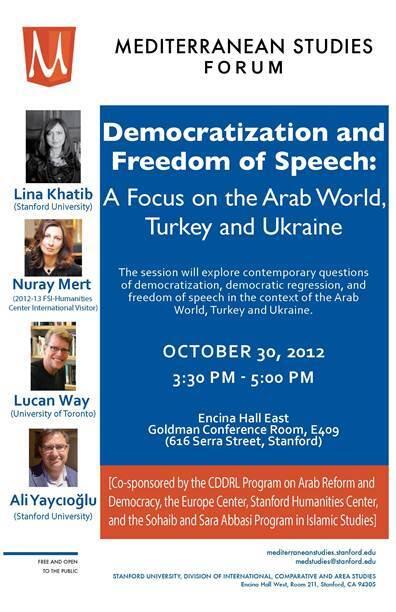
Richard and Rhoda Goldman Conference Room
Nuray Mert
FSI-Humanities Center International Visitor
Panelist
Lina Khatib
Program Manager for the Program on Arab Reform and Democracy
Panelist
CDDRL
Lucan Way
Associate Professor of Political Science
Panelist
University of Toronto
Ali Yaycioğlu
Assistant Professor of Middle East History
Moderator
Stanford
Panel Discussions
Democratization and Freedom of Speech: A Focus on Turkey, Arab World, and Ukraine
-
Co-sponsored by the Abbasi Program on Islamic Studies, CDDRL Program on Arab Reform and Democracy, the Europe Center, Stanford Humanities Center, the Mediterranean Studies Forum, and the Center for Russian, East European and Eurasian Studies.
Reuben W. Hills Conference Room
Nuray Mert
2012-13 FSI-Humanities International Visitor
Speaker
Lina Khatib
Speaker
Lucan Way
0
Visiting Associate Professor, Fall 2012
Lucan Way’s research focuses on global patterns of democracy and dictatorship. His most recent book (with Steven Levitsky), Revolution and Dictatorship: The Violent Origins of Durable Authoritarianism (forthcoming Princeton University Press), provides a comparative historical explanation for the extraordinary durability of autocracies (China, Cuba, USSR) born of violent social revolution. Way’s solo-authored book, Pluralism by Default: Weak Autocrats and the Rise of Competitive Politics (Johns Hopkins, 2015), examines the sources of political competition in the former Soviet Union. Way argues that pluralism in the developing world often emerges out of authoritarian weakness: governments are too fragmented and states too weak to monopolize political control. His first book, Competitive Authoritarianism: Hybrid Regimes after the Cold War (with Steven Levitsky), was published in 2010 by Cambridge University Press. Way’s work on competitive authoritarianism has been cited thousands of times and helped stimulate new and wide-ranging research into the dynamics of hybrid democratic-authoritarian rule.
Ali Yaycioğlu
Speaker
Panel Discussions