Violence
Graduate School of Business 655 Knight Way Stanford, CA 94305
(650) 721 1298
0
Associate Professor of Political Economy, GSB
Associate Professor, by courtesy, of Economics and of Political Science
saumitra_jha.jpg

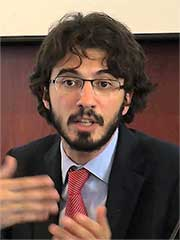
Along with being a Senior Fellow at the Freeman Spogli Institute for International Studies, Saumitra Jha is an associate professor of political economy at the Stanford Graduate School of Business, and convenes the Stanford Conflict and Polarization Lab. 

Jha’s research has been published in leading journals in economics and political science, including Econometrica, the Quarterly Journal of Economics, the American Political Science Review and the Journal of Development Economics, and he serves on a number of editorial boards. His research on ethnic tolerance has been recognized with the Michael Wallerstein Award for best published article in Political Economy from the American Political Science Association in 2014 and his co-authored research on heroes with the Oliver Williamson Award for best paper by the Society for Institutional and Organizational Economics in 2020. Jha was honored to receive the Teacher of the Year Award, voted by the students of the Stanford MSx Program in 2020.

Saum holds a BA from Williams College, master’s degrees in economics and mathematics from the University of Cambridge, and a PhD in economics from Stanford University. Prior to rejoining Stanford as a faculty member, he was an Academy Scholar at Harvard University. He has been a fellow of the Niehaus Center for Globalization and Governance and the Center for the Study of Democratic Politics at Princeton University, and at the Center for Advanced Study in the Behavioral Sciences at Stanford. Jha has consulted on economic and political risk issues for the United Nations/WTO, the World Bank, government agencies, and for private firms.


Senior Fellow at the Freeman Spogli Institute for International Studies
Dan C. Chung Faculty Scholar at the Freeman Spogli Institute for International Studies
Senior Fellow at the Stanford Institute for Economic Policy Research
Date Label
Paragraphs

The levels of violence in Mexico have dramatically increased in the last few years due to structural changes in the drug trafficking business. The increase in the number of drug trafficking organizations (DTOs) fighting over the control of territory and trafficking routes has resulted in a substantial increase in the rates of homicides and other crimes. This study evaluates the economic costs of drug-related violence. We propose electricity consumption as an indicator of the level of municipal economic activity and use two different empirical strategies to test this. To estimate the marginal effects of violence, we utilize an instrumental variable regression created by Mejía and Castillo (2012) based on historical seizures of cocaine in Columbia interacted with the distance of the Mexican border towns to the United States. We find that marginal increases of violence have negative effects on labor participation and the proportion of unemployed in an area. The marginal effect of the increase in homicides is substantive for earned income and the proportion of business owners, but not for energy consumption. We also employ the methodology of synthetic controls to evaluate the effect that inter-narco wars have on local economies. These wars in general begin with a wave of executions between rival criminal organizations and are accompanied by the deterioration of order and a significant increase in extortion, kidnappings, robberies, murders, and threats affecting the general population. To evaluate the effect that these wars between different drug trafficking organizations have on economic performance, we define the beginning of a conflict as the moment when we observe an increase from historical violence rates at the municipal level beyond a certain threshold, and construct counterfactual scenarios as a weighted average from optimal control units. The analysis indicates that the drug wars in those municipalities that saw dramatic increases in violence between 2006 and 2010 significantly reduced their energy consumption in the years after the change occurred.

All Publications button
1
Publication Type
Working Papers
Publication Date
Authors
Beatriz Magaloni
Gabriela Calderón
Paragraphs

Image
povgov conf  banner 2015

Following in the footsteps of last year’s international conference on violence and policing in Latin American and U.S. Cities, on April 28th and 29th of 2015, the Poverty Goverance and Violence Lab (PovGov) at Stanford’s Center on Democracy, Development and the Rule of Law (CDDRL) turned Encina Hall at the Freeman Spogli Institute of International Studies (FSI) into a dynamic, instructive and stimulating discussion platform. The exchange of experiences, expertise and ideals that flourished within this space helped create a “dialogue for action,” as speakers and participants explored the various dimensions of youth and criminal violence in Mexico, Brazil and the United States, while advocating for the importance of opening up adequate pathways to hope. The event was sponsored by the Center for Latin American StudiesThe Bill Lane Center for the America WestThe Mexico Initiative at FSI, and the Center on International Security and Cooperation.

All Publications button
1
Publication Date
Authors
Veriene Melo
-

ABSTRACT

The Iraqi government, the Peshmerga, the international coalition and a consortium of militia have been winning the war against ISIS in Iraq.  The concern moving forward is whether Iraq’s state institutions have what it takes to prevent ISIS from reemerging in a new, and more deadly form after the current conflict is over. What does recent history, the current military campaign, and the Donald Trump administration’s current trajectory tell us about Iraq’s prospects?


SPEAKER BIO

Image
headshot 2
Zaid Al-Ali is the Senior Adviser on Constitution-Building for the Arab Region at International IDEA and an independent scholar.  In his work, Al-Ali focuses on constitutional developments throughout the Arab region, with a particular focus on Iraq and the wave of reforms that took place in Morocco, Tunisia, Libya, Egypt, Jordan and Yemen following the start of popular uprisings in December 2010.  Al-Ali has published extensively on constitutional reform in the Arab region, including on process design issues and the impact of external influence.  He is the author of The Struggle for Iraq’s Future: How Corruption, Incompetence and Sectarianism Have Undermined Democracy (Yale University Press 2014).  Prior to joining International IDEA, Zaid worked as a legal adviser to the United Nations in Iraq, focusing on constitutional, parliamentary and judicial reform.  He also practiced international commercial arbitration law for 12 years, representing clients in investment and oil and gas disputes mainly as an attorney with Shearman & Sterling LLC in Paris and also as a sole practitioner.  He holds an LL.M. from Harvard Law School, a Maitrise en Droit from the University of Paris I (Panthéon-Sorbonne) and an LL.B. from King’s College London.  He was a Law and Public Affairs Fellow and Visiting Lecturer at Princeton University in 2015-2016.  He is the founder of the Arab Association of Constitutional Law and is a member of its executive committee.

Reuben Hills Conference Room
2nd Floor East Wing E207
Encina Hall
616 Serra Street
Stanford, California 94305

Zaid Al-Ali Senior Adviser International IDEA
Seminars
-

ABSTRACT

From 1975 to 1990, Lebanon experienced a long war involving various national and international actors. The peace agreement that followed and officially propelled the country into a "postwar" era did not address many of the root causes of war, nor did it hold main actors accountable. Instead, a politics of "no victor, no vanquished" was promoted, in which the political elite agreed simply to consign the war to the past. However, since then, Lebanon has found itself still entangled in various forms of political violence, from car bombings and assassinations to additional outbreaks of armed combat.

In this talk, Sami Hermez discusses his newly released book War Is Coming. The book argues that the country's political leaders have enabled the continuation of violence and examines how people live between these periods of conflict. What do everyday conversations, practices, and experiences look like during these moments? How do people attempt to find a measure of certainty or stability in such times? Hermez's ethnographic study of everyday life in Lebanon between the volatile years of 2006 and 2009 tackles these questions and reveals how people engage in practices of recollecting past war while anticipating future turmoil. Hermez demonstrates just how social interactions and political relationships with the state unfold and critically engages our understanding of memory and violence, seeing in people's recollections living and spontaneous memories that refuse to forget the past. With an attention to the details of everyday life, War Is Coming shows how even a conversation over lunch, or among friends, may turn into a discussion about both past and future unrest.

Shedding light on the impact of protracted conflict on people's everyday experiences and the way people anticipate political violence, Hermez highlights an urgency for alternative paths to sustaining political and social life in Lebanon.


SPEAKER BIO

Image
hermez sami
Sami Hermez, PhD, is assistant professor in residence of anthropology at Northwestern University in Qatar. He obtained his doctorate degree from the Department of Anthropology at Princeton University. His recently published book with Penn Press, War is Coming: Between Past and Future Violence in Lebanon (2017), focuses on the everyday life of political violence in Lebanon and how people recollect and anticipate this violence.  His broader research concerns include the study of social movements, the state, memory, security, and human rights in the Arab World. He has held posts as Visiting Scholar in the Department of Anthropology at Harvard University, Visiting Professor of Contemporary International Issues at the University of Pittsburgh, Visiting Professor of Anthropology at Mt. Holyoke College, and Postdoctoral Fellow at the Centre for Lebanese Studies, St. Antony’s College, Oxford University. At Northwestern in Qatar he teaches classes in anthropology that include topics such as violence, gender, and anthropology in the Middle East.

CISAC Central Conference Room
Encina Hall, 2nd Floor
616 Serra St
Stanford, CA 94305

Sami Hermez Assistant Professor of Anthropology Northwestern University in Qatar
Seminars
News Type
News
Date
Paragraphs

“We found that when the government came to arrest or kill the leaders of the drug cartels . . . the structure of crime became disorganized and often made things worse because the leaders of the drug cartels had some capacity to control their armed soldiers. When the [federal police] removed them, they created these short-term spikes in violence that resulted from drug-trafficking gangs fighting each other for turf or for leadership of their criminal organization” says Beatriz Magaloni, Director of the Poverty and Governance Project a CDDRL/FSI Senior Fellow for Stanford Magazine. Read the whole article here.

Hero Image
gettyimages 459322868
People take a part during a protest at Eje Central Avenue in Mexico City, on November 20, 2014 to demand the safe return of 43 students who went missing in southern Mexico after an attack by gang-linked police last September 26.
ALFREDO ESTRELLA/AFP/Getty Images
All News button
1

A Stanford Training Seminar for Law Enforcement Professionals

encina group shot The CNS delegation concludes its seminar with seminar with co-directors Beatriz Magaloni and Alberto Diaz Cayeros in a group shot outside
historic Encina Hall, home of the Freeman Spogli Institute and the site of the seminar.

The Stanford Program on Poverty and Governance delivered a five-day training course for the Planning Unit of the Mexican Comision Nacional de Seguridad (CNS) from October 11 to 15, 2016. The training was led by Professors Beatriz Magaloni and Alberto Diaz-Cayeros, co-principal investigators of the State Department-funded research project “Citizen Trust and Evidence-Based Police Accountability and Professionalization in Mexico.” Learn more about the seminar from this report. To view event images click here.


A Stanford Training Seminar for Law Enforcement Professionals
Download docx
Seminars
News Type
News
Date
Paragraphs

Max Fisher and Amanda Taub, in their New York Times column Interpreter from October 8, are exploring the idea that the United States of America are in a moral position to address the state of democracy in the world. CDDRL Mosbacher Director Francis Fukuyama said this began with America’s founding fathers, who “had this idea that the success of democracy in the world would depend on its success here.” Read the whole article here

Hero Image
gettyimages 613363646
Syrian pro-government soldiers patrol the Uwaija neighborhood as they advance in Aleppo's rebel-held areas, on October 8, 2016.
GEORGE OURFALIAN/AFP/Getty Images
All News button
1
-

ABSTRACT

By now, those following the news on Syria have been saturated with analysis, data, information, and misinformation on developments there since 2011. Yet we observe an increasing gravitation to mutually exclusive narratives that adorn websites and publications on the situation in Syria: (a) the narrative of pure and consistent revolution versus that of (b) external conspiracy/designs on Syria. Both narratives carry grains of truth, but are encumbered by maximalist claims and fundamental blindspots that forfeit various potentials for enduring cease-fires and/or transitions, let alone mutual understanding. This talk will address these competing narratives in the context of international escalation marked by increasing US-Russian tension and continued multi-layered conflicts on the battlefield. It closes with addressing a framework for understanding and gauging potential prospects despite conflicting declarations by all parties involved.


SPEAKER BIO

Image
unnamed
Bassam Haddad is Director of the Middle East Studies Program and Associate Professor at the School of Policy, Government, and International Affairs (SPGIA) at George Mason University. He is the author of Business Networks in Syria: The Political Economy of Authoritarian Resilience (Stanford University Press, 2011) and Co-Editor of Dawn of the Arab Uprisings: End of an Old Order? (Pluto Press, 2012). Bassam serves as Founding Editor of the Arab Studies Journal a peer-reviewed research publication and is co-producer/director of the award-winning documentary film, About Baghdad, and director of a critically acclaimed film series on Arabs and Terrorism, based on extensive field research/interviews. Bassam is Co-Founder/Editor of Jadaliyya Ezine and the Executive Director of the Arab Studies Institute, an umbrella for five organizations dealing with knowledge production on the Middle East. He serves on the Board of the Arab Council for the Social Sciences and is Executive Producer of Status Audio Journal.


*This event is supported by the Stanford Initiative for Religious and Ethnic Understanding and Coexistence


[[{"fid":"224129","view_mode":"crop_870xauto","fields":{"format":"crop_870xauto","field_file_image_description[und][0][value]":"Bassam Haddad flyer","field_file_image_alt_text[und][0][value]":"","field_file_image_title_text[und][0][value]":"","field_credit[und][0][value]":"","field_caption[und][0][value]":"","field_related_image_aspect[und][0][value]":"","thumbnails":"crop_870xauto"},"type":"media","attributes":{"width":"870","class":"media-element file-crop-870xauto"}}]]

Reuben Hills Conference Room
2nd Floor East Wing E207
Encina Hall
616 Serra Street
Stanford, California 94305

Bassam Haddad Associate Professor George Mason University
Seminars
News Type
Q&As
Date
Paragraphs

Stanford University’s Center on Democracy, Development and the Rule of Law (CDDRL) is proud to announce our four incoming fellows who will be joining us in the 2016-2017 academic year to develop their research, engage with faculty and tap into our diverse scholarly community. 

The pre- and postdoctoral program will provide fellows the time to focus on research and data analysis as they work to finalize and publish their dissertation research, while connecting with resident faculty and research staff at CDDRL. 

Fellows will present their research during our weekly research seminar series and an array of scholarly events and conferences.

Topics of the incoming cohort include electoral fraud in Russia, how the elite class impacts state power in China, the role of emotions in support for democracy in Zimbabwe, and market institutions in Nigeria. 

Learn more in the Q&A below.


Image
natalia embedded
Natalia Forrat

CDDRL Pre-Doctoral Fellow

Hometown: Tomsk, Russia

Academic Institution: Northwestern University

Discipline and expected date of graduation: Sociology, April 2017

Research Interests: authoritarianism, state capacity, social policy, civil society, trust, Russia and post-communist countries

Dissertation Title: The State that Betrays the Trust: Infrastructural State Power, Public Sector Organizations, and Authoritarian Resilience in Putin's Russia

What attracted you to the CDDRL Pre/post-doctoral program? I study the connection between state capacity and political regimes - the topic that is at the core of many research initiatives at CDDRL. Learning more about this work and receiving feedback for my dissertation will enrich and sharpen my analysis, while helping me to place it into a comparative context. I am looking forward to discussing my work with the faculty who study the post-Soviet region. I also will explore policy implications of my work with the help of policy experts at CDDRL.

What do you hope to accomplish during your nine-month residency at the CDDRL? Besides finishing writing my dissertation, I will workshop three working papers to prepare them for publication. The first one argues that Putin's regime used the school system to administer a large-scale electoral fraud in 2012 presidential elections; the second one shows how the networks of social organizations were used by subnational autocrats to strengthen the regime; and the third one will look at the factors that make the abuse of such organizations more difficult in some regions. In addition to these papers I will continue developing my post-graduation research project exploring the relationship between social trust and distrust, institutions, political competition, and democratization.

Fun fact: I have spent 25 years of my life in Siberia, and I can tell you: Chicago winters are worse!


Image
shelby embedded
Shelby Grossman

CDDRL Postdoctoral Fellow

Hometown: Reading, MA

Academic Institution: Harvard University

Discipline & Graduation Date:  Government, Summer 2016

Research interests: political economy of development, private governance, market institutions, Sub-Saharan Africa, survey methods

Dissertation Title: The Politics of Order in Informal Markets: Evidence from Lagos

What attracted you to the CDDRL post-doctoral program? I was attracted to CDDRL largely for its community of scholars. Affiliated faculty work on the political economy of development and medieval and modern market institutions, topics that are tied to my own interests.

What do you hope to accomplish during your nine-month residency at the CDDRL? I plan to prepare a book manuscript based on my dissertation, a project that explains variation in the provision of pro-trade institutions in private market organizations through the study of physical marketplaces in Nigeria. In addition, I will continue to remotely manage an on-going project in Nigeria (with Meredith Startz) investigating whether reputation alleviates contracting frictions. I also plan to work on submitting to journals a few working papers, including one on the politics of non-compliance with polio vaccination in Nigeria (with Jonathan Phillips and Leah Rosenzweig). 

Fun fact: Contrary to popular belief, not all cheese is vegetarian. I have a website to help people determine if a cheese is vegetarian or not: IsThisCheeseVegetarian.com. 


Image
daniel embedded
Daniel Mattingly

CDDRL Postdoctoral Fellow

Hometown: Oakland, California

Academic Institution: University of California, Berkeley

Discipline & Graduation Date: Political Science, Summer 2016

Research Interests: Governance, rule of law, state building, authoritarian politics, Chinese politics

Dissertation Title: The Social Origins of State Power: Democratic Institutions and Local Elites in China

What attracted you to CDDRL?  The Center has a fantastic community of scholars and practitioners who work on the areas that I'm interested in, including governance and the rule of law. I'm excited to learn from the CDDRL community and participate in the Center's events. The fellowship also provides me with valuable time to finish my book manuscript before I start teaching.

What do you hope to accomplish during your nine-month residency at the CDDRL? While at CDDRL, I plan to prepare my book manuscript and to work on some related projects on local elites and state power in China and elsewhere. 

Fun fact: I grew up on an organic farm in Vermont.


Image
lauren embedded
Lauren E. Young

CDDRL Postdoctoral Fellow

Hometown: Saratoga, CA

Academic Institution: Columbia University 

Discipline & Graduation Date: Political Science (Comparative Politics, Methods), May 2016 (defense), Oct 2016 (degree conferral)

Research Interests: political violence, political economy of development, autocratic persistence, democratization, protest, electoral violence

Dissertation Title: The Psychology of Repression and Dissent in Autocracy

What attracted you to the CDDRL post-doctoral program? As a graduate of the CISAC honors program when I was an undergraduate at Stanford, I have seen first-hand how intellectually stimulating, collaborative, and plugged into policy CDDRL is. While at the center I will be revising my dissertation work on the political psychology of participation in pro-democracy movements in Zimbabwe for submission as a book manuscript, and moving forward new projects that similarly seek to understand how different forms of violence by non-state actors affects citizens' preferences and decision-making. Because of its deep bench of experts on autocracy, narco-trafficking, and insurgency, CDDRL will add enormous value to these projects.

What do you hope to accomplish during your nine-month residency at the CDDRL?  During my fellowship year, my primary goal is to revise my research on Zimbabwe into a book manuscript. I defended my dissertation as three stand-alone articles, including two experiments showing that emotions influence whether opposition supporters in Zimbabwe express their pro-democracy preferences and a descriptive paper showing that repression has a larger effect on the behavior of the poor. To prepare the book manuscript during my fellowship, I will bring in additional quantitative and qualitative descriptive evidence and tie the three papers together into a cohesive argument about how opposition supporters make decisions about participation in protest, why emotions have such a large effect on these decisions, and how this affects variation across individuals and the strategic choices of autocrats and activists.

Fun fact: During my fieldwork I took an overnight train from Victoria Falls to a southern city in Zimbabwe and hitch-hiked into a national park. It got a little nerve-wracking when night started to fall, but ended with  an invitation to a barbecue! 


Hero Image
cddrl fellows 2016 logo
All News button
1
Subscribe to Violence