History
-

The Program on Human Rights at CDDRL and the Center for South Asia  are honored to host Anand Patwardhan, Gopal Guru and Aishwary Kumar for this special film panel discussion as part of the PHR Collaboratory project.

Building 50, Room 51A - Main Quad, Stanford University

Anand Patwardhan Filmmaker Speaker
Gopal Guru Professor of Social and Political Theory, Centre for Political Studies Speaker Jawaharlal Nehru University
Aishwary Kumar Assistant Professor of Modern South Asian History and Modern Intellectual History Speaker Stanford University
Conferences

Lou Henry Hoover Building
Stanford, CA 94305-6010

0
Visiting Scholar 2012-13
xia.jpg

Yeliang Xia is a professor in the Department of Economics at Peking University. His research fields include institutional economics, macroeconomic analysis and public policy, economic history, and labor economics. He has been teaching Principles of Economics, Labor Economics, Institutional Economics, and Western Economic History at Peking University since 2000.

He was deputy director of the institute of public policy, China Society for Restructuring Economic System (2003 –2009) and deputy director of the Center for Western Economic Theory, Peking University(2004--2009). He is also one of the founders of Cathay Institute of Public Affairs (CIPA or “Jiuding” in Chinese).

His books, the Economic Anatomy of Public Issues (2002) and the Weight that Economics Could Not Bear (2003) analyzed economic reform, institutional change and public issues in contemporary China.

-

Abstract
Drawing on fieldwork among Free and Open Source software hackers and the Anonymous protest movement, I will discuss some attributes of hacker and geek activism that set their actions apart from other modalities of dissent and contextualize their actions in light of broader historical trends concerning censorship, intellectual property law and surveillance.

Gabriella (Biella) Coleman is the Wolfe Chair in Scientific and Technological Literacy in the Art History and Communication Studies Department at McGill University. Trained as an anthropologist, teaches, researches, and writes on computer hackers. Her work examines the ethics of online collaboration/institutions as well as the role of the law and digital media in sustaining various forms of political activism. Her first book, "Coding Freedom: The Aesthetics and the Ethics of Hacking" is forthcoming with Princeton University Press and she is currently working on a new book on Anonymous and digital activism.

Wallenberg Theater

Gabriella Coleman Assistant Professor of Media, Culture, and Communication Speaker McGill University
Seminars
-

Abstract
Drawing on open-ended interviews with more than sixty political staffers, accounts of practitioners, and fieldwork, in this talk I present the previously untold history of the uptake of new media in Democratic electoral campaigning from 2000 to 2012. I follow a group of technically-skilled Internet staffers who came together on the Howard Dean campaign and created a series of innovations in campaign organization, tools, and practice. After the election, these individuals founded an array of consulting firms and training organizations and staffed a number of prominent Democratic campaigns. In the process, they carried their innovations across Democratic politics and contributed to a number of electoral victories, including Barack Obama's historic bid for the presidency, and currently occupy senior leadership positions in the president's re-election campaign. This history provides a lens for understanding the organizations, tools, and practices that are shaping the 2012 electoral cycle.  

In detailing this history, I analyze the role of innovation, infrastructure, and organization in electoral politics. I show how the technical and organizational innovations of the Dean and Obama campaigns were the product of the movement of staffers between fields, organizational structures that provided spaces for technical development, and incentives for experimentation. I reveal how Dean's former staffers created an infrastructure for Democratic new media campaigning after the 2004 elections that helped transfer knowledge, practice, and tools across electoral cycles and campaigns.  Finally, I detail how organizational contexts shaped the uptake of tools by the Obama campaign in 2008 and 2012, analyze the emergence of data systems and managerial practices that coordinate collective action, and show how digital cultural work mobilizes supporters and shapes the meaning of electoral participation.

I conclude by discussing the relationship between technological change and democratic practice, showing how from Howard Dean to Barack Obama, new media have provided campaigns with new ways to find and engage supporters, to run their internal operations, and to translate the energy and enthusiasm generated by candidates and political opportunities into the staple resources of American electioneering.  While these tools have facilitated a resurgence in political activity among the electorate, this participation has come in long institutionalized domains: fundraising, volunteer canvassing, and voter mobilization.  Meanwhile, participation is premised on sophisticated forms of data profiling, targeted persuasive communications, and computational managerial practices that coordinate collective action.  As such, I argue that the uptake of new media in electoral campaigning is a hybrid form of organizing politics that combines both management and empowerment. 

Daniel Kreiss is Assistant Professor in the School of Journalism and Mass Communication at the University of North Carolina at Chapel Hill. Kreiss's research explores the impact of technological change on the public sphere and political practice. In Taking Our Country Back: The Crafting of Networked Politics from Howard Dean to Barack Obama (Oxford University Press, 2012)Kreiss presents the history of new media and Democratic Party political campaigning over the last decade. Kreiss is an affiliated fellow of the Information Society Project at Yale Law School and received a Ph.D. in Communication from Stanford University. Kreiss's work has appeared in New Media and SocietyCritical Studies in Media CommunicationThe Journal of Information Technology and Politics, and The International Journal of Communication, in addition to other academic journals.

Wallenberg Theater

Daniel Kreiss Assistant Professor in the School of Journalism and Mass Communication Speaker University of North Carolina at Chapel Hill
Seminars
-

Co-sponsored by CDDRL Program on Arab Reform and Democracy, the Europe Center, Stanford Humanities Center, and the Abbasi Program in Islamic Studies
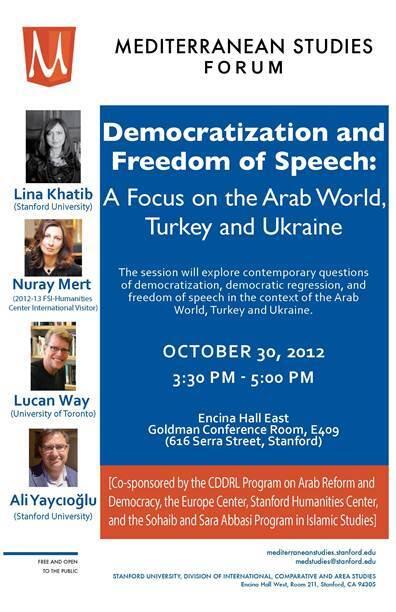
More info: http://www.stanford.edu/group/mediterranean/cgi-bin/web/2012/08/democratization-and-freedom-of-speech-a-focus-on-turkey-arab-world-and-ukraine/

Image

Richard and Rhoda Goldman Conference Room

Nuray Mert FSI-Humanities Center International Visitor Panelist
Lina Khatib Program Manager for the Program on Arab Reform and Democracy Panelist CDDRL
Lucan Way Associate Professor of Political Science Panelist University of Toronto
Ali Yaycioğlu Assistant Professor of Middle East History Moderator Stanford
Panel Discussions
-

Abstract:

Marking the publication of Lina Khatib's latest book Image Politics in the Middle East: The Role of the Visual in Political Struggle, this seminar focuses on the evolution of political expression in the Middle East over the past decade, highlighting the visual dimension of power struggles between citizens and leaders in Lebanon, Iran, Egypt, Libya, and Syria.

About the speaker:

Lina Khatib is a co-founder and Program Manager of the Program on Arab Reform and Democracy at the Center on Democracy, Development, and the Rule of Law at Stanford University. She joined Stanford University in 2010 from the University of London where she was an Associate Professor. Her research is firmly interdisciplinary and focuses on the intersections of politics, media, and social factors in relation to the politics of the Middle East. She is also a consultant on Middle East politics and media and has published widely on topics such as new media and Islamism, US public diplomacy towards the Middle East, and political media and conflict in the Arab world, as well as on the political dynamics in Lebanon and Iran. She has an active interest in the link between track two dialogue and democratization policy. She is also a Research Associate at SOAS, University of London, and, from 2010-2012, a Research Fellow at the USC Center on Public Diplomacy at the Annenberg School.

Lina is a founding co-editor of the Middle East Journal of Culture and Communication, a multidisciplinary journal concerned with politics, culture and communication in the region, and in 2009 co-edited (with Klaus Dodds) a special issue of the journal on geopolitics, public diplomacy and soft power in the Middle East. She also edited the Journal of Media Practice from 2007-2010. She is one of the core authors of the forthcoming Arab Human Development Report (2012) published by the UNDP.

She has written two books, Filming the Modern Middle East: Politics in the Cinemas of Hollywood and the Arab World (IB Tauris 2006), which is a study of the link between international relations and film, focusing on 25 years of cinematic representation of politics in the region (1980-2005), from the Arab-Israeli conflict to the Gulf War to Islamic fundamentalism, and Lebanese Cinema: Imagining the Civil War and Beyond (IB Tauris 2008). The book takes a socio-political approach to the study of Lebanese cinema over the last thirty years, focusing on the issues of Lebanese national identity, history, sectarian conflict, and memory of the Civil War.

Lina has recently finished writing a book titled Image Politics in the Middle East: The Role of the Visual in Political Struggle for IB Tauris. The book examines the power struggles among states, other political actors, and citizens in the region that are expressed through visuals, and focuses on case studies from Lebanon, Egypt, Syria, Libya, and Iran, with a focus on the role of the image as a political tool in the Arab Spring. She has also recently led a multidisciplinary research project on US public diplomacy in the digital age, in collaboration with the University of Oxford and the University of Wolverhampton, the outcome of which will appear in the Middle East Journal in 2012.

Before joining the academic field, Lina worked in broadcast journalism in Lebanon. She is a frequent commentator on the Middle East in the media with appearances on Al-Jazeera (Arabic and English), CNN, BBC, Sky News and other media outlets across the globe

CISAC Conference Room

Lina Khatib Program Manager for the Program on Arab Reform and Democracy Speaker CDDRL
Seminars
Paragraphs

The central problem in human trafficking since the first global efforts to abolish the slave trade in the late eighteenth century is the persistence of demand for unfree women, children, and men. Women and children have increasingly composed the largest share of trafficked people. Women and children can be forced into a wide range of work—from sex work and domestic labor to farm work and low skilled manufacturing—where their labor and their bodies are exploited by their owners and their clients. Women and children have distinctive social and cultural vulnerabilities that enhance their risks of being trafficked and exploited. Of the approximately 700,000 to 2,400,000 people trafficked annually across international borders today, 88% are women and children.1 As long as profits from the exploitation of unfree women and children remain high and as long as patriarchy in its many forms entrenches women and children’s vulnerabilities and seeks to exploit those vulnerabilities, trafficking will continue.

All Publications button
1
Publication Type
Working Papers
Publication Date
Journal Publisher
PHR Working Paper
Authors
Authors
News Type
News
Date
Paragraphs

Adrian Bonifacio, a second generation Filipino-American from Chicago, is one of the recipients of the Program on Human Rights and the McCoy Family Center for Ethics in Society's 2012 Human Rights Fellowship.  The Program on Human Rights at the Center on Democracy, Development, and the Rule of Law together with the McCoy Family Center for Ethics in Society offer four annual summer fellowships in human rights open to Stanford undergraduates interested in working for organizations, government agencies, NGOs or international organizations that promote or defend human rights.

This summer, Bonifacio will work with the Asian Pacific Mission for Migrants, a non-governmental organization based in Hong Kong that promotes and defends the rights of migrant workers, a majority of whom are Filipino. Filipino immigrants in Hong Kong work predominately as domestic workers. The situation of Filipino diasporas is very complex with more than 10% of the Filipino population abroad, and over 4,000 Filipinos leaving the country every day.

Passionate about Filipino and Filipino-American issues relating to human rights such as migration, exploitation, and servitude, Stanford undergraduate Bonifacio has joined Filipino groups such as Stanford’s Pilipino American Student Union (PASU) and Anakbayan Silicon Valley, a youth organization based in Santa Clara County. He is currently pursuing a major in international relations with a minor in economics as well as co-term masters degree in sociology.

In the 1970s, Filipino dictator Ferdinand Marcos began the Labor Export Policy (LEP), a deliberate policy to send Filipino workers abroad. “This became a vicious cycle, the Philippines tried to achieve economic development based on remittances but because it sends both high skill and low skill workers abroad, and because the remittances they send are not usually put towards investment and long term development, there is not much progress happening in the country," explained Bonifacio. "Every president since Marcos has continued to promote the LEP in the name of national development.”

Last summer, Bonifacio worked for HURIGHTS OSAKA, a human rights non-profit organization, where he conducted research related to Filipino migrants in Japan to understand the link between human rights and remittances. “Although it was difficult integrating with the community in such a limited timeframe, a lot of different opportunities presented themselves—celebrating Philippine Independence Day, cooking Filipino food for events, even performing traditional dances," said Bonifacio. "My supervisor at work and all the migrants I have come to know made my transition into life in Japan, as well as my research, much easier.”

Japan and agencies in the Philippines that facilitate labor migration are notorious for abusing “entertainment visas” which allowed young women to be trafficked into Japan. Many Filipino women were promised jobs in high-end hotels as singers or dancers, but upon arrival in Japan, were trafficked into bars, with some entering prostitution rings and red light districts... Starting in the mid-1980s, many Japanese men in rural areas began to “import” Filipino women as mail-order brides, to solve the demographic problem of low birth rates caused largely by women moving out to cities to pursue professional careers.

Although the mail-order bride phenomenon has died down and Japan has since abolished the entertainment visa in 2006, there are still cases of abuse and human trafficking. Moreover, Filipino men have a history of working in construction, often as day laborers with insecure sources of income and housing. According to Bonifacio, “It is hard to determine the proportion of remittances that come from exploitation, but if you look at general trends and the types of employment Filipinos have all over the world—for example as “entertainers” in Japan or domestic workers in Hong Kong, Saudi Arabia, and even the United States—one could say that remittances and exploitation are closely connected.”

In preparation for his fellowship in Hong Kong Bonifacio says, “I was humbled by what I saw in Japan. I think that one of the best things one can do to educate oneself - and something that does not always happen in a classroom - is to understand the community we want to serve. We need to learn about the issues these communities face before considering fighting for change.”

Students interested in applying to the human rights fellowship for the summer of 2013 should contact Nadejda Marques to learn about the selection process and deadline for submission.

Hero Image
adrian Logo
All News button
1

________________________________________________

Stanford U.S.-Russia Forum Capstone Conference

April 18 - 20, 2012, Stanford University

                                                                                CONFERENCE AGENDA

 Day 1 Wednesday, April 18th, 2012

 12:00 - 1:00pm Lunch

 1:30 - 2:30pm Panel: Business

 Speakers: Birger Steen, Parallels CEO; Bobby Chao, DFJ DragonFund Managing

 Director; David Yang, ABBYY Founder and Chairman of the Board

 Moderator: Alexandra Johnson, DFJ

 Topic: International Entrepreneurs and VCs in Conversation

 4:30 - 6pm Keynote

 Speaker: Francis Fukuyama

 Topic: Regime Change in Middle East and Post-Soviet Space

 6:00 - 7:00pm Dinner 

Day 2 Thursday, April 19th, 2012 

 9:15 - 10:30am Delegate Presentations -- Civil Society

 Groups: U.S.-Russia Perceptions, Corruption

 11:00am - 12:30pm Panel: Civil Society

 Speakers: Professor Kathryn Stoner-Weiss of Stanford, Professor Steve Fish of

 Berkeley

 Moderator: Dr. Patricia Young of Stanford

 Topic: The Post-Election Political Landscape in Moscow

 12:30 - 2:30pm: Joint BBQ with the Russian Student Association

 Performance: Fleet Street

 2:30 - 3:30pm Speaker: Gender

 Speaker: Professor Katherine Jolluck, Stanford

 Topic: Women in the Post-Soviet Sphere

 5:15 - 7:15pm Delegate Presentations -- Economy

 Groups: Investment Banking, Public-Private Partnerships, Resource Curse

 Day 3 Friday, April 20th, 2012
 

 9:30 - 11:00am Panel: Nuclear Defense

 Speakers: Professor David Holloway of Stanford, Ambassador Jack Matlock of

 Columbia, Professor Theodore Postol of MIT

 Moderator: Dr. Benoît Pelopidas of Stanford

 Topic: NATO, US and Russia & Cooperative Missile Defense

 11:30am - 1:30 pm Delegate Presentations -- Security

 Groups: Afghanistan, Missile Defense, Space

 1:45 - 2:45pm Lunch

 3:00 - 4:30pm Speaker: Foreign Policy

 Speakers: Professor Abbas Milani of Stanford

 Topic: Russia, U.S. and Iran Sanctions

 4:45 - 6:00pm Delegate Presentations -- Institutions

 Groups: Education, Immigration

 6:30-8:30pm Closing Dinner

 Keynote: Professor Stephen Walt of Harvard

 Additional Information:

 Meals only for SURF delegates, officers and paid attendees.

 All presentations and panels will be held at the Black Community Services

Center, Room 418

Santa Teresa Street, Stanford, CA.

The closing dinner will be held at the Stanford Faculty Club, 439 Lagunita Drive

Stanford, CA.

The Closing Dinner is available by invitation only 

Black Community Service Center
418 Santa Teresa Street
Stanford, California

Birger Steen CEO Parallels Speaker
Bobby Chao Managing Director, DFJ DragonFund Speaker
David Yang ABBYY Founder and Chairman of the Board Speaker
Alexandra Johnson DFJ Moderator

Encina Hall, C148
616 Jane Stanford Way
Stanford, CA 94305

0
Olivier Nomellini Senior Fellow at the Freeman Spogli Institute for International Studies
Director of the Ford Dorsey Master's in International Policy
Research Affiliate at The Europe Center
Professor by Courtesy, Department of Political Science
yff-2021-14290_6500x4500_square.jpg

Francis Fukuyama is the Olivier Nomellini Senior Fellow at Stanford University's Freeman Spogli Institute for International Studies (FSI), and a faculty member of FSI's Center on Democracy, Development and the Rule of Law (CDDRL). He is also Director of Stanford's Ford Dorsey Master's in International Policy, and a professor (by courtesy) of Political Science.

Dr. Fukuyama has written widely on issues in development and international politics. His 1992 book, The End of History and the Last Man, has appeared in over twenty foreign editions. His book In the Realm of the Last Man: A Memoir will be published in fall 2026.

Francis Fukuyama received his B.A. from Cornell University in classics, and his Ph.D. from Harvard in Political Science. He was a member of the Political Science Department of the RAND Corporation, and of the Policy Planning Staff of the US Department of State. From 1996-2000 he was Omer L. and Nancy Hirst Professor of Public Policy at the School of Public Policy at George Mason University, and from 2001-2010 he was Bernard L. Schwartz Professor of International Political Economy at the Paul H. Nitze School of Advanced International Studies, Johns Hopkins University. He served as a member of the President’s Council on Bioethics from 2001-2004. He is editor-in-chief of American Purpose, an online journal.

Dr. Fukuyama holds honorary doctorates from Connecticut College, Doane College, Doshisha University (Japan), Kansai University (Japan), Aarhus University (Denmark), the Pardee Rand Graduate School, and Adam Mickiewicz University (Poland). He is a non-resident fellow at the Carnegie Endowment for International Peace. He is a member of the Board of Trustees of the Rand Corporation, the Board of Trustees of Freedom House, and the Board of the Volcker Alliance. He is a fellow of the National Academy for Public Administration, a member of the American Political Science Association, and of the Council on Foreign Relations. He is married to Laura Holmgren and has three children.

(October 2025)

CV
Date Label
Francis Fukuyama Olivier Nomellini Senior Fellow at the Freeman Spogli Institute for International Studies (FSI) Speaker Stanford University

FSI
Stanford University
Encina Hall C140
Stanford, CA 94305-6055

(650) 736-1820 (650) 724-2996
0
Satre Family Senior Fellow, Freeman Spogli Institute for International Studies
kathryn_stoner_1_2022_v2.jpg MA, PhD

Kathryn Stoner is the Mosbacher Director of the Center on Democracy, Development, and the Rule of Law (CDDRL), and a Senior Fellow at CDDRL and the Center on International Security and Cooperation at FSI. From 2017 to 2021, she served as FSI's Deputy Director. She is Professor of Political Science (by courtesy) at Stanford and she teaches in the Department of Political Science, and in the Program on International Relations, as well as in the Ford Dorsey Master's in International Policy Program. She is also a Senior Fellow (by courtesy) at the Hoover Institution.

Prior to coming to Stanford in 2004, she was on the faculty at Princeton University for nine years, jointly appointed to the Department of Politics and the Princeton School for International and Public Affairs (formerly the Woodrow Wilson School). At Princeton she received the Ralph O. Glendinning Preceptorship awarded to outstanding junior faculty. She also served as a Visiting Associate Professor of Political Science at Columbia University, and an Assistant Professor of Political Science at McGill University. She has held fellowships at Harvard University as well as the Woodrow Wilson Center in Washington, DC. 

In addition to many articles and book chapters on contemporary Russia, she is the author or co-editor of six books: "Transitions to Democracy: A Comparative Perspective," written and edited with Michael A. McFaul (Johns Hopkins 2013);  "Autocracy and Democracy in the Post-Communist World," co-edited with Valerie Bunce and Michael A. McFaul (Cambridge, 2010);  "Resisting the State: Reform and Retrenchment in Post-Soviet Russia" (Cambridge, 2006); "After the Collapse of Communism: Comparative Lessons of Transitions" (Cambridge, 2004), coedited with Michael McFaul; and "Local Heroes: The Political Economy of Russian Regional" Governance (Princeton, 1997); and "Russia Resurrected: Its Power and Purpose in a New Global Order" (Oxford University Press, 2021).

She received a BA (1988) and MA (1989) in Political Science from the University of Toronto, and a PhD in Government from Harvard University (1995). In 2016 she was awarded an honorary doctorate from Iliad State University, Tbilisi, Republic of Georgia.

Download full-resolution headshot; photo credit: Rod Searcey.

Mosbacher Director, Center on Democracy, Development and the Rule of Law
Professor of Political Science (by courtesy), Stanford University
Senior Fellow (by courtesy), Hoover Institution
CV
Date Label
Kathryn Stoner-Weiss Senior Fellow, Freeman Spogli Institute for International Studies Speaker Stanford University
Dr. Patricia Young Moderator Stanford University
Katherine Jolluck Professor Speaker Stanford University
Steve Fish Professor Speaker UC Berkeley
David Holloway Raymond A. Spruance Professor of International History, Professor of Political Science & Senior Fellow at Freeman Spogli Institute for International Studies Speaker
Jack Matlock Ambassador Speaker Columbia
Theodore Postol Professor Speaker MIT
Dr. Benoit Pelopidas Moderator Stanford University

615 Crothers Way,
Encina Commons, Room 128A
Stanford University
Stanford, CA 94305

(650) 721-4052
0
Research Fellow, Hoover Institution
abbas_milani_photo_by_babak_payami.jpg PhD

Abbas Milani is the Hamid and Christina Moghadam Director of Iranian Studies at Stanford University and a visiting professor in the department of political science. In addition, Dr. Milani is a research fellow and co-director of the Iran Democracy Project at the Hoover Institution.

Prior to coming to Stanford, Milani was a professor of history and political science and chair of the department at Notre Dame de Namur University and a research fellow at the Institute of International Studies at the University of California at Berkeley. Milani was an assistant professor in the faculty of law and political science at Tehran University and a member of the board of directors of Tehran University's Center for International Studies from 1979 to 1987. He was a research fellow at the Iranian Center for Social Research from 1977 to 1978 and an assistant professor at the National University of Iran from 1975 to 1977.

Dr. Milani is the author of Eminent Persians: Men and Women Who Made Modern Iran, 1941-1979, (Syracuse University Press, Syracuse, NY, 2 volumes, November, 2008); King of Shadows: Essays on Iran's Encounter with Modernity, Persian text published in the U.S. (Ketab Corp., Spring 2005); Lost Wisdom: Rethinking Persian Modernity in Iran, (Mage 2004); The Persian Sphinx: Amir Abbas Hoveyda and the Riddle of the Iranian Revolution (Mage, 2000); Modernity and Its Foes in Iran (Gardon Press, 1998); Tales of Two Cities: A Persian Memoir (Mage 1996); On Democracy and Socialism, a collection of articles coauthored with Faramarz Tabrizi (Pars Press, 1987); and Malraux and the Tragic Vision (Agah Press, 1982). Milani has also translated numerous books and articles into Persian and English.

Milani received his BA in political science and economics from the University of California at Berkeley in 1970 and his PhD in political science from the University of Hawaii in 1974.

Hamid and Christina Moghadam Director of Iranian Studies
Co-director of the Iran Democracy Project
CDDRL Affiliated Scholar
Date Label
Abbas Milani Director, Iranian Studies Program, Division of International Comparative & Area Studies Speaker Stanford University
Conferences
Subscribe to History