Human Rights
Authors
News Type
News
Date
Paragraphs

In a talk dated April 20, 2016, American University of Kuwait Scholar Farah Al-Nakib discussed her recently released book Kuwait Transformed: A History of Oil and Urban Life (Stanford University Press, 2016). The book traces the relationships between the urban landscape, patterns and practices of everyday life, and social behaviors and relations in Kuwait, from its settlement in 1716 through the bridge of oil discovery to the twenty-first century. The history that emerges reveals how decades of urban planning, suburbanization, and privatization have eroded an open, tolerant society and given rise to the insularity, xenophobia, and divisiveness that characterize Kuwaiti social relations today. However, over the past decade several social forces and youth-based movements—from political protesters to architects and small entrepreneurs—have been staking claims to the city and demanding a different kind of urban experience. Beyond simply reviving the declined urban center, Al-Nakib argues, their efforts have the potential to restore Kuwaiti society’s lost urbanity.


Hero Image
screen shot 2016 05 17 at 11 26 11 am
All News button
1
News Type
News
Date
Paragraphs

CDDRL is pleased to announce that several affiliates have been awarded the prestigious Andew Carnegie Fellowship for 2016. The fellowship will provide 33 preeminent scholars and thinkers the opportunity to advance their research in the social sciences and humanities with total awards reaching $6.6 million. Each award recipient will receive up to $200,000 toward the funding of one to two years of scholarly research and writing aimed at addressing some of the world’s most urgent challenges to U.S. democracy and international order.

CDDRL-affiliated recipients include:

Mark Massoud, Assistant Professor of Politics and Legal Studies, UCSC; former CDDRL postdoctoral fellow (2008-2009). Research project title: "Human Rights and Islamic States: Can Religion Rebuild the Rule of Law After War?"

Nathaniel Persily, James B. McClatchy Professor of Law, Stanford Law School; researcher for CDDRL's Program on American Democracy in Comparative Perspective. Research project title: "The Campaign of the Future."

Landry Signe, Professor of Political Science, University of Alaska, Anchorage (UAA); former CDDRL postdoctoral fellow (2011-2013). Research project title: "Why African Nations Fail and How to Fix It: The Political Economy of Economic Growth and Democratic Development."

Launched in 2000, the fellowship program supports both established and emerging scholars, journalists, and authors whose work distills knowledge, enriches culture, and equips leaders in the realms of education, law, technology, business, and public policy. For more information about the fellowship program and the other recipients, please click here

Hero Image
mail   christian ollano   outlook
All News button
1
-

Abstract

Two student leaders and activists will discuss the new era of Hong Kong's democracy movement with prospects for the future of Hong Kong after 2047.


Speaker Bios 

Image
wl
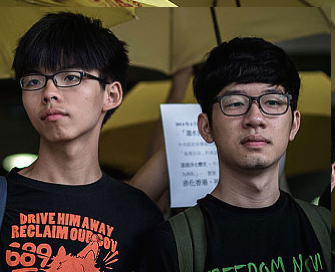
Joshua Chi-fung Wong (left), 19, founded the Hong Kong student activist group Scholarism,  and is best known for his leadership role among fellow high school students in the Sept-Dec 2014 pro-democracy  Umbrella Movement, a massive protest that demanded genuine universal suffrage for China's Hong Kong Special Administrative Region. Wong first attained popular fame in the highly successful mid-2012 "anti-Brain Washing" campaign against the HKSAR government's introduction of a mandatory "national education" course to all local schools to promote pro-PRC/CCP patriotism. He was named one of TIME Magazine's “Most influential Teens of 2014” and was nominated for TIME's 2014 “Person of The Year”.

Nathan Kwun-chung Law, 22, Is a well-known student leader and organizer in Hong Kong. He is Secretary General of the Hong Kong Federation of Students, having been a Standing Committee member from 2014-15. He participated in the only negotiation session with the Hong Kong SAR government during the Umbrella Movement.

This event is sponsored by the Taiwan Democracy Project in the Center on Democracy, Development, and the Rule of Law. It is free and open to the public. 


Video of event

Post-event interview with Joshua Wong and Nathan Law

CISAC Conference Room

Encina Hall, 2nd Floor

616 Serra Street, Stanford, CA 94305


Joshua Wong Speaker
Nathan Law Speajer
Seminars
-

Abstract

In this talk Nancy Okail will reflect on the renewed crackdown on civil society in Egypt, the closing of public space, and the continued regression in rights and freedoms. In the course of the past months the military-sponsored regime of Abdel-Fattah Al-Sisi has escalated its confrontation with civil society organizations by announcing a new set of investigations against prominent human rights defenders and NGOs. The talk will analyze the conditions motivating the regime’s renewed crackdown against civil society and the impact of these politically motivated investigations on the regime’s domestic and international standing and the struggle for political change in Egypt.
 

Speaker Bio

Image
nancy okail
Nancy Okail is the Executive Director of The Tahrir Institute for Middle East Policy (TIMEP). She brings more than 15 years of experience promoting democracy and development in the Middle East and North Africa region to this role. Prior to joining TIMEP, Dr. Okail was the director of Freedom House’s Egypt program. She has also worked with the Egyptian government as a senior evaluation officer of foreign aid and has managed programs for Egyptian pro-democracy organizations that challenged the Mubarak regime. She was also one of the defendants convicted in the widely publicized case of 43 non-governmental organization employees charged with using foreign funds to foment unrest in Egypt. She was sentenced in absentia to five years in prison, and, as a result, has spent the last four years in exile. She holds a Ph.D. from the University of Sussex in the U.K. where her dissertation examined the power relations of foreign aid.


[[{"fid":"222701","view_mode":"crop_870xauto","fields":{"format":"crop_870xauto","field_file_image_description[und][0][value]":"Nancy Okail flyer","field_file_image_alt_text[und][0][value]":"","field_file_image_title_text[und][0][value]":"","field_credit[und][0][value]":"","field_caption[und][0][value]":"","field_related_image_aspect[und][0][value]":"","thumbnails":"crop_870xauto"},"type":"media","attributes":{"width":"870","class":"media-element file-crop-870xauto"}}]]


CISAC Central Conference Room
Encina Hall, 2nd Floor
616 Serra St
​Stanford, CA 94305

Nancy Okail Executive Director TIMEP
Seminars
-

Abstract:

The Wild Lily movement was a student demonstration in 1990 calling for democracy through direct election. 24 years later, the Sunflower movement was driven by a coalition of students and civic groups that were discontent with the Taiwanese government's handling of China relations. We discuss the general trajectory of student movements and the subsequent rise of numerous 'Third Force' parties that represent a new way for civic engagement in politics. 

Speaker Bio:

Dr. Fan Yun (范雲), PhD, is associate professor of sociology at the National Taiwan University. She is a politician, sociology scholar, feminist theorist, and former chairperson of the Social Democratic Party in Taiwan. After graduating from NTU with a B.A. and M.A. in Sociology, she received her PhD in Sociology from Yale University. She was president of the student association at NTU, assistant research fellow at Academia Sinica, commander for the Wild Lily student movement, and chairperson for the Awakening Foundation for women's rights. Her research interests include social movement, collective action, gender politics, identity politics, civil society and democracy. She has participated in social movement since the Wild Lily student movement in 1990, and was participant and witness to the trajectory of Taiwan’s transition into modern civil society and democracy.

Bechtel Conference Room

Encina Hall, 1st Floor

616 Serra St., Stanford, CA

Fan Yun Associate Professor of Sociology Keynote Speaker National Taiwan University
Lectures
News Type
Q&As
Date
Paragraphs

The Program on Arab Reform and Democracy (ARD) at Stanford’s Center on Democracy, Development, and the Rule of Law (CDDRL) is pleased to welcome Egyptian economist Samer Atallah as a visiting scholar for the 2015-16 academic year. Atallah has taught economics at the American University in Cairo (AUC) since 2011, and his work focuses on development economics and political economy of democratization. He is a leading contributor to debates on economic public policy in Egypt, and previously served as an advisor to the 2012 presidential campaign of Abdel-Moneim Abul-Fettouh. He holds a PhD in Economics from McGill University and a Masters Degree in Engineering from University of California, Berkeley. His research on the Arab world has received the support of the Arab Council for Social Sciences and the Economic Research Fund, and spans a wide range of areas, including; education, electoral behavior, public opinion, trade policies, and political institutions in resource dependent economies.

During his residency at CDDRL, Atallah will work on a series of publications examining salient questions in the political economy of the Arab World, including the impact of trade and capital flows on governance in Egypt and Tunisia, and the relationship between education and wealth inequality in Egypt. Atallah’s fellowship is generously funded by a grant from the Carnegie Corporation to support scholars from the Arab world. In the following interview, Atallah discusses his current research projects and their relevance to important public policy debates.


What are your research goals and priorities during your residency at CDDRL?

First of all, I would like to say that I am extremely delighted to be here and excited at this valuable opportunity to collaborate with distinguished scholars at CDDRL and Stanford University, which promises to be a nourishing environment for my research. 

My research agenda during my residency here at CDDRL includes working on two projects, both of which are related to broader questions of democratization and development. This first one is a comprehensive theoretical and empirical study investigating how political and economic institutions evolve as economies become integrated in the global economy. I am interested in understanding how trade and capital flows impact institutions - in the economic sense of the term - and the implications of that impact on political change. For instance, the experiences of economic liberalization in countries like Egypt and Tunisia had unquestionable consequences on the distribution of wealth within their respective societies. Economic liberalization policies had equally important effects on the performance and evolution of their legal, economic governance and political institutions. My own research seeks to investigate how these institutional changes have evolved and the impact of these processes on political change.  The second project is an empirical study examining the relationship between wealth inequality and educational inequality in Egypt.


In what ways do your projects speak to contemporary debates on the origins and trajectories of the Arab uprisings?

I would argue that the divergence in outcomes across the various uprisings in Arab region cannot be understood without seriously thinking about the different historical evolution of political and economic institutions in these countries. These institutions impact the functioning of the economy, its growth, and the social inclusiveness of that growth—factors that were very pertinent to the popular mobilization that advanced the post-2010 uprisings. Certainly these institutions are in part the product of how the economy is managed in a given country in the short-run. At the same time, they are the result of long-term external and internal factors that we need to investigate and understand.

A case in point is the bureaucratic apparatus in Egypt. That sizable bureaucracy is the outcome of a long-standing policy of guaranteed employment, which the government had adopted in the 1960s to secure political support. Whereas economic liberalization policies adopted by President Anwar al-Sadat in the 1970s shrunk the economic role of the state, the size of the bureaucracy, nevertheless, increased significantly. Thus, the question we confront as researchers is why have these institutions remained stagnant and shielded from change despite the fact the nature and priorities of the economy have shifted. This is a major concern in my own research.


What lessons, if any, does your work offer policy-makers involved in the areas of economic and human development?

My second project on inequality and education speaks to one of the central factors that have animated the post-2010 uprisings in the Arab world, namely economic inclusion. In the context of Egypt, educational inequality has contributed greatly to the huge disparities in income and wealth in the country. Exacerbating and reinforcing these disparities is an intergenerational dependency in educational attainment—that is, children of uneducated parents are highly likely to remain uneducated, and by implication, economically underprivileged. This is an area that leaves a lot of room for policy interventions.

But such interventions must be grounded in a better understanding of the causes of this dependency and why it persists. Toward that end, my research seeks to investigate how the type and range of assets in a given household affect schooling and education decisions. Other key determinants of these decisions include access to credit, spatial distribution of educational facilities, and volatility of household income. With a sufficiently nuanced understanding of the problem at hand, all of these factors present potential areas for policy interventions to alter the incentives for school enrolment and quality of education delivery. Such interventions could potentially lead to a better distribution of education and income in the long run.


What are the potentially important research questions that address Arab reform and democracy?

I believe the recent upheavals in the Arab world have pushed us to re-evaluate our understanding of the underlying reasons and implications of political and economic change. This has opened up a multitude of lines of inquiry related to the economic incentives and costs of political change. One such endeavor entails an ambitious effort to compare the evolution of social movements, economic policies, and political structures in the Arab world with other regions of the world. For instance, I think we could draw multiple parallels between the Arab experience and that of many Latin American countries, especially with respect to the role of military institutions, the impact of economic liberalization, social inequality, and civil society movements. Having said that, there is also a lot of work that needs be done in understanding and analyzing the divergent outcomes of the Arab uprisings.

Hero Image
fb img 1430070553548
All News button
1
Authors
News Type
Commentary
Date
Paragraphs

As part of a talk titled "Tunisia's Pathway to Democracy," former Tunisian Ministry of Industry, Energy, and Mines Kamel Ben Naceur spoke at the Program on Arab Reform and Democracy on March 2, 2016 about his experience in the 2014 technocratic government, which was tasked with helping bring the country's democratic transition back on track after a period of political turbulence. Mr. Ben Naceur, who is currently the Director for Sustainability, Technology, and Outlooks at the International Energy Agency, discussed how the technocratic government managed the challenges of organizing the country’s first fully democratic presidential and legislative elections, re-establishing security, and restoring economic fundamentals. He also examined the prospects for democratic and economic development in Tunisia one year after the appointment of the government that resulted from the 2014 elections.


Hero Image
screen shot 2016 03 06 at 5 30 04 pm
All News button
1
Subscribe to Human Rights