Human Rights
-

ABSTRACT

This talk examines the ways through which successive Egyptian governments have utilized lawmaking to eliminate opponents and silence voices of dissent since the coup of 3 July 2013. Key examples include the adoption of a draconian protest law and anti-terrorism laws. Most recently, the legislature passed a bill that, subject to the president’s approval, is poised to significantly curtail the autonomy of civil society organizations. By restricting freedom of expression and association and clamping down on voices of dissent, these legal initiatives have helped upgrade the repressive bureaucratic tools at the disposal of the government.

SPEAKER BIO

Image
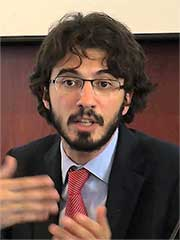
amr hamzawy cropped
Amr Hamzawy is a Senior Fellow at the Middle East Program at the Carnegie Endowment for International Peace and FSI-Stanford Humanities Center International Visitor, 2016-17. He studied political science and developmental studies in Cairo, The Hague, and Berlin. After finishing his doctoral studies and after five years of teaching in Cairo and Berlin, Hamzawy joined the Carnegie Endowment for International Peace (Washington, DC) between 2005 and 2009 as a senior associate for Middle East Politics. Between 2009 and 2010, he served as the research director of the Middle East Center of the Carnegie Endowment in Beirut, Lebanon. In 2011, he joined the Department of Public Policy and Administration at the American University in Cairo, where he continues to serve today. Hamzawy also serves as an associate professor of political science at the Department of Political Science, Cairo University. He is a former Visiting Scholar at CDDRL's Program on Arab Reform and Democracy.

His research and teaching interests as well as his academic publications focus on democratization processes in Egypt, tensions between freedom and repression in the Egyptian public space, political movements and civil society in Egypt, contemporary debates in Arab political thought, and human rights and governance in the Arab world.

Dr. Hamzawy is a former member of the People’s Assembly after being elected in the first Parliamentary elections in Egypt after the 25th of Jan 2011 revolution. He is also a former member of the Egyptian National Council for Human Rights. Hamzawy contributes a daily column and a weekly op-ed to the Egyptian independent newspaper Shorouk.

Amr Hamzawy Senior Fellow Senior Fellow at the Middle East Program at the Carnegie Endowment for International Peace
Seminars
News Type
News
Date
Paragraphs

“We found that when the government came to arrest or kill the leaders of the drug cartels . . . the structure of crime became disorganized and often made things worse because the leaders of the drug cartels had some capacity to control their armed soldiers. When the [federal police] removed them, they created these short-term spikes in violence that resulted from drug-trafficking gangs fighting each other for turf or for leadership of their criminal organization” says Beatriz Magaloni, Director of the Poverty and Governance Project a CDDRL/FSI Senior Fellow for Stanford Magazine. Read the whole article here.

Hero Image
gettyimages 459322868
People take a part during a protest at Eje Central Avenue in Mexico City, on November 20, 2014 to demand the safe return of 43 students who went missing in southern Mexico after an attack by gang-linked police last September 26.
ALFREDO ESTRELLA/AFP/Getty Images
All News button
1
-

This film screening is hosted by the Arab Reform and Democracy Program at the Center on Democracy, Development and the Rule of Law. 


This is a ticketed event, only guests with tickets will be admitted. Please print out your tickets before the event and present them at the door. All persons, regardless of age, require a ticket. Directions and parking information is available below. Doors will open at 6:30 pm. 


About Tickling Giants:

In the midst of the Egyptian Arab Spring, Bassem Youssef makes a decision that’s every mother’s worst nightmare… He leaves his job as a heart surgeon to become a full-time comedian. Dubbed, “The Egyptian Jon Stewart,” Bassem creates the satirical show, Al Bernameg. The weekly program quickly becomes the most viewed television program in the Middle East. In a country where free speech is not settled law, Bassem’s show becomes as controversial as it popular. He and his staff must endure physical threats, protests, and legal action, all because of jokes. As Bassem attempts to remain on the air, keep his staff safe, and not get arrested, he continues to let those in power know they’re being held accountable. Despite increasing danger, the team at Al Bernameg employ comedy, not violence, to comment on hypocrisy in media, politics, and religion. Directed by Sara Taksler, Tickling Giants follows the team of Al Bernameg as they discover democracy is not easily won. For more information visit http://ticklinggiants.com


About Bassem Youssef:

Image
bassem headshot

Named one of TIME’s “100 most influential people in the world” in 2013, Bassem Youssef is an Egyptian satirist, columnist, and talk show host. A cardiac surgeon by training, Youssef turned to comedy after he was inspired by the Egyptian revolution. He uploaded the first episode of his homemade newscast, “The B+ Show,” to YouTube in May 2011. After it garnered more than 5 million views in three months, Youssef was named the host of “Al-Bernameg,” a satirical newscast modeled after Jon Stewart’s “The Daily Show.” Youssef’s bold, intelligent, and humorous critiques of Egyptian politics quickly became a hit with audiences in the country and garnered more than 40 million viewers. Due to its sharp criticism of Egyptian leaders, Al-Bernameg faced political pressure from successive governments until it was finally taken off the air in the summer of 2014. Recently, Youssef launched “The Democracy Handbook,” a Fusion TV digital series that satirizes American politics through a Middle Eastern perspective. Youssef is currently a Visiting Scholar at CDDRL's Program on Arab Reform and Democracy. He served as a resident fellow at the Institute of Politics at Harvard University’s Kennedy School of Government in 2015.


Event Information:

-- Movie duration: 111 mins
-- Q&A with Bassem Youssef after the movie
-- Food and drink are prohibited in all indoor venues
-- Cameras and all recording devices are prohibited
-- Guests will be ask to turn off cell phones, pagers and alarms during the event

Directions 

Via I-280 (north or south): LINK

From the east bay via CA-92 (San Mateo Bridge): LINK

Via US 101 (north or south): LINK

Additional directions are available here


Parking 

Parking Structure 7 offers underground parking at the Knight Management Center. Permits are required and enforced Monday through Friday from 8 am to 4 pm. Click here to access Campus Maps.

One-day visitor permits (called “scratchers”) allow for parking in any pay-and-display or metered space, and are available for purchase at the Parking and Transportation Services (P&TS) office for $12 each. Be sure to scratch off the correct date and hang your permit facing outward from your rear-view mirror. "A," "C," and "shared" resident/commuter lots are enforced Monday-Friday, 6 a.m. to 4 p.m. You are free to park in these areas after enforcement hours.

You can also pay for parking using the pay-by-space kiosks located in Structure 7. Simply enter the number for your parking space and pay with cash or card. You do not need to display your receipt in your vehicle. The receipt is not valid in any other location.

Other nearby parking locations include:

  • Parking lot at Bonair Siding Rd. and Serra St. — coin-meter spaces, two-minute walk
  • Parking lot at Memorial Way and Galvez St. — pay-and-display machine, five-minute walk
  • Visitor Center parking lot at 295 Galvez St. — pay-and-display machine, ten-minute walk
  • Parking Structure 6 at Campus Dr. East and Wilbur Way — pay-and-display machine, ten-minute walk

Meters are generally enforced 8 a.m. to 4 p.m., unless otherwise posted. You are free to park in these areas after enforcement hours.

More parking and permit information is available here.

We honor any state's disabled person placards in nearly all marked parking spaces on campus. Please visit the Persons with Disabilities page for more information.


Cemex Auditorium, Knight Management Center
655 Knight Way
Stanford, CA 94305

Bassem Youssef Visiting Scholar, CDDRL
Film Screenings
-


This event is hosted by the Program on Arab Reform and Democracy at the Center on Democracy, Development and the Rule of Law. Bassem Youssef's fellowship at CDDRL is supported by the Carnegie Corporation of New York, and the Stanford Arts Office of the Associate Dean.


Event Details

  • This is a ticketed event, only guests with tickets will be admitted. Please print out your tickets before the event and present them at the door. All persons, regardless of age, require a ticket. 
  • The event will be held at Cubberley Auditorium at Stanford University. More information on directions and parking is available below. 
  • Doors will open at 6:30 pm. We ask that you please be seated by 6:50 pm. Any unclaimed seats at that time will be released to the stand-by line.


Join the conversation at #BassematStanford


Abstract

The Arab Spring and the political changes it accompanied brought to the forefront of the public realm a wide range of satirical political expressions, whether through talk shows, social media channels and pages, and even repertoires of political protests. In this talk, international media figure and political satirist Bassem Youssef will reflect on the popularity these forms of expressions have gained in light of the Arab Spring, and why states and their advocates found them threatening and were quick to limit and undermine them.


Speaker Bio

Named one of TIME’s “100 most influential people in the world” in 2013, Bassem Youssef is an Egyptian satirist, columnist, and talk show host. A cardiac surgeon by training, Youssef turned to comedy after he was inspired by the Egyptian revolution. He uploaded the first episode of his homemade newscast, “The B+ Show,” to YouTube in May 2011. After it garnered more than 5 million views in three months, Youssef was named the host of “Al-Bernameg,” a satirical newscast modeled after Jon Stewart’s “The Daily Show.” Youssef’s bold, intelligent, and humorous critiques of Egyptian politics quickly became a hit with audiences in the country and garnered more than 40 million viewers. Due to its sharp criticism of Egyptian leaders, Al-Bernameg faced political pressure from successive governments until it was finally taken off the air in the summer of 2014. Recently, Youssef launched “The Democracy Handbook,” a Fusion TV digital series that satirizes American politics through a Middle Eastern perspective. Youssef is currently a Visiting Scholar at CDDRL's Program on Arab Reform and Democracy. He served as a resident fellow at the Institute of Politics at Harvard University’s Kennedy School of Government in 2015.


Directions

FROM 101: Take the University Avenue exit west. University will change to Palm Drive once you get onto campus. Take a left onto Campus Drive East. Take a right onto Mayfield Avenue. Take a right into the Tressider Union parking lot and park. Walk towards White Plaza (Bookstore), then towards the Clock Tower. Cubberley Auditorium appears after the Clock tower on the right.

FROM 280: Take the Sand Hill Road exit east. Follow Sand Hill Road, then take a right onto Junipero Serra Boulevard. Take a left onto Campus Drive East. Take a left onto Mayfield Avenue. Take a right into the Tressider Union parking lot and park. Walk towards White Plaza (Bookstore), then towards the Clock Tower. Cubberley Auditorium appears after the Clock tower on the right.


Parking Information

Meters and permitted parking is generally enforced 8 a.m. to 4 p.m., unless otherwise posted. You are free to park in these areas after enforcement hours.

Park either on the main Oval, or the Memorial Lot just north of the Memorial Hall on Memorial Way, or South of the campus union at Mayfield Ave.

For map and additional parking information visit http://campus-map.stanford.edu

[[{"fid":"224151","view_mode":"crop_870xauto","fields":{"format":"crop_870xauto","field_file_image_description[und][0][value]":"","field_file_image_alt_text[und][0][value]":false,"field_file_image_title_text[und][0][value]":false,"field_credit[und][0][value]":"","field_caption[und][0][value]":"","field_related_image_aspect[und][0][value]":"","thumbnails":"crop_870xauto"},"type":"media","field_deltas":{"1":{"format":"crop_870xauto","field_file_image_description[und][0][value]":"","field_file_image_alt_text[und][0][value]":false,"field_file_image_title_text[und][0][value]":false,"field_credit[und][0][value]":"","field_caption[und][0][value]":"","field_related_image_aspect[und][0][value]":"","thumbnails":"crop_870xauto"}},"attributes":{"width":"870","class":"media-element file-crop-870xauto","data-delta":"1"},"link_text":null}]]

Cubberley Auditorium
485 Lasuen Mall
Stanford, CA 94305

Bassem Youssef Visiting Scholar Visiting Scholar, CDDRL
Seminars
-

ABSTRACT

By now, those following the news on Syria have been saturated with analysis, data, information, and misinformation on developments there since 2011. Yet we observe an increasing gravitation to mutually exclusive narratives that adorn websites and publications on the situation in Syria: (a) the narrative of pure and consistent revolution versus that of (b) external conspiracy/designs on Syria. Both narratives carry grains of truth, but are encumbered by maximalist claims and fundamental blindspots that forfeit various potentials for enduring cease-fires and/or transitions, let alone mutual understanding. This talk will address these competing narratives in the context of international escalation marked by increasing US-Russian tension and continued multi-layered conflicts on the battlefield. It closes with addressing a framework for understanding and gauging potential prospects despite conflicting declarations by all parties involved.


SPEAKER BIO

Image
unnamed
Bassam Haddad is Director of the Middle East Studies Program and Associate Professor at the School of Policy, Government, and International Affairs (SPGIA) at George Mason University. He is the author of Business Networks in Syria: The Political Economy of Authoritarian Resilience (Stanford University Press, 2011) and Co-Editor of Dawn of the Arab Uprisings: End of an Old Order? (Pluto Press, 2012). Bassam serves as Founding Editor of the Arab Studies Journal a peer-reviewed research publication and is co-producer/director of the award-winning documentary film, About Baghdad, and director of a critically acclaimed film series on Arabs and Terrorism, based on extensive field research/interviews. Bassam is Co-Founder/Editor of Jadaliyya Ezine and the Executive Director of the Arab Studies Institute, an umbrella for five organizations dealing with knowledge production on the Middle East. He serves on the Board of the Arab Council for the Social Sciences and is Executive Producer of Status Audio Journal.


*This event is supported by the Stanford Initiative for Religious and Ethnic Understanding and Coexistence


[[{"fid":"224129","view_mode":"crop_870xauto","fields":{"format":"crop_870xauto","field_file_image_description[und][0][value]":"Bassam Haddad flyer","field_file_image_alt_text[und][0][value]":"","field_file_image_title_text[und][0][value]":"","field_credit[und][0][value]":"","field_caption[und][0][value]":"","field_related_image_aspect[und][0][value]":"","thumbnails":"crop_870xauto"},"type":"media","attributes":{"width":"870","class":"media-element file-crop-870xauto"}}]]

Reuben Hills Conference Room
2nd Floor East Wing E207
Encina Hall
616 Serra Street
Stanford, California 94305

Bassam Haddad Associate Professor George Mason University
Seminars
News Type
News
Date
Paragraphs

The Program on Arab Reform and Democracy (ARD) at Stanford’s Center on Democracy, Development, and the Rule of Law (CDDRL) is pleased to welcome international media figure and Egyptian political satirist Bassem Youssef as a visiting scholar during the Fall of 2016. Dubbed the Jon Stewart of the Arab World, Youssef was the host of the popular TV political satire show Al-Bernameg, which was the first of its kind in the Middle East region. Al-Bernameg was the most watched show in the history of Egyptian TV with an average of 40 million viewers every week. Due to its sharp criticism of Egyptian leaders, Al-Bernameg faced political pressure from successive governments until it was finally taken off the air in the summer of 2014. Recently, Youssef launched “The Democracy Handbook,” a Fusion TV digital series that satirizes American politics through a Middle Eastern perspective. Named one of TIME’s “100 most influential people in the world” in 2013, Youssef served as a resident fellow at the Institute of Politics at Harvard University’s Kennedy School of Government in 2015.

Youssef’s fellowship is supported by a generous grant from the Carnegie Corporation, and by the Stanford Arts Office of the Associate Dean. In the following interview Youssef discusses his current projects and their relevance to the Stanford community.


[[{"fid":"224139","view_mode":"crop_870xauto","fields":{"format":"crop_870xauto","field_file_image_description[und][0][value]":"Bassem Youssef at CDDRL","field_file_image_alt_text[und][0][value]":"","field_file_image_title_text[und][0][value]":"","field_credit[und][0][value]":"Djurdja Jovanovic Padejski ","field_caption[und][0][value]":"Bassem Youssef speaking with members of the CDDRL community at Stanford University, September 29, 2016","field_related_image_aspect[und][0][value]":"","thumbnails":"crop_870xauto"},"type":"media","attributes":{"width":"870","class":"media-element file-crop-870xauto"}}]]

Bassem Youssef in conversation with ARD Associate-Director Hesham Sallam and CDDRL Visiting Scholar Alexandra Pichler Fong at the CDDRL fall 2016 reception, September 29, 2016 (Photo credit: Djurdja Jovanovic Padejski)


What are your research goals and priorities at CDDRL, Stanford?

I am not a stranger to CDDRL. About a year ago I spoke at the Center in conversation with Professor Larry Diamond in what might have been one of the best interviews I had on a college campus in the United States. During my visit, I was very impressed with CDDRL’s efforts to try to make sense of all what is happening in the Middle East and to nuance American perspectives on the situation the region. I was elated when I was informed that there was a chance for me to join forces with this prestigious center.

Through my fellowship at CDDRL, I would like to bring a different voice to the discussion over what is happening in the Middle East and the Muslim World, and how narratives in the United States can affect the realities in the region. Beyond my own research on satire and social change, my priority is to connect with the student community at Stanford and encourage them to find their own voices and their own opinions about that part of the world. I believe that satire can be a great tool to understand and even change how people view the world around them. As much I have a lot to share with students, I am sure I will have a great deal to learn from them too, and from the Stanford community more generally. I had the privilege to meet with some of the smartest young people here and I look forward to benefit from this intellectually promising experience.


How are the ongoing political developments in the United States informing your current projects?

After I moved to the United States, I started to follow the American elections very closely. With the rise of a populist Right not just in the States but also in Europe, I could see many similarities of how masses are being controlled through hate, xenophobia, and fear. These have been key elements in the narratives used by many Middle Eastern regimes for decades. As people were horrified with the likes of Donald Trump, Ted Cruz and Ben Carson, this came to me as a reminder that no nation, no matter how strong or advanced, is free of such forms of public manipulation and fear-mongering. This was a great starting point for me here in the States. I discovered many similarities that I can comment on and use to show people that we are not that different from each other and that intolerance and bigotry have no single home or language. I was fortunate to relay that message in my new show in America "Democracy Handbook" and also in my coverage of the National Conventions of the Republican and Democratic Parties.


What is your assessment of the prospects for meaningful political change at the current moment in Egypt?

The current realities in Egypt and the Middle East are a product of decades of authoritarian rule. What happened in the Arab Spring interrupted the rule of particular autocrats, but did not succeed in delivering the type of lasting social change we all had hoped for. The biggest obstacle to meaningful social change in Egypt remains the massive webs of special interests that have ruled the country for the last 60 years and shaped its political and social hierarchies. It was naive of us to think that 18 days of protests could make profound changes to the system. You can get rid of the autocrat at the helm, but the system can still endure, as evidenced by the current realities. Any changes will be worthless in the absence of complete transparency and accountability of the ruling class that controls the country’s economy, governance, and legislation.

Hero Image
bassem
Bassem Youssef at the CDDRL fall 2016 reception, September 29, 2016
Djurdja Jovanovic Padejski
All News button
1
Paragraphs

Poverty relief programs are shaped by politics. The particular design that social programs take is, to a large extent, determined by the existing institutional constraints and politicians' imperative to win elections. The "Political Logic of Poverty Relief" places elections and institutional design at the core of poverty alleviation. The authors develop a theory with applications to Mexico about how elections shape social programs aimed at aiding the poor. Would political parties possess incentives to target the poor with transfers aimed at poverty alleviation, or would they instead give these to their supporters? Would politicians rely on the distribution of particularistic benefits rather than public goods? The authors assess the welfare effects of social programs in Mexico and whether voters reward politicians for targeted property alleviation programs. The book provides a new interpretation of the role of cash transfers and poverty relief assistance in the development of welfare state institutions.

To purchase the book, click here.

All Publications button
1
Publication Type
Books
Publication Date
Journal Publisher
Cambridge University Press, 2016
Authors
Alberto Díaz-Cayeros
Beatriz Magaloni
News Type
Q&As
Date
Paragraphs

Stanford University’s Center on Democracy, Development and the Rule of Law (CDDRL) is proud to announce our four incoming fellows who will be joining us in the 2016-2017 academic year to develop their research, engage with faculty and tap into our diverse scholarly community. 

The pre- and postdoctoral program will provide fellows the time to focus on research and data analysis as they work to finalize and publish their dissertation research, while connecting with resident faculty and research staff at CDDRL. 

Fellows will present their research during our weekly research seminar series and an array of scholarly events and conferences.

Topics of the incoming cohort include electoral fraud in Russia, how the elite class impacts state power in China, the role of emotions in support for democracy in Zimbabwe, and market institutions in Nigeria. 

Learn more in the Q&A below.


Image
natalia embedded
Natalia Forrat

CDDRL Pre-Doctoral Fellow

Hometown: Tomsk, Russia

Academic Institution: Northwestern University

Discipline and expected date of graduation: Sociology, April 2017

Research Interests: authoritarianism, state capacity, social policy, civil society, trust, Russia and post-communist countries

Dissertation Title: The State that Betrays the Trust: Infrastructural State Power, Public Sector Organizations, and Authoritarian Resilience in Putin's Russia

What attracted you to the CDDRL Pre/post-doctoral program? I study the connection between state capacity and political regimes - the topic that is at the core of many research initiatives at CDDRL. Learning more about this work and receiving feedback for my dissertation will enrich and sharpen my analysis, while helping me to place it into a comparative context. I am looking forward to discussing my work with the faculty who study the post-Soviet region. I also will explore policy implications of my work with the help of policy experts at CDDRL.

What do you hope to accomplish during your nine-month residency at the CDDRL? Besides finishing writing my dissertation, I will workshop three working papers to prepare them for publication. The first one argues that Putin's regime used the school system to administer a large-scale electoral fraud in 2012 presidential elections; the second one shows how the networks of social organizations were used by subnational autocrats to strengthen the regime; and the third one will look at the factors that make the abuse of such organizations more difficult in some regions. In addition to these papers I will continue developing my post-graduation research project exploring the relationship between social trust and distrust, institutions, political competition, and democratization.

Fun fact: I have spent 25 years of my life in Siberia, and I can tell you: Chicago winters are worse!


Image
shelby embedded
Shelby Grossman

CDDRL Postdoctoral Fellow

Hometown: Reading, MA

Academic Institution: Harvard University

Discipline & Graduation Date:  Government, Summer 2016

Research interests: political economy of development, private governance, market institutions, Sub-Saharan Africa, survey methods

Dissertation Title: The Politics of Order in Informal Markets: Evidence from Lagos

What attracted you to the CDDRL post-doctoral program? I was attracted to CDDRL largely for its community of scholars. Affiliated faculty work on the political economy of development and medieval and modern market institutions, topics that are tied to my own interests.

What do you hope to accomplish during your nine-month residency at the CDDRL? I plan to prepare a book manuscript based on my dissertation, a project that explains variation in the provision of pro-trade institutions in private market organizations through the study of physical marketplaces in Nigeria. In addition, I will continue to remotely manage an on-going project in Nigeria (with Meredith Startz) investigating whether reputation alleviates contracting frictions. I also plan to work on submitting to journals a few working papers, including one on the politics of non-compliance with polio vaccination in Nigeria (with Jonathan Phillips and Leah Rosenzweig). 

Fun fact: Contrary to popular belief, not all cheese is vegetarian. I have a website to help people determine if a cheese is vegetarian or not: IsThisCheeseVegetarian.com. 


Image
daniel embedded
Daniel Mattingly

CDDRL Postdoctoral Fellow

Hometown: Oakland, California

Academic Institution: University of California, Berkeley

Discipline & Graduation Date: Political Science, Summer 2016

Research Interests: Governance, rule of law, state building, authoritarian politics, Chinese politics

Dissertation Title: The Social Origins of State Power: Democratic Institutions and Local Elites in China

What attracted you to CDDRL?  The Center has a fantastic community of scholars and practitioners who work on the areas that I'm interested in, including governance and the rule of law. I'm excited to learn from the CDDRL community and participate in the Center's events. The fellowship also provides me with valuable time to finish my book manuscript before I start teaching.

What do you hope to accomplish during your nine-month residency at the CDDRL? While at CDDRL, I plan to prepare my book manuscript and to work on some related projects on local elites and state power in China and elsewhere. 

Fun fact: I grew up on an organic farm in Vermont.


Image
lauren embedded
Lauren E. Young

CDDRL Postdoctoral Fellow

Hometown: Saratoga, CA

Academic Institution: Columbia University 

Discipline & Graduation Date: Political Science (Comparative Politics, Methods), May 2016 (defense), Oct 2016 (degree conferral)

Research Interests: political violence, political economy of development, autocratic persistence, democratization, protest, electoral violence

Dissertation Title: The Psychology of Repression and Dissent in Autocracy

What attracted you to the CDDRL post-doctoral program? As a graduate of the CISAC honors program when I was an undergraduate at Stanford, I have seen first-hand how intellectually stimulating, collaborative, and plugged into policy CDDRL is. While at the center I will be revising my dissertation work on the political psychology of participation in pro-democracy movements in Zimbabwe for submission as a book manuscript, and moving forward new projects that similarly seek to understand how different forms of violence by non-state actors affects citizens' preferences and decision-making. Because of its deep bench of experts on autocracy, narco-trafficking, and insurgency, CDDRL will add enormous value to these projects.

What do you hope to accomplish during your nine-month residency at the CDDRL?  During my fellowship year, my primary goal is to revise my research on Zimbabwe into a book manuscript. I defended my dissertation as three stand-alone articles, including two experiments showing that emotions influence whether opposition supporters in Zimbabwe express their pro-democracy preferences and a descriptive paper showing that repression has a larger effect on the behavior of the poor. To prepare the book manuscript during my fellowship, I will bring in additional quantitative and qualitative descriptive evidence and tie the three papers together into a cohesive argument about how opposition supporters make decisions about participation in protest, why emotions have such a large effect on these decisions, and how this affects variation across individuals and the strategic choices of autocrats and activists.

Fun fact: During my fieldwork I took an overnight train from Victoria Falls to a southern city in Zimbabwe and hitch-hiked into a national park. It got a little nerve-wracking when night started to fall, but ended with  an invitation to a barbecue! 


Hero Image
cddrl fellows 2016 logo
All News button
1
News Type
News
Date
Paragraphs


Stanford University’s Center on Democracy, Development, and the Rule of Law calls on the Bahraini authorities to release the travel ban on Sheikh Maytham Al Salman. Sheikh Al Salman was selected to participate in the 2016 Draper Hills Summer Fellowship Program at Stanford University from over 500 applicants based on the significant contributions that he has made to build more tolerant societies to counter violence and extremism in the Middle East.


Image
img 1969

The faculty and staff at CDDRL have been notified that his passport has been held – without his consent - by the Bahraini authorities who have refused to release it to allow him to travel. We are very disappointed and shocked by the Bahraini government’s decision to prevent Sheikh Al Salman from traveling to attend our academic program at Stanford University. We join the international community in condemning this decision and call upon the Bahraini authorities to reverse this decision and allow Sheikh Al Salman to participate in our leadership development program this July.


Sheikh al-Salman is well recognized for his work building tolerant societies in the Middle East and countering incitement to violence and discrimination in accordance with international human rights standards, in particular respect for freedom of expression as per Articles 19 and 20 of the International Covenant on Civil and Political Rights, which Bahrain is not a signatory. He is the director of Middle East North Africa Coalition Against Hate Speech; chairperson of Bahrain Interfaith; head of the religious freedom unit at Bahrain Human Rights Observatory; member of the UN committee for partnering with Interfaith leaders; member of the UN advisory committee for the role of religious leaders in preventing genocide; and Arabian Gulf representative of International association for religious freedom. Sheikh Al Salman is applauded for his calls for equal citizenship, his condemnation of all forms of discrimination and his opposition to violence and extremism in the name of religion.


Francis Fukuyama, Mosbacher Director of the Center on Democracy, Development, and the Rule of Law

Larry Diamond, Senior Fellow Freeman Spogli Institute for International Studies

Sarina Beges, Associate Director Center on Democracy, Development, and the Rule of Law


Hero Image
maytham al salman
All News button
1
Subscribe to Human Rights