Human Rights
-

Image


Abstract:

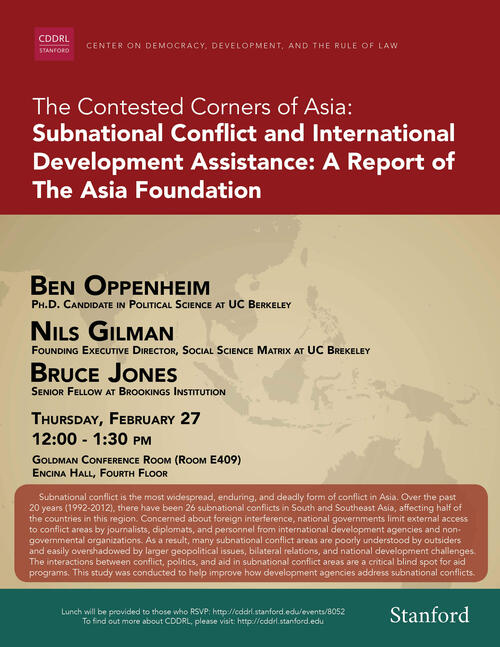
Subnational conflict is the most widespread, enduring, and deadly form of conflict in Asia. Over the past 20 years (1992-2012), there have been 26 subnational conflicts in South and Southeast Asia, affecting half of the countries in this region. Concerned about foreign interference, national governments limit external access to conflict areas by journalists, diplomats, and personnel from international development agencies and non-governmental organizations. As a result, many subnational conflict areas are poorly understood by outsiders and easily overshadowed by larger geopolitical issues, bilateral relations, and national development challenges. The interactions between conflict, politics, and aid in subnational conflict areas are a critical blind spot for aid programs. This study was conducted to help improve how development agencies address subnational conflicts.


Speaker Bios:

Ben Oppenheim is a Fellow (non-resident) at the Center on International Cooperation at New York University. His research spans a diverse set of topics, including fragile states, transnational threats (including pandemic disease risks and terrorism), and the strategic coherence and effectiveness of international assistance in fragile and conflict-affected areas.

Oppenheim has consulted for organizations including the World Bank, the United Nations, the Asia Foundation, the Institute for the Future, and the Fritz Institute, on issues including organizational learning, strategy, program design, foresight, and facilitation. In 2009, he served as Advisor to the first global congress on disarmament, demobilization, and reintegration, supported by the World Bank and the UN.

In 2013, Oppenheim was a visiting fellow at the Uppsala University Forum on Democracy, Peace, and Justice. His research has been supported by a Simpson Fellowship, and a fellowship with the Institute on Global Conflict and Cooperation. He was also a research fellow with UC Berkeley's Institute of International Studies, affiliated with the New Era Foreign Policy Project.


Nils Gilman is the Executive Director of Social Science Matrix. He holds a B.A., M.A. and Ph.D. in History from the University of California, Berkeley. Gilman’s first scholarly interest was in American and European intellectual history, with a particular focus on the institutional development of the social sciences, the lateral transfer and translation of ideas across disciplinary boundaries, and the impact of social scientific ideas on politics and policy.

Gilman is the author of Mandarins of the Future: Modernization Theory in Cold War America (Johns Hopkins University Press, 2004), the co-editor of Staging Growth: Modernization, Development, and the Global Cold War (University of Massachusetts Press, 2003) and Deviant Globalization: Black Market Economy in the 21st Century (Continuum Press, 2011), as well as the founding Co-editor of Humanity: An International Journal of Human Rights, Humanitarianism, and Development. He also blogs and tweets.

Prior to joining Social Science Matrix in September 2013, Gilman was research director at Monitor 360, a San Francisco consultancy that addresses complex, cross-disciplinary global strategic challenges for governments, multinational businesses, and NGOs. He has also worked at a variety of enterprise software companies, including Salesforce.com, BEA Systems, and Plumtree Software. Gilman has taught and lectured at a wide variety of venues, from the Harvard University, Columbia University, and National Defense University, to PopTech, the European Futurists Conference, and the Long Now Foundation.


Bruce Jones is a senior fellow and the director of the Project on International Order and Strategy in the Foreign Policy program at the Brookings Institution. He is also the director of the Center on International Cooperation at New York University.

Jones served as the senior external advisor for the World Bank’s 2011 World Development Report, Conflict, Security and Development, and in March 2010 was appointed by the United Nations secretary-general as a member of the senior advisory group to guide the Review of International Civilian Capacities. He is also consulting professor at the Center for International Security and Cooperation at Stanford University and professor (by courtesy) at New York University’s department of politics.

Jones holds a Ph.D. from the London School of Economics, and was Hamburg fellow in conflict prevention at Stanford University.

He is co-author with Carlos Pascual and Stephen Stedman of Power and Responsibility: Building International Order in an Era of Transnational Threats (Brookings Press, 2009); co-editor with Shepard Forman and Richard Gowan of Cooperating for Peace and Security (Cambridge University Press, 2009); and author of Peacemaking in Rwanda: The Dynamics of Failures(Lynne Reinner, 2001).

Jones served as senior advisor in the office of the secretary-general during the U.N. reform effort leading up to the World Summit 2005, and in the same period was acting secretary of the Secretary-General’s Policy Committee. In 2004-2005, he was deputy research director of the High-level Panel on Threats, Challenges and Change. From 2000-2002 he was special assistant to and acting chief of staff at the office of the U.N. special coordinator for the Middle East peace process. 

Richard and Rhoda Goldman Conference Room

Ben Oppenheim Ph.D. Candidate in Political Science Speaker UC Berkeley
Nils Gilman Founding Executive Director, Social Science Matrix Speaker UC Berkeley
Bruce Jones Senior Fellow Speaker Brookings Institution
Seminars
-

Abstract:
Armed conflict causes profound and widespread adverse consequences for health and human rights. It directly causes death as well as physical and mental disabilities among combatants and increasingly among non-combatants. It damages the health-supporting infrastructure of society, including public health services and medical care. It forces people to leave the safety and security of their homes and communities. It diverts human and financial resources away from activities that benefit society. It leads to further violence. And, in these and other ways, armed conflict violates human rights.  This presentation will provide examples of these adverse consequences of armed conflict and what can be done to minimize these consequences and to prevent armed conflict.


Dr.Barry Levy is a physician and epidemiologist who has edited books, written papers, and spoken widely on these issues. He is an Adjunct Professor of Public Health at Tufts University School of Medicine. Previously, he served as a medical epidemiologist for the CDC, a tenured professor at the University of Massachusetts Medical School, USAID coordinator for AIDS prevention in Kenya, executive director of the International Physicians for the Prevention of Nuclear War, and in other roles. He is a past president of the American Public Health Association and a recipient of its Sedgwick Memorial Medal. He has written more than 200 published papers and book chapters, many on the adverse effects of war. He has co-edited 17 books, including, with co-editor Dr. Victor Sidel and many contributing authors, two editions each of the books War and Public Health, Terrorism and Public Health, and Social Injustice and Public Health.    

Building 200 (History Corner)
Room 205
Stanford University

Barry S. Levy, M.D., M.P.H. Adjunct Professor of Public Health Speaker Tufts University School of Medicine
Seminars
-

Abstract
The framework of "LGBT rights" can be critiqued as challenging tradition or as culturally specific, yet at the same time, it can be essential to one's sense of identity and justice.  Where can the discourse of "public health" help overcome barriers for LGBT people, both within the right to health and beyond? What are the limits to using public health to talk about human rights, LGBT or otherwise?  What are the dangers of conflating these distinct areas of concern?  We will explore these questions and focus on how academics and activists can most effectively navigate challenges to benefit both public health and LGBT rights.

Jessica Stern is the Executive Director of the International Gay and Lesbian Human Rights Commission. As the first researcher on lesbian, gay, bisexual and transgender (LGBT) human rights at Human Rights Watch, she conducted fact-finding investigations and advocacy around sexual orientation and gender identity in countries including Iran, Kyrgyzstan, South Africa, and the United Arab Emirates. As a Ralph Bunche Fellow at Amnesty International, she documented police brutality for what became its landmark report on police brutality in LGBT communities in the U.S., “Stonewalled.” She was a founding collective member and co-coordinator of Bluestockings, then New York’s only women’s bookstore. She has campaigned extensively for women’s rights, LGBT rights, and economic justice with the Center for Constitutional Rights, Control Ciudadano, the National Gay & Lesbian Task Force, and the Urban Justice Center. She holds a masters degree in human rights from the London School of Economics. She is frequently quoted in the Mail & Guardian, Al Jazeera English, the Associated Press, Reuters, Agence France Presse, Deutsche Welle, Voice of America, The Guardian and The BBC.

Building 200 (History Corner)
Room 205
Stanford University

Jessica Stern Executive Director Speaker International Gay and Lesbian Human Rights Commission
Seminars
-

Hon.Agnes Binagwaho has served as Permanent Secretary of the Ministry of Health in Rwanda since October 2008. She specialized in emergency pediatrics, neonatology, and the treatment of HIV/AIDS; and she chairs the Rwandan Pediatric Society. From 1986 to 2002, she practiced medicine in public hospitals in Rwanda and several other countries before joining Rwanda's National AIDS Control Commission as Executive Secretary. She is a member of the Editorial Board of Public Library of Science, and the Harvard University Health and Human Rights Journal. Dr. Binagwaho co‐chaired the Millennium Development Goal Project Task Force on HIV/AIDS and Access to Essential Medicines for the Secretary‐General of the United Nations under the leadership of Professor Jeffrey Sachs. She was the global co‐chair of the Joint Learning Initiative on Children and HIV/AIDS. In addition to her medical degree and Master in Peadiatry, she received an Honorary Doctor of Sciences from Dartmouth College. Dr. Binagwaho serves as a visiting lecturer in the Department of Global Health and Social Medicine of Harvard Medical School.

Building 200 (History Corner)
Room 205
Stanford University

Hon. Agnes Binagwaho Minister of Health Speaker Rwanda
Seminars
-

Abstract:
The peoples of Burma/Myanmar have faced military rule, human rights violations, and poor health outcomes for decades. The country Is now undergoing a political liberalization, and multiple changes in political, social and economic life. The human rights and health situation of the country's many ethnic nationalities remain challenging, and represent one of the clearest threats to the prospect of successful transition to peace, and to democracy. We will explore the current health and human rights situation in the country, the ongoing threats to peace, and ways forward for this least developed nation as it emerges from 5 decades of military rule.

Chris Beyrer MD, MPH, is a professor of Epidemiology, International Health, and Health, Behavior, and Society at the Johns Hopkins University Bloomberg School of Public Health. He is the founding Director of the University¹s Center for Public Health and Human Rights, which seeks to bring the tools of population-based sciences to bear on Health and rights threats. Dr. Beyrer also serves as Associate Director of the Johns Hopkins Centers for AIDS Research (CFAR) and of the Center for Global Health. He has been involved in health and human rights work with Burmese populations since 1993. Prof. Beyrer is the author of more than 200 scientific papers, and author or editor of six books, including War in the Blood: Sex, Politics and AIDS in Southeast Asia, and Public Health and Human Rights: Evidence-Based Approaches. He has served as a consultant and adviser to numerous national and international institutions, including the National Institutes of Health, the World Bank, WHO, UNAIDS, the Open Society Foundations, the Walter Reed Army Institute for Research, amfAR The Foundation for AIDS Research, Physicians for Human Rights and Human Rights Watch. Dr. Beyrer received a BA in History from Hobart and Wm. Smith Colleges, his MD from SUNY Downstate in Brooklyn, NY, and completed his residency in Preventive Medicine, public health training, an MPH and a Infectious Diseases Fellowship at Johns Hopkins University in Baltimore. He received an honorary Doctorate (PhD) in Health Sciences from Chiang Mai University in Thailand, in 2012, in recognition of his 20 years of public health service in Thailand

Building 200 (History Corner)
Room 205
Stanford University

Chris Beyrer Director Speaker Johns Hopkins Center for Public Health & Human Rights
Seminars
-

**** PLEASE NOTE CHANGE OF SPEAKER***

Dr. Susan Kasedde currently serves as Senior Advisor and Team Leader on HIV and Adolescents for UNICEF based in New York since November 2009. In this role, she has contributed towards global level evidence generation, technical guidance development, advocacy, global partnership development, and technical assistance towards the global response towards HIV prevention, treatment and care in adolescents aged 10 - 19. Since 2011, on behalf of UNICEF, Susan has coordinated a series of efforts including documentation of global practices in the care of adolescents living with HIV; mathematical modeling with the Futures Institute to assess the impact and cost of scale up of proven high impact HIV prevention, treatment and care interventions within a holistic response, on new HIV infections and AIDS deaths in adolescents; and a systematic review with the London School of Hygiene and Tropical Medicine to confirm evidence on effective approaches for programming to reduce HIV infection, illness and death in adolescents. This work has contributed to stronger advocacy and technical guidelines for programming for adolescents, a group of children previously largely neglected. In 2013, the documentation on adolescents living with HIV was a major contribution to the new WHO guidelines on HIV testing and counseling and care in adolescents. The impact modeling and systematic review are among a series of key papers that will be released in a special supplement on HIV prevention, treatment and care in adolescents at the International AIDS Society Conference in Melbourne, Australia in 2014.


 Susan joined UNICEF having served since 2007 as Regional Adviser with the UNAIDS Regional Office for Eastern & Southern Africa. In that role, she was responsible for coordinating analytic work on the epidemic and response and modes of HIV transmission in several high HIV burden countries, working extensively with government teams and partners in the highest HIV burden countries in the world to use an incidence model to predict the next 1000 new HIV infections and assess alignment of national strategies with the national epidemic. Susan has over 18 years of experience working on adolescents sexual and reproductive health of which 16 of those have been focused on HIV in adolescents. Susan holds a doctorate in Epidemiology and Population Health from the London School of Hygiene & Tropical Medicine, a Masters degree in Public Health from Boston University and Bachelors degrees in Biomedical Science and French. Susan is a national of Uganda and speaks English and French.

Building 200 (History Corner)
Room 205
Stanford University

Susan Kasedde Senior Advisor and Team Leader on HIV and Adolescents Speaker UNICEF
Seminars
-

Abstract
According to international human rights law, countries have to provide palliative care and pain treatment medications as part of their core obligations under the right to health. The failure to take reasonable steps to ensure that people who suffer pain have access to adequate pain treatment may also result in the violation of the obligation to protect against cruel, inhuman and degrading treatment. The lecture will discuss Human Rights Watch’s research on this issue in India, Ukraine, Senegal, Kenya, and Mexico; our national and international advocacy efforts; and how we evaluate the impact of our work.

Joe Amon, PhD MSPH, is the Director of the Health and Human Rights Division at Human Rights Watch. Since joining Human Rights Watch in 2005, Joe has worked on a wide range of issues including access to medicines; discrimination, arbitrary detention and torture in health settings; censorship and the denial of health information; and the role of civil society in the response to infectious disease outbreaks and environmental health threats. Between January 2009 and June 2013 he oversaw Human Rights Watch's work on disability rights. He is an associate in the department of epidemiology at the Bloomberg School of Public Health at Johns Hopkins University and a lecturer in public and international affairs at Princeton University. In 2012 he was a distinguished visiting lecturer at the Paris School of International Affairs of SciencesPo.            

Building 200 (History Corner)
Room 205
Main Quad
450 Serra Mall
Stanford University

Joe Amon Director of Health and Human Rights Speaker Human Rights Watch
Seminars
-

Abstract
Preventing tobacco addiction is one of the leading ways to prevent fatal disease, yet many nations have declined to take steps against it. In recent years an international legal effort has begun to fill this void. In this lecture Professor Koh, formerly Legal Adviser of the U.S. State Department, will review the various dimensions of the legal campaign that is now underway.

Harold Hongju Koh is Sterling Professor of International Law at Yale Law School. He returned to Yale Law School in January 2013 after serving for nearly four years as the 22nd Legal Adviser of the U.S. Department of State.

Professor Koh is one of the country’s leading experts in public and private international law, national security law, and human rights. He first began teaching at Yale Law School in 1985 and served as its fifteenth Dean from 2004 until 2009. From 2009 to 2013, he took leave as the Martin R. Flug ’55 Professor of International Law to join the State Department as Legal Adviser, service for which he received the Secretary of State's Distinguished Service Award. From 1993 to 2009, he was the Gerard C. & Bernice Latrobe Smith Professor of International Law at Yale Law School, and from 1998 to 2001, he served as U.S. Assistant Secretary of State for Democracy, Human Rights and Labor.

Building 200 (History Corner)
Room 205
Stanford University

Harold Hongju Koh Sterling Professor of International Law Speaker Yale Law School
Seminars
-

Abstract
The most important post-Nuremberg health-related human right and bioethics principle is informed consent. A series of post-9/11 developments, including quarantine and forced vaccination proposals, "altered standards of care" for disaster responders, eliminating consent for "emergency research," the post-ACA rise of "standard of care research," whole genome screening guidelines for adults and children, and proposals for newborns, gene bank proposals for "broad" or no consent, and the force-feeding of hunger strikers at Guantanamo and in US prisons, all suggest that informed consent should be seen as optional, and judged by a physician-determined standard of care. It's time to kill these zombies, and save the life of informed consent, and thus of the individual person who retains dignity and human rights.

George Annas is the cofounder of Global Lawyers and Physicians, a transnational professional association of lawyers and physicians working together to promote human rights and health.  He has degrees from Harvard College (A.B. economics, '67), Harvard Law School (J.D. '70) and Harvard School of Public Health (M.P.H. '72).

Professor Annas is the author or editor of 18 books on health law and bioethics, including Worst Case Bioethics:  Death, Disaster, and Public Health(2010),Public Health Law (2007),American Bioethics: Crossing Human Rights and Health Law Boundaries(2005),The Rights of Patients(3d ed. 2004),Some Choice: Law, Medicine, and theMarket (1999), Standard of Care: The Law of American Bioethics (l993), and Judging Medicine (1987), and a play entitled Shelley's Brain, that has been presented to bioethics audiences across the U.S. and in Australia. Professor Annas wrote a regular feature on "law and bioethics" for the Hastings Center Report from 1976 to 199l, and a regular feature on "Public Health and the Law" in the American Journal of Public Health from 1982 to 1992 and since 1991 has written a regular feature for the NewEngland Journal of Medicine (“Health Law, Ethics & Human Rights”).

He  is a fellow of the American Association for the Advancement of Science, a member of the Institute of Medicine, a member of the National Academies’ Human Rights Committee, and co-chair of the American Bar Association's Committee on Health Rights and Bioethics (Individual Rights and Responsibilities Section). He has also held a variety of government regulatory posts, including Vice Chair of the Massachusetts Board of Registration in Medicine, Chair of the Massachusetts Health Facilities Appeals Board, and Chair of the Massachusetts Organ Transplant Task Force.


Building 200 (History Corner)
Room 205
Stanford University

George J. Annas, JD, MPH Professor Speaker Boston University Schools of Public Health, Medicine, and Law
Seminars
Subscribe to Human Rights