Human Rights
-

Abstract
The trajectory of human rights in the contemporary world is one in which ideas and cultural practices constitute each other in ways that can bedevil theorists and empirical researchers alike. The conventional wisdom is that this dynamic interaction, or “vernacularization,” must be understood as the inevitable, if (to some) lamentable, result of the rapid expansion of international and transnational human rights after the end of the Cold War. This talk challenges the conventional wisdom by tracing the genealogy of one such idea—that of universality—from the work of a mysterious, though highly consequential, UNESCO committee in 1947 and 1948 to the practical human rights advocacy of a peasant intellectual living in a remote region of the Bolivian Andes. Doing so allows us to reframe a key moment in the history of the birth of the modern human rights movement after the Second World War; appreciate the extent to which the narrative of universal human dignity does important cultural work as a matter of practical ethics; and realize that a critical approach to both the promises and dilemmas of human rights does not stand apart from mainstream human rights advocacy, but is rather woven into the very fiber of its history.


Mark Goodale is currently Professor of Conflict Analysis and Anthropology at George Mason University and Series Editor of Stanford Studies in Human Rights. He is the author or editor of nine books, including Human Rights at the Crossroads (Oxford UP, 2013), Mirrors of Justice: Law and Power in the Post-Cold War Era (with Kamari Maxine Clarke, Cambridge UP, 2010), Human Rights: An Anthropological Reader (Blackwell, 2009), Surrendering to Utopia: An Anthropology of Human Rights (Stanford UP, 2009), Dilemmas of Modernity: Bolivian Encounters with Law and Liberalism (Stanford UP, 2008), and The Practice of Human Rights: Tracking Law Between the Global and the Local (with Sally Engle Merry, Cambridge UP, 2007). Forthcoming volumes include Human Rights Encounters Legal Pluralism (with Eva Brems and Giselle Corradi, Hart/Oñati International Series in Law and Society, 2014). His writings have appeared in Current Anthropology, American Anthropologist, American EthnologistLaw & Society Review, Law & Social Inquiry, Social & Legal Studies, Current Legal Theory, and the Journal of Legal Pluralism, among others. He is at work on several new research projects, including an NSF-funded empirical study of the relationship between human rights and radical political and social change in Bolivia and a set of essays that examine the culture, contested politics, and phenomenology of human rights after the post-Cold War.

Encina Ground Floor Conference Room

Mark Goodale Professor of Conflict Analysis and Anthropology Speaker George Mason University
Seminars
-

Abstract:

Public health is widely understood to be both inherently political and easily politicized, yet few studies have examined how global health interventions actively, if unintentionally, co-constitute local political systems and practices of governance in the developing world. Three examples from rural Malawi offer insight into how health promotion campaigns in the areas of sanitation, reproductive health, and immunization have helped to make and expand local structures of authority from village heads to police. The consequences of these intersections are explored with respect to key normative development constructs including community participation, human rights, and women’s empowerment. Ms. West’s talk draws on 18 months of ethnographic fieldwork with community outreach workers and rural households in Malawi, as well as archival research on colonial public health and the development of the national health system in the early post-independence period.

Bio:

Anna West is a 2013-14 pre-doctoral fellow at CDDRL and a PhD candidate in the Department of Anthropology at Stanford. Her dissertation research in Malawi examines how modular global health interventions engage local power structures, patronage systems, and political cultures. Anna combines ethnographic fieldwork and archival research on encounters between government outreach workers, village heads, and rural households to trace the salience of health promotion strategies for the formation and consolidation of ideas, values, and processes of governance and democracy in Malawi. Her work focuses in particular on traditional authorities' involvement in rural health promotion and the significance of chiefly governance for local and national discourse on community participation, human rights, and citizenship. Anna's research has been supported by the National Science Foundation, the Fulbright U.S. Student Program, a U.S. State Department FLAS Fellowship, and Stanford's Center for African Studies.

Encina Ground Floor Conference Room

Encina Hall
616 Serra Street
Stanford, CA 94305-6055

0
CDDRL Pre-doctoral Fellow, 2013-14
West_HS.jpg

Anna West is a 2013-14 pre-doctoral fellow at CDDRL and a PhD candidate in the Department of Anthropology at Stanford. Her dissertation research in Malawi examines how modular global health interventions engage local power structures, patronage systems, and political cultures. Anna combines ethnographic fieldwork and archival research on encounters between government outreach workers, village heads, and rural households to trace the salience of health promotion strategies for the formation and consolidation of ideas, values, and processes of governance and democracy in Malawi. Her work focuses in particular on traditional authorities' involvement in rural health promotion and the significance of chiefly governance for local and national discourse on community participation, human rights, and citizenship. Anna's research has been supported by the National Science Foundation, the Fulbright U.S. Student Program, a U.S. State Department FLAS Fellowship, and Stanford's Center for African Studies.

Anna West 2013-14 Pre-Doctoral Fellow Speaker CDDRL
Seminars
-

Abstract:

It is almost too obvious to state, but access to public services and the nature of governance varies hugely within countries, regions and cities. Nevertheless, most work on the “quality of government”, rule of law, corruption, etc. focuses on between-country comparisons. After providing some evidence that within-country variation belies any notion of a national “quality of government”, I lay out a framework for explaining why outcomes vary so much across localities within countries. I explore the usefulness of the framework by providing evidence from three ongoing projects. The first relies on surveys designed to examine the role of slum-level social and political networks in conditioning access to basic public services in Udaipur, India. The second project relies on four post-civil war settings to understand why authorities target some localities with electrification projects but not others.  The third project involves a field experiment embedded in an aid program that compares alternative means of improving accountability in Ghana’s district governments. I will conclude with some reflections on the costs and benefits of working with donors on governance programming.

Speaker Bio: 

Erik Wibbels is an Associate Professor of Political Science at Duke University. His research focuses on development, decentralized governance and other areas of political economy. He has also spent considerable time working with USAID's Center of Excellence on Democracy, Human Rights and Governance in an effort to improve the quality of aid programs aimed at decentralized governance and service provision.


Encina Ground Floor Conference Room

Erik Wibbels Associate Professor of Political Science Speaker Duke University
Seminars
-


*This event is free and open to the public.*


Image

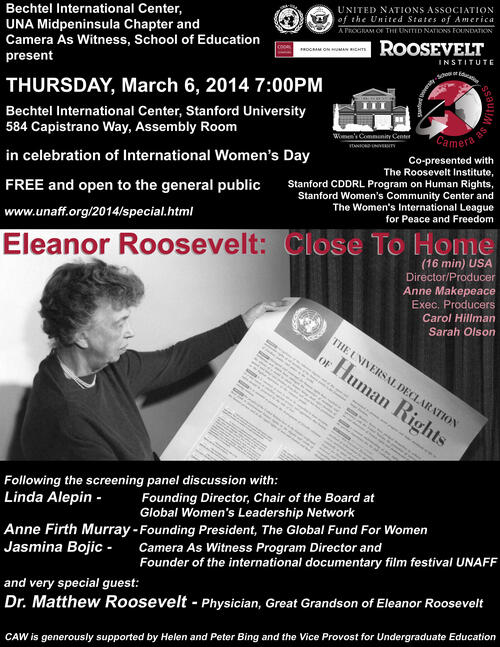
Eleanor Roosevelt: Close to Home is an overview of the inspirational life of Eleanor Roosevelt and highlights her dedication as champion of social justice and racial equality. The film introduces viewers to Val-Kill, the home of this extraordinary American who became a world leader in human rights and creator of the Universal Declaration of Human Rights. The remarkable modesty, independence and humanitarian leadership that made Eleanor Roosevelt the "First Lady of the World" are reflected in the Cottage's rooms, furnishings and surroundings. No other place allows visitors to connect with, rediscover and appreciate anew this woman whose influence is still so widely felt.

Following the screening, there will be a panel discussion.

This event is co-presented with the CDDRL Program on Human Rights, Roosevelt Institute, Stanford Women's Community Center and Women's International League for Peace and Freedom and sponsored by the Bechtel International Center, UNA Midpeninsula Chapter and Camera As Witness, Stanford Graduate School of Education in celebration of International Women's Day. 

Bechtel International Center
Assembly Room
Stanford University
584 Capistrano Way

Linda Alepin Founding Director, Chair of the Board Speaker Global Women's Leadership Network
Anne Firth Murray Founding President Speaker The Global Fund For Women
Jasmina Bojic Camera As Witness Program Director and Founder of the international documentary film festival UNAFF Speaker
Dr. Matthew Roosevelt Physician Speaker Great Grandson of Eleanor Roosevelt
Conferences
News Type
News
Date
Paragraphs

At a CDDRL event on February 3, human rights activist Virak Ou, president of the Cambodian Center for Human Rights, discussed the recent protests in Cambodia, addressing the potential conditions for revolution.

Hero Image
OU LOGO
Virak Ou, human rights activist, speaks on the prospect of revolution in Cambodia. Photo taken in Encina Hall at Stanford University.
Christian Ollano
All News button
1
-

*This event is free and open to the public.*


PANELISTS

Don Emmerson - Director of the Southeast Asia Forum, Shorenstein Asia-Pacific Research Center; Affiliated Scholar, Abbasi Program in Islamic Studies; Affiliated Faculty, CDDRL

Erik Jensen - Professor of the Practice of Law, Stanford Law School; Senior Advisor for Governance and Law, The Asia Foundation; Senior Research Scholar, CDDRL; Director, Rule of Law Program, Stanford Law School

Norman Naimark - Director of the Stanford Global Studies Division; Professor of History

Diane H. Steinberg (Panel Chair) - Visiting Scholar at Stanford's Program on Human Rights, Center on Democracy, Development, and the Rule of Law (CDDRL)


Image

 
The Act of Killing visits former Indonesian death squad killers who wreaked havoc in 1965 and 1966 in the aftermath of Indonesia's military coup and yet have never been held accountable for slaughtering between 200,000 to 2 million people in a genocide often forgotten.  The dramatic reenactments of the murders in the documentary catalyze an unexpected emotional journey for Anwar Congo from arrogance to regret as he confronts for the first time in his life the full implications of what he has done.
 
The Act of Killing is an award-winning documentary film directed by Joshua Oppenheimer with co-director Christine Cynn and and an anonymous co-director from Indonesia. It is a Danish-British-Norwegian co-production, presented by Final Cut for Real in Denmark and produced by Signe Byrge Sørensen. It was recently nominated for an Academy Award for Best Documentary Feature.

"Director Joshua Oppenheimer has made a documentary in which he interviews the leaders of Indonesian death squads, who were responsible, collectively, for the deaths of millions of Communists, leftists and ethnic Chinese in 1965 and 1966. But he doesn't just interview them. He has them re-enact their crimes and even invites them to write, perform and film skits dramatizing their murders." Mick LaSalle, San Francisco Chronicle, 8/8/2013
 
"The Act of Killing is a bold reinvention of the documentary form, as well as an astounding illustration of man's infinite capacity for evil." Rene Rodriguez, The Miami Herald, 8/15/2013
 
After the screening of the  Director's Cut of The Act of Killing (160 minutes), there will be a thirty-minute panel discussion.
 
For more information regarding the film, please visit: http://theactofkilling.com/.
 
This event is presented and sponsored by Stanford Global Studies, CDDRL's Program on Human Rights, and the Vice Provost of Undergraduate Education.

Cubberley Auditorium

Conferences
-
We invite you to join Gary Haugen, former director of the UN investigation of the Rwanda Genocide and President and CEO of the International Justice Mission, to discuss his latest book The Locust Effect: Why the End of Poverty Requires the End of Violence. Haugen will discuss the devastating impact that everyday violence is having on the global fight to reduce poverty and how we can help make the poor safe enough to thrive. Haugen has been recognized by the U.S. State Department as a Trafficking in Persons “Hero” – the highest honor given by the U.S. government for anti-slavery leadership. Book purchase and signing available.
 

Book purchase and signing available.

Image


This event is sponsored by: IJM, Bay Area Anti-Trafficking Coalition & the Stanford Program on Human Rights.


For more Information please contact:

Betty Ann Boeving   bettyann@baatc.org


Bechtel Conference Center

Gary Haugen President and CEO of International Justice Mission Speaker
Conferences
-

Abstract
Social media and new technology are being harnessed for social benefit in contexts from healthcare, economic development, and sustainable energy to civic engagement and government transparency in California and worldwide. The Center for Information Technology Research in the Interest of Society (CITRIS) takes an interdisciplinary approach to addressing these problems and promoting innovation for students, faculty and entrepreneurs. In this talk, I will give a short overview of CITRIS's programs and initiatives, before diving into specific projects in the areas I lead: the Data and Democracy Initiative and the Social Apps Lab.

Camille Crittenden joined the Data and Democracy Initiative as Director in May 2012 and was named Deputy Director of CITRIS in May 2013. Prior to this appointment, she served as Executive Director of the Human Rights Center at Berkeley Law, where she was responsible for overall administration of the Center, including fundraising, communications, and outreach, and helped to develop its program in human rights, technology, and new media. She held previous positions as Assistant Dean for Development in the division of International and Area Studies at UC Berkeley and in development and public relations at University of California Press and San Francisco Opera. She holds a Ph.D. from Duke University.


Wallenberg Theater

Camille Crittenden Deputy Director, CITRIS & Director, Data and Democracy, CITRIS Speaker UC Berkeley
UC Berkeley


Speaker
Speaker


Speaker
Seminars
Date Label
-

This event is co-sponsored by the Stanford Center for East Asian Studies.


Abstract: 

Virak Ou will discuss the possibility and demographic underpinnings of a so-called “Cambodian Spring” — and will offer suggestions for what the international community can do to assist Cambodians during this transitional, tense time.   


Speaker Bio: 

Human rights activist and intellectual Virak Ou is the president of the Cambodian Center for Human Rights (CCHR), one of Cambodia’s most prominent human rights organizations. Ou is the recipient of the 2007 Reebok Human Rights Award for his campaign to free activists and decriminalize defamation in Cambodia. He is also the founder of the Alliance for Freedom of Expression in Cambodia, otherwise known as AFEC. He is a survivor of the Cambodian Khmer Rouge era and was a child refugee before settling in the United States in 1989. Ou holds an MA in economics from San Jose State University.   

Cambodia is currently experiencing unprecedented social upheaval, in the wake of the hotly contested elections of last summer. Ou’s CCHR has been at the forefront of advocating for human rights protections and free speech for both sides of the political debate. 


Oksenberg Conference Room

Virak Ou Human Rights Activist Speaker
Seminars
-

Speaker Bio:

John Prendergast is Co-founder of the Enough Project, an initiative to end genocide and crimes against humanity. During the Clinton administration, John was involved in a number of peace processes in Africa while he was director of African Affairs at the National Security Council and special advisor at the Department of State. John has also worked for members of Congress, the United Nations, humanitarian aid agencies, human rights organizations, and think tanks.


Image

CISAC Conference Room

John Prendergast Founder Speaker Enough Project
Seminars
Subscribe to Human Rights