Policy Analysis
Paragraphs

New Challenges for Maturing Democracies in Korea and Taiwan takes a creative and comparative view of the new challenges and dynamics confronting these maturing democracies.

Numerous works deal with political change in the two societies individually, but few adopt a comparative approach—and most focus mainly on the emergence of democracy or the politics of the democratization processes. This book, utilizing a broad, interdisciplinary approach, pays careful attention to post-democratization phenomena and the key issues that arise in maturing democracies.

“As two paradigmatic cases of democratic development, Korea and Taiwan are often seen as exemplars of both modernization and democratization. This volume both contributes and moves beyond this focus, looking forward to assess the maturation but also the risks to democracy in both countries. With its strong comparative focus and a sober appreciation of how hard it can be not to just to attain but to sustain democracy, it represents a major contribution."  

     — Benjamin Reilly, Dean, Sir Walter Murdoch School of Public Policy and International Affairs, Murdoch University

What emerges is a picture of two evolving democracies, now secure, but still imperfect and at times disappointing to their citizens—a common feature and challenge of democratic maturation. The book demonstrates that it will fall to the elected political leaders of these two countries to rise above narrow and immediate party interests to mobilize consensus and craft policies that will guide the structural adaptation and reinvigoration of the society and economy in an era that clearly presents for both countries not only steep challenges but also new opportunities.

_________________________________________________________________________

Larry Diamond is a Senior Fellow at the Hoover Institution and the Freeman Spogli Institute for International Studies at Stanford. He is also Director of Stanford's Center on Democracy, Development, and the Rule of Law. Gi-Wook Shin is Director of the Walter H. Shorenstein Asia-Pacific Research Center, the Tong Yang, Korea Foundation, and Korea Stanford Alumni Chair of Korean Studies, and Professor of Sociology at Stanford.

All Publications button
1
Publication Type
Books
Publication Date
Journal Publisher
Stanford University Press
Authors
Larry Diamond
Number
9780804787437
-

Image


Abstract:

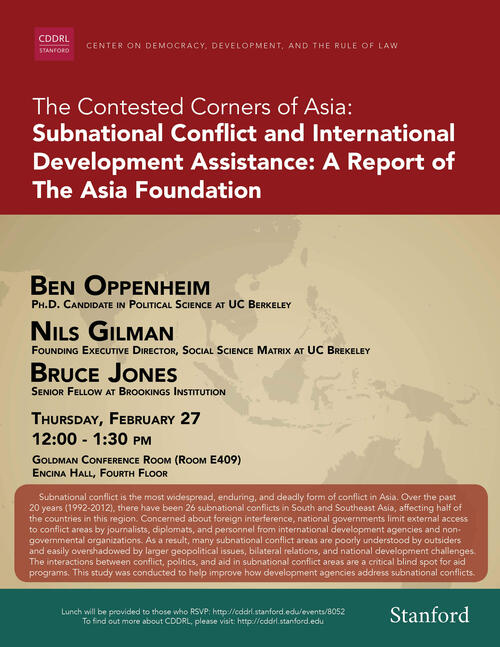
Subnational conflict is the most widespread, enduring, and deadly form of conflict in Asia. Over the past 20 years (1992-2012), there have been 26 subnational conflicts in South and Southeast Asia, affecting half of the countries in this region. Concerned about foreign interference, national governments limit external access to conflict areas by journalists, diplomats, and personnel from international development agencies and non-governmental organizations. As a result, many subnational conflict areas are poorly understood by outsiders and easily overshadowed by larger geopolitical issues, bilateral relations, and national development challenges. The interactions between conflict, politics, and aid in subnational conflict areas are a critical blind spot for aid programs. This study was conducted to help improve how development agencies address subnational conflicts.


Speaker Bios:

Ben Oppenheim is a Fellow (non-resident) at the Center on International Cooperation at New York University. His research spans a diverse set of topics, including fragile states, transnational threats (including pandemic disease risks and terrorism), and the strategic coherence and effectiveness of international assistance in fragile and conflict-affected areas.

Oppenheim has consulted for organizations including the World Bank, the United Nations, the Asia Foundation, the Institute for the Future, and the Fritz Institute, on issues including organizational learning, strategy, program design, foresight, and facilitation. In 2009, he served as Advisor to the first global congress on disarmament, demobilization, and reintegration, supported by the World Bank and the UN.

In 2013, Oppenheim was a visiting fellow at the Uppsala University Forum on Democracy, Peace, and Justice. His research has been supported by a Simpson Fellowship, and a fellowship with the Institute on Global Conflict and Cooperation. He was also a research fellow with UC Berkeley's Institute of International Studies, affiliated with the New Era Foreign Policy Project.


Nils Gilman is the Executive Director of Social Science Matrix. He holds a B.A., M.A. and Ph.D. in History from the University of California, Berkeley. Gilman’s first scholarly interest was in American and European intellectual history, with a particular focus on the institutional development of the social sciences, the lateral transfer and translation of ideas across disciplinary boundaries, and the impact of social scientific ideas on politics and policy.

Gilman is the author of Mandarins of the Future: Modernization Theory in Cold War America (Johns Hopkins University Press, 2004), the co-editor of Staging Growth: Modernization, Development, and the Global Cold War (University of Massachusetts Press, 2003) and Deviant Globalization: Black Market Economy in the 21st Century (Continuum Press, 2011), as well as the founding Co-editor of Humanity: An International Journal of Human Rights, Humanitarianism, and Development. He also blogs and tweets.

Prior to joining Social Science Matrix in September 2013, Gilman was research director at Monitor 360, a San Francisco consultancy that addresses complex, cross-disciplinary global strategic challenges for governments, multinational businesses, and NGOs. He has also worked at a variety of enterprise software companies, including Salesforce.com, BEA Systems, and Plumtree Software. Gilman has taught and lectured at a wide variety of venues, from the Harvard University, Columbia University, and National Defense University, to PopTech, the European Futurists Conference, and the Long Now Foundation.


Bruce Jones is a senior fellow and the director of the Project on International Order and Strategy in the Foreign Policy program at the Brookings Institution. He is also the director of the Center on International Cooperation at New York University.

Jones served as the senior external advisor for the World Bank’s 2011 World Development Report, Conflict, Security and Development, and in March 2010 was appointed by the United Nations secretary-general as a member of the senior advisory group to guide the Review of International Civilian Capacities. He is also consulting professor at the Center for International Security and Cooperation at Stanford University and professor (by courtesy) at New York University’s department of politics.

Jones holds a Ph.D. from the London School of Economics, and was Hamburg fellow in conflict prevention at Stanford University.

He is co-author with Carlos Pascual and Stephen Stedman of Power and Responsibility: Building International Order in an Era of Transnational Threats (Brookings Press, 2009); co-editor with Shepard Forman and Richard Gowan of Cooperating for Peace and Security (Cambridge University Press, 2009); and author of Peacemaking in Rwanda: The Dynamics of Failures(Lynne Reinner, 2001).

Jones served as senior advisor in the office of the secretary-general during the U.N. reform effort leading up to the World Summit 2005, and in the same period was acting secretary of the Secretary-General’s Policy Committee. In 2004-2005, he was deputy research director of the High-level Panel on Threats, Challenges and Change. From 2000-2002 he was special assistant to and acting chief of staff at the office of the U.N. special coordinator for the Middle East peace process. 

Richard and Rhoda Goldman Conference Room

Ben Oppenheim Ph.D. Candidate in Political Science Speaker UC Berkeley
Nils Gilman Founding Executive Director, Social Science Matrix Speaker UC Berkeley
Bruce Jones Senior Fellow Speaker Brookings Institution
Seminars
-


Image

Abstract:

Scholars of state development have paid insufficient attention to the question of regionalism; too often modeling state-building as the extension of the authority of a 'center' over peripheral territories, and too often linking regionalism to cultural or ethnic heterogeneity. A purely spatial account of the challenges to central control shows that even in the absence of cultural fractionalization, the presence of economically powerful and politically salient regions undermines political development. Three analytically distinct mechanisms - divergent public good preferences, economic self-sufficiency, and institutional design - underlie this relationship. I explore these issues through a region-wide analysis of Latin America, and case studies of the United States, Ecuador, Colombia, and early modern Poland.

Speaker Bio:

Hillel David Soifer earned his PhD in the Government Department at Harvard, and is currently Assistant Professor of Political Science at Temple University. His research has been centered in Latin America, with a focus on political development and state capacity, and has been published in journals including Latin American Research Review and Comparative Political Studies. He is currently completing a book on the long-term divergence in state capacity in Latin America which contrasts the cases of Chile, Colombia, Mexico, and Peru.

Encina Ground Floor Conference Room

Hillel Soifer Assistant Professor of Political Science Speaker Temple University
Seminars
-

Abstract:

We design an original laboratory experiment to investigate whether redistributive actions hinder the formation of Pareto-improving groups. We test, in an anonymous setting with no feedback, whether people choose to destroy or steal the endowment of others and whether they choose to give to others, when granted the option. We then test whether subjects join a group that increases their endowment but exposes them to redistribution. We conduct the experiment in three very different settings with a priori different norms of pro-social behavior: a university town in the UK, the largest slum in Nairobi, Kenya and rural Uganda. We find a lot of commonality but also large differences between sites. UK subjects behave in a more selfish and strategic way -- giving less, stealing more. Kenyan and Ugandan subjects behave in a more altruistic and less strategic manner. However, pro-social norms are not always predictive of joining behavior. African subjects are less likely to join a group when destruction or stealing is permitted. It is as if they are less trusting even though they are more trustworthy. These findings contradict the view that African underdevelopment is due to a failure of generalized morality. 


Speaker Bio:

Marcel Fafchamps is senior fellow at the Freeman Spogli Institute for International Studies and member of the Center on Democracy, Development and the Rule of Law. Before joining FSI, he served as Professor of Development Economics at Oxford University and as Deputy Director of the Center for the Study of African Economies. Before that he taught at Stanford University. He also worked for the International Labour Organization in Africa. His research focuses on market institutions and social networks, writ large. Fafchamps holds a PhD from UC Berkeley and degrees in Law and in Economics from the Catholic University of Louvain.


Encina Ground Floor Conference Room

Encina Hall
616 Jane Stanford Way
Stanford, CA 94305-6055

0
Senior Fellow Emeritus at the Freeman Spogli Institute for International Studies
Professor, by courtesy, of Economics
marcel_fafchamps_2025.jpg

Marcel Fafchamps is a Senior Fellow Emeritus at the Freeman Spogli Institute for International Studies (FSI) and a member of the Center on Democracy, Development and the Rule of Law. Previously, he was the Satre Family Senior Fellow at FSI. Fafchamps is a professor (by courtesy) for the Department of Economics at Stanford University. His research interests include economic development, market institutions, social networks, and behavioral economics — with a special focus on Africa and South Asia.

Prior to joining FSI, from 1999-2013, Fafchamps served as professor of development economics in the Department of Economics at Oxford University. He also served as deputy director and then co-director of the Center for the Study of African Economies. From 1989 to 1996, Fafchamps was an assistant professor with the Food Research Institute at Stanford University. Following the closure of the Institute, he taught for two years at the Department of Economics. For the 1998-1999 academic year, Fafchamps was on sabbatical leave at the research department of the World Bank. Before pursuing his PhD in 1986, Fafchamps was based in Addis Ababa, Ethiopia, for 5 years during his employment with the International Labour Organization, a United Nations agency that oversees employment, income distribution, and vocational training in Africa.

He has authored two books: Market Institutions in Sub-Saharan Africa: Theory and Evidence (MIT Press, 2004) and Rural Poverty, Risk, and Development (Elgar Press, 2003), and has published numerous articles in academic journals.

Fafchamps served as the editor-in-chief of Economic Development and Cultural Change until 2020. Previously, he had served as chief editor of the Journal of African Economies from 2000 to 2013, and as associate editor of the Economic Journal, the Journal of Development Economics, Economic Development and Cultural Change, the American Journal of Agricultural Economics, and the Revue d'Economie du Développement.

He is a research associate of the National Bureau of Economic Research, an affiliated professor with J-PAL, a senior fellow with the Bureau for Research and Economic Analysis of Development, a research fellow with IZA, Germany, and with the Center for Economic and Policy Research, UK, and an affiliate with the University of California’s Center for Effective Global Action.

Fafchamps has degrees in Law and in Economics from the Université Catholique de Louvain. He holds a PhD in Agricultural and Resource Economics from the University of California, Berkeley. 

Curriculum Vitae

Publications 

Working Papers

Date Label
Marcel Fafchamps Senior Fellow Speaker Freeman Spogli Institute for International Studies
Seminars
-

Abstract:
The peoples of Burma/Myanmar have faced military rule, human rights violations, and poor health outcomes for decades. The country Is now undergoing a political liberalization, and multiple changes in political, social and economic life. The human rights and health situation of the country's many ethnic nationalities remain challenging, and represent one of the clearest threats to the prospect of successful transition to peace, and to democracy. We will explore the current health and human rights situation in the country, the ongoing threats to peace, and ways forward for this least developed nation as it emerges from 5 decades of military rule.

Chris Beyrer MD, MPH, is a professor of Epidemiology, International Health, and Health, Behavior, and Society at the Johns Hopkins University Bloomberg School of Public Health. He is the founding Director of the University¹s Center for Public Health and Human Rights, which seeks to bring the tools of population-based sciences to bear on Health and rights threats. Dr. Beyrer also serves as Associate Director of the Johns Hopkins Centers for AIDS Research (CFAR) and of the Center for Global Health. He has been involved in health and human rights work with Burmese populations since 1993. Prof. Beyrer is the author of more than 200 scientific papers, and author or editor of six books, including War in the Blood: Sex, Politics and AIDS in Southeast Asia, and Public Health and Human Rights: Evidence-Based Approaches. He has served as a consultant and adviser to numerous national and international institutions, including the National Institutes of Health, the World Bank, WHO, UNAIDS, the Open Society Foundations, the Walter Reed Army Institute for Research, amfAR The Foundation for AIDS Research, Physicians for Human Rights and Human Rights Watch. Dr. Beyrer received a BA in History from Hobart and Wm. Smith Colleges, his MD from SUNY Downstate in Brooklyn, NY, and completed his residency in Preventive Medicine, public health training, an MPH and a Infectious Diseases Fellowship at Johns Hopkins University in Baltimore. He received an honorary Doctorate (PhD) in Health Sciences from Chiang Mai University in Thailand, in 2012, in recognition of his 20 years of public health service in Thailand

Building 200 (History Corner)
Room 205
Stanford University

Chris Beyrer Director Speaker Johns Hopkins Center for Public Health & Human Rights
Seminars
-


Abstract
Earlier generations of radicals understood themselves to be in an ongoing battle against the privatization of land and water.  They instrumentalized maps in the court system as a tool for battling for native sovereignty over traditional lands, protecting the rights of squatters, and securing access to water by poor farmers in the developing world.   Wherever battles for the commons take the form of a war for access to particular spaces, maps can help, whether activists are striking against high rents in the city, or protecting rivers from pollution.  Today, crowdsourced maps of land, food, and water present an opportunity for makers who want to work in support of a movement. My talk will highlight some of the most and least promising frontiers ahead.

 Professor Jo Guldi is presently Assistant Professor in the History of Britain and its Empire at Brown, where I teach courses related to capitalism, empire, land use, and computation.  Born in Dallas, Texas, I received my AB from Harvard University, and then studied at Trinity College, Cambridge before completing my PhD in History at the University of California, Berkeley, after which I continued on to postdocs at the University of Chicago and the Harvard Society of Fellows.  My first book, Roads to Power: Britain Invents the Infrastructure State (Harvard University Press, 2011), tells the story of how Britain built the first nation connected by infrastructure and technology caused strangers to stop speaking on the public street.  My next monograph, The Long Land War, will tell the story of international land reform movements from the Irish land war to Movimiento sin Tierra, lingering on legal reformers and civil servants, London's dredlocked squatters and their accidental influence on World Bank Policy, and the genesis of participatory mapping from Marxist development economists in the 1970s through radical coders in contemporary Chennai.

Wallenberg Theater

Prof. Jo Guldi Asst Prof., Department of History Speaker Brown University
Seminars
Date Label
-

Speaker bio:

Karl Eikenberry is the William J. Perry Fellow in International Security at the Center for International Security and Cooperation and a faculty member of the Shorenstein Asia-Pacific Research Center at Stanford University.  He is also an affiliated faculty member with the Center for Democracy, Development, and Rule of Law, and researcher with The Europe Center.

Prior to his arrival at Stanford, he served as the U.S. Ambassador to Afghanistan from May 2009 until July 2011, where he led the civilian surge directed by President Obama to reverse insurgent momentum and set the conditions for transition to full Afghan sovereignty.

Before appointment as Chief of Mission in Kabul, Ambassador Eikenberry had a thirty-five year career in the United States Army, retiring in April 2009 with the rank of Lieutenant General.  His military operational posts included commander and staff officer with mechanized, light, airborne, and ranger infantry units in the continental U.S., Hawaii, Korea, Italy, and Afghanistan as the Commander of the American-led Coalition forces from 2005-2007. 

He has served in various policy and political-military positions, including Deputy Chairman of the North Atlantic Treaty Organization (NATO) Military Committee in Brussels, Belgium; Director for Strategic Planning and Policy for U.S. Pacific Command at Camp Smith, Hawaii; U.S. Security Coordinator and Chief of the Office of Military Cooperation in Kabul, Afghanistan; Assistant Army and later Defense Attaché at the United States Embassy in Beijing, China; Senior Country Director for China, Taiwan, Hong Kong and Mongolia in the Office of the Secretary of Defense; and Deputy Director for Strategy, Plans, and Policy on the Army Staff.

He is a graduate of the U.S. Military Academy, has master’s degrees from Harvard University in East Asian Studies and Stanford University in Political Science, and was a National Security Fellow at the Kennedy School of Government at Harvard.

Ambassador Eikenberry earned an Interpreter’s Certificate in Mandarin Chinese from the British Foreign Commonwealth Office while studying at the United Kingdom Ministry of Defense Chinese Language School in Hong Kong and has an Advanced Degree in Chinese History from Nanjing University in the People’s Republic of China. 

His military awards include the Defense Distinguished and Superior Service Medals, Legion of Merit, Bronze Star, Ranger Tab, Combat and Expert Infantryman badges, and master parachutist wings.  He has received the Department of State Distinguished, Superior, and Meritorious Honor Awards, Director of Central Intelligence Award, and Chairman of the Joint Chiefs of Staff Joint Distinguished Civilian Service Award.  He is also the recipient of the George F. Kennan Award for Distinguished Public Service and Harvard University Graduate School of Arts and Sciences Centennial Medal.  His foreign and international decorations include the Canadian Meritorious Service Cross, French Legion of Honor, Afghanistan’s Ghazi Amir Amanullah Khan and Akbar Khan Medals, and the NATO Meritorious Service Medal.

Ambassador Eikenberry serves as a Trustee for the International Institute for Strategic Studies, The Asia Foundation, and the National Committee on American Foreign Policy, and is a Fellow of the American Academy of Arts and Sciences.  He is a member of the Council on Foreign Relations, the American Academy of Diplomacy, and the Council of American Ambassadors, and was previously the President of the Foreign Area Officers Association.  His articles and essays on U.S. and international security issues have appeared in Foreign Affairs, The Washington Quarterly, American Foreign Policy Interests, The New York TimesThe Washington Post, Foreign Policy, and The Financial Times.  He has a commercial pilot’s license and instrument rating, and also enjoys sailing and scuba diving.

Reuben W. Hills Conference Room

Karl Eikenberry William J. Perry Fellow in International Security at CISAC, CDDRL, TEC, and Shorenstein APARC Distinguished Fellow; and Former U.S. Ambassador to Afghanistan and Retired U.S. Army Lt. General Speaker FSI
Seminars
-

Speaker bio:

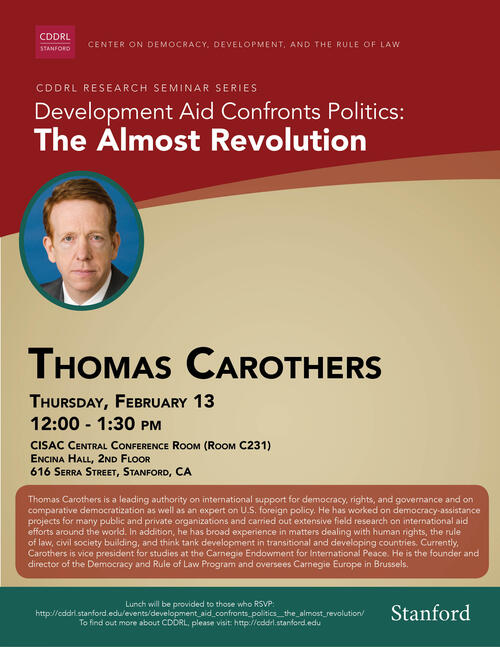
Thomas Carothers is vice president for studies at the Carnegie Endowment for International Peace. He is the founder and director of the Democracy and Rule of Law Program and oversees Carnegie Europe in Brussels.

Carothers is a leading authority on international support for democracy, rights, and governance and on comparative democratization as well as an expert on U.S. foreign policy. He has worked on democracy-assistance projects for many public and private organizations and carried out extensive field research on international aid efforts around the world. In addition, he has broad experience in matters dealing with human rights, the rule of law, civil society building, and think tank development in transitional and developing countries.

He is the author of six critically acclaimed books as well as many articles in prominent journals and newspapers. Carothers has also worked extensively with the Open Society Foundations (OSF), including currently as chair of the OSF Think Tank Fund and previously as chair of the OSF Global Advisory Board. He is an adjunct professor at the Central European University in Budapest and was previously a visiting faculty member at Nuffield College, Oxford University, and Johns Hopkins SAIS.

Prior to joining the Endowment, Carothers practiced international and financial law at Arnold & Porter and served as an attorney adviser in the Office of the Legal Adviser of the U.S. Department of State.

Carothers is the co-author (with Diane de Gramont) of Development Aid Confronts Politics: The Almost Revolution (Carnegie, 2013) and author of Confronting the Weakest Link: Aiding Political Parties in New Democracies (Carnegie, 2006); Promoting the Rule of Law Abroad: In Search of Knowledge (Carnegie, 2006); Uncharted Journey: Promoting Democracy in the Middle East, co-edited with Marina Ottaway (Carnegie, 2005); Critical Mission: Essays on Democracy Promotion (Carnegie, 2004); Funding Virtue: Civil Society Aid and Democracy Promotion, co-edited with Marina Ottaway (Carnegie, 2000); Aiding Democracy Abroad: The Learning Curve (Carnegie, 1999); and Assessing Democracy Assistance: The Case of Romania (Carnegie, 1996).

Image

CISAC Conference Room

Thomas Carothers Vice President for Studies Speaker Carnegie Endownment for International Peace
Seminars

Encina Hall
616 Jane Stanford Way
Stanford, CA 94305-6055

0
Senior Fellow Emeritus at the Freeman Spogli Institute for International Studies
Professor, by courtesy, of Economics
marcel_fafchamps_2025.jpg

Marcel Fafchamps is a Senior Fellow Emeritus at the Freeman Spogli Institute for International Studies (FSI) and a member of the Center on Democracy, Development and the Rule of Law. Previously, he was the Satre Family Senior Fellow at FSI. Fafchamps is a professor (by courtesy) for the Department of Economics at Stanford University. His research interests include economic development, market institutions, social networks, and behavioral economics — with a special focus on Africa and South Asia.

Prior to joining FSI, from 1999-2013, Fafchamps served as professor of development economics in the Department of Economics at Oxford University. He also served as deputy director and then co-director of the Center for the Study of African Economies. From 1989 to 1996, Fafchamps was an assistant professor with the Food Research Institute at Stanford University. Following the closure of the Institute, he taught for two years at the Department of Economics. For the 1998-1999 academic year, Fafchamps was on sabbatical leave at the research department of the World Bank. Before pursuing his PhD in 1986, Fafchamps was based in Addis Ababa, Ethiopia, for 5 years during his employment with the International Labour Organization, a United Nations agency that oversees employment, income distribution, and vocational training in Africa.

He has authored two books: Market Institutions in Sub-Saharan Africa: Theory and Evidence (MIT Press, 2004) and Rural Poverty, Risk, and Development (Elgar Press, 2003), and has published numerous articles in academic journals.

Fafchamps served as the editor-in-chief of Economic Development and Cultural Change until 2020. Previously, he had served as chief editor of the Journal of African Economies from 2000 to 2013, and as associate editor of the Economic Journal, the Journal of Development Economics, Economic Development and Cultural Change, the American Journal of Agricultural Economics, and the Revue d'Economie du Développement.

He is a research associate of the National Bureau of Economic Research, an affiliated professor with J-PAL, a senior fellow with the Bureau for Research and Economic Analysis of Development, a research fellow with IZA, Germany, and with the Center for Economic and Policy Research, UK, and an affiliate with the University of California’s Center for Effective Global Action.

Fafchamps has degrees in Law and in Economics from the Université Catholique de Louvain. He holds a PhD in Agricultural and Resource Economics from the University of California, Berkeley. 

Curriculum Vitae

Publications 

Working Papers

Date Label
-

Kavita Srivatsava, one of India's leading activists will be joining us for an informal conversation on activism around hunger, peace and justice in India.  Kavita is Secretary of People's Union for Civil Liberties, that has been at the forefront of the struggle for civil, political and socio-economic justice in India.  She is the petitioner in the internationally renowned ‘Right to food’ litigation in the Supreme Court of India, one of the most impactful socio-economic litigations in India.  She has also played a prominent role in women's movements in Rajasthan and has worked on numerous cases of violence against women. 

In addition these core issues, Kavita has also worked on issues such as communal violence, landmines in the Indo-Pak border, election monitoring in Kashmir, supporting Dalits networks an on practically every major social issue in North India.  Come join us for an informal conversation on hunger, peace and justice with this versatile activist.

Time: 3 pm

Date: 12 Nov, 2013 (Tuesday)

Location: E008 Encina Hall (East)

Supported by:

Center on Democracy, Development and the Rule of Law

Center for South Asia

San Jose Peace and Justice Center

E 008, Encina Hall (East)
616 Serra St., Stanford University

Kavita Srivastava Secretary Speaker People's Union for Civil Liberties
Seminars
Subscribe to Policy Analysis