


Countering Violent Extremism
-
Abstract
Under Secretary Sewall will deliver remarks on Countering Violent Extremism, the U.S. Government’s comprehensive approach for preventing the spread of ISIL and emergence of new terrorist threats. The Under Secretary will describe how the evolution of violent extremism since the 9/11 attacks necessitates a “whole of society” approach to prevent people from aligning with terrorist movements and ideologies in the first place. Drawing on recent travel to Indonesia, India, and Egypt, the Under Secretary will describe the vital role of actors outside government in this approach, including women, youth, religious leaders, businesses, and researchers. She will also elaborate on new steps the U.S. Government is taking to intensify its CVE efforts around the world. The Under Secretary will also take questions from the audience.
Speaker bio
Image

Dr. Sarah Sewall is the Under Secretary for Civilian Security, Democracy, and Human Rights at the U.S. State Department, and is a longtime advocate for advancing civilian security and human rights around the world. Dr. Sewall was sworn in on February 20, 2014. She serves concurrently as the Special Coordinator for Tibetan Issues. Over the previous decade, Dr. Sewall taught at the Harvard Kennedy School of Government, where she served as Director of the Carr Center for Human Rights Policy and directed the Program on National Security and Human Rights.
Dr. Sewall has extensive experience partnering with the U.S. armed forces around civilian security. At the Kennedy School, she launched the MARO (Mass Atrocities Response Operations Project) to assist the U.S. military with contingency planning to protect civilians from large-scale violence. She was a member of the Defense Policy Board and served as the Minerva Chair at the Naval War College in 2012. She also led several research studies of U.S. military operations for the Department of Defense and served as the inaugural Deputy Assistant Secretary of Defense for Peacekeeping and Humanitarian Assistance in the Clinton Administration. Prior joining the executive branch, Dr. Sewall served for six years as the Senior Foreign Policy Advisor to U.S. Senate Majority Leader George J. Mitchell and earned a Ph.D at Oxford University, where she was a Rhodes Scholar.
This event is co-sponsored by Stanford in Government and CISAC.
[[{"fid":"222126","view_mode":"crop_870xauto","fields":{"format":"crop_870xauto","field_file_image_description[und][0][value]":"Sewall Flyer","field_file_image_alt_text[und][0][value]":"","field_file_image_title_text[und][0][value]":"","field_credit[und][0][value]":"","field_caption[und][0][value]":"","field_related_image_aspect[und][0][value]":"","thumbnails":"crop_870xauto"},"type":"media","attributes":{"width":"870","class":"media-element file-crop-870xauto"}}]]
Dr. Sarah Sewall
Under Secretary for Civilian Security, Democracy, and Human Rights
U. S. State Department
Lectures
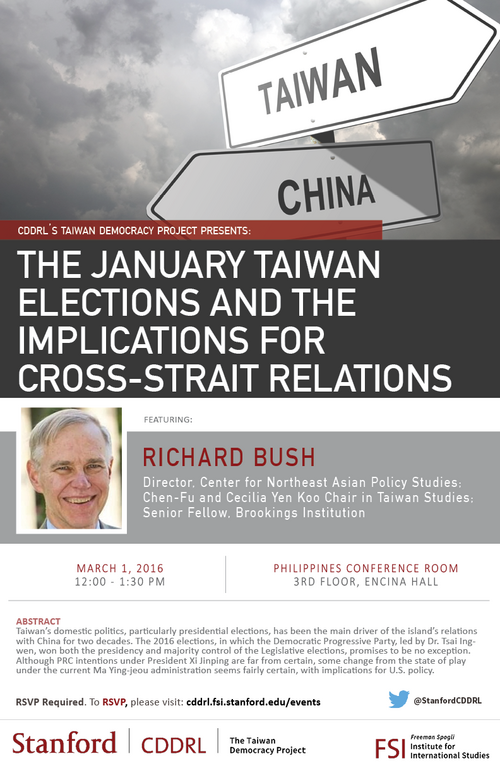
The January Taiwan Elections and the Implications for Cross-Strait Relations
-
Abstract
Taiwan’s domestic politics, particularly presidential elections, has been the main driver of the island’s relations with China for two decades. The 2016 elections, in which the Democratic Progressive Party, led by Dr. Tsai Ing-wen, won both the presidency and majority control of the Legislative elections, promises to be no exception. Although PRC intentions under President Xi Jinping are far from certain, some change from the state of play under the current Ma Ying-jeou administration seems fairly certain, with implications for U.S. policy.
Bio
Richard Bush is a Senior Fellow at the Brookings Institution and Director of its Center for Northeast Asian Policy Studies, and the Chen-Fu and Cecilia Yen Koo Chair in Taiwan Studies. He came to Brookings in July 2002 after nineteen years working in the US government, including five years as the Chairman and Managing Director of the American Institute in Taiwan. He is the author of a number of articles on U.S. relations with China and Taiwan, and of At Cross Purposes, a book of essays on the history of America’s relations with Taiwan, published in March 2004 by M. E. Sharpe. In the spring of 2005, Brookings published his study on cross-Strait relations, entitled Untying the Knot: Making Peace in the Taiwan Strait. In 2013, Brookings published his Uncharted Strait: The Future of China-Taiwan Relations.
This talk is co-sponsored by the Taiwan Democracy Project in the Center on Democracy, Development, and the Rule of Law and the U.S.-Asia Security Initiative in the Walter H. Shorenstein Asia-Pacific Research Center.
Image
Richard C. Bush
Senior Fellow and Director, Center for East Asian Policy Studies
Brookings Institution
Seminars
The Russian Intervention in Syria and its Implication on the Syrian Crisis
-
Abstract
After five years of political support for the regime of Bashar Al-Asad in its war against the opposition, Russia intervened militarily on his behalf in September 2015 and suddenly later this year Russian President Vladimir Putin announced the withdrawal of the Russian troops from Syria. While Moscow claims that its intervention was aimed at destroying ISIS and other terrorists groups, but the vast majority of its air strikes seem to target the moderate armed opposition, which has fought ISIS on the ground. This presentation assesses the outcome of Russia’s intervention, arguing that it neither achieved its goal of destroying ISIS nor did it tip the balance favor of Asad. Instead, the intervention had resulted in the killing of Syrian civilians, complicated the conflict in Syria, and constrained the prospects for a political solution by empowering Asad on the ground.
Speaker Bio
Image

CISAC Central Conference Room
Encina Hall, 2nd Floor
616 Serra St
Stanford, CA 94305
Radwan Ziadeh
Arab Center, Washington, DC
Seminars
Causes and Dynamics of the Syrian Uprising: From Civil Protests to the Implications of the Russian Intervention
-
Abstract
After nearly five years since the start of the uprising, Syria finds itself divided and embattled, with no end in sight. More significantly, more than half of the Syrian population is displaced and the death toll surpassed 300,000 by all counts. The Syrian tragedy persists and, more than any other case of mass uprising in the region, continues to be shrouded in political power-plays and contradictions at the local, regional, and international levels. Defined increasingly by an absence of a clear favorable outcome, considering existing parties to the conflict, the logic of the lesser evil reigns supreme. This lecture is an attempt to understand the roots and dynamics of the tragic Syrian uprising, with particular attention to its background and to the recent Russian intervention.
Speaker Bio
Image
This event is co-sponsored by The Markaz: Resource Center at Stanford University.
[[{"fid":"221861","view_mode":"crop_870xauto","fields":{"format":"crop_870xauto","field_file_image_description[und][0][value]":"Bassam Haddad January 21","field_file_image_alt_text[und][0][value]":"","field_file_image_title_text[und][0][value]":"","field_credit[und][0][value]":"","field_caption[und][0][value]":"","field_related_image_aspect[und][0][value]":"","thumbnails":"crop_870xauto"},"type":"media","attributes":{"width":"870","class":"media-element file-crop-870xauto"}}]]
CISAC Central Conference Room
Encina Hall, 2nd Floor
616 Serra St
Stanford, CA 94305
Bassam Haddad
Associate Professor
George Mason University
Seminars
FSI scholars offer insight on historic China-Taiwan talks
News Type
Q&As
Date
Paragraphs
In the wake of the recent historic meeting of the leaders of China and Taiwan, the Stanford News Service asked two of the university's Asia experts about the aftermath of that meeting and its possible effects on political relations between the two countries, the military situation and Taiwan's Jan. 16 presidential and parliamentary elections.
The first presidential meeting between the leaders of the communist mainland and the democratic island, split by civil war in 1949, was held in early November on neutral territory in Singapore.
Kharis Templeman is the Taiwan Democracy program manager at Stanford's Center on Democracy, Development, and the Rule of Law at the Freeman Spogli Institute for International Studies. He recently wrote about why Taiwan's defense spending has fallen as China's has risen. Thomas Fingar is a distinguished fellow at Stanford's Walter H. Shorenstein Asia-Pacific Research Center. He served as the chairman of the National Intelligence Council and in other key positions in Washington.
Do you anticipate any lasting effects from the face-to-face meeting of Chinese leader Xi Jinping and Taiwanese President Ma Ying-jeou?
Thomas Fingar: At a minimum, the meeting appears intended by both sides to validate and lock in the much-improved cross-Taiwan Strait relationship that has evolved over the past several years.
Kharis Templeman: I do think the Ma-Xi meeting itself will have one lasting legacy: it has created a precedent for treating the directly elected president of the Republic of China as an equal and as the rightful representative of Taiwanese interests in cross-strait relations. From now on, leaders in Beijing are going to have a hard time arguing that a non-KMT (the Kuomintang, Taiwan's governing party,) president is illegitimate, as they did during the [former Taiwanese president] Chen Shui-Bian era, or to continue to insist on referring to Taiwan’s leaders as provincial-level officials. So, the next president will come into office somewhat strengthened by that precedent.
Will the meeting have any effect on the January elections in Taiwan?
Templeman: I don’t think it will make much, if any, difference. Taiwanese public opinion is deeply divided about Ma Ying-Jeou’s meeting with Xi. Ma himself remains quite unpopular, the economy is barely growing, and the KMT presidential candidate remains at least 20 points behind in the polls. There’s little indication that this meeting has shaken up what has been a large and steady lead for DPP (Democratic Progressive Party) presidential candidate Tsai Ing-Wen, and I would be shocked if she didn’t win a comfortable victory in January.
Fingar: Probably not. Beijing seems to have learned that its past attempts to influence elections on Taiwan have been ineffectual or counterproductive, and the meeting is unlikely to change minds or votes on the island.
How might the elections affect military spending on either sides, or China's aggressive island-building for military bases?
Fingar: The meeting will not have any effect on military spending or the building of artificial islands in the South China Sea, but Beijing may have hoped that agreeing to meet with Ma to demonstrate how "good" the relationship is might persuade Washington not to approve another round of arms sales to Taiwan. Regardless of who wins the election on Taiwan, the next administration is likely to seek another round of U.S. arms sales in order to prove that it has the support of the United States.
Templeman: The meeting will have no impact on the security balance in the region. Ma reportedly raised the issue of PRC (People's Republic of China) missiles within easy range of Taiwan, but Xi claimed, implausibly, that they were not targeted at Taiwan, and that was the end of it. The broader trends are unchanged: the PRC’s military budget is growing annually by double-digit rates while Taiwan’s remains essentially flat. The consequence is that the PRC’s capacity to take coercive measures against Taiwan continues to expand, even as cross-strait cooperation has been improved and institutionalized.
Dan Stober is at the Stanford News Service.
Hero Image

Taiwanese President Ma Ying-jeou meets with Chinese President Xi Jinping in Singapore on Nov. 7, 2015.
Flickr/Office of the President Republic of China (Taiwan)
All News button
1
Syria today, Syria tomorrow: Politics, security, and society
-
Abstract:
The Syrian crisis continues to grind on without a viable settlement to the conflict in sight. The problems spurred by the crisis, from refugees to extremist groups, have become a tangible concern for the West, not just Middle Eastern countries. Meanwhile, from Russia to Iran to Saudi Arabia, Turkey, and Qatar, several countries have turned Syria into a political and military playground. The lack of strategy to end the conflict on part of the USA, Europe, and the United Nations has paved the way for those state and non-state actors to increase the scope of their actions in Syria. The continuation of this dynamic can only mean further instability across the Middle East and beyond.
This talk links the international relations, security, and social dimensions of the Syrian conflict to address how and why the crisis has reached the level it is at today, with a focus on the role of external stakeholders as well as of rising extremist groups. It will reflect on how a settlement to the conflict might be reached and what the implications of a settlement would be for the Middle East.
Bio:
Image

This event is sponsored by CDDRL's Program on Arab Reform and Democracy.
[[{"fid":"221011","view_mode":"crop_870xauto","fields":{"format":"crop_870xauto","field_file_image_description[und][0][value]":"","field_file_image_alt_text[und][0][value]":"","field_file_image_title_text[und][0][value]":"","field_credit[und][0][value]":"","field_caption[und][0][value]":"","field_related_image_aspect[und][0][value]":"","thumbnails":"crop_870xauto"},"type":"media","attributes":{"width":"870","class":"media-element file-crop-870xauto"}}]]
CISAC Central Conference Room
Encina Hall, 2nd Floor
616 Serra St
Stanford, CA 94305
Lina Khatib
Arab Reform Initiative
Seminars
Where's Taiwan on the Trans-Pacific Partnership?
News Type
Blogs
Date
Paragraphs
With the announcement on Monday that an agreement has been reached on the Trans-Pacific Partnership (TPP), the controversial trade accord is in the news all across Asia this week. Taiwan is not one of the founding participants, but its leaders have reiterated their determination to join the next round of negotiations if the agreement is ratified and comes into effect. Taiwan's prospects for entry remain uncertain, however, and will depend to a great degree on the attitudes of decision-makers in the United States and the People's Republic of China.
The Taiwan Democracy Project (TDP) at the Center on Democracy, Development, and the Rule of Law has been at the forefront of research and discussion on this topic. In the fall of 2013, the TDP held a conference to explore the prospects for Taiwan’s participation in the TPP that brought together policymakers and scholars from Taiwan along with with leading specialists from other Asian countries and the U.S. The key findings of the conference are summarized in a conference report. The key conclusions of the conference remain valid today: it is in Taiwan's national interest to join the TPP; external obstacles to Taiwan's accession to the partnership are signficant but not insurmountable; and Taiwanese policy-makers need to worry about domestic obstacles as much as international ones in seeking TPP membership.
The Taiwan Democracy Project will continue to monitor TPP-related developments over the coming months and plans to revisit Taiwan's prospects for TPP entry in a symposium in February 2016.
Hero Image

Container ship, Hyundai Freedom, at the Port of Kaohsiung.
Tommy Ian
All News button
1
Of Paradigms, Politics and Principles: The 2016 Taiwan Elections and Implications for China’s Security Strategy and Cross-Strait Relations
-
Sponsored by the Taiwan Democracy Project and the U.S. Asia Security Initiative at the Asia-Pacific Research Center (APARC)
Abstract
During the recent meeting between PRC President Xi Jinping and Taiwan President Ma Ying-jeou, the “1992 One China Consensus” served as a mutually acceptable paradigm for maintaining “peaceful and stable” conditions across the Taiwan Strait. For Xi Jinping, the warmth of the visit thinly veiled a message to Taiwan’s leaders and electorate, as well as to onlookers in Washington. Chinese officials and media clearly link the talks and confirmation of the 1992 Consensus to “the great rejuvenation of the Chinese nation”—a concept that is increasingly unpalatable to many in Taiwan. Xi hopes to keep DPP presidential candidate Tsai Ing-wen (and perhaps even future KMT leaders) in the 1992 Consensus “box” and to co-opt the U.S. in this effort, but perhaps underestimates the political transformation underway on Taiwan.
The Xi administration has also hardened its position regarding “core interests” such as Taiwan, embodied in a “bottom line principle” policy directive that eschews compromise. Although many commentators and most officials across the region have shied away from stating that the PRC and Taiwan are at the crossroads of crisis, the collision of political transformation on Taiwan and the PRC’s “bottom line principle” will challenge the fragile foundations of peaceful cross-Strait co-existence. Changes in the regional balance of military power brought about by a more muscular People’s Liberation Army compounds the potential for increased friction, providing Beijing with more credible options for coercion and deterrence.
This talk will consider the politics and principles involved in cross-Taiwan Strait relations in light of the upcoming 2016 Taiwan elections and the policies of the Xi Jinping administration; and will discuss some of the possible implications for China’s national security policy, regional stability, and the future of cross-Strait relations.
Bio
Image

2016 Taiwan Elections and Implications for Cross-Strait and Regional Security
Download pdf
Cortez Cooper
Senior International Policy Analyst
RAND Corporation
Seminars
The Possible Approaches for Defusing Tensions in the South China Sea: A Taiwanese Perspective
-
In this talk, Wellington Shih will provide a historical and legal overview of the Republic of China’s territorial claims in the South China Sea. He will also review the latest developments in the ongoing dispute between the People’s Republic of China, the ROC on Taiwan, and other claimants in the region, including the Philippines, and discuss the South China Sea Peace Initiative proposed by the administration of President Ma Ying-jeou.
The Possible Approaches for Defusing Tensions in the South China Sea: A Taiwanese Perspective
Download pdf
Visiting scholar
Ministry of Foreign Affairs, Republic of China (Taiwan)
Lectures