Diplomacy
News Type
News
Date
Paragraphs
Hans Blix, the U.N.'s chief weapons inspector from 2000-03, led the inspections in Iraq prior to the U.S. invasion. On the five-year anniversary of the invasion, Dr. Blix spoke with Rebecca Tuhus-Dubrow, associate editor of Boston Review Books, about what makes a good diplomat, the Iraq inspections, and his new book from Boston Review Books calling for new, global disarmament efforts. He will discuss his book, Why Nuclear Disarmament Matters, at a special Program on Global Justice workshop Friday, April 4.

How did you get involved in diplomacy and inspection work?

I had originally intended to become a professor. I took a PhD at Cambridge and I also studied at Columbia University for two years. Then as I got back to Stockholm and did some teaching, I was asked to come in as a consultant to the Foreign Ministry, and gradually I got gobbled up by the ministry.

Can you describe the experience of doing inspections in Iraq?

My job was mainly to make sure that our inspectors had all their rights to do what they needed to do, that they were not stopped. Remember that in the '90s, Iraq frequently stopped inspectors and we suspected that they had something to hide. But in 2002-2003, we were never stopped for any inspection, not even the so-called palaces of Saddam Hussein. I thought that in the '90s sometimes the inspectors from New York had been a bit too Rambo-like, and of course inspectors from the teams often had people from the intelligence side, both from the U.S. and the U.K. We were determined to be completely independent. And I think we were. We were in nobody's pocket.

There were moments which were thrilling. At one point our inspectors found some munitions which had been for chemical weapons. There was no chemical in them, but they had not been declared. For a moment we thought maybe this is the tip of an iceberg, but gradually came to the conclusion that it was floes from an iceberg that had been there.

Preemption is where you see an attack coming, where an attack is imminent... You can take action when the airplanes or the missiles are approaching your territory. Another matter, however, is to attack a foreign country saying that we suspect that they will attack us.

From the beginning, like most people, our gut feelings were that there were weapons of mass destruction, although when we were asked about it we said, we are not here to tell you gut feelings, but to inspect. But as we inspected more and more cases, and did not find any weapons of mass destruction, the gut feeling changed, naturally.

There's a sad feeling about the whole thing that we were not able to have a greater impact. I was sometimes told, or it was assumed, that my phone had been bugged. And my reflection on that is simply that I wish that they had listened better to what I had to say.

There were also things that were amusing.

Do you have any amusing anecdotes you want to share?

Well, I remember that before we were admitted, Kofi Annan tried to bring me into discussions with Iraqis in the spring of 2002, and the Iraqis would have nothing to do with me, because they were negative to inspections, and they called me a spy. Before that they said I was a nonentity. Eventually when they accepted inspection, I was addressed as Your Excellency. So I thought when I became a spy I'd at least been promoted from a nonentity, and then when I was addressed as Your Excellency I'd really arrived.

What do you think is the key to being an effective diplomat?

You have to know your mandate first. In our case that was set by the resolutions, 1284 and 1441. As a lawyer I knew them very well. Our role was to inspect and report to the Security Council. We were not there to tell the Council what it should do. We were, as it were, the police investigation and they were the judges.

The second is that you must know your dossier. The facts. We spent lots of time going through what had happened in the '90s.

The third point I think is to exercise critical thinking, as police investigations do. They have a hypothesis, but you must collect and examine all the evidence. If you do not have the right diagnosis, how can [the] Security Council find the right therapy? This was the error, the big error, in the U.S. and the U.K. They did not have critical minds. They came, and they relied far too much on defectors. And the defectors were not interested in inspection, they were interested in invasion.

It also has to do something with--this is the fourth point--how inspectors behave. As I said I thought sometimes in the '90s the animosity and difficulty that they had in Iraq was due to the conduct of the inspectors--Rambo-style. I said when I took over that we intended to use all the rights that we had under the Security Council resolutions, but we were not there in order to provoke or harass or humiliate the Iraqis. When you ask what is important in diplomacy, I think that one of the most important things is always to avoid humiliation.

You say in your book that the climate for arms control has deteriorated, even as international cooperation has increased in some other areas like health and the environment. Why do you think that is?

The interdependence that results from more communication and transport and increased trade forces the world into a great deal of agreements, because it wouldn't function otherwise. SARS or avian flu or what have you--all this requires cooperation. The body of international law has increased tremendously, and most of it functions without any courts or any threats of sanctions.

We also have basic rules about how states conduct against each other, like diplomatic relations and the interpretation of treaties and consular relations, but also, nowadays, on the use of force. And that's an area, as I say in my book, where law is much less reliable. It's relatively new. Such rules did not exist before the U.N. Charter. The League of Nations did not prohibit states to go to war. It obliged them to try first with peaceful means. It's only in 1945 that people in San Francisco laid down the rule that states must not use armed force against each other unless they do it in self-defense against an armed attack or unless they do it under authorization of the Security Council. So that was a leap forward in 1945. Now, during the Cold War there were many violations of this. But what was new in 2002 was that the U.S. National Security Strategy declared that the rules of the Charter were too narrow for them, and they declared that they would take armed action regardless of these limitations in the Charter.

And this is no small point. This is a question of preventive war. Preemption is where you see an attack coming, where an attack is imminent. It is generally recognized that you can take action before the bombs fall. You can take action when the airplanes or the missiles are approaching your territory. Another matter, however, is to attack a foreign country saying that we suspect that they will attack us. In the case of Iran, that's taking armed action already at the sight of a few grams of uranium enriched to 4 percent. Now that's not an armed attack.

What do you think about the current prospects for disarmament?

I'm delighted to see that there's a strong body of American opinion, non-partisan, and led by former Secretary of State Shultz, and Kissinger, and Sam Nunn and Bill Perry. Many, including Colin Powell, side with them. They say, yes, the arsenal of nuclear weapons was needed during the Cold War, but no longer, and it can only damage and give ideas to other people; if the great powers need nuclear weapons maybe we also need them. So they urge the United States to take the initiative vis-a-vis Russia to move toward nuclear disarmament. They're not starry-eyed idealists. They know this is going to take time, but there are plenty of things that can be undertaken now.

And what are the most important steps to be taken now?

I have no hesitation that the most important signal would be a ratification and entry into force of the Comprehensive Test Ban Treaty. This was rejected by the U.S. Senate during the Clinton administration. Both Hillary Clinton and Barack Obama have said that they would want to have that treaty ratified. And I think the chances are that if the US ratifies it then China will, if China will, India will, if India does I think Pakistan will, then we will get the whole bunch. So this is at the top of the agenda. But taking nuclear weapons off hair-trigger alert--which really is a relic from the cold war--I think is also very high up on the agenda.

What do you think is the most worrisome development in terms of nuclear weapons today?

I think the most acute questions are the negotiations with North Korea and with Iran. I'm favorable to the approach that's been taken lately by the U.S. in relation to North Korea. I don't think that threatening the North Koreans with any military action is a defensible policy. Military pressure is more likely to be counterproductive and lead them to a hardening of their positions; that's what we have seen in the past. However, the six-power talks in Beijing have been looking much more for carrots, and including, notably, a guarantee against attack, and also a guarantee of diplomatic relations with the U.S. and with Japan, if the North Koreans go along with a nuclear settlement. I think this is much more likely to yield results.

In the case of Iran, I think that while the Europeans have a number of carrots on the table, they say that these carrots are only available to Iran if, first, Iran does its part. There's a precondition that Iran should suspend enrichment. I don't know any negotiations in which one party says, yes, I will do my part and then we'll discuss what you'll give me for it. But the two elements I mentioned in the case of North Korea are not, to my knowledge, on the table in the case of Iran. Namely, a guarantee against attack, and talk about diplomatic relations. So I think that playing these two cards would be enormously valuable.

What about the possibility of nuclear weapons falling into terrorist hands?

One can hardly exclude any risk, but most experts deem it highly unlikely that non-state actors would be able to master this. They have to put together the weapons; they also have to find some means of delivery. And we also know from the case of terrorists in Tokyo a number of years ago that they chose rather the chemical weapons in their attack in the subway. There's some talk about what they call dirty bombs, a way of using radioactive material and exploding it and contaminating an area. That would be a terror weapon, but can by no means be compared to a nuclear weapon.

What's your advice to U.S. voters who are concerned about nuclear weapons?

I certainly think that McCain is a respectable, upright person with integrity. But from the point of view of disarmament, and the need for a new wind in international relations, I think that both Hillary and Obama are far better placed.

What are you up to these days?

I give a lot of lectures around the world. I travel much too much.

Actually, what I would want to do and what I'm starting to do is write a book about the development of international law and disarmament. How can we move the world slowly towards more peaceful relations? Well, you'll find beginnings of my thinking in Why Disarmament Matters. This is something I should do, but all these engagements to speak at various conferences take a lot of my time.

Aside from the former U.S. statesmen who support disarmament, are there any other causes for optimism you can see?

We need, as I said, a new wind. And I think a change of leaders, perhaps, could give a chance to that. In Russia you have a change of leaders even though Putin hovers over the scene. In Washington you will have a new leader. In France it's new, in Germany relatively new, and in the U.K., the new government is much more pro-disarmament. So there are some glimmers of hope.

All News button
1
-

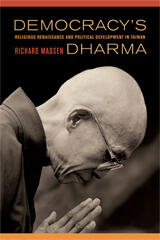
This is a CDDRL's Special Event within our Democracy in Taiwan Program. It is also co-sponsored by the Public Diplomacy/Emerging Publics Project of the Center for the Pacific Rim at University of San Francisco. In this seminar, Dr. Richard Madsen will talk about his new book that explores the religious renaissance that has reformed, revitalized, and renewed the practices of Buddhism and Daoism in Taiwan and how this religious renaissance embraces democracy modernity.  

Image
10896
Richard Madsen is distinguished professor and chair of the sociology department at the University of California, San Diego and a co-author (with Robert Bellah et al.) of The Good Society and Habits of the Heart which received the Los Angeles Times Book Award and was jury nominated for the Pulitzer Prize. He has authored or co-authored five books on China, including Morality and Power in a Chinese Village for which he received the C. Wright Mills Award; China's Catholics: Tragedy and Hope in an Emerging Civil Society; and China and the American Dream.  He also co-edited (with Tracy B. Strong) The Many and the One: Religious and Secular Perspectives on Ethical Pluralism in the Modern World. His latest book is Democracy’s Dharma: Religious Renaissance and Political Development in Taiwan.

Richard Madsen received an MA in Asian studies and a Ph.D. in sociology from Harvard.

"Madsen is a genial and well-informed guide, both to social-political change in Taiwan and to the ins and outs of religious movements. His engaging writing skillfully interweaves profound insights and themes into the descriptive analytical narrative. Democracy's Dharma presents new material based on recent research while offering a fresh spin on thinking about Asian religions."–Thomas Gold, editor of Social Connections in China: Institutions, Culture, and the Changing Nature of Guanxi

Philippines Conference Room

Richard Madsen Distinguished Professor Speaker Department of Sociology at the University of California, San Diego
Conferences
-
Mr. Melia has been Deputy Executive Director since May 2005.  He was previously Director of Research at the Institute for the Study of Diplomacy, and Adjunct Professor in the School of Foreign Service, at Georgetown University in Washington, DC where he continues to teach graduate courses about democracy promotion. For more than a dozen years, Melia held senior posts at the National Democratic Institute for International Affairs (NDI), a leading non-governmental organization engaged in the promotion of democracy worldwide. From 1998 to 2001, he was the Institute's Vice President for Programs. Earlier, he managed the Institute's programs in Central and Eastern Europe (1988 to 1993), in the Middle East (1993 to 1996), and directed programs in more than a dozen African countries. 

Mr. Melia was Associate Director of the Free Trade Union Institute of the AFL-CIO (1986 to 1988). Prior to that he served for six years as Legislative Assistant for foreign and defense policy to U.S. Senator Daniel Patrick Moynihan (D-NY).  Thomas Melia received his M.A. in Africa Studies from the Johns Hopkins University School of Advanced International Studies.

CISAC Conference Room

Thomas O. Melia Deputy Executive Director Speaker Freedom House
Seminars
-
Robin Wright is an American journalist currently covering U.S. foreign policy for The Washington Post. She has reported for The Washington Post, The Los Angeles Times, The Sunday Times (of London), CBS News and The Christian Science Monitor, and has served as a foreign correspondent in the Middle East, Europe, and Africa. She has also written for The New Yorker, The Atlantic Monthly, Foreign Affairs, Foreign Policy, The New York Times, and The International Herald Tribune.

Awards and Honors
Wright received the U.N. Correspondents Association Gold Medal for coverage of international affairs, the National Magazine Award for reportage from Iran in The New Yorker, and the Overseas Press Club Award for "best reporting in any medium requiring exceptional courage and initiative" for coverage of African wars. For coverage of U.S. foreign policy, she was named journalist of the year by the American Academy of Diplomacy for “distinguished reporting and analysis of international affairs ” and won the National Press Club Award and the Weintal Prize for diplomatic reporting. Wright has also been the recipient of a John D. and Catherine T. MacArthur Foundation grant.

Wright has been a fellow at the Carnegie Endowment for International Peace, the Brookings Institution, Yale University, Duke University, Stanford University, the University of California at Santa Barbara and the University of Southern California. She also lectures extensively around the United States and has been a television commentator on ABC, NBC, CBS, CNN and MSNBC programs, including "Meet the Press," "Face the Nation," "This Week," “Nightline," the PBS Newshour, "Frontline," and "Larry King Live."

Philippines Conference Room

Robin Wright Diplomatic Correspondent Speaker The Washington Post
Seminars
Authors
Michael A. McFaul
News Type
Commentary
Date
Paragraphs
As the year draws to a close, write Michael A. McFaul and Abbas Milani in the Washington Post, it's important to note that the U.S. debate on Iran is stalled, trapped between "regime changers" vs. "arms controllers," "hawks" vs. "doves," and "idealists" vs. "realists." The National Intelligence Estimate released this month offers an opportunity to escape this straitjacketed debate by embracing a new strategy that would pursue both the short-term goal of arms control and the long-term goal of democracy in Iran.

Reprinted with permission from Washingtonpost.Newsweek Interactive Company and The Washington Post

As the year draws to a close, it's important to note that the U.S. debate on Iran is stalled, trapped between "regime changers" vs. "arms controllers," "hawks" vs. "doves," and "idealists" vs. "realists." The National Intelligence Estimate released this month offers an opportunity to escape this straitjacketed debate by embracing a new strategy that would pursue both the short-term goal of arms control and the long-term goal of democracy in Iran.

The NIE's "key judgment" that Iran suspended its nuclear weapons program has thrust the arms controllers onto center stage. Because the nuclear threat is no longer immediate, the arms controllers insist that the time is ripe for the United States to engage in direct diplomacy with Tehran as a way to change the regime's behavior, but not the regime itself -- specifically, to persuade the mullahs to suspend their nuclear enrichment program.

Those who profess to back regime change claim that the NIE changes nothing and that the United States should continue to use coercive power, potentially including military strikes, to counter Tehran.

Both sides have part of the strategy right, but on its own neither offers a long-term vision for dealing with Iran.

It is folly to assume that advocates of military strikes are in the same camp as those who advocate regime change. There is no better way to prolong the life of the autocratic regime in Tehran, to strengthen increasingly weakened radicals such as Iranian President Mahmoud Ahmadinejad, than bombing Iran. Thankfully, the NIE has made military strikes less likely.

But the estimate provides no evidence to suggest that Iran's regime has changed its ways to be more compatible with American national interests or the interests of the Iranian people. The regime continues to repress its own people; supports terrorist organizations that threaten Israel and destabilize the governments in Iraq, Lebanon and the Palestinian territories; and still has not suspended its enrichment program, the key aspect of developing a nuclear weapon. Iran's suspension of its military nuclear program in 2003 was a tactical response to revelations about the clandestine operation, not a fundamental shift in strategic thinking.

To presume, therefore, that the NIE gives the United States license to bargain with Iran over its enrichment program and forgo any pressure on the regime is also folly. Focusing solely on enrichment would play into the hands of the mullahs, who see how the NIE has weakened the coalition in support of serious sanctions. They have every incentive to stretch out any negotiations -- while continuing to develop their enrichment program. Days after the NIE was made public, Ahmadinejad announced that Iran plans to have a cascade of 50,000 centrifuges, surely enough to make highly enriched uranium. American diplomatic tools to alter this behavior are extremely weak. Moreover, this strategy gives Iran a free pass on its support for terrorism and human rights abuses.

The United States and its allies must develop an Iran strategy that establishes both short- and long-term goals. Specifically, the United States must recommit to a policy of encouraging democratization inside Iran, because only a democratic regime will stop supporting terrorist groups abroad and repression at home. A democratic Iran is also less likely to restart a nuclear weapons program, especially if the United States and a new Iranian regime establish close military ties, a likely outcome.

Although counterintuitive to some, diplomatic engagement is required to pursue the long-term goal of democratization and, in parallel, the short-term goal of arms control. The first American offer of direct talks should include everything: the prospect of formal diplomatic relations and the lifting of sanctions; the potential supply and disposal of nuclear fuel (from a third-party organization or state); suspension of nuclear enrichment; an end to aid to Hezbollah and Hamas; and a serious discussion about stopping the arrests of students and human rights advocates and the persecution of union leaders and religious minorities. Discussion of new security institutions in the region should also be on the table. America's experience dealing with the Soviet Union during the Cold War demonstrates that we can engage a despotic regime without compromising our commitment to democracy and human rights.

Greater contact between Iranian and American societies will further undermine the regime's legitimacy, strengthen the independence of Iranian economic and political groups, and perhaps even compel some regime leaders to cash out and exchange their diminishing political power for enduring property rights. Over the past four decades, autocratic regimes have rarely crumbled as a result of isolation but more often have collapsed when seeking to engage with the West. Even the collapse of the Soviet Union occurred not when tensions between Moscow and Washington were high but during a period of engagement.

Will Iran follow a similar path? We will never know if we do not try. Of course, the mullahs might reject our overtures, but their refusal would embolden the opposition inside Iran. And a serious attempt to engage the Islamic republic now would strengthen the American case for more coercive diplomatic and economic pressure, should they be necessary in the future.

Michael McFaul is a professor of political science at Stanford University. Abbas Milani is director of the Iranian studies program at Stanford. Both are fellows at the Hoover Institution.

Copyright Washingtonpost.Newsweek Interactive and The Washington Post. All rights Reserved.

All News button
1

Do international factors, including democracy promotion policies of Western actors, play a significant role in encouraging or discouraging transitions to democracy? If so, when and how do external incentives, financial and technical aid, socialization techniques, diplomacy or demonstration effects influence domestic decision-makers to attempt to transition to democracy? What combination of domestic conditions and external factors are most likely to lead to the weakening of non-democratic regimes and their replacement with democratic governments?

Authors
News Type
News
Date
Paragraphs
CDDRL Director and political science Professor Michael A. McFaul gave the 2007 Class Day lecture on Saturday, June 16. More than 6,000 Stanford graduates, family members, faculty, and alumni attended the lecture.

Political science Professor Michael McFaul gave the Class Day lecture Saturday in Maples Pavilion.

If Stanford is indeed a bubble, political science Professor Michael McFaul deftly pointed out its radiant lining while simultaneously bursting it with a needle--in the form of sobering statistics and descriptions that paint a dour portrait of America's international standing--during his Class Day lecture on Saturday in Maples Pavilion.

Sponsored by the Stanford Alumni Association, the Class Day tradition gathers graduates and their families before a distinguished faculty member for a keynote address that is at once congratulatory and weighty. But McFaul, the Peter and Helen Bing Senior Fellow at the Hoover Institution, began by describing his humble roots as a boy from Montana.

"When I came to Stanford as a 17-year-old freshman, I was raw and not ready for prime time," McFaul admitted. "I had never lived anywhere but Montana. I hadn't even set foot in California, let alone a foreign country."

In 1986, McFaul said he emerged from the Farm a dramatically different person--holding a bachelor's degree in international relations and Slavic languages and literatures, as well as a master's in Russian and East European studies. He had lived in the Soviet Union, Nigeria and Poland; and today, McFaul is regarded as one of the top scholars in terms of bringing together the theory and practice of democracy.

"I came here wanting to practice law and left here wanting to practice diplomacy," said McFaul, who in 2005 was appointed director of the Center for Democracy, Development and the Rule of Law at the Freeman Spogli Institute for International Studies. "So, my time in the bubble changed me."

Then McFaul brought out the needle. He noted that, just as this year's graduates were first arriving on the Farm, President George W. Bush was outlining his "freedom agenda," a plan to transform the world. McFaul said the plan outlined Bush's strategy for promoting democracy around the world as a way of keeping Americans safe.

But so far, McFaul lamented, few of the plan's goals have been realized. "It hasn't been pretty out there," McFaul said. "While you have been living inside the bubble, a lot has been happening--much of it bad--outside of the bubble."

McFaul then reminded graduates of positive developments, such as the Rose Revolution in Georgia in 2003 and the Orange Revolution in Ukraine in 2004. And, no one, he added, misses the Taliban regime in Afghanistan or Saddam Hussein in Iraq.

"But overall, trends are disappointing," McFaul said. "In Afghanistan, democracy is barely holding on. In Iraq and Palestine, there's civil war."

Between 2003, when the departing undergraduates in the audience arrived as freshmen, and today, more than 3,000 American soldiers, roughly 60,000 Iraqis and more than 200,000 people in Darfur have died, McFaul said. He added that the number of al-Qaida's followers also has grown during the four years that the Class of 2007 was in "the bubble."

And yet, the graduates might have left Maples completely deflated were it not for the main message of McFaul's lecture, which was one of renewal. When he graduated from Stanford in 1986, McFaul gave a graduation speech at the ceremony for international relations majors in which he lamented the failing arms control treaty between the Soviet Union and the United States. He also expressed dismay that South Africa's apartheid regime had just declared emergency rule and that Washington seemed too confrontational or too indifferent to address either.

"However, after each of these periods, the United States had found a way to renew itself and become again a force for freedom and justice around the world," McFaul said. "So, my understanding of history gives me confidence in our capacity for renewal. But so does my sense of the future that comes from teaching here at Stanford University."

McFaul said he has taught enough of this year's graduates to know that they have the smarts, the drive and the convictions to turn things around--young men and women from throughout the United States but also from nations such as Afghanistan, Brazil, Egypt, India, Indonesia and Nigeria.

"Someone sitting here right now will someday open the first U.S. Embassy in a democratic Iran," McFaul said. "Someone sitting here right now will inspire a third grader in the South Bronx to become the first kid in his neighborhood to win a Nobel Prize in physics."

But in the effort to renew the world, McFaul also told the graduates they should not forget to renew themselves. He urged them not to describe whatever occupation they take up simply as a job title, but as an action verb; to occasionally welcome idle time to refocus their energies; to embrace uncertainty; and to continue to learn and stay connected to Stanford.

McFaul's parting message echoed the welcome address by Howard Wolf, '80, vice president for alumni affairs and president of the Stanford Alumni Association. "Alumni are the only permanent stakeholders" of the university, Wolf said. "Get involved, stay connected."

All News button
1
-

Ambassador John Beyrle presented his credentials to President Parvanov as U.S. Ambassador to Bulgaria on September 8, 2005. A career officer in the senior Foreign Service at the rank of Minister-Counselor, Ambassador Beyrle has held policy positions and foreign assignments with an emphasis on U.S. relations with Central and Eastern Europe, Russia, and the USSR since joining the State Department in 1983.

Ambassador Beyrle's overseas service has included two tours at the U.S. Embassy in Moscow, most recently as Deputy Chief of Mission. He was Counselor for Political and Economic Affairs at the U.S. Embassy in Prague, and a member of the U.S. Delegation to the CFE Negotiations in Vienna. He served an earlier tour at the U.S. Embassy in Bulgaria 1985-87. His Washington assignments include Acting Special Adviser to the Secretary of State for the New Independent States, and Director for Russian, Ukrainian and Eurasian Affairs at the National Security Council. He served as a staff officer to Secretaries of State George Shultz and James Baker, and as a Pearson Fellow and foreign policy adviser to the late Senator Paul Simon.

Ambassador Beyrle received a B.A. degree with honors from Grand Valley State University, and an M.S. degree as a Distinguished Graduate of the National War College.

Ambassador Elena Poptodorova has been the Ambassador of the Republic of Bulgaria since February 2002. Prior to assuming the ambassadorial post, Mrs. Poptodorova has held a number of government positions and served as a member of parliament for 11 years (1990-2001) as a representative of the Bulgarian Socialist Party. She is a signature figure of the new Bulgarian democracy, playing an active role in policy making and known as one of the liberal and maverick members of her party. In the period of June 2001 to August 2002, she led the Directorate of International Organizations and Human Rights. She served as Spokes of the Ministry of Foreign Affairs immediately before becoming Bulgarian Ambassador to the United States.

Ambassador Poptodorova received her B.A. and M.A. in English and Italian Language and Literature from Tthe Kiment Ohridski University of Sofia, Bulgaria. She has a M.A. in international relations and diplomacy from the University of National and World Economy, Sofia, Bulgaria.

This event is co-sponsored by the Forum on Contemporary Europe and the Center for Russian, East European and Eurasian Studies.

Calendar of the Ambassadors' trip in the US

CISAC Conference Room

His Excellency John R. Beyrle U.S. Ambassador to Bulgaria Speaker
Her Excellency Elena Poptodorova Ambassador of the Republic of Bulgaria to the U.S. Speaker
Conferences
Authors
Michael A. McFaul
News Type
Commentary
Date
Paragraphs

Well before George W. Bush finally won the U.S. presidency, Vladimir Putin and his surrogates made it clear that they hoped for a Republican victory. Putins team believes that the new Bush team for foreign policy will adopt a more realpolitik philosophy toward international affairs. In their view, this means less attention to pesky issues like human rights, corruption and the war in Chechnya, and more attention to traditional issues of foreign diplomacy such as arms control and great power regulation of regional conflicts.

All News button
1
Authors
Michael A. McFaul
Larry Diamond
News Type
Commentary
Date
Paragraphs

One group of Washington-based pundits and exiled Iranians wants to push the United States into increasingly hostile and direct confrontation with the Islamic regime, using coercive diplomacy and even military pressure if necessary. This group also wants to encourage demonstrators inside Iran to rise up and confront the regime as quickly and boldly as possible, even if this would prompt violence, revolution or civil war. Some members of this group -- following in the footsteps of the Iraqi exiles and U.S. policymakers who favored installing exiled banker Ahmad Chalabi as leader of Iraq -- are determined to handpick Iran's next leader. Their choice is Reza Pahlavi, the eldest son of the last shah to rule in Iran.

A second group in Washington is pushing for a completely different U.S. policy toward Iran: detente. Increasingly, Iranian hard-liners have hinted that they might be willing to restrain Islamic radicals based in Iran who are stirring things up in Iraq. But in exchange, they've suggested, they would want guarantees that the U.S. will not support opponents of the Iranian regime. Desperate to hold onto power, Iran's leaders seem suddenly willing to deal with the U.S. in exchange for stability.

These proponents of engagement inside Iran have allies in the U.S. Since Hashemi Rafsanjani was elected president of Iran 15 years ago, a group of U.S. scholars, retired diplomats and businessmen (especially oil company executives) has acted as de facto lobbyists for the Islamic regime. They considered Rafsanjani to be Iran's great hope: a "moderate mullah" who wanted rapprochement with the West. When reformer [Mohammad Khatami] was elected to replace him in 1997, they changed horses, but not their recommended strategy of engaging with the existing regime.

All News button
1
Subscribe to Diplomacy