Democracy
Authors
News Type
Q&As
Date
Paragraphs

With political upheaval sweeping the Arab world and the presidential campaign entering the home stretch in the United States, democracy and elections are hot topics. But a bigger story about those bedrocks of fair and open governments has unfolded all over the world in the past two decades, as more than 50 authoritarian regimes have converted to democratic societies.

The change hasn’t always been ideal. Corruption and violence continue to mar some budding democracies, while restrictive voter ID laws and big money have tainted the political process in the world’s most established democratic systems.

Stanford political scientist Stephen J. Stedman just wrapped up his work as director of the Global Commission on Elections, Democracy and Security – a group that spent almost two years reviewing the integrity of elections worldwide. The panel was convened by the International Institute for Democracy and Electoral Assistance and the Kofi Annan Foundation, an organization founded by the former U.N. secretary general.

The panel’s report lists 13 steps that individual countries, civil society leaders and the international community can take to make sure elections and democracies are fair, open and honest.

“The first is the most basic,” said Stedman, a Freeman Spogli Senior Fellow at the Center on Democracy, Development, and the Rule of Law. “You have to have a society where citizens feel everyone is equal under the law.”

Stedman discusses the panel’s work in the following Q&A.

What was the need and motivation to analyze how free elections are faring around the world?

Each of the commissioners came to this with different concerns. Kofi Annan, who chaired the commission, was very much driven by his experience of having to deal with several elections in Africa that had become violent and had gone off the rails. And there’s a frustration he feels about how little attention had been paid to those places before they blew up.

Ernesto Zedillo, (a former Mexican president and vice chair of the panel), was motivated to join the commission by a real alarm at the nefarious influence of huge sums of money in political finance – not just in America, but in parts of the world where transnational organized crime is getting involved in the political process. We’re finding that political finance and campaign finance might be ways for those groups to buy legitimacy or protection through democratic political systems.

Others were concerned that despite the incredible growth of democracy during the last 20 years, there isn’t a guarantee that you’re getting good government out of it – especially in poorer, developing countries.

Has the global economic slump stressed democracies?

A fundamental pillar of democracy is political equality; that every citizen has an equal opportunity to influence politics.. But in a world where the gap between the rich and poor is growing, its more challenging to make sure everyone has that opportunity.

For developing countries, there’s a real challenge in building democracy under scarcity. The biggest danger for poor countries is that all the resources tend to be centered in the state, and elections are about getting those resources. So if you lose, you have nowhere to go. In wealthy democracies, that’s not the case. Whoever loses the U.S. election this year will still have a comfortable life. That’s not true in many parts of the world. If you lose in Asia or Africa, for instance, you’re just out of the game. But that winner-takes-all system has to change in order to have a strong democracy.

The report concludes that the “rise of uncontrolled political finance threatens to hollow out democracy everywhere in the world.” How is that playing out?

Political finance is absolutely necessary for democracy. It’s good that citizens feel so strongly that they’re willing to make donations and express their preferences by contributing to campaigns and candidates. And candidates and parties need money to get their messages out. But you just have to look around the world over the last 15 years and see all the countries that have had political finance scandals. It’s a long list, and it includes some of the best-known democracies in the world. Even in the best conditions, it’s a problem that can corrupt your democracy.

And the problem is becoming more urgent. With growing economic disparity, it’s become easier for certain groups to buy and influence elections and governments.

The commission specifically criticizes the U.S. Supreme Court’s decision in Citizens United v. Federal Election Commission, which says the government cannot restrict independent political spending by a corporation or union. Does the ruling delegitimize America’s efforts to push for solid democracies and fair elections in developing countries?

Citizens United has essentially created a system of “anything goes.” In the eyes of many Americans, political finance is corrupting our democracy. And America’s reputation has taken a large hit internationally. In doing this report and talking to democratic activists around the world, so many of the conversations immediately go to the decision and the amount of money allowed to influence the system. It has diminished our reputation.

Both Western Europe and the United States are often better at professing the best practices of elections and democracy than following them. It definitely hurts when people overseas say: “Wait. You’re telling us to do this. But what do you do, exactly?”

Other than money, what are some of the barriers to political participation that hurt the growth of democracy?

It varies around the world. But across the board, women are still vastly underrepresented in voting and in political office in most democracies. That speaks to a slew of cultural, social and economic barriers.

In the United States, the problems tend to manifest themselves as barriers to the participation of minorities – especially African-Americans and Hispanics. It goes to the heart of many debates over the use of legal restrictions to register voters. And the restrictions are usually couched in language about protecting the integrity of elections. But the policies have the net effect of restricting participation by minority poor voters. And that’s what actually hurts the integrity of elections. The amount of out-and-out electoral fraud in the U.S. is miniscule. The amount of voters who are marginalized and dispossessed because of these voter ID laws is much greater.
All News button
1
Paragraphs

Democracy, Political Parties and Reform: A Review of Public Opinion in Yemen,” by Chris Miller, Hafez al-Bukari and Olga Aymerich provides a rare glimpse into Yemeni public opinion. The survey data presented in the paper paints a picture of a population that is overwhelmingly supportive and enthusiastic about democracy as a mode of governance. At the same time, it highlights a lack of knowledge of basic electoral rights as well as options for institutional change. As Yemen prepares for a process of national dialogue and constitutional reform, the public opinion data in the paper provides a critical window into the demands and priorities of citizens.

All Publications button
1
Publication Type
Working Papers
Publication Date
Journal Publisher
CDDRL Working Papers
Authors
-

Abstract:

Turkey redefined its geographical security environment over the last decade by deepening its engagement with neighboring regions, especially with the Middle East. The Arab spring, however, challenged not only the authoritarian regimes in the region but also Turkish foreign policy strategy. This strategy was based on cooperation with the existing regimes and did not prioritize the democracy promotion dimension of the issue. The upheavals in the Arab world, therefore, created a dilemma between ethics and self-interest in Turkish foreign policy. Amid the flux of geopolitical shifts in one of the world’s most unstable regions, Turkish foreign policy-making elites are attempting to reformulate their strategies to overcome this inherent dilemma. The central argument of the present paper is that Turkey could make a bigger and more constructive impact in the region by trying to take a more detached stand and through controlled activism. Thus, Turkey could take action through the formation of coalitions and in close alignments with the United States and Europe rather than basing its policies on a self-attributed unilateral pro-activism.

Ziya Öniş is Professor of International Relations and the Director of the Center for Research on Globalization and Democratic Governance (GLODEM) at Koç University in Istanbul, Turkey. He received his BSc. and MSc. in Economics from London School of Economics, and his Ph.D. in Development Economics from University of Manchester.  He also taught at Boğaziçi University (Istanbul), Işık University (Istanbul), and University of Manchester. He has written extensively on various aspects of Turkish political economy. His most recent research focuses on the political economy of globalization, crises and post-crises transformations, Turkey’s Europeanization and democratization experience and the analysis of new directions in Turkish foreign policy. Among his most recent publications are  “Beyond the Global Economic Crisis: Structural Continuities as Impediments to a Sustainable Recovery” (All Azimuth, 2012), “Power, Interests and Coalitions: The Political Economy of Mass Privatization in Turkey” (Third World Quarterly, 2011), “Europe and the Impasse of Center-Left Politics in Turkey: Lessons from the Greek Experience” (Journal of Balkan and Near Eastern Studies, 2010), Turkey and the Global Economy: Neo-liberal Restructuring and Integration in the Post-Crisis Era (2009), and Turkish Politics in a Changing World: Global Dynamics and Domestic Transformations (2007)

The event is organized as part of the Annual Koç Lecture Series, a three-year project organized under the framework of the Mediterranean Studies Forum’s Turkish Studies Initiative and in collaboration with Stanford Center for Russian, East European, and Eurasian Studies, and the Sohaib & Sara Abbasi Program in Islamic Studies. It is also co-sponsored by the CDDRL Program on Arab Reform and Democracy.

Richard and Rhoda Goldman Conference Room

Ziya Öniş Professor of International Relations and the Director of the Center for Research on Globalization and Democratic Governance (GLODEM) Speaker Koç University in Istanbul, Turkey
Panel Discussions

Encina Hall
616 Serra Street
Stanford, CA 94305-6055

0
Fulbright and BAEF postdoctoral fellow 2012-2013
del_biondo.jpg

Karen Del Biondo is a 2012-2013 postdoctoral scholar at CDDRL. Her research is funded with a Fulbright-Schuman award and a postdoctoral grant from the Belgian-American Educational Foundation (BAEF). She holds an MA in Political Science (International Relations) from Ghent University and an MA in European Studies from the Université Libre de Bruxelles. In 2007-2008 she obtained a Bernheim fellowship for an internship in European affairs at the Belgian Ministry of Foreign Affairs and Permanent Representation to the EU. 

Karen Del Biondo obtained her PhD at the Centre for EU Studies, Ghent University in September 2012 with a dissertation entitled ‘Norms, self-interest and effectiveness: Explaining double standards in EU reactions to violations of democratic principles in sub-Saharan Africa’. Her PhD research was funded by the Flemish Fund for Scientific Research (FWO). Apart from her PhD research, she has been involved in the research project ‘The Substance of EU Democracy Promotion’ (Ghent University/University of Mannheim/Centre of European Policy Studies) and has published on the securitisation of EU development policies. In January 2011 she conducted field research in Addis Ababa, Ethiopia. Her postdoctoral research will focus on the comparison between EU and US democracy assistance in sub-Saharan Africa.

Karen Del Biondo’s recent publications include: ‘Security and Development in EU External Relations: Converging, but in which direction?’ (with Stefan Oltsch and Jan Orbie), in S. Biscop & R. Whitman (eds.) Handbook of European Union Security, Routledge (2012); ‘Democracy Promotion Meets Development Cooperation: The EU as a Promoter of Democratic Governance in Sub-Saharan Africa’, European Foreign Affairs Review, Vol. 16, N°5, 2011, 659-672; and ‘EU Aid Conditionality in ACP Countries. Explaining Inconsistency in EU Sanctions Practice’, Journal of Contemporary European Research, Vol. 7, N°3, 2011, 380-395.

Lou Henry Hoover Building
Stanford, CA 94305-6010

0
Visiting Scholar 2012-13
xia.jpg

Yeliang Xia is a professor in the Department of Economics at Peking University. His research fields include institutional economics, macroeconomic analysis and public policy, economic history, and labor economics. He has been teaching Principles of Economics, Labor Economics, Institutional Economics, and Western Economic History at Peking University since 2000.

He was deputy director of the institute of public policy, China Society for Restructuring Economic System (2003 –2009) and deputy director of the Center for Western Economic Theory, Peking University(2004--2009). He is also one of the founders of Cathay Institute of Public Affairs (CIPA or “Jiuding” in Chinese).

His books, the Economic Anatomy of Public Issues (2002) and the Weight that Economics Could Not Bear (2003) analyzed economic reform, institutional change and public issues in contemporary China.

-

Abstract
The manifestations of 'open' are permeating the society enabled by the rise of participatory culture and improved communication technologies. In her research, Tanja Aitamurto examines the impact of openness on traditionally closed processes such as journalism, policy-making and design. Aitamurto draws on several case studies, in which collective intelligence is harnessed through crowdsourcing, open innovation and co-creation. Her work is based on data from 150 in-depth interviews and about 8,000 data points recorded by netnography. Aitamurto's research is situated in social sciences, informed by organization studies and management science and engineering. She finds that the 'open' challenges the incumbent power structures when participatory mechanisms become a means to practice social control.

Tanja Aitamurto is a visiting researcher at the Program on Liberation Technology at the Center on Democracy, Development and the Rule of Law at Stanford. In her PhD project she examines how collective intelligence, whether harvested by crowdsourcing, co-creation or open innovation, impacts incumbent processes in journalism, public policy making and design process. Her work has been published in several academic publications, such as the New Media and Society. Related to her studies, she advises the Government and the Parliament of Finland about Open Government principles, for example about how open data and crowdsourcing can serve democratic processes.

Aitamurto has previously studied at the Center for Design Research and at the Innovation Journalism Program at Stanford. She is a PhD Student at the Center for Journalism, Media and Communication Research at Tampere University in Finland, and she holds a Master’s Degree in Public Policy, and a Master of Arts in Humanities. Prior to returning to academia, she made a career in journalism in Finland specializing in foreign affairs, doing reporting in countries such as Afghanistan, Angola and Uganda. She has also taught journalism at the University of Zambia, in Lusaka, and worked at the Namibia Press Agency, Windhoek. More about Tanja’s work at www.tanjaaitamurto.com and on Twitter @tanjaaita.

Wallenberg Theater

Tanja Aitamurto Visiting Researcher, Program on Liberation Technology, CDDRL Speaker Stanford University
Seminars
-

Abstract:

This book focuses upon three core questions. Is democratic governance good for economic prosperity? Has this type of regime accelerated progress towards achieving the Millennium Development Goals, social welfare, and human development? Does it generate a peace-dividend and reduce conflict at home? This book advances the argument that both liberal democracy and governance capacity need to be strengthened in parallel for effective development, within the constraints posed by structural conditions. The argument is demonstrated using systematic evidence gathered from countries worldwide during recent decades and selected cases illustrating the effects of regime change on human security.

About the speaker:

Pippa Norris is the McGuire Lecturer in Comparative Politics at Harvard University and ARC Laureate Fellow and Professor of Government and International Relations at the University of Sydney. She is the author of a dozen related books published by Cambridge University Press, including Driving Democracy (2008) and Democratic Deficit (2011). Her contribution to the humanities and social science has been recognized most recently by the award of the 2011 Johann Skytte prize (with Inglehart) and the 2011 Kathleen Fitzpatrick Australian Laureate Fellowship.

CISAC Conference Room

Pippa Norris McGuire Lecturer in Comparative Politics Speaker the John F. Kennedy School of Government, Harvard University

Encina Hall, C148
616 Jane Stanford Way
Stanford, CA 94305

0
Olivier Nomellini Senior Fellow at the Freeman Spogli Institute for International Studies
Director of the Ford Dorsey Master's in International Policy
Research Affiliate at The Europe Center
Professor by Courtesy, Department of Political Science
yff-2021-14290_6500x4500_square.jpg

Francis Fukuyama is the Olivier Nomellini Senior Fellow at Stanford University's Freeman Spogli Institute for International Studies (FSI), and a faculty member of FSI's Center on Democracy, Development and the Rule of Law (CDDRL). He is also Director of Stanford's Ford Dorsey Master's in International Policy, and a professor (by courtesy) of Political Science.

Dr. Fukuyama has written widely on issues in development and international politics. His 1992 book, The End of History and the Last Man, has appeared in over twenty foreign editions. His book In the Realm of the Last Man: A Memoir will be published in fall 2026.

Francis Fukuyama received his B.A. from Cornell University in classics, and his Ph.D. from Harvard in Political Science. He was a member of the Political Science Department of the RAND Corporation, and of the Policy Planning Staff of the US Department of State. From 1996-2000 he was Omer L. and Nancy Hirst Professor of Public Policy at the School of Public Policy at George Mason University, and from 2001-2010 he was Bernard L. Schwartz Professor of International Political Economy at the Paul H. Nitze School of Advanced International Studies, Johns Hopkins University. He served as a member of the President’s Council on Bioethics from 2001-2004. He is editor-in-chief of American Purpose, an online journal.

Dr. Fukuyama holds honorary doctorates from Connecticut College, Doane College, Doshisha University (Japan), Kansai University (Japan), Aarhus University (Denmark), the Pardee Rand Graduate School, and Adam Mickiewicz University (Poland). He is a non-resident fellow at the Carnegie Endowment for International Peace. He is a member of the Board of Trustees of the Rand Corporation, the Board of Trustees of Freedom House, and the Board of the Volcker Alliance. He is a fellow of the National Academy for Public Administration, a member of the American Political Science Association, and of the Council on Foreign Relations. He is married to Laura Holmgren and has three children.

(October 2025)

CV
Date Label
Francis Fukuyama Olivier Nomellini Senior Fellow Moderator CDDRL, Stanford University
Seminars
-

Abstract:

This talk will present an account of long-run institutional development in Latin America that emphasizes the social and political foundations of state-building processes. The argument focuses on societal dynamics that have path-dependent consequences at two critical points: the initial consolidation of national institutions in the wake of independence, and at the time when the "social question" of mass political incorporation forced its way into the national political agenda across the region during the Great Depression. Dynamics set into motion at these points in time have produced widely varying, but highly stable distributions of state capacity in the region.

About the speaker:

Marcus Kurtz is an Associate Professor at Ohio State University. His research and teaching interests are in the areas of comparative politics, democratization, political economy and development, with a focus on Latin America. His publications have appeared in such journals as American Journal of Political Science, World Politics, Comparative Politics, Comparative Political Studies, International Organization, Journal of Politics, and Politics & Society. He has written two books, Free Market Democracy and the Chilean and Mexican Countryside (Cambridge, 2004) and Latin American State Building in Comparative Perspective (forthcoming, Cambridge 2013).

Encina Ground Floor Conference Room

Marcus Kurtz Associate Professor, Department of Political Science Speaker Ohio State University

Encina Hall, C148
616 Jane Stanford Way
Stanford, CA 94305

0
Olivier Nomellini Senior Fellow at the Freeman Spogli Institute for International Studies
Director of the Ford Dorsey Master's in International Policy
Research Affiliate at The Europe Center
Professor by Courtesy, Department of Political Science
yff-2021-14290_6500x4500_square.jpg

Francis Fukuyama is the Olivier Nomellini Senior Fellow at Stanford University's Freeman Spogli Institute for International Studies (FSI), and a faculty member of FSI's Center on Democracy, Development and the Rule of Law (CDDRL). He is also Director of Stanford's Ford Dorsey Master's in International Policy, and a professor (by courtesy) of Political Science.

Dr. Fukuyama has written widely on issues in development and international politics. His 1992 book, The End of History and the Last Man, has appeared in over twenty foreign editions. His book In the Realm of the Last Man: A Memoir will be published in fall 2026.

Francis Fukuyama received his B.A. from Cornell University in classics, and his Ph.D. from Harvard in Political Science. He was a member of the Political Science Department of the RAND Corporation, and of the Policy Planning Staff of the US Department of State. From 1996-2000 he was Omer L. and Nancy Hirst Professor of Public Policy at the School of Public Policy at George Mason University, and from 2001-2010 he was Bernard L. Schwartz Professor of International Political Economy at the Paul H. Nitze School of Advanced International Studies, Johns Hopkins University. He served as a member of the President’s Council on Bioethics from 2001-2004. He is editor-in-chief of American Purpose, an online journal.

Dr. Fukuyama holds honorary doctorates from Connecticut College, Doane College, Doshisha University (Japan), Kansai University (Japan), Aarhus University (Denmark), the Pardee Rand Graduate School, and Adam Mickiewicz University (Poland). He is a non-resident fellow at the Carnegie Endowment for International Peace. He is a member of the Board of Trustees of the Rand Corporation, the Board of Trustees of Freedom House, and the Board of the Volcker Alliance. He is a fellow of the National Academy for Public Administration, a member of the American Political Science Association, and of the Council on Foreign Relations. He is married to Laura Holmgren and has three children.

(October 2025)

CV
Date Label
Francis Fukuyama Olivier Nomellini Senior Fellow Moderator CDDRL, Stanford University
Seminars
-

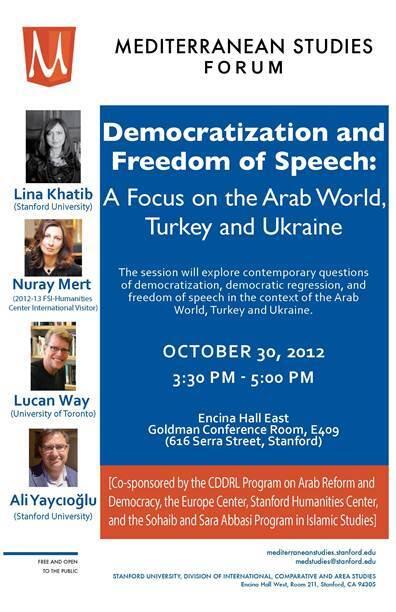
Co-sponsored by CDDRL Program on Arab Reform and Democracy, the Europe Center, Stanford Humanities Center, and the Abbasi Program in Islamic Studies

More info: http://www.stanford.edu/group/mediterranean/cgi-bin/web/2012/08/democratization-and-freedom-of-speech-a-focus-on-turkey-arab-world-and-ukraine/

Image

Richard and Rhoda Goldman Conference Room

Nuray Mert FSI-Humanities Center International Visitor Panelist
Lina Khatib Program Manager for the Program on Arab Reform and Democracy Panelist CDDRL
Lucan Way Associate Professor of Political Science Panelist University of Toronto
Ali Yaycioğlu Assistant Professor of Middle East History Moderator Stanford
Panel Discussions
-

Co-sponsored by the Abbasi Program on Islamic Studies, CDDRL Program on Arab Reform and Democracy, the Europe Center, Stanford Humanities Center, the Mediterranean Studies Forum, and the Center for Russian, East European and Eurasian Studies.

Reuben W. Hills Conference Room

Nuray Mert 2012-13 FSI-Humanities International Visitor Speaker
Lina Khatib Speaker
0
Visiting Associate Professor, Fall 2012
lucan_way-book_-_lucan_way.jpg

Lucan Way’s research focuses on global patterns of democracy and dictatorship. His most recent book (with Steven Levitsky), Revolution and Dictatorship: The Violent Origins of Durable Authoritarianism (forthcoming Princeton University Press), provides a comparative historical explanation for the extraordinary durability of autocracies (China, Cuba, USSR) born of violent social revolution. Way’s solo-authored book, Pluralism by Default: Weak Autocrats and the Rise of Competitive Politics (Johns Hopkins, 2015), examines the sources of political competition in the former Soviet Union. Way argues that pluralism in the developing world often emerges out of authoritarian weakness: governments are too fragmented and states too weak to monopolize political control. His first book, Competitive Authoritarianism: Hybrid Regimes after the Cold War (with Steven Levitsky), was published in 2010 by Cambridge University Press. Way’s work on competitive authoritarianism has been cited thousands of times and helped stimulate new and wide-ranging research into the dynamics of hybrid democratic-authoritarian rule.

Lucan Way Speaker
Ali Yaycioğlu Speaker
Panel Discussions
Subscribe to Democracy