Environment

FSI scholars approach their research on the environment from regulatory, economic and societal angles. The Center on Food Security and the Environment weighs the connection between climate change and agriculture; the impact of biofuel expansion on land and food supply; how to increase crop yields without expanding agricultural lands; and the trends in aquaculture. FSE’s research spans the globe – from the potential of smallholder irrigation to reduce hunger and improve development in sub-Saharan Africa to the devastation of drought on Iowa farms. David Lobell, a senior fellow at FSI and a recipient of a MacArthur “genius” grant, has looked at the impacts of increasing wheat and corn crops in Africa, South Asia, Mexico and the United States; and has studied the effects of extreme heat on the world’s staple crops.

Paragraphs

The year was 1909, and Gifford Pinchot, Chief Forester of the United States, faced a terrible personal dilemma.  He had discovered a pattern of corruption in the sale of public lands to developers and other private interests. But the new president, William Howard Taft, depended on support from western Republicans and had placed a gag order on the whole affair. Pinchot was outraged at this evidence of corruption reaching the White House, but he wanted to give Taft a fair hearing.  The new president had, after all, vowed to support conservation and strong control over federal lands. Taft invited Pinchot to the White House, where he alternately implored Pinchot not to go public with the matter and threatened him with dismissal if he violated the gag order. Pinchot had in his pocket a letter that could expose the scandal. This case explores the dilemma of Pinchot, a mid-level bureaucrat dependent on a president’s good will, and the strategies available to him. It shows the power of a single leader and the similarities the United States once had with many developing nations struggling with widespread corruption. 


Case studies are integral teaching tools for the Leadership Academy for Development workshops conducted around the world.

All Publications button
1
Publication Type
Case Studies
Publication Date
Authors
Francis Fukuyama
-

This event is open to Stanford undergraduate students only. 

The Center on Democracy, Development, and the Rule of Law (CDDRL) is currently accepting applications from eligible juniors due February 27, 2015 who are interested in writing their senior thesis on a subject touching upon democracy, economic development, and rule of law (DDRL) from any university department. CDDRL faculty and current honors students will be present to discuss the program and answer any questions.

For more information on the CDDRL Senior Honors Program, please click here.


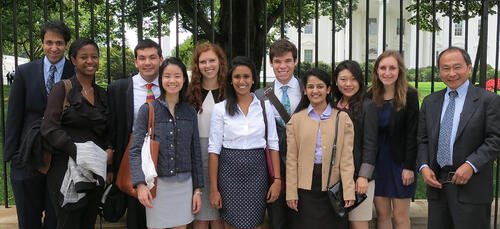
CDDRL Class of 2015 Class of 2015 in front of the White House with Francis Fukuyama.


[[{"fid":"217337","view_mode":"crop_870xauto","fields":{"format":"crop_870xauto","field_file_image_description[und][0][value]":"SHP15 Info Session Flyer","field_file_image_alt_text[und][0][value]":"","field_file_image_title_text[und][0][value]":"","field_credit[und][0][value]":"","field_caption[und][0][value]":"SHP15 Info Session Flyer","field_related_image_aspect[und][0][value]":"","thumbnails":"crop_870xauto","pp_lightbox":false,"pp_description":false},"type":"media","attributes":{"height":1056,"width":870,"class":"media-element file-crop-870xauto"}}]]

Encina Hall, C148
616 Jane Stanford Way
Stanford, CA 94305

0
Olivier Nomellini Senior Fellow at the Freeman Spogli Institute for International Studies
Director of the Ford Dorsey Master's in International Policy
Research Affiliate at The Europe Center
Professor by Courtesy, Department of Political Science
yff-2021-14290_6500x4500_square.jpg

Francis Fukuyama is the Olivier Nomellini Senior Fellow at Stanford University's Freeman Spogli Institute for International Studies (FSI), and a faculty member of FSI's Center on Democracy, Development and the Rule of Law (CDDRL). He is also Director of Stanford's Ford Dorsey Master's in International Policy, and a professor (by courtesy) of Political Science.

Dr. Fukuyama has written widely on issues in development and international politics. His 1992 book, The End of History and the Last Man, has appeared in over twenty foreign editions. His book In the Realm of the Last Man: A Memoir will be published in fall 2026.

Francis Fukuyama received his B.A. from Cornell University in classics, and his Ph.D. from Harvard in Political Science. He was a member of the Political Science Department of the RAND Corporation, and of the Policy Planning Staff of the US Department of State. From 1996-2000 he was Omer L. and Nancy Hirst Professor of Public Policy at the School of Public Policy at George Mason University, and from 2001-2010 he was Bernard L. Schwartz Professor of International Political Economy at the Paul H. Nitze School of Advanced International Studies, Johns Hopkins University. He served as a member of the President’s Council on Bioethics from 2001-2004. He is editor-in-chief of American Purpose, an online journal.

Dr. Fukuyama holds honorary doctorates from Connecticut College, Doane College, Doshisha University (Japan), Kansai University (Japan), Aarhus University (Denmark), the Pardee Rand Graduate School, and Adam Mickiewicz University (Poland). He is a non-resident fellow at the Carnegie Endowment for International Peace. He is a member of the Board of Trustees of the Rand Corporation, the Board of Trustees of Freedom House, and the Board of the Volcker Alliance. He is a fellow of the National Academy for Public Administration, a member of the American Political Science Association, and of the Council on Foreign Relations. He is married to Laura Holmgren and has three children.

(October 2025)

CV
Date Label
Honors Program Director

Encina Hall, C150
616 Jane Stanford Way
Stanford, CA 94305

0
Center Fellow, Freeman Spogli Institute for International Studies
didi_kuo_2023.jpg

Didi Kuo is a Center Fellow at the Freeman Spogli Institute for International Studies (FSI) at Stanford University. She is a scholar of comparative politics with a focus on democratization, corruption and clientelism, political parties and institutions, and political reform. She is the author of The Great Retreat: How Political Parties Should Behave and Why They Don’t (Oxford University Press) and Clientelism, Capitalism, and Democracy: the rise of programmatic politics in the United States and Britain (Cambridge University Press, 2018).

She has been at Stanford since 2013 as the manager of the Program on American Democracy in Comparative Perspective and is co-director of the Fisher Family Honors Program at CDDRL. She was an Eric and Wendy Schmidt Fellow at New America and is a non-resident fellow with the Carnegie Endowment for International Peace. She received a PhD in political science from Harvard University, an MSc in Economic and Social History from Oxford University, where she studied as a Marshall Scholar, and a BA from Emory University.

Date Label
Mentor
-

Join the Center for African Studies and the Center on Democracy, Development and the Rule of Law's (CDDRL) Program on Social Entrepreneurship (in partnership with the Haas Center for Public Service) for a special lunchtime seminar.

Three leaders from the Global Women’s Water Initiative (GWWI) will share their work in East Africa transforming women from being water bearers to water providers and social entrepreneurs. GWWI is training and building a cadre of women water, sanitation and hygiene (WASH) specialists steeped in a holistic set of technical and entrepreneurial skills to lift themselves from poverty and create self-reliance. Women have developed the capacity to construct technologies, provide health education and generate revenue by professionalizing their services. Come to Africa Table for an engaging hour listening to the stories of these three incredible leaders.

Gemma Bulos is a multi award-winning social entrepreneur, water champion and musician. As Director of the Global Women's Water Initiative, she trains women to be technicians and entrepreneurs who are able to build clean water and sanitation solutions in their communities. Her work has provided over 200,000 people with clean water in Asia and Africa.

Rose Wamalwa manages GWWI in-country logistics as Kenya/Tanzania Regional Coordinator. She was named one of the '8 African Water Women to Watch' by WASH Advocates alongside President Ellen Johnson Sirleaf of Liberia and President Joyce Banda of Malawi. She is currently an IREX Community Solutions Fellow sponsored by the US State Department.

Godliver Businge, Head Technology Trainer is a trained mason, welder, bricklayer, and a candidate for a Civil Engineering degree in Uganda. She is admired for her ability to train women with no background in construction. Godliver received a scholarship from the Uganda Rural Devlop-ment Trust, and was recently featured in Reuters trust.org as a Female Water Role Model. 

Lunch will be served.

[[{"fid":"216629","view_mode":"crop_870xauto","fields":{"format":"crop_870xauto","field_file_image_description[und][0][value]":"","field_file_image_alt_text[und][0][value]":"","field_file_image_title_text[und][0][value]":"","field_credit[und][0][value]":"","field_caption[und][0][value]":"","field_related_image_aspect[und][0][value]":"","thumbnails":"crop_870xauto","pp_lightbox":true,"pp_description":true},"type":"media","attributes":{"height":1145,"width":870,"class":"media-element file-crop-870xauto"}}]]

Room 202, Encina Hall West

616 Serra Street, Stanford, CA

Gemma Bulos Director Global Women's Water Initiative
Rose Wamalwa Kenya/Tanzania Regional Coordinator Global Women's Water Initiative
Godliver Businge Head Technology Trainer Global Women's Water Initiative
Seminars
-

Stanford’s Program on Human Rights in the Center on Democracy, Development and the Rule of Law is collaborating with U.S. Fund for UNICEF and the Stanford Center for Innovation in Global Health to present the Children’s Human Rights Seminar Series for 2014-2015. This monthly series will bring together UNICEF representatives, academic experts, and global civil society leaders to discuss some of the most pressing issues facing children today. Each event will highlight one of UNICEF's main programmatic areas, in the following order: emergency response, HIV/AIDS, disabilities, child protection, nutrition, water and sanitation, health and immunizations, and education.

SPEAKERS BIOS

Nick Hellmann, MD is the Strategy and Science Advisor at the Elizabeth Glaser Pediatric AIDS Foundation (EGPAF) and a consultant to the Bill and Melinda Gates Foundation on HIV-related issues. He previously worked from June 2008 to April 2014 as the EGPAF Executive Vice President of Medical & Scientific Affairs, responsible for strategic oversight and direction of the Foundation’s research initiatives and medical programs focused on ending HIV/AIDS in children and providing HIV prevention, care, and treatment services to children, women, and families at over 7000 foundation-supported sites in 14 countries across the globe.

Lisa Jacobs is a global health consultant with expertise in advocacy and communications, strategy, governance, and global health architecture. Lisa was a founding staff member at the GAVI Alliance, and served as head of governance for 10 years. In 2012 and 2013 she worked as a consultant to the UNICEF HIV/AIDS section in New York, supporting the development of UNICEF’s role in the global effort to eliminate mother-to-child transmission of HIV (eMTCT) and its strategy for adolescents and HIV/AIDS. Her other clients have included AVAC: Global Advocacy for HIV Prevention, WHO, UNAIDS, UCSF, and Clinton Health Access Initiative.

CISAC Central Conference Room

2nd FLoor Encina Hall

Nick Hellmann, MD Strategy and Science Advisor at the Elizabeth Glaser Pediatric AIDS Foundation
Lisa Jacobs Global Health Consultant
-


slaveryforumfrontlinesoffreedomupdated2 Freedom From Slavery Forum Flyer


Parking near Encina Hall:

Additional parking available in Parking Structure 7 located in the Knight Management Center. 

Image
parking

Bechtel Conference Center

Conferences
News Feed Image
frontlines_of_freedom_9.14.14.jpg

The forum is planned as an annual gathering of anti-slavery leaders, designed to achieve two major goals:

  • Create a congenial space where leaders can coalesce, build partnerships and develop a shared agenda for action.
  • Distill the experience and evidence gained from programs, develop knowledge dissemination stratages, identify critical gaps in the evidence base and craft a knowledge agenda.

Bechtel Conference Center

Conferences
-

Abstract:

Moulay Hicham’s newly published memoir, Journal d’un prince banni, retells his personal life within the context of devastating political critique against the Moroccan political system, its authoritarian monarchy, and the “deep state” within that resists democratic change, the Makhzen.  Written during Moulay Hicham's time as a fellow at the Center for Democracy, Development, and Rule of Law at Stanford University, the volume is neither a settlement of accounts nor a gossipy narrative of frivolous stories.  It instead uniquely ensconces vivid personal recollections within the context of authoritarian politics.  The prince witnessed the rise of the system under King Hassan II, the long-lasting ruler who eliminated all opposition, centralized power, and linked a loyal community of courtiers, elites, and cronies to his will—the Makhzen.  The memoir reveals how Moulay Hicham’s aspirations towards autonomy and independence were constantly blocked by this system, often by either the King himself or his coercive apparatus, comprising the intelligence services and military.  At the same time, the nearly half-century reign of King Hassan exposes critical insight into the development of Moroccan politics and identity, from his acumen regarding the Western Sahara problem to his ability to make the kingdom a focal point of Arab politics after the demise of Nasserism. 

Those personal observations on governance continue with the royal ascent of Hassan’s son, Mohamed VI, who assumed the throne in 1999 and is Moulay Hicham’s cousin.  Replacing Hassan’s powerfully intent personality was this more humane yet political disengaged new king.  His inability to curb the Makhzen and enact meaningful democratic reforms shows the system’s very success.  Whereas the pressures of conforming to the system crushed many of those personalities who grew up in the court, Moulay Hicham managed to elude this destructive side through his self-imposed exile to the United States and his intellectual decision to criticize an authoritarian machine to which he was meant to belong.  As the memoir concludes, such resistance to change implicates the monarchy’s future.  Decades of political exclusion, false promises, and rising inequality have alienated much of the Moroccan public.  As the Arab Spring showed, such discontentment portends to future social and political conflict that could well discredit the monarchy, resulting in its overthrow after 350 years of continuous reign.

Journal d’un prince banni has become a literary and political phenomenon in Morocco and the Moroccan diaspora worldwide.  Its release ignited tumultuous debates within the press, social media, and civil society.  Dubbed an “exceptional document” by Le Nouvel Observateur, the memoir has become one of the best-selling non-fiction works in France.  Though print versions are currently unavailable in Morocco, electronic versions have been downloaded and disseminated on an exponential scale.  Arabic, English, and other language-editions are scheduled for release in the near future.


Speaker Bio:

Hicham Ben Abdallah received his B.A. in Politics in 1985 from Princeton University, and his M.A. in Political Science from Stanford in 1997. His interest is in the politics of the transition from authoritarianism to democracy.

He has lectured in numerous universities and think tanks in North America and Europe. His work for the advancement of peace and conflict resolution has brought him to Kosovo as a special Assistant to Bernard Kouchner, and to Nigeria and Palestine as an election observer with the Carter Center. He has published in journals such Le Monde,  Le Monde Diplomatique,Pouvoirs, Le Debat, The Journal of Democracy, The New York Times, El Pais, and El Quds.

In 2010 he has founded the Moulay Hicham Foundation which conducts social science research on the MENA region. He is also an entrepreneur with interests in agriculture, real estate, and renewable energies. His company, Al Tayyar Energy, has a number of clean energy projects in Asia and Europe. 


Oksenberg Conference Room

CDDRL
Stanford University
Encina Hall
616 Serra Street
Stanford, CA 94305-6055

0
Consulting Professor
Ben_Abdallah.jpg MA

Hicham Ben Abdallah received his B.A. in Politics in 1985 from Princeton University, and his M.A. in Political Science from Stanford in 1997. His interest is in the politics of the transition from authoritarianism to democracy.

He has lectured in numerous universities and think tanks in North America and Europe. His work for the advancement of peace and conflict resolution has brought him to Kosovo as a special Assistant to Bernard Kouchner, and to Nigeria and Palestine as an election observer with the Carter Center. He has published in journals such Le Monde,  Le Monde Diplomatique,Pouvoirs, Le Debat, The Journal of Democracy, The New York Times, El Pais, and El Quds.

In 2010 he has founded the Moulay Hicham Foundation which conducts social science research on the MENA region. He is also an entrepreneur with interests in agriculture, real estate, and renewable energies. His company, Al Tayyar Energy, has a number of clean energy projects in Asia and Europe. 

Hicham Ben Abdallah Consulting Professor Speaker Stanford University
Conferences
-

Over the past 23 years, Mongolia’s democracy has advanced on many fronts. The initial transition to democracy was peaceful in both economic and political areas. Since embracing democracy in 1990, democratic development in Mongolia has been coupled with rapid economic growth, sustained by a neo-liberal economic policy. Regionally, Mongolia is often seen as a successful case of democratic transition and development. However, in recent years, the fragilities in Mongolian democracy have revealed themselves, especially domestically, in the booming economic climate that is unparalleled in the country's history.

Mongolia, located in north East Asia, locked between China and Russia, has a unique geopolitical situation, unlike any other country in the world. With these two large, powerful and politically changing neighbors, Mongolia pays constant and careful attention to maintaining diplomatic balance. Russia's historical, political, and cultural influence on Mongolia's 20th century cannot be underestimated. China, in complicated and important areas, represents vast economic opportunities. These economic opportunities, and the development that they drive, are viewed with increased suspicion domestically and regionally. However, Mongolia’s rapid economic development and democratic reforms may create additional opportunities and positive political developments in the region.

Philippines Conference Room

Encina Hall
616 Serra Street
Stanford, CA 94305-6055

0
Zandanshatar.jpg

Zandanshatar Gombojav comes to Stanford as a Visiting Scholar at CDDRL, having recently served as the General Secretary of the Mongolian People's Party, Mongolia's largest party by membership. From 2004 until 2012, he was a Member of the Parliament of Mongolia, and from 2009 to 2012, he was Mongolia's Minister of Foreign Affairs and Trade.

Before his appointment as Foreign Minister, during which he had many foreign policy accomplishments from renewing the country's foreign policy concept to adopting new trade agreements with several partners, he had a successful career in Mongolia's banking sector, working at the Agricultural Bank, Khan Bank, and the Central Bank of Mongolia. He also served as the Deputy Minister of Agriculture, before being elected to Parliament. After graduating from the State Institute of Finance in Russia, he began his career as a Lecturer on Economics and Finance at Mongolia's Institute of Commerce and Industry.
His current research interest focuses on issues related to the democratic and political development of Mongolia given its geostrategic situation. At Stanford, he will be working on a larger research project encompassing regional democratic and political development from Mongolia's unique perspective.

He has published extensively on various banking issues and also on topics regarding the international relations process in refereed journals and different conference proceedings. He has been a strong supporter of the reform process, being actively involved in the organisation of youth development.

Visiting Scholar, 2016, 2014-15
Zandanshatar Gombojav Visting Scholar 2014, Center on Democracy, Development and the Rule of Law Speaker Stanford University
Seminars
Date Label
-

For nearly 70 years, CARE has been serving individuals and families in the world's poorest communities. Today, they work in 84 countries around the world, with projects addressing issues from education and healthcare to agriculture and climate change to education and women's empowerment. Helene Gayle, president and CEO of CARE USA, will discuss her work with CARE and her experiences in the field of international development. Dr. Gayle will discuss how access to global health is integral to CARE's effort in addressing the underlying causes of extreme global poverty.

Dr. Michele Barry, director of the Center for Innovation in Global Health, will moderate a conversation between CARE President and CEO, Dr. Helene Gayle and former Prime Minister of Norway and United Nations Special Envoy, Dr. Gro Brundtland. 

This event is sponsoredy by CARE USA, the Center on Democracy, Development and the Rule of Law and the Haas Center for Public Service.

A reception will follow the event. 


Dr. Gro Brundtland Bio:

Dr. Gro Harlem Brundtland is the former prime minister of Norway and the current deputy chair of The Elders, a group of world leaders convened by Nelson Mandela and others to tackle the world’s toughest issues. She was recently appointed as the Mimi and Peter E. Haas Distinguished Visitor for spring 2014 at the Haas Center for Public Service at Stanford University. Dr. Brundtland has dedicated over 40 years to public service as a doctor, policymaker and international leader. She was the first woman and youngest person to serve as Norway’s prime minister, and has also served as the former director-general of the World Health Organization and a UN special envoy on climate change.

Her special interest is in promoting health as a basic human right, and her background as a stateswoman as well as a physician and scientist gives her a unique perspective on the impact of economic development, global interdependence, environmental issues and medicine on public health.


 Dr. Helene Gayle Bio:

Helene D. Gayle joined CARE USA as president and CEO in 2006. Born and raised in Buffalo, New York, she received her B.A. from Barnard College of Columbia University, her M.D. from the University of Pennsylvania and her M.P.H. from Johns Hopkins University. After completing her residency in pediatric medicine at the Children's Hospital National Medical Center in Washington, D.C., she entered the Epidemic Intelligence Service at the Centers for Disease Control and Prevention, followed by a residency in preventive medicine, and then remained at CDC as a staff epidemiologist.

At CDC, she studied problems of malnutrition in children in the United States and abroad, evaluating and implementing child survival programs in Africa and working on HIV/AIDS research, programs and policy. Dr. Gayle also served as the AIDS coordinator and chief of the HIV/AIDS division for the U.S. Agency for International Development; director for the National Center for HIV, STD, and TB Prevention, CDC; director of CDC's Washington office; and health consultant to international agencies including the World Health Organization, UNICEF, the World Bank and UNAIDS. Prior to her current position, she was the director of the HIV, TB and reproductive health program for the Bill and Melinda Gates Foundation.


Hewlett 201
Hewlett Teaching Center
370 Serra Mall
Stanford, CA 94305

Dr. Gro Brundtland Mimi and Peter E. Haas Distinguished Visitor Panelist Haas Center for Public Service, Stanford University
Dr. Helene Gayle President and CEO Panelist CARE USA
Michele Barry Director Moderator Center for Innovation in Global Health
Conferences
Subscribe to Environment