Governance

FSI's research on the origins, character and consequences of government institutions spans continents and academic disciplines. The institute’s senior fellows and their colleagues across Stanford examine the principles of public administration and implementation. Their work focuses on how maternal health care is delivered in rural China, how public action can create wealth and eliminate poverty, and why U.S. immigration reform keeps stalling. 

FSI’s work includes comparative studies of how institutions help resolve policy and societal issues. Scholars aim to clearly define and make sense of the rule of law, examining how it is invoked and applied around the world. 

FSI researchers also investigate government services – trying to understand and measure how they work, whom they serve and how good they are. They assess energy services aimed at helping the poorest people around the world and explore public opinion on torture policies. The Children in Crisis project addresses how child health interventions interact with political reform. Specific research on governance, organizations and security capitalizes on FSI's longstanding interests and looks at how governance and organizational issues affect a nation’s ability to address security and international cooperation.

News Type
News
Date
Paragraphs

On the fourth anniversary of Egypt's January 25 Revolution, Hesham Sallam, associate director of CDDRL's Program on Arab Reform and Democracy and Jadaliyya co-editor, remarks on the return of authoritarianism in Egypt under President Abdel Fattah el-Sisi. Sallam argues that the ruling military regime has become more repressive than that of President Hosni Mubarak, highlighting growing victimization of civil society members. Listen to Sallam's interview with KPFA 94.1 Berkeley below.


Hero Image
Egypt Yannis Behrakis headliner Reuters Yannis Behrakis
All News button
1
-

Event Description

Join us to hear from female speakers with experience at all levels of policy-making, learn about the challenges that women face in the political arena, and explore solutions to gender inequality. 

This panel will be moderated by Professor Shelley Correll.

This event is sponsored by the Center on Democracy, Development, and the Rule of Law; Feminist, Gender, and Sexuality Studies; Stanford in Government; and the Women's Community Center. 


[[{"fid":"217920","view_mode":"crop_870xauto","fields":{"format":"crop_870xauto","field_file_image_description[und][0][value]":"","field_file_image_alt_text[und][0][value]":"","field_file_image_title_text[und][0][value]":"","field_credit[und][0][value]":"","field_caption[und][0][value]":"","field_related_image_aspect[und][0][value]":"","thumbnails":"crop_870xauto","pp_lightbox":true,"pp_description":false},"type":"media","attributes":{"height":1126,"width":870,"class":"media-element file-crop-870xauto"}}]]

Bechtel Conference Center, Encina Hall

Congresswoman Jackie Speier United States Representative 14th Congressional District, California
Kimberly Ellis Executive Director EMERGE California
Karina Kloos Stanford Department of Sociology
Shelley Correll (moderator) Director Clayman Institute for Gender Research
Seminars
News Type
Commentary
Date
Paragraphs

Writing for Democratization, Kyong Jun Choi at the University of Washington reviewed New Challenges for Maturing Democracies in Korea and Taiwan (Stanford University Press, 2014), a co-edited book by Stanford professors Larry Diamond and Gi-Wook Shin.

“Among the most notable strengths of this volume is its analysis of new phenomena that have rarely been addressed in existing literature,” Choi writes.

The book seeks to illustrate different characteristics of the evolution of democracy in Taiwan and South Korea. The two countries share similar economic and political directions since industrialization took place in the 1960s and transition toward democracy began in the 1980s.

Choi says that the book “certainly stands as a stepping stone for research on new democracies struggling to consolidate democracy.”

“New Challenges” is one outcome of a multiyear research project at the Walter H. Shorenstein Asia-Pacific Research Center, and a conference co-hosted with the Center on Democracy, Development and the Rule of Law in 2011.

The review is featured in Democratization’s vol. 21, issue 7. Information about accessing the review can found by clicking here.

Hero Image
rtx6qo4
Demonstrators in Seoul commemorate the historic June 10 mass pro-democracy movement of 1987.
Reuters/Jo Yong-Hak
All News button
1

The Program on Arab Reform and Democracy (ARD) speaker series seeks to promote critical discussions around questions of political change, social and economic rights, power and resistance in the countries of the Arab world. Scholars from across disciplines are invited to present new, innovative research that sheds light on the nuances of ongoing, salient developments and trends in the Arab world, while situating them in a rich historical context.

-

Abstract

Convened by Professor Joel Beinin and Professor Robert Crews, this one-day conference will explore the global history of the Middle East and North Africa. The conference is chronologically delimited by two New York-centered financial panics that had substantial consequences for the Middle East and North Africa. While the region has long been engaged in global circuits of commerce, culture, and migration, this choice of chronological frame highlights the renewed salience of political economy in several academic disciplines.


Conference Program

8:45 -9:00 Welcoming Remarks

9:00 -10:30 Political Economy

Chair: Robert Crews (Stanford University)

Toby Jones (Rutgers University) “Energy and War in the Persian Gulf” (Abstract)

Brandon Wolfe-Honnicutt (California State University, Stanislaus) “Oil, Guns, and Dollars: U.S. Arms Transfers and the Breakdown of Bretton Woods” (Abstract)

10:45-12:15 Ideas and Institutions

Chair: Aishwary Kumar (Stanford University)

Yoav Di-Capua (University of Texas at Austin) “An Iconic Betrayal: Jean Paul Sartre and the Arab World” (Abstract)

Omnia El Shakry (University of California, Davis) “The Arabic Freud: Psychoanalysis and the Psyche in postwar Egypt” (Abstract)

1:30-3:30 Global Palestine

Chair: Hesham Sallam (Stanford University)

Laleh Khalili (University of London, SOAS) “Palestine and Circuits of Coercion” (Abstract)

Ilana Feldman (George Washington University) “Humanitarianism and Revolution: Samed, the Palestinian Red Crescent Society, and the work of liberation” (Abstract)

3:15-4:45 Circulation of Popular Culture

Chair: Alexander Key (Stanford University)

Hisham Aidi (Columbia University)  “Frantz Fanon and Judeo-Arab Music” (Abstract)

Paul A. Silverstein (Reed College) “A Global Maghreb: Crossroads, Borderlands, and Frontiers in the Rethinking of Area Studies” (Abstract)

5:00 pm Concluding Remarks

Chair: Joel Beinin (Stanford University)

For more information, please contact The Sohaib and Sara Abbasi Program in Islamic Studies abbasiprogram@stanford.edu

*Organized by the The Sohaib and Sara Abbasi Program in Islamic Studies and co-sponsored by the History Department, CDDRL's Program on Arab Reform and Democracy, The Mediterranean Studies Forum, Stanford Global Studies, and the Stanford Humanities Center*


[[{"fid":"217988","view_mode":"crop_870xauto","fields":{"format":"crop_870xauto","field_file_image_description[und][0][value]":"Abbasi annual conference 2015","field_file_image_alt_text[und][0][value]":"","field_file_image_title_text[und][0][value]":"","field_credit[und][0][value]":"","field_caption[und][0][value]":"","field_related_image_aspect[und][0][value]":"","thumbnails":"crop_870xauto","pp_lightbox":false,"pp_description":false},"type":"media","attributes":{"width":870,"class":"media-element file-crop-870xauto"}}]]


Conferences
-

ABSTRACT

The current state of democracy in Mongolia is 1960 Kuwait, 1980 Qatar, 1995 Abu Dhabi, 2012 Mongolia all the same? This was the headline of the “Financial Times” newspaper in March 2012. Mongolia experienced the fastest growing economic growth in the world with 17.2 % of GDP growth in 2011, 12.3% in 2012. But the growth rate didn’t sustain longer and showed significant decline since 2012. Why? The country has since then not been able to meet the expectations that it had accumulated from its previous year’s successful growth performances. At the same time, the assessments of the rule of law, the political stability and the effectiveness of the government have been downgraded, suggesting that Mongolia may not be immune to the resources curse. In fact, Mongolian democracy has been in decline in the past 5 years because of the weak rule of law and justice, clientelism, patronage, corruption and cronyism without much public engagement. Clientelism and relations of patronage are all at risk, especially with the low level of rule of law and high corruption in the country. 

Mongolia is a landlocked country situated between the world’s two superpowers with hybrid regimes. In the south, it is bordered with China that has socialism with its own Chinese characteristics, and in the north, it is bordered with Russia that has authoritarian/totalitarian oligarchy with father figurehead leaders, what we call as countries with hybrid regime system.

Nevertheless, given the present state of Mongolia, external and internal factors, the manifestation of strong civil society and sound political movements for the change might be crucial aspect for defining country’s path towards full democratic development or essentially a corrupt police state with small elite fraction groups ruling over the poor masses.


SPEAKER BIO

Image
Zandanshatar

Zandanshatar Gombojav comes to Stanford as a Visiting Scholar at CDDRL.  Before his appointment as Foreign Minister, 2011 during which he had many foreign policy accomplishments from renewing the country's foreign policy concept, which was described as democracy-oriented third neighbour policy, to adopting new trade agreements with several partners and thus started the economic dimension program of the foreign relations. He has made significant contribution in making Mongolia the official member of The Organization for Security and Co-operation in Europe (OSCE). One of the major achievements during his tenure is that Mongolia took presidency over the community of democracies. His current research interest focuses on issues related to the democratic and political development of Mongolia given its geostrategic situation. At Stanford, he will be working on a larger research project encompassing regional democratic and political development from Mongolia's unique perspective.

He has published extensively on various banking issues and also on topics regarding the international relations process in refereed journals and different conference proceedings. He has been a strong supporter of the reform process, being actively involved in the organization of youth development.

Zandanshatar Gombojav General Secretary of the Mongolian People's Party
Seminars
-

The final class will pose nine questions, each question digging into
each of the nine topics covered over the quarter.  Pizza at 6pm!

Bechtel Conference Center, EncinaHall

Helen Stacy
-

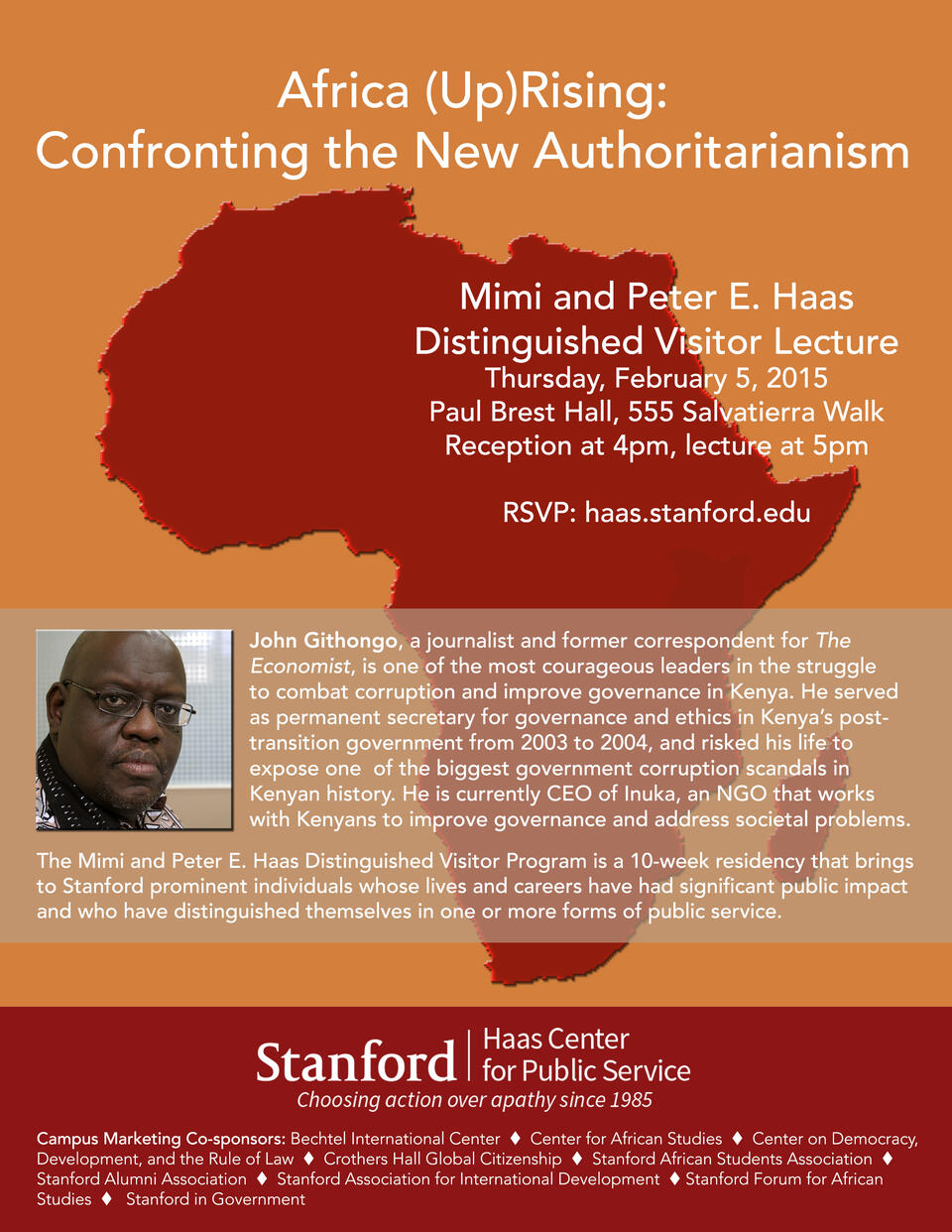
*Please note that the seminar begins with a reception at 4:00pm where you can meet and talk with Mr. Githongo, followed by a lecture at 5:00pm in Paul Brest Hall at Stanford University.*


Speaker Bio: 

johngithongo 145x205 John Githongo
John Githongo, a journalist and former correspondent for The Economist, is one of the most courageous leaders in the struggle to combat corruption and improve governance in Kenya. He served as permanent secretary for governance and ethics in Kenya’s post-transition government in 2003–4, and risked his life and career to expose one of the biggest government corruption scandals in Kenyan history. He has served as CEO of Transparency International Kenya, vice president of World Vision, senior associate member at St Antony’s College Oxford, and member of the Kenya Human Rights Commission. Currently he is CEO of Inuka, an NGO that works with Kenyans, youth in particular, to improve governance and address societal problems. In 2011 Githongo was selected as one of the world’s 100 most influential Africans by New African magazine and one of the world’s top 100 global thinkers by Foreign Policymagazine. 

Image
dvposter2015  final

This event is co-sponsored by the Center on Democracy, Development and the Rule of Law. 

Paul Brest Hall 

555 Salvatierra Walk

Stanford, CA

John Githongo 2015 Mimi and Peter E. Haas Distinguished Visitor
Seminars
Authors
News Type
Commentary
Date
Paragraphs

Nick Deychakiwsky, program officer at the C.S. Mott Foundation, and Maurice Middleberg, executive director of Free the Slaves, engaged in a realistic, yet encouraging conversation on the fabric of NGOs for CDDRL's Program on Human Rights’ Winter Speaker Series “U.S. Human Rights NGOs and International Human Rights” on January 14, 2015.

Deychakiwsky gave the audience the macro perspective to NGOs working in human rights, while Middleberg, working on a specific mission to end modern day slavery, provided the micro perspective. Both Deychakiwsky and Middleberg pronounced the complications and challenges of working for and running an NGO today, narrating a cautionary yet motivating story of NGO management. Deychakiwsky pointed out that all too often, accountability to the society whose projects are designed to help gets lost in the bigger picture of NGO management. He emphasized that to have a positive impact, an NGO must remain mindful of and true to its core values and organizational mission. Middleberg agreed with Deychakiwsky’s view that an organization must always stay true to its mission, while at the same time emphasized that an NGO must nurture its own financial health and organizational culture in order to have the capacity for safekeeping its mission.  

Helen Stacy, director of the Program on Human Rights, was struck by the overlap in Deychakiwsky and Middleberg’s stances on NGO management. Stacy questioned Deychakiwsky about indicators for testing local accountability, and Deychakiwsky pointed out that when a community is willing to offer resources such as time or money, that it is a very strong indication that the project will succeed. Stacy probed Middleberg on his theory of change, asking whether there is an overemphasis of “head” (organizational management) over “heart” (organizational mission). Middleberg asserted that the head and heart of an organization are not in contradiction, but that the head has to be “squared off” in order for the organization to not lose its heart. When asked about NGO competition, both Middleberg and Deychakiwsky believe that there need to be fewer emerging NGOs, and more partnerships and mergers between those that currently exist. Questions from the audience included the resources required for theory of change, the need and ability to stay true to one’s mission, and the systems in place to test and measure change.  

Dana Phelps, Program Associate, Program on Human Rights


Hero Image
dsc 0446
All News button
1
Authors
News Type
Commentary
Date
Paragraphs

Douglas Rutzen, president and CEO of the International Center for Not-for-Profit Law (ICNL), and adjunct professor of law at Georgetown University in Washington, D.C., gave a talk on defending civil society for the Stanford Program on Human Rights’ Winter Speaker Series, “U.S. Human Rights NGOs and International Human Rights,” on January 7, 2015.

Rutzen sounded the alarm of today’s disturbing trend of governments around the world using the rule of law to restrict civic spaces of congregation and protestation. Highlighting that national governments are constitutionally committed to a rule of law, Rutzen claimed this is not being applied in the interests of the citizen but rather to restrict citizens’ criticism of government. Rutzen emphasized that this misuse of the rule of law to restrict civil society is a tool of manipulation utilized not just by nations with a history of civic control, such as Cuba and Russia, but also by liberal democracies, including the United States.

Rutzen noted that the Millennium Development Goals (MDG) established in 2000 were dramatically altered by the attacks of September 11, 2001. NGOs were targeted as potential terrorist organizations, while at the same time recognized for their potential to fight terrorism. This contradiction shows the tension in the role of NGOs in civil society. The challenge now lies in a long-term transformation of the relationship between NGOs representing civil society and national governments.

The talk continued with a discussion with Helen Stacy, director of the Program on Human Rights, and Rutzen. Stacy posed provocative questions that challenged Rutzen to defend his stance with questions on U.S. cultural imperialism; “good” and “bad” civil society groups; and the need to understand domestic civil society engagement with human rights issues as part of international human rights activism. 

-Dana Phelps, Program Associate, Program on Human Rights


Hero Image
dsc 0433 Dana Phelps
All News button
1
Subscribe to Governance