Governance

FSI's research on the origins, character and consequences of government institutions spans continents and academic disciplines. The institute’s senior fellows and their colleagues across Stanford examine the principles of public administration and implementation. Their work focuses on how maternal health care is delivered in rural China, how public action can create wealth and eliminate poverty, and why U.S. immigration reform keeps stalling. 

FSI’s work includes comparative studies of how institutions help resolve policy and societal issues. Scholars aim to clearly define and make sense of the rule of law, examining how it is invoked and applied around the world. 

FSI researchers also investigate government services – trying to understand and measure how they work, whom they serve and how good they are. They assess energy services aimed at helping the poorest people around the world and explore public opinion on torture policies. The Children in Crisis project addresses how child health interventions interact with political reform. Specific research on governance, organizations and security capitalizes on FSI's longstanding interests and looks at how governance and organizational issues affect a nation’s ability to address security and international cooperation.

Authors
News Type
News
Date
Paragraphs

The Center for Democracy, Development and the Rule of Law (CDDRL) hosted a conference on the democratic transition in Egypt on Friday as part of its Program on Arab Reform and Democracy.

A series of four panels explored a number of issues surrounding the transition to democracy following the overthrow of President Hosni Mubarak. Prominent scholars from Stanford and other institutions participated in the conference.

Twelve Egypt scholars from American, Egyptian and European universities and think tanks convened in four panels throughout the day to discuss the revolution, the transition process, the changing political landscape and Egypt's future. The conference was co-sponsored by the Abbasi Program in Islamic Studies.

Panelists included Hoover Institution senior fellow Larry Diamond, history professor Joel Beinin, political science assistant professor Lisa Blaydes, CDDRL visiting scholar Ben Rowswell and CDDRL Program Manager Lina Khatib. They were joined by academics from Kent State University, Harvard University, Georgetown University, the University of Texas, Notre Dame University, the University of Exeter, the American University in Cairo and the Brookings Doha Center.

Each panel featured an introduction by the chair, followed by two or three 30-minute talks by panelists and a 30-minute Q&A session.

Emad Shahin, an associate professor of religion, conflict and peacebuilding at Notre Dame, opened the first panel with a talk that emphasized the role of the youth in charging the 18 days of protest that toppled former President Hosni Mubarak.

"In 18 days, this movement dismantled three pillars of Mubarak's regime-the security apparatus, NDP [National Democratic Party] and...the military," he said.

Samer Shehata, an assistant professor of Arab politics at Georgetown University, discussed the response of the regime to the protests and the reasons for its failure.

The second panel looked to the future, focusing on the Egyptian presidential elections scheduled for later this year. Speeches addressed the process of negotiations between the regime and opposition groups, the agenda for constitutional and institutional reform and political repression.

Panelist Jason Brownlee, an associate professor in the Department of Government at University of Texas at Austin, drew a parallel between the current situation in Egypt and the one in Russia in 1991. He described the liberal movement as "electorally weak" and said it experienced difficulty in maintaining momentum.

The third panel addressed political parties in the post-revolution landscape, including the Islamist Muslim Brotherhood party. Panelist Hesham Sallam, a doctoral candidate at Georgetown University, spoke on how the timeline for the parliamentary elections, currently set for this September, disadvantages newly formed parties and favors parties such as the Muslim Brotherhood.

"The speed of transition in Egypt  gives advantage to existing political parties by not allowing time for newcomers to organize," he said.

"The Brotherhood knows how to play politics where liberals have absolutely no idea," added Shadi Hamid, the director of research at the Brookings Doha Center.

Diamond described parallels with the situation in Iraq in 2004 and 2005.

"The liberals weren't good at organizing, had no mass constituency and got electorally crushed...but they had a constructive influence on the constitution making process," he said.

"We should look at this as an iterative process of several elections to come," he added.

The final panel focused on looking forward. Rowswell presented a new "Open Source Democracy Promotion" project, designed to provide Egyptian activists with an option for crowd sourcing constitutional negotiations.

"The best approach is for informed and engaged citizens to support the Egyptian activists...inspired by the opportunity Egyptians have given themselves but also inspired by what Egyptians have given the world regarding democratic state building and ushering in a new age of democracy based on mutual collaboration and participation," Rowswell said.

Hamid delivered the final talk of the conference, presenting his forecast for the parliamentary elections. He singled out newly formed parties backed by wealthy individuals as key players in the upcoming vote.

"The established political parties will do quite well, but also individuals with name recognition in their districts and those with resources will do well," he said.

Hamid cautioned against overly idealistic projections, given the disorganization of the liberal parties in Egypt.

"We have to be realistic," he said. "We wanted to think for a long time that once there was democracy, Egyptians would become fluffy American-style liberals, and we don't know if that is true."

"From the perspective of international actors doing democracy promotion, I think there's a distinction between encouraging Egyptians to make one choice over another," Rowswell said. "I think it should be ensuring that there is a choice to make."

All News button
1
News Type
News
Date
Paragraphs

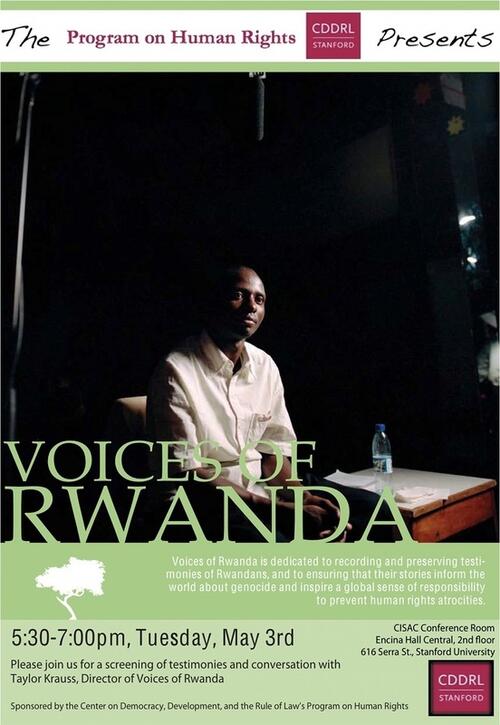
On May 3, 2011, the Program on Human Rights at CDDRL hosted Taylor Krauss, executive director of Voices of Rwanda and an award-winning video-journalist. Krauss screened a short film of testimonies from survivors of the Rwandan genocide to a rapt audience of 40 at the CISAC Central Conference room in Encina Hall. Learn more about Voices of Rwanda and view clips of testimony at http://www.voicesofrwanda.org.

All News button
1
-

The Stanford Students for Engagement and Activism in Microfinance (SEAM), together with the Program on Poverty and Governance at the Center on Democracy, Development, and the Rule of Law, and the Center for Latin America Studies present, The Inside Scoop on Latin America's Largest Microfinance Institution. This event will feature Carlos Danel, Co-founder and Vice President of Compartamos Banco with an introduction by Professor Beatriz Magaloni of the Political Science department.

COMPARTAMOS BANCO was founded in 1990 as an NGO to help create opportunities for development and to allow micro-businesses to grow. In 2006, it established itself as a commercial bank, and in 2008 opened for public investment. Its growth has been unprecedented, currently serving more than 1.6 million clients. Compartamos has been recognized numerous times as one of the best companies to work for in Mexico. Moreover, it is the largest microfinance institution in Latin America.

CARLOS DANEL has been with Compartamos from the beginning as Co-Founder and is the Co-CEO. At the World Economic Forum in 2003, Danel was named a Young Global Leader. He serves on the board of Progresso Financiero, Vista Desarrollos, Grupo CP, and VIFAC A.C. He holds a degree in architecture from the the Universidad Iberoamericana and an MBA from the Instituto Panamericano de Alta Dirección de Empresas.

Koret Pavilion
Ziff Center (Hillel)
Stanford University

Dept. of Political Science
Encina Hall, Room 436
Stanford University,
Stanford, CA

(650) 724-5949
0
Senior Fellow at the Freeman Spogli Institute for International Studies
Graham H. Stuart Professor of International Relations
Professor of Political Science
beatriz_magaloni_2024.jpg MA, PhD

Beatriz Magaloni Magaloni is the Graham Stuart Professor of International Relations at the Department of Political Science. Magaloni is also a Senior Fellow at the Freeman Spogli Institute, where she holds affiliations with the Center on Democracy, Development and the Rule of Law (CDDRL) and the Center for International Security and Cooperation (CISAC). She is also a Stanford’s King Center for Global Development faculty affiliate. Magaloni has taught at Stanford University for over two decades.

She leads the Poverty, Violence, and Governance Lab (Povgov). Founded by Magaloni in 2010, Povgov is one of Stanford University’s leading impact-driven knowledge production laboratories in the social sciences. Under her leadership, Povgov has innovated and advanced a host of cutting-edge research agendas to reduce violence and poverty and promote peace, security, and human rights.

Magaloni’s work has contributed to the study of authoritarian politics, poverty alleviation, indigenous governance, and, more recently, violence, crime, security institutions, and human rights. Her first book, Voting for Autocracy: Hegemonic Party Survival and its Demise in Mexico (Cambridge University Press, 2006) is widely recognized as a seminal study in the field of comparative politics. It received the 2007 Leon Epstein Award for the Best Book published in the previous two years in the area of political parties and organizations, as well as the Best Book Award from the American Political Science Association’s Comparative Democratization Section. Her second book The Politics of Poverty Relief: Strategies of Vote Buying and Social Policies in Mexico (with Alberto Diaz-Cayeros and Federico Estevez) (Cambridge University Press, 2016) explores how politics shapes poverty alleviation.

Magaloni’s work was published in leading journals, including the American Political Science Review, American Journal of Political Science, Criminology & Public Policy, World Development, Comparative Political Studies, Annual Review of Political Science, Cambridge Journal of Evidence-Based Policing, Latin American Research Review, and others.

Magaloni received wide international acclaim for identifying innovative solutions for salient societal problems through impact-driven research. In 2023, she was named winner of the world-renowned Stockholm Prize in Criminology, considered an equivalent of the Nobel Prize in the field of criminology. The award recognized her extensive research on crime, policing, and human rights in Mexico and Brazil. Magaloni’s research production in this area was also recognized by the American Political Science Association, which named her recipient of the 2021 Heinz I. Eulau Award for the best article published in the American Political Science Review, the leading journal in the discipline.

She received her Ph.D. in political science from Duke University and holds a law degree from the Instituto Tecnológico Autónomo de México.

Director, Poverty, Violence, and Governance Lab
Co-director, Democracy Action Lab
CV
Date Label
Beatriz Magaloni Associate Professor Moderator Department of Political Science, Stanford University
Carlos Danel Co-Founder and Vice President Speaker Compartamos Banco
Conferences
News Type
News
Date
Paragraphs

On March 8, Professor Larry May delivered a lecture entitled "Reparations, Restitution, and Transitional Justice" as part of the Program on Human Right's Sanela Diana Jenkins International Human Rights Speaker Series. May, a Professor of Philosophy and of Law at Vanderbilt University, presented his analysis of transitional justice and jus post bellum that has appeared in some of his 25 published books, as well as the many scholarly articles and essays he has written.

May began his lecture by explaining the historical origin of the idea of transitional justice, referencing the theory of distributive and compensatory justice as articulated by Aristotle. According to May, Aristotle's work could inform modern day thinking of how to achieve justice in transitional settings. Specifically, May argued that Aristotle's continuum of compensation to victims - ranging from excessive to deficient - reveals an unfortunate reality of transitional justice. This reality, according to May, is that in most instances the compensation to victims who suffer crimes against humanity is insufficient to rectify the injustices these individuals suffer.

After posing the rhetorical question of how the international community could even compensate the millions of individuals displaced or affected by the crisis in Darfur, May presented what he considers radical solution to this enduring problem. May suggested that the international community establish a worldwide fund out of which innocent and harmed citizens in war-torn countries would be compensated. While admitting that his solution may be logistically and politically problematic, May believed such a fund would be the only manner to provide true justice to affected people, as their governments may be themselves unable or unwilling to take such action.


All News button
1
Paragraphs

Protest, demonstrations and social unrest have been increasingly prevalent across the European Union. European citizens appear ever more discontent with their national governments and with ‘Europe'. Reforms and policies aimed at countering the challenges of the economic crises and increased global competition are met by strong public opposition. Recent student movements protesting against educational reforms, strikes and massive anti-austerity demonstrations in many European capitals, protest votes for extreme right or left political parties are just some of these manifestations. What translates dissatisfaction to protest and drives these collective actions? How is protest expressed in European politics and in the public sphere today? Who is protesting and against what? Is this growing opposition the result of socio-economic insecurity felt by European citizens due to Europe's increasingly strained economic security and prosperity? Or, has Europe hit the limits of how much integration and diversity it can digest? As the current model of European economic liberalism is attacked by protest groups and populists from both left and right, how does this affect European democracy and the future of the European project? 

All Publications button
1
Publication Type
Working Papers
Publication Date
Journal Publisher
CDDRL Working Papers
Authors
Ruby Gropas
News Type
News
Date
Paragraphs

Each year, CDDRL awards fellowships to four outstanding pre and post-doctoral students who are in the write-up stage or recent graduates from doctoral programs examining the fields of democracy, development, and the rule of law. Fellows spend the academic year at the Center completing their projects, participating in seminars, and interacting with the resident faculty and research staff.

The selection process was extremely competitive this year, as the Center received 95 applications to the program and awarded four fellowships to scholars whose research demonstrated significant depth and alignment with the mission and research programming at the Center. The scholarly community at CDDRL will be enriched and enhanced by the addition of two pre-doctoral and two post-doctoral scholars hailing from leading graduate programs in the United States. Fellows will be arriving in September to begin the nine month fellowship.

Please join CDDRL in welcoming:


Michael Albertus

Post-doctoral Fellow
Stanford University
Ph.D. In Political Science, expected June 2011
Research Interests: Political Regimes, Democratization, Autocratic Survival, Wealth Redistribution, Economic Inequality, Clientelism 
Dissertation: "Political Regimes and Redistribution"


Eric Kramon

Pre-doctoral Fellow
University of California Los Angeles 
Ph.D. In Political Science, expected June 2012
Research Interests: Clientelism, Distributive Politics, Democratization, Politics and Health, Political Economy of Development, Natural Resource Politics, African Politics, Experimental Methods
Dissertation: "Clientelism, Vote Buying and Democracy in Africa"


Reo Matsuzaki

Post-doctoral Fellow
Massachusetts Institute of Technology
Ph.D. In Political Science, expected June 2011
Research Interests: Civil War and Post-Conflict Reconstruction, Ethnic and Identity Politics, Comparative-Historical Analysis of Governance Institutions, East Asia
Dissertation: "Institutions by Imposition: Colonial Lessons for Contemporary State- Building"


Alexander Ruiz Euler

Pre-doctoral Fellow
University of California San Diego
Ph.D. In Political Science, expected September 2013
Research Interests: Inequality, Poverty, Democratization, Public Goods
Dissertation: "The Effects of Income Inequality in the Provision of Public Goods: The Case of Mexico"


Hero Image
books logo
All News button
1
-

Why are the Arab uprisings sweeping the Middle East taking place now and where are they likely to lead? Janine Zacharia will share insights from from her time as a reporter for the Washington Post in the Middle East leading up to the start of the revolts in January and on the ground as they erupted. She will provide a reporter's perspective on what led to Egyptian President Hosni Mubarak's downfall, how his inner circle saw things playing out, how one of the U.S.'s chief allies - Bahrain -- lost control of a Shiite-led revolt, and what is likely, or rather not likely, to transpire in Saudi Arabia.

Janine Zacharia was Jerusalem Bureau Chief and Middle East Correspondent for the Washington Post from December 2009 through April 2011. During her time at the Washington Post, she reported widely throughout the Middle East beyond Israel, the West Bank and Gaza Strip, including assignments in Egypt, Jordan, Lebanon, Iraq, Bahrain, Saudi Arabia, the UAE and Turkey. She reported on the uprisings in Egypt and Bahrain as they began in early 2011. From 2005-2009, Ms. Zacharia worked as chief diplomatic correspondent for Bloomberg News based in Washington. During this period, she traveled to more than 40 countries with then U.S. Secretary of State Condoleezza Rice and other senior administration and military officials. Ms. Zacharia's earlier career included five years as Washington bureau chief for the Jerusalem Post, and five years in Jerusalem working for various news outlets including the Reuters news agency. She was a regular contributor to the New Republic and has appeared routinely as a cable news analyst on MSNBC, CNN and other networks. She was also a regular panelist on Gwen Ifill's Friday evening roundtable, Washington Week in Review. During the 2008-2009 academic year, Ms. Zacharia was awarded a Knight Journalism Fellowship at Stanford University. She earned her Bachelor's of Arts degree in Literary Studies from Middlebury College and is originally from Long Island.

CISAC Conference Room

Janine Zacharia Former Middle East Correspondent Speaker The Washington Post
Seminars
Subscribe to Governance