Governance

FSI's research on the origins, character and consequences of government institutions spans continents and academic disciplines. The institute’s senior fellows and their colleagues across Stanford examine the principles of public administration and implementation. Their work focuses on how maternal health care is delivered in rural China, how public action can create wealth and eliminate poverty, and why U.S. immigration reform keeps stalling. 

FSI’s work includes comparative studies of how institutions help resolve policy and societal issues. Scholars aim to clearly define and make sense of the rule of law, examining how it is invoked and applied around the world. 

FSI researchers also investigate government services – trying to understand and measure how they work, whom they serve and how good they are. They assess energy services aimed at helping the poorest people around the world and explore public opinion on torture policies. The Children in Crisis project addresses how child health interventions interact with political reform. Specific research on governance, organizations and security capitalizes on FSI's longstanding interests and looks at how governance and organizational issues affect a nation’s ability to address security and international cooperation.

-

Abstract:

The Performance of Democracies is a research project that will start in May 2014. The project is funded by the European Research Council, the budget is 4.2 mil. Euro. The problems this project will address are the following. While more countries than ever are now considered to be democratic, there is only a very weak, or none, correlation between standard measures of human well-being and measures of democracy. A second problem is that a large number of democracies turn out to have severe difficulties managing their public finances in a sustainable way. The third problem is that democracy seems not to be a cure against pervasive corruption. Empirical research shows that these problems have severe consequences for citizens’ perception of the legitimacy of their political system. The project intends to use an institutional approach to answer the question why some democracies perform better than others.


Speaker Bio:

Bo Rothstein holds the August Röhss Chair in Political Science at University of Gothenburg in Sweden where he is head of the Quality of Government (QoG) Institute. The QoG Institute consists of about twenty researchers studying the importance of trustworthy, reliable, competent and non-corrupt government institutions.

Rothstein took is PhD at Lund University in 1986 and served as assistant and associate professor at Uppsala University 1986 to 1994. He has been a visiting scholar at the Russell Sage Foundation in New York, Cornell University, Harvard University, Collegium Budapest Institute for Advanced Study, the Australian National University and the University of Washington in Seattle. In 2006, he served as Visiting Professor at Harvard University.

Image

Encina Ground Floor Conference Room

Bo Rothstein August Röhss Chair in Political Science Speaker University of Gothenburg
Seminars
-

Image


Abstract:

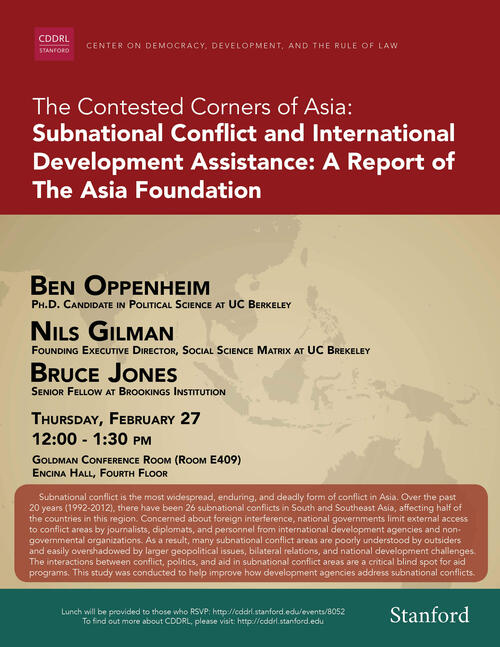
Subnational conflict is the most widespread, enduring, and deadly form of conflict in Asia. Over the past 20 years (1992-2012), there have been 26 subnational conflicts in South and Southeast Asia, affecting half of the countries in this region. Concerned about foreign interference, national governments limit external access to conflict areas by journalists, diplomats, and personnel from international development agencies and non-governmental organizations. As a result, many subnational conflict areas are poorly understood by outsiders and easily overshadowed by larger geopolitical issues, bilateral relations, and national development challenges. The interactions between conflict, politics, and aid in subnational conflict areas are a critical blind spot for aid programs. This study was conducted to help improve how development agencies address subnational conflicts.


Speaker Bios:

Ben Oppenheim is a Fellow (non-resident) at the Center on International Cooperation at New York University. His research spans a diverse set of topics, including fragile states, transnational threats (including pandemic disease risks and terrorism), and the strategic coherence and effectiveness of international assistance in fragile and conflict-affected areas.

Oppenheim has consulted for organizations including the World Bank, the United Nations, the Asia Foundation, the Institute for the Future, and the Fritz Institute, on issues including organizational learning, strategy, program design, foresight, and facilitation. In 2009, he served as Advisor to the first global congress on disarmament, demobilization, and reintegration, supported by the World Bank and the UN.

In 2013, Oppenheim was a visiting fellow at the Uppsala University Forum on Democracy, Peace, and Justice. His research has been supported by a Simpson Fellowship, and a fellowship with the Institute on Global Conflict and Cooperation. He was also a research fellow with UC Berkeley's Institute of International Studies, affiliated with the New Era Foreign Policy Project.


Nils Gilman is the Executive Director of Social Science Matrix. He holds a B.A., M.A. and Ph.D. in History from the University of California, Berkeley. Gilman’s first scholarly interest was in American and European intellectual history, with a particular focus on the institutional development of the social sciences, the lateral transfer and translation of ideas across disciplinary boundaries, and the impact of social scientific ideas on politics and policy.

Gilman is the author of Mandarins of the Future: Modernization Theory in Cold War America (Johns Hopkins University Press, 2004), the co-editor of Staging Growth: Modernization, Development, and the Global Cold War (University of Massachusetts Press, 2003) and Deviant Globalization: Black Market Economy in the 21st Century (Continuum Press, 2011), as well as the founding Co-editor of Humanity: An International Journal of Human Rights, Humanitarianism, and Development. He also blogs and tweets.

Prior to joining Social Science Matrix in September 2013, Gilman was research director at Monitor 360, a San Francisco consultancy that addresses complex, cross-disciplinary global strategic challenges for governments, multinational businesses, and NGOs. He has also worked at a variety of enterprise software companies, including Salesforce.com, BEA Systems, and Plumtree Software. Gilman has taught and lectured at a wide variety of venues, from the Harvard University, Columbia University, and National Defense University, to PopTech, the European Futurists Conference, and the Long Now Foundation.


Bruce Jones is a senior fellow and the director of the Project on International Order and Strategy in the Foreign Policy program at the Brookings Institution. He is also the director of the Center on International Cooperation at New York University.

Jones served as the senior external advisor for the World Bank’s 2011 World Development Report, Conflict, Security and Development, and in March 2010 was appointed by the United Nations secretary-general as a member of the senior advisory group to guide the Review of International Civilian Capacities. He is also consulting professor at the Center for International Security and Cooperation at Stanford University and professor (by courtesy) at New York University’s department of politics.

Jones holds a Ph.D. from the London School of Economics, and was Hamburg fellow in conflict prevention at Stanford University.

He is co-author with Carlos Pascual and Stephen Stedman of Power and Responsibility: Building International Order in an Era of Transnational Threats (Brookings Press, 2009); co-editor with Shepard Forman and Richard Gowan of Cooperating for Peace and Security (Cambridge University Press, 2009); and author of Peacemaking in Rwanda: The Dynamics of Failures(Lynne Reinner, 2001).

Jones served as senior advisor in the office of the secretary-general during the U.N. reform effort leading up to the World Summit 2005, and in the same period was acting secretary of the Secretary-General’s Policy Committee. In 2004-2005, he was deputy research director of the High-level Panel on Threats, Challenges and Change. From 2000-2002 he was special assistant to and acting chief of staff at the office of the U.N. special coordinator for the Middle East peace process. 

Richard and Rhoda Goldman Conference Room

Ben Oppenheim Ph.D. Candidate in Political Science Speaker UC Berkeley
Nils Gilman Founding Executive Director, Social Science Matrix Speaker UC Berkeley
Bruce Jones Senior Fellow Speaker Brookings Institution
Seminars
-

Abstract:

Election observation is central to democracy promotion efforts around the world, yet relatively little is known about observers' effects on electoral quality.  Do election observers deter electoral fraud, violence, and voter intimidation? Or do political parties strategically respond to the presence of observers, thereby negating their impact?  This project leverages the random assignment of 1,000 election observers to polling stations during Ghana's 2012 presidential and parliamentary elections to address these questions.  We show that observers significantly reduce indicators of fraud at the polling stations to which they are deployed. We also find, however, that political parties successfully relocate fraud from observed to unobserved stations in their historical strongholds, where they enjoy social penetration and political competition is low, whereas they are not able to do so in politically competitive constituencies.  The presentation will also report preliminary results from a household survey conducted after the elections designed to measure observers’ effects on patterns of electoral violence and voter intimidation.  The findings have implications for understanding political party behavior and the complex effects of governance interventions.


Speaker Bio:

Eric Kramon received his PhD in political science from UCLA in 2013 and is a 2013-14 Minerva Postdoctoral Fellow.  He will be an assistant professor of political science and international affairs at George Washington University starting in Summer 2014.  While at CDDRL, he is working on a book project on vote buying and clientelism in Africa, as well as additional projects on the impact of election observation on electoral fraud and electoral quality, ethnicity and the politics of public goods provision in Africa, and the political determinants of good governance reforms.


Image

Encina Ground Floor Conference Room

Encina Hall, C139
616 Serra Street
Stanford, CA 94305-6055

0
Minerva Postdoctoral Fellow 2013-2014, CDDRL Pre-doctoral Fellow 2011-2013
KRAMON_hs.jpg

Eric Kramon received his PhD in political science from UCLA in 2013 and is a 2013-14 Minerva Postdoctoral Fellow.  He will be an assistant professor of political science and international affairs at George Washington University starting in Summer 2014.  While at CDDRL, he is working on a book project on vote buying and clientelism in Africa, as well as additional projects on the impact of election observation on electoral fraud and electoral quality, ethnicity and the politics of public goods provision in Africa, and the political determinants of good governance reforms.

Eric Kramon Minerva Postdoctoral Fellow Speaker CDDRL
Seminars
-
Abstract:
 
How can international organizations influence behavior at the level of the individual?  This paper tests whether incentive-based and norm promoting strategies have effects that trickle down to individuals and affect their behavior at the ground level.  The study uses a hard case, that of discrimination against the Roma (commonly known by the disfavored term  "Gypsies"), and spans three towns, Murska Sobota and Novo mesto in Slovenia and Cakovec in Croatia.  Levels of discrimination were estimated via trust games played with money, which are particularly appropriate because the Roma are widely stereotyped as cheaters and thieves.  The findings suggest that the EU accession process, widely regarded as an exceptionally strong incentive-based mechanism of rights diffusion, does not severely reduce discrimination on the ground.  Instead, they suggest that ground level organizing aimed at improving relations between Roma and non-Roma helps reduce discrimination.
 
 
Speaker Bio: 
 
Ana Bracic is a postdoctoral fellow at CDDRL. She received her PhD from NYU in May 2013, and was a Junior Visiting Fellow at the Human Rights Program at Harvard Law School in 2012-13. Her research aims to identify and understand mechanisms that tangibly improve the lives of people whose rights are violated, whether through measures are best applied at the state level or on the ground. Her dissertation consists of three related projects: a micro-level fieldwork study of discrimination against the Roma in Slovenia and Croatia, a macro-level study of cross-country diffusion of human rights practices, and a macro-level comparison of physical integrity rights violations in failed and stable autocracies. Her work has been funded in part by the American Political Science Association.

Encina Ground Floor Conference Room

Ana Bracic Postdoctoral Fellow Speaker CDDRL
Seminars
-


Image

Abstract:

Scholars of state development have paid insufficient attention to the question of regionalism; too often modeling state-building as the extension of the authority of a 'center' over peripheral territories, and too often linking regionalism to cultural or ethnic heterogeneity. A purely spatial account of the challenges to central control shows that even in the absence of cultural fractionalization, the presence of economically powerful and politically salient regions undermines political development. Three analytically distinct mechanisms - divergent public good preferences, economic self-sufficiency, and institutional design - underlie this relationship. I explore these issues through a region-wide analysis of Latin America, and case studies of the United States, Ecuador, Colombia, and early modern Poland.

Speaker Bio:

Hillel David Soifer earned his PhD in the Government Department at Harvard, and is currently Assistant Professor of Political Science at Temple University. His research has been centered in Latin America, with a focus on political development and state capacity, and has been published in journals including Latin American Research Review and Comparative Political Studies. He is currently completing a book on the long-term divergence in state capacity in Latin America which contrasts the cases of Chile, Colombia, Mexico, and Peru.

Encina Ground Floor Conference Room

Hillel Soifer Assistant Professor of Political Science Speaker Temple University
Seminars
-

Abstract:

We design an original laboratory experiment to investigate whether redistributive actions hinder the formation of Pareto-improving groups. We test, in an anonymous setting with no feedback, whether people choose to destroy or steal the endowment of others and whether they choose to give to others, when granted the option. We then test whether subjects join a group that increases their endowment but exposes them to redistribution. We conduct the experiment in three very different settings with a priori different norms of pro-social behavior: a university town in the UK, the largest slum in Nairobi, Kenya and rural Uganda. We find a lot of commonality but also large differences between sites. UK subjects behave in a more selfish and strategic way -- giving less, stealing more. Kenyan and Ugandan subjects behave in a more altruistic and less strategic manner. However, pro-social norms are not always predictive of joining behavior. African subjects are less likely to join a group when destruction or stealing is permitted. It is as if they are less trusting even though they are more trustworthy. These findings contradict the view that African underdevelopment is due to a failure of generalized morality. 


Speaker Bio:

Marcel Fafchamps is senior fellow at the Freeman Spogli Institute for International Studies and member of the Center on Democracy, Development and the Rule of Law. Before joining FSI, he served as Professor of Development Economics at Oxford University and as Deputy Director of the Center for the Study of African Economies. Before that he taught at Stanford University. He also worked for the International Labour Organization in Africa. His research focuses on market institutions and social networks, writ large. Fafchamps holds a PhD from UC Berkeley and degrees in Law and in Economics from the Catholic University of Louvain.


Encina Ground Floor Conference Room

Encina Hall
616 Jane Stanford Way
Stanford, CA 94305-6055

0
Senior Fellow Emeritus at the Freeman Spogli Institute for International Studies
Professor, by courtesy, of Economics
marcel_fafchamps_2025.jpg

Marcel Fafchamps is a Senior Fellow Emeritus at the Freeman Spogli Institute for International Studies (FSI) and a member of the Center on Democracy, Development and the Rule of Law. Previously, he was the Satre Family Senior Fellow at FSI. Fafchamps is a professor (by courtesy) for the Department of Economics at Stanford University. His research interests include economic development, market institutions, social networks, and behavioral economics — with a special focus on Africa and South Asia.

Prior to joining FSI, from 1999-2013, Fafchamps served as professor of development economics in the Department of Economics at Oxford University. He also served as deputy director and then co-director of the Center for the Study of African Economies. From 1989 to 1996, Fafchamps was an assistant professor with the Food Research Institute at Stanford University. Following the closure of the Institute, he taught for two years at the Department of Economics. For the 1998-1999 academic year, Fafchamps was on sabbatical leave at the research department of the World Bank. Before pursuing his PhD in 1986, Fafchamps was based in Addis Ababa, Ethiopia, for 5 years during his employment with the International Labour Organization, a United Nations agency that oversees employment, income distribution, and vocational training in Africa.

He has authored two books: Market Institutions in Sub-Saharan Africa: Theory and Evidence (MIT Press, 2004) and Rural Poverty, Risk, and Development (Elgar Press, 2003), and has published numerous articles in academic journals.

Fafchamps served as the editor-in-chief of Economic Development and Cultural Change until 2020. Previously, he had served as chief editor of the Journal of African Economies from 2000 to 2013, and as associate editor of the Economic Journal, the Journal of Development Economics, Economic Development and Cultural Change, the American Journal of Agricultural Economics, and the Revue d'Economie du Développement.

He is a research associate of the National Bureau of Economic Research, an affiliated professor with J-PAL, a senior fellow with the Bureau for Research and Economic Analysis of Development, a research fellow with IZA, Germany, and with the Center for Economic and Policy Research, UK, and an affiliate with the University of California’s Center for Effective Global Action.

Fafchamps has degrees in Law and in Economics from the Université Catholique de Louvain. He holds a PhD in Agricultural and Resource Economics from the University of California, Berkeley. 

Curriculum Vitae

Publications 

Working Papers

Date Label
Marcel Fafchamps Senior Fellow Speaker Freeman Spogli Institute for International Studies
Seminars
-

Abstract:
Armed conflict causes profound and widespread adverse consequences for health and human rights. It directly causes death as well as physical and mental disabilities among combatants and increasingly among non-combatants. It damages the health-supporting infrastructure of society, including public health services and medical care. It forces people to leave the safety and security of their homes and communities. It diverts human and financial resources away from activities that benefit society. It leads to further violence. And, in these and other ways, armed conflict violates human rights.  This presentation will provide examples of these adverse consequences of armed conflict and what can be done to minimize these consequences and to prevent armed conflict.


Dr.Barry Levy is a physician and epidemiologist who has edited books, written papers, and spoken widely on these issues. He is an Adjunct Professor of Public Health at Tufts University School of Medicine. Previously, he served as a medical epidemiologist for the CDC, a tenured professor at the University of Massachusetts Medical School, USAID coordinator for AIDS prevention in Kenya, executive director of the International Physicians for the Prevention of Nuclear War, and in other roles. He is a past president of the American Public Health Association and a recipient of its Sedgwick Memorial Medal. He has written more than 200 published papers and book chapters, many on the adverse effects of war. He has co-edited 17 books, including, with co-editor Dr. Victor Sidel and many contributing authors, two editions each of the books War and Public Health, Terrorism and Public Health, and Social Injustice and Public Health.    

Building 200 (History Corner)
Room 205
Stanford University

Barry S. Levy, M.D., M.P.H. Adjunct Professor of Public Health Speaker Tufts University School of Medicine
Seminars
-

Abstract
The framework of "LGBT rights" can be critiqued as challenging tradition or as culturally specific, yet at the same time, it can be essential to one's sense of identity and justice.  Where can the discourse of "public health" help overcome barriers for LGBT people, both within the right to health and beyond? What are the limits to using public health to talk about human rights, LGBT or otherwise?  What are the dangers of conflating these distinct areas of concern?  We will explore these questions and focus on how academics and activists can most effectively navigate challenges to benefit both public health and LGBT rights.

Jessica Stern is the Executive Director of the International Gay and Lesbian Human Rights Commission. As the first researcher on lesbian, gay, bisexual and transgender (LGBT) human rights at Human Rights Watch, she conducted fact-finding investigations and advocacy around sexual orientation and gender identity in countries including Iran, Kyrgyzstan, South Africa, and the United Arab Emirates. As a Ralph Bunche Fellow at Amnesty International, she documented police brutality for what became its landmark report on police brutality in LGBT communities in the U.S., “Stonewalled.” She was a founding collective member and co-coordinator of Bluestockings, then New York’s only women’s bookstore. She has campaigned extensively for women’s rights, LGBT rights, and economic justice with the Center for Constitutional Rights, Control Ciudadano, the National Gay & Lesbian Task Force, and the Urban Justice Center. She holds a masters degree in human rights from the London School of Economics. She is frequently quoted in the Mail & Guardian, Al Jazeera English, the Associated Press, Reuters, Agence France Presse, Deutsche Welle, Voice of America, The Guardian and The BBC.

Building 200 (History Corner)
Room 205
Stanford University

Jessica Stern Executive Director Speaker International Gay and Lesbian Human Rights Commission
Seminars
-

Hon.Agnes Binagwaho has served as Permanent Secretary of the Ministry of Health in Rwanda since October 2008. She specialized in emergency pediatrics, neonatology, and the treatment of HIV/AIDS; and she chairs the Rwandan Pediatric Society. From 1986 to 2002, she practiced medicine in public hospitals in Rwanda and several other countries before joining Rwanda's National AIDS Control Commission as Executive Secretary. She is a member of the Editorial Board of Public Library of Science, and the Harvard University Health and Human Rights Journal. Dr. Binagwaho co‐chaired the Millennium Development Goal Project Task Force on HIV/AIDS and Access to Essential Medicines for the Secretary‐General of the United Nations under the leadership of Professor Jeffrey Sachs. She was the global co‐chair of the Joint Learning Initiative on Children and HIV/AIDS. In addition to her medical degree and Master in Peadiatry, she received an Honorary Doctor of Sciences from Dartmouth College. Dr. Binagwaho serves as a visiting lecturer in the Department of Global Health and Social Medicine of Harvard Medical School.

Building 200 (History Corner)
Room 205
Stanford University

Hon. Agnes Binagwaho Minister of Health Speaker Rwanda
Seminars
-

Zainab Hawa Bangura of Sierra Leone is Special Representative on Sexual Violence in Conflict at the level of Under-Secretary-General at the United Nations.

Prior to this appointment, Ms. Bangura was the Minister of Health and Sanitation for the Government of Sierra Leone, and brings to the position over 20 years of policy, diplomatic and practical experience in the field of governance, conflict resolution and reconciliation in Africa. She was previously the second female Minister of Foreign Affairs and International Cooperation, including Chief Adviser and Spokesperson of the President on bilateral and international issues. Ms. Bangura has been instrumental in developing national programmes on affordable health, advocating for the elimination of genital mutilation, managing the country’s Peace Building Commission and contributing to the multilateral and bilateral relations with the international community. She is experienced in meeting with interlocutors in diverse situations, including rebel groups, and familiar in dealing with State and non-State actors relevant to issues of sexual violence while fighting corruption and impunity.

Ms. Bangura has on-the-ground experience with peacekeeping operations from within the United Nations Mission in Liberia (UNMIL), where she was responsible for the management of the largest civilian component of the Mission, including promoting capacity-building of government institutions and community reconciliation. She is an experienced results-driven civil society, human and women’s rights campaigner and democracy activist, notably as Executive Director of the National Accountability Groups, Chair and Co-founder of the Movement for Progress Party of Sierra Leone, as well as Coordinator and Co-founder of the Campaign for Good Governance.

Ms. Bangura is a former fellow of the Chartered Insurance Institute of London, possessing Diplomas in Insurance Management from the City University Business School of London and Nottingham University. She received her Bachelor of Arts from the Fourah Bay College, University of Sierra Leone.

Building 200 (History Corner)
Room 205
Stanford University

Zainab Bangura United Nations Special Representative on Sexual Violence in Conflict Speaker
Seminars
Subscribe to Governance