
FSI's research on the origins, character and consequences of government institutions spans continents and academic disciplines. The institute’s senior fellows and their colleagues across Stanford examine the principles of public administration and implementation. Their work focuses on how maternal health care is delivered in rural China, how public action can create wealth and eliminate poverty, and why U.S. immigration reform keeps stalling.
FSI’s work includes comparative studies of how institutions help resolve policy and societal issues. Scholars aim to clearly define and make sense of the rule of law, examining how it is invoked and applied around the world.
FSI researchers also investigate government services – trying to understand and measure how they work, whom they serve and how good they are. They assess energy services aimed at helping the poorest people around the world and explore public opinion on torture policies. The Children in Crisis project addresses how child health interventions interact with political reform. Specific research on governance, organizations and security capitalizes on FSI's longstanding interests and looks at how governance and organizational issues affect a nation’s ability to address security and international cooperation.


Fukuyama compares governance in China and U.S.
News Type
News
Date
Paragraphs
In a recent blog article in The Huffington Post, Francis Fukuyama compares the triumphs and pitfalls of Chinese and U.S. models of governance, acknowledging the necessity for China to establish a formal legal system with better accountability.
Hero Image

U.S. President Barack Obama meets with Chinese President Xi Jinping at The Annenberg Retreat at Sunnylands in Rancho Mirage, California, on June 7, 2013.
Kevin Lamarque, Reuters
All News button
1
Eleanor Roosevelt: Close To Home
-
*This event is free and open to the public.*
Image
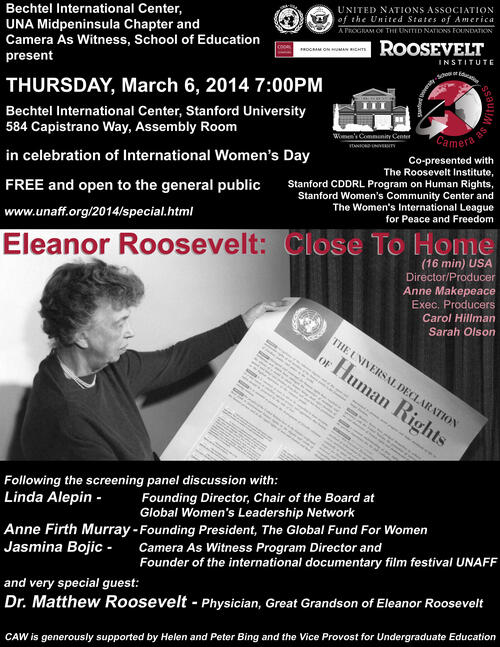
Eleanor Roosevelt: Close to Home is an overview of the inspirational life of Eleanor Roosevelt and highlights her dedication as champion of social justice and racial equality. The film introduces viewers to Val-Kill, the home of this extraordinary American who became a world leader in human rights and creator of the Universal Declaration of Human Rights. The remarkable modesty, independence and humanitarian leadership that made Eleanor Roosevelt the "First Lady of the World" are reflected in the Cottage's rooms, furnishings and surroundings. No other place allows visitors to connect with, rediscover and appreciate anew this woman whose influence is still so widely felt.
Following the screening, there will be a panel discussion.
This event is co-presented with the CDDRL Program on Human Rights, Roosevelt Institute, Stanford Women's Community Center and Women's International League for Peace and Freedom and sponsored by the Bechtel International Center, UNA Midpeninsula Chapter and Camera As Witness, Stanford Graduate School of Education in celebration of International Women's Day.
Bechtel International Center
Assembly Room
Stanford University
584 Capistrano Way
Linda Alepin
Founding Director, Chair of the Board
Speaker
Global Women's Leadership Network
Anne Firth Murray
Founding President
Speaker
The Global Fund For Women
Jasmina Bojic
Camera As Witness Program Director and Founder of the international documentary film festival UNAFF
Speaker
Dr. Matthew Roosevelt
Physician
Speaker
Great Grandson of Eleanor Roosevelt
Conferences
The Origins and Development of Taiwan’s Policies toward its Overseas Citizens’ Participation in Homeland Governance and Policymaking
-
Abstract:
This presentation traces the origins and evolution of the Republic of China (ROC)’s policies towards its overseas constituents since its founding in 1912, and its transfer to Taiwan in 1949. While discussing the ideological and legal principles underpinning the POC’s policies toward the overseas community, the talk also focuses on how the changing international and domestic political circumstances have affected the degree and nature of involvement of overseas citizens in homeland political and economic decision-making. More essentially, democratization and the rise of Taiwanese-centered identity and consciousness have, since the mid-1990s, driven the ROC government to re-define and re-conceptualize its relations to Taiwan as well as to its overseas citizens, thus resulting in the transformation of the political and legal policies toward the overseas compatriot community. The implications of these changes on the future of Taiwan’s domestic politics and foreign relations will also be examined.
Speaker Bio:
Dean P. Chen received his doctorate from the University of California, Santa Barbara in 2010. He is Assistant Professor of Political Science at the Salameno School of Humanities and Global Studies, Ramapo College of New Jersey. His research and teaching interests are international politics, U.S.-China-Taiwan relations, and governance and institutions in China and Taiwan. His most recent publications include Sustaining the Triangular Balance: The Taiwan Strait Policy of Barack Obama, Xi Jinping, and Ma Ying-jeou (University of Maryland School of Law, 2013), "The Evolution of Taiwan’s Policies toward the Political Participation of Citizens Abroad in Homeland Governance" (with Pei-te Lien) in Tan Chee-Bang, ed. Routledge Handbook of the China Diaspora (Routledge, 2013) and U.S> Taiwan Strait Policy: The Origins of Strategic Ambiguity (Lynne Rienner, 2012).
Philippines Conference Room
Dean P. Chen
Assistant Professor of Political Science
Speaker
Salameno School of Humanities and Global Studies
Seminars
Activist speaks on prospect of revolution in Cambodia
News Type
News
Date
Paragraphs
At a CDDRL event on February 3, human rights activist Virak Ou, president of the Cambodian Center for Human Rights, discussed the recent protests in Cambodia, addressing the potential conditions for revolution.
Hero Image

Virak Ou, human rights activist, speaks on the prospect of revolution in Cambodia. Photo taken in Encina Hall at Stanford University.
Christian Ollano
All News button
1

McFaul returns to Stanford
News Type
News
Date
Paragraphs
When Michael McFaul steps down from his post as Washington’s ambassador to Moscow later this month, he will return to Stanford where he is a senior fellow at the Freeman Spogli Institute for International Studies (FSI) and a former director of the institute’s Center on Democracy, Development, and the Rule of Law (CDDRL).
Announcing his decision this week to leave Russia following the Winter Olympics, McFaul wrote on his blog that "it is time to come home."
"We are immensely proud of the service Michael McFaul has rendered in these past five years of steering U.S. policy toward Russia, first at the National Security Council and then for the past two years as U.S. Ambassador to Russia," said CDDRL Director Larry Diamond. "During this time, he has navigated skillfully through some of the toughest challenges in U.S. foreign policy, showing that it is possible for the United States to advance its strategic interests while also standing up for its values of freedom, democracy and an open society."
At Stanford, McFaul will resume his academic activities as a professor in the department of political science, a resident faculty member at CDDRL and the Peter and Helen Bing Senior Fellow at the Hoover Institution.
"Ambassador McFaul's return is a sterling opportunity for Stanford and FSI," said FSI Director Mariano-Florentino Cuéllar. "His unique experience as a diplomat and a leading scholar are enormous assets to our centers and educational programs, and to the entire university."
McFaul has worked in the Obama administration for the past five years, and was tapped as ambassador in 2011. He arrived in Russia with the mandate to reset relations with Moscow, which proved to be challenging in a political climate marked by increasing tensions between the two countries. From the ban on U.S. adoptions to the Edward Snowden affair, McFaul faced many setbacks as he embarked on his political mandate.
Nevertheless, McFaul leaves Moscow citing major gains in improving trade and tourism between the two countries, having worked to secure Russia's membership to the World Trade Organization and a new visa regime. He was also integral to negotiating the historic agreement with Russia to eliminate Syrian chemical weapons.
U.S. Secretary of State John Kerry praised McFaul's service in a statement released by the U.S. State Department, "From the New START Treaty to securing Russian cooperation on Iran’s nuclear program, to resupplying our troops in Afghanistan and expanding our trade, there’s scarcely an issue in our bilateral agenda that didn’t benefit from Mike’s steady hand and good old fashioned willpower."
Kerry continued to commend McFaul's deep commitment and engagement with Russian civil society on human rights and the independent media, which often invoked tension with the Russian government.
McFaul was a trailblazer in public diplomacy, using the social media platforms Twitter and Facebook to connect to audiences in Russia and beyond. In his blog, McFaul admits to never having sent a tweet before his time as ambassador but now reaches over 60,000 followers through his Twitter account.
"He grasped the importance of social media in an information age, but he also grasped a much more essential truth: that all people everywhere should be able to express themselves and, ultimately, determine how they are governed," said Kerry. "That’s an enduring conviction, and Mike leaves behind an enduring legacy."
Hero Image

McFaul is seen here with President Barack Obama outside Air Force One. McFaul's departure will mark the end of over five-years of work for President Obama's administration.
Michael McFaul
All News button
1
A Relationship Transformed: Rethinking the Prospects for Conflict and Peace in the Taiwan Strait
-
Abstract:
After long being viewed as potential flashpoint, relations across the Taiwan Strait have stabilized tremendously in recent years, reflecting moderation in the approaches both Beijing and Taipei have taken with regard to the cross-Strait sovereignty dispute. In my presentation, I consider whether this new-found stability in the Taiwan Strait is likely to persist. In particular, I consider how fundamental trends in cross-Strait relations—such as rapidly growing Chinese military power and deepening cross-Strait economic exchange—are affecting the likelihood that the conflict scenarios which worried analysts prior to the current détente will re-emerge as future concerns. My analysis suggests that the relationship across the Taiwan Strait is likely to be more stable in the years ahead than was the case in the years preceding 2008; this conclusion holds even if there is a change in ruling party in Taiwan. But I also emphasize that the cross-Strait relationship has not been fundamentally transformed, and that the potential for serious conflict remains.
Speaker Bio:
Scott L. Kastner is Associate Professor and Director of Undergraduate Studies in the Department of Government and Politics, University of Maryland, College Park. Kastner’s research interests include China’s foreign relations, the international politics of East Asia, and international political economy. His book, Political Conflict and Economic Interdependence across the Taiwan Strait and Beyond, was published in the Studies in Asian Security series by Stanford University Press (2009). His work has also appeared in journals such as International Security, Journal of Conflict Resolution, International Studies Quarterly, Comparative Political Studies, Security Studies, and Journal of Peace Research. Kastner received his Ph.D. in Political Science from the University of California, San Diego.
Oksenberg Conference Room
Scott L. Kastner
Associate Professor and Director of Undergraduate Studies
Speaker
Department of Government and Politics, University of Maryland, College Park
Seminars
<i>The Act of Killing (Director's Cut)</i> Film Screening and Panel Discussion
-
*This event is free and open to the public.*
PANELISTS
Don Emmerson - Director of the Southeast Asia Forum, Shorenstein Asia-Pacific Research Center; Affiliated Scholar, Abbasi Program in Islamic Studies; Affiliated Faculty, CDDRL
Erik Jensen - Professor of the Practice of Law, Stanford Law School; Senior Advisor for Governance and Law, The Asia Foundation; Senior Research Scholar, CDDRL; Director, Rule of Law Program, Stanford Law School
Norman Naimark - Director of the Stanford Global Studies Division; Professor of History
Diane H. Steinberg (Panel Chair) - Visiting Scholar at Stanford's Program on Human Rights, Center on Democracy, Development, and the Rule of Law (CDDRL)
Image

The Act of Killing visits former Indonesian death squad killers who wreaked havoc in 1965 and 1966 in the aftermath of Indonesia's military coup and yet have never been held accountable for slaughtering between 200,000 to 2 million people in a genocide often forgotten. The dramatic reenactments of the murders in the documentary catalyze an unexpected emotional journey for Anwar Congo from arrogance to regret as he confronts for the first time in his life the full implications of what he has done.
The Act of Killing is an award-winning documentary film directed by Joshua Oppenheimer with co-director Christine Cynn and and an anonymous co-director from Indonesia. It is a Danish-British-Norwegian co-production, presented by Final Cut for Real in Denmark and produced by Signe Byrge Sørensen. It was recently nominated for an Academy Award for Best Documentary Feature.
"Director Joshua Oppenheimer has made a documentary in which he interviews the leaders of Indonesian death squads, who were responsible, collectively, for the deaths of millions of Communists, leftists and ethnic Chinese in 1965 and 1966. But he doesn't just interview them. He has them re-enact their crimes and even invites them to write, perform and film skits dramatizing their murders." Mick LaSalle, San Francisco Chronicle, 8/8/2013
"Director Joshua Oppenheimer has made a documentary in which he interviews the leaders of Indonesian death squads, who were responsible, collectively, for the deaths of millions of Communists, leftists and ethnic Chinese in 1965 and 1966. But he doesn't just interview them. He has them re-enact their crimes and even invites them to write, perform and film skits dramatizing their murders." Mick LaSalle, San Francisco Chronicle, 8/8/2013
"The Act of Killing is a bold reinvention of the documentary form, as well as an astounding illustration of man's infinite capacity for evil." Rene Rodriguez, The Miami Herald, 8/15/2013
After the screening of the Director's Cut of The Act of Killing (160 minutes), there will be a thirty-minute panel discussion.
For more information regarding the film, please visit: http://theactofkilling.com/.
This event is presented and sponsored by Stanford Global Studies, CDDRL's Program on Human Rights, and the Vice Provost of Undergraduate Education.
Cubberley Auditorium
Conferences