International Development

FSI researchers consider international development from a variety of angles. They analyze ideas such as how public action and good governance are cornerstones of economic prosperity in Mexico and how investments in high school education will improve China’s economy.

They are looking at novel technological interventions to improve rural livelihoods, like the development implications of solar power-generated crop growing in Northern Benin.

FSI academics also assess which political processes yield better access to public services, particularly in developing countries. With a focus on health care, researchers have studied the political incentives to embrace UNICEF’s child survival efforts and how a well-run anti-alcohol policy in Russia affected mortality rates.

FSI’s work on international development also includes training the next generation of leaders through pre- and post-doctoral fellowships as well as the Draper Hills Summer Fellows Program.

-

Abstract:

One of Taiwan's leading political scientists and most widely quoted authorities on Taiwan politics and cross-Strait relations, Professor Chu will address five issues in his talk:

   First, how should we interpret the outcome of the January election and the nature and extent of President Ma's renewed mandate?

   Second, to what extent has the 2012 election enhanced the overall quality of Taiwan's democracy?

   Third, what can we expect in terms of President Ma's domestic agenda for the next four years?

   Fourth, how much further and faster can the warming of cross-Strait relations proceed during President Ma's second term?

   Fifth, what are the challenges and opportunities for the US-Taiwan relationship in the coming year?

 Speaker Bio:

Yun-han Chu is Distinguished Research Fellow of the Institute of Political Science at Academia Sinica and Professor of Political Science at National Taiwan University. He also serves concurrently as President of Chiang Ching-Kuo Foundation for International Scholarly Exchange. Professor Chu joined the faculty of National Taiwan University in 1987. He was a visiting associate professor at Columbia University in 1990-1991 and has held a visiting professorship at Peking University since 2007. Professor Chu specializes in politics of Greater China, East Asian political economy, international political economy, and democratization. He is the Coordinator of Asian Barometer Survey, a regional network of survey on democracy, governance and development covering more than seventeen Asian countries. He currently serves on the editorial board of Pacific Affairs, International Studies Perspective, China Review, Journal of Contemporary China, Journal of East Asian Studies and Journal of Democracy. He is the author, co-author, editor or co-editor of thirteen books. Among his recent English publications are Consolidating Third-Wave Democracies (Johns Hopkins University Press, 1997), China Under Jiang Zemin (Lynne Reinner, 2000), The New Chinese Leadership: Challenges and Opportunities after the 16th Party Congress (Cambridge University Press 2004) and How East Asians View Democracy (Columbia University Press, 2008).

Philippines Conference Room

Yun-han Chu Distinguished Research Fellow at Academia Sinica; Professor of Political Science Speaker National Taiwan University
Seminars
-

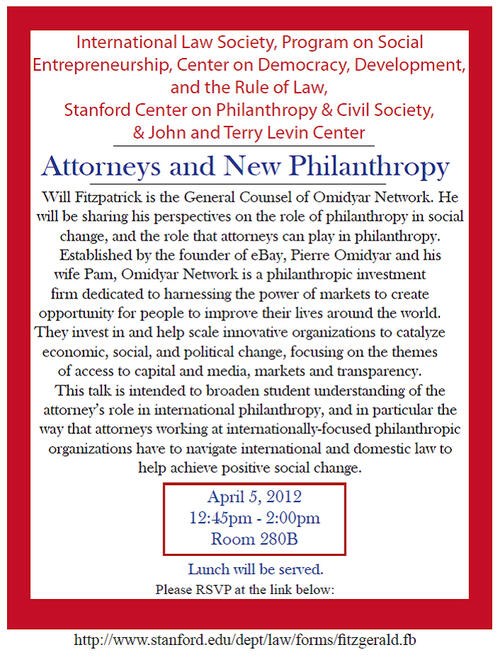
Will Fitzpatrick is the General Counsel of Omidyar Network.  He will be sharing his perspectives on the role of philanthropy in social change, and the role that attorneys can play in philanthropy.  Established by the founder of eBay, Pierre Omidyar and his wife Pam, Omidyar Network is a philanthropic investment firm dedicated to harnessing the power of markets to create opportunity for people to improve their lives around the world.  They invest in and help scale innovative organizations to catalyze economic, social, and political change, focusing on the themes of access to capital and media, markets and transparency.  This talk is intended to broaden student understanding of the attorney's role in international philanthropy, and in particular the way that attorneys working at internationally-focused philanthropic organizations have to navigate international and domestic law to achieve positive social change.

Please RSVP to the link below:

http://www.stanford.edu/dept/law/forms/fitzgerald.fb

Lunch will be provided

Image

Room 280B

Will Fitzpatrick General Counsel Speaker Omidyar Network
Conferences
News Type
News
Date
Paragraphs

Steve Hilton, senior advisor to British Prime Minister David Cameron, will join Stanford as a visiting scholar at the university’s Freeman Spogli Institute for International Studies.

Hilton, who will also be a visiting fellow at Stanford’s Hoover Institution, will arrive in May and spend his year on campus teaching, researching and writing.

“We look forward to having Steve Hilton in residence at FSI starting later this spring,” said Coit Blacker, FSI’s director. “Lively and engaging, Steve is certain to bring a fresh perspective to many of the issues and challenges that are of ongoing concern to our faculty, fellows and students.”

As Cameron’s top advisor, Hilton’s primary responsibility is the development and implementation of domestic policy. He specializes in the promotion of enterprise and economic growth, public service reform, family policy, decentralization, and government transparency and accountability.

Hilton will focus on innovation in government, public services and communities around the world while at Stanford. He will work with a wide range of centers and organizations across the university, including FSI’s Center on Democracy, Development and the Rule of Law and The Europe Center; the Graduate School of Business' Center for Social Innovation; the Center on Philanthropy and Civil Society; and the Hasso Plattner Institute of Design.

"I'm delighted to be joining the academic community at Stanford and greatly look forward to an exhilarating and productive year,” Hilton said. “It will be a huge pleasure to be able to focus on our most pressing social and governmental challenges."

Before Cameron’s election as prime minister in 2010, Hilton served as his chief strategist and developed the ideas associated with the modernization of the British Conservative Party.

Hilton previously ran Good Business, a corporate responsibility consulting firm, and is the author of Good Business: Your World Needs You. The book makes the case for businesses to play a more direct and active role in advancing social progress.

Hero Image
Hilton SQUARE
All News button
1
-

Dear members of the Arab Studies Table, 

You are cordially invited to a private informal networking event with  world-renowned Palestinian activist, MP, and former presidential candidate and Nobel Peace Prize nominee  

 Dr. Mustafa Barghouti  

on Monday March 5, 6-7pm   

at CISAC central conference room, Encina Hall 2nd floor

followed by a speech at

Cubberley Auditorium

at 7:00pm

The event is an exclusive opportunity for the members of the Arab Studies Table to meet and network with Dr. Barghouti, who will be delivering a speech afterwards at the Cubberley Auditorium (at 7pm) on non-violent activism in Palestine. Please see attached flyer for further details. The Cubberley talk is a public event.  

We hope you can join us for the informal networking event with Dr. Barghouti on March 5 at 6pm. Coffee, refreshments, and cookies will be served!  

Please RSVP by replying to Arab Studies Table coordinator Brian Johnsrud (johnsrud@stanford.edu) with your name and affiliation. Non-Arab Studies Table guests are welcome if they are accompanied by a Table member (please send their names when you RSVP). Please RSVP by Sunday March 4.

Dr. Barghouti's bio:

Member of the Palestinian parliament; former Minister of Information under the 2007 National Unity Government; 2005 presidential candidate; General Secretary of the Palestinian National Initiative; physician; social, political, human rights and peace activist; one of the most active grassroots leadersin Palestine; campaigner for the development of Palestinian civil society and grassroots democracy; outspoken advocate of internal reform; international spokesperson for the Palestinian cause; leading figure in the non-violent, peaceful struggle against the Occupation; and organizer of international solidarity presence in the Palestine, Mustafa Barghouthi has made an extraordinary contribution to initiatives to peacefully challenge the ongoing Israeli Occupation of Palestine and bring it to end, as well as efforts to build the institutional framework of Palestinian civil society and promote the principles of internal democracy and good governance.  He writes extensively for local and international audiences on civil society and democracy issues and the political situation in Palestine, as well as on health development policy in Palestine. In 2010 Dr. Mustafa Barghouthi was nominated for the Nobel Peace Prize by Mairead Maguire, Nobel Peace Prize Laureate and Co-founder of the Peace People. 

In 2002, Dr. Barghouthi co-founded Al Mubadara (the Palestinian National Initiative, PNI), along with Dr. Edward Said, Dr. Haider Abdel-Shafi and Mr. Ibrahim Dakak, and currently serves as its General Secretary.  Al Mubadara is a democratic opposition movement that provides a reformist, inclusive, democratic alternative to both autocracy and corruption, and to fundamentalist groups.  It looks to achieve this by promoting an accountable and transparent democratic system in Palestine, and by strengthening contacts between Palestinians in the Territories and those in the Diaspora.  It also seeks to develop mass non-violence and international solidarity as the preferred means of ending the Israeli Occupation and achieving lasting peace, and to mobilize public opinion by making the Palestinian story visible in the international media.  

 Latest article on non-violent activism in the New York Times: http://www.nytimes.com/2012/02/22/opinion/peaceful-protest-can-free-palestine.html?ref=opinion

  Arab Studies Table at Stanford: http://www.stanford.edu/group/arabstudiestable/index.html


Cubberley Auditorium
459 Lasuen Mall
Stanford, CA, 94305

Dr. Mustafa Barghouti Co-founder of the Palestinian National Initiative and the Union of Palestinian Medical Committees Speaker
Conferences
Paragraphs

This is the first paper in the BDC-Stanford Project on Arab Transitions series, authored Dr. Tamir Moustafa of Simon Fraser University in Canada and entitled “Drafting Egypt’s New Constitution: Can a New Legal Framework Revive a Flawed Transition?”. Using Egypt as a case study, Moustafa, author of The Struggle for Constitutional Power: Law, Politics, and Economic Development in Egypt , highlights the deficiencies of the constitution-writing process there to serve as an example to other Arab countries as they embark on their own national projects. In addition, Moustafa offers key recommendations to the international community, as well as to Egypt’s Constituent Assembly on the various statutes, provisions, and conditions that should be included in the document to ensure that human rights protections, judicial independence, and institutions of governance are enforced.

All Publications button
1
Publication Type
Policy Briefs
Publication Date
Journal Publisher
BDC-Stanford Project on Arab Transitions
Authors
-

Life expectancy at aged 65 is remarkably similar in the three Chinese cities of Hong Kong, Shanghai, and Taipei, even though the cities differ in levels of socioeconomic development, health systems, and other factors. Edward Jow-Ching Tu will discuss research that aims to understand this phenomenon. Despite unprecedented increases in life expectancy and attainment of similar current levels of life expectancy, the cities differ in the contributions of changes in major causes of death to the improvements in life expectancy among the elderly. Tu and colleagues have explored several possible determinants of these different patterns and trends in the three cities, including socioeconomic development, health service delivery systems, cause-of-death classification systems, and competing risks from cardiovascular disease and other diseases. Their analysis suggests that the effect of equity of health service delivery has become more important over time.

Edward Jow-Ching Tu is a senior lecturer of demography in the Division of Social Science at Hong Kong University of Science and Technology. His work is focused on the impact of fertility, mortality, and migration on socio-economic changes in East Asia countries with special emphasis on nations experiencing a transition from planned economy to market economy; on causes and impacts of mortality changes and health transition on aging societies; and on the causes of lowest-low fertility in many East Asia countries. He has several active research projects ongoing in China, Japan, Taiwan, Hong Kong, and Singapore. He holds graduate degress from West Virginia University, the University of Pennsylvania, and the University of Tennessee (Knoxville). Tu has worked extensively in Asia, and has served as an adjunct professor and taught in many universities in China, including Peking University, Peoples University, Nankai Univerity, and Fudan University. He had served as a senior research scientist at the New York State Health Department and as a research fellow (full professor) at the Institute for Social Sciences and Philosophy at Academia Sinica. Tu has also taught at the State University of New York in Albany.

Philippines Conference Room

Edward Jow-Ching Tu Senior Lecturer of Demography at the Division of Social Science Speaker Hong Kong University of Science and Technology
Seminars
-

Abstract:

Nunn's paper examines the effect of U.S. food aid on conflict in recipient countries. To establish a causal relationship, he and Nancy Qian exploit time variation in food aid caused by fluctuationsin U.S. wheat production together with cross-sectional variation in a country's tendency to receive any food aid from the United States. Their estimates show that an increase in U.S. food aid increases the incidence, onset and duration of civil conflicts in recipient countries. The results suggest that the effects are larger for smaller scale civil conflicts. No effect is found on interstate warfare.

Speaker Bio: 

Professor Nunn was born in Canada, where he received his PhD from the University of Toronto in 2005.  In 2009, Professor Nunn was selected as an Alfred P. Sloan Research Fellow and grant recepient.

Professor Nunn’s primary research interests are in economic history, economic development, political economy and international trade. One stream of Nunn’s research focuses on the long-term impact that historic events can have on current economic development. In “Historical Legacies: A Model Linking Africa’s Past to its Current Underdevelopment”, published in the Journal of Development Economics in 2007, Nunn develops a game-theoretic model showing how the slave trade and colonial rule could have had permanent long-term effects on economic performance. In “The Long-Term Effects of Africa’s Slave Trades” (Quarterly Journal of Economics, 2008), Nunn documents the long-term adverse economic effects of Africa’s slave trades. His current research continues to examine the specific channels through which the slave trade affects current development within Africa. In "The Slave Trade and the Origins of Mistrust in Africa" (American Economic Review, forthcoming), coauthored with Leonard Wantchekon, he empirically documents how the slave trade engendered a culture of mistrust amongst the descendants of those heavily threatened by the slave trade.

A second stream of Professor Nunn’s research focuses on the importance of hold-up and incomplete contracting in international trade. He has published research showing that a country’s ability to enforce written contracts is a key determinant of comparative advantage (“Relationship-Specificity, Incomplete Contracts and the Pattern of Trade,” Quarterly Journal of Economics, 2007). Other work, coauthored with Daniel Trefler, examines the relationship between the cross-industry structure of a country's tariffs and its long-term economic growth (“The Structure of Tariffs and Long-Term Growth,” American Economic Journal: Macroeconomics, 2010). The study identifies growth-promoting benefits of a tariff structure focused in skill-intensive industries. It also shows how and why governments that succumb to political influence and rent-seeking are unable to focus tariffs in these key industries.


Philippines Conference Room

Nathan Nunn Paul Sack Associate Professor of Political Economy, Department of Economics Speaker Harvard University
Seminars
Subscribe to International Development