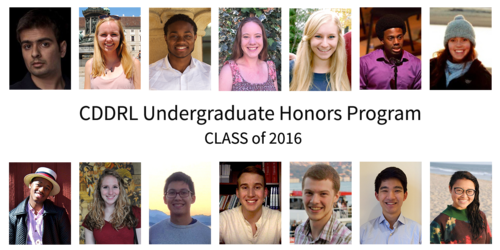
Stanford’s Center on Democracy, Development, and the Rule of Law (CDDRL) is proud to announce its 2016 class of undergraduate honors students. This year’s incoming class comprises one of the program’s largest and most diverse cohorts, with 15 students hailing from the U.S. and across the developing world, including: Jamaica, Pakistan, the Philippines and South Africa. Majors represented span both the social and technical sciences, providing students the opportunity to conduct research at the intersections of a variety of disciplines from computer science and economics to international relations.
Honors students will engage in research projects that explore a broad range of issues facing democracy in both the developed and developing world, including: youth unemployment in Egypt; civil-military relations in Burma; government response to natural disasters in the Philippines; and polarization in data-driven political campaigns in the U.S.
This summer, many honors students – with funding from the CDDRL Undergraduate Senior Honors Program and the Freeman Spogli Institute - will take the opportunity to travel and conduct field research to collect data to inform their thesis project.
Honors students spend three quarters participating in research seminars led by CDDRL Deputy Director Stephen Stedman - who is the new director of CDDRL’s Undergraduate Senior Honors Program - to refine their proposed thesis topic, while working in consultation with a faculty advisor to supervise their project.
In September, the group will travel to Washington, D.C., for Honors College where they will visit leading government, think tanks and development organizations to witness policymaking in practice. Students consult with key decision-makers, scholars and luminaries in the foreign policy field to help define their thesis topic.
Previous students of the CDDRL honors program have continued their research beyond graduation, partnering with international NGOs and in some cases, influencing policy at both a domestic and international level. For a complete list of honors student alumni, please see here.
Please join CDDRL in congratulating the 2016 senior honors students and welcoming them to the Center. Below are profiles of the fifteen honors students highlighting their academic interests, why they applied to CDDRL, and some fun facts.
CDDRL Undergraduate Honors Students Class of 2016
Rehan Adamjee | Anna Blue | Brandon Hill | Sarah Johnson | Shang-Ch'uan Li | Hannah Meropol | Jelani Munroe | Hannah Potter | Tebello Qhotsokoane | Hadley Reid | Paul Shields | Zachary Sorensen | Vehbi Deger Turan | Alonzo Virata | Angela Zhang
Rehan Adamjee
Major: Economics; Public Policy
Hometown: Karachi, Pakistan
Thesis Title: Exploring the failure of land reform in Pakistan through the tension between religious courts and national attempts at land redistribution.
Thesis Advisor: Erik Jensen; Aishwary Kumar
Why is this topic important to the field of democracy, development, and the rule of law? This topic explores how a country with a mixed legal system like Pakistan faces institutional constraints in its attempt to engage in crucial reforms that affect development. The research is also focused on understanding which forms of legal authority (legal vs secular) take precedence over time, and how this is affected by the relationship between the military, religious institutions, and the feudal class.
What attracted you to the CDDRL undergrad honors program? The opportunity to ask a fundamental political economy question that not only has development implications for Pakistan but also gets at questions of national and religious identity in my country. The CDDRL program encourages one to seek multiple sources of data to ask big picture questions. Engaging in such a process will be key to the success of my project.
Future aspiration post-Stanford: To work in the field of primary healthcare in Pakistan and get people angry about the stagnation of land reform and the plight of the landless in my country.
What are your summer research plans? To conduct research on my thesis topic and relevant stakeholders. I also aim to work in slum communities on a novel primary healthcare project.
Fun Fact about yourself: I am an avid squash player
Anna Blue
Major: International Relations; Modern Languages (Minor)
Hometown: North Potomac, Maryland
Thesis Title: Reforming the Justice System in Guatemala to Better Prosecute Cases of Violence Against Women
Thesis Advisor: Larry Diamond
Why is this topic important to the field of democracy, development, and the rule of law? One of the greatest human rights crises in my eyes is how many women in Latin America have been marginalized by their governments, deprived of an education due to harsh working conditions, and sometimes subjected to sexual abuse. I think my topic also addresses a number of growing concerns about the effectiveness of democratic institutions in third world countries. My thesis will analyze whether or not legal reform is even possible and if it is, I will investigate the most efficient means to rebuild a justice system that is unprejudiced and evenhanded. I will also investigate how three decades of internal armed conflict affects government accountability, country stability, and women's rights, a question that is very relevant considering how warfare nowadays is shifting towards more civil war.
What attracted you to the CDDRL undergrad honors program? CDDRL offers an incredible mentor and support network to guide me in an independent research project that I build from the ground up. I am excited for the class seminars, in which I can discuss my passions for human rights and health policy with other like-minded students, and for the honors college in Washington, D.C. I think that writing a thesis with CDDRL will help me to become a well-rounded International Relations major that can master concepts such as international civil rights and political freedoms.
Future aspiration post-Stanford: Right after graduating, I want to work for the Peace Corps, possibly in Latin America. I want to earn a degree in international law and someday work with an international organization, such as the WHO or the UN.
What are your summer research plans? I am hoping to visit Guatemala City this summer to work with organizations such as Accion Humana and the local office of UN Women to investigate conditions on the ground and how grassroots advocacy is changing the cultural and legal norms in the country.
Fun Fact about yourself: I scuba dive so much I am basically a mermaid. I'm currently working on my Rescue Diver certification and my goal is to scuba dive in over 50 countries one day!
Brandon Hill
Major: Political Science
Hometown: Eden Prairie, MN
Thesis Title: The United States of Africa: The Case for African Unification
Thesis Advisor: Larry Diamond
Why is this topic important to the field of democracy, development, and the rule of law? As the world’s most underdeveloped and most highly colonized region, the question of African prosperity is one that both intrigues and perplexes the world. African leaders and scholars, historical and contemporary alike have advocated for a more unified cohesive African continent as an introductory solution to African political, social, and economic empowerment. The uprising of Africa, the notion of union would be of critical importance to democracy, development, and the rule of law.
What attracted you to the CDDRL undergrad honors program? I came to CDDRL because I felt that I could fully explore my intellectual interests and equip myself with the skills to make powerful academic inquiries.
Future aspiration post-Stanford: My dream post-Stanford is to revolutionize the system of education in marginalized communities by developing a new model of school for the 21st century. I especially see education as a radical form of decolonization and want to use it to contribute to growth in various parts of the African continent and its Diaspora. I plan to earn a dual JD/MBA several years after completing Stanford.
What are your summer research plans? This summer I plan to do research that I can perform from the US, as I will be unable to reach Africa this summer with my full time internship at Google.
Fun Fact about yourself: I have studied English, Spanish, Mandarin, Swahili, and Xhosa language. Currently I am learning Java.
Sarah Johnson
Major: Economics; Middle Eastern Languages, Literatures, and Cultures (Minor)
Hometown: West Tisbury, Massachusetts
Thesis Title: Political Unrest and the Youth Unemployment Crisis in Egypt
Thesis Advisor: Lisa Blaydes
Why is this topic important to the field of democracy, development, and the rule of law? Almost 50% of the Egyptian population are under the age of 24. This massive youth population played a key role in the 2011 revolution, and ensuing political unrest. This same population faces some of the highest unemployment rates in the world, a factor that helped to fuel the unrest. My research seeks to understand recent trends in youth employment and unemployment in Egypt, particularly since the revolution. Understanding youth unemployment is crucial to understanding what it takes to create a strong economy, and stable, participatory political system.
What attracted you to the CDDRL undergrad honors program? I love that it is so interdisciplinary. I am extremely excited to work with faculty and fellow students from a variety of departments.
Future aspiration post-Stanford: I’m not really sure yet. My primary interests include social entrepreneurship, American-Middle Eastern relations, and development economics--so perhaps something that combines these interests?
What are your summer research plans? I will not be doing thesis research, but will instead be working with the Stanford Institute for Innovation in Developing Economies (SEED) in Accra, Ghana.
Fun Fact about yourself: I am from a tiny island in Massachusetts, and taking “the ferry” was a regular part of my childhood.
Shang-Ch’uan Li
Major: Materials Science and Engineering
Hometown: Batu Gajah, Perak Darul Ridzuan, Malaysia
Thesis Title: Changes in the opinions and jurisprudence of counter-hegemonic petitioners in the Federal Court of Malaysia before and after 1988
Thesis Advisor: Justin Grimmer; Erik Jensen
Why is this topic important to the field of democracy, development, and the rule of law? Most measures of the Rule of Law rely either on a series of case studies, or of surveying data from the public or legal practitioners. A clear Judicial Crisis splits court cases into two sets, allowing us to test theories about what changed quantitatively in court opinions before and after 1988 and how persistent those changes were. This quantitative performance can further be mapped onto measures of public confidence in the Judiciary and correlations with subsequent legal reforms.
What attracted you to the CDDRL undergrad honors program? The CDDRL is one of the few places outside of a JSD program where I could write this thesis, yet the interdisciplinary breadth of the Center allows me to cover this problem using techniques from computer science, legal analysis, and organizational theory that I couldn't do in a pure law-school setting. Furthermore, the program is well constructed curricularly and will get me to engage my non-natural science or engineering passions with at great depth without pouring all my elective units into a second major.
Future aspiration post-Stanford: Non-profit strategic consulting in education or graduate school in engineering
What are your summer research plans? Data trawling, testing various theories, and interviewing legal practitioners, think tanks, and academics in Malaysia.
Fun Fact about yourself: Like all Malaysians, I love food. Unlike all Malaysians, here in the States, I've learnt to cook some of it.
Hannah Meropol
Major: Political Science; Arabic (Minor)
Hometown: Shaker Heights, Ohio
Thesis Title: The Effect of Social Media on Moroccan Women's Empowerment
Thesis Advisor: Lisa Blaydes
Why is this topic important to the field of democracy, development, and the rule of law? In countries like Morocco where men dominate the physical public sphere, social media provides a platform for women to otherwise engage both socially and civically in their communities. For example, Facebook creates a space for women to post their opinions, to share photos of themselves, and to converse with each other and with men. In my thesis I aim to discern what impact social media has on women's empowerment in Morocco- whether it be through greater agency in the home, increased social and civic participation, or through some other measurement. If social media empowers women in these ways, then it can further liberalize Moroccan society to be more inclusive of the female population.
What attracted you to the CDDRL undergrad honors program? The CDDRL Honors Program is not only tailored well to my interests in the subject matter that it encompasses, but it also provides excellent mentorship and a cohort of students in a diverse array of academic departments that will support me throughout the process of writing a thesis. I am excited to embark on a project that draws conclusions from both existing studies and those of my own design, and the CDDRL honors program offers the resources and guidance for me to do so.
Future aspiration post-Stanford: After graduation, I hope to further define my interests in policy and public service through an array of new experiences before going to graduate school.
What are your summer research plans? This summer, I will be a research intern at the Brookings Doha Center in Qatar, contributing to the center's existing projects and hopefully getting a start on my thesis research. I hope to spend a few weeks in Morocco following my internship in Doha to conduct interviews for my thesis.
Fun Fact about yourself: I really like to run, especially long distance, and hope to run a marathon one day!
Jelani Munroe
Major: Public Policy; Economics
Hometown: Kingston, Jamaica
Thesis Title: Structural Adjustment & Political Economy: The IMF in the Caribbean
Thesis Advisor: Larry Diamond
Why is this topic important to the field of democracy, development, and the rule of law? In spite of a relatively strong history of democratic governance, Jamaica has struggle with regard to economic development. Its debt-to-GDP ratio is extraordinarily high, and the government recently turned to the International Monetary Fund for assistance in financing fiscal initiatives and servicing foreign debt. The quality of democracy is threatened in such a context. These considerations have made me interested in the link between democracy and economic development, with Political Economy at the crux. Public Debt management, and the incentive problems faced by a government delivering bitter medicine in hard times, has enormous implications for political stability. Through a comparative study of the history of structural adjustment programs in Jamaica and other Caribbean countries, I want to examine the extent to which multilateral debt intervention is democracy assistance, or hindrance.
What attracted you to the CDDRL undergrad honors program? The interdisciplinary CDDRL Honors program is my ideal capstone undergraduate experience: a confluence of my academic interests in political economy and development economics, and my experiences at Stanford outside the classroom. I hope the opportunity allows me to continue to delineate my ethical and pragmatic parameters, especially when the world asks tough questions.
Future aspiration post-Stanford: Ultimately, I want to be an ‘academic practitioner’. I hope to use the intellectual rigor of academic work to guide my hands-on work in policy formation and implementation - in whatever capacity.
What are your summer research plans? This summer, I will work as an intern in the Embassy of Jamaica, Washington D.C., thinking through the ways in which diplomacy affects tangible outcomes of multilateral involvement in developing countries.
Fun Fact about yourself: I have an identical twin brother!
Hannah Potter
Major: International Relations
Hometown: Yarmouth, Maine
Thesis Title: The Right to Health for International Migrants in the Bay Area
Thesis Advisor: Stephen Stedman
Why is this topic important to the field of democracy, development, and the rule of law? This topic is relevant to the DDRL themes since it strives to understand the inherent inequities that international migrants face in the domestic context. In my academic program and work experience I have become acutely aware of both the quantitative and qualitative health disparities that international migrants face. The United States has yet to recognize health as a human right, and the weight of this shortcoming primarily falls on immigrant and refugee populations. On the one hand, there is a quantitative disparity: a lack of health care access. On the other hand, there is a qualitative disparity: a lack of culturally sensitive health care. Throughout my research I hope to understand and expose how the intersection of law and social development can create positive changes for migrant health.
What attracted you to the CDDRL undergrad honors program? I was initially attracted to the CDDRL undergraduate honors program since I seek to develop an academic expertise on this topic which I can later apply to a career in promoting migrant rights. Throughout my varied work experience in social development, one thing has become strikingly clear: I can only begin to work on a mechanism for improvement if I first have a strong academic understanding of the problem. Therefore, the CDDRL honors program is a crucial step to equip me with the necessary background and research skills to pursue a career as an advocate for migrant health rights. Further, the CDDRL honors program will help me realize my role as a scholar activist. Stanford has taught me many strategies to apply academia to social development, and I now seek to put this knowledge to use. With the unique mentorship, resources and seminar of the CDDRL program, I will be able to gain the tools and background that will actualize this goal.
Future aspiration post-Stanford: Explore, adventure, learn, be critical, smile, stay curious. Down the line, I hope to pursue a graduate program that combines my interests in access to health and migrant rights… I have my eye on a few Masters in Public Health and MBA dual degree programs -- but we shall see!
What are your summer research plans? My research will begin this summer with an internship at the Newcomers Health Program (NHP) in San Francisco. NHP is a community-focused program run through the San Francisco Department of Public Health which acts as the initial entry point for international migrants into the Bay Area health care system. Throughout my time in San Francisco, I hope to interact with other organizations to contextualize this issue from a variety of perspectives.
Fun Fact about yourself: Recently while drinking tea out of a beautiful, hand-made bowl, I realized a new life goal: become a ceramicist!
Tebello Qhotsokoane
Major: Mathematics; English
Hometown: Hlotse, Lesotho and Johannesburg South Africa
Thesis Title: Assessing talented tenth models of human capital development in Africa: A case study assessment on the African Leadership Academy as a model for leadership development for Africa
Thesis Advisor: Pascaline Dupas
Why is this topic important to the field of democracy, development, and the rule of law? Leadership, or the lack of it, has been quoted a prime reason for underdevelopment on the African continent, and the question of leadership training is one that is extremely popular right now. With organisations like the African leadership Academy, Ashesi University, OWLAG and now the African Leadership University creating robust programs to educate and develop ethical impactful leaders for the continent, I think that it would be extremely important to assess these programs and look at them in the context of other similar programs that have existed.
What attracted you to the CDDRL undergrad honors program? I was particularly impressed by the interdisciplinary nature of the program and its focus on development and institutional arrangements for socioeconomic advancement. I like that I am able to receive perspectives from people who come from a variety of academic backgrounds and interests on my own question, and on the subject of development.
Future aspiration post-Stanford: I want to move back to work on the African continent, specifically in North Africa or Southern Africa. I am interested in working for an NGO that works with youth development and education accessibility, but to eventually move into government working on education and growth and development policy making. In the long run I want to, in addition to working in government, own a hipster creme brulee cart shop in Cape Town and Maseru in Lesotho.
What are your summer research plans? This summer, I am choosing between working for the largest insurance and healthcare services company in South Africa, doing strategic consulting for their technology and healthcare innovations sectors, and doing a senior synthesis project on migration and return migration narratives of White South Africans. I am yet to receive funding for the research.
Fun Fact about yourself: I have a serious case of Nordic envy (Scandanavian envy + Finnish envy).
Hadley Reid
Major: Human Biology
Hometown: Chapel Hill, North Carolina
Thesis Title: Organization, Training, and Health Outcomes in the Indian Informal Care Sector
Thesis Advisor: Marcella Alsan
Why is this topic important to the field of democracy, development, and the rule of law? This thesis will explore the way public institutions, or lack thereof, affect health outcomes in India. About two thirds of healthcare in India today is provided through the private sector, and it is estimated that about 50% of this private sector is made up of informal care providers. Informal care providers are a heterogeneous group across the subcontinent. This lends itself to a comparison of how they provide care as well as what the outcomes of this care are. I plan to explore these questions, as well as analyze governmental attempts at training and regulating the informal healthcare sector to study how health, as an aspect of development, is being provided in India today.
What attracted you to the CDDRL undergrad honors program? The strong community of other prospective thesis writers created by CDDRL was definitely a strong draw for me. Also, the mentorship and guidance offered by the program were very appealing as a support system while I hone my critical thinking skills over the course of writing my thesis.
Future aspiration post-Stanford: I am planning to attend medical school and pursue a joint MD/MPH after Stanford. I hope to both practice clinically and continue academic research after medical school, although in what way these two aspects will be balanced is something I am still thinking about.
What are your summer research plans? I am going to India for two months this summer to study the informal care sector with the Stanford India Health Policy Initiative out of FSI. We will be based out of Mumbai and conducting qualitative interviews in the surrounding peri-urban areas.
Fun Fact about yourself: I was a competitive ice skater for 12 years. For all of high school I was also a synchronized skater and a two time national competitor in this discipline.
Paul Shields
Major: International Relations; Slavic Languages and Literature
Hometown: Gig Harbor, WA
Thesis Title: The Persistence of Tuberculosis in the Russian Federation
Thesis Advisor: Kathryn Stoner
Why is this topic important to the field of democracy, development, and the rule of law? Tuberculosis remains a critical health threat in Russia and is the leading infectious disease killer. Russia has the third highest rate of multi-drug resistant (MDR) tuberculosis in the world and these levels are currently growing. This systemic issue is important, as it confronts Russian society with pertinent long-term and short-term problems for the country’s future development.
What attracted you to the CDDRL undergrad honors program? I was attracted to the CDDRL undergraduate honors program because I thought it would be a great capstone to my time at Stanford. Having the opportunity to work with brilliant advisors and explore a subject I am interested in for a sustained period seemed like a rewarding experience. Furthermore, I like to think that belonging to a community of students with diverse backgrounds and interests will help me grow both intellectually and personally.
Future aspiration post-Stanford: Although the future is uncertain, I hope to work in international law.
What are your summer research plans? In the summer I plan to continue reading relevant literature and I hope to travel to Eastern Europe and conduct interviews while gathering data.
Fun Fact about yourself: I have been playing the viola for 16 years and enjoy composition.
Zachary Sorenson
Major: Computer Science; Economics (Minor)
Hometown: Orinda, California
Thesis Title: Polarization and the Data-Driven Political Campaign
Thesis Advisor: Justin Grimmer
Why is this topic important to the field of democracy, development, and the rule of law? Political campaigns at all levels are evolving rapidly because of changing communication technology. TV and direct mail advertising are beginning to be supplanted by online advertising and social media. Campaigns and political parties are keeping increasingly detailed information about voters, and using this data to craft individually targeted messages. All of this is happening during a time of exceptional political polarization, and whether this data-driven outreach reduces or amplifies polarization could have long-lasting implications for democracy.
What attracted you to the CDDRL undergrad honors program? As a computer science student interested in public policy and governance, I am excited about the chance to write an interdisciplinary thesis that draws on both fields. Additionally, I am looking forward to working with a variety of faculty members working in democracy and development, and learning from the other students in the cohort and their projects.
Future aspiration post-Stanford: After graduation, I plan on sticking around Stanford for an extra quarter or two to complete a coterminal M.A. in public policy. After that, I hope to work and travel for a few years before attending law school.
What are your summer research plans? Over the summer, I will be working as a policy intern at the Sunlight Foundation, a nonprofit in Washington DC that combines open data and policy analysis to make government more transparent. In addition to the direct exposure to my topic that I will have as an intern, I am also planning to use my time in DC to conduct background research and interview former campaign staffers.
Fun Fact about yourself: I love the outdoors, and grew up backpacking, skiing, mountain biking, fishing, and exploring in California’s Sierra Nevada. I especially enjoy taking people backpacking for the first time, which I’ve done as a Boy Scout and later as a SPOT leader at Stanford.
Vehbi Deger Turan
Major: Computer Science; Political Science (Minor)
Hometown: Istanbul, Turkey
Thesis Title: Implementation of Large Scale Data Analysis for Open Ended Opinion Polling
Thesis Advisor: Francis Fukuyama; Justin Grimmer
Why is this topic important to the field of democracy, development, and the rule of law? Some of the most significant facets of representative democracy, such as multiple choice ballots and referendums, have arisen out of practical limitations. Today, increases in computational power and natural language processing techniques have the potential to fundamentally change citizens' interaction with their government and perception of their role in a democracy. Introduction of artificial intelligence in governance is a slow process, and a demonstration of large scale opinion extraction can show that new means of assessing public opinion beyond quantitative polling can be useful for collective communication.
What attracted you to the CDDRL undergrad honors program? I want to combine an analysis of the political and sociological implications of open-ended querying with developing a proof-of-concept data analysis program. The CDDRL thesis program offers strong flexibility and support for a multidisciplinary project through its wide scope and faculty support.
Future aspiration post-Stanford: I'm planning to combine my computer science degree with graduate studies in the school of governance, hoping to extend the use of cutting-edge technology further into governance and public policy.
Fun Fact about yourself: In my free time, you can find me practicing Latin and Arabic calligraphy and devising new scripts!
Alonzo Virata
Major: Political Science
Hometown: Manila, Philippines
Thesis Title: Evaluating the Philippine Government’s Responsiveness to Natural Disasters
Thesis Advisor: Francis Fukuyama
Why is this topic important to the field of democracy, development, and the rule of law? Natural disasters are, at the least, an annual problem for the Philippines, and yet despite the frequency of the problem, there continues to be consistently high levels of damage from these typhoons and super-typhoons. Already by examining the consequences of the damage alone, the consequences it has for the development of the Philippines are evident. Moreover however, the issues the government faces in effectively responding to such natural disasters may indicate the general problems that the country faces in governance. The responsiveness then and the prior preparation for these natural disasters may be examined as a metric to make broader judgements on the Philippines and its government as a whole.
What attracted you to the CDDRL undergrad honors program? The CDDRL Honors program provides a rigorous program that tailors especially well to my topic. In addition, through the program’s training, I intend to develop not only my knowledge of the Philippines and my general background in the social sciences, but I also hope to be a much more critical and intensive thinker, one who can tackle a problem and engage with greater depth than before.
Future aspiration post-Stanford: I hope to continue pursuing this issue in Philippine development and governance as it appears to me to be one of the most important but underappreciated issues in the country. Ideally, in the future, I could then make a difference with the knowledge and training I’ve attained from Stanford and of course from this program.
What are your summer research plans? I hope to return to the Philippines and directly contact and learn from the departments concerned with natural disasters in the Philippines, as well as from the local entities (such as the mayoralty or the municipality of damaged towns and cities) who tackle the same problem in a different manner.
Fun Fact about yourself: One year ago, I tried surfing for the first time. Despite falling off and having my face hit the sand, I still think it is one of the most enjoyable things ever, and I hope to one day redeem myself.
Angela Zhang
Major: International Relations
Hometown: Chino Hills, CA
Thesis Title: Impact of Civil-Military Relations on Burma's Political Transition
Thesis Advisor: Francis Fukuyama
Why is this topic important to the field of democracy, development, and the rule of law? Burma’s military regime has proved strong and durable, yet civil-military relations are variable and unstable. Despite the regime’s claims of a genuine multi-party democracy, the 2008 constitution does not address the lopsided political relationship between the military and civilians nor plans for the eventual transition to a truly democratic government. Serious dissension within the armed forces is the major credible threat to continued military rule, but various precautionary measures make it unlikely. A truly free, democratic system necessitates a fundamental transformation in Burma's civil-military relations. Through my thesis, I will explore the dynamics of civil-military relations in Burma and assess the nature of the country’s potential political transition.
What attracted you to the CDDRL undergrad honors program? I am drawn to the interdisciplinary nature of CDDRL. It allows me to examine my topic through various lenses, thereby forming a more comprehensive understanding of the issue. I also enjoy interacting with my energetic, diverse cohort and learning from supportive CDDRL-affiliated faculty members who challenge me to expand my intellectual horizons.
Future aspiration post-Stanford: I aim to bridge cultural divisions between countries, communities, and humans to help reach common understandings in this increasingly globalized world.
What are your summer research plans? I will be working at the U.S. Embassy in Rangoon this summer. I also plan to do research and conduct interviews in Burma, Indonesia, and Thailand to gain a comparative perspective on civil-military relations and political transitions.
Fun Fact about yourself: I am entranced.

 FSI researchers consider international development from a variety of angles. They analyze ideas such as how public action and good governance are cornerstones of economic prosperity in Mexico and how investments in high school education will improve China’s economy.
 Cara Reichard (left) and Garima Sharma (right) both received awards under CDDRL for their outstanding theses projects.
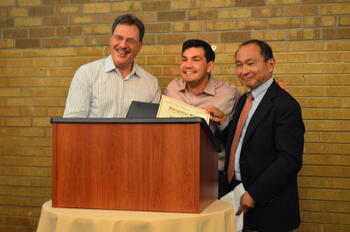 Stefan Norgaard with CDDRL Director Larry Diamond (left) and FSI Olivier Nomellini Senior Fellow Francis Fukuyama (right).

 Policemen chat during their break at Rocinha favela.