Foreign Policy
-

Speaker bio:

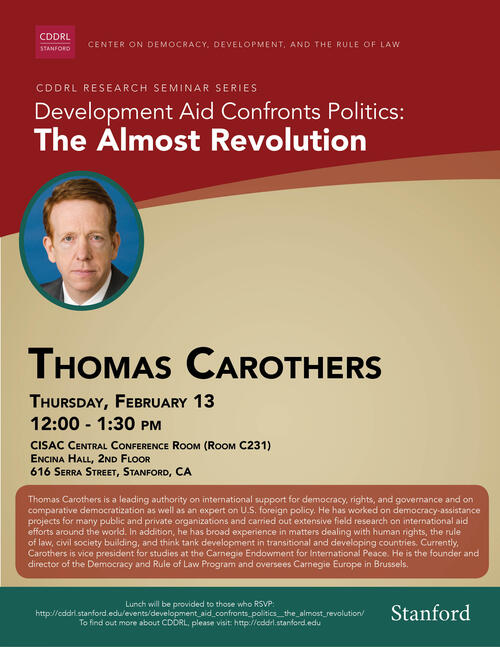
Thomas Carothers is vice president for studies at the Carnegie Endowment for International Peace. He is the founder and director of the Democracy and Rule of Law Program and oversees Carnegie Europe in Brussels.

Carothers is a leading authority on international support for democracy, rights, and governance and on comparative democratization as well as an expert on U.S. foreign policy. He has worked on democracy-assistance projects for many public and private organizations and carried out extensive field research on international aid efforts around the world. In addition, he has broad experience in matters dealing with human rights, the rule of law, civil society building, and think tank development in transitional and developing countries.

He is the author of six critically acclaimed books as well as many articles in prominent journals and newspapers. Carothers has also worked extensively with the Open Society Foundations (OSF), including currently as chair of the OSF Think Tank Fund and previously as chair of the OSF Global Advisory Board. He is an adjunct professor at the Central European University in Budapest and was previously a visiting faculty member at Nuffield College, Oxford University, and Johns Hopkins SAIS.

Prior to joining the Endowment, Carothers practiced international and financial law at Arnold & Porter and served as an attorney adviser in the Office of the Legal Adviser of the U.S. Department of State.

Carothers is the co-author (with Diane de Gramont) of Development Aid Confronts Politics: The Almost Revolution (Carnegie, 2013) and author of Confronting the Weakest Link: Aiding Political Parties in New Democracies (Carnegie, 2006); Promoting the Rule of Law Abroad: In Search of Knowledge (Carnegie, 2006); Uncharted Journey: Promoting Democracy in the Middle East, co-edited with Marina Ottaway (Carnegie, 2005); Critical Mission: Essays on Democracy Promotion (Carnegie, 2004); Funding Virtue: Civil Society Aid and Democracy Promotion, co-edited with Marina Ottaway (Carnegie, 2000); Aiding Democracy Abroad: The Learning Curve (Carnegie, 1999); and Assessing Democracy Assistance: The Case of Romania (Carnegie, 1996).

Image

CISAC Conference Room

Thomas Carothers Vice President for Studies Speaker Carnegie Endownment for International Peace
Seminars
-

Abstract:

The Tahrir and Gezi Park protests were, amongst many other things, moments of energetic artistic creativity, in the sound world as well as other domains. Though well documented, and clearly a vital component of the political energies and transformations of the moment, they have proved difficult to think about. This talk, a musicologist's perspective, will explore them in the light of some recent thinking about crowds and social movements. 

Bio:

Martin Stokes  is King Edward Professor of Music at King's College, London. He is an ethnomusicologist, working primarily on the questions of ethnicity, identity, emotions, globalization in the context of the Middle East. His most recent book,  The Republic of Love: Cultural Intimacy in Turkish Popular Music (University of Chicago Press, 2010), has received the Merriam Prize from the Society for Ethnomusicology. Among his other publications are Celtic Modern: Music on the Global Fringe (Scarecrow 2004), Ethnicity, Identity and Music: The Musical Construction of Place (Berg 1994), and The Arabesk Debate: Music and Musicians in Modern Turkey (Oxford 1992).


Co-sponsored by the Mediterranean Studies Forum, the CDDRL Program on Arab Reform and Democracy, Department of Music, and Department of Anthropology


Encina Hall West - Room 208

Martin Stokes King Edward Professor of Music at King's College Speaker London
Conferences

Asylum Access
1611 Telegraph Avenue
Suite #1111
Oakland, CA 94612

0
PSE Visiting Practitioner in Residence, 2013-14
emily_hs.jpg

Emily Arnold-Fernández was a social entrepreneur in residence during the fall 2012 quarter with CDDRL's Program on Social Entrepreneurship. She will be spending the 2013/14 academic year as a practitioner-in-residence with the Program on Social Entrepreneurship.

She is the founder and executive director of Asylum Access, is a social entrepreneur and human rights pioneer. Recognizing that refugees throughout Africa, Asia and Latin America – some of whom flee with nothing more than the clothes on their backs – were almost always unequipped to go into a legal proceeding in a foreign country, alone, and explain why they should not be deported, Emily founded Asylum Access to advocate on behalf of refugees seeking to assert their rights.

“For half a century, international law has given refugees the rights to live safely,
seek employment, send children to school and rebuild their lives. But those rights are
meaningless unless they are respected on the ground,” she says. “Asylum Access
provides a rare opportunity to fill a gaping hole in our human rights system – by making
refugee rights a reality for real people.”

For her innovative approach to the global refugee crisis, Emily was honored by the
Dalai Lama as one of 50 “Unsung Heroes of Compassion” from around the world (2009)
and Waldzell Institute’s Architects of the Future Award (2012). She has also been
recognized as Pomona College’s Inspirational Young Alumna (2006), awarded the
prestigious Echoing Green fellowship (2007), and recognized as the New Leaders
Council’s 40 Under 40 (2010), among others. Emily’s ground-breaking work with
Asylum Access has earned her international speaking invitations and widespread media
attention, including the Rotary International Peace Symposium (2008, 2009), the UN
High Commissioner for Refugees’ Annual Consultations (2008, 2009), a cover feature in
the Christian Science Monitor (September 2009), and the San Francisco Examiner’s
Credo column (July 2011). She holds a B.A. cum laude from Pomona College and a J.D.
from Georgetown University Law Center.

Committed to sharing her knowledge with young and aspiring social
entrepreneurs, Emily serves as an adjunct professor at the University of San Francisco,
teaching a course in social entrepreneurship. In Fall 2012, Emily was selected as one of
three Social Entrepreneurs in Residence at Stanford where she participated as “expert
respondent” in Stanford Law School’s Law, Social Entrepreneurship and Social Change
course, and in Spring 2013, Emily led an intensive skills-building course on social
entrepreneurship at Pomona College.

A visionary human rights activist, Emily Arnold-Fernández takes her inspiration
from a line in a June Jordan poem: “We are the ones we have been waiting for.”

-

Professor Yu Keping will systematically survey the dominant processes and key issues of China’s governance changes over the last 30 years since reform. His talk will summarize the major achievements and the ongoing problems of this 30 year long process. It will offer a brief analysis of the underlying reasons for these reforms and the main characteristics of China’s governance model. After enumerating an array of factual evidence, Yu will show that the drive behind China’s governance reforms stems from unitary governance to pluralist governance, centralization to decentralization, rule of man to rule of law, regulatory government to service oriented government, and from internal party democracy to the people’s democracy.

---

Dr. YU Keping is the Deputy President of the Central Compilation & Translation Bureau (CCTB), and the founding Director of the China Center for Global Governance and Development (CCGGD). He also serves as Prof. and Director of the Center for Chinese Government Innovations at Peking University, and Prof. and Director of the Institute of Political Development at Tsinghua University. He was a visiting professor or senior fellow at many top universities, including Harvard University, Duke University in the US and Free University in Berlin. His fields of expertise include political philosophy, comparative politics, globalization, civil society, governance and politics in China. Among his many books are Governance and Rule of Law in China (ed., Brill, 2012) and Democracy Is A Good Thing (Brookings, 2010).  As a leading intellectual in China, Professor Yu was selected as one of the “30 most influential figures in the past 30 years since the reform in China” in 2008 and ranked 19 in “2011 Global Top 100 Thinkers” by Foreign Policy in the US.

Philippines Conference Room

YU Keping Director of the Center for Chinese Government Innovations Speaker Peking University
Seminars
-

Abstract:

In less than three decades, Taiwan has transformed from a repressive, authoritarian state into a vibrant democracy. Changes to the legal system, and particularly the criminal justice system, have played a central role in this story. Reform-minded politicians, lawyers, judges, prosecutors, and scholars have been crucial advocates for strengthening human rights protections, as has Taiwan’s Constitutional Court. Since the end of martial law, the Court has vigorously given heft to rights enshrined in the Republic of China’s constitution. Now that Taiwan has adopted the contents of the International Covenant on Civil and Political Rights as domestic law, it is an opportune moment to reflect on Taiwan’s journey towards embracing international human rights norms and to confront remaining challenges. The situation across the strait is markedly different. Today, Taiwan’s Constitutional Court has no counterpart on the Mainland and analogues to Taiwan’s former police-controlled punishments remain in full effect. As calls for reform on the Mainland become increasingly vocal, how might Taiwan’s experience inform efforts to increase human rights protections in the People’s Republic of China? 

Speaker Bio:

Image
margaret lewis1
Maggie Lewis joined Seton Hall Law School as an Associate Professor in 2009. She is a Term Member of the Council on Foreign Relations, a Public Intellectuals Program Fellow with the National Committee on U.S.-China Relations, and an Affiliated Scholar of NYU School of Law’s U.S.-Asia Law Institute. Her recent publications have appeared in the Columbia Journal of Transnational Law, NYU Journal of International Law and Politics, Columbia Journal of Asian Law, and Virginia Journal of International Law. She is also the co-author of the book Challenge to China: How Taiwan Abolished Its Version of Re-Education Through Labor with Jerome A. Cohen. 

Most recently before joining Seton Hall, Professor Lewis served as a Senior Research Fellow at NYU School of Law’s U.S.-Asia Law Institute where she worked on criminal justice reforms in China. Following graduation from law school, she worked as an associate at the law firm of Cleary, Gottlieb, Steen & Hamilton in New York City. She then served as a law clerk for the Honorable M. Margaret McKeown of the U.S. Court of Appeals for the Ninth Circuit in San Diego. After clerking, she returned to NYU School of Law and was awarded a Furman Fellowship.

Professor Lewis received her J.D., magna cum laude, from NYU School of Law, where she was inducted into the Order of the Coif and was a member of Law Review. She received her B.A., summa cum laude, from Columbia University. In addition, she has studied at the Hopkins-Nanjing Center for Chinese and American Studies in Nanjing, China, and Bucerius Law School in Hamburg, Germany. 

Philippines Conference Room

Margaret Lewis Associate Professor Speaker Seton Hall Law School
Seminars
-

This event is being presented in partnership with CDDRL, the U.S. Holocaust Memorial Museum, the Hoover Institution, and a student led movement to end atrocities at Stanford (STAND).

Abstract:

Sixty-eight years after the Holocaust, governments continue to struggle with preventing genocide and mass atrocities. In 2005, United Nations member states agreed that nations share a responsibility to protect their citizens from genocide, crimes against humanity, war crimes, and ethnic cleansing. Join us for a discussion about how the responsibility to protect (or R2P) has been applied in recent crises.


Speakers bio:

Richard Williamson is a nonresident senior fellow in Foreign Policy at Brookings and a principal in the consulting firm Salisbury Strategies LLP. His work focuses on human rights, multilateral diplomacy, nuclear nonproliferation and post-conflict reconstruction. Prior to those positions, Mr. Williamson served as U.S. special envoy to Sudan, under President George W. Bush. Earlier in the Bush administration, Mr. Williamson, who has broad foreign policy and negotiating experience, served as ambassador to the United Nations for Special Political Affairs, and as ambassador to the U.N. Commission on Human Rights. Previously, Mr. Williamson served in several other senior foreign policy positions under Presidents Ronald Reagan and George H.W. Bush, including as assistant secretary of state for international organizations at the Department of State, and as an assistant to the president for intergovernmental affairs in the White House.

Michael Abramowitz is director of the Center for the Prevention of Genocide at the U.S. Holocaust Memorial Museum. He joined the Museum in 2009 after nearly 25 years at the Washington Post, where he served as White House correspondent and previously as national editor, helping supervise coverage of national politics, the federal government, social policy, and national security. He is a member of the Council on Foreign Relations and a non-resident fellow of the German Marshall Fund. He was also a media fellow at the Hoover Institution at Stanford University.

Tod Lindberg is a research fellow at the Hoover Institution, Stanford University, based in Hoover’s Washington, DC, office. His areas of research are political theory, international relations, national security policy, and US politics. 

Lindberg is a contributing editor to the Weekly Standard and an adjunct associate professor at Georgetown University, where he teaches in the School of Foreign Service. From 1999 until it ceased publication in 2013, he was editor of the bimonthly journal Policy Review.

In 2007–8, Lindberg served as head of the expert group on international norms and institutions of the Genocide Prevention Task Force, a joint project of the U.S. Holocaust Memorial Museum, the American Academy of Diplomacy, and the U.S. Institute of Peace. In 2005, Lindberg was the coordinator for the group Preventing and Responding to Genocide and Major Human Rights Abuses for the United States Institute of Peace's Task Force on the United Nations. He was a member of the Steering Committee of the Princeton Project on National Security, for which he served as cochair of the working group on anti-Americanism. He is a member of the Council on Foreign Relations.

Lina Khatib is the co-founding Head of the Program on Arab Reform and Democracy at the Center on Democracy, Development, and the Rule of Law at Stanford University. She joined Stanford University in 2010 from the University of London where she was an Associate Professor. Her research is firmly interdisciplinary and focuses on the intersections of politics, media, and social factors in relation to the politics of the Middle East. She is also a consultant on Middle East politics and media and has published widely on topics such as new media and Islamism, US public diplomacy towards the Middle East, and political media and conflict in the Arab world, as well as on the political dynamics in Lebanon and Iran. She has an active interest in the link between track two dialogue and democratization policy. She is also a Research Associate at SOAS, University of London, and, from 2010-2012, was a Research Fellow at the USC Center on Public Diplomacy at the Annenberg School. 

Image

Bechtel Conference Center

Richard Williamson Senior fellow in Foreign Policy Speaker Brookings
Michael Abramowitz Director of the Center for the Prevention of Genocide Moderator U.S. Holocaust Memorial Museum
Tod Lindberg Research fellow at the Hoover Institution Speaker Stanford
Lina Khatib Program Manager Speaker Arab Reform and Democracy Program at CDDRL
Conferences
-

Speaker bio:

Martin Carnoy is the Vida Jacks Professor of Education at Stanford University School of Education. Prior to coming to Stanford, he was a Research Associate in Economics, Foreign Policy Division, at the Brookings Institution. He is also a consultant to the World Bank, Inter-American Development Bank, Asian Development Bank, UNESCO, IEA, OECD, UNICEF, International Labour Office.

Dr. Carnoy is a labor economist with a special interest in the relation between the economy and the educational system. To this end, he studies the US labor market, including the role in that relation of race, ethnicity, and gender, the US educational system, and systems in many other countries. He uses comparative analysis to understand how education influences productivity and economic growth, and, in turn, how and why educational systems change over time, and why some countries educational systems are marked by better student performance than others'. He has studied extensively the impact of vouchers and charter schools on educational quality, and has recently focused on differences in teacher preparation and teacher salaries across countries as well as larger issues of the impact of economic inequality on educational quality.

Currently, Dr. Carnoy is launching new comparative projects on the quality of education in Latin America and Southern Africa, which include assessing teacher knowledge in mathematics, filming classroomsm and assessing student performance. He is also launching major new project to study changes in university financing and the quality of engineering and science tertiary education in China, India, and Russia.

Dr. Carnoy received his BA in Electrical Engineering from California Institute of Technology, MA and PhD in Economics from the University of Chicago.

Encina Ground Floor Conference Room

Martin Carnoy Vida Jacks Professor of Education at Stanford University Speaker
Seminars
-


Abstract
Digital technologies have brought disruption to political systems throughout the world, it is disrupting the practice of diplomacy.  State-to-state communication continues, but foreign ministries struggle to understand and engage with the new actors that self-organized citizen movements represent.  Since Canada closed its embassy in Tehran in 2012, its foreign ministry has explored ways to use the internet to engage the people of Iran directly.  Its "Direct Diplomacy" campaign has engaged half a million Iranians in a two-way dialogue, offering Canada the opportunity to better understand dynamics in this crucial country, and giving Iranians another opportunity to bypass their government and share their views with the international community.  This presentation will outline the objectives, tools and lessons learned from this innovation in diplomacy and offer perspectives on the conduct of international relations in a digital age.
 
Ben Rowswell is Director for Iran, Iraq and the Arabian Peninsula at Canada's Department of Foreign Affairs, Trade and Development.  From 2010 to 2011 he was Visiting Scholar in the Center on Democracy, Development and the Rule of Law at Stanford, conducting research on the use of technology by democracy activists in the Egyptian revolution.  His diplomatic career includes stints as the Representative of Canada in Kandahar, Afghanistan; as Deputy Head of Mission in Kabul; as Chargé d'Affaires in Baghdad, Iraq; and in the political section of Canada's embassy to Egypt.  He is the founder of the Democracy Unit at DFATD, an alumnus of the National Democratic Institute and a former Visiting Scholar at the Center for Strategic and International Studies in Washington DC.  In 2007 he edited the volume "Iraq: Preventing a New Generation of Conflict."

Wallenberg Theater

Ben Rowswell Director for Iran, Iraq and the Arabian Peninsula Speaker Department of Foreign Affairs, Trade and Development in Canada
Seminars
Date Label
Authors
News Type
News
Date
Paragraphs

On March 18, Congolese militia leader Bosco Ntaganda surrendered himself unexpectedly to the U.S. Embassy in Kigali, Rwanda asking for transfer to the International Criminal Court (ICC) at The Hague, where he was wanted for allegedly committing crimes against humanity. The apprehension of ICC indictees was one of the main challenges raised during the Program on Human Right's (PHR) Sanela Diana Jenkins Human Rights Speaker Series last quarter. Ntaganda’s voluntary surrender provoked reflection on the lessons learned from the seminar’s evaluation of the ICC’s impact on international justice as it marked its first decade and exploration of its mandate moving forward.

Featuring lectures from international experts, academics, and activists, the seminar addressed many of the current challenges and future hopes of the ICC, including competing notions of justice and peace, budgetary constraints, and victims’ rights.

The series was led by PHR Director Helen Stacy and UCLA Law Professor Richard Steinberg, also a visiting scholar at Stanford's department of political science. They both kicked off the series by presenting the history and structure of the ICC and concluded with a discussion on its impact, commenting on how the ICC has helped shape the narrative on mass atrocities.

“Reflecting Diana Jenkins' personal commitment to restoring dignity, prosperity, justice and hope to those who most need it, the human rights speaker series aims to engage students on the most pressing human rights issues of our time,” said Stacy. “The International Criminal Court's 10th anniversary invites careful thought about its role so far, and its future. Our speakers brought an extensive range of opinions on the Court, but everyone agreed that the very existence of the Court has advanced the dialogue on international justice.”

A wide array of positions were offered by the speakers, representing the nonprofit, academic and policymaking arenas. Citing some of the limitations facing the ICC, Human Rights Watch’s Director of International Justice Program Richard Dicker made a compelling case for the Court, highlighting the role of civil society in promoting the adoption of the Rome Statute - the treaty that established the ICC - by its 122 current signatories.

William Pace, convener of the Coalition for the International Criminal Court described the Rome Statute as “among the greatest advancements ever in international human rights law.”

Stanford political science Professor James Fearon questioned whether the Court can be effective in deterring mass atrocities while relying on states parties to turn over suspects without a police force of its own. He argued that the Court may in fact limit the liability of human rights abusers because it gives them a choice of whether (or not) to turn themselves over to the ICC for trial. This could potentially contribute to prolonged civil conflict if governments’ hands are tied in offering backdoor deals in exchange for an end to the conflict.

Many speakers proposed modifications to the current ICC structure and suggested the following measures to enhance the work of the Court:

  • Cherif Bassiouni, who led the drafting committee to launch the ICC, emphasized the need for the Court to appoint well-trained judges;
  • David Scheffer, former U.S. Ambassador at Large for War Crimes Issues, highlighted the tremendous diplomatic challenge of not having instruments of arrest or enforcement under ICC control and limited to pressuring states parties to follow through on their obligation to detain indictees of the Court;
  • Carla Ferstman, director of REDRESS, a human rights organization that helps torture survivors obtain justice and reparations, focused on the challenges presented by the ICC's distance from the home countries of those on trial and how victims might have a more significant role in the justice process.

Recognizing the ICC’s inevitable growing pains, Shamila Batohi, a senior legal advisor to the Office of the Prosecutor, offered a hopeful conclusion to the series, reminding students of the Court’s commitment to protecting the rights of the more than 2.3 billion people represented by the statute’s 122 states parties and ending impunity for war crimes, genocide and crimes against humanity.

“Over the course of these nine weeks, students, faculty, and our guest speakers collaborated to develop a range of policies that could potentially improve the ICC system,” said Richard Steinberg. “Though the colloquium took place here on the Stanford campus, the broader collaboration engaged 19,000 users in a fruitful discussion via an online forum.”

Following each lecture, Dr. Diane Steinberg led a dinner discussion for interested students to distill the speaker’s main points into a thought-provoking question to be debated by a global audience on the Human Rights & International Criminal Law Online Forum. Stanford students joined forum participants from around the world to discuss vital questions, such as: “How should the relationship between the International Criminal Court and the United Nations Security Council be changed, if at all, to advance international justice?” and “Assuming that the ICC chooses to retain victim participation in its processes, how can victims’ representation at the ICC be improved and victims’ rights be protected?”

The seminar left students with these provocative questions – and many more – to ponder while tracking the Ntaganda case and the future trial of Uhuru Kenyatta, Kenya’s newly elected president wanted by the ICC for crimes against humanity following the 2007 presidential elections.

Stay tuned for more information on the 2014 Sanela Diana Jenkins Speakers Series, which will focus on the right to health and healthcare delivery.

Hero Image
RTR236IP logo
All News button
1
Subscribe to Foreign Policy