Foreign Policy
-

For nearly 70 years, CARE has been serving individuals and families in the world's poorest communities. Today, they work in 84 countries around the world, with projects addressing issues from education and healthcare to agriculture and climate change to education and women's empowerment. Helene Gayle, president and CEO of CARE USA, will discuss her work with CARE and her experiences in the field of international development. Dr. Gayle will discuss how access to global health is integral to CARE's effort in addressing the underlying causes of extreme global poverty.

Dr. Michele Barry, director of the Center for Innovation in Global Health, will moderate a conversation between CARE President and CEO, Dr. Helene Gayle and former Prime Minister of Norway and United Nations Special Envoy, Dr. Gro Brundtland. 

This event is sponsoredy by CARE USA, the Center on Democracy, Development and the Rule of Law and the Haas Center for Public Service.

A reception will follow the event. 


Dr. Gro Brundtland Bio:

Dr. Gro Harlem Brundtland is the former prime minister of Norway and the current deputy chair of The Elders, a group of world leaders convened by Nelson Mandela and others to tackle the world’s toughest issues. She was recently appointed as the Mimi and Peter E. Haas Distinguished Visitor for spring 2014 at the Haas Center for Public Service at Stanford University. Dr. Brundtland has dedicated over 40 years to public service as a doctor, policymaker and international leader. She was the first woman and youngest person to serve as Norway’s prime minister, and has also served as the former director-general of the World Health Organization and a UN special envoy on climate change.

Her special interest is in promoting health as a basic human right, and her background as a stateswoman as well as a physician and scientist gives her a unique perspective on the impact of economic development, global interdependence, environmental issues and medicine on public health.


 Dr. Helene Gayle Bio:

Helene D. Gayle joined CARE USA as president and CEO in 2006. Born and raised in Buffalo, New York, she received her B.A. from Barnard College of Columbia University, her M.D. from the University of Pennsylvania and her M.P.H. from Johns Hopkins University. After completing her residency in pediatric medicine at the Children's Hospital National Medical Center in Washington, D.C., she entered the Epidemic Intelligence Service at the Centers for Disease Control and Prevention, followed by a residency in preventive medicine, and then remained at CDC as a staff epidemiologist.

At CDC, she studied problems of malnutrition in children in the United States and abroad, evaluating and implementing child survival programs in Africa and working on HIV/AIDS research, programs and policy. Dr. Gayle also served as the AIDS coordinator and chief of the HIV/AIDS division for the U.S. Agency for International Development; director for the National Center for HIV, STD, and TB Prevention, CDC; director of CDC's Washington office; and health consultant to international agencies including the World Health Organization, UNICEF, the World Bank and UNAIDS. Prior to her current position, she was the director of the HIV, TB and reproductive health program for the Bill and Melinda Gates Foundation.


Hewlett 201
Hewlett Teaching Center
370 Serra Mall
Stanford, CA 94305

Dr. Gro Brundtland Mimi and Peter E. Haas Distinguished Visitor Panelist Haas Center for Public Service, Stanford University
Dr. Helene Gayle President and CEO Panelist CARE USA
Michele Barry Director Moderator Center for Innovation in Global Health
Conferences

Encina Hall
616 Serra Street
Stanford, CA 94305-6055

0
Zandanshatar.jpg

Zandanshatar Gombojav comes to Stanford as a Visiting Scholar at CDDRL, having recently served as the General Secretary of the Mongolian People's Party, Mongolia's largest party by membership. From 2004 until 2012, he was a Member of the Parliament of Mongolia, and from 2009 to 2012, he was Mongolia's Minister of Foreign Affairs and Trade.

Before his appointment as Foreign Minister, during which he had many foreign policy accomplishments from renewing the country's foreign policy concept to adopting new trade agreements with several partners, he had a successful career in Mongolia's banking sector, working at the Agricultural Bank, Khan Bank, and the Central Bank of Mongolia. He also served as the Deputy Minister of Agriculture, before being elected to Parliament. After graduating from the State Institute of Finance in Russia, he began his career as a Lecturer on Economics and Finance at Mongolia's Institute of Commerce and Industry.
His current research interest focuses on issues related to the democratic and political development of Mongolia given its geostrategic situation. At Stanford, he will be working on a larger research project encompassing regional democratic and political development from Mongolia's unique perspective.

He has published extensively on various banking issues and also on topics regarding the international relations process in refereed journals and different conference proceedings. He has been a strong supporter of the reform process, being actively involved in the organisation of youth development.

Visiting Scholar, 2016, 2014-15
-

Abstract:

Professor Schuck's new book first identifies the endemic  ineffectiveness of much federal domestic policy as a major cause of public disaffection with Washington.  This disaffection has grown along with the size and ambition of federal programs and  now threatens the very legitimacy of our polity.  Synthesizing a vast amount of social science evidence and analysis,  he argues that this widespread policy failure has little to do with which party dominates Congress and the White house but instead reflects the systemic, structural, institutional obstacles to effective policy.  These deep obstacles to coherent policymaking include our political culture, political actors' perverse incentives, voters' collective irrationality, policymakers' poor information, the government's inherent inflexibility and lack of credibility, the effect of dynamic markets on policy coherence, the inherent limits of law as a policy instrument, a deviant implementation process, and a deteriorating bureaucracy.  Those policies that have succeeded help to explain why most policies fail. Professor Schuck proposes a variety of remedies to reduce government's failure rate.

Speaker Bio:

Peter H. Schuck is the Simeon E. Baldwin Professor of Law Emeritus at Yale University in New Haven, Connecticut.  He has held the Baldwin professorship since 1984, and also served as Deputy Dean of the Law School. Prior to joining the Yale faculty in 1979, he was Principal Deputy Assistant Secretary for Planning and Evaluation in the U.S. Department of Health, Education, and Welfare (1977-79), Director of the Washington Office of Consumers Union (1972-77), and consultant to the Center for Study of Responsive Law (1971-72).  He also practiced law in New York City (1965-68) and holds degrees from Cornell (B.A. 1962), Harvard Law School (J.D. 1965), N.Y.U. Law School (Ll.M. in International Law 1966), and Harvard University (M.A. in Government 1969). 

His major fields of teaching and research are tort law; immigration, citizenship, and refugee law; groups, diversity, and law; and administrative law. He has published hundreds of articles on these and a broad range of other public policy topics in a wide variety of scholarly and popular journals.  His newest book is Why Government Fails So Often, and How It Can Do Better (April 2014).  Earlier books include Understanding America: The Anatomy of An Exceptional Nation (2008) (co-editor with James Q. Wilson; Targeting in Social Programs: Avoiding Bad Bets, Removing Bad Apples (2006)(with Richard J. Zeckhauser); Meditations of a Militant Moderate: Cool Views on Hot Topics (2006); Immigration Stories (co-editor with David A. Martin, 2005); Foundations of Administrative Law (editor, 2d ed., 2004)  Diversity in America: Keeping Government at a Safe Distance (Harvard/Belknap, 2003); The Limits of Law: Essays on Democratic Governance (2000); Citizens, Strangers, and In-Betweens: Essays on Immigration and Citizenship (1998); and Paths to Inclusion: The Integration of Migrants in the United States and Germany (co-editor with Rainer Munz, 1998); Tort Law and the Public Interest: Competition, Innovation, and Consumer Welfare (editor, 1991); Agent Orange on Trial: Mass Toxic Disasters in the Courts (1987); Citizenship Without Consent: Illegal Aliens in the American Policy (with Rogers M. Smith, 1985); Suing Government: Citizen Remedies for Official Wrongs (1983); and The Judiciary Committees (1974). He is a contributing editor of The American Lawyer.

Encina Ground Floor Conference Room

Peter Schuck Simeon E. Baldwin Professor of Law Emeritus Speaker Yale University
Seminars
-

**** PLEASE NOTE CHANGE OF LOCATION****

Abstract
The Internet makes lives better, around the world, in ways people couldn't have imagined not even a decade ago.  It sparks prosperity, inspires dissent, improves education, and encourages freedom.  But all of the good it does is under threat, largely from governments. He will discuss where those threats are coming from, and the critical importance for us all that we overcome them.

David Drummond joined Google in 2002, initially as vice president of corporate development. Today as senior vice president and chief legal officer, he leads Google’s global teams for legal, government relations, corporate development (M&A and investment projects) and new business development (strategic partnerships and licensing opportunities).

David was first introduced to Google in 1998 as a partner in the corporate transactions group at Wilson Sonsini Goodrich and Rosati, one of the nation’s leading law firms representing technology businesses. He served as Google’s first outside counsel and worked with Larry Page and Sergey Brin to incorporate the company and secure its initial rounds of financing. During his tenure at Wilson Sonsini, David worked with a wide variety of technology companies to help them manage complex transactions such as mergers, acquisitions and initial public offerings.


Image

Law School
Room 190

David C. Drummond Senior Vice President, Corporate Development and Chief Legal Officer Speaker Google, Inc
Seminars
Authors
News Type
News
Date
Paragraphs

When Michael McFaul steps down from his post as Washington’s ambassador to Moscow later this month, he will return to Stanford where he is a senior fellow at the Freeman Spogli Institute for International Studies (FSI) and a former director of the institute’s Center on Democracy, Development, and the Rule of Law (CDDRL).

Announcing his decision this week to leave Russia following the Winter Olympics, McFaul wrote on his blog that "it is time to come home."

"We are immensely proud of the service Michael McFaul has rendered in these past five years of steering U.S. policy toward Russia, first at the National Security Council and then for the past two years as U.S. Ambassador to Russia," said CDDRL Director Larry Diamond. "During this time, he has navigated skillfully through some of the toughest challenges in U.S. foreign policy, showing that it is possible for the United States to advance its strategic interests while also standing up for its values of freedom, democracy and an open society."  

At Stanford, McFaul will resume his academic activities as a professor in the department of political science, a resident faculty member at CDDRL and the Peter and Helen Bing Senior Fellow at the Hoover Institution.

"Ambassador McFaul's return is a sterling opportunity for Stanford and FSI," said FSI Director Mariano-Florentino Cuéllar. "His unique experience as a diplomat and a leading scholar are enormous assets to our centers and educational programs, and to the entire university."

McFaul has worked in the Obama administration for the past five years, and was tapped as ambassador in 2011. He arrived in Russia with the mandate to reset relations with Moscow, which proved to be challenging in a political climate marked by increasing tensions between the two countries. From the ban on U.S. adoptions to the Edward Snowden affair, McFaul faced many setbacks as he embarked on his political mandate.

Nevertheless, McFaul leaves Moscow citing major gains in improving trade and tourism between the two countries, having worked to secure Russia's membership to the World Trade Organization and a new visa regime. He was also integral to negotiating the historic agreement with Russia to eliminate Syrian chemical weapons.

U.S. Secretary of State John Kerry praised McFaul's service in a statement released by the U.S. State Department, "From the New START Treaty to securing Russian cooperation on Iran’s nuclear program, to resupplying our troops in Afghanistan and expanding our trade, there’s scarcely an issue in our bilateral agenda that didn’t benefit from Mike’s steady hand and good old fashioned willpower."

Kerry continued to commend McFaul's deep commitment and engagement with Russian civil society on human rights and the independent media, which often invoked tension with the Russian government.

McFaul was a trailblazer in public diplomacy, using the social media platforms Twitter and Facebook to connect to audiences in Russia and beyond. In his blog, McFaul admits to never having sent a tweet before his time as ambassador but now reaches over 60,000 followers through his Twitter account.

"He grasped the importance of social media in an information age, but he also grasped a much more essential truth: that all people everywhere should be able to express themselves and, ultimately, determine how they are governed," said Kerry. "That’s an enduring conviction, and Mike leaves behind an enduring legacy."

Hero Image
Feb 14 McFaul Logo
McFaul is seen here with President Barack Obama outside Air Force One. McFaul's departure will mark the end of over five-years of work for President Obama's administration.
Michael McFaul
All News button
1
-

Image


Abstract:

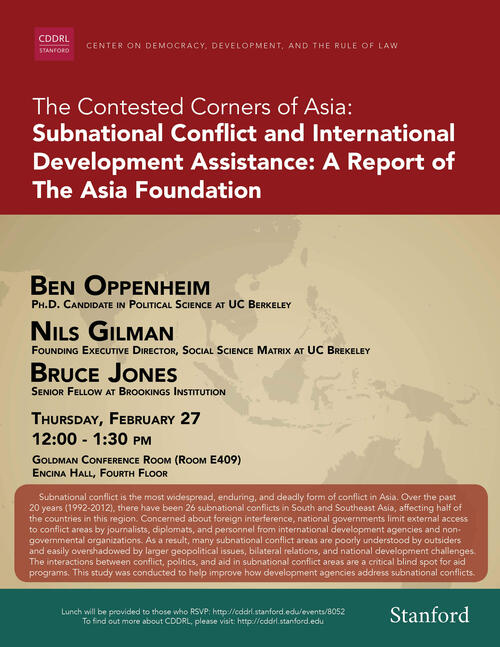
Subnational conflict is the most widespread, enduring, and deadly form of conflict in Asia. Over the past 20 years (1992-2012), there have been 26 subnational conflicts in South and Southeast Asia, affecting half of the countries in this region. Concerned about foreign interference, national governments limit external access to conflict areas by journalists, diplomats, and personnel from international development agencies and non-governmental organizations. As a result, many subnational conflict areas are poorly understood by outsiders and easily overshadowed by larger geopolitical issues, bilateral relations, and national development challenges. The interactions between conflict, politics, and aid in subnational conflict areas are a critical blind spot for aid programs. This study was conducted to help improve how development agencies address subnational conflicts.


Speaker Bios:

Ben Oppenheim is a Fellow (non-resident) at the Center on International Cooperation at New York University. His research spans a diverse set of topics, including fragile states, transnational threats (including pandemic disease risks and terrorism), and the strategic coherence and effectiveness of international assistance in fragile and conflict-affected areas.

Oppenheim has consulted for organizations including the World Bank, the United Nations, the Asia Foundation, the Institute for the Future, and the Fritz Institute, on issues including organizational learning, strategy, program design, foresight, and facilitation. In 2009, he served as Advisor to the first global congress on disarmament, demobilization, and reintegration, supported by the World Bank and the UN.

In 2013, Oppenheim was a visiting fellow at the Uppsala University Forum on Democracy, Peace, and Justice. His research has been supported by a Simpson Fellowship, and a fellowship with the Institute on Global Conflict and Cooperation. He was also a research fellow with UC Berkeley's Institute of International Studies, affiliated with the New Era Foreign Policy Project.


Nils Gilman is the Executive Director of Social Science Matrix. He holds a B.A., M.A. and Ph.D. in History from the University of California, Berkeley. Gilman’s first scholarly interest was in American and European intellectual history, with a particular focus on the institutional development of the social sciences, the lateral transfer and translation of ideas across disciplinary boundaries, and the impact of social scientific ideas on politics and policy.

Gilman is the author of Mandarins of the Future: Modernization Theory in Cold War America (Johns Hopkins University Press, 2004), the co-editor of Staging Growth: Modernization, Development, and the Global Cold War (University of Massachusetts Press, 2003) and Deviant Globalization: Black Market Economy in the 21st Century (Continuum Press, 2011), as well as the founding Co-editor of Humanity: An International Journal of Human Rights, Humanitarianism, and Development. He also blogs and tweets.

Prior to joining Social Science Matrix in September 2013, Gilman was research director at Monitor 360, a San Francisco consultancy that addresses complex, cross-disciplinary global strategic challenges for governments, multinational businesses, and NGOs. He has also worked at a variety of enterprise software companies, including Salesforce.com, BEA Systems, and Plumtree Software. Gilman has taught and lectured at a wide variety of venues, from the Harvard University, Columbia University, and National Defense University, to PopTech, the European Futurists Conference, and the Long Now Foundation.


Bruce Jones is a senior fellow and the director of the Project on International Order and Strategy in the Foreign Policy program at the Brookings Institution. He is also the director of the Center on International Cooperation at New York University.

Jones served as the senior external advisor for the World Bank’s 2011 World Development Report, Conflict, Security and Development, and in March 2010 was appointed by the United Nations secretary-general as a member of the senior advisory group to guide the Review of International Civilian Capacities. He is also consulting professor at the Center for International Security and Cooperation at Stanford University and professor (by courtesy) at New York University’s department of politics.

Jones holds a Ph.D. from the London School of Economics, and was Hamburg fellow in conflict prevention at Stanford University.

He is co-author with Carlos Pascual and Stephen Stedman of Power and Responsibility: Building International Order in an Era of Transnational Threats (Brookings Press, 2009); co-editor with Shepard Forman and Richard Gowan of Cooperating for Peace and Security (Cambridge University Press, 2009); and author of Peacemaking in Rwanda: The Dynamics of Failures(Lynne Reinner, 2001).

Jones served as senior advisor in the office of the secretary-general during the U.N. reform effort leading up to the World Summit 2005, and in the same period was acting secretary of the Secretary-General’s Policy Committee. In 2004-2005, he was deputy research director of the High-level Panel on Threats, Challenges and Change. From 2000-2002 he was special assistant to and acting chief of staff at the office of the U.N. special coordinator for the Middle East peace process. 

Richard and Rhoda Goldman Conference Room

Ben Oppenheim Ph.D. Candidate in Political Science Speaker UC Berkeley
Nils Gilman Founding Executive Director, Social Science Matrix Speaker UC Berkeley
Bruce Jones Senior Fellow Speaker Brookings Institution
Seminars
-

Hon.Agnes Binagwaho has served as Permanent Secretary of the Ministry of Health in Rwanda since October 2008. She specialized in emergency pediatrics, neonatology, and the treatment of HIV/AIDS; and she chairs the Rwandan Pediatric Society. From 1986 to 2002, she practiced medicine in public hospitals in Rwanda and several other countries before joining Rwanda's National AIDS Control Commission as Executive Secretary. She is a member of the Editorial Board of Public Library of Science, and the Harvard University Health and Human Rights Journal. Dr. Binagwaho co‐chaired the Millennium Development Goal Project Task Force on HIV/AIDS and Access to Essential Medicines for the Secretary‐General of the United Nations under the leadership of Professor Jeffrey Sachs. She was the global co‐chair of the Joint Learning Initiative on Children and HIV/AIDS. In addition to her medical degree and Master in Peadiatry, she received an Honorary Doctor of Sciences from Dartmouth College. Dr. Binagwaho serves as a visiting lecturer in the Department of Global Health and Social Medicine of Harvard Medical School.

Building 200 (History Corner)
Room 205
Stanford University

Hon. Agnes Binagwaho Minister of Health Speaker Rwanda
Seminars
-

Abstract
Preventing tobacco addiction is one of the leading ways to prevent fatal disease, yet many nations have declined to take steps against it. In recent years an international legal effort has begun to fill this void. In this lecture Professor Koh, formerly Legal Adviser of the U.S. State Department, will review the various dimensions of the legal campaign that is now underway.

Harold Hongju Koh is Sterling Professor of International Law at Yale Law School. He returned to Yale Law School in January 2013 after serving for nearly four years as the 22nd Legal Adviser of the U.S. Department of State.

Professor Koh is one of the country’s leading experts in public and private international law, national security law, and human rights. He first began teaching at Yale Law School in 1985 and served as its fifteenth Dean from 2004 until 2009. From 2009 to 2013, he took leave as the Martin R. Flug ’55 Professor of International Law to join the State Department as Legal Adviser, service for which he received the Secretary of State's Distinguished Service Award. From 1993 to 2009, he was the Gerard C. & Bernice Latrobe Smith Professor of International Law at Yale Law School, and from 1998 to 2001, he served as U.S. Assistant Secretary of State for Democracy, Human Rights and Labor.

Building 200 (History Corner)
Room 205
Stanford University

Harold Hongju Koh Sterling Professor of International Law Speaker Yale Law School
Seminars
-

Speaker bio:

Karl Eikenberry is the William J. Perry Fellow in International Security at the Center for International Security and Cooperation and a faculty member of the Shorenstein Asia-Pacific Research Center at Stanford University.  He is also an affiliated faculty member with the Center for Democracy, Development, and Rule of Law, and researcher with The Europe Center.

Prior to his arrival at Stanford, he served as the U.S. Ambassador to Afghanistan from May 2009 until July 2011, where he led the civilian surge directed by President Obama to reverse insurgent momentum and set the conditions for transition to full Afghan sovereignty.

Before appointment as Chief of Mission in Kabul, Ambassador Eikenberry had a thirty-five year career in the United States Army, retiring in April 2009 with the rank of Lieutenant General.  His military operational posts included commander and staff officer with mechanized, light, airborne, and ranger infantry units in the continental U.S., Hawaii, Korea, Italy, and Afghanistan as the Commander of the American-led Coalition forces from 2005-2007. 

He has served in various policy and political-military positions, including Deputy Chairman of the North Atlantic Treaty Organization (NATO) Military Committee in Brussels, Belgium; Director for Strategic Planning and Policy for U.S. Pacific Command at Camp Smith, Hawaii; U.S. Security Coordinator and Chief of the Office of Military Cooperation in Kabul, Afghanistan; Assistant Army and later Defense Attaché at the United States Embassy in Beijing, China; Senior Country Director for China, Taiwan, Hong Kong and Mongolia in the Office of the Secretary of Defense; and Deputy Director for Strategy, Plans, and Policy on the Army Staff.

He is a graduate of the U.S. Military Academy, has master’s degrees from Harvard University in East Asian Studies and Stanford University in Political Science, and was a National Security Fellow at the Kennedy School of Government at Harvard.

Ambassador Eikenberry earned an Interpreter’s Certificate in Mandarin Chinese from the British Foreign Commonwealth Office while studying at the United Kingdom Ministry of Defense Chinese Language School in Hong Kong and has an Advanced Degree in Chinese History from Nanjing University in the People’s Republic of China. 

His military awards include the Defense Distinguished and Superior Service Medals, Legion of Merit, Bronze Star, Ranger Tab, Combat and Expert Infantryman badges, and master parachutist wings.  He has received the Department of State Distinguished, Superior, and Meritorious Honor Awards, Director of Central Intelligence Award, and Chairman of the Joint Chiefs of Staff Joint Distinguished Civilian Service Award.  He is also the recipient of the George F. Kennan Award for Distinguished Public Service and Harvard University Graduate School of Arts and Sciences Centennial Medal.  His foreign and international decorations include the Canadian Meritorious Service Cross, French Legion of Honor, Afghanistan’s Ghazi Amir Amanullah Khan and Akbar Khan Medals, and the NATO Meritorious Service Medal.

Ambassador Eikenberry serves as a Trustee for the International Institute for Strategic Studies, The Asia Foundation, and the National Committee on American Foreign Policy, and is a Fellow of the American Academy of Arts and Sciences.  He is a member of the Council on Foreign Relations, the American Academy of Diplomacy, and the Council of American Ambassadors, and was previously the President of the Foreign Area Officers Association.  His articles and essays on U.S. and international security issues have appeared in Foreign Affairs, The Washington Quarterly, American Foreign Policy Interests, The New York TimesThe Washington Post, Foreign Policy, and The Financial Times.  He has a commercial pilot’s license and instrument rating, and also enjoys sailing and scuba diving.

Reuben W. Hills Conference Room

Karl Eikenberry William J. Perry Fellow in International Security at CISAC, CDDRL, TEC, and Shorenstein APARC Distinguished Fellow; and Former U.S. Ambassador to Afghanistan and Retired U.S. Army Lt. General Speaker FSI
Seminars
Subscribe to Foreign Policy