Security

FSI scholars produce research aimed at creating a safer world and examing the consequences of security policies on institutions and society. They look at longstanding issues including nuclear nonproliferation and the conflicts between countries like North and South Korea. But their research also examines new and emerging areas that transcend traditional borders – the drug war in Mexico and expanding terrorism networks. FSI researchers look at the changing methods of warfare with a focus on biosecurity and nuclear risk. They tackle cybersecurity with an eye toward privacy concerns and explore the implications of new actors like hackers.

Along with the changing face of conflict, terrorism and crime, FSI researchers study food security. They tackle the global problems of hunger, poverty and environmental degradation by generating knowledge and policy-relevant solutions. 

-

This event is open to Stanford undergraduate students only. 

The Center on Democracy, Development, and the Rule of Law (CDDRL) is currently accepting applications from eligible juniors due February 12, 2016 who are interested in writing their senior thesis on a subject touching upon democracy, economic development, and rule of law (DDRL) from any university department. CDDRL faculty and current honors students will be present to discuss the program and answer any questions.

For more information on the CDDRL Senior Honors Program, please click here.


Image
cddrl senior honors program 2016 flyer 2


CDDRL
Encina Hall, C152
616 Jane Stanford Way
Stanford, CA 94305-6055

(650) 725-2705 (650) 724-2996
0
Senior Fellow at the Freeman Spogli Institute for International Studies
Professor, by courtesy, of Political Science
Stedman_Steve.jpg PhD

Stephen Stedman is a Senior Fellow at the Freeman Spogli Institute for International Studies (FSI) and the Center on Democracy, Development and the Rule of Law (CDDRL), an affiliated faculty member at CISAC, and professor of political science (by courtesy) at Stanford University. He is director of CDDRL's Fisher Family Honors Program in Democracy, Development and Rule of Law, and will be faculty director of the Program on International Relations in the School of Humanities and Sciences effective Fall 2025.

In 2011-12 Professor Stedman served as the Director for the Global Commission on Elections, Democracy, and Security, a body of eminent persons tasked with developing recommendations on promoting and protecting the integrity of elections and international electoral assistance. The Commission is a joint project of the Kofi Annan Foundation and International IDEA, an intergovernmental organization that works on international democracy and electoral assistance.

In 2003-04 Professor Stedman was Research Director of the United Nations High-level Panel on Threats, Challenges and Change and was a principal drafter of the Panel’s report, A More Secure World: Our Shared Responsibility.

In 2005 he served as Assistant Secretary-General and Special Advisor to the Secretary- General of the United Nations, with responsibility for working with governments to adopt the Panel’s recommendations for strengthening collective security and for implementing changes within the United Nations Secretariat, including the creation of a Peacebuilding Support Office, a Counter Terrorism Task Force, and a Policy Committee to act as a cabinet to the Secretary-General.

His most recent book, with Bruce Jones and Carlos Pascual, is Power and Responsibility: Creating International Order in an Era of Transnational Threats (Washington DC: Brookings Institution, 2009).

Director, Fisher Family Honors Program in Democracy, Development and Rule of Law
Director, Program in International Relations
Affiliated faculty at the Center for International Security and Cooperation
Date Label

Encina Hall, C148
616 Jane Stanford Way
Stanford, CA 94305

0
Olivier Nomellini Senior Fellow at the Freeman Spogli Institute for International Studies
Director of the Ford Dorsey Master's in International Policy
Research Affiliate at The Europe Center
Professor by Courtesy, Department of Political Science
yff-2021-14290_6500x4500_square.jpg

Francis Fukuyama is the Olivier Nomellini Senior Fellow at Stanford University's Freeman Spogli Institute for International Studies (FSI), and a faculty member of FSI's Center on Democracy, Development and the Rule of Law (CDDRL). He is also Director of Stanford's Ford Dorsey Master's in International Policy, and a professor (by courtesy) of Political Science.

Dr. Fukuyama has written widely on issues in development and international politics. His 1992 book, The End of History and the Last Man, has appeared in over twenty foreign editions. His book In the Realm of the Last Man: A Memoir will be published in fall 2026.

Francis Fukuyama received his B.A. from Cornell University in classics, and his Ph.D. from Harvard in Political Science. He was a member of the Political Science Department of the RAND Corporation, and of the Policy Planning Staff of the US Department of State. From 1996-2000 he was Omer L. and Nancy Hirst Professor of Public Policy at the School of Public Policy at George Mason University, and from 2001-2010 he was Bernard L. Schwartz Professor of International Political Economy at the Paul H. Nitze School of Advanced International Studies, Johns Hopkins University. He served as a member of the President’s Council on Bioethics from 2001-2004. He is editor-in-chief of American Purpose, an online journal.

Dr. Fukuyama holds honorary doctorates from Connecticut College, Doane College, Doshisha University (Japan), Kansai University (Japan), Aarhus University (Denmark), the Pardee Rand Graduate School, and Adam Mickiewicz University (Poland). He is a non-resident fellow at the Carnegie Endowment for International Peace. He is a member of the Board of Trustees of the Rand Corporation, the Board of Trustees of Freedom House, and the Board of the Volcker Alliance. He is a fellow of the National Academy for Public Administration, a member of the American Political Science Association, and of the Council on Foreign Relations. He is married to Laura Holmgren and has three children.

(October 2025)

CV
Date Label
0
brett_carter_2025.jpg

Brett Carter is an Associate Professor in the Department of Political Science and International Relations at the University of Southern California, a Hoover Fellow at Stanford University's Hoover Institution, and a Faculty Affiliate at Stanford's Center on Democracy, Development and the Rule of Law. He received a Ph.D. from Harvard University, where he was a fellow at the Harvard Academy for International and Area Studies.

Carter studies politics in the world's autocracies. His first book, Propaganda in Autocracies: Institutions, Information, and the Politics of Belief (Cambridge University Press), draws on the largest archive of state propaganda ever assembled — encompassing over eight million newspaper articles in six languages from nearly 60 countries around the world — to show how political institutions shape the propaganda strategies of repressive governments. It received the William Riker Prize for the Best Book in Political Economy, the International Journal of Press/Politics Hazel Gaudet-Erskine Best Book Award, Honorable Mention for the Gregory Luebbert Award for the Best Book in Comparative Politics, and Honorable Mention for the APSA Democracy & Autocracy Section's Best Book Award.

His second book, in progress, shows how politics in Africa’s autocracies changed after the fall of the Berlin Wall and how a new era of geopolitical competition — marked by the rise of China and the resurgence of Russia — is changing them again.

Carter’s other work has appeared in the Journal of Politics, British Journal of Political Science, Perspectives on Politics, Journal of Conflict Resolution, Security Studies, China Quarterly, Journal of Democracy, and Foreign Affairs, among others. His work has been featured by The New York Times, The Economist, The National Interest, and NPR’s Radiolab.

Hoover Fellow
CDDRL Affiliated Scholar
CDDRL Visiting Scholar, 2020-2021
Date Label

Encina Hall, C150
616 Jane Stanford Way
Stanford, CA 94305

0
Center Fellow, Freeman Spogli Institute for International Studies
didi_kuo_2023.jpg

Didi Kuo is a Center Fellow at the Freeman Spogli Institute for International Studies (FSI) at Stanford University. She is a scholar of comparative politics with a focus on democratization, corruption and clientelism, political parties and institutions, and political reform. She is the author of The Great Retreat: How Political Parties Should Behave and Why They Don’t (Oxford University Press) and Clientelism, Capitalism, and Democracy: the rise of programmatic politics in the United States and Britain (Cambridge University Press, 2018).

She has been at Stanford since 2013 as the manager of the Program on American Democracy in Comparative Perspective and is co-director of the Fisher Family Honors Program at CDDRL. She was an Eric and Wendy Schmidt Fellow at New America and is a non-resident fellow with the Carnegie Endowment for International Peace. She received a PhD in political science from Harvard University, an MSc in Economic and Social History from Oxford University, where she studied as a Marshall Scholar, and a BA from Emory University.

Date Label
-

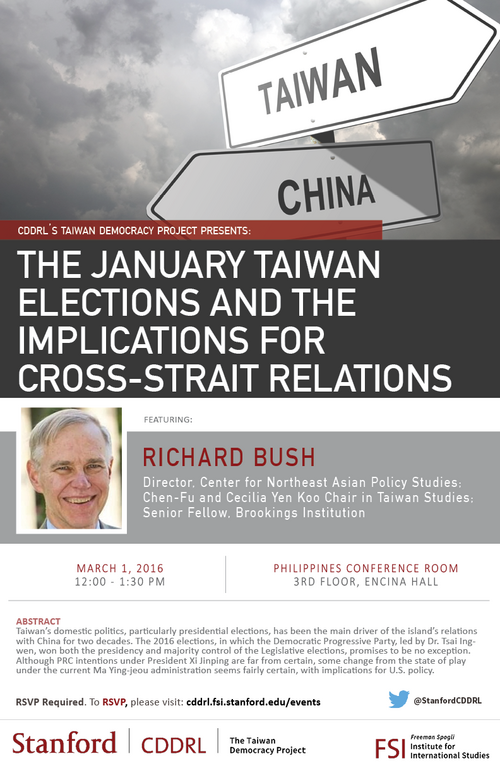
Abstract

Taiwan’s domestic politics, particularly presidential elections, has been the main driver of the island’s relations with China for two decades. The 2016 elections, in which the Democratic Progressive Party, led by Dr. Tsai Ing-wen, won both the presidency and majority control of the Legislative elections, promises to be no exception. Although PRC intentions under President Xi Jinping are far from certain, some change from the state of play under the current Ma Ying-jeou administration seems fairly certain, with implications for U.S. policy.


Bio

Richard Bush is a Senior Fellow at the Brookings Institution and Director of its Center for Northeast Asian Policy Studies, and the Chen-Fu and Cecilia Yen Koo Chair in Taiwan Studies. He came to Brookings in July 2002 after nineteen years working in the US government, including five years as the Chairman and Managing Director of the American Institute in Taiwan. He is the author of a number of articles on U.S. relations with China and Taiwan, and of At Cross Purposes, a book of essays on the history of America’s relations with Taiwan, published in March 2004 by M. E. Sharpe. In the spring of 2005, Brookings published his study on cross-Strait relations, entitled Untying the Knot: Making Peace in the Taiwan Strait. In 2013, Brookings published his Uncharted Strait: The Future of China-Taiwan Relations.


This talk is co-sponsored by the Taiwan Democracy Project in the Center on Democracy, Development, and the Rule of Law and the U.S.-Asia Security Initiative in the Walter H. Shorenstein Asia-Pacific Research Center.

Image
richard bush taiwan talk flyer


Richard C. Bush Senior Fellow and Director, Center for East Asian Policy Studies Brookings Institution
Seminars
-

Abstract

After five years of political support for the regime of Bashar Al-Asad in its war against the opposition, Russia intervened militarily on his behalf in September 2015 and suddenly later this year Russian President Vladimir Putin announced the withdrawal of the Russian troops from Syria. While Moscow claims that its intervention was aimed at destroying ISIS and other terrorists groups, but the vast majority of its air strikes seem to target the moderate armed opposition, which has fought ISIS on the ground. This presentation assesses the outcome of Russia’s intervention, arguing that it neither achieved its goal of destroying ISIS nor did it tip the balance favor of Asad. Instead, the intervention had resulted in the killing of Syrian civilians, complicated the conflict in Syria, and constrained the prospects for a political solution by empowering Asad on the ground.

Speaker Bio

Image
radwan
Radwan Ziadeh is a senior analyst at the Arab Center in Washington D.C. He is the founder and director of the Damascus Center for Human Rights Studies in Syria and co-founder and executive director of the Syrian Center for Political and Strategic Studies in Washington, D.C. He is a Visiting Scholar at the Center for the Study of Human Rights at Columbia University, and Fellow at the Institute for Social Policy and Understanding (ISPU) in Washington D.C. Ziadeh was the managing editor of the Transitional Justice Project in the Arab World, and the Head of the Syrian Commission for Transitional Justice, which was established on November 14, 2013 by the Syrian Interim Government. He was also involved in the Syrian political opposition. He was elected in October 2011 as director of the Foreign Relations Office of the Syrian National Council until he resigned from the position in November 2012. He wrote more than twenty books in English and Arabic. His most recent book is Syria's Role in a Changing Middle East: The Syrian-Israeli Peace Talks (I.B.Tauris, 2016). Ziadeh holds a D.D.S in Dentistry from Damascus University, Diploma in international Human Rights Law from College of Law at the American University in Washington D.C, an MA in Democracy and Governance from Georgetown University in Washington D.C, and an MS in Finance from Kogod School of Business at the American University in Washington D.C.


[[{"fid":"222587","view_mode":"crop_870xauto","fields":{"format":"crop_870xauto","field_file_image_description[und][0][value]":"Radwan Ziadeh flyer","field_file_image_alt_text[und][0][value]":"","field_file_image_title_text[und][0][value]":"","field_credit[und][0][value]":"","field_caption[und][0][value]":"","field_related_image_aspect[und][0][value]":"","thumbnails":"crop_870xauto"},"type":"media","attributes":{"width":"870","style":"width: 870px;","class":"media-element file-crop-870xauto"}}]]


CISAC Central Conference Room
Encina Hall, 2nd Floor
616 Serra St
​Stanford, CA 94305

Radwan Ziadeh Arab Center, Washington, DC
Seminars
-

Abstract

After nearly five years since the start of the uprising, Syria finds itself divided and embattled, with no end in sight. More significantly, more than half of the Syrian population is displaced and the death toll surpassed 300,000 by all counts. The Syrian tragedy persists and, more than any other case of mass uprising in the region, continues to be shrouded in political power-plays and contradictions at the local, regional, and international levels. Defined increasingly by an absence of a clear favorable outcome, considering existing parties to the conflict, the logic of the lesser evil reigns supreme. This lecture is an attempt to understand the roots and dynamics of the tragic Syrian uprising, with particular attention to its background and to the recent Russian intervention.

Speaker Bio

Image
unnamed
Bassam Haddad is Director of the Middle East Studies Program and Associate Professor in the Department of Public and International Affairs at George Mason University, and is Visiting Professor at Georgetown University. He is the author of Business Networks in Syria: The Political Economy of Authoritarian Resilience (Stanford University Press, 2011). Haddad is currently editing a volume on Teaching the Middle East After the Arab Uprisings, a book manuscript on pedagogical and theoretical approaches. His most recent books include two co-edited volumes: Dawn of the Arab Uprisings: End of an Old Order? (Pluto Press, 2012) and Mediating the Arab Uprisings (Tadween Publishing, 2013). Haddad serves as Founding Editor of the Arab Studies Journal a peer-reviewed research publication and is co-producer/director of the award-winning documentary film, About Baghdad, and director of the critically acclaimed film series, Arabs and Terrorism, based on extensive field research/interviews. More recently, he directed a film on Arab/Muslim immigrants in Europe, titled The "Other" Threat. Haddad is Co-Founder/Editor of Jadaliyya Ezine and serves on the Editorial Committee of Middle East Report. He is the Executive Director of the Arab Studies Institute, an umbrella for five organizations dealing with knowledge production on the Middle East and Founding Editor of Tadween Publishing.


This event is co-sponsored by The Markaz: Resource Center at Stanford University.


[[{"fid":"221861","view_mode":"crop_870xauto","fields":{"format":"crop_870xauto","field_file_image_description[und][0][value]":"Bassam Haddad January 21","field_file_image_alt_text[und][0][value]":"","field_file_image_title_text[und][0][value]":"","field_credit[und][0][value]":"","field_caption[und][0][value]":"","field_related_image_aspect[und][0][value]":"","thumbnails":"crop_870xauto"},"type":"media","attributes":{"width":"870","class":"media-element file-crop-870xauto"}}]]


CISAC Central Conference Room
Encina Hall, 2nd Floor
616 Serra St
Stanford, CA 94305

Bassam Haddad Associate Professor George Mason University
Seminars
Authors
News Type
Q&As
Date
Paragraphs

In the wake of the recent historic meeting of the leaders of China and Taiwan, the Stanford News Service asked two of the university's Asia experts about the aftermath of that meeting and its possible effects on political relations between the two countries, the military situation and Taiwan's Jan. 16 presidential and parliamentary elections.

The first presidential meeting between the leaders of the communist mainland and the democratic island, split by civil war in 1949, was held in early November on neutral territory in Singapore.

Kharis Templeman is the Taiwan Democracy program manager at Stanford's Center on Democracy, Development, and the Rule of Law at the Freeman Spogli Institute for International Studies. He recently wrote about why Taiwan's defense spending has fallen as China's has risen. Thomas Fingar is a distinguished fellow at Stanford's Walter H. Shorenstein Asia-Pacific Research Center. He served as the chairman of the National Intelligence Council and in other key positions in Washington. 

Do you anticipate any lasting effects from the face-to-face meeting of Chinese leader Xi Jinping and Taiwanese President Ma Ying-jeou?

Thomas Fingar: At a minimum, the meeting appears intended by both sides to validate and lock in the much-improved cross-Taiwan Strait relationship that has evolved over the past several years.

Kharis Templeman: I do think the Ma-Xi meeting itself will have one lasting legacy: it has created a precedent for treating the directly elected president of the Republic of China as an equal and as the rightful representative of Taiwanese interests in cross-strait relations. From now on, leaders in Beijing are going to have a hard time arguing that a non-KMT (the Kuomintang, Taiwan's governing party,) president is illegitimate, as they did during the [former Taiwanese president] Chen Shui-Bian era, or to continue to insist on referring to Taiwan’s leaders as provincial-level officials. So, the next president will come into office somewhat strengthened by that precedent.   

Will the meeting have any effect on the January elections in Taiwan?

Templeman: I don’t think it will make much, if any, difference. Taiwanese public opinion is deeply divided about Ma Ying-Jeou’s meeting with Xi. Ma himself remains quite unpopular, the economy is barely growing, and the KMT presidential candidate remains at least 20 points behind in the polls. There’s little indication that this meeting has shaken up what has been a large and steady lead for DPP (Democratic Progressive Party) presidential candidate Tsai Ing-Wen, and I would be shocked if she didn’t win a comfortable victory in January.

Fingar: Probably not. Beijing seems to have learned that its past attempts to influence elections on Taiwan have been ineffectual or counterproductive, and the meeting is unlikely to change minds or votes on the island. 

How might the elections affect military spending on either sides, or China's aggressive island-building for military bases?

Fingar: The meeting will not have any effect on military spending or the building of artificial islands in the South China Sea, but Beijing may have hoped that agreeing to meet with Ma to demonstrate how "good" the relationship is might persuade Washington not to approve another round of arms sales to Taiwan.  Regardless of who wins the election on Taiwan, the next administration is likely to seek another round of U.S. arms sales in order to prove that it has the support of the United States.

Templeman: The meeting will have no impact on the security balance in the region. Ma reportedly raised the issue of PRC (People's Republic of China) missiles within easy range of Taiwan, but Xi claimed, implausibly, that they were not targeted at Taiwan, and that was the end of it. The broader trends are unchanged: the PRC’s military budget is growing annually by double-digit rates while Taiwan’s remains essentially flat. The consequence is that the PRC’s capacity to take coercive measures against Taiwan continues to expand, even as cross-strait cooperation has been improved and institutionalized.

Dan Stober is at the Stanford News Service.

Hero Image
22655287560 9d34c4bd69 o
Taiwanese President Ma Ying-jeou meets with Chinese President Xi Jinping in Singapore on Nov. 7, 2015.
Flickr/Office of the President Republic of China (Taiwan)
All News button
1
Authors
News Type
News
Date
Paragraphs


Negotiators from 12 Pacific Rim countries recently reached an agreement on the Trans-Pacific Partnership (TPP), a sweeping trade pact that has been promoted by the Obama administration as a high-quality, next-generation deal that will set standards for international trade for years to come. While noting the agreement still requires ratification by each member state, Stanford scholars believe that the TPP will be approved and reshape not only trade but also security relations in the Asia-Pacific region and beyond.


The TPP negotiations originally began as an expansion of the Trans-Pacific Economic Partnership Agreement signed by Brunei, Chile, New Zealand and Singapore in 2005, and then took on broader significance in 2008 when the United States expressed interest. The number of members eventually grew to include the other North American Free Trade Agreement (NAFTA) economies of Canada and Mexico, as well as Australia, Peru, Vietnam, Malaysia and Japan. Even before the agreement was finalized, leaders of many other Asia-Pacific countries expressed interest in joining the next round of negotiations, including South Korea, Taiwan, the Philippines, Colombia, Thailand and most recently, Indonesia.


leaders of tpp member states A summit with leaders of the member states of the Trans-Pacific Strategic Economic Partnership Agreement (TPP). Pictured, from left, are Naoto Kan (Japan), Nguyễn Minh Triết (Vietnam), Julia Gillard (Australia), Sebastián Piñera (Chile), Lee Hsien Loong (Singapore), Barack Obama (United States), John Key (New Zealand), Hassanal Bolkiah (Brunei), Alan García (Peru), and Muhyiddin Yassin (Malaysia). Six of these leaders represent countries that are currently negotiating to join the group.

The appeal of the TPP in the region is twofold. First, the repeated failure of new trade talks at the World Trade Organization (WTO) has forced countries seeking greater trade liberalization to pursue it through other bilateral or regional multilateral negotiations. Second, in the Asia-Pacific region, the number of these agreements has rapidly multiplied, creating myriad different standards, procedures and tariff rates that raise the costs of doing business across state borders and inhibit international trade and investment.


The TPP offers the prospect of a common set of rules governing investment, production and exchange across all member states, with significant improvements in economic efficiency. In addition, the danger of being excluded from a new trade regime that includes a huge share of the region’s economic activity has created a sense of urgency to seek membership from those countries not in the initial round of negotiations. By far the most conspicuous absence among the TPP members is China, which is now the world’s second-largest economy and a significant trading partner of all current member states.


The Trans-Pacific Partnership has been a research focus at the Freeman Spogli Institute for International Studies.


The Walter H. Shorenstein Asia-Pacific Research Center has organized several events exploring aspects of the TPP, and the Taiwan Democracy Project in the Center on Democracy, Development, and the Rule of Law held a conference in 2013 that examined the TPP from a Taiwanese perspective. The conference produced a comprehensive report on the topic, and an audio recording of an earlier Shorenstein APARC panel event was made available online. Now that negotiations have concluded, the Taiwan Democracy Project will revisit the topic in an upcoming conference on Feb. 9.


With the public release of the agreement in early October, three noted experts from Stanford University, Thomas Fingar, Michael Armacost, and Donald Emmerson, offered their analysis of the TPP’s prospects for ratification and its impact on the Asia-Pacific region.


Now that the agreement has been published, what is significant about the TPP? What does it mean for China?


Image
tom fingar2
The TPP is a big deal for many reasons, perhaps the most important of which is that it will provide the impetus and the template for concluding the Trans-Atlantic Trade and Investment Partnership (TTIP) and myriad other regional and mini-lateral trade negotiations initiated in response to the failure of the Doha Round of WTO reform. As with all trade agreements, there will be winners and losers, pain will be local and benefits diffuse, and critics will find much to criticize. But the agreement is likely to be ratified and its provisions will affect corporate strategies, investment decisions and globalized production chains. The fact that North America (the United States, Canada and Mexico) are parties to the TPP virtually assures that the globally important NAFTA group will not accept terms in TTIP or other negotiations that are incompatible with the TPP because NAFTA governments and companies do not want to cope with multiple standards, requirements, and procedures. The same is true of other major trading states and international firms, so the TPP will quickly become the new standard for “everyone” wishing to take advantage of opportunities in a globalized world.

This means that the TPP will serve as a—the—decisive building block for beyond-WTO trade arrangements. Without success in the TPP (or TTIP, which also has the size and importance to have become the new global standard if it had been concluded before the TPP) negotiations, there was a danger that the advantages of an integrated global trading system would be degraded by adoption of multiple and partially incompatible sub-regional agreements. Now those negotiating bilateral and mini-lateral agreements are likely to strive for consistency with the requirements adopted by key trading nations and the firms based in them.

The TPP is often but erroneously described as part of a U.S. effort to contain or constrain China. It isn’t. The United States should and will seek to bring China into the TPP, not to exclude it. I anticipate that Beijing will join together with South Korea, Indonesia, and possibly other states that are not yet members.


Thomas Fingar is a Shorenstein APARC Distinguished in the Freeman Spogli Institute for International Studies. He served previously as assistant secretary of the State Department’s Bureau of Intelligence and Research, principal deputy assistant secretary, deputy assistant secretary for analysis, director of the Office of Analysis for East Asia and the Pacific, and chief of the China Division.


Does the TPP carry security benefits? What are possible consequences for the U.S.-Japan relationship?


Image
armacost 2
The TPP is a trade agreement, not a security pact. Security is generally a predicate for growth and trade. It does not thrive amidst turmoil, let alone conflict. But with greater economic interdependence, the incentives for avoiding conflict increase. And fortuitously Asia remains an unusually peaceful region despite some growing tensions between China and its neighbors.

The TPP agreement is certainly an integral feature of the Obama administration’s effort to “rebalance” toward the Asia-Pacific region. It embeds the United States in a new institution whose membership, I believe, is destined to grow. America’s engagement in the region is a source of reassurance to our friends and allies there. The United States has been bolstering its alliance with Japan, and this agreement will add a broader framework to the U.S. alliance, which was established through the Treaty of Mutual Cooperation and Security, and which contains a specific clause encouraging expanded economic collaboration.

I regret that selling the agreement publicly has included some explicitly anti-Chinese features such as the claim that if the United States and others don’t write the rules of trade, China will. The TPP is and should be open to new members who are prepared to live up to its requirements and that includes China.


Michael H. Armacost is a Shorenstein APARC Distinguished Fellow in the Freeman Spogli Institute for International Studies. He held a 24-year career in the public service, including having served as U.S. ambassador to Japan and the Philippines.


How does the TPP fit into the context of Southeast Asia and its possible alternative arrangements for economic cooperation in the Asia-Pacific region?


Image
don emmerson 2
In strictly economic terms, there is no exact alternative to the distinctively comprehensive and intrusive TPP. In loosely economic but mainly geopolitical terms, however, a competitor does exist: the Regional Comprehensive Economic Partnership (RCEP). The United States is in the TPP. China is not. In the RCEP, the reverse is true. The United States has propelled the TPP. China and the Association of Southeast Asian Nations (ASEAN) are driving the formation of RCEP by all ten ASEAN states plus Australia, China, India, Japan, New Zealand and South Korea.

Compared with the TPP, RCEP is far less robust. RCEP is mainly about straightening the overlapping and sometimes inconsistent free trade agreements that already complicate Asian regionalism—the tangled contents of Asia’s “noodle bowl” of overlapping FTAs. (Trade agreements in the Asia-Pacific have burgeoned from around 60 ten years ago to some 300 today.) Under pressure from the more detailed and thoroughgoing TPP, RCEP’s would-be progenitors have been trying to expand their agenda to include more intrusive proposals. Partly for that reason, observers are pessimistic that RCEP’s negotiators will be able to proclaim its successful completion before the end of 2015.

ASEAN is divided. Myanmar, Cambodia, Indonesia, Laos, the Philippines, and Thailand are inside RCEP but outside the TPP. The other four ASEAN members—Brunei, Malaysia, Singapore, and Vietnam—enjoy the advantage of sitting at both negotiating tables. If only one of the two projected partnerships fails, these four states would still have the other arrangement to fall back on, and so much the better for them if both schemes succeed. It is partly for this reason that varying degrees of interest in joining the TPP have been expressed by five of the six non-TPP states in Southeast Asia. The exception is Myanmar, but once the structure and character of its new government have been clarified, its leaders too may wish to consider the TPP. Even China’s initially hostile view of the TPP has softened.

Given the market-favoring and regulation stipulations of the TPP, new entrants may be unwilling to accept its detailed, full-spectrum rules. But the Doha Round is dead, and the proposal to replace it with a scaled-down “Global Recovery Round” has gone nowhere. For the time being, the best one can hope for in the Asia-Pacific region is a successful TPP that China could eventually join, or a successful RCEP that could someday welcome the United States, or the birth of both arrangements followed by effective steps to render them complementary rather than competitive.


Donald K. Emmerson is director of the Southeast Asia Program at the Walter H. Shorenstein Asia-Pacific Research Center in the Freeman Spogli Institute for International Studies, where he is also affiliated with the Center for Democracy, Development, and the Rule of Law and the Abbasi Program in Islamic Studies.


Interested in joining the conversation? The Taiwan Democracy Project will revisit this topic on Feb. 9. The one-day symposium will bring together scholars and practitioners to reconsider Taiwan's prospects for entry into the Trans-Pacific Partnership. RSVP here today.


Image
img 6130

Listen to the audio from the event "The Trans-Pacific Partnership (TPP) -- A New Order for the Asia-Pacific?" with Stanford scholars Donald Emmerson, Thomas Fingar, Daniel Sneider and Kathleen Stephens.


Hero Image
16762169536 80a0c68f25 o
President Barack Obama participates in a trilateral meeting with Prime Minister Tony Abbott of Australia and Prime Minister Shinzo Abe of Japan, right, at the Brisbane Convention and Exhibition Center, Brisbane, Queensland, Australia, Nov. 16, 2014.
Official White House Photo by Pete Souza
All News button
1
-

Abstract:

Joshua Tucker and his colleagues have introduced a novel classification of strategies employed by autocrats to combat hostile activity on the web and in social media in particular. Their classification looks at these options from the point of view of the end internet user and distinguishes online from offline response and exerting control from engaging in opinion formation. For each of the three options - offline action, infrastructure regulation and online engagement - they provide a detailed account for the evolution of Russian government strategy since 2000. In addition, for online engagement option they construct the tools for detecting such activity on Twitter and test them on a large dataset of politically relevant Twitter data from Russia, gathered over the period of nine month in 2014.
 

Bio:

Joshua Tucker
Joshua Tucker is a Professor of Politics and, by courtesy, Russian and Slavic Studies at New York University with an affiliate appointment at NYU-Abu Dhabi.  He is a Co-PI of the NYU Social Media and Political Participation laboratory (SMaPP), a Co-Author of the award winning politics and policy blog - The Monkey Cage at The Washington Post, and the Co-Editor of the Journal of Experimental Political Science. 


Wallenberg Theatre,

Wallenberg Hall (Main Quad)

Seminars
News Type
News
Date
Paragraphs


On November 17, CDDRL’s Program on Arab Reform and Democracy (ARD) hosted Lina Khatib, a senior research associate with the Arab Reform Initiative, for a special talk on the Syrian crisis. Khatib was a co-founder of the ARD Program and managed its research agenda for four years before leaving CDDRL to lead the Carnegie Middle East Center in Beirut.

After conducting extensive fieldwork on the Syrian-Turkish border, Khatib provided a detailed analysis of ISIS’ origins and how they are benefitting from the unresolved crisis in Syria. Khatib also weighed in on the refugee crisis, as well as the regional rivalries that are using Syria as a proxy to exert themselves militarily. Khatib argued that a military solution to solving the ISIS problem is not the right approach, and encouraged the international community to begin engaging different members of the Syrian opposition, and rethinking their approach to international diplomatic negotiations.


Photo Album

Hero Image
dsc 0158
All News button
1
-

**To RSVP, please email Jessie Brunner at jbrunner@stanford.edu.**

[[{"fid":"221010","view_mode":"crop_870xauto","fields":{"format":"crop_870xauto","field_file_image_description[und][0][value]":"","field_file_image_alt_text[und][0][value]":"","field_file_image_title_text[und][0][value]":"","field_credit[und][0][value]":"","field_caption[und][0][value]":"","field_related_image_aspect[und][0][value]":"","thumbnails":"crop_870xauto"},"type":"media","attributes":{"width":"870","class":"media-element file-crop-870xauto"}}]]

Abstract

As the protracted and chaotic conflict in Syria continues into its fifth year, Syrians of all backgrounds are being subjected to gross human rights violations. A growing number of parties to the conflict, including the Government and the Islamic State, display disregard for international legal conventions and employ tactics such as sexual violence, murder, and torture that have resulted in mass civilian casualties, large-scale displacement, and the destruction of Syria’s cultural heritage.


Peter Bouckaert

Peter Bouckaert is Human Rights Watch’s emergencies director, coordinating the organization’s response to major wars and other human rights crises. A Belgian-born Stanford Law School graduate, Bouckaert has conducted fact-finding missions around the world, including currently documenting Syrian refugees in Europe.

Sareta Ashraph

Sareta Ashraph specializes in international criminal, humanitarian, and human rights law and has served since 2012 as the Senior Analyst on the UN Commission of Inquiry on the Syrian Arab Republic, investigating and reporting on violations of international law in the context of ongoing events in Syria.


To RSVP, please email Jessie Brunner at jbrunner@stanford.edu.

Peter Bouckaert Director, Emergencies, Human Rights Watch
Sareta Ashraph Senior Analyst, UN Commission of Inquiry on the Syrian Arab Republic
Seminars
Subscribe to Security